

Chapter 1: Introduction: Why Do You Need to Choose the Right SMD Inductor Coils ?
Nowadays, electronic products are getting smaller and more functional. Wearable gadgets, mobile phones, controllers, automotive electronics and others require good performance within a minimal printed circuit board (PCB) size.
One of the key components helping to create compact electronic devices is the SMD inductor (surface-mount device inductor). In comparison with the standard through-hole inductor, this device provides the best space efficiency, electrical properties, and automatic mounting.
However, selection of an SMD inductor cannot be only related to choosing the most miniature component. Many aspects should be considered, such as inductance value, current rating, frequency characteristics, size limitation, temperature performance, application needs and other. The wrong choice of the inductor may lead to the problems, such as unstable power supply, signal distortion, overheating, poor longevity and other.
This guide is dedicated to understanding how the engineer chooses the right SMD inductor and can be used by electronic designers, purchasing teams and manufactures.
Chapter 2:SMD Inductor: Definition and Features
2.1 What Is the SMD Air Core Inductor?
The SMD inductor is a passive electronic component that stores electrical energy in a magnetic field using a coil. In comparison with traditional inductors that have wire leads, the SMD inductor can be mounted directly on the surface of the printed circuit board (PCB).
The typical components of the SMD Air Core inductor include:
Magnetic or air core
Conductive coil winding
Electrode terminals
Package protective material
The magnetic properties of the core material are determining such features as inductance stability, frequency characteristics and power handling capacity.
The common types of the SMD inductors are:
2.2. Wire-Wound SMD Inductors
This type of SMD SMD Air Core inductor has the structure of the coil, which is wound around the magnetic core. These inductors provide:
High inductance
High Q factor
Good energy storing capabilities
Excellent performance in the power applications
The typical applications of these inductors are:
DC-DC converters
Power modules
RF circuits
2.3. Multilayer SMD Inductors
The multilayer SMD Air Core inductors are produced using the process of stacking multiple ceramic layers with internal conductive patterns.
Features:
Extra small size
High reliability
Good for high-frequency applications
Application areas:
Mobile communication devices
Wireless modules
IoT devices
2.4. SMD Air Core Inductors
These inductors use the air as magnetic core.
Features:
Low electromagnetic loss
Good high-frequency stability
Excellent linearity
The typical applications are:
RF circuits
Antenna matching networks
High-frequency communication equipment
Chapter 3: Package Size for Compact Electronics
One of the main reasons why an engineer prefers the SMD inductor is the size of the component.
Modern electronics require compact PCB design and the size of the components is very important aspect.
SMD Air Core inductor Packages
The common package sizes of the inductors include:
0201
0402
0603
0805
1206
1210
Larger power packages
The smaller packages consume less PCB space but they usually provide lower current rating.
For example:
Package size
Advantage
Application
0201/0402
Very small size
Wearable electronics
0603/0805
Balance of size and performance
Consumer electronics
1206+
High power handling
Industrial power circuits
Size vs. Performance
The small size of the SMD Air Core inductor does not always mean good performance.
The engineer should take into account such aspects as:
PCB size
Required inductance
Rated current
Heat dissipation
Operating frequency
In some cases of power applications the slightly larger component will provide the better performance.
For example, compact IoT device prefers small size, but the industrial controller prefers good heat dissipation and longevity.
Chapter 4: SMD Air Core inductor Inductors Application
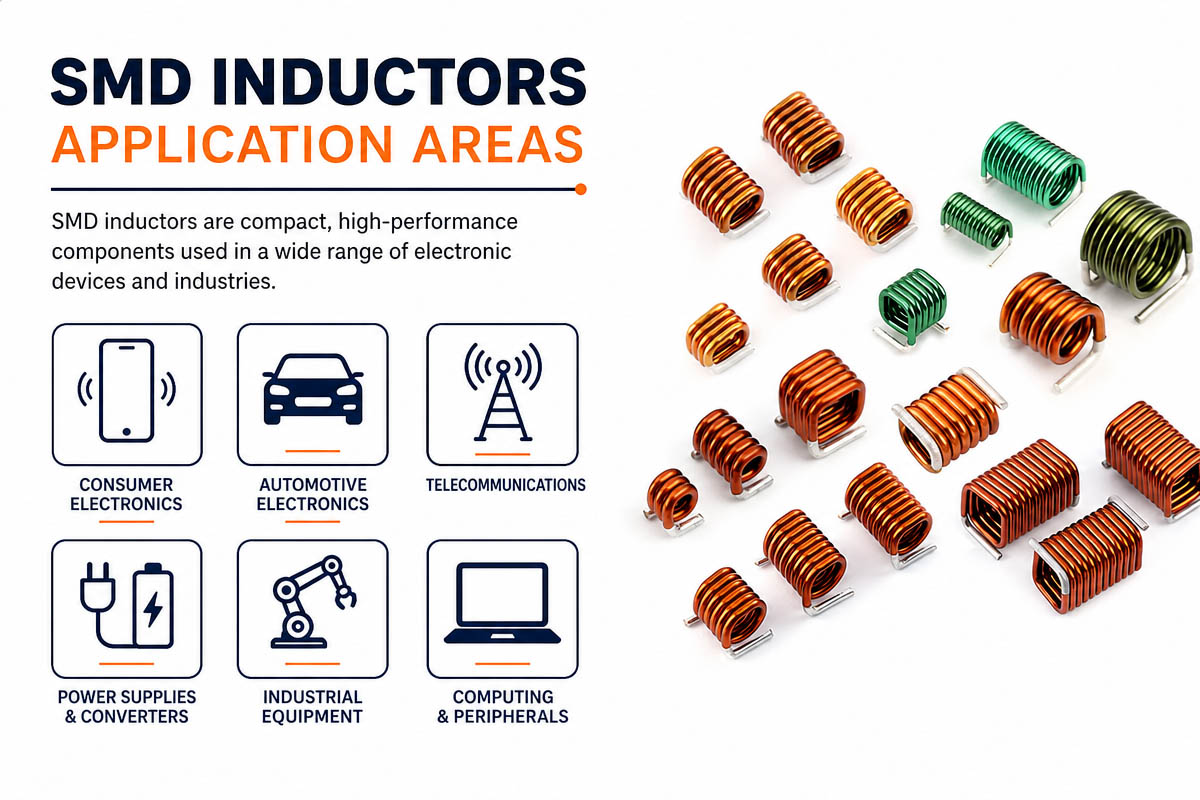
Different electronic applications require the different SMD inductor features.
4.1 SMD Air Core inductor: Power Supply Applications
In the power circuits the SMD inductors are used for:
Energy storage
Voltage conversion
Filtering current ripples
The common parameters of the inductors are:
High saturation current
Low DC resistance (DCR)
Low power loss
Typical products:
Power SMD inductors
Shielded SMD inductors
4.2 : RF and Communication Applications
The wireless electr
SMD Air Core inductor
onic devices require inductors with good high-frequency performance.
The typical applications are:
Bluetooth modules
Wi-Fi devices
5G communication equipment
The common specifications are:
High Q factor
Stable inductance
Low parasitic capacitance
4.3 SMD Air Core inductor : Automotive Electronics
The electronic systems in the automotive industry should be resistant to:
Changes of temperature
Vibration
Continuous operation during long periods of time
The inductors used in the automotive applications should provide:
High reliability
Temperature resistance
Stable electrical characteristics
4.4 SMD Air Core inductor: Industrial Control Systems
The industrial equipment operates continuously.
The SMD inductors are used in:
PLC controllers
Sensors
Motor control systems
Automation equipment
The priorities are:
High longevity
Good mechanical reliability
Stable performance
Chapter 5:Cost vs. Performance: Finding the Best Balance
The cost is always an important aspect of the electronic product development.
However, the choice of the cheapest SMD Air Core inductor may increase the cost due to:
Product failure
Higher warranty costs
Low reliability
Costs Factors for SMD Inductors
The price depends on:
5.1 Material Selection
Using high-quality magnetic materials increases:
Efficiency
Temperature stability
Reliability
5.2 Manufacturing Process
The advanced winding and molding technologies improve performance but increase the cost of production.
5.3 Custom Requirements
The customized SMD inductors require:
Special dimensions
Unique inductance values
Special frequency performance
Finding the Best Balance
The engineer should evaluate:
Required performance
Production volume
Product longevity
Operating environment
The best component is not always the cheapest one, but the component which provides the lowest total cost of ownership.
Chapter 6: Main Application Areas of SMD Inductors in Compact Electronics
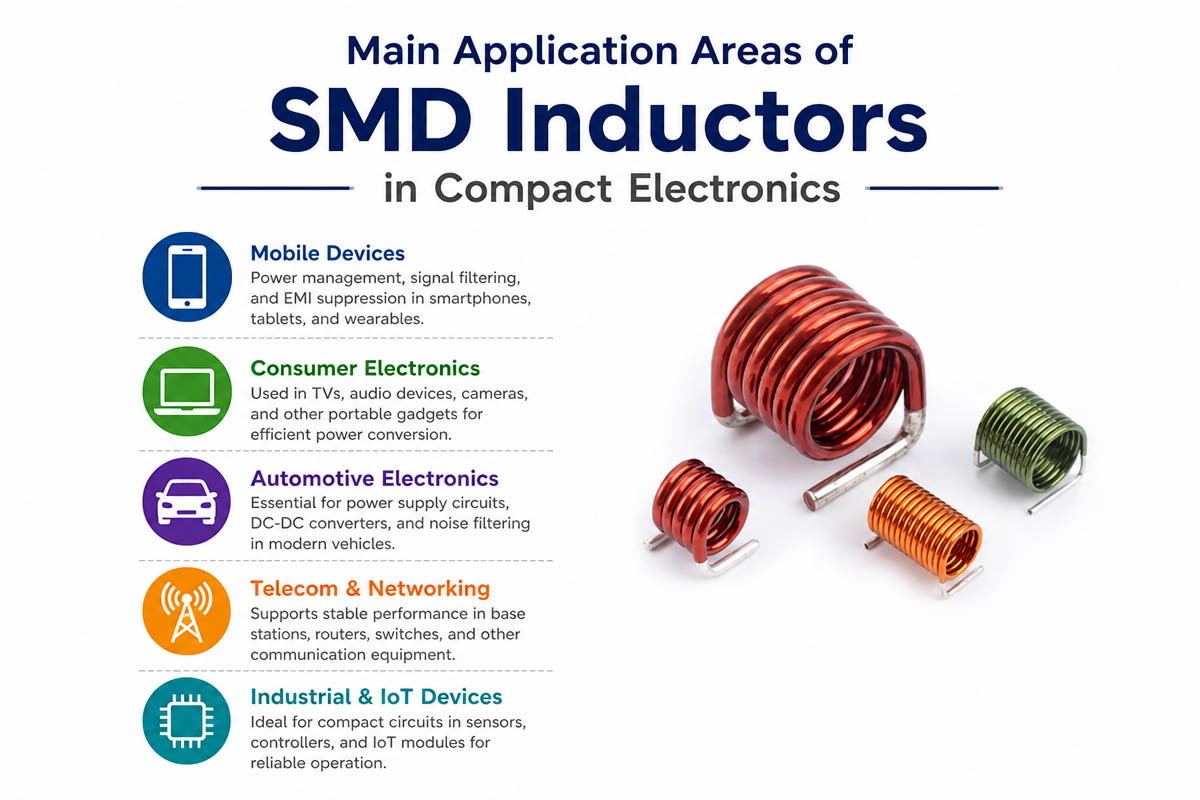
The popularity of the compact electronic products increases the demand for SMD inductors.
Main applications are:
Smartphones
Used for:
Power management
Signal filtering
RF circuits
Wearable Devices
Examples:
Smart watches
Fitness trackers
Requires:
Extra small size
Low power consumption
IoT Devices
The inductors support:
Wireless communication
Battery management
Sensor systems
Medical Electronics
Includes:
Portable monitoring devices
Diagnostic equipment
Requires:
High reliability
Stable operation
Consumer Electronics
For example:
Cameras
Tablets
Smart home products
Chapter 7: Benefits of the SMD Air Core Inductors
In comparison with traditional through-hole inductors, the SMD inductors provide several benefits.
7.1 Space Saving
Since the inductors are mounted directly on the PCB surface, they significantly save the board size.
7.2 SMT Assembly Compatibility
The SMD components allow:
Fast SMT assembly
Lower labor costs
Higher production efficiency
7.3 Good High-Frequency Performance
The majority of the SMD inductors is designed for modern high-frequency circuits.
7.4 Improved Mechanical Reliability
Due to absence of long leads, the SMD inductors are more resistant to vibration and mechanical stress.
7.5 Design Flexibility
There are thousands of sizes and specifications of the SMD inductors available.
Chapter 8:Tips for Choosing the Best SMD Inductors
Choosing the SMD inductor the engineer should take into account the following points.
8.1 Check Required Inductance Value
The inductance value directly determines performance of the circuit.
The common units of the inductance are:
nH (nanohenry)
μH (microhenry)
mH (millihenry)
8.2 Check Rated Current
The current rating should satisfy the application requirements.
The important values:
Saturation current
Temperature rise current
8.3 Consider Operating Frequency
The inductors operate differently at various frequencies.
The special SMD inductors are required for high-frequency circuits.
8.4 Evaluate DC Resistance
Low DC resistance helps:
To reduce energy losses
Increase efficiency
Reduce heating
8.5 Check Temperature Performance
The following parameters should be taken into account:
Operating temperature range
Thermal environment
Heat dissipation conditions
8.6 Work With Reliable Suppliers
The professional SMD inductor supplier should provide:
Technical datasheets
Quality certificates
Testing reports
Custom design capabilities
Chapter 9: Why Are SMD Air Core Inductor Coils So Popular Nowadays?
The SMD inductor coil has become one of the most common passive components for modern electronic devices. Along with the constant development of compact electronics, IoT gadgets, automotive equipment, wearables, and high-frequency communications devices, the usage of SMD inductors became very popular among engineers thanks to their high performance and low PCB footprint.
Unlike traditional lead-through inductors, SMD inductor coils are created to be surface-mounted directly to printed circuit boards (PCB). Below you will find the main reasons of the increasing popularity of SMD inductor coils.
9.1 Small Size for the Increasing Trend Towards Miniaturization of Electronic Products
The first main reason of the popularity of SMD inductor coils is the constant tendency towards the creation of small-size electronic devices.
Electronic devices such as:
smartphones
smart watches
wireless earbuds
IoT sensors
medical monitoring devices
portable industrial equipment
need to perform more functions inside the device with less volume occupied by components.
Comparing to traditional inductors that have wire leads, which take a lot of area on PCB and restrict the assembling process, SMD inductors are produced in very small packages such as:
0201
0402
0603
0805
1206
That allows engineers to create compact and light-weight products without reducing the performance of the device.
9.2 Excellent Compatibility with SMT Assembly Processes
Nowadays the assembling process of electronic products is automated with the help of special machines.
The SMD inductor coil was created for Surface Mount Technology (SMT) process, and it allows using:
high-speed pick-and-place machines
automated soldering system
high volume production lines
SMD inductors offer in comparison with through-hole components:
faster assembly speed
lower cost of labor
higher efficiency
better manufacturing uniformity
For the manufacturing of thousands or millions of products SMT compatibility becomes an important feature.
9.3 Stable Performance of High-Frequency Electronic Products
Demand for high-frequency electronic devices is constantly increasing.
Applications such as:
5G communication devices
Bluetooth modules
Wi-Fi devices
RF circuits
wireless charging systems
require components with stable performance in high-frequency mode.
Many SMD Air Core inductor coils offer:
low parasitic capacitance
high Q factor
stable inductance characteristics
good frequency response
That makes them perfect for high-technology devices.
9.4 Increased Efficiency of Power Consumption
Energy efficiency becomes one of the important parameters of modern electronics.
In power management circuitry SMD power inductors are widely used in:
DC-DC converters
voltage regulators
battery management systems
power supply modules
Using high-quality SMD air core inductor coil allows to:
reduce energy loss
increase efficiency of power conversion
decrease heat emission
extend the lifetime of the battery
In case of mobile electronic products better power efficiency increases the customer satisfaction.
9.5 Great Variety of Available Specifications
Another reason of the increasing popularity of SMD air core inductors is great variety of available specifications.
Depending on their needs engineers can choose SMD air core inductors with the following characteristics:
inductance value
current rating
package size
operating frequency
temperature range
shielding requirements
The most common types are:
Wire-Wound SMD Inductors
Advantages:
high inductance
high current capability
excellent power performance
Usage in:
power supplies
industrial electronics
automotive systems
MultiLayer SMD Inductors
Advantages:
ultra-small size
high reliability
suitable for high-frequency circuits
Usage in:
mobile electronics
RF applications
SMD Air Core Inductor Coils
Advantages:
low magnetic losses
stability at high frequency
high linearity
Usage in:
RF communication
antenna circuits
precision electronics
9.6 Strong Demand from IoT and Smart Devices
The development of IoT caused an increased demand for small-size electronic components.
IoT devices need:
small size
low energy consumption
wireless communication
long operating life
SMD inductor coils are widely used in:
smart sensors
smart home devices
wearables
wireless modules
Since the number of connected devices grows worldwide in billions, the demand for SMD air core inductors will grow in future.
9.7 Better Reliability and Mechanical Stability
SMD inductor coils offer greater mechanical reliability than traditional components.
Since they are directly mounted to the PCB:
no long leads breakage
improved vibration resistance
mechanical stress decreases
This makes them suitable for tough conditions such as:
automotive electronics
industrial automation
aerospace equipment
medical devices
9.8 Lower Total Cost of Manufacturing
Despite the fact that some SMD inductors offer high performance, therefore have a high component price, they reduce the total cost of manufacturing.
Benefits are:
smaller PCB size
faster assembly
decreased manual labor
increased efficiency of production
reduced failure rate
In the case of large-scale manufacturing it creates great savings.
9.9 Support of Advanced PCB Design
Modern PCB design requires:
high component density
multi-layer board
compact layout
good electromagnetic performance
SMD inductor coils allow using advanced PCB design techniques since they can be mounted closer to other components.
This helps engineers to achieve:
small product size
good integration of the circuit
better electrical performance
Chapter 10:Tips to avoid Common Mistakes During SMD
Air Core Inductor Selection
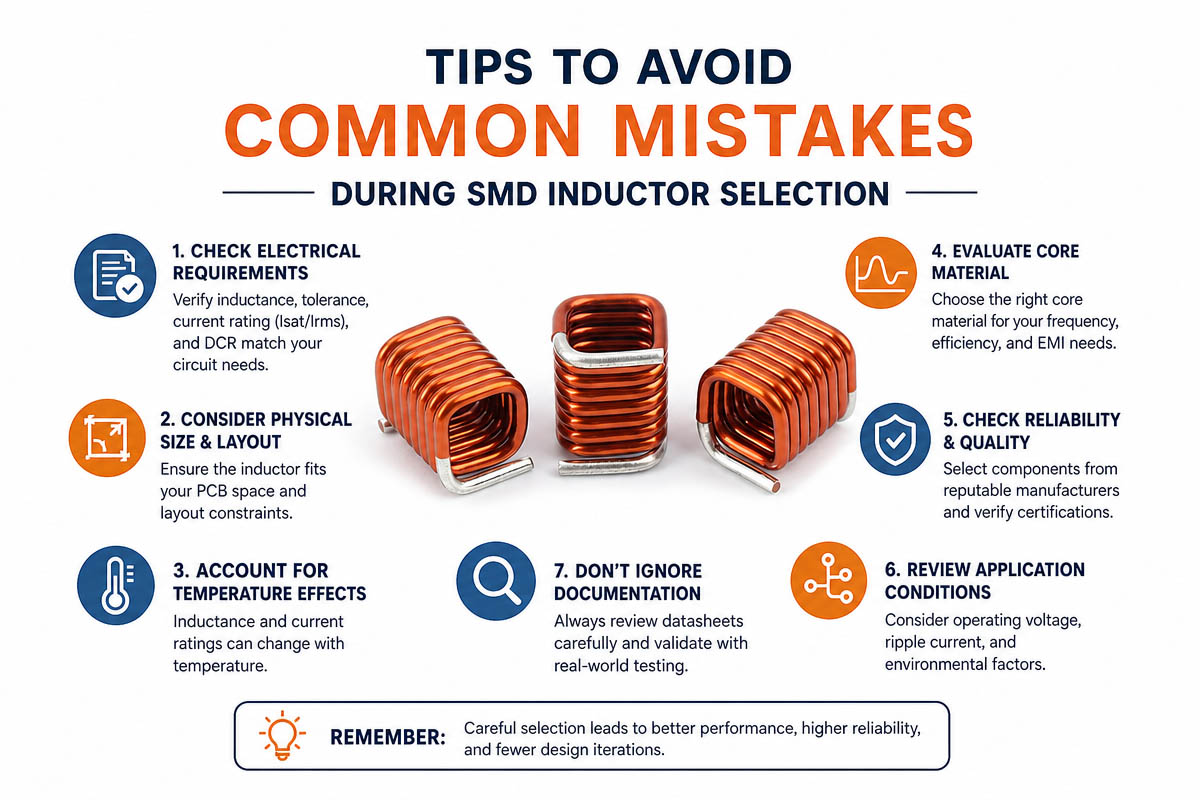
The major part of the design problems appears due to the improper component selection.
Mistake 1: Choosing Only Based on Size
The small inductor may not handle required current.
Solution: Always check electrical specifications.
Mistake 2: Missing the Saturation Current
If the current exceeds the saturation rating:
Inductance reduces
The circuit efficiency decreases
The temperature of the component increases
Mistake 3: Using Low-Cost Components Without Testing
The poor-quality inductors may cause:
Instability of the performance
Short product lifespan
Mistake 4: Missing the Frequency Characteristics
The inductor that is suitable for the low-frequency power circuit may fail in the RF application.
Mistake 5: Missing the Production Requirements
The engineer should consider:
SMT compatibility
Availability
Manufacturer capability
Chapter 11 : Future Trend of SMD Air Core Inductor Coils
The future of SMD inductor coils is associated with rapid miniaturization of electronic devices and intelligent gadgets, fast data communication, and energy-efficient systems. Along with increasing miniaturization and the improvement of performance of electronic products, SMD inductors will occupy an important place in future circuit design.
Firstly, one of the main trends will be even further miniaturization. In order to obtain small-sized products, smartphones, IoT sensors, wearable devices, and other types of electronic gadgets need extremely miniaturized components. The future of SMD inductor coils will be associated with further reduction of the size of components and at the same time providing high inductance and high current capacity.
Secondly, due to the development of electric cars, solar energy systems, and advanced power management systems, there will be a need for SMD inductors with higher power density and higher efficiency. With the help of innovative magnetic materials, the advanced coil structure, and advanced production technologies, it will be possible to create inductors with improved thermal performance and efficiency.
Thirdly, the growing number of applications associated with 5G communication and wireless communication will increase the demand for high-frequency SMD inductor coils. Applications in the field of wireless communications and Internet of Things will require inductors with good frequency stability and reduced electromagnetic interference. RF SMD inductors and air-core SMD inductors will become widespread in the field of communication modules and smart devices.
Fourthly, customization will be one of the main future developments in SMD inductor production. Various industries have specific requirements regarding size, inductance, operating temperature, and resistance to the environment. There will be a need for customized solutions from SMD inductor manufacturers in the fields of automotive industry, industrial automation, and medical devices.
Moreover, the issue of sustainability will affect the development of SMD air core inductors. Manufacturers will strive to minimize material wastage, improve production process efficiency, and develop eco-friendly manufacturing processes.
To conclude, the future of SMD air core inductor coils will be characterized by reduced dimensions, high performance, high reliability, and customization. With the development of electronic technology, SMD air core inductors will be one of the components of the next generation of compact and intelligent electronic products.
Chapter 12:Frequently Asked Questions (FAQ)
Q1: What is an SMD air core inductor?
The SMD air core inductor is a surface-mounted passive component which stores energy due to a magnetic field and is installed on the PCB surface.
Q2: What are the types of SMD Air Core inductors?
The main types are:
Wire-wound SMD Air core inductors
Multilayer SMD Air core inductors
SMD air core inductors
Q3: How do I choose the right SMD Air Core inductor?
You should take into account:
Inductance value
Current rating
Frequency
Size
Temperature performance
Q4: Are the SMD inductors better than traditional inductors?
For creating compact electronic design the SMD inductors usually provide better space efficiency and automated assembly features.
Q5: What applications use the SMD inductors?
They are used in:
Smartphones
IoT devices
Automotive electronics
Industrial equipment
RF communication systems
Q6: Can the SMD inductors be customized?
Yes. There are many manufacturer who provide the customizations of the inductors depending on:
Size requirements
Inductance value
Q7: What are the reasons of SMD inductor failure?
The main reasons are:
Over current
Excessive temperature
Incorrect selection
Poor quality materials
Q8: Why are the SMD inductors important in the modern electronics?
They allow to create the smaller, lighter and more efficient electronic products.
Chapter 13:Conclusion
The SMD inductor has become one of the main components in the modern compact electronics. With the development of the new technologies, the products become smaller and smarter. And the engineers need reliable inductors which can provide the good electrical performance within the minimal PCB size.
The selection of the right SMD inductor requires the evaluation of:
Inductance value
Package size
Current rating
Frequency performance
Temperature resistance
Cost efficiency
The proper selection of the component is not only finding the most miniature or cheap component. The right SMD inductor is one which provides the best performance, reliability and cost-efficiency.
For the electronic manufacturer cooperation with the experience SMD inductor supplier will provide additional advantages, such as customization, technical support and reliable production quality.
With the increasing demand for the wearable devices, IoT products, automotive electronics and smart industrial systems, the SMD inductors will play an important role in the future electronic innovation.


