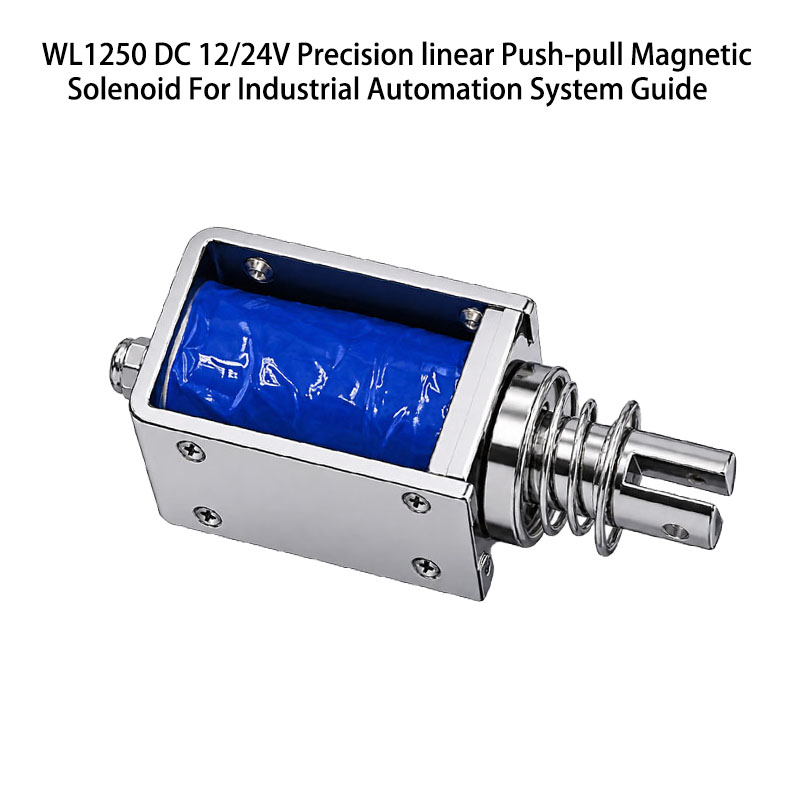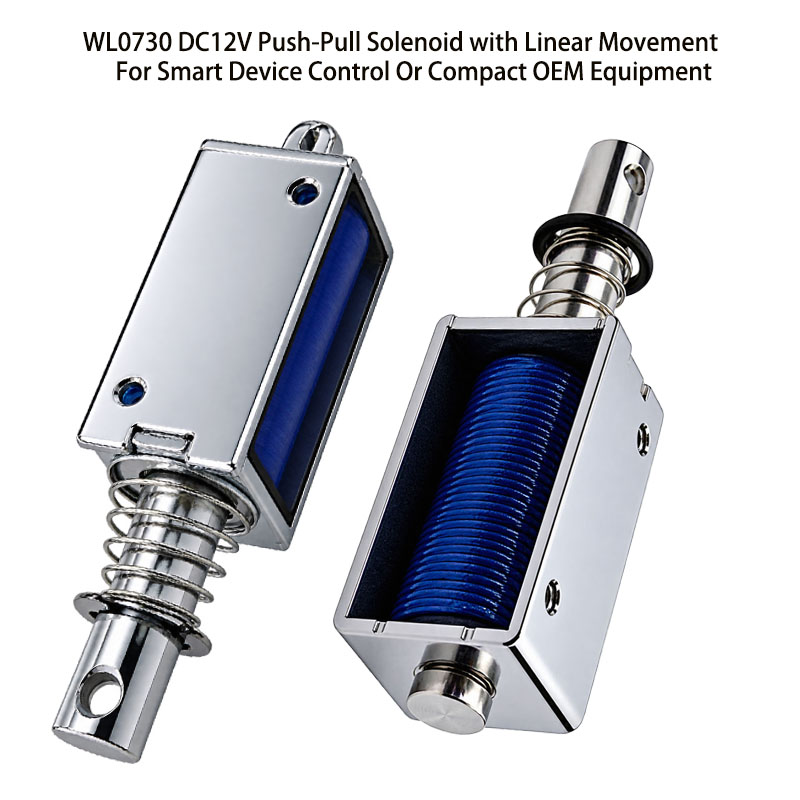
Introduction to Linear Push-Pull Solenoid
In modern industrial automation, it is necessary to transform electrical energy into precise mechanical motion for machine operation, valve control, lock mechanism operation, and automation of various processes. The solenoid is one of the most common devices that perform such transformations.
A linear push-pull solenoid is an electromagnetic actuator that transforms electrical energy into linear motion directly. When the electrical current passes through the coil of the device, the magnetic field is created, which pushes the internal iron plunger forward or backward. Such a principle of operation allows a linear push-pull solenoid to be a reliable and compact device for various applications.
There are many advantages of solenoids over the larger mechanical drive systems, such as compactness, fast response, ease of electrical control, and relatively easy installation.
But how does a linear push-pull solenoid convert electrical energy into motion?
What happens in the coil when the power is on? What determines the traction, thrust, stroke, and speed of operation of the linear push-pull solenoid?
This article describes the working principle, internal structure, energy conversion process, main performance parameters, and industrial applications of linear push-pull solenoids.
1. What is the linear push-pull solenoid?
A linear push-pull solenoid is an electromagnetic actuator that provides linear displacement when its coil is energized.
The word ‘linear’ characterizes the direction of the movement. The word ‘push-pull’ characterizes the fact that the movement can be used for the creation of mechanical movement in two directions with a proper mechanical arrangement.
Linear actuators, unlike rotary solenoids, provide a linear motion of a plunger.
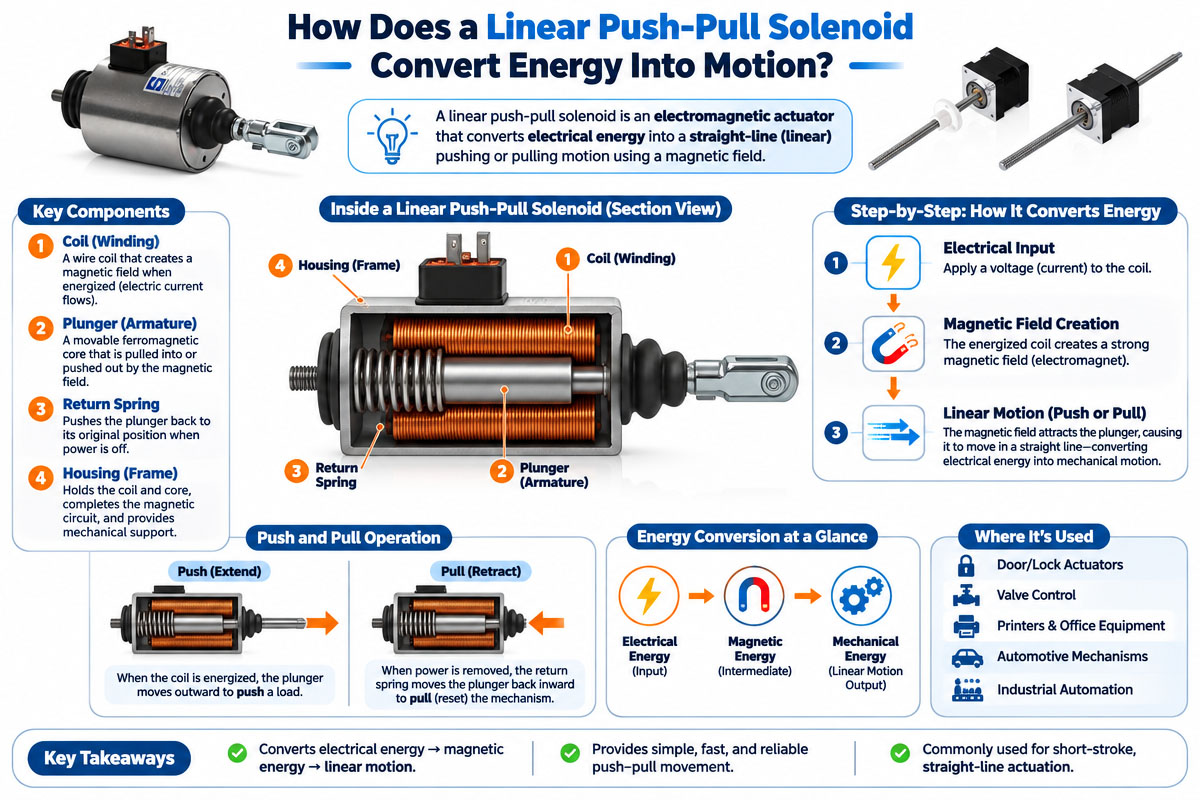
A typical linear solenoid consists of several main components:
Electromagnetic coil: copper winding on a bobbin that creates a magnetic field when energized.
Plunger—a movable ferromagnetic metal core that moves along the centerline of the actuator.
Magnetic housing: steel housing for a magnetic return path.
Return spring: used in spring-return configurations for the return of the plunger to its original position when power is switched off.
Bobbin: an insulator for the support and insulation of the copper winding from the surrounding metal parts.
Electrical terminals or wires: they connect the actuator to a DC or AC power source depending on the actuator design.
All these components create a linear push-pull solenoid that can transform electrical energy into mechanical energy.
Depending on the design, the actuator can be pull type, push type, or both.
2. How a linear push-pull solenoid functions
The linear push-pull solenoid working principle is electromagnetic attraction.
The copper winding has electrical current flowing through it, and the electrical current creates a magnetic field around the coil. The magnetic field creates a force that attracts the movable iron plunger into a position of low reluctance in the magnetic circuit.
This process can be divided into 4 main steps.
Step 1: Electric Power is Provided
DC voltage is supplied to the coil, and electrical current starts to flow through the copper winding.
The current depends on the applied voltage and the electrical resistance of the coil.
According to Ohm’s law:
V = I * R
Where?
V = voltage applied
I = current (electrical)
R = resistance of coil
If you have a coil with a nominal resistance of 12 ohms and you connect it to a 12V DC power supply, then the steady-state current will be about 1 amp.
The whole actuation process starts with the supply of electrical energy to the coil.
Step 2: The coil creates a magnetic field.
The windings create an electromagnetic field due to the current passing through them.
The magnetic field intensity depends on a number of factors. These include:
number of windings in the coil.
electric current.
shape of the coil.
magnetic properties of materials.
air gap in a magnetic circuit.
The magnetomotive force depends on the ampere-turns (current times number of turns in the coil).
However, the more turns or current also influence coil resistance, power consumption, temperature, and total actuator dimensions.
Therefore, electromagnetic design should take into account magnetic performance and electrical and thermal constraints.
Step 3: The plunger is moved by the magnetic field.
When the magnetic field is created, the movable ferromagnetic plunger is subjected to an electromagnetic force.
The plunger moves in the direction of the region of high magnetic attraction, thus reducing the effective air gap of the magnetic circuit.
This is the movement that transforms electromagnetic energy into mechanical motion.
The force depends on the magnetic flux density, effective pole area, air gap, and magnetic circuit design.
For a simplified magnetic system, the electromagnetic force can be estimated by
F = B² × A / (2μ₀)
Where:
F = Electromagnetic force in newtons.
B = Magnetic flux density in tesla.
A = Effective magnetic pole area in square meters.
μ₀ = Permeability of free space.
This formula gives a simple explanation of the relationship between magnetic field strength and force. However, the actual solenoid performance depends on leakage flux, saturation, geometry, and the position of the plunger.
Step 4: Mechanical Motion Is Created
The plunger moves and transfers mechanical force to an external part.
This movement can be used to: depending on the actuator structure:
Turn a valve on or off.
Open a mechanical lock.
position an object.
Pull a lever.
Switch on or off.
operate a mechanical device.
When electrical power is switched off, a spring-return design usually pushes or pulls the plunger to the original position.
That finishes one actuation cycle.
3. How does a linear push-pull linear solenoid work?
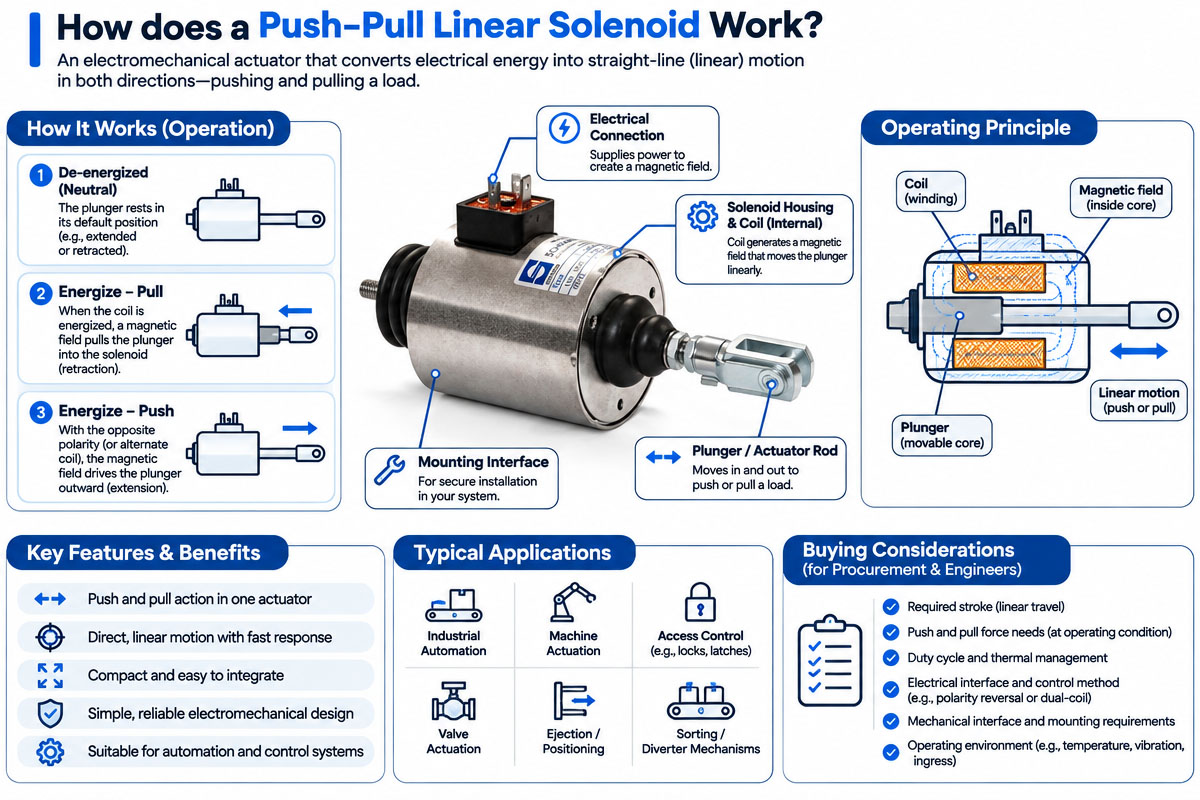
The push-pull feature is one of the important features of this actuator class.
The typical spring return solenoid will have a power stroke in one direction and a spring return stroke in the opposite direction.
For instance:
3.1 Operation pull type:
When the coil is energized, the plunger is pulled into the body of the solenoid. When the power is switched off, the return spring pushes it outward.
3.2 Push-type operation:
In another mechanical design, the energizing of the coil results in an outward push. When the power is switched off, a spring or other mechanical means pushes the plunger back.
3.3 Bi-directional operation.
Some applications require powered motion in both directions. This can be provided by special dual-coil designs, opposed magnetic circuits, or other actuator configurations.
Remember that not all conventional solenoids can provide the powered force in both directions.
When selecting a Linear Push-pull solenoid, engineers should determine exactly whether the application requires spring return, power in one direction, or electrically controlled motion in both directions.
This feature allows manufacturers to design a proper magnetic structure and mechanical configuration.
4. What Determines the Force of a Linear Solenoid?
Force is one of the most important parameters of performance in the selection of an electromagnetic actuator.
A linear push-pull solenoid must generate enough force during its stroke to overcome the external load, friction, spring force, and other mechanical forces.
The strength of its output depends on some factors.
4.1 Current in the Coil
The strength of the magnetic field depends on the current in the coil.
The higher the current, the higher the magnetic force, especially if the magnetic circuit is not saturated.
Too much current, however, creates more heat and can burn the insulation or reduce the life of the coil.
4.2 Number of Turns of the Coil
The number of turns of the copper wire influences the magnetic field created by the winding.
More turns can increase the magnetic excitation but require more winding space and can increase the electrical resistance.
The engineers should balance the winding design with the required voltage, current, power consumption, and installation space.
4.3 Luftspalt
The electromagnetic force is strongly dependent on the air gap between the plunger and the magnetic pole.
Usually, a larger air gap requires more magnetic excitation to create the same force.
When the plunger gets closer to the magnetic pole, the magnetic reluctance becomes smaller and the electromagnetic force usually increases.
This is why often a solenoid has different starting force and end-of-stroke force.
4.4 Materials Magnétiques
The magnetic circuit is influenced by the magnetic properties of the housing, plunger, and other internal parts.
The magnetic efficiency can be increased by using proper ferromagnetic materials with appropriate permeability and saturation.
The materials should also be chosen with proper regard for mechanical strength, corrosion resistance, operating temperature, and manufacturing requirements.
4.5 Stroke Length
Stroke is the straight-line distance the plunger travels.
Generally, the longer the stroke, the larger the magnetic working range required, and the more difficult it is to maintain sufficient force through the movement.
For this reason, engineers should check the force-displacement curve rather than rely on one maximum-force value only.
5. Linear Push-pull Solenoid Relationship between Voltage, Power, and Operating Temperature
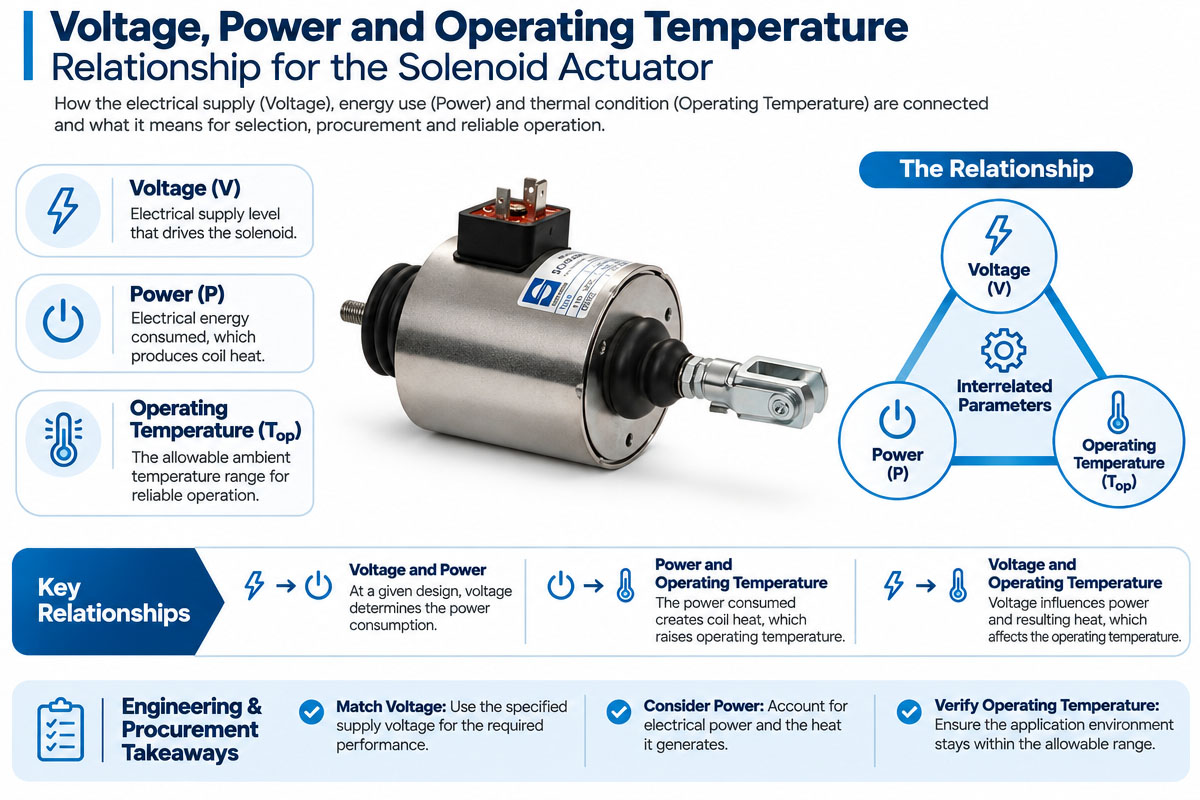
Another important aspect in the design of a linear push-pull solenoid is electrical performance.
The current flowing through the coil depends on the applied voltage and the coil resistance.
Electrical power can be calculated using:
P = V × I
For a DC resistive coil under steady-state conditions:
P = V² / R
For example, a 12V coil with a resistance of 24 ohms will draw about 6 watts at steady state.
However, electrical energy is also converted into heat, and thus coil temperature increases during operation.
High temperature could result in degradation of insulation, resistance drift, and actuator reliability degradation.
The linear push-pull solenoid duty cycle of operation therefore becomes of prime importance.
Solenoids are also rated for duty cycle. A 10% duty-cycle solenoid is intended to be energized intermittently. A 100% duty-cycle solenoid is intended to be energized continuously within its published thermal and environmental specifications.
For continuous operation applications, engineers should pay special attention to copper wire size, coil resistance, thermal dissipation, insulation class, and ambient temperature.
In some applications, PWM (Pulse Width Modulation) control can be used to provide a higher initial force to activate and then reduce the power to hold.
This way the application can use a high starting force but a lower force to hold its position and thus save energy and produce less heat.
6. Typical Applications of Linear Push-Pull Solenoids
Linear actuators are extensively used in different industries due to their small size and electromagnetic control.
Here are typical examples of applications.
6.1 Industrial Automation
Solenoids are used in manufacturing machinery to operate locks, position parts, turn switches, and control mechanisms’ movement.
It operates fast, which makes it suitable for repeatable automation operations.
6.2 Medical Devices
Actuators are required in fluid systems, valves, sampling devices, and other precision mechanism components in medical equipment.
Properly designed linear push-pull solenoids can provide the required movement in a limited installation space.
For these applications, it is necessary for manufacturers to take into account operating noise, reliability, temperature rise, and lifetime of an actuator.
6.3 Automotive Industry
Automotive applications comprise door locks, transmission devices, fuel control systems, and other electro-mechanical elements.
These actuators might be subject to vibrations, temperature variations, humidity, and prolonged duty cycles.
6.4 Locking and Security Systems
Electromagnetic actuators are widely used in electronic locks, access control, automatic locking devices, and security systems.
Depending on the design, the plunger engages or disengages the mechanical locking mechanism.
Commercial and Domestic Equipment
Solenoids can also be used in vending machines, home appliances, office equipment, dispensing systems, and other electrical control systems.
They are small and rather simple for control, making them perfect for mass-produced products.
7. How to Choose the Right Linear Push-Pull Solenoid
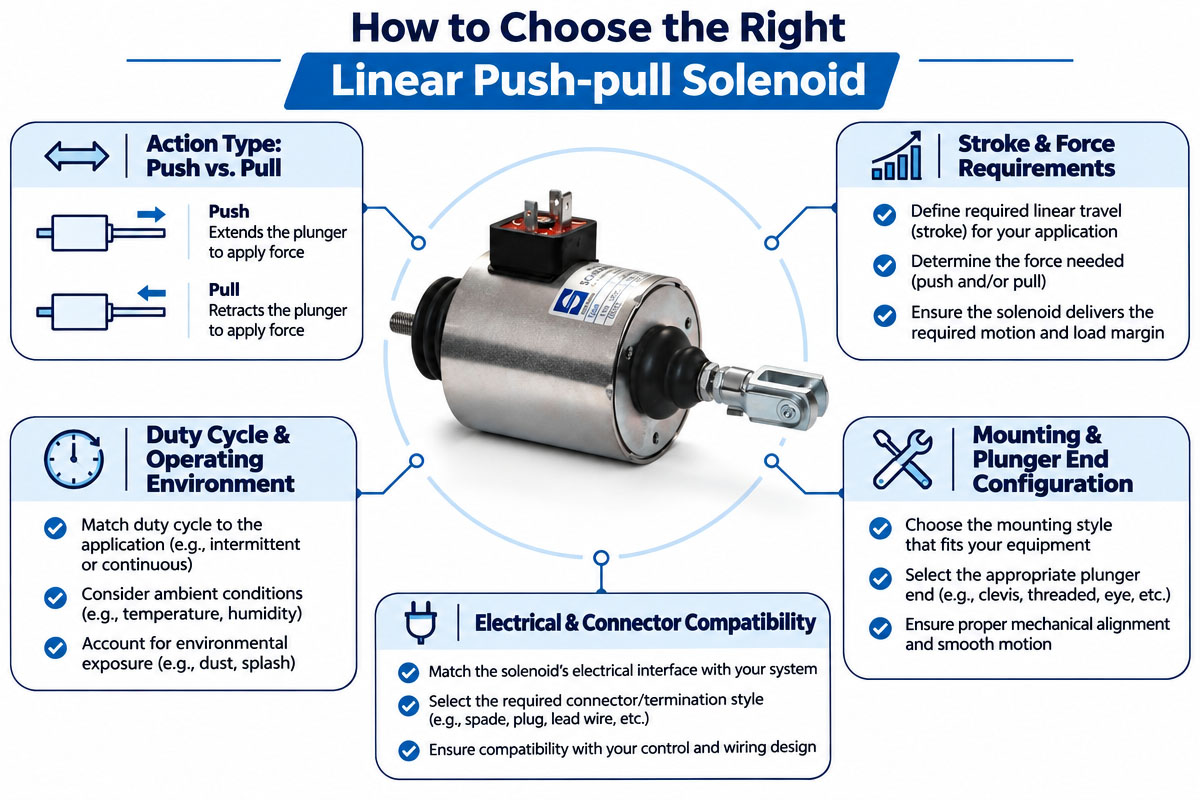
Choosing the correct actuator is essential for achieving reliable operation and avoiding energy waste and mechanical problems.
Before contacting a manufacturer, buyers need to know these technical requirements.
7.1 Operating voltage
DC or AC voltage needed (5V, 12V, 24V…etc.).
7.2 Force required
Set the required minimum force to be generated from the beginning, middle, and ending of the stroke.
7.3 Stroke length
State the real stroke needed by the application, e.g., 2 mm, 5 mm, 10 mm, or 15 mm.
7.4 Duty cycle
State whether the actuator is going to be operated intermittently or constantly.
7.5 Frequency of operation
State how many cycles per minute/hour/day you expect to get.
7.6 Size of installation
State the maximum installation size, mounting holes, plunger diameter, and connection sizes.
7.7 Return method
Define whether the spring return or an additional return force is required or the power movement on both ways is required.
7.8 Environmental conditions
Consider operating temperature, humidity, vibration, dust, and corrosion.
7.9 Expected life time
Set up the expected mechanical cycle life, e.g., 100 000, 500 000, or 1 million cycles.
A professional manufacturer can analyze all these details to evaluate the magnetic structure, copper winding, plunger dimensions, and other design features.
In many OEM projects a custom-made linear push-pull solenoid is a better choice than selecting a standard one depending only on external dimensions.
8. Why Make a Custom Linear Push-Pull Solenoid?
There are standard products on the market, but many industrial applications have special mechanical and electrical requirements.
The client may require a certain operating voltage, a stroke of 5 mm, an output force of 20 N, and continuous operation in a limited installation area.
This requirement cannot be satisfied with the standard product.
The customized linear push-pull solenoid allows engineers to customize these features:
Coil winding and resistance to electricity.
Magnetic circuit and output force.
Diameter and stroke of the plunger.
Return and spring force.
Housing and mounting structure size.
Operating temperature and duty cycle.
Electrical wiring and insulation.
Surface treatment and corrosion protection.
Also, customization could help to reduce unnecessary expenses on materials and better integration into the customer’s final device.
For OEM manufacturers it will make it easier for the product development and increase the compatibility of the actuator and whole mechanical system by cooperating with a specialized solenoid manufacturer.
9. Why choose Weilong as your linear push-pull solenoid manufacturer?

<PRIVATE_PERSON> Weilong Intelligent Technology (Dongguan) Co., Ltd. is a professional manufacturer specializing in the production of customized solenoids and inductor coils since 2007.
Weilong has many years of experience in the development and production of electromagnetic actuators, providing the customized solutions to industrial clients in various sectors.
We have the following manufacturing capabilities:
Metal stamping, tooling.
Plastic injection molding.
CNC machining.
Copper winding.
Assembly of solenoid.
Evaluation of product performance.
With all these capabilities, Wei Long is able to control the production process and develop actuators according to the special client’s requirements.
We don’t supply just standard off-the-shelf products, but our engineering team creates designs according to specifications of required force, stroke, voltage, current, duty cycle, installation dimensions, operating environment, and order quantity for each project.
Whether it’s a small linear push-pull solenoid actuator for medical devices, a high-force solenoid for industrial automation, or a customized electromagnetic locking device Weilong understands client’s requirements and offers an appropriate technical solution.
Quality management and product compliance certificates of Weilong: ISO 9001, IATF 16949, CE, RoHS, REACH
Need to choose the trusted Linear Push-pull solenoid manufacturer?
Discuss your application with Weilong Intelligent Technology. The sales and engineering team can help you to review your technical specifications and engineer a custom solenoid solution for your project.
Web site: https://www.smartsolenoid.com/
10. Frequently Asked Questions
Q1: What is the main function of a linear push-pull solenoid?
Its main task is transforming electrical energy into direct mechanical movement. Depending on the design, the solenoid moves an external mechanism in pushing or pulling mode, doing opening valves, releasing locks, or moving mechanical parts.
Q2. What is the difference between a pull-type and a push-type solenoid?
Because of the mechanical and magnetic design of the solenoid, the pull-type solenoid, after energizing, pulls the plunger to the coil, while the push-type solenoid pushes the plunger outward.
Then the selection of the design depends on the required direction of movement and installation structure.
Q3: Can the linear push-pull solenoid move in both directions?
Yes, but the way of operation depends on the design. The typical spring return mechanism has the powered movement in one direction and the spring return movement. In case of needing movement in both directions, it might be necessary to have a specially designed dual coil or bi-directional electromagnetic system.
Q4. What defines the force of a solenoid?
The main factors are the coil current, number of winding turns, magnetic material properties, air gap, pole area, and plunger position. Output force is affected also by the stroke and external mechanical resistance.
Q5: Can the linear push-pull solenoid perform continuously?
Yes. “Some designs are designed to operate with a 100% duty cycle.
But the continuous operation requires certain coil resistance, copper wire size, insulating materials, and proper thermal control.
Q6: How long can the solenoid last?
The service life depends on the design, load conditions, operating frequency, temperature, and mechanical structure. Depending on the application, the manufacturers produce solenoids that are able to perform 100,000 or over 1 million cycles. The actual service life must be confirmed by testing in the required operating environment.
Q7: Does Weilong produce customized linear push-pull solenoids?
Yes. Weilong produces customized solenoids according to clients’ requirements. We are able to customize the voltage, force, stroke, coil winding, external dimensions, mounting structure, and duty cycle to meet special OEM application requirements.
Q8: What information should I give when requesting a quotation?
Ideally, please state the operating voltage, the required force, the stroke distance, the duty cycle, the operating frequency, the available installation space, the environmental conditions, and the order quantity.
Also, the 2D drawing, 3D model, or a sample of the final device as a reference will help our engineers to analyze your project better.
11. Conclusion
Linear solenoids are efficient and practical electromagnetic actuators that transform electrical energy into mechanical movement using the force of a magnet.
Understanding the work principle, internal design, force characteristics, electrical requirements, and operating conditions helps the engineers to choose the proper actuator for their application.
Properly designed linear push-pull solenoids provide reliable movement, compact installation, quick operation, and long operation life in wide industrial and commercial products.
Customization is frequently the best solution when OEM projects require certain force, stroke, voltage, duty cycle, and installation size.
Weilong Intelligent Technology ready to help with your next solenoid development project. Please contact our team and discuss your requirements and find a customized electromagnetic actuator solution.