Custom Ferrite Coil Antenna for IoT Communication
Ferrite Coil Antenna for Smart Meter Communication
Ferrite Coil Inductor Antenna for Industrial RF Systems
Ferrite Coil Inductor Antenna for RFID Applications
Ferrite Coil Inductor Antenna for Wireless Devices
High Performance Ferrite Coil Inductor Antenna Design
Custom Ferrite Coil Antenna for IoT Communication
Ferrite Coil Antenna for Smart Meter Communication
Ferrite Coil Inductor Antenna for Industrial RF Systems
Ferrite Coil Inductor Antenna for RFID Applications
Ferrite Coil Inductor Antenna for Wireless Devices
High Performance Ferrite Coil Inductor Antenna Design

WL1215 Industrial Ferrite Coil Inductor Antenna Solutions

A ferrite coil inductor antenna is an electromagnetic device with a small size, which can efficiently receive or transmit radio-frequency signals, consisting of a ferrite rod or core with a precision-wound copper coil. Ferrite material increases magnetic flux, and the antenna becomes more sensitive to signals, has improved inductance, better reception, and smaller size. You will meet them in RFID systems, AM radios, wireless sensor networks, smart utility meters, industrial equipment, medical electronics, and IoT devices.

Ferrite antennas are perfect for industrial environments due to the reduction of the electromagnetic interference and improved signal quality. Customization for a particular application includes ferrite material, number of turns of the coil, wire diameter, frequency of operation and inductance. Ferrite coil inductor antennas are key components for modern wireless communication and sensing electronics, providing reliable long-time operation and low power consumption.

ndustrial Ferrite Coil Inductor Antenna Product Overview

Ferrite coil inductor antennas are special-purpose electromagnetic devices, which are optimized for RF signal reception and transmission. Using high-quality ferrite materials and premium enameled copper wire, these antennas provide high inductance, low signal loss and outstanding stability. These antennas are available in different sizes, inductance values and frequency of operation and can be customized for OEM and ODM projects. Usage includes RFID systems, wireless communication, smart meters, industrial automation, IoT devices, automotive electronics and medical electronics. Strict quality control provides consistent performance, durability and conformity with international manufacturing standards for difficult industrial environments.

How does a ferrite rod inductor antenna work?

The Ferrite Coil Inductor Antenna works based on the principle of electromagnetic induction.

Electromagnetic wave passing through the ferrite rod. High magnetic permeability of the ferrite material leads to concentration of the magnetic field. Copper coil wrapped around the ferrite core is under a changing magnetic flux. As a result, the voltage is induced in the coil according to Faraday ‘s Law of Electromagnetic Induction .

Induced signal is transferred to the receiver circuit where it is amplified, filtered and processed. Electrical current flowing through the coil creates a magnetic field. Magnetic field radiates electromagnetic energy.

The presence of the ferrite core provides significant increase of magnetic flux density. The antenna receives:

Improved inductance

Increased sensitivity.

Improved Signal-to-Noise Ratio

Compact antenna size

Decreased electromagnetic interference

All these features make ferrite antennas perfect for low and medium frequency communication systems.

Ferrite Coil Inductor Antenna Main Features

Ferrite coil inductor antennas are characterized by high magnetic permeability, small size, high receiving sensitivity and good electromagnetic performance. Ferrite antennas have higher inductance than air-core coils, lower power consumption and stable operation. Ferrite core increases signal intensity, decreases the electromagnetic interference and improves communication. Ferrite antennas can be customized for ferrite material, inductance, frequency of operation, wire diameter and dimensions for particular application requirements. They are ideal for industrial automation, RFID systems, wireless communication devices, medical electronics, smart meters and IoT products because of their excellent temperature stability, long time operation and consistent electrical parameters.


Industrial Ferrite Coil Inductor Antenna Video

Industrial Ferrite Coil Inductor Antenna Detailed Display

Industrial Ferrite Coil Inductor Antenna Datasheet

Item Description
Ferrite Coil Inductor Enameled copper wire
Wire Diameter 0.2 (AWG options available)
Winding Type Single-layer round or sectional  winding
Core Material  Magnetic Rod
Footprint length 5 mm


Encapsulation Optional varnish, epoxy, or coating
Mounting Through-foot / Custom

Electrical Specifications (Typical)

Parameter Description
Inductance Range 0.1 µH – 100 µH (customizable)
Inductance Tolerance ±2%, ±5%, ±10%
DC Resistance (DCR) Custom
Q Factor High Q, optimized for frequency range
Self-Resonant Frequency High, application-dependent
Operating Frequency kHz to MHz range
Rated Current Custom per design
Insulation Resistance ≥100 MΩ

Why is Ferrite Coil Inductor Antenna Getting So Popular?

The growing demand for small, low power consumption, high-reliability wireless communication devices makes ferrite coil inductor antennas increasingly popular. They are ideal for modern electronic products because they allow to get excellent signal sensitivity in a compact size.

The fast growth of RFID technology, Industry 4.0, smart factories, IoT devices, wireless sensors, smart utility meters, automotive electronics and medical devices leads to the increased demand for high-performing ferrite antennas. Ferrite coil antennas provide better performance in low frequencies, electromagnetic interference and low power consumption compared to many traditional antennas.

Advances in manufacturing technology allowed to achieve better tolerances of inductance, automated precision winding, better ferrite materials and consistent mass production. OEM customization allows engineers to optimize antenna performance for a particular application and frequency of operation.

With industries increasingly moving to wireless connectivity and intelligent monitoring systems, ferrite coil inductor antennas become one of the most practical and cost-effective ways to achieve reliable communications, which makes it an important component of next-generation electronic products.

Ferrite Coil Inductor Antenna Industrial Application

Ferrite Coil Inductor Antenna: Advantages and Disadvantages

Ferrite coil inductor antennas are widely used in many industries due to the advantages of compact size, high sensitivity, and good electromagnetic performance.

They ensure reliable wireless communication between sensors, controllers, and monitoring systems in industrial automation. Ferrite antennas are used in RFID readers to improve reading range and accuracy and to reduce interference with the signal. Ferrite antennas are crucial components for smart utility meters, providing reliable wireless data transmission in difficult conditions.

Ferrite rod antennas are applied in consumer electronics such as AM radios and portable receivers for effective low-frequency signal receiving without using bulky external antennas. Ferrite antennas are used in medical electronics in wireless monitoring devices when a small size and reliable signal are important.

Ferrite antennas are used in automotive electronics in keyless entry systems, tire pressure monitoring, and vehicle communication modules. Ferrite antennas are used in security systems, access control equipment, and inventory management systems for reliable wireless performance.

Fast growth of IoT devices expanded the usage of ferrite antennas in smart agriculture, environmental monitoring, smart buildings, industrial sensors, logistics tracking, and asset management. They are suitable for battery-operated devices, which require long-time stability and reliable communication due to low power consumption and high signal sensitivity.

Ferrite Coil Inductor Antenna Advantage and Disadvantage

Ferrite Coil Inductor Antenna: Advantages and Disadvantages

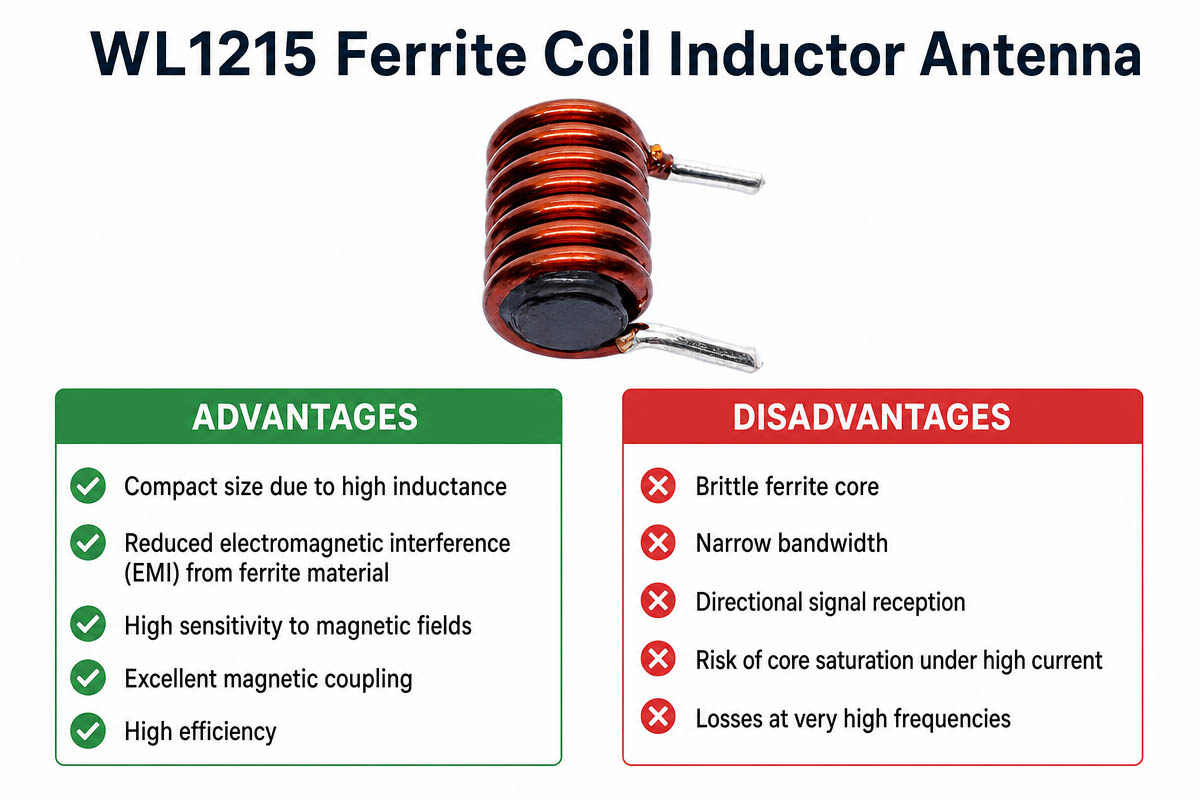
The ferrite coil inductor antenna has many advantages, which makes it one of the most widely used antennas for low and medium frequency communication. Their small size allows designers to use high-performing antennas in small devices. The ferrite core significantly increases the magnetic permeability and provides high inductance, good signal pickup, and improved sensitivity compared to the air-core coils. They also have good immunity to electromagnetic interference, low power consumption, stable electrical parameters, and a long operational limanufacturer can tailor the inductance and sizefacturer for a particular frequency range and winding.

Ferrite antennas have many advantages, but there are also some disadvantages. They perform worse at very high frequencies, and other types of antennas should be used there. In strong magnetic fields the ferrite material may saturate, and this will reduce efficiency. Improper impedance matching, poor winding, and improper material choice can negatively affect the performance. The ferrite core may be cracked by mechanical impacts, so it should be handled carefully. Also, you have to design and test the antenna to get the best performance. However, ferrite coil inductor antennas provide a good compromise between performance, size, and cost for RFID, AM radio, IoT, industrial automation, and wireless sensing applications.

Ferrite Coil Inductor Antenna Troubleshooting

Ferrite Coil Inductor Antenna troubleshooting guide

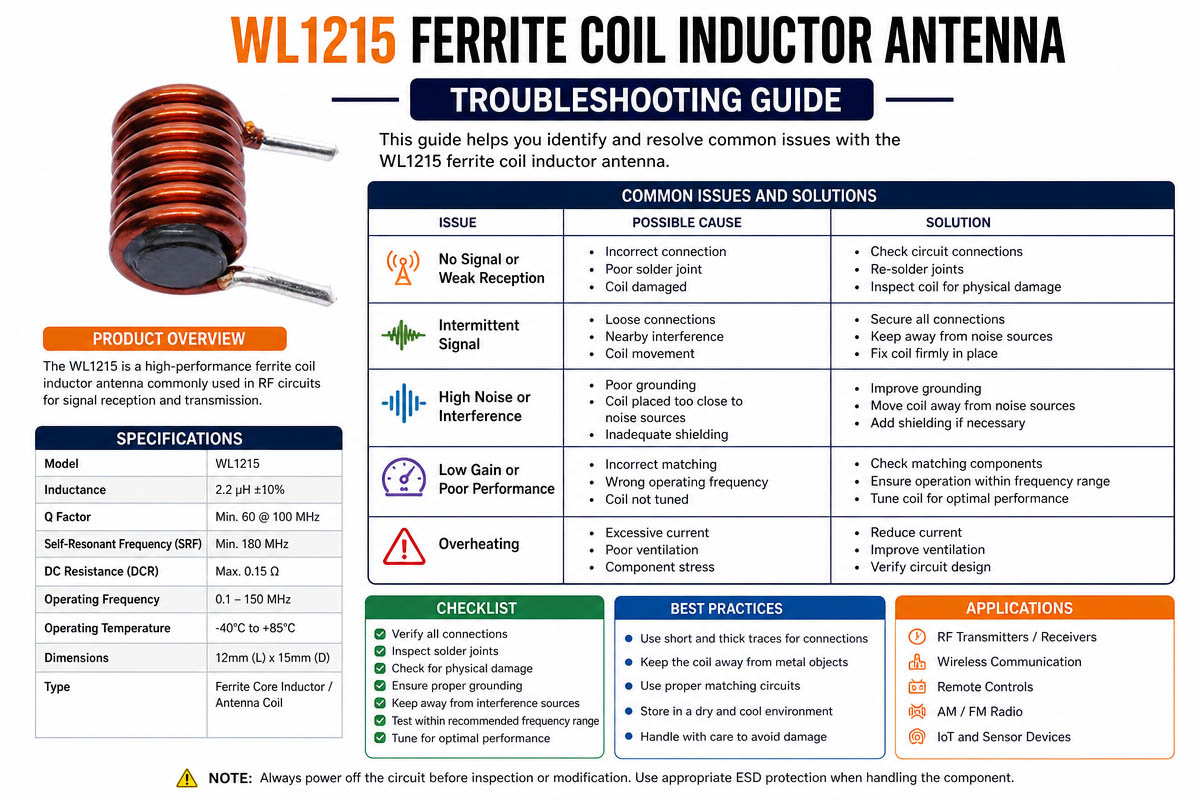
If a ferrite coil inductor antenna does not perform well, the first step is to measure its inductance and DC resistance to check if the coil was damaged. Check the ferrite core for cracks or chips, which could negatively affect its magnetic performance. Check all solder connections and wire connections for continuity. Poor connections are one of the main reasons for unstable signal reception.

Weak signal strength requires you to make sure that the antenna is operating in the required frequency range and that the impedance match with the RF circuit is proper. Performance may be degraded due to excessive electromagnetic interference from nearby motors, power supplies, or metal structures.

Measure/test the quality factor (Q) with appropriate test equipment. Improper winding, damaged insulation, or inappropriate ferrite material can cause low Q. Temperature changes also have to be considered, as overheating will change the ferrite parameters.

In case of manufacturing problems, check the consistency of the coil winding, wire diameter, insulation quality, and ferrite material parameters. Testing of prototypes with network analyzers or LCR meters allows the detection of design problems before the mass production.

Routine inspection and preventive maintenance provide long-term reliability and stable communication performance

FAQs of Ferrite Coil Inductor Antenna

1. What is a ferrite coil antenna inductor?

Ferrite coil inductor antenna is an electromagnetic antenna consisting of a ferrite core with a coil of copper wire wound around it. The ferrite material concentrates the magnetic field and increases inductance and improves signal reception or transmission. They are widely used in AM radios, RFID systems, wireless sensors, smart meters and industrial communication devices.

2. What advantages does a ferrite coil inductor antenna have?

The advantages of ferrite coil inductor antennas are the following:

high sensitivity

Small and light design

Good low frequency performance

Lower EMI (electromagnetic interference)

Low power consumption

Stable electrical behavior

Long life expectancy

Easy customization for industrial and OEM applications

3. What are some uses for ferrite coil inductor antennas?

Ferrite coil inductor antennas are widely used in;

RFID readers and labels

Automation equipment (industrial)

Smart utility meters

IoT devices

AM radio receivers

Car electronics

Medical surveillance devices

Wireless sensor networks

Access control & security systems

Consumer electronics

4. What is the right ferrite coil inductor antenna to choose?

If you are choosing a ferrite coil inductor antenna then consider the following:

frequency of operation

value of inductance

type of ferrite materials

dimensions of the antenna

Q factor (quality factor)

number of turns

wire diameter

environmental conditions and temperature

impedance matching

application-specific performance

customization ability of OEM

5. Can ferrite coil inductor antennas be customized?

Yes.  Most manufacturers provide OEM and ODM customization, including the following:

ferrite core material and dimensions

inductance

frequency of operation

coils winding

diameter of wire:

lead wire length

connector type

encapsulation process

mounting structure

electrical specifications according to customer requirements


6. Ferrite coil inductor antenna performance. What affects it?

Antenna performance is affected by many factors, including the following:

permeability of ferrite cores

accuracy of coils winding

number of turns

resistance of a wire

quality factor (Q)

frequency of operation

core dimensions .

nearby metal parts

electromagnetic interference (EMI)

impedance matching

7. What are the problems with ferrite coil inductor antennas?

The typical problems are:

bad signal reception

incorrect inductance

broken or loose coils wires

shattered ferrite core

impedance mismatch

too much electromagnetic interference

low Q-factor

coils overheating

manufacturing defects

damage during installation

Most of these problems can be avoided with proper design, quality materials and routine testing.

8. Why pick a professional OEM ferrite coil inductor antenna manufacturer?

Professional manufacturer provides:

engineering support experience

design of custom antennas

automatic precision coils winder

high quality ferrite materials

strict quality control

trusted electrical testing

rapid Prototyping

mass production on stable level

world quality standards

technical support from design to production

Seasoned OEM provider will help you to get consistent product quality, shorter development time and the best possible antenna performance for your application.

Choosing a Ferrite Coil Inductor Antenna

The first step in choosing a ferrite coil inductor antenna is to understand the frequency of operation. Different ferrite materials are optimal for different frequency ranges, and you should choose the right ferrite core to get the best efficiency.

After that, consider inductance values and the quality factor (Q). Higher inductance increases sensitivity at lower frequencies, while an optimized Q factor will ensure efficient reception of the signal with minimum losses.

Also, you should think about the physical size of the antenna and the available space for mounting. Small electronic devices require small ferrite antennas, which do not affect their electrical parameters.

The number of coil turns, wire diameter, and winding will have a direct influence on inductance, resistance, and signal quality. Precision winding ensures consistent performance and reliability in manufacturing.

It is important to take into account environmental conditions. Ferrite materials with good thermal stability are required for high-temperature industrial environments. Long-time reliability requires moisture resistance, vibration resistance, and mechanical stability.

For wireless communication systems, impedance matching to RF circuits is crucial to ensure the best efficiency of signal transfer.

Another important criterion is the ability to personalize. The experienced OEM manufacturer can customize the ferrite material, winding design, inductance tolerance, frequency of operation, and connector configuration based on your requirements.

Last but not least, you should choose a manufacturer with in-house manufacturing, automated winding equipment, advanced testing equipment, and strict quality control procedures. OEM certifications, engineering support, fast prototyping, and steady manufacturing capacity will help to reduce development cycles and to ensure product consistency.

The right ferrite coil inductor antenna improves the reliability of the communication, expands the working range, reduces interference, and provides stable performance for the whole life of the product.

Tips to Avoid Ferrite Coil Inductor Antenna Design Mistakes

Choosing the appropriate ferrite material for frequency of operation.

Do not use too many coil turns, as it will increase resistance.

Increasing inductance without degradation of the Q factor.

Maintaining tension while winding.

Making sure of proper impedance matching.

Minimizing parasitic capacity.

Reducing electromagnetic interference.

Keeping enough distance from the metal parts.

Checking operating temperature range.

Prototype testing before mass production.

Using precise winding equipment.

Checking the frequency response with RF equipment.

Taking the mechanical vibration resistance into consideration, for example.

Choosing the right insulating materials.

Collaboration with experienced antenna engineers while developing the product.

Get A Free Quote Now

Contact Form

Related Products

Related News

Scroll to Top

Get A Free Quote Now !

Contact Form
If you have any questions, please do not hesitate to contact us.
Weilong Solenoid Company Culture