

Introduction
There is an ongoing revolution in the automotive sector. Modern vehicles are equipped with a multitude of electronic components, such as advanced driver-assisted systems, infotainment systems, batteries, control units, lighting, communication modules, and others.
As the electronics of cars are growing, engineers need passive components that are capable of providing reliable electrical performance and take minimal amounts of space. Flat inductor coils have recently become quite popular in automotive applications because of these reasons.
Flat inductor coil: It is an inductive device that is made in the form of a flat or planar coil. The advantages of a flat inductor coil over a conventional wound inductor include a lower profile, space efficiency, better electrical performance, and integration with PCB or custom electronic modules.
Flat inductor coils are an effective way to solve various problems in automotive electronics related to power, signal processing, electromagnetic compatibility, reliability, and efficiency.
Chapter 1: What Are Flat Coil Inductors?
Flat inductor coils are the inductors that are constructed by means of a flat or planar winding structure. Unlike the conventional winding of a cylindrical shape, the conductive structure of a flat inductor is flat.
The conductive part of the coil can be done with the help of wire, flattened wire, etched conductive patterns, printed circuit board structures, and other manufacturing methods.
The primary function of an inductor is energy storage within a magnetic field and opposing any changes in electric current. Thus, inductors are basic components in circuits of power conversion, filtering, signal processing, electromagnetic interference suppression, and energy management.
The flat construction of inductor coils provides designers with more options for creating compact electronic systems in automobiles.
Chapter 2: Low Profile for Automotive Electronics
One of the greatest challenges in the design of automotive electronics is the space.
Modern vehicles have many electronic modules that fit into places where there is not enough space. The components may need to fit into dashboards, door modules, battery packs, engine compartments, lighting systems, power converters, and many other tight spaces.
The low-profile structure of flat inductor coils will help engineers to reduce the height of an electronic assembly.
It can be especially useful for designing compact PCB assemblies when there is a lack of vertical space.
Moreover, the flat design of the coil will make it easier to integrate several electronic components in close proximity, which will allow manufacturers to create smaller control modules without losing the inductive functionality.
Chapter 3: Flat Inductor Coils with High Frequency Operation
Automotive electronic systems often operate in high-frequency mode.
The high-frequency electrical signals can be generated by power converters, DC-DC converters, communication systems, wireless modules, and advanced control electronics.
Flat inductor coils can be designed for particular frequency ranges and electrical properties. This way, the engineers will be able to customize the component for high-frequency applications.
The geometry of the coil, conductor dimensions, substrate, magnetic material, and winding configuration all affect the electrical performance of the component.
With the help of tuning these parameters, manufacturers will be able to create flat inductors that are perfect for automotive power and signal applications with the particular frequency response.
Chapter 4: Efficient PCB Space Utilization
Inside the vehicle, printed circuit boards are becoming denser and denser.
A single automotive control module can have the following components: microcontroller, sensors, capacitors, resistors, power semiconductor devices, communication components, connectors, and inductors.
Flat inductor coils can be designed in a way that would make them space-efficient.
The flat structure of the component allows engineers to consider both the surface area and height of the component when designing the PCB layout.
It can be especially beneficial when designing compact electronic control units with highly optimized component placement.
Chapter 5: Application in DC-DC Converters
DC-DC converters are widely used in automotive electronics.
There are many different voltage levels in the vehicle. Power management circuitry needs to convert one DC voltage to another in order to supply different electronic systems.
Inductors are essential components in many power converters because of the ability to store and release electrical energy during the switching process.
The flat inductor coils can be designed for use in these power conversion circuits, taking into account the necessary inductance, current rating, frequency, and thermal conditions.
Potential applications include power supplies for infotainment, electronic control modules, sensors, communications equipment, and many others.
Chapter 6: Flat Inductor Coils Have EMI and Noise Filters
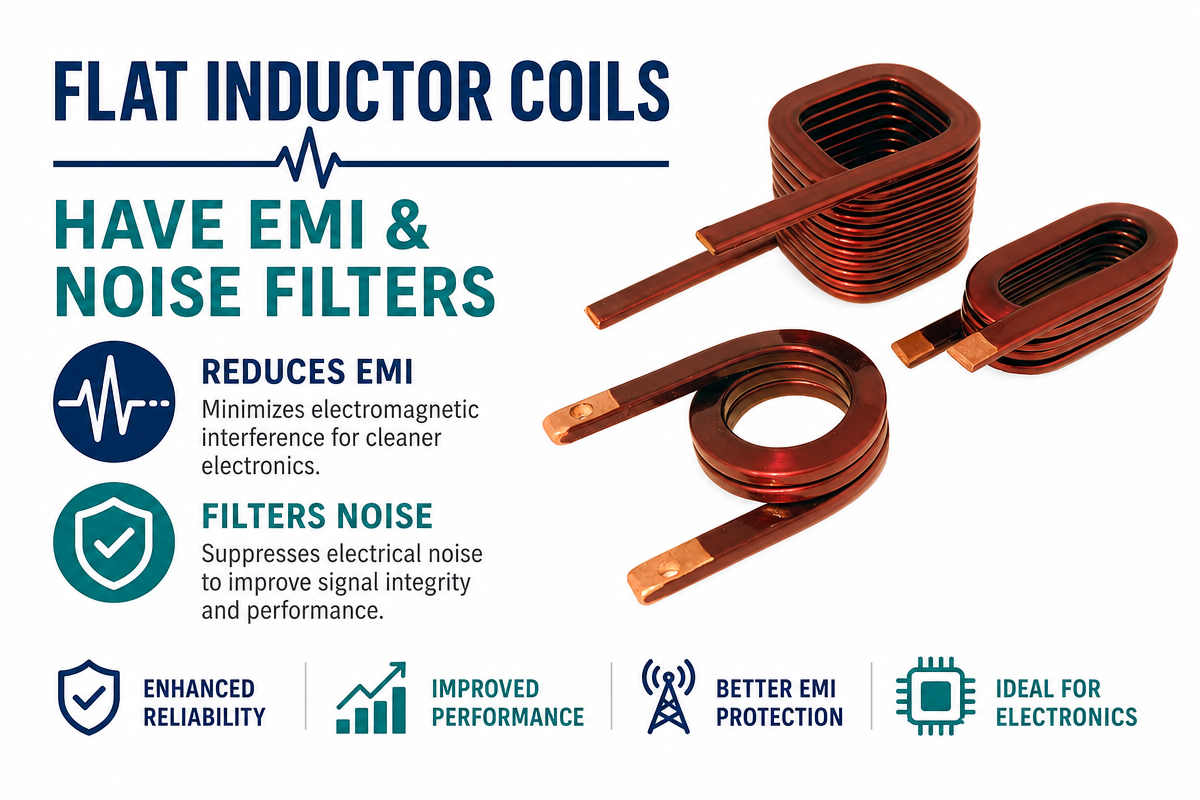
Electromagnetic interference is one of the big issues in modern cars.
There are many electronic systems inside the vehicle, working at the same time. Electromagnetic noise can be generated by power supplies, motors, communication systems, ignition systems, high-current electrical circuits, and others.
Inductors are used as parts of filter circuits for suppressing the high-frequency noise and maintaining signal integrity.
Flat inductor coils can be a significant part of automotive electromagnetic compatibility design.
By choosing the right inductance and frequency characteristics, engineers can use this component in filters to reduce electrical interference.
It is especially relevant due to the appearance of many wireless communication systems and high-speed digital circuits in the vehicles.
6. Support for Electric and Hybrid Vehicles
The development of electric and hybrid vehicles creates the new requirements for automotive inductive components.
Electric vehicles are equipped with high-power electronic systems, including:
- battery management system
- chargers
- converters, DC-DC
- inverters
- motor control systems
- charging systems
- high-voltage power distribution
For such systems, we need solutions for power conversion and electromagnetic compatibility.
Flat inductor coils are suitable for filtering and power-management applications if the electrical and mechanical characteristics of the component meet the requirements.
With the increase in the level of electronic integration and the downsizing of electric vehicles, the demand for low-profile, high-performance passive components will probably increase.
Chapter 7: Reliable Auto Electronic Performance
The automotive electronics are designed to operate in the harsh environmental conditions.
The component may be subjected to:
- temperature changes
- mechanical oscillation
- trauma
- humidity
- electrical transients
- long-time operation
The reliability of the component is a significant issue.
Flat inductor coils can be designed using materials and construction that are suitable for demanding environments.
The manufacturer can optimize coil structure, insulation system, substrate, terminals, and encapsulation according to the application.
The engineers should take into account temperature characteristics, current capacity, mechanical stability, insulation performance, and the expected service life of the component for automotive applications.
Chapter 8: Flat Inductor Coils with Benefits of Thermal Management
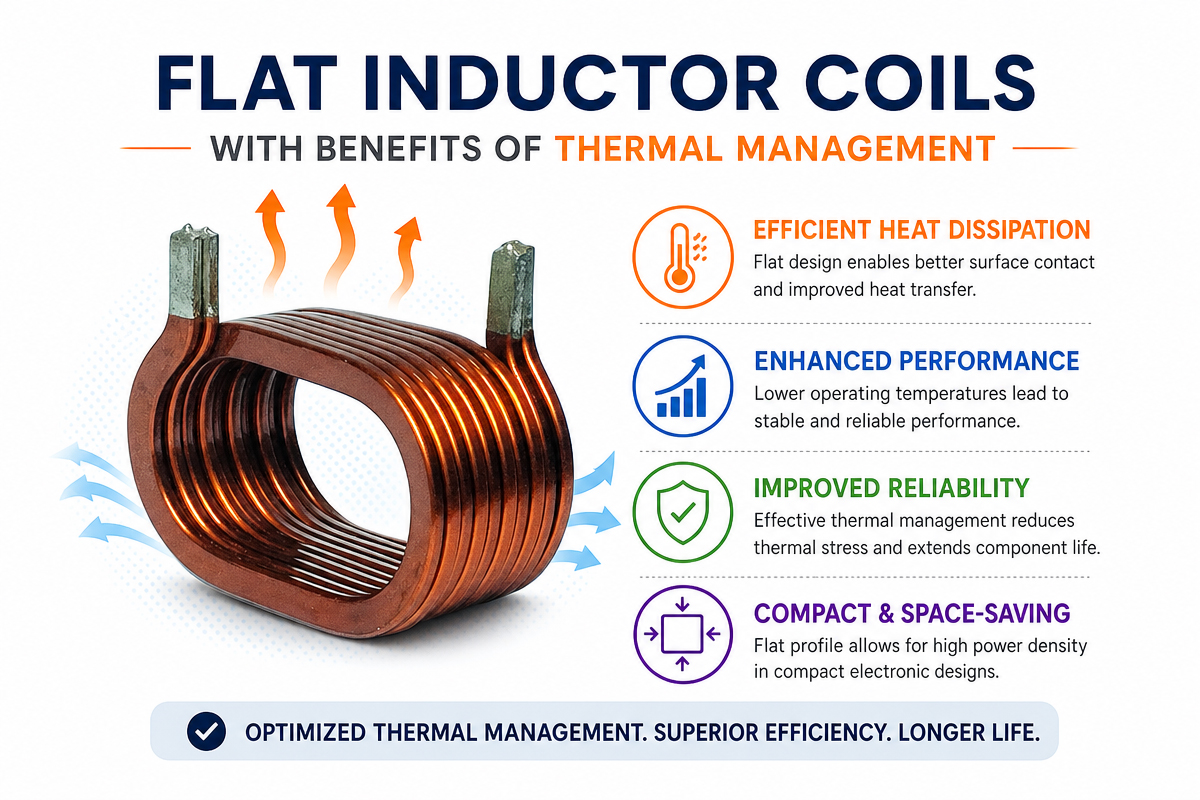
Due to the increasing complexity of automotive electronic systems, heat management is becoming more and more important.
As power density increases, a smaller electronic module produces more heat.
The geometry of the inductor defines the electrical resistance, current density, magnetic losses, and thermal behavior of the component.
Flat inductor coils can be designed with optimized conductor dimensions and thermal paths for better heat dissipation.
For high-current applications, using wide conductors or an optimized winding structure reduces resistive losses.
The actual thermal performance will depend on the coil design, the operating current, frequency, surrounding materials, PCB construction, and cooling conditions.
Chapter 9: Fit to Make Customized
Automobile electronics are rarely composed of purely generic components.
The car manufacturers and Tier 1 suppliers often have particular requirements regarding the dimensions, electrical properties, environmental behavior, and assembly processes of the components.
The advantage of flat inductor coils is design flexibility.
The engineers can customize the component with the help of manufacturing technology according to the following parameters:
- inductivity
- dimensions of the coil
- outer diameter
- inner diameter
- heights
- wire or conductor diameter
- opposition
- current rating
- number of turns
- terminal setup
- mounting structure
- magnetic material
The possibility of customization makes it possible to adjust the design of the component to the electronic circuit, not vice versa.
Chapter 10: Automotive sensors and control units
Sensors and control modules of automotive electronics need reliable electrical performance.
Modern vehicles are equipped with various sensors for measuring temperature, pressure, position, speed, current, voltage, acceleration, and other parameters.
The signals generated by these sensors need to be processed and transmitted reliably.
The inductive components are used in the circuits for signal filtering, power conditioning, and electromagnetic compatibility of electronic sensor modules.
Flat inductor coils can be especially attractive for applications when the low profile and compact PCB integration are important.
Thanks to the compact structure, the manufacturers will be able to pack more functionality into compact electronic modules.
Chapter 11: Applications of Automotive Lighting
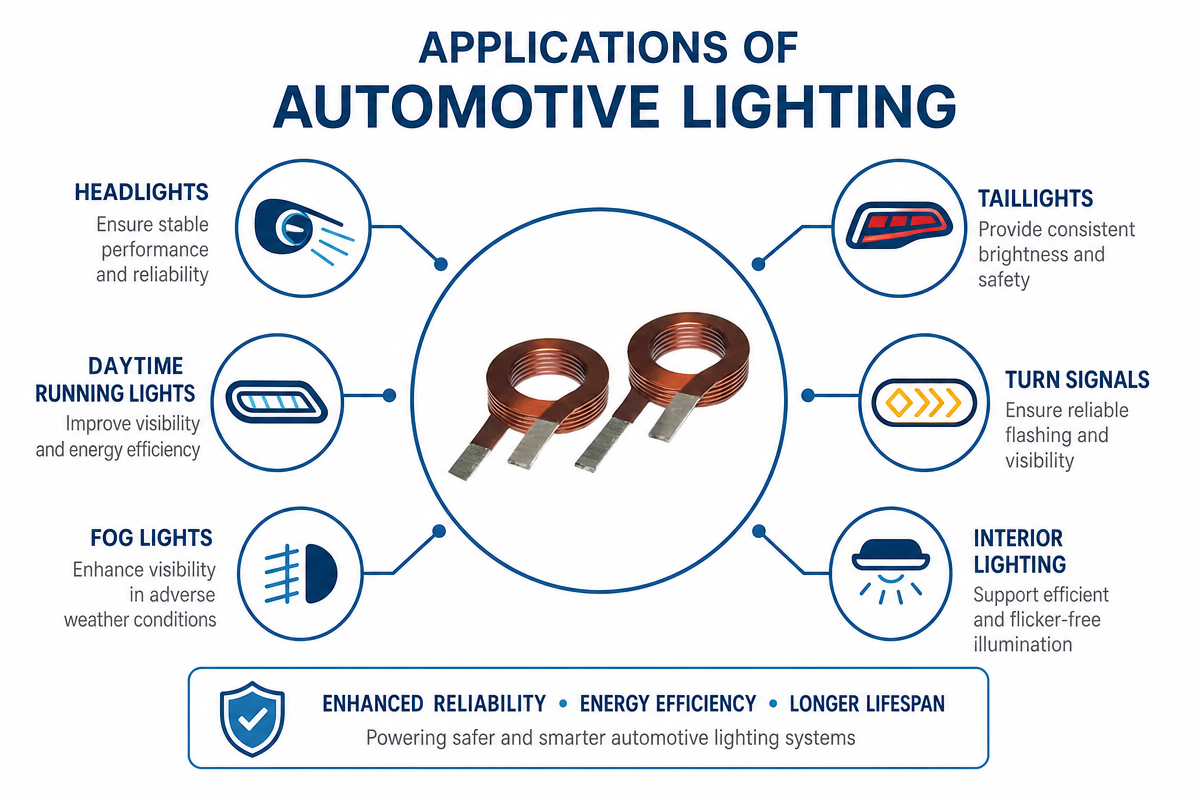
Modern vehicle lighting systems are also becoming very electronic.
The electronic drivers and power management circuits are required for LED headlamps, daytime running lights, interior lighting, adaptive lighting, and intelligent lighting systems.
The inductors are used in the circuits of LED drivers, DC-DC converters, and filtering.
In the case of automotive lighting modules, when the installation space is limited, the low-profile flat inductor coils can be a suitable solution if the electrical specification is appropriate.
Chapter 12: Manufacturing Integration Improved
In the automotive industry, the components are supposed to be produced and assembled consistently.
Flat coil structures can be compatible with automated assembly processes, depending on the design and the manufacturing technology.
Consistency in dimensions and electrical characteristics is especially important for mass production of automotive products.
Custom flat inductor coils are produced by the manufacturer in cooperation with the automotive electronics designer, specifying the dimensional tolerances, electrical specifications, inspection procedure, and reliability requirements.
This can help to achieve the consistency of the production process.
Chapter 13: Why Automotive Engineers Use Flat Inductor Coils
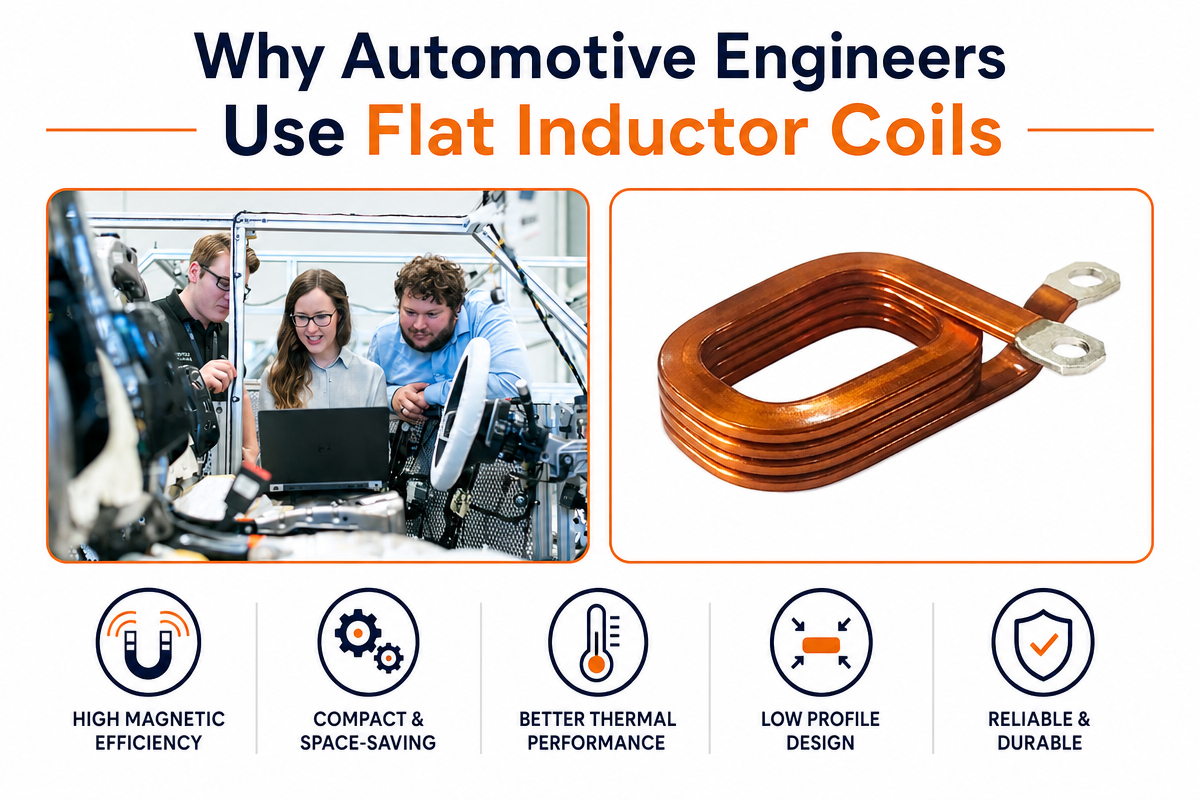
When the automotive engineer is selecting an inductor, he usually takes more than just inductance into consideration.
The following parameters can be of key importance:
Inductance
The inductance value must be appropriate for the circuit requirements.
Rated Current
The component must be able to withstand the expected continuous and peak current without temperature increase and loss of performance.
DC Resistance
Lower resistance of the component will help to decrease conduction losses, especially in power applications.
Frequency of operation
The component must have adequate electrical characteristics for the particular frequency range.
Heat treatment
The automotive components can be subjected to a wide temperature range.
Size
The height and footprint of the component must be appropriate for the installation space.
EMI Effectiveness
The component must satisfy the filtering and electromagnetic compatibility requirements of the system.
Reliability
The construction of the component must be appropriate for the expected vibrations, temperature, humidity, and lifetime.
Chapter 14: Flat Inductor Coils vs. Traditional Inductors
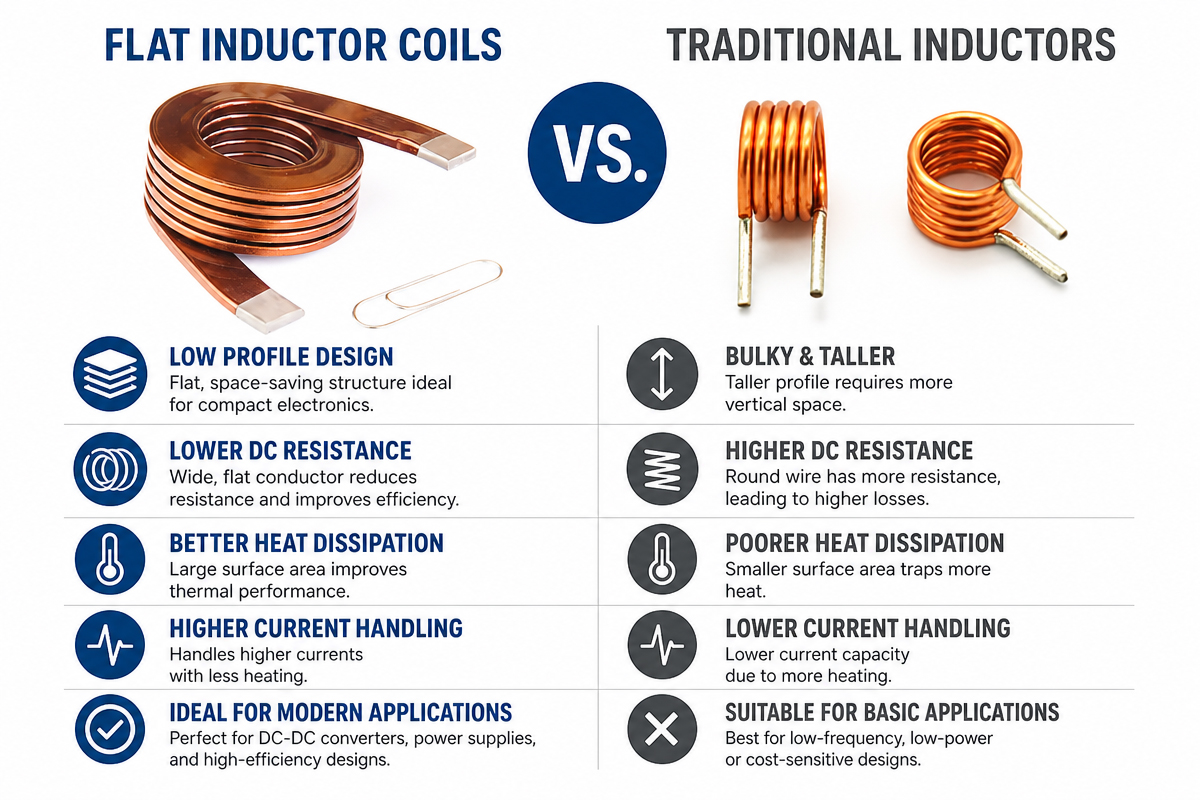
Traditional wire-wound inductors remain useful across many automotive applications. However, flat inductor coils can offer advantages where low profile and compact integration are priorities.
| Feature | Flat Inductor Coils | Traditional Inductors |
| Profile | Low-profile designs available | Often taller |
| Space utilization | Efficient planar structure | Depends on construction |
| PCB integration | Well suited to compact layouts | Varies by package |
| Customization | Highly customizable | Depends on product type |
| High-frequency use | Suitable for selected designs | Application dependent |
| Automotive use | Power, filtering, control modules | Broad range of applications |
The best solution depends on the electrical and mechanical requirements of the specific circuit.
Chapter 15: Future Trends of Automotive Product Flat Inductor Coils
The automotive electronics market is developing towards higher power density, electrification, high communication speed, and electronic integration.
The trends described above are expected to drive the demand for compact passive components.
Electric vehicles require advanced power management systems. Advanced driver assistance systems require high-performance electronic control units. Connected vehicles require additional communication and filtering circuits.
At the same time, the automotive manufacturers want the compact and lightweight electronic modules.
These trends create the opportunity for flat inductor coils with optimized electrical characteristics, lower losses, better thermal performance, and smaller dimensions.
The development of advanced magnetic materials, conductor structures, automated manufacturing, and customization according to the application can be among the trends for the future.
Chapter 16: Conclusion
Flat inductor coils are an attractive option for automotive products due to their compact structure, useful electrical performance, and flexible integration.
The engineers will be able to save valuable space in automotive PCBs and electronic modules with the help of the low-profile structure of the component. They can also be used in automotive applications like power conversion, EMI filtering, sensors, lighting systems, battery management electronics, and others.


