
Tubular Electromagnetic Solenoid for Automotive Systems
Tubular Electromagnetic Solenoid for Medical Device Application
Tubular Electromagnetic Solenoid for Access Control Guide
Tubular Electromagnetic Solenoid for Locking System application
Tubular Electromagnetic Solenoid for Vending Machine solutions
Compact Tubular Electromagnetic Solenoid for Automation
Tubular Electromagnetic Solenoid for Automotive Systems
Tubular Electromagnetic Solenoid for Medical Device Application
Tubular Electromagnetic Solenoid for Access Control Guide
Tubular Electromagnetic Solenoid for Locking System application
Tubular Electromagnetic Solenoid for Vending Machine solutions
Compact Tubular Electromagnetic Solenoid for Automation

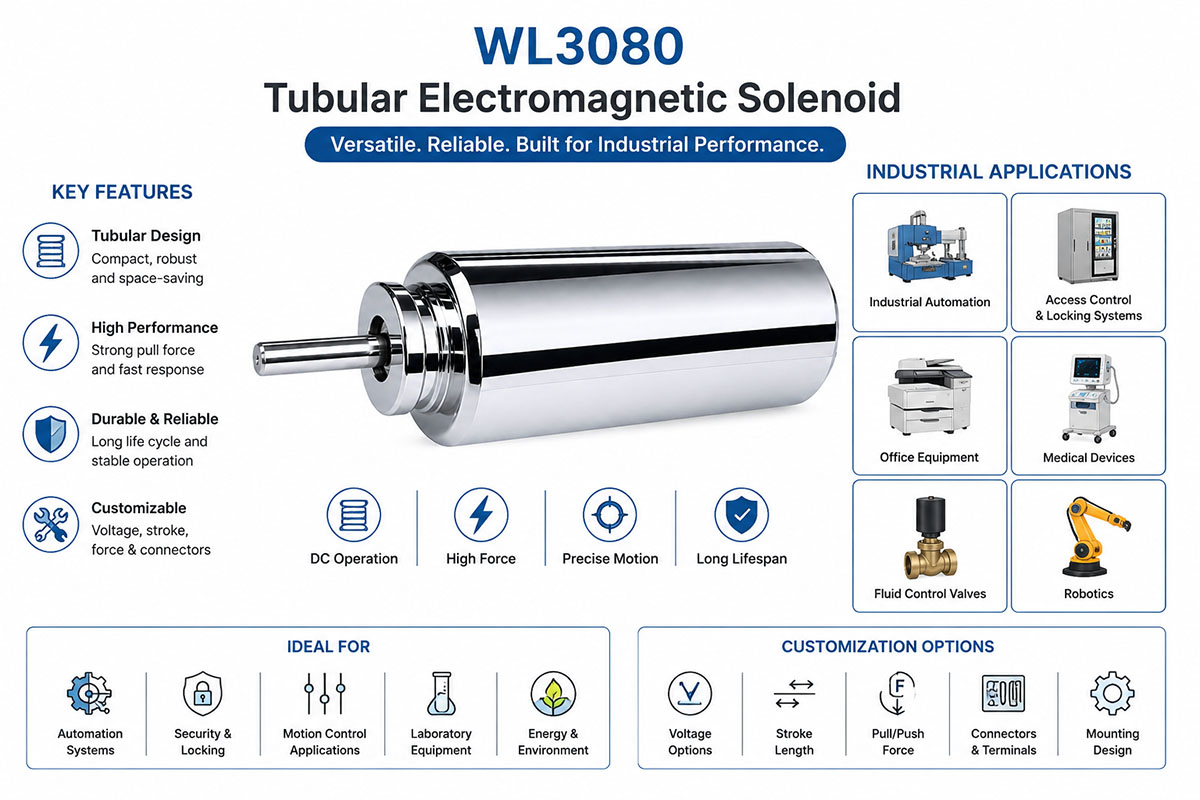
WL3080 Tubular Electromagnetic Solenoid for Medical Device Solutions

A tubular electromagnetic solenoid is a linear actuator for providing controlled push or pull movement in industrial or commercial equipment. Its cylindrical shape makes it easy to install and save space. You can control the electromagnetic force.

A standard tubular solenoid includes a coil, magnetic housing, a plunger, a return spring, and electrical connections. Upon enethe coil, it generates a magnetic field that causes the plunger to movenger for a certain distance. The return mechanism returns the plunger to its original position upon disconnecting the power.

Customized tubular solenoids can be designed according to your voltage, force, stroke, speed, duty cycle, dimensions, mounting, and environmental conditions requirements. They are perfect for automation machinery, robotics, automotive devices, access control systems, vending and medical equipment, printers, home appliances, and industrial control systems.

The right choice is a combination of electromagnetic performance, thermal behavior, mechanical load, and lifetime.

Tubular Electromagnetic Solenoid Product Overview

A tubular electromagnetic solenoid is a small linear actuator for controlled electromagnetic movement. An electrical input is converted into mechanical force using a coil and a plunger within the cylindrical housing. The solenoid can be designed for providing pull, push,, or push-pull actions.

The important parameters are operating voltage, rated power, starting force, holding force, stroke, response time, duty cycle, coil resistance, temperature rise, and service life. Mechanical parameters are housing diameter, overall length, shaft dimensions, and mounting configuration.

Tubular solenoids are produced as standard products or custom OEM components. Due to the compact design and flexible configuration, they are suitable for industrial automation, automotive devices, robotics, access control, vending, and other equipment.

Working Principle of a Tubular Electromagnetic Solenoid

The tubular deof the electromagnetic solenoid operates based onng to the principle of electromagnetic attraction.

Step 1 – Electrical Power Supply

The coil of the solenoid is energized with DC voltage.

Step 2 – Creation of the Magnetic Field

Current is conducted by copper wire windings, and a magnetic field appears in the tubular magnetic circuit.

Step 3 – Movement of the Plunger

A magnetic field attracts the ferromagnetic plunger to the magnetic center of the coil. It results in a linear movement.

4. Mechanical Work Output

The plunger passes the electromagnetic force to the customer’s mechanism, producing a controlled push or pull movement.

Step 5 – Return Journey

The power is switched off, and the plunger is returned to its original position due to the return spring or another external mechanical force.

Basic Principle

Electrical Energy –> Magnetic Field –> Movement of the Plunger –> Linear Mechanical Force

The output depends on the design of the coil, magnetic materials, air gap, stroke, voltage, current, and mechanical load. The required force should always be calculated on the work stroke and not the starting position.

Main Characteristics of a Tubular Electromagnetic Solenoid

Tubular electromagnetic solenoids provide a compact design and controlled linear actuation. The main characteristics are cylindrical housing, efficient magnetic circuit, customizable plunger configuration, and flexible mounting. Depending on the application, different coil designs can provide standard DC voltage requirements such as 5V, 12V, 24V, and 48V. The force and stroke can be customized for the mechanical load.

Different mechanisms can be designed in push, pull, and push-pull types. The return springs can be customized for the required restoring force and response. The design of the tubular solenoids can be customized for the particular duty cycle, operating frequency, temperature conditions, and lifetime requirements. The above-mentioned characteristics make them suitable for compact industrial automation and OEM equipment.

Tubular Electromagnetic Solenoid Product Video

Tubular Electromagnetic Solenoid Detailed Display

Compact Tubular Electromagnetic Solenoid Datasheet

Brand Weilong Technology Model Number WL 3080
Rated Voltage (V) DC 12 or 24 V Rated Power (W) 10–18 W
Work Model 100,000 Lifespan Cycles Push Pull Force (N) 1-20 Gf
Stroke (mm) 10–20 MM Reset Time(s) 1 S 3S Off


Service Life 300 Thousand Times Certification CE, ROHS, ISO9001,
Material Carbon Steel Housing with Zinc-Plated Coating Lead Wire Length (mm) 200
Install Style both sides with three mounted screw holes for easy setup Tolerance of Dimension ± 0.1 MM
Water-proof None Insulation Class F. Cel. 150 Degree
Hi-Pot Test AC 600V 50/60Hz 1 s Non-excitation Holding Force 0
Working Temperature -10°C-100°C Duty Cycle 1-100%
Thread Depth (mm) / Payment Term TT, or LC at Sight
Sample Order Yes. Warranty 1 Year
MOQ 500 pcs Supply Ability 5000 pcs per week
Delivery Time 30 Days Port of Loading Shenzhen

The difference between a tubular electromagnetic solenoid and a frame-type solenoid


Feature Tubular Electromagnetic Solenoid Frame Electromagnetic Solenoid
Structure Cylindrical/tubular housing Open-frame or U/E-frame structure
Installation Excellent for narrow spaces Better where mounting space is open
Magnetic Circuit Enclosed and generally symmetrical More exposed/open magnetic structure
Appearance Compact cylindrical design More conventional rectangular/open-frame design
Mechanical Integration Easy shaft-axis integration Flexible bracket-based integration
Plunger Alignment Naturally centered along the tubular axis Depends more on frame and guide structure
Space Efficiency Strong advantage in confined spaces Can require more surrounding space
Protection Housing can provide additional physical protection. Open construction may require additional protection.
Customization Diameter, length, stroke, and shaft can be customized. Frame size and mounting can be customized.
Typical Applications Automotive, locking, vending, robotics, automation Industrial machinery, relays, valves, general actuators
Best Use Case Compact linear actuation General-purpose electromagnetic actuation
OEM Integration Excellent for cylindrical or embedded mechanisms Excellent for bracket-mounted mechanisms


Which one to choose?

If you need a tubular electromagnetic solenoid, choose:

Cylindrical design

Restricted space for installation

Movement of axial plunger

Easy integration into shaft drive

Custom Length and Diameter

Mechanical construction enclosure

Compact integration or automotive automation

The electromagnetic solenoid frame should be selected:

If more flexible mounting space is required

A bracket/open-frame structure is better.

If the application requires a normal rectangular actuator

Cost and easy mounting are more important than compact cylindrical integration.

The Bottom Line

The best selection depends on the installation space available, force, stroke, duty cycle, mechanical load, and method of integration. Neither design is always better than the other. The right structure is the one providing necessary electromagnetic performance and suitable for the machine architecture.


Tubular Electromagnetic Solenoid Industrail Application

Tubular Electromagnetic Solenoid Industrial Application

Electromagnetic solenoids in a tubular shape are widely used whenever the equipment requires compact linear movement.

They are used in industrial automation for the operation of mechanical locks, positioning devices, clamps, actuators, and automatic control devices. Their cylindrical shape is especially advantageous in areas where installation space is limited.

Tubular solenoids are used in the automotive industry for locking mechanisms, transmission-related actuators, seat systems, charging equipment, HVAC control systems, and other electromechanical devices.

In access control they provide controlled movement for electronic locks, cabinet locks, security equipment, and door mechanisms.

Tubular solenoids can be used for releasing products in vending machines, control mechanisms, and actuation of mechanical components.

In medical equipment, appropriately designed solenoids can be used for valve actuation, positioning, dispensing, and mechanical control.

In robotics they provide short stroke linear movement for gripping, positioning, switching, and mechanical release mechanisms.

Other applications include printers, office equipment, HVAC, home appliances, battery equipment, EV-related devices, agricultural machinery, and industrial control systems.

In OEM applications, the actual load, stroke, operating frequency, available voltage, installation dimensions, environmental conditions, and lifetime should be considered when choosing the solenoid. However, proper integration is the key to the reliable operation of the system.

What Makes The Tubular Electromagnetic Solenoid A Popular Automotive Device Solution?

Tubular electromagnetic solenoids are becoming more popular for automotive device solutions since modern cars need compact, lightweight, and electronically controlled mechanical actuation.

There is often not enough installation space in automotive systems. The tubular cylindrical design allows automotive engineers to add linear actuation into tight or restricted spaces with a relatively simple mechanical design.

Another advantage is design flexibility. OEM engineers specify voltage, force, stroke, shaft configuration, mounting dimensions, and duty cycle according to the vehicle subsystem.

Potential automotive applications:

Electronic Locks

  1. Seat adjustment and locking systems

HVAC Control Systems

Charging equipment

Actuation related to the battery

Mechanisms related to the transmission

Latch and release mechanisms

Vehicle access systems

Mechanical interior controls

Sensor or actuaDue to increased electrification of cars, compact electro-mechanical components that can interface with electronic control systems are required.ems are needed.

However, for automotive applications, the requirements are more demanding than simply selecting a suitable force rating. Engineers have to take into account temperature, vibration, operating frequency, voltage variations, contamination, lifetime, EMC issues, and mechanical integration.

For automotive OEM projects, the best way is to develop the tubular solenoid together with the whole mechanism and test its performance in the vehicle operating environment.


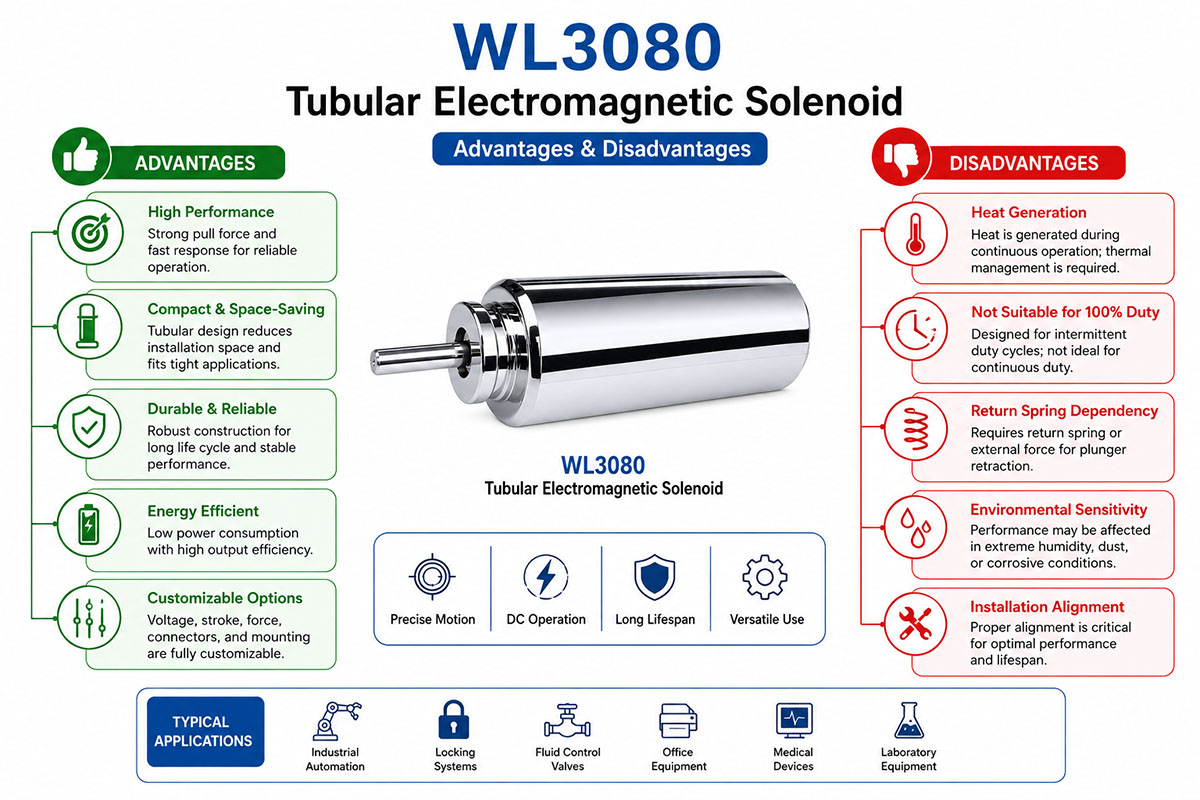
Tubular Electromagnetic Solenoid advantage and disadvantage

Tubular Electromagnetic Solenoid Advantage and Disadvantage

Tubular Electromagnetic Solenoid Advantages

Space Saving:

The tubular construction saves installation space and is suitable for small equipment.

Linear Direct Motion:

The solenoid itself is an electrical-to-linear mechanical conversion device, without using a separate motor and gearbox.

Fast Response:

Electromagnetic actuation provides rapid motion for switching and short stroke mechanisms.

Simple Construction:

A simple solenoid has a relatively small number of moving elements.

OEM flexibility:

Force, stroke, voltage, dimensions, type of spring, and mounting can be customized.

Cost-Effective Actuator:

For many simple linear movements, a solenoid is usually cheaper than a motor-driven actuator.

Tubular Electromagnetic Solenoid Drawbacks

Heat Generation:

Continuous energization leads to heating of the coil and requires heat management.

Force depends on stroke:

In most cases, the electromagnetic force generated depends on the plunger position and must be determined during the plunger stroke.

Power Consumption:

If a certain energized position needs to be kept without power consumption, then a latching mechanism or other holding mechanism is needed.

Short Stroke:

Generally solenoids are best suited for relatively short linear movements.

Effect and Interference:

Depending on the speed, structure, and cushioning, it is possible to create an audible impact during mechanical movement of the plunger.

Thus, tubular solenoids are especially useful for applications that require a simple, compact, and controlled short-stroke linear movement.

Troubleshooting Tubular Electromagnetic Solenoid Troubleshooting Guide

Tubular Electromagnetic Solenoid Troubleshooting Guide

Problem 1: No Movement of the Solenoid

Causes:

No power supply to

Incorrect voltage

Coil Broken

Electrical Problem

Mechanical obstruction by plunger

Test: Check the voltage of the coil terminal.

Problem 2: Insufficient Force

Causes:

Too high mechanical load

Long stroke

Low Voltage

Against the spring force

Incorrect position of the plunger

Test: Measure force at the actual stroke and not only at the start position.

Problem 3: Solenoid is too hot.

Causes may include:

High Duty Cycle

Overvoltage or

Incorrect resistance of the coil

Insufficient cooling

Too high ambient temperature.

Test: Actual operating conditions against rated duty cycle.

Problem 4: Movement Slow or Unstable

Causes may include:

Low Voltage

Mechanical (friction)

Incorrect Plungers

Overload

Broken return spring.

Test: Test the solenoid without the external load.

Problem 5: Too Much Noise

Causes may include:

Effect of Plunger

Loose pieces

Improper installation

Over speeding.

Test: Mechanical mounting, cushioning, spring optimization, or structure modification.

Problem 6. Short lifetime of operation

Check: Load, stroke, duty cycle, temperature, mechanical wear, and operating frequency. Reliability problems are associated with the system integration rather than the electromagnetic coil alone.

8 FAQs of Tubular Electromagnetic Solenoid

1. Discuss the tubular solenoid and its working.

A tubular solenoid is an electromechanical device that converts electrical energy into linear mechanical motion (push/pull). It consists of a coil wound on a cylindrical, closed-metal tube in which a movable plunger (or core) is placed. An electric current running through the coil creates a magnetic field, which draws the plunger inside the solenoid, creating the actuating force.

2. What is the difference between pull and push type tubular solenoid?

They both work on the same basic principle of magnetism. In pull-type, the plunger is drawn inside the solenoid by the magnetic field, and the movement is used to actuate the load. In a push type, a shaft is attached to the plunger. The plunger is drawn inside the solenoid, and the shaft is pushed out of the hole in the case to actuate the load. The only difference between them is the direction of the output force relative to the body of the solenoid.

3. What are the main advantages of a tube design?

The coil and magnetic circuit are enclosed within the tube design to reduce the leakage of magnetic flux. It makes the solenoid more efficient and prevents magnetic interference with the nearby electronics. Tubular solenoids are very rugged and durable compared to open-frame solenoids and provide high force density in a compact package.

4. What are the usual disadvantages or limitations?

Tubular solenoids are mainly high-force devices with short strokes. The force decreases rapidly with increasing stroke. Another major limitation is heat generation, especially in continuous duty applications, since it causes overheating and possible coil burnout. They are more expensive to purchase compared to simple open-frame solenoids.

5. What is duty cycle? Explain its significance.

Duty Cycle—The ratio of time that a solenoid is energized to the total cycle time (ON time / (ON time + OFF time)). This is an important parameter, as it defines the thermal limit of the solenoid. If you heat the coil above the rated duty cycle, it will fail. For example, a duty cycle of 25% means that the solenoid can be powered for 25% of the time but must spend the remaining 75% cooling off.

6. Can tubular solenoids operate continuously?

Yes, but you have to use a solenoid model for continuous duty. Such models have improved heat dissipation to withstand the continuous power input without overheating. With a continuous duty solenoid, you may still have to provide external thermal management, such as heat sinks, to ensure reliable operation.

7. What are the common causes of failure in tubular solenoid?

Typical failures are

Coil Burnout: This is usually due to overheating, either by exceeding the duty cycle, voltage mismatch, or manufacturing defects. This results in a short or an open circuit in the coil.

Poor Wiring. Solenoid operation will be improper if the electrical connections are loose, corroded, or damaged.

Loose Iron Core: The iron core maybecomet loose due to vibrations and wear with time, reducing the magnetic force and causing loss of functionality.

8. For what purposes are tubular solenoids generally used?

Tubular solenoids are used in a wide variety of applications because of their high force, small size, and reliability, including:

Industrial Automation: Machinery locking systems and actuation for valve control

Automotive Systems: Shifters, disconnects, door controls

Medical Devices: For precise control in dispensing and mixing systems

Security Systems: Smart locks, safes, turnstiles, and barriers

Vending and Packaging Machines: For sorting, dispensing, and packaging

Tips for Selecting a Tubular Electromagnetic Solenoid

The application is the first step in choosing the right tubular electromagnetic solenoid, not the available product size.

1. Determine the Force Needed

Find out the actual mechanical load that the solenoid is supposed to move. Specify the minimum force required for the working stroke. Do not choose a solenoid according to the maximum starting force.

2. Verify the Stroke

Calculate the required plunger stroke. The long stroke can significantly influence the available force, power consumption, and overall solenoid size.

3. Choose the Voltage

Check the power supply available in the equipment, such as 5V, 12V, 24V, or 48V DC. The coil should be designed according to the specified voltage and conditions of operation.

4. Calculate the Duty Cycle

Specify whether the solenoid is continuous or intermittent. For instance, a solenoid that operates for one second every minute has very different thermal design requirements than a continuously operating solenoid.

5. Check the Operating Frequency

Calculate the expected number of cycles per minute, hour, and lifetime. For high-frequency applications, you will need appropriate mechanical materials, coil design, and thermal management.

6. Check the Space for Installation

Specify the maximum diameter and length possible. In addition, verify mounting holes, shaft clearance, connector position, and installation orientation.

7. Set Up the Return Mechanism

Establish whether the solenoid will use an internal return spring or an external spring or mechanical return force. You should consider the spring force in the calculation of the net output force.

8. Consider Temperature

Check the ambient temperature, the temperature generated by the coil, and the surrounding components. Continuous operation will increase the temperature significantly.

9. Consider the Environment

Consider vibration, humidity, dust, oil, chemicals, and outdoor exposure. Housing materials and surface treatment should be appropriate for the environment.

10. Lifetime of Testing

Specify the required number of operating cycles (100,000 cycles, etc.) and request the appropriate reliability testing.

Best Practice: provide manufacturer voltage + force + stroke + duty cycle + frequency + dimensions + load + environment + lifetime. This allows the engineering team to suggest a proper design instead of matching a catalog dimension.

Advice to Avoid Frequent Mistakes in the Design of Tubular Electromagnetic Solenoid

Mistake 1: Choosing the Wrong Side Based on Force Only

The required force might be available at one position of the solenoid but not at the actual working stroke.

Solution: Adjust the force to the stroke.

Mistake 2 – Ignoring the Duty Cycle

Operating the short-duty solenoid continuously will lead to excessive temperature rise and coil failure.

Solution: Define ON time, OFF time, and operating frequency.

Mistake 3: Choosing the Voltage Without Power Checks

Two 24V solenoids can have the same voltage but very different current and power requirements.

Solution: Verify the voltage, current, resistance, and wattage.

Mistake 4: Underestimating the Return-Spring Force

Spring force opposes the electromagnetic force.

Solution: Determine the net force after taking into account spring force and mechanical load.

Mistake 5: Not Enough Installation Clearance

Nominal solenoid sizes might fit, but the moving shaft or connector won’t.

Solution: Provide the installation envelope.

Mistake 6: Ignoring Temperature

Temperature affects the electrical resistance of the coil and reduces its performance.

Solution: Verify the thermal performance under real duty cycle conditions.

Mistake 7: Designing the Solenoid in Isolation from the Machine

A solenoid that operated perfectly in laboratory tests may not perform well upon installation.

Test the solenoid with the actual mechanical load and mechanism.

Error 8: Switching Materials Without Re-Validation

Force and lifetime can be changed with different plunger, housing, spring, or coil materials.

Solution: Revalidate the performance after significant material changes.


Get A Free Quote Now

Contact Form

Related Products

Related News

Scroll to Top

Get A Free Quote Now !

Contact Form
If you have any questions, please do not hesitate to contact us.
Weilong Solenoid Company Culture