
Chapter 1: Solenoid Force Attenuation Introduction
With increasing emphasis on precision and energy conservation in present-day industries, prevention of solenoid force attenuation has been one of the primary goals in the design of electromagnets and actuators. In the past few years, engineers have developed numerous technological innovations, along with conventional approaches like thermal and structural optimization, to prevent solenoid force attenuation.
To avoid malfunctions, understanding the reasons for solenoid force attenuation and ways to deal with it become crucial for designers. Below, we will explain the main reasons for solenoid force attenuation, dampening, and engineering methods to prevent them.
Chapter 2:: What is a Solenoid Force Attenuation
Solenoid force attenuation is the gradual decrease in electromagnetic force during operation due to the solenoid defect.
Symptoms of Solenoid Force Attenuation include:
– Decrease in force of push/pull;
– Lags;
– Malfunction of parts;
– Inconsistent work;
– Frequent crashes.
Solenoid force attenuation adversely affects safety, performance, and durability.
Basic Reasons for Solenoid Force Reduction
It is important to understand why solenoids experience force damping for effective prevention.
2.1. Heat generation caused solenoid force attenuation
increased electrical resistance, and weakening of the magnetic field
First of all, solenoid force dampening happens because of heating. With current flowing in the winding,:
– Heat appears;
– Winding heats up;
– Electrical resistance increases;
– Electromagnetic force decreases.
2.2. Magnetic material degradation will also cause the solenoid force attenuation.winding,
Heat also leads to decreased efficiency of magnetic material, thus lowering the following parameters:
– Magnetic permeability;
– Efficiency of energy usage;
– Ability to create electromagnetic forces.
2.3. Coil insulation damage
Insulation deteriorates because of heat generation:
– Coil insulation degrades;
– Short circuiting;
– Destruction of coils.
As a result, the process of force generation becomes impossible.
2.4. Magnetic circuit inefficiencies
Bad design might include:
– Losses of the magnetic field;
– Leakage of magnetic flux;
– Presence of air gaps.
All the above-listed features increase the temperature and decrease the electromagnetic force.
Chapter 3:attenuation. Main Principles that causes the Solenoid Force Attenuation
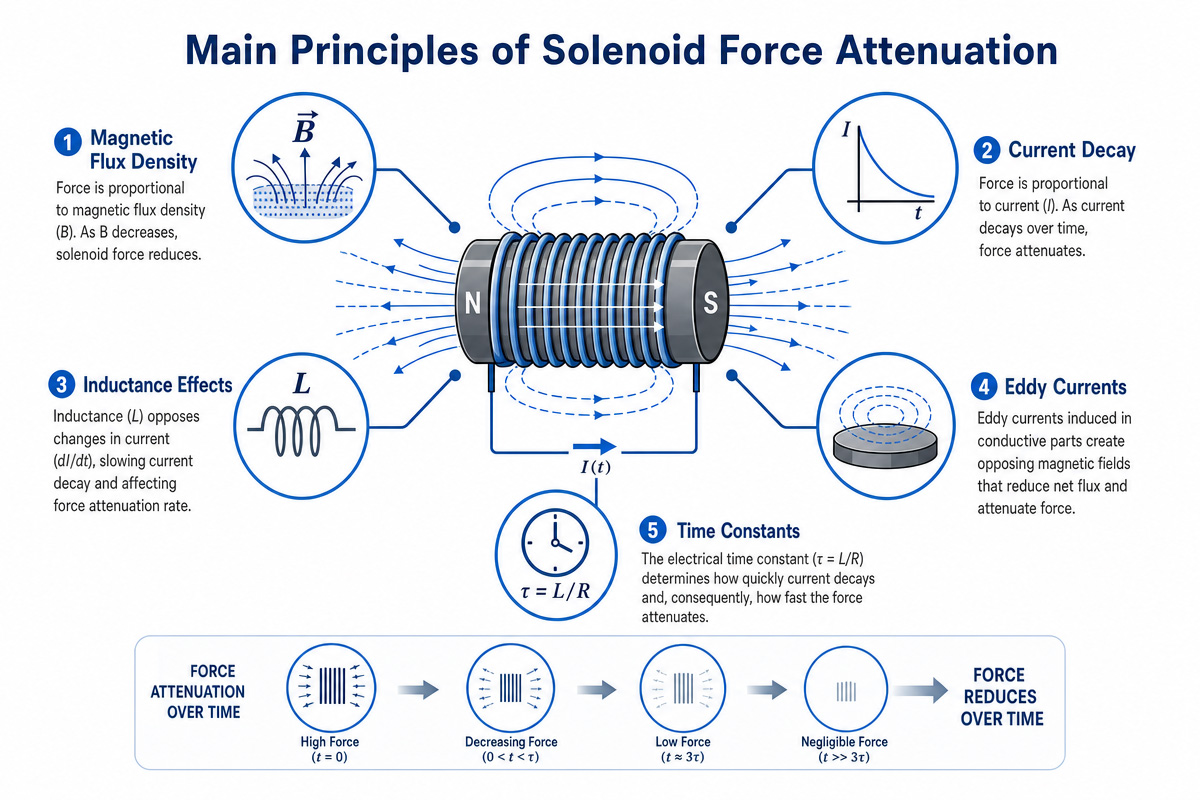
Two main strategies will allow you to reduce force dampening:
1) Heat management system will cause the solenoid force attenuation.
2) Efficient creation and maintenance of magnetic flux.
Chapter 4: Engineering Method 1: Choosing the Right Solenoid Type and Parameters
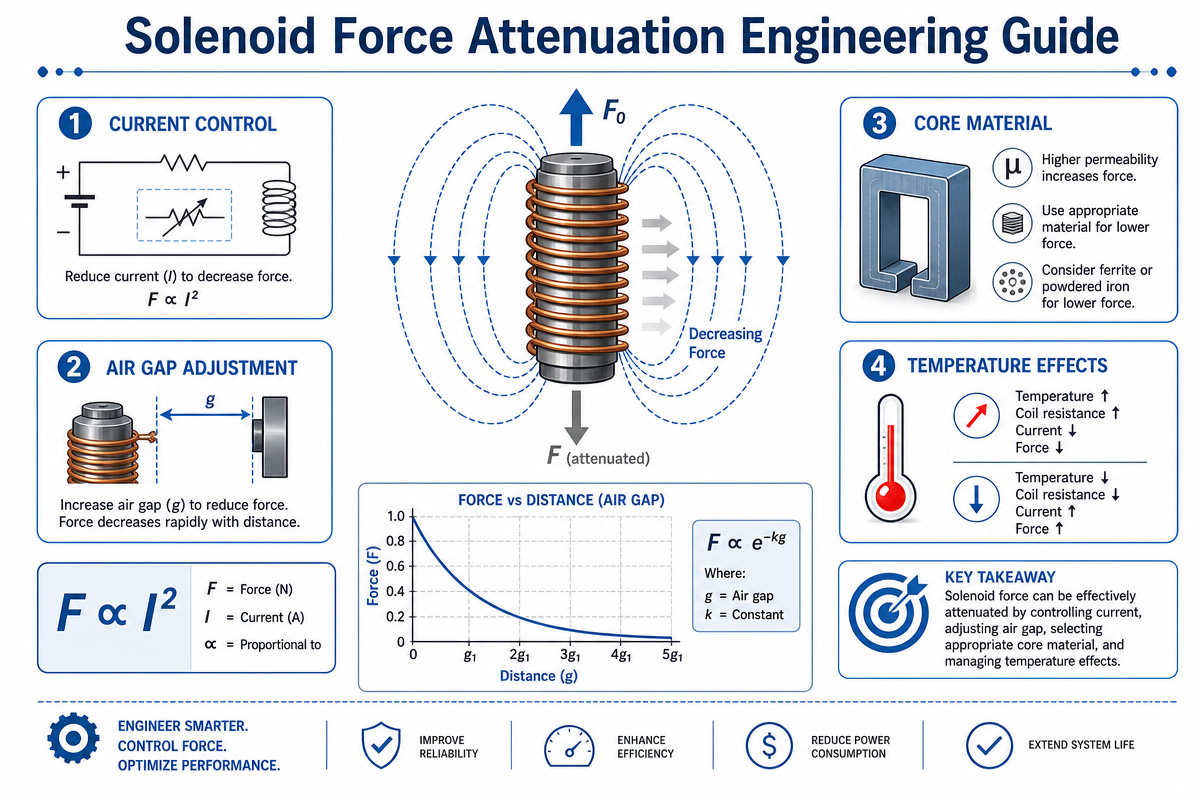
The right choice of a solenoid design becomes one of the best ways to cope with force dampening.
Advantages:
– Lower heating in the winding;
– Unlimited current flow;
– Good ability to produce magnetic flux;
– Better cooling properties.
Selection of an appropriate design and power directly reduce force attenuation.
Chapter 5:: Engineering Method 2: Optimizing Coil Features
The coil has the: main effect on heat generation and force dampening.
5.1. Larger conductor diameter
– Reduces heat generation;
– Increases quality of insulation;
– Minimizes heating;
– Allows for stable current;
5.2. Appropriate turn count
The rightThe coil has the number of turns prevents the following:The right
– Too many turns,prevents the following: which cause overheating;
– Too few turns,turns, which reduce force;
5.3. Multi-layer coil winding
Layered winding provides for betterturns, cooling since it:
– Maximizes airflow around the coil;
– Prevents appearance of hot spots;
5.4. High-quality coil insulation
Good insulation decreases chances of forced dampening.
Chapter 6: Engineering Method 3: Use of High-Quality Magnetic Material
Choosing the proper core material becomes one way to cope with force dampening.
Materials:
– Grain-oriented silicon steel;
– Highly efficient soft magnetic materials.
Properties:
– Higher magnetic permeability;
– Energy-efficient operation;
– More even force generation.
Chapter 7: Engineeringbetter Method 4: Improvement of Magnetic Circuit Structure
Good construction of a magnetic: Engineering circuit becomes another important factor.
Steps to optimize a magnetica magnetic circuit include the following:a magnetic
– Minimization of air gaps;
– Surface contact optimization;
– Creation of closed loops of magnetic flux;
– Minimization of magnetic flux losses.
Chapter 8: Engineering Method 5: Enhancement of Heat Dissipation
Temperature becomes one of the key factors for successful operation without any force dampening.
Steps for improving the coolinginclude the following: process include the following:the cooling
– Passive cooling;
– Use of high-conductivity and large heat sink surfaces;
– Application of active cooling via fans or liquids;
– Use of thermal interface materials;
– Liquid cooling in certain cases.
Effective heat dissipation will decrease force dampening.
Chapter 9: Engineering Method 6: PWM
Application of pulse-width modulation becomes one of the most efficient methods of fighting force dampening.
Steps of implementing PWM include:
– Decrease of average energy consumption;
– Lower heat generation;
– Stable solenoid force.
For example, brief activation with strong current and keeping current low afterward becomes a good strategy for maintaining force levels despite attenuation.
Chapter 10: Engineering Method 7: Adaptation of Solenoid Design to Operating Conditions
Operating conditions change, and therefore, the influence of force attenuation becomes different.
High-frequency operating conditions:
– Application of PWM;
– Heat dissipation improvements;
– Optimization of coil design;
– Accounting for environmental temperature;
– Taking into account material resistance and thermal characteristics;
– Ventilation and improved insulation.
Conditions of short duty cycles or continuous operating:
– Decrease of power supply;
– Thermal considerations.
Engineering Methods to Prevent Solenoid Force Attenuation
The following approaches will be able to minimize force damping.
1) Definition of product constraints;
2) Thermal analysis;
3) Solenoid and core optimization;
4) Enhancement of heat dissipation abilities;
5) Intelligent control system implementation;
6) Testing of the designed prototype.
Chapter 11: Typical Mistakes That Cause Solenoid Force Attenuation
Some common mistakes in the design that might cause attenuation include:
– Not considering heat generation problems;
– Failure to properly analyze the required solenoid force;
– Using poor-quality and cheap materials;
– Ignoring limits on duty cycle;
Chapter 12: Future Trends in Solenoid Force Attenuation Prevention

1. Intelligent Drive Control: Is This the End of PWM?
Heating issues as well as force attenuation have traditionally been addressed via Pulse Width Modulation (PWM). Nowadays, modern science points out that purely relying on PWM does not suffice for reaching high levels of precision in terms of performance.
New Trends:
– The IPFM Model
– Sigma-delta modulation
– Adaptive hybrid control algorithms
These types of control provide better system linearity, preventing instabilities induced by PWM switching dynamics. According to recent research, complex modulation allows attaining more stable output dynamics compared to traditional PWM.
Engineering Influence 2:
– Reducing heat generation
– Minimizing current ripple
– Providing a more even force production
– Attenuating solenoid force less
2. Self-Holding Solenoid (Latching) Design Trend
A new development trend involves the use of self-retaining (also known as latching) solenoids.
Mechanism:
– Only powered up when changing state
– Can maintain position without applying continuous current
Advantages:
– Avoidance of continuous heat generation
– Significant power savings
– Solenoid force losses mitigation via heat prevention
The latest reports suggest the invention of energy-efficient, small-size latching solenoids for use in thermal management systems.
Industry Trend:
Applied in such devices as:
– Smart locks
– Automotive electronics systems
– Battery-powered machines
3. Multi-Physics Simulation and Digital Twin Design Techniques
Up to recently, solenoid design was mainly empirical. At present, simulation techniques are increasingly applied in design processes.
What Is New:
– Simulating electromagnetic, thermal, flow dynamics, and structural effects
– Developing real-time digital twins
Through such methods, engineers gain an ability to predict the following:include the following:
– Heat generation
– Magnetic flux losses
– Wear and tear
As stated in the latest scientific papers, multi-field modeling helps achieve higher accuracy and reliability when designing in extreme conditions.
Advantages:
– Identification of potential risks associated with attenuation of solenoid force
– Optimization prior to making physical prototypes
4. High-Performance Magnetic Material Selection and Heat Treatment
Advanced material science provides opportunities to mitigate force attenuation.
Current developments include:
– Using special alloys
– Choosing higher grades of silicon steel
– Innovations in heat treatments: creating nano-crystalline soft magnetic materials
Proper annealing improves magnetic properties.
Results:
– Enhances electromagnetic efficiency
– Limits flux losses
– Mitigates attenuation of solenoid force
5. Optimization of Structure and Geometry Design Trends
Modern trends involve designing solenoids as lightweight components.
Example Innovation:
– Armature perforation
According to the latestpredict the following: studies, strategic perforation helps:
– Improve dynamic effects
– Ensure sufficient electromagnetic force
Nevertheless, improper positioning results in excessive force losses, highlighting the importance of optimization.
Trend Direction:
– AI-aided geometry design (topology optimization)
– Fast assembly of high-speed actuators
6. Integration of Thermal Management into Design Process
Previously, engineers tended to consider heat aspects in a separate stage of the design process. Nowadays, thermal management becomes a central part of it.
New Approaches:
– Embedding of cooling channels
– Use of heat pipes
– Thermal interface materials with high conductivity
Solenoids become more often incorporated into system-level thermal management circuits, such as
– Battery cooling in electric vehicles
– Thermals in electronics
The current trend implies dramatic reduction of force attenuation as a result of improved temperature control.
7. AI and Sensorless Control and Monitoring Technologies
Artificial intelligence technologies are starting to change the face of solenoid control.
New Abilities Include:
– Online temperature estimation based on current measurement
– Sensorless stroke position sensing
– Predictive maintenance
AI-based algorithms are able to estimate temperature and dynamics of the solenoid based on electrical characteristics, thus enabling preventative control in order to avoid force losses.
8. Energy-Efficient Drive Circuits
Conservation of energy is one of the major approaches to minimizing force attenuation in solenoids.
Technologies include:
– Use of boost-and-hold circuits
– Adaptive currents
– Smart integrated circuits (ICs)
The following is achieved:
– High initial magnetic force
– Low holding current
– Overall heat generation reduction
Conclusion:
– Heat reduction
– Extended lifetime of parts
– Decreased chances of solenoid force attenuation
9. Fast Response and High-Frequency Uses
With increasing speed of operation driven by robotics and automation technologies, more and more solenoids work in high-frequency regimes.
The issue:
– Higher operational speeds mean greater wear and heat production
The solution:
– Optimization of switching dynamics
– Adjusting structure for higher frequency response
– Computer-based control algorithms
Current studies highlight the effect of structural optimizations on improving dynamics and stability.
Chapter 12 : Conclusion
Solenoid Force Attenuation Solenoid force dampening becomes a challenging problem. Reduction in force attenuation involves heat management and improvement of magnetic features.
Important considerations:
– Minimization of temperature rise;
– Improvement of heat dissipation;
– Current stabilization;
– Usage of magnetic materials.
Following those guidelines allows for stable force and better life and performance of the solenoid.
Final Remark
There is no universal remedy for dealing with solenoid force attenuation. To get great results, one needs to adapt his approach to the product itself. This technical guide gives you fast access to the solution.
Chapter 13 : FAQs of solenoid force attenuation
Question: Is solenoid force attenuation permanent?
Answer: Yes. Overheating can damage insulation, thus causing permanent loss of force.
Question: How fast does it happen?
Answer: It may occur pretty fast (in minutes) depending on current and temperature. Good engineering helps to maintain stable force levels for years.
Question: Is higher voltage beneficial for solenoids?
Answer: No. Higher voltage means more heat generation. Voltage should only satisfy product requirements.
Question: Could a solenoid be changed to decrease force dampening?
Answer: Yes, sometimes. It is possible to add heat sinks, implement PWM control, replace insulation and core material, or even redesign the part when needed.
Question: Which type of solenoid usually faces more problems with force dampening?
Answer: It is usually a DC solenoid because it has fewer protections against overheating, while AC solenoids face other challenges. However, different techniques work well for different solenoids.
Question: Which is the easiest way to minimize solenoid force dampening?
Answer: The easiest and fastest way would be the implementation of PWM control and adjustment of the holding current.
Question: Are there any solenoids on the market with minimal force dampening?
Answer: Yes. Solenoids with the following parameters will help minimize force damping:
– High insulation classes F, H, or C;
– Duty cycle rating;
– Cooling capabilities.
Choose solenoids based on data sheets.
Question: How can I determine if my solenoid experiences force dampening?
Answer: Monitor temperature and electromagnetic force continuously and plot force values in dependence on time. If there is a drop by 10-15%, force dampening occurs.
Question: Can solenoid force dampening decrease solenoid durability?
Answer: Yes. An increase in operating temperature causes rapid destruction of insulation and coils. Thus, decreasing force dampening allows extending solenoid life.
Question: Should I refer to professionals to solve the problem of force dampening?
Answer: If standard measures cannot help, you should contact specialists.