Introduction to Air-Core Coil Supplier for Communication Equipment
Electronic elements installed in the communication equipment must work reliably even under severe operational conditions. The role of coils is huge in such things as tuning, filtering, impedance matching, and others, and the use of them can be observed in RF modules, wireless devices, base stations, networking systems, antennas, filters, and other signal-processing equipment.
Air-core coils can be a suitable choice when an engineer needs to avoid magnetic-core saturation and losses caused by this core.
However, achieving the required level of electrical performance for the product is only half of the problem. The OEM must obtain consistency in dimensions, winding geometry, inductance, resistance, and many others.
Therefore, the selection of a proper air-core coil manufacturer will influence the development, manufacturing, and reliability of communication equipment.
When choosing coil suppliers, buyers must pay attention to technical and other aspects related to the selection process. That is why the next chapter will focus on these problems in detail.
For purchasing managers and engineers the process of selecting suppliers must be much more than a mere comparison of quotations. This guide contains the necessary information for communication equipment buyers who want to purchase air-core coils.
1. Define the Requirements of the Communication Equipment
First of all, it is necessary to know the technical requirements of the coil before the suppliers can be selected.
Communications equipment can be installed in any electrical environment and can function at any frequency. It means that the component built for a certain purpose cannot be successfully applied for the other, even if the inductance level is the same.
Define the following parameters to develop the requirements for the air-core coils:
inductivity
tolerance of inductance
operating frequency
resistance (DC)
Q factor (when it is necessary)
present requirements
diameter of wire
coil dimensions
number of revolutions
pitch (winding)
configuration Lead
temperature range of operation
mechanical requirements
Pass all the technical data to the potential air-core coil suppliers, and you will be able to understand if the supplier is ready to produce your product and has enough capacity to implement the manufacturing process. Furthermore, you will obtain competitive quotations from several suppliers who will compete with each other while fulfilling these requirements.
2. Identify RF & High Frequency Experience
The use of high frequencies is characteristic for the communication equipment. Therefore, experience in high-frequency components is critical in this case.
Above this level, a component behaves differently than simple inductance. Such characteristics as parasitic capacitance, skin effect, proximity effect, self-resonance, winding geometry, and conductor properties are influencing the performance of the component.
If the manufacturer specializes in low frequencies, he may lack experience in RF applications.
When selecting air-core coil suppliers, you should inquire about their RF experience or any experience with communication applications.
You do not have to get the data about the supplier’s customers’ secrets. You have to know the engineering experience of the company and the way it measures, the usual frequency range of application, and the possibilities of winding the coils with optimal configuration.
3. Investigate CustomAir-Core Coil Supplier Engineering Capabilities
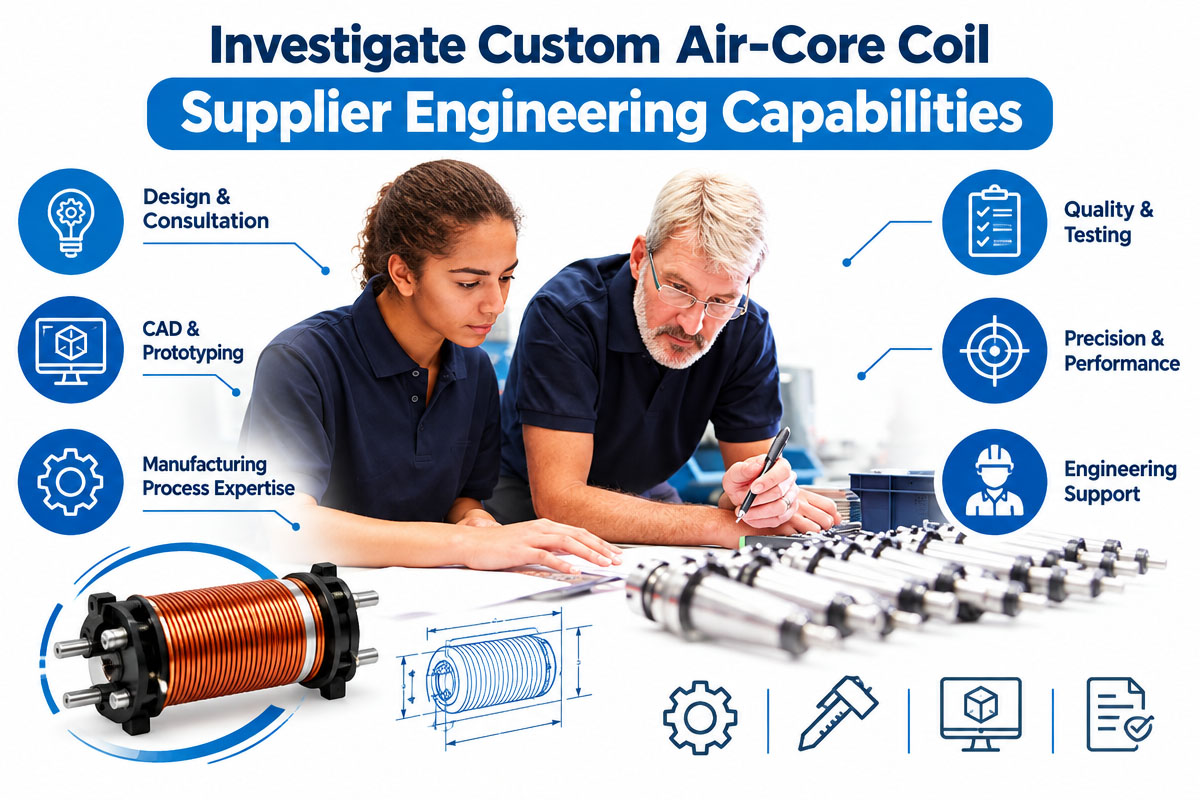
The standard air-core coils can be successful if their parameters satisfy the circuitry needs of the communication equipment, but they often require customized solutions.
Dependent on the space of the equipment, certain customization is required.
Occasionally your engineering team needs a unique set of such parameters as inductance, diameter, winding length, resistance, lead configuration, and frequency performance that is not included in standard components.
Your potential supplier must analyze your requests, offer manufacturability and performance improvements, and produce items per the provided drawings.
Good supplier engineering services can be helpful, especially in the early stages of developing the communication equipment.
4. Control Inductance and Tolerance of it
Many communication circuits need inductance control.
If the inductance values differ between components, the circuit behavior will also differ. The tuning, filtering, matching, and other characteristics of circuits can change.
The buyers of air-core coils must establish real tolerance levels dependent on circuit requirements.
Very strict tolerances can be quite expensive in the manufacture and testing process. Do not specify tolerance requirements if they exceed application requirements.
Inquire each air-core coil supplier about the control of inductance in production.
Questions about measuring instruments and methods, standardized conditions of testing, how often measurements will be held, and how the nonconforming parts are processed are also important here.
In the cases of critical application, OEMs must require measurement data on the prototype or pilot production samples.
5. Control Winding Accuracy
Winding geometry is one of the most important factors affecting the performance of air-core coils.
The electrical characteristics change depending on coil diameter, turns number, spacing, pitch, winding length, and other factors.
That is why winding accuracy becomes so important.
One of the main capabilities of a good supplier of air-core coils is controlled winding technology that provides repeatable winding geometry in batches.
Assess the supplier, and check the appearance of samples and their dimensions. Pay attention to such things as turn spacing, coil shape, lead configuration, and overall workmanship.
In the high-volume projects it is necessary to clarify whether the winding is manual, semi-automated, or automated and how key parameters of the production process are controlled.
Automation does not guarantee the quality of components, but the higher volume of production requires such a thing as a controlled and repeatable winding process.
6. Analyze CustomAir-Core Coil Supplier’s High-Frequency Testing Capacity
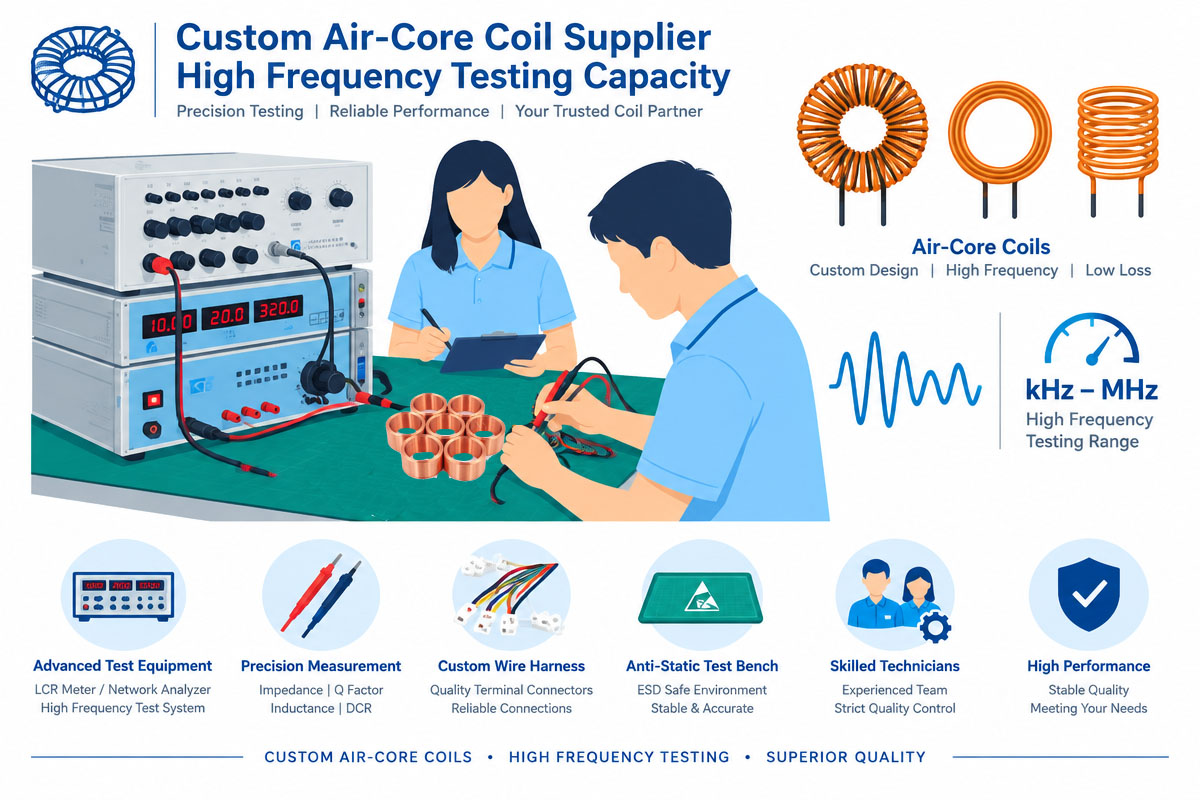
Though an air-core coil satisfies the inductance requirement, it does not mean that it performs properly under operation frequencies.
Thus, the electrical characteristics that are required for communication equipment must be specified.
They may include inductance at certain test frequencies, resistance, Q factor, self-resonant frequency, impedance, or other RF characteristics.
These requirements shall be discussed with your air-core coil supplier prior to producing bulk quantity.
The supplier must know what the requirements are and what the engineering reference measurements are.
The special verification can be carried out at OEM or external laboratories with the help of end-circuitry.
7. Pay Attention to DCR
The DCR is one more important aspect of air-core coils.
As the winding resistance becomes higher, the power losses become bigger. The efficiency and other parameters can be decreased due to such reasons.
It depends on the type of the conductor material, the wire diameter, the total wire length, the winding configuration, and others.
While choosing suppliers of air-core coils, try to find out if the supplier can produce a coil with DCR limited to a certain value.
But pay attention that DCR must not be considered without connection to other design parameters.
In the case of low resistance, the wire with a bigger diameter may be required. It increases the size of the component or changes the winding geometry.
8. Assess Wire Material Quality and Traceability
At the first step of providing manufacturing consistency, the supplier must control the materials.
Performance and quality of the finished air-core coil depend on the conductor resistance, dimensions, insulation properties, and winding behavior.
The suppliers must inform buyers how they test, identify, store, and trace incoming materials.
Material consistency is very important for long-term communication equipment programs because it is the same part that can be purchased for several years.
A reputable supplier of air-core coils always must have procedures for excluding unauthorized or uncontrollable material substitutions.
If your program needs any environmental regulations or compliance, please remember to specify this requirement in the qualification procedure, but not at the beginning of the mass production stage.
9. Verify CustomAir-Core Coil Supplier Quality Control Systems
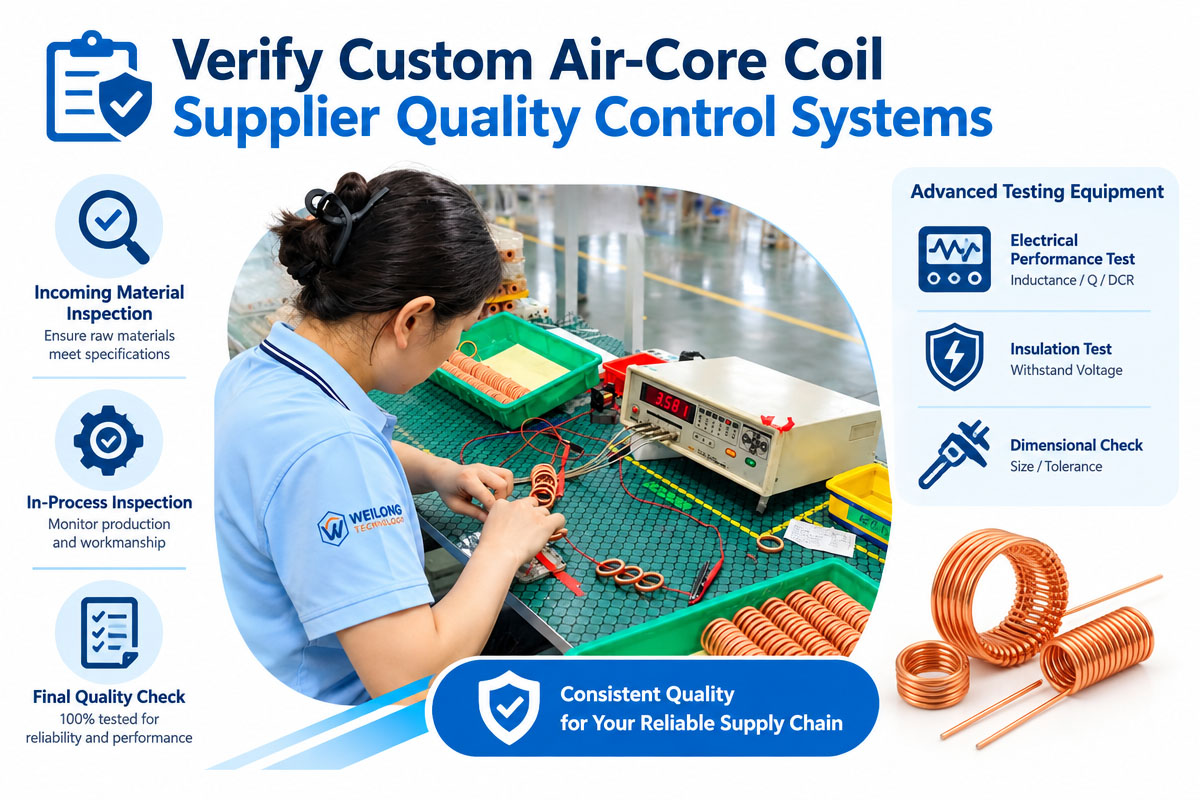
A supplier shall be able to explain the way quality is controlled from incoming materials up to shipping to you.
Among inspection points we can name such activities as
wire test
control of winding-up process
sight inspection
dimensional measurements
testing of inductance
resistance tests
inspection lead
final review
Lot number
To qualify as the air-core coil supplier, you can ask him about his quality control system. You may also wish to learn about calibration procedures, corrective action systems, non-conforming material control systems, traceability, production record retention, and others for higher volumes or higher-reliability communication products. Quality must be designed into the process, not inspected into the product.
10. Request Prototypes Before Bulk Production
Prototype samples are necessary for customized coils.
The drawing can describe the dimensions and electrical characteristics, but it cannot say anything about performance inside your equipment.
The prototype can be used for electrical characteristics evaluation, PCB fitting, lead configuration, assembly compatibility, and stability of performance under operational conditions.
When it is possible, you can test representative samples in the circuit prior to approving the air-core coil supplier for bulk production. If it is used in an RF circuit, testing the sample under realistic frequencies and conditions is recommended.
Freezing the relevant drawing revision and specifications will be helpful after the samples are approved.
11. First-Article Inspection—Think First
For custom components, the first-article inspection will give you a bit more confidence when proceeding into production.
First Article Reports will provide you with key dimensions and electrical measurements of the first produced article.
It proves the knowledge of the drawing and the ability of the supplier to produce the demanded design.
Proper revision control of the drawing must be established when dealing with an air-core coil supplier.
Whenever your engineers introduce changes to the inductance, wire size, dimensions, leads, or other parameters, you must be sure that obsolete instructions won’t be applied to further productions.
Revision control is even more critical when dealing with several coil types of OEMs.
12. Custom Air-Core Coil Supplier Assessment of production capacity
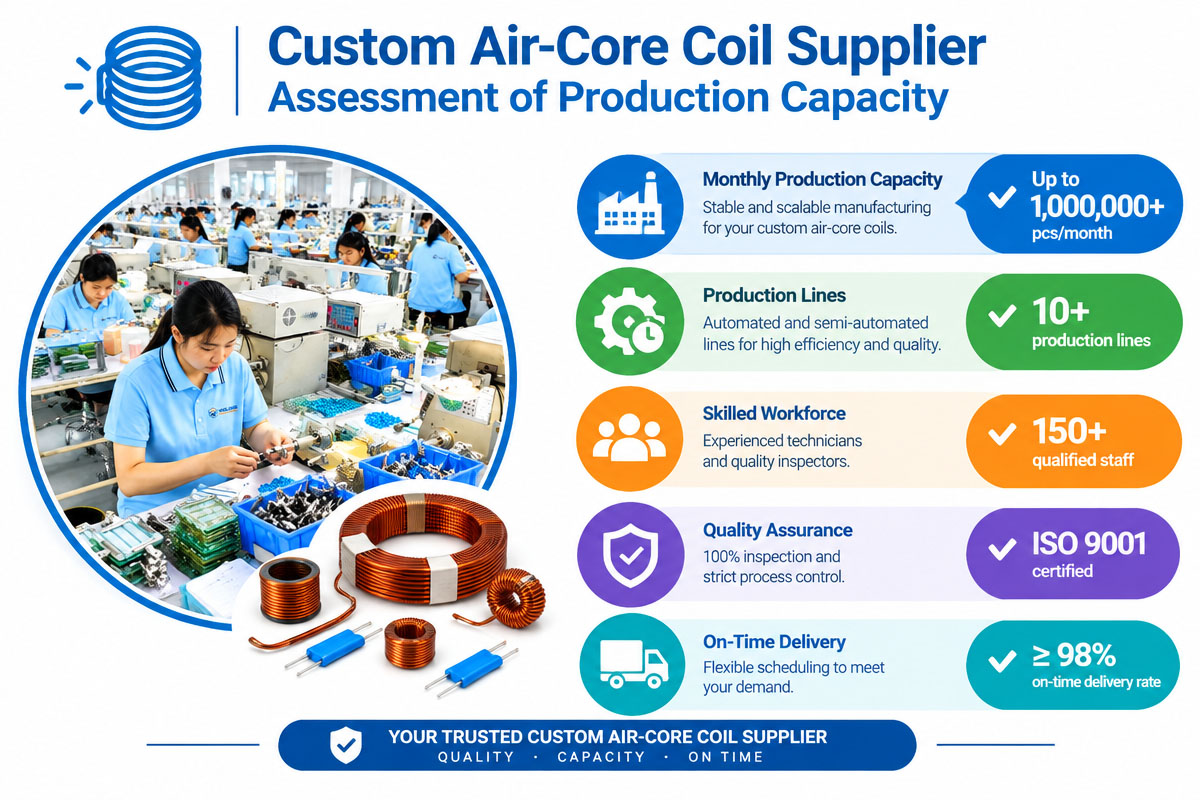
If a supplier is able to make 20 excellent prototypes, it doesn’t mean that they will be able to produce 50,000 units consistently on a monthly basis.
Therefore, your demand expectations should be the metric for assessing production capacity.
Speak to the supplier of the air-core coils about the equipment, its capacity, normal production volumes, testing capacity, number of staff, and possibility to react to demand changes.
Also consider speaking to the supplier about the requirements for the forecast.
A realistic forecast allows planning production capacity in the future. This aspect is especially important in case of communication equipment programs when the demand is volatile.
For components that are strategically important, speak to the supplier about the contingency planning in case the equipment fails or the orders increase unexpectedly.
13. Careful Comparison of Lead Times
The lead time can significantly impact OEM inventory and production planning.
Don’t ask only for the lead-time number. Know what it consists of.
The lead time of a custom coil may consist of engineering review, sample development, sample approval, material procurement, tooling or fixture preparation, production, testing, and shipping.
Find an air-core coil supplier whom you can rely on to give realistic lead times, not aggressive ones that cannot be guaranteed.
Buyers need to understand that the lead time for a prototype is not identical to the lead time for production and should be considered separately.
Forecasting or agreements on blanket purchases may help stabilize supply for recurring orders.
14. Understanding the MOQ & Pricing
Minimum order quantity can be important for communication products when demand expectations are still unclear.
Ask suppliers for the MOQ for the prototype, the MOQ for the pilot production, and the MOQ for the regular production.
Review unit pricing over several volume levels.
Ask for prices in several realistic quantity breaks—not the maximum quantity you are forecasting.
Comparing the suppliers of air-core coils, it is important to understand that the lowest unit price doesn’t always translate into the lowest total price.
Such inconsistencies in quality can lead to the incoming inspection costs, production delays, reworks, engineering investigation, scrap, and problems with field reliability.
Don’t only care about the cost—consider the quality, delivery, and engineering.
15. Checking Custom Air-Core Coil Supplier packaging and shipping protection
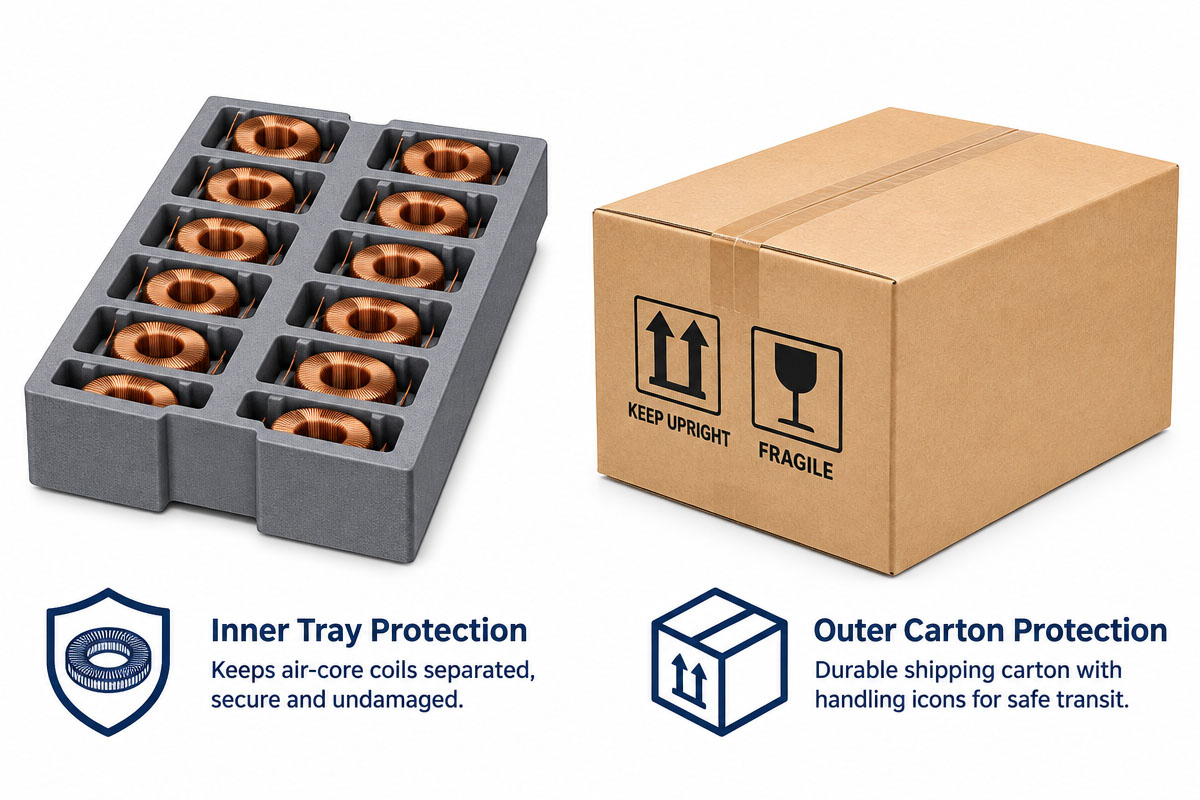
Air-core coils can be quite mechanically sensitive due to their geometry that impacts their electrical characteristics.
Bad packaging can cause deformation of the coil or leads during the transportation.
Thus, packaging is a factor of interest, especially for the coils made from fine wires with the peculiar geometry and precision spacing, or for the formed leads.
Ask the air-core coil supplier how they will pack their products for prototype and production deliveries.
The package should guarantee the protection of the coil and also facilitate straightforward handling at the OEM facility.
The orientation and format of the package are important for the automation of assembly. Thus, it is necessary to discuss packaging early in the mass production process, rather than at the end.
16. Finding strong technical communication
Often, custom component projects require extensive engineering discussions.
Your engineers might need to define dimensions, change winding geometry, test the results, alter the lead configuration, or examine unexpected behavior of the circuit.
Delays in development may occur due to the slow response of the supplier or poor communication of technical details.
It is important to consider the communication of the air-core coil supplier during the quotation and prototype phase.
Are the questions technical? Is there any clarification needed regarding your specifications that the supplier is inquiring about? Are your drawings and revisions precise? Manufacturing constraints—can the supplier team explain that to you?
Quite often it is possible to evaluate the pre-production experience as an insight into long-term collaboration.
17. Inquiring about change management
Developers of communications equipment can encounter some troubles with unexpected changes.
A small alteration in wire, winding method, dimensions, tooling, or manufacturing location can impact the performance of the component.
OEM buyers would like to know how suppliers manage process and material changes.
A good air-core coil supplier will have a process for managing significant changes and, if agreed by the customer, will inform the customer before implementing them.
For critical applications, document all changes that need to be communicated to customers or that require re-qualification.
Thus, the OEM won’t find out about any important changes in production after the component’s behavior changes.
18. Evaluating the reliability of the supply chain
The quality of the components is equal to the timely delivery of parts.
Supply-chain stability should also be part of the supplier qualification for the communication equipment OEM.
These factors include raw material availability, supplier location, capacity, normal lead time, logistics, and contingency planning.
In case the volumes are high, ask the air-core coil supplier about the management of the demand fluctuations and material shortages.
Depending on the importance of the component, OEM can consider safety stocks, scheduling, forecast sharing, or even second-source strategy.
What approach is appropriate depends on the predictability of the demand, the uniqueness of the component, and the consequences of the supply interruption.
19. Scorecard to Compare Suppliers
A structured scorecard can help the purchasing and engineering teams to make a balanced decision.
Here are some factors to consider besides the price when choosing suppliers:
Technical competence
Experience in RF
Prototype Quality
Consistency of production
Testing capability
Quality systems
Production capacity: You are qualified as of October 2023.
Time to take the lead.
Communication
Price
Safety of supply
Customization support
The scorecard provides an easier opportunity to objectively compare the air-core coil supplier to another.
It helps to align the priorities between engineering and procurement teams. The procurement team considers the cost, capacity, and delivery, while engineering may consider the performance and process capability. Joint evaluation provides a more comprehensive sourcing decision.
20. Thinking about Long-Term Partnership
Communication products may stay in production for many years, and product families tend to evolve.
The coil may be initially designed and then require changes in dimensions, resistance, inductance, lead configuration, production volumes, etc.
Choosing a supplier who will be able to perform all these changes will ease your future development efforts.
A good long-term supplier of the air-core coils should provide stable production, responsive engineering support, clear communication, quality, and reliable delivery.
Grouping certain projects with a capable supplier may benefit OEMs that use a lot of custom coils across various product families, as it can optimize communications.
However, buyers need to constantly monitor performance and delivery during the collaboration.
21. Conclusion
More is involved in choosing an air-core coil supplier than just a comparison of the inductance and the unit prices.
For the communication equipment OEMs, it is necessary to pay special attention to such characteristics of the coil as high-frequency experience, customization ability, winding precision, DCR control, testing equipment, quality systems, material traceability, production capacity, lead times, packaging, technical communication, and supply chain stability.
Of course it is especially important to test the prototypes.
Only after that can your design be approved if you are sure the coil behaves correctly in the actual conditions of your communication circuit.
An air-core coil supplier should be both a manufacturer and a technical partner.
Communication equipment OEMs may reduce their sourcing risks and improve the long-term product performance by clearly defining requirements and carefully evaluating manufacturing capability and quality expectations.
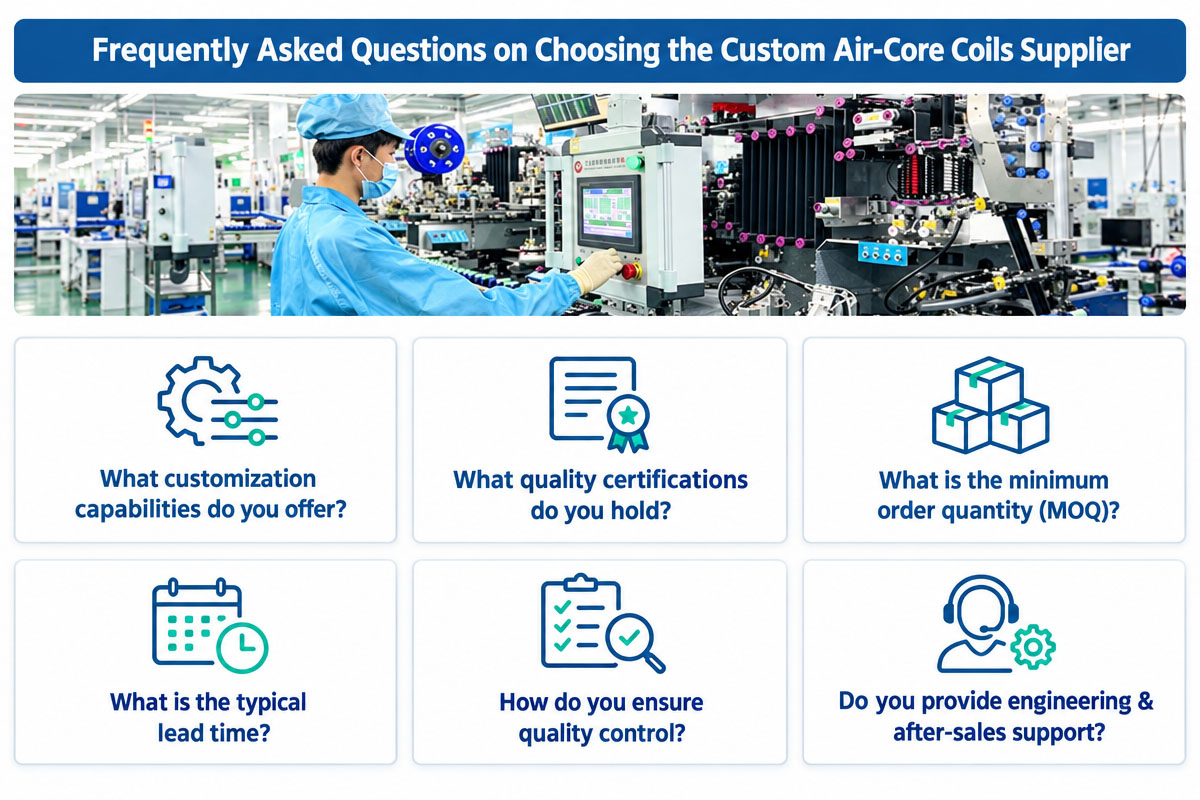
22. Frequently Asked Questions on Choosing the Custom Air-Core Coils Supplier
1. What information do I need to provide for a quote from the air-core coil supplier?
The inductance & tolerance, frequency of operation, max DCR, current requirements, specifications of wire (if fixed), coil dimensions, lead configuration, operating temperature, testing requirements, quantity of prototype, production, and annual forecast. Preferably with a drawing. Specify all the specifications and which one is negotiable for the supplier.
2. How do I know that the supplier has enough RF experience?
Ask about the types of high-frequency coils the company makes, measurement equipment, supported frequency ranges, engineering capability, and ability to control the winding geometry. Furthermore, you may specify your specifications and evaluate the quality of the questions and suggestions from the supplier. The performance of the coil prototype in the actual communication circuit is also important.
3. Can I choose the supplier of the air-core coils with the lowest price?
No always. Don’t only compare unit prices. Compare the total purchasing value. consider engineering support, sample quality, consistency, electrical testing, lead time, capacity, communication, traceability, and delivery performance. If the components with inconsistency cause the stoppage of the line, rework, additional inspection, and product failures, then a small difference in unit price is irrelevant.
4. Which samples do I need to ask for before mass production approval?
Whenever possible, request samples made with materials and processes that are representative of production. These are inductance, DCR, dimensions, winding geometry, lead positions, and any other electrical characteristics that are important for your particular application. Then put the samples in the communication equipment and verify the performance at the circuit level.
5. What quality tests should be performed by the air-core coils supplier?
The tests are carried out according to your requirement, but usually there are inductance measurements, resistance testing, dimensional inspections, visual inspections, and lead verification. In the case of high-frequency applications, there are electrical measurements. Buyers shouldn’t think that all manufacturers follow the same inspection process. It is necessary to negotiate with the air-core coil supplier about the critical characteristics before the production.
6. How do I check the consistency between the production coil and the approved sample?
The best way is to use controlled drawings, specifications, revision number, measurable acceptance criteria, and representative approved samples wherever appropriate. Ask about the process control, material traceability, documentation of the process, calibration, and change management procedures. In the case of a critical project, it may be useful to perform the first article inspection or regular production testing.
7. Which questions should I ask about the production capacity and lead times?
Say what you expect from the supplier on a monthly and yearly basis. Ask if they are able to fulfill your needs and unexpected changes in demand. Discuss raw-material lead times, production capacity, testing capacity, standard lead times, seasonal constraints, and contingency planning. In case of recurring orders, forecasting may be helpful.
8. What warning signs should I watch out for while qualifying as an air-core coil supplier?
These warning signs include vague technical answers, refusal to provide the samples, inconsistent dimensions of samples, unexpected material substitutions, poor revision control, poor testing, too aggressive lead-time promises, poor communication, and very low prices without explanation of the manufacturing process. Buyers need to investigate all these things before giving the program to the vendor.