

1. Introduction
The development of smart homes, intelligent buildings, electronic access control, and connected security devices led to the emergence of the need for compact and energy-efficient locking mechanisms. Modern smart locks should provide reliable mechanical movement with minimum power consumption. This phenomenon is
This phenomenon is one of the reasons why latching solenoids become more and more widespread in smart locking devices.
Unlike conventional solenoids, which usually need to be continuously powered to maintain their position, latching solenoids can retain their position, either latched or unlatched, after the pulse of power has been removed. It can be accomplished by means of permanent magnets, magnetic circuits, or bistable mechanical structures.
Latching solenoids are especially advantageous for battery-powered smart locks and other intelligent security devices, as they are capable of maintaining the position without the need for continuous power.
Latching solenoids can be considered as effective converters of the electrical signal into reliable mechanical locking/unlocking operation in the case of electronic cabinet locks, hotel locks, parcel lockers, access control devices, smart safes, and residential door locks.
2. What Is a Latching Solenoid?
A latching solenoid is the electromagnetic actuator designed to retain either of the two mechanical positions after the electrical command is removed.
In contrast, conventional solenoids typically extend the plunger when voltage is applied and return to their initial position when the electrical current is removed, aided by a return spring.
However, latching solenoids can hold their position after the electrical pulse is removed, without the need for continuous energization of the coil.
Many latching mechanisms can maintain two positions:
Locked Position
OPEN POSITION
A short electric pulse is required to change the position of the plunger.
After the position change is completed, the actuator holds its position without continuous energization of the coil.
This operation principle makes the actuator quite appropriate for applications where energy efficiency is one of the key aspects.
2.1 Very Low Power Consumption
Reduced power consumption is the main feature of latching solenoids in smart locking devices.
A conventional solenoid requires a constant power supply to maintain a certain lock position. Such designs can quickly discharge the batteries of portable or wireless products.
In contrast to conventional actuators, latching design does not need to consume electricity continuously, as the electrical pulse can be removed when the actuator is in the required position. Position is maintained by the internal magnetic or mechanical locking mechanism.
For example, a smart cabinet lock powered by batteries can use only a short pulse of electricity when the user unlocks/locks the cabinet. The actuator does not need constant power between operations.
It can significantly increase the life of your battery.
In the case of smart locks, which can be used thousands of times between battery replacements, low standby energy consumption can become a key competitive advantage of the product.
2.2 Good for Battery-Powered Smart Locks
Many modern locking devices are designed to work without the constant wired power supply.
Examples of them are
Intelligent door locks
Parcel lockers
Smart wardrobes
Electronic filing cabinets.
Hotel room locks
Batteries-powered safes
Smart mail boxes
Access control devices
These products usually also use batteries because it is inconvenient and expensive to wire every lock individually.
In such applications, latching solenoids can be used to reduce energy consumption for each locking action.
To start the actuator, the control circuit sends a short pulse to it. When the lock has been moved to the desired position, the coil can be turned off.
Such latching technology is especially appropriate for low-power security products.
3. Latching Solenoid with Two Stable Positions
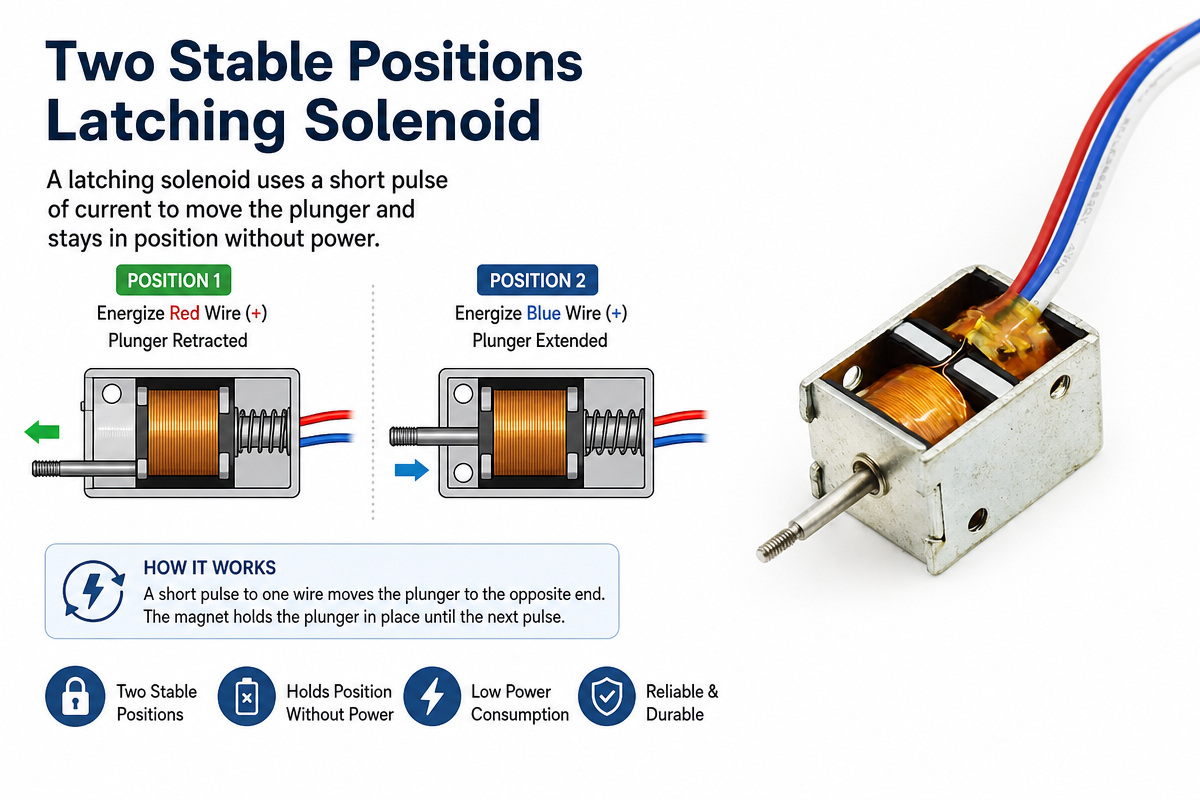
Many smart locks need both locking and unlocking functionalities.
A two-position latching solenoid is capable of maintaining two stable positions. One position means the locked state; the other means the unlocked state.
The actuator can be changed from one position to another with the electrical pulse.
For example:
Unlock command → electrical impulse → plunger movement → lock opened
And later:
Lock command → opposite electric pulse → plunger movement → lock engaged
The operation of electrical control depends on the particular design of the actuator. For instance, some two-coil latching solenoids use separate coils for two directions, while some use a single coil with polarity reversal.
The capability of maintaining two stable positions makes latching solenoids a perfect fit for smart locks.
4. Improved battery life
Extended battery life is an important selling point for many smart locking devices.
Users usually expect that a smart lock will work for a long period of time before it needs to be charged or the battery should be replaced. This is difficult to achieve if the device is constantly consuming power.
Latching solenoids can be maintained in their position without constant power supply, which means that only short pulses of electricity are required.
This means that the locking mechanism consumes significantly less power than a constantly powered actuator.
Battery life will depend on such factors as
Activation frequency
Resistance of the coil
Length of pulse
Supply voltage
Efficiency of locking mechanism
Power consumption of control circuit
Environmental temperature
Size of the battery
However, the low-power operation principle of the latching solenoid provides a solid ground for the development of energy-efficient smart locks.
5. Reliable mechanical holding of the latching solenoid
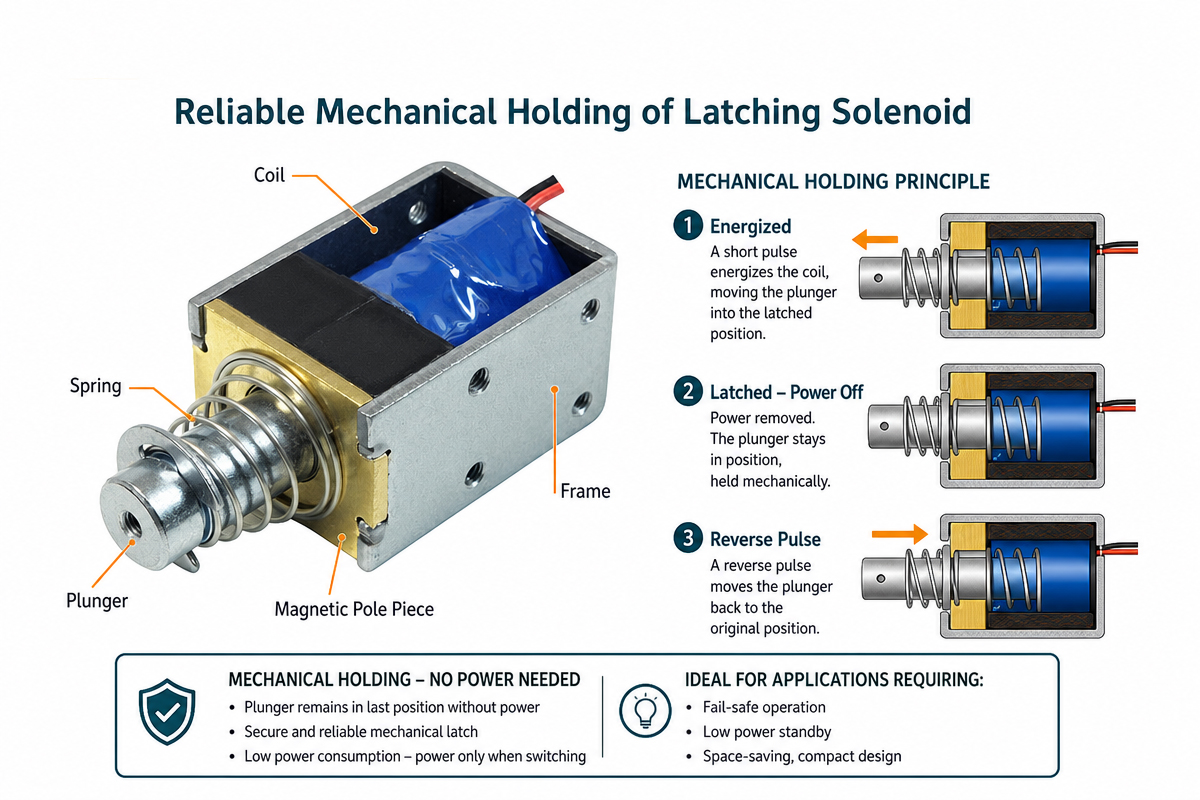
Reliability of position is important for smart locking products.
If the actuator accidentally switches from the locked position to the unlocked one, the security mechanism may be disabled.
Latching solenoids are designed to maintain their mechanical state after activation. A well-engineered magnetic latching mechanism can guarantee position retention without the need for constant electrical power.
This can be especially useful if the product has to be locked for a long period of time.
For example, a smart storage cabinet can be locked for hours or days. In this case, the actuator does not require a constant power supply to retain the locking state.
6. Compact Construction
Smart locks usually have limited space inside.
Modern locking devices have to contain batteries, control boards, sensors, communication modules, mechanical elements, and the actuator within the limited housing.
A compact latching actuator can improve product integration.
The manufacturer can adjust:
Actuator general size
Plunger Ø
Stroke
Mounting structure
Coil arrangement
Leads or connectors
Retentive strength
Operating voltage
It provides an engineer the possibility to optimize the actuator for the available space.
The customization of the actuator can be especially useful for miniature smart locks and electronic cabinet locks.
7. Fast Response to the Electronic Command
Fast response is the necessary requirement for smart locking systems when a user authenticates using a fingerprint scanner, password, RFID card, Bluetooth, or mobile application.
The electronic controller can send the activation pulse to the solenoid upon receiving the proper authorization command.
After that, the actuator performs the necessary mechanical movement, which results in unlocking or locking the lock mechanism.
A solenoid is a quite responsive mechanism of actuation because it converts electrical energy into linear motion.
8. Easy Integration With Smart Control Systems
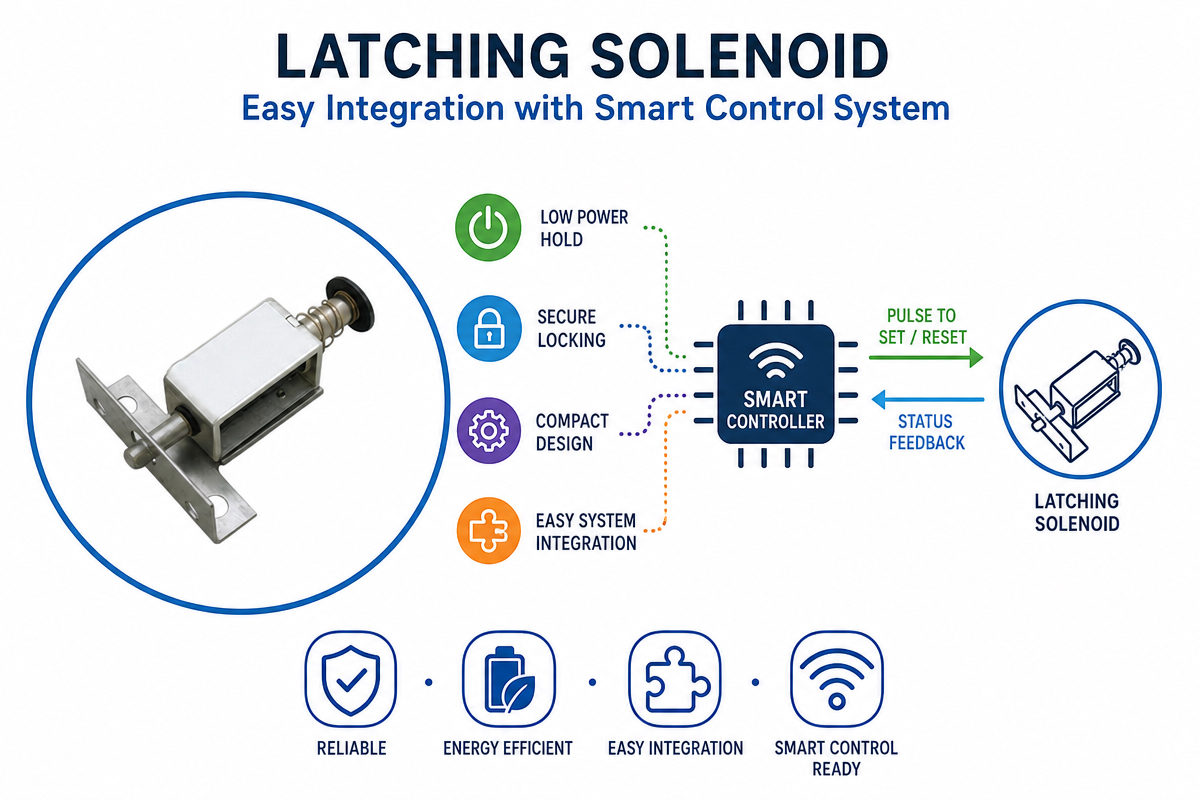
Modern smart locks usually contain electronic control boards that perform authentication, communication, sensing, and power management.
The appropriate driver circuitry can incorporate a latching solenoid into this system.
The controller can decide when to send the activation pulse depending on information received from:
Fingerprint scanners.
Keyboards
RFID reader
Near-field communication systems
Bluetooth modules
Wi-Fi systems
Apps on mobile devices
Software for access control
The solenoid will unlock or lock the lock mechanism.
This creates a direct link between the digital command and the physical security mechanism.
9. Less Heat Generation
Lower heat generation is the benefit of the latching solenoids during their operation.
While the conventional solenoid constantly generates heat due to continuous power consumption in the coil, a latching design powers the coil only for a short time to change its position.
Lower average power consumption is especially useful to decrease heat generation inside small smart lock housing.
This feature can be especially useful if the product has some heat-sensitive electronic components such as processors, sensors, wireless communication modules, and batteries.
10. Applicable to Various Smart Lock Applications
The flexibility of latching technology makes it suitable for a variety of intelligent locking applications.
Smart Lock
Latching solenoids are used for unlocking and locking mechanisms in residential and commercial smart doors.
Electronic Locks for Cabinets
They can lock office cabinets, industrial control cabinets, storage units, and intelligent furniture.
Package Lockers
Only with the help of reliable electronic control and a mechanical lock can a smart parcel locker be created. The latching actuator is used to maintain the lock position with low power consumption.
Locking Systems for Hotels
Small electromechanical actuators can be used in electronic hotel locks to operate locking mechanisms.
Smart Safes
A latching mechanism can be used in electronic safes and other security devices to control internal bolts or release mechanisms.
Smart Mail Boxes
A compact locking mechanism with low power consumption is particularly well suited for smart mailboxes, which are battery powered and can be idle for long periods of time.
Access Control Devices
Commercial access-control devices can combine authentication technology with latching actuators to control physical access.
11. Latching Solenoid vs. Conventional Solenoid
Understanding the difference between a conventional solenoid and a latching solenoid helps engineers choose the appropriate actuator.
| Feature | Latching Solenoid | Conventional Solenoid |
| Position holding | Maintains position without continuous power | Often requires power to hold |
| Energy consumption | Very low average consumption | Can be higher |
| Battery applications | Excellent | Less suitable for continuous holding |
| Heat generation | Generally lower average heat | Can be higher during continuous energization |
| Control | Pulse-based | Often continuous or switched power |
| Two-position operation | Common | Usually one active position |
| Smart locks | Highly suitable | Suitable for some designs |
The best choice depends on the locking mechanism and system requirements. However, for battery-powered smart products where standby energy consumption is critical, the latching design has a clear advantage.
12. How to Select a Latching Solenoid?
There is much more to selecting a latching solenoid than checking the operating voltage.
Engineers have to consider several key specifications.
Voltage
The coil voltage should be compatible with the available power supply and driver circuit.
Stroke
The stroke should be enough to operate the locking mechanism fully.
Strength
The actuator should be capable of generating sufficient force at the required stroke to overcome friction and mechanical resistance.
Power Holding
The holding force should be sufficient to retain the locked/unlocked position.
Duration of Pulse
To get reliable switching, the control system should provide the proper activation pulse.
Duty cycle (latching solenoids can consume low average power, but still the coil has to be operated within its electrical limitations).
Operating Temperature
The actuator has to be compatible with the temperature range of the end product.
Service Life
The engineers must estimate the number of locking and unlocking cycles for commercial smart locks.
13. Why You Should Use Custom Latching Solenoids
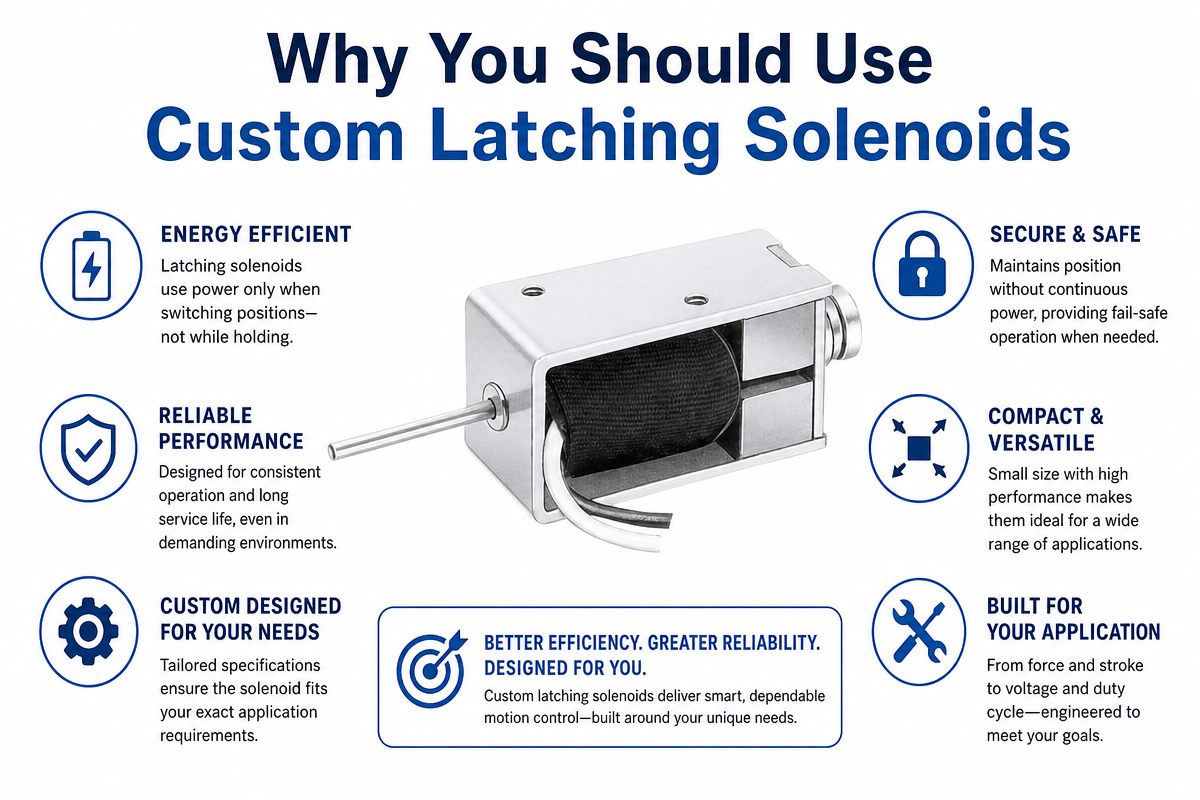
Not every smart lock application can use a standard actuator.
Custom latching solenoids can be designed to meet the customer’s particular mechanical and electrical requirements.
Customizations can include magnetic circuit, coil specification, stroke, force, mounting structure, plunger size, return mechanism, and electrical connections.
In the case of smart lock products with high production volume, a custom latching solenoid can provide several benefits:
Better space utilization
Improved power consumption
Better mechanical fit
More appropriate force and stroke
Easier assembly
Greater reliability of the product
Collaboration with a reliable solenoid manufacturer during the product development process can provide engineers the opportunity to estimate these parameters before making the locking mechanism.
14. Conclusion
The evolution of battery-powered and energy-efficient security systems directly correlates with widespread use of latching solenoids in smart locking devices.
These actuators are especially useful for smart locks, electronic cabinets, parcel lockers, safes, access control systems, and other intelligent products because they can maintain their position, either latched or unlatched, without continuous electrical power consumption.
The main benefits of the latching solenoids are low power consumption, extended battery life, position holding, compact design, quick response, low heat generation, and flexible electronic control.
Manufacturers developing new generations of smart locking products must choose the right latching actuator based on parameters such as voltage, stroke, force, holding force, pulse duration, available installation space, operating temperature, and service life.
The latching solenoid has well-designed magnetic and mechanical characteristics that make it an effective link between electronic intelligence and physical security, helping to create reliable, compact, and energy-efficient smart locking products.


