

Chapter 1: Introduction: The Importance of Selecting the Correct Solenoid Manufacturer
Choosing the right solenoid manufacturer is not just a purchasing decision but has a direct effect on performance, safety, cost and even brand reputation. In OEM engineers and procurement manager, buying from the wrong manufacturer may result in problems such as: Unstable output of magnetic force Leakage of seals or failure of seals Variability in batch quality Short life cycle product When a buyer searches for a solenoid supplier, price should not be the key deciding factor. Rather, the key metric is based on engineering capability, flexibility and stability, and more. Today, OEM buyers look for a solenoid manufacturer who is also a partner in the engineering process.
Chapter 2: What Does a Custom Solenoid Manufacturer Do?
A custom solenoid manufacturer is responsible for designing and producing electromagnetic actuators for various applications such as: Automotive systems Medical apparatus Industrial automation Fluid control systems Smart lock systems Energy equipment Compared with off-the-shelf solenoid parts, customized solenoids require: Precision EM design Optimization of stroke force and temperature control assistance Mechanical assistance Troubleshooting and reliability testing for specific applications A solenoid manufacturer is more than a supplier, but a development partner.
Chapter 3: Four Key Features to know a Reliable Solenoid Manufacturer
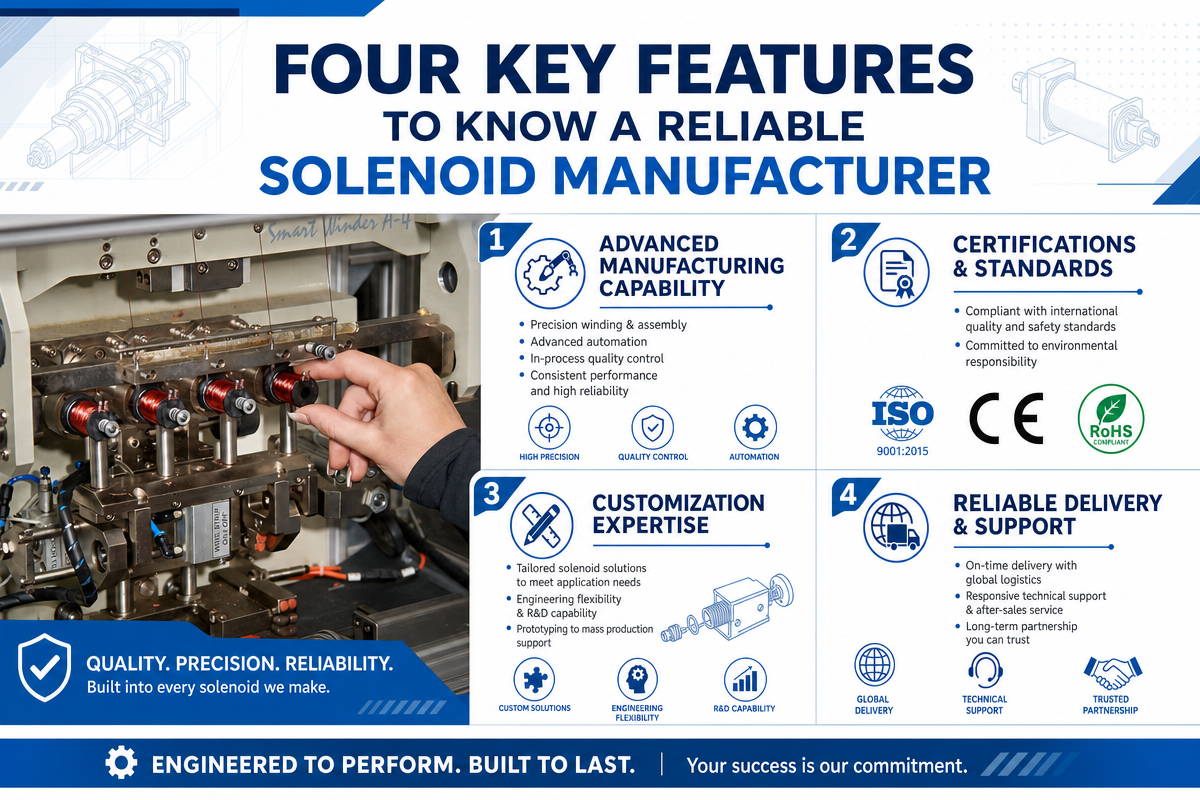
3.1. In-house Tooling Capability
One of the qualities of a good solenoid manufacturer is that they should have their own tooling department for both plastic and metal tooling.
Benefits of having an in-house tooling department are: Better quality control More rapid development Lower cost structure As mentioned, in-house tooling is the key for a stable quality mass production.
3.2. Engineering Competence
A good solenoid manufacturer should be an engineering partner, not just a manufacturing plant.
Robust engineering teams can support: EM simulation Force-stroke performance improvement Thermal performance optimization Design for manufacturing (DFM) troubleshooting Failure troubleshooting Tips for buyers: Low engineering capability = High customization risk.
3.3. Test & Validation Laboratory
An experienced solenoid manufacturer should have testing capability.
Main test types are: Environmental test (temp/humidity/vibration/ salt fog/etc) Mechanical life cycle test Stroke force-displacement validation Electrical equipment testing (resistance/insulation/hi-pot test) Valve leakage test Tips for buyers: The testing capability of the manufacturer shows how reliable it is in the market.
3.4. Certification and Compliance
The minimum requirement for any global solenoid supplier: ISO 9001:2015 Quality System RoHS compliant REACH compliant Industry-specific certification Certification is essential for systematic, traceable and continuous improvements in manufacturing processes.
Chapter 4: How to Evaluate and Select a Good Solenoid Manufacturer
4.1 Engineering Skills Question: Do they have their own electromagnetic engineers? Can they reproduce force-stroke performance? Can they prototype validation?
4.2 Flexibility for Customization Customized voltage range (AC/DC) Custom correction du AVC Custom tuning of force Housing redesign Customized connectors or mounting Avoid manufacturers which have only catalog products.
4.3 Stability of Production Product’s sample performance is not the key factor. Confirm: Level of automation Batch failure rate Sampling or 100% Inspection Coil stability winding
4.4 Quality System Ensure ISO 9001 compliance RoHS compliant Compliance with industry regulations
4.5 Testing Capability A good manufacturer should offer: Life cycle testing Thermal rise testing Vibrations/shock testing Corrosion testing Force-displacement validation
4.6 Lead-time and Capacity Calculation: Prototype lead time Mass-production capability Material source stability Emergency production capacity
4.7 Transparency in Costs A trusted manufacturer offers: Bill of Material breakdown Transparent tooling cost No hidden engineering cost Flexible pricing benefit
Chapter 5: why global OEMs buyer prefer specialized solenoid manufacturer
With the increasing demands for solenoids in many sectors, OEMs find specialized manufacturers a valuable partner in order to minimize engineering risk and enhance long-term stability. The advantages of specializing solenoid manufacturers include: Robust Engineering Collaborative development in electromagnetic systems Optimization of structure & thermal performance Shorter cycle of design iteration 2. Stable mass production Zero defect manufacturing attitude Controlled assembly process Long-term stability across millions of cycles 3. Application experience In Vibration environments for automobiles Medical systems with high accuracy Hard environment in industries 4. Faster time to market Modular design platform Less prototyping cycle Time-efficient product introduction 5. Value of long-term partnership Agreement in price stability Priority production schedule Engineering cooperation agreement
Chapter 6: Common Mistakes to avoid when choosing a solenoid manufacturer
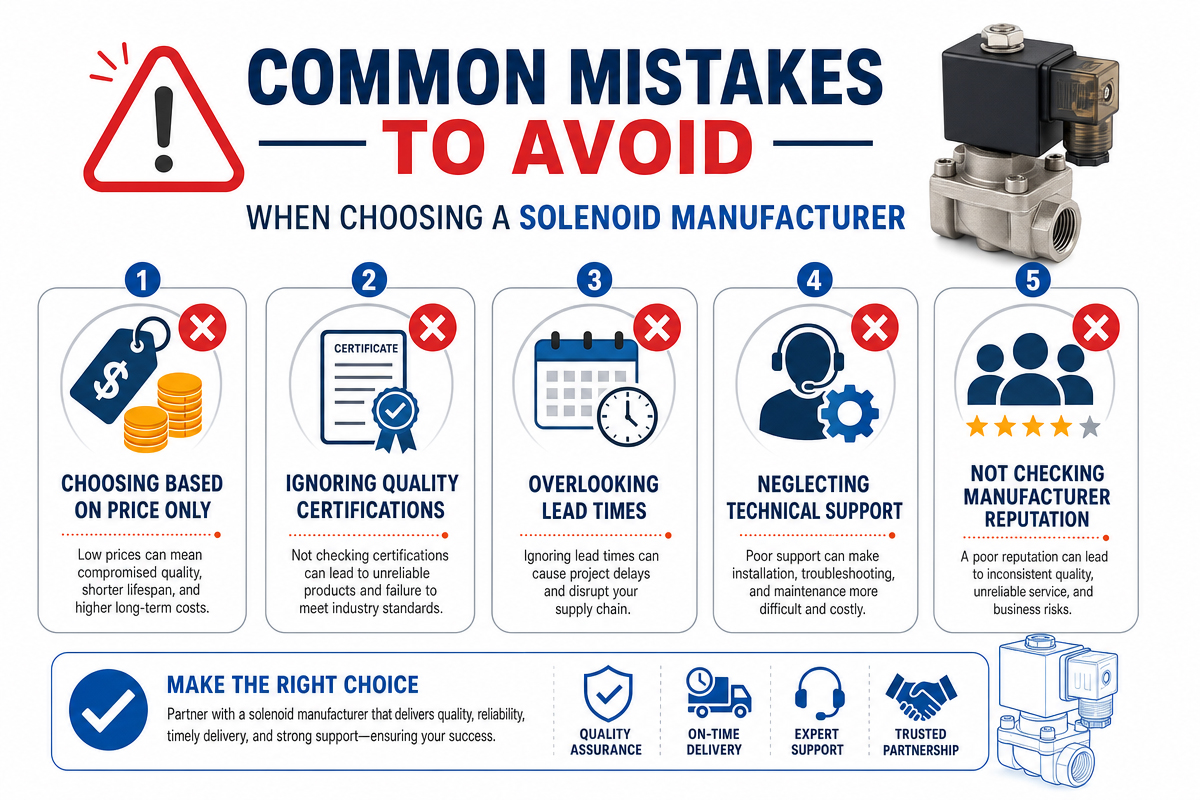
6.1. Price as the only factor in solenoid manufacturer selection
Making the most expensive mistake possible. A valve that is 20% less expensive but twice more likely to fail will cost way more in terms of downtime, additional replacements and losses caused by failure. Fix: Total Cost of Ownership (TCO).
Not only the price per unit. Unit price + maintenance cost + repair downtime + replacement frequency.
6.2. Lack of consideration of environmental conditions
Ordering an “air / water” valve without verifying exact environmental parameters (temperature, humidity, vibration, chemical environment). A standard NBR seal performs perfectly at 20°C but will become hard and begin to leak at 80°C. Fix: Inform the manufacturer of your exact operating conditions (temperature range, chemical composition, peaks of pressure etc.)
6.3. Lack of verification of manufacturer’s ability to produce the valve
Many distributors and assemblers sell themselves as manufacturers. Since these companies do not control the production process, issues such as failure analysis, design modification, quality control and product traceability cannot be done by such distributors and integrators. Fix: Make sure to conduct a factory audit and check its testing facilities.
6.4. Lack of attention to certification issues at early stages
Use of non-certified valve in applications requiring ATEX/SIL/UL or other safety standards will result in delays, increased costs due to retrofitting, or even rejection of the project by the regulatory body. Fix: Verify whether the manufacturer has all the relevant certifications at an early stage.
6.5. Lack of concern regarding future reengineering needs in slection of a solenoid manufacturer
If a valve’s discontinuation occurs in the event of a short lifecycle or unreliable supplier, the project will need to be reengineered. Fix: Verify information about guarantee for spare parts availability and lifetime commitments.
6.6. Sample testing
It is risky to rely only on product datasheets. Fix: Always make sure to order some samples for testing under real conditions prior to purchasing a larger batch.
6.7. Misunderstanding minimum order quantity (MOQ)
An example: the manufacturer will be able to provide a small number of units for prototypes but be able to produce at high volumes too. However, after a while, you discover that the manufacturer will require a huge MOQ (5,000 pieces) but no intermediate quantities (from 100 to 5000 pieces). Fix: Clarify the MOQ policy for various stages (prototypes vs production etc.)
6.8. Attention to technical support
The lack of prompt assistance prior to sales will indicate lack of technical knowledge. In turn, post-sales help will not be fast enough in case of emergencies and failure recovery. Fix: Ask a question and see if you’ll receive a prompt reply.
6.9. Non-standard porting & mounting
A slight saving of the space in the installation site is not worth having to deal with the single-source supplier and having to pay for product modifications later. Fix: If possible, use industrial standard connections.
6.10. Attention to delivery time & logistics
The quoted 15 days will eventually become 30-45 days due to unexpected delivery problems, customs procedures and other factors. Fix: Take into account delivery buffer time and make sure to verify manufacturer’s reported on-time delivery performance.
Solenoid Manufacturer Buyer Scoring Model
| Category | Weight |
| Engineering capability | 25% |
| Quality system | 20% |
| Customization ability | 15% |
| Production consistency | 15% |
| Testing & validation | 10% |
| Cost structure | 10% |
| Delivery reliability | 5% |
Recommended threshold: 80% or above
Chapter 7: Design Considerations for Selecting a Solenoid Manufacturer
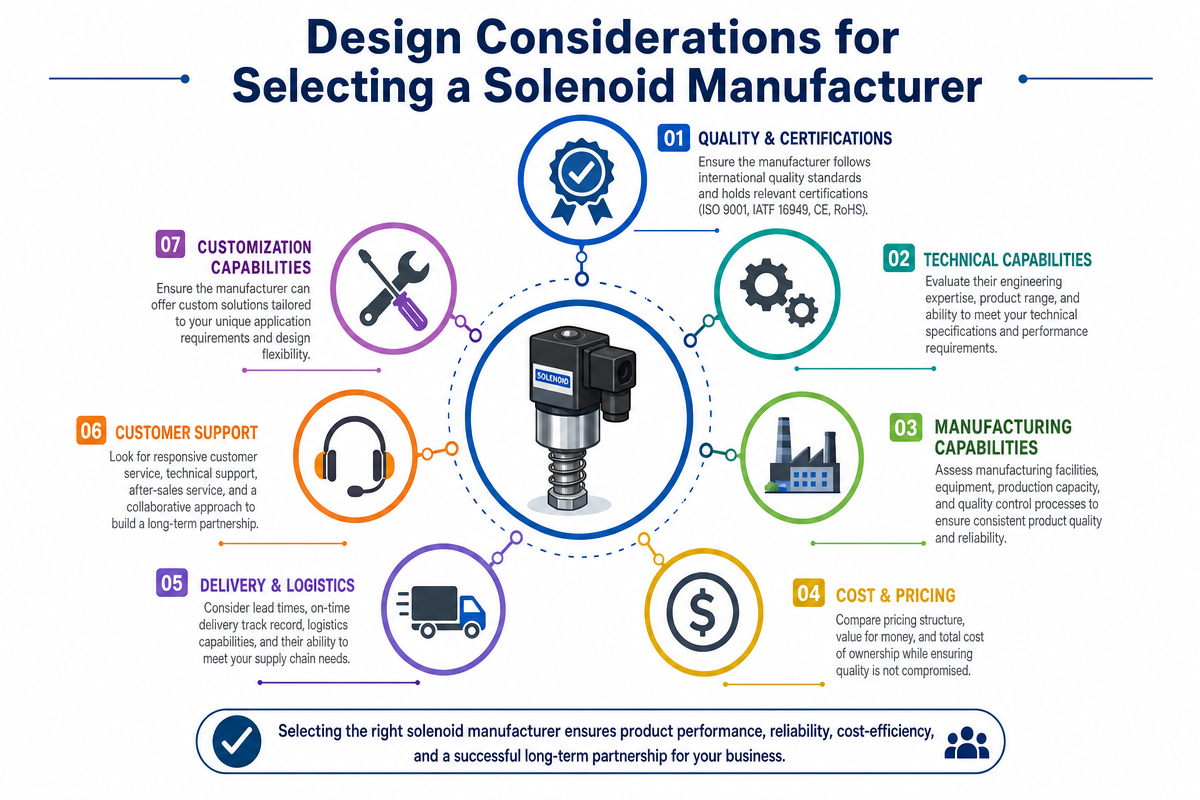
7.1. Standard vs. Customized Products
Standard off-the-shelf products tend to be cheaper and quicker but still reliable. Suitable for non-critical, high-volume applications.
On the other hand, customized products (customized dimension, material, voltage, termination or manifold) have better integration and performance. But customized solenoid parts are more expensive in terms of tooling cost and longer lead time.
Weighting factor: Are you able to design based on your standard product? Only customized products can become your strength if the manufacturer has in-house design capability, otherwise not.
7.2. Environmental Compatibility and Media Compatibility
Important considerations when selecting the right solenoid:
Pressure: High pressure requires stronger structure, robust seal and robust piloting, resulting in higher cost and larger size Temperature: Extreme high/low temp needs special materials (high-temp seals/coils), thus increases cost. Media: Corrosive media requires stainless-steel housing and high-temp seals (PTFE/EPDM), clean air/water allows brass/NBR housing, which saves cost. Weighing factor: Specification too detailed is costly, while too few specifications will cause early failure. It’s necessary to work out with the manufacturer on finding the most suitable materials based on your service condition.
7.3. AC Coils vs DC Coils
AC coils with voltage at 120V/240V have initial force, but consume more energy and generate higher heat DC coils with 12V/24V are silent, watertight and more energy-efficient, but require more current protection Latching/Solenoid coils allow bistable mode and save energy at battery powered applications Weighing factor: Energy-efficiency vs cost/simplicity — Also ensure that the supplier can offer the precise voltage.
7.4. Port Size & Cv
Larger port size and high Cv value increase system efficiency, but enlarge valve and increase the cost You are balancing between Cv and valve cost and manifold compatibility. Weighing factor: Oversizing of Cv causes throttling problem and increased cost. An application engineer of manufacturer can help you select appropriate Cv value.
7.5. Duty Cycle & Response Time
Fast response (<10ms) requires special solenoids and spring design Intermitting duty saves cost while continuous duty requires robust solenoid design and large size Weighing factor: Your reaction time & frequency of duty cycles can drive cost up. Try to be specific only when necessary.
7.6. Direct Mounting vs Threaded Mount vs Manifold Integration
Direct mounting decreases leaking point, makes assembly easier, but restricts flexibility Threaded connection (NPT/BSP/G-threads) increases the time and need sealant. But it is highly versatile. Manifold Integration saves space and piping, but restricts your manufacturer choices in future. Weighing factor: What’s your plan for upgrading? Proprietary design limits manufacturer choice in future.
7.7. Sealing Technology of solenoid manufacturer
Popet valves are simple design with good sealing, thus good for high-pressure applications. Limited flow. Spool valves have excellent flow, respond quickly but has internal leaking, bad for vacuum/gas tight application Diaphragm valves have low pressure rating but are highly reliable for dirty/corrosive media. Weighing factor: Depending on your service condition (media purity & pressure), select one which suits your need. Some manufacturers are strong on popet valves, some are good on spools. Find out which technology fits your need the best.
7.8. Connectivity and Cable Options
Flying lead wire (standardized) is cheap and versatile but not so durable in vibrations DIN Connectors are standardized but the manufacturer should support your connector type M12 and automotive-type connector are expensive, but more preferable for harsh applications Pre-wired harness is easy to install, but locks manufacturer in your system Weighing factor: What’s your plan for standardization vs customization?
7.9. Regulatory Requirements & Certifications
For general industry: ISO 9001 is the minimum. Hazardous areas: ATEX/IECEx certification requires flame-proof enclosure, thus costly Safety systems: SIL rated valves must have third-party certifier, more cost Food/pharma. FDA approval is mandatory for manufacturers. Automotive industry: IATF 16949 for strict traceability and PPAP document Weighing factor: Don’t pay for certifications you don’t need.
7.10. Risk of Obsolescence
Oftentimes, people forget to consider: Large companies with many product lines will stop production after a few years Smaller companies with specific product lines usually produce them for several decades Assemblers do change components without notice, thus changing performance Weighing factor: If your equipment needs longevity of 15-20 years, choose the manufacturer which can commit long-term support.
Chapter 8 : Why Global Buyers are interested in Weilong Solenoid manufacturer
According to the opinion of a buyer, Weilong Intelligent Technology (Dongguan) Co., Ltd is one of the most trustworthy solenoid manufacturers thanks to their stable manufacturing process and engineering competence.
Some of the advantages are:
Own plastic & metal tooling
Strong engineering support team
In-house Testing Laboratory
ISO 9001:2015 certified system
OEM/ODM capabilities
Rich experience in applying solenoids in different industries
Instead of being just a component supplier it operates as a part of client’s engineering team.
Chapter 9 : Final checklist for buyers before placing an order
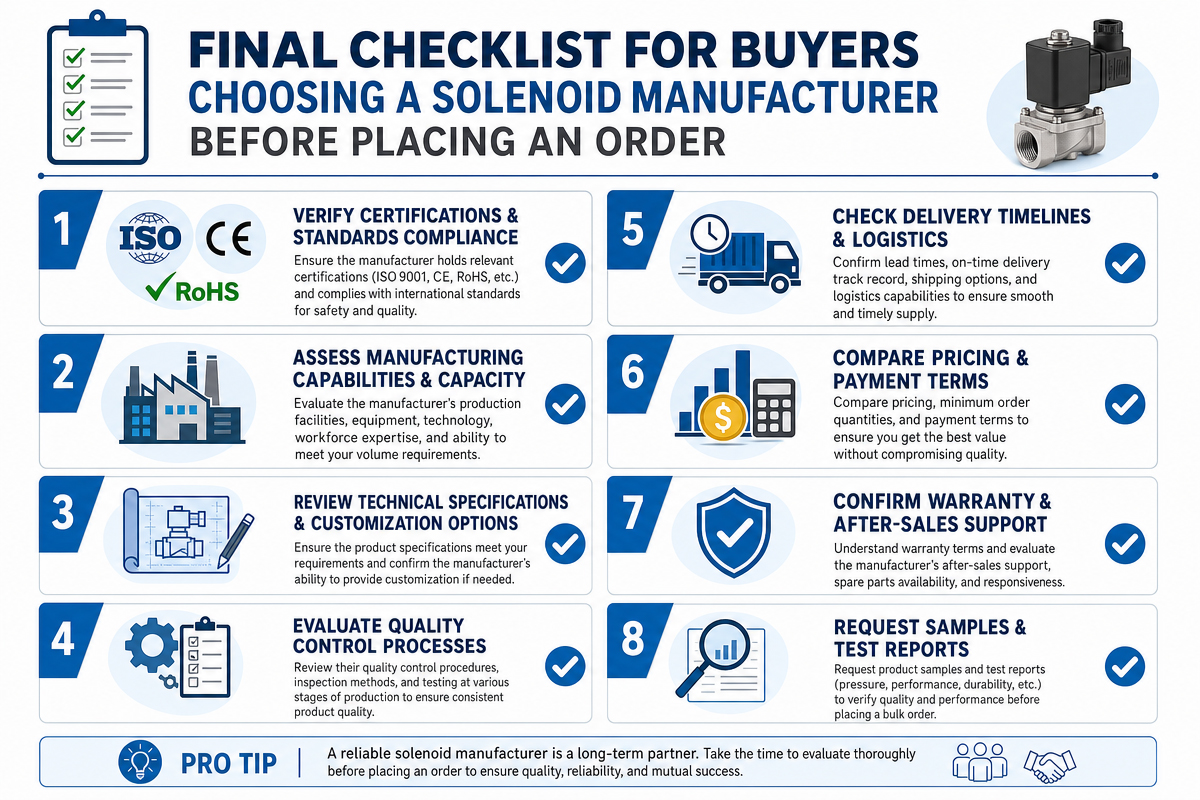
To ensure that the chosen manufacturer of solenoids can satisfy the required criteria, before ordering, buyers should go through a last-minute checklist.
First, buyers should check the technical compatibility. It includes voltage, power, stroke, duty cycle, speed, response time, and environmental compatibility. The selected producer should be able to develop the solenoid according to customized specifications, not just produce standard products.
Secondly, it is crucial to analyze the engineering competence of the producer. They should have in-house designers who will create prototypes and provide buyers with high-quality drawings (in 2D/3D format).
Thirdly, buyers should analyze the quality control system of the company. It should have certification according to ISO 9001, and it is better if they provide reports of tests, including lifetime test, temperature rise test, and vibration test.
Fourthly, buyers need to analyze the ability of the company to source materials and components. Copper wire, magnetic steel quality, and the kind of seals determine durability and efficiency of solenoids.
Fifthly, it is essential to evaluate production capacity and lead times. The buyer must be confident that they can increase orders to get mass-produced goods.
Sixthly, buyers need to evaluate communication and responsiveness of the company to provide feedback on time.
Lastly, it is important to check availability of support services and replacement policies.
This checklist allows reducing sourcing risks.
Chapter 10. FAQ: How to choose a Solenoid Manufacturer?
10.1 What are the different kinds of solenoid suppliers and why does it matter?
There are different types of suppliers and you need to know the difference. It means that you will encounter real manufacturers (who design and manufacture the valves themselves), assemblers (who assemble ready parts), distributors and trading companies.
Why it matters:
Only a genuine manufacturer can guarantee consistent product availability, custom design options, extensive engineering expertise and the longevity of the product throughout the 10-20 year lifetime of industrial equipment. A manufacturer is crucial for critical OEM integration or custom solenoid projects, while distributor is sufficient for replacements.
10.2. What are the main credentials to evaluate in the manufacturing process?
Do not just rely on a brochure in terms of a manufacturer’s technical skills and quality assurance measures. Pay attention to the following signs:
Certifications: Quality and safety management certifications, i.e. ISO 9001 (quality), IATF 16949 (automotive), SIL 3 (hazardous environment), ATEX/IECEx (explosion-proof certification), UL/cUL (electrical safety in North America)
In-house testing: A reliable manufacturer tests valves in a laboratory and performs tests, including pressure integrity, leak detection, coil resistance testing, functional testing, switching, lifecycle and temperature tests.
Traceability: Each batch and shipment shall contain product identification, batch records and Certificate of Conformance
10.3. Why is the selection of the material crucial?
Solenoid manufacturer Material knowledge is one of the key competencies of a manufacturer. The material selected determines performance and durability of the valve.
Body material: Brass is widely used in general-purpose valves working with air or water, while corrosion-resistant materials (e.g. stainless steel 316L and duplex steel) are required for aggressive liquids and high pressures
Seal Material: In case of incompetent supplier you will end up with an inappropriate seal for your particular application. NBR (nitrile) is cheap and works well with air-water mixture but fails with aggressive media. FKM/Viton stands out in the case of oils and elevated temperatures. EPDM is best suited for steam. PTFE is best for aggressive liquids. Warning: Do not go for a supplier which selects one seal for all valve types, regardless of the media.
10.4. What performance criteria can be expected from a reliable manufacturer?
It is vital that the manufacturer shows transparency in respect to their operations. Based on the following criteria you can assess a potential manufacturer: 3.
Target > 95% On-Time Delivery Rate. Top performers have >99%
Response Time: The fastest response within less than 3 hours is the sign of good customer service and efficiency
Reorder Rate: At least 20% reorder rate reflects good customer satisfaction and product reliability (example: Fuan Vision Machinery & Electric Co., Ltd has 32% reorder rate)
Experience: Suppliers with 5-10+ years of experience are preferable due to more matured processes and financial stability
10.5. Major manufacturing centers and what is best for each
Sourcing globally brings numerous benefits but requires proper understanding of the regional manufacturing processes. Major manufacturing centers are:
Guangdong: High levels of automation and integration of manufacturing process and logistics. Perfect for complex designs and quick export
Zhejiang: Large scale manufacturers of low-cost standardized valves. Suitable for volume-driven projects focused on price/performance ratio
Fujian & Hubei: Specialists in making robust, industrial-grade components in harsh environment conditions. Often ISO/CE/UL certified
10.6. How do the price & MOQ differ in solenoid manufacturer selection?
Depending on the type of material, customization and batch size the prices fluctuate. Below you can see a typical classification for standard parts:
Supplier Tier Unit Price Range (USD) Typical MOQ Typical Lead Time Best For
High Reliability $3.50-$6.00 1,000 pcs-5,000 pcs 15-25 days Medical, aerospace, critical systems
Balanced Performance $2.00 – $3.50 500-2,000 pcs 10-20 days Industrial Automation, HVA
Budget-Conscious (volume) $1.20 – $2.00 5,000+ pcs 20-35 days Consumer electronics, low risk application
Additional cost is applied for special customization and non-standard features (cable length, custom material, specific coatings, laser engraving). Such orders usually have a higher MOQ (up to 10,000 pcs) to cover tooling costs.
10.7. How to check manufacturer’s claims prior to placing a bulk order?
Due diligence is an essential part of any partnership and there are several tried-and-tested methods to achieve it:
Sample testing: ask for samples and conduct your own tests in accordance with your needs.
Solenoid Manufacturer audit: request a tour of factory production facilities and QA procedures. All the reputable suppliers are happy to oblige.
Solenoid Manufacturer Performance data: request information on delivery rates, response times and reorder rate statistics
Solenoid Manufacturer Certificates check: verify if the supplier holds appropriate certificates, i.e. ISO, CE, UL, RoHS
10.8. What engineering support should I expect from the top-tier manufacturer?
Apart from supplying products, an OEM manufacturer offers comprehensive engineering support which includes:
Application review: assisting in selecting media-compatible seals and evaluating pressure differentials
Custom design capabilities: changing dimensions, materials, coil voltage, mounting options etc.
Failure analysis: conducting a root cause investigation on prematurely failed solenoid valves
Long-term support solenoid manufacturer: long product life, provision of replacement parts and engineering services to avoid costly redevelopment if the original valve is discontinued by assemblers/traders
Chapter 11: Solenoid Manufacturer Selection Conclusion.
Choosing a right solenoid manufacturer is a highly strategic decision.
From the point of view of a buyer, an ideal solenoid manufacturer is a trusted OEM who has stable manufacturing capabilities and extensive customization abilities. More and more OEMs are opting for specialized solenoid manufacturer to improve product quality, speed innovation and minimize risks associated with the product development cycle.

