

Chapter 1 : What is a linear solenoid for direct current?
A DC linear solenoid is a device that converts DC electrical power into linear motion. A DC linear solenoid consists of a coil, a movable part called a plunger, and a stationary part called a case. The coil is the part where the DC power is applied. The DC power applied to the coil causes the solenoid to produce a magnetic field. The magnetic field causes the movable part to move in a straight direction.
The DC linear solenoid is commonly used in many control devices where linear action is important.
Chapter 2 : DC Linear Solenoid Product overview
A DC linear solenoid is a device that is mainly used for:
Linear action with short strokes
Fast action
Compact design
High reliability
Simple ON/OFF control; no complex drive circuitry required
Similarities between the two products:
Input is DC voltage, which is either 6V, 12V, or 24V
The action is linear, either a push action or a pull action
Control is either excited or non-excited
The force is dependent on the stroke and the coil configuration
The duty cycle is either intermittent action or steady action, depending on the configuration
Chapter 3: Types of DC Linear Solenoids
Push-type solenoid
When the electricity is turned on, the solenoid pushes the plunger out.
Used for devices that require pushing or throwing something away
Pull-type solenoid
The solenoid pulls the plunger into the coil when the electricity is turned on.
Most common type
The solenoid has a mechanical link between the two actions.
The solenoid is capable of moving in two different directions
The solenoid is small, round, and tube-shaped.
Smooth action for efficient operation.
Common in medical and industrial devices
Has a solenoid with an open frame
The open frame structure
Easy to add to and cheap
Bistable Latching Solenoid
Remains in place even when the electricity supply fails
Has a stationary magnetic field
Chapter 4 : The key components of DC Linear Solenoid
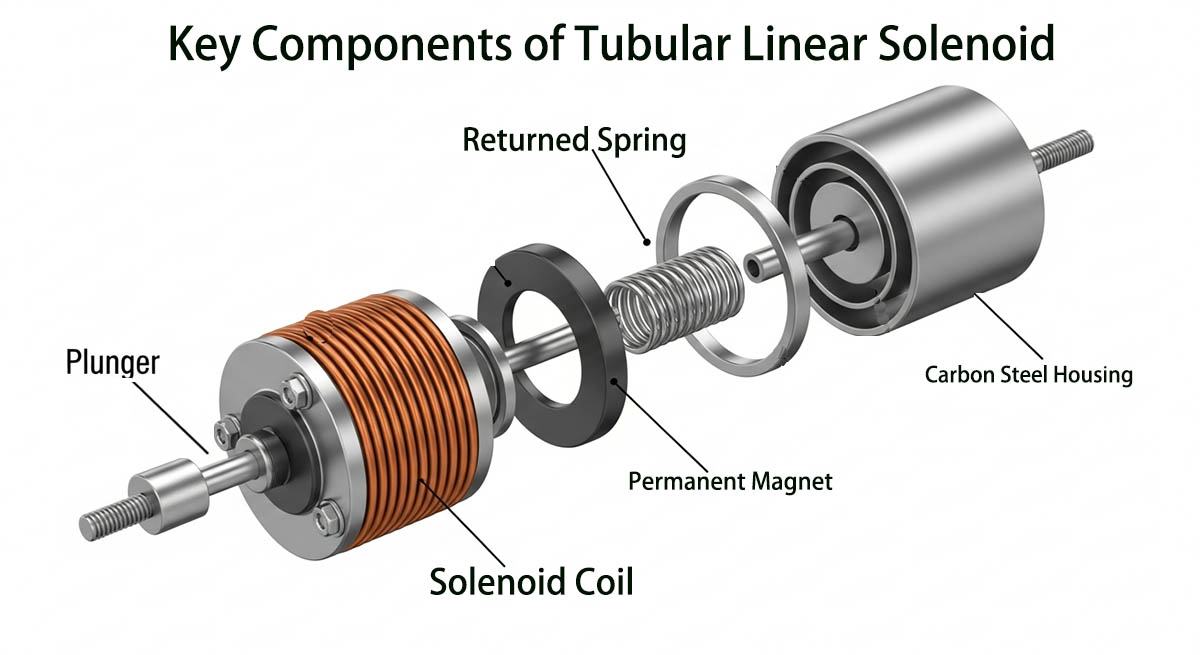
The most important parts of a DC Linear Solenoid are:
Coil (Copper Winding): This produces a magnetic field when an electric current flows through it.
Iron Core/Housing: This provides support for the structure.
Plunger (Armature): This is a piece of iron which can be moved and make other objects move.
The plunger returns to its initial position when the return spring is disconnected.
Bobbin/Insulation: This holds the coil winding’s in place and stops them touching each other.
Chapter 5: How a DC Linear Solenoid Works
It works by using electricity:
The coil receives electricity when a DC voltage supply is used.
The coil produces a magnetic field.
The magnetic field attracts a piece of iron called a plunger.
The plunger can be pulled in or out of the coil.
When electricity supply is disconnected:
The magnetic field disappears.
The return spring pushes the plunger back to where it was initially.
Key point:
The amount of force depends on the current, number of coil turns, air gaps, and magnetic circuit design.
Chapter 6 : Key parameters of DC Linear Solenoid
The datasheet for a DC Linear Solenoid will normally include:
Electricity Parameters
Rated voltage (VDC)
The coil’s resistance (Ω)
The current drawn (A)
The use of power (W)
The duty cycle ( 10%–100%)
Settings for Mechanics
The length of the stroke in mm
The holding force (N)
The initial force or the pull force in relation to the stroke curve
The time to answer (ms)
The power of the return spring
Things that change the environment
The temperature range for operation
The type of insulation
The IP rating or the level of protection
Performance Curves
The force vs. stroke curve
The increase in temperature compared to the present
The duty cycle in relation to the power limit
Chapter 7 : DC Linear Solenoid Design Guide
When building or putting together a DC linear solenoid,
7.1 Force vs. Stroke
The longer the stroke, the less the force.
Verify the end of the stroke has the correct amount of force.
7.2 Duty Cycle and Heating
For things to work properly, things need to stay within a certain temperature.
Don’t let the coil get too hot.
7.3 Picking the Right Voltage
Verify the voltage is the same as the voltage rating.
Overvoltage makes things stronger but also cuts their life short.
7.4 How well magnets work
To make things work even better, make the distance between the magnets even smaller.
Improve the materials used for the magnetic path
7.5 The Machine’s Load
The weight of the load, the friction, and the alignment must be considered.
7.6 How to Get Back
The coil’s force and the spring’s power must be the same.
7.7 The world around you
The temperature, the humidity, the dust, and the vibration must not interfere with the solenoid.
7.8 The stability of the power supply
A steady DC supply guarantees that everything is done the same way each time.
Chapter 8 : DC Linear Solenoid application
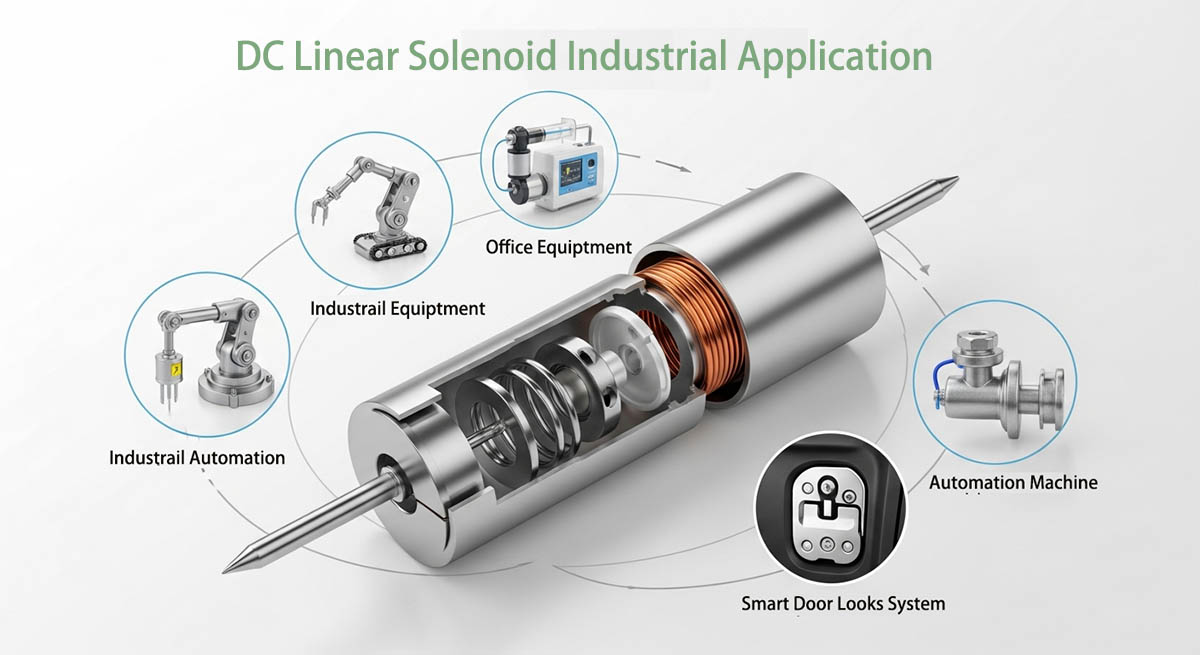
DC linear solenoids are used in a number of applications:
Automotive: door latches and fuel injectors
Industrial: actuators and sorting equipment
Medical: gadgets such as pumps, valves, and diagnostics
Home appliances: gadgets such as coffee makers and washing machines
Security: gadgets such as electric locks and security doors
Locking and dispensing: gadgets that dispense items for sale
Office equipment: gadgets such as printers and copiers
Gaming: gadgets such as coin slots and ejectors
Chapter 9 : DC Linear Solenoid Pros and Cons
The Pros of DC linear Solenoid
Easy to use and design
Fast response time
Inexpensive
Reliable and durable
Easy to turn on and off
Compact and easy to grow
Disadvantages
Short stroke distance
Stroke distance decreases the power
It produces heat while in use
May need cooling time for continuous use
No control over position
Uses a lot of power when used continuously
Chapter 10 : How to Choose a DC Linear Solenoid
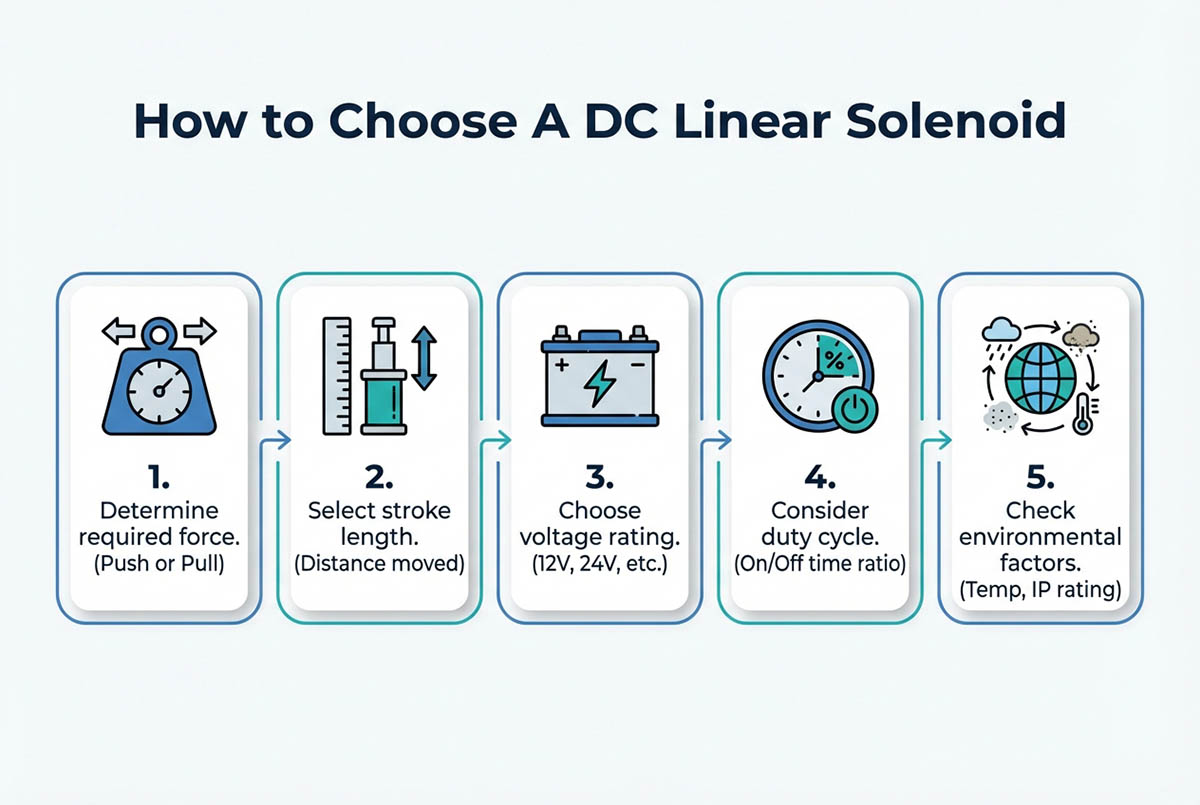
When selecting the best DC linear solenoid for a project or system, the following should be considered:
10.1 The amount of force needed
The load force is the amount of force needed, considering friction and a security margin
10.2 Length of stroke
The stroke should move the correct distance
10.3 The power and voltage source
Verify that it is compatible with the system voltage
10.4 The duty cycle
Intermittent or continuous use
Select the correct rating for the application
10.5 The environmental conditions
The conditions of the environment in which the solenoid is used
The weather, the temperature, and the humidity
10.6 Restrictions on Size
Space in the application for physical space
10.7 Time to Answer
Required speed of activation
10.8 Putting together and putting up
Mechanical interface, direction, and how to install it
10.9 Things that are needed for a lifetime
Expectations about how long the cycle will last and how reliable it will be
10.10 Safety Margin
Make sure to leave a space of 20% to 50% above the needed force when you design.
Chapter 11 : Questions and Answers of DC Linear Solenoid
11.1 What makes a solenoid different from an electromagnet?
A solenoid is used to generate controlled linear motion, while an electromagnet is generally used to make a magnetic field to hold or lift things.
11.2 Can a DC solenoid work all the time?
Yes, but only if it is made for a continuous duty cycle and is kept at the proper temperature.
11.3 What makes a solenoid get hot?
This is due to the coil’s resistance as well as the flow of current.
11.4 What causes the solenoid force to change?
The coil has current.
How many turns there are, as well as the space between them
The material at the center
Making a magnetic circuit
11.5 How can I make the solenoid stronger?
Increasing the voltage, though not too high.
Improving the magnetic path
Making the space between turns in air smaller.
Improving the design of the coil
11.6 What does the duty cycle signify for a solenoid?
This refers to the percent of time spent on as opposed to the entire cycle.
11.7 What happens if the voltage goes over the rated value?
The solenoid gets stronger, though it can get too hot and break.
11.8 How long does a DC solenoid work?
A solenoid can work for millions of cycles as long as it is used within correct settings. However, this depends on its use as well as the environment.

