How to Choose a Ferrite Coil?
The right choice of the ferrite coil depends on its electrical, mechanical and application requirements.
1.Choose Operating Frequency
Operating frequency is one of the most important parameters. Magnetic properties of different ferrite materials vary at different frequencies. Select a ferrite rod coil for your desired frequency band.
2.Check the Inductance Value
Inductance is a property that shows how the coil works when connected to electrical circuits. Required inductance value depends on the circuit design, tuning requirements and signal processing conditions.
3.Select Appropriate Ferrite Material
Ferrite materials differ in permeability, loss characteristics and temperature stability. High-quality ferrite material ensures good efficiency and stability of the coil.
4.Considerations about Coil Size
The rod length, diameter, winding space and mounting options should correspond to the equipment design. Small ferrite coils for compact applications and large cores for high sensitivity applications.
5.Check Wire Specifications
The diameter of the wire determines the current carrying capacity, resistance and mechanical strength of the coil. Select the appropriate wire diameter for your electrical requirements.
6.Consider Environment
Reliability of the operation should take into account the temperature range, humidity, vibration and industrial conditions.
7.Customize the Ferrite Coil
Manufacturers can customize ferrite rod coils according to the OEM applications’ requirements in inductance, frequency, size, connector type and packaging.
8.Check Supplier Quality
Choose suppliers with rigorous quality control system, accurate test equipment and manufacturing expertise.
System efficiency and reduction of the signal loss is guaranteed by proper selection of the ferrite rod coil, providing reliability of its operation.
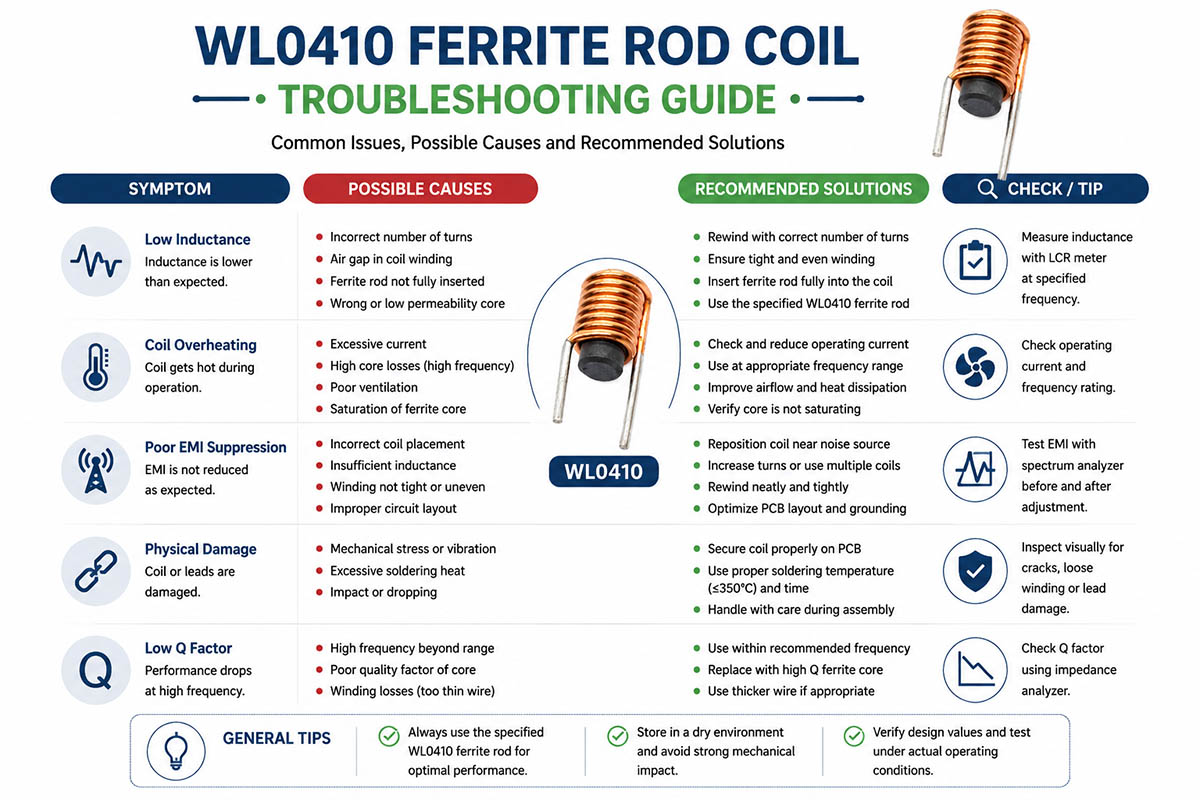
Ferrite Rod Coil Design Tips To Avoid Common Mistakes
Selection of the Wrong Ferrite Material
Different ferrite materials are used for different frequencies. Selection of inappropriate ferrite material may result in loss of signal.
Neglect of the Inductance Tolerance
Minor inductance variations may affect tuning accuracy and circuit performance.
Faulty Coil Winding Design
Wrong spacing or wire choice may result in additional resistance and loss of efficiency.
Neglect of Temperature Effects
Properties of ferrite change with temperature thus affect its stability.
Bad Mechanical Design
Lack of adequate protection may lead to damage during assembly and operation of the coil.
Electromagnetic Interference (EMI) Mitigation
Tests should be conducted appropriately to avoid noise and signal distortion.
Non-Conducting Final Performance Test
Prototype testing before mass production is vital.