High Force Large Push Pull Solenoid Manufacturer
Heavy Duty Large Push Pull Solenoid Solutions
Custom Large Push Pull Solenoid for Machines
Large Push Pull Solenoid for Motion Control Systems
Large Push Pull Solenoid Supplier for Industry
Large Push Pull Solenoid for Automation Equipment
High Force Large Push Pull Solenoid Manufacturer
Heavy Duty Large Push Pull Solenoid Solutions
Custom Large Push Pull Solenoid for Machines
Large Push Pull Solenoid for Motion Control Systems
Large Push Pull Solenoid Supplier for Industry
Large Push Pull Solenoid for Automation Equipment

WL1253 Large Push Pull Solenoid for Industrial Automation Solutions

A large push pull solenoid is an electromechanical component that converts electrical energy into mechanical motion in the form of linear actuation. It includes a solenoid coil and a ferromagnetic core, typically with a plunger, that slides in and out of a guiding tube.

The electric current passing through the coil creates a magnetic field that magnetizes the core. The magnetic field exerts a magnetic force on the plunger that pulls the latter into the coil (the “pull” effect). After turning off the current, the plunger slides out from the coil as a result of a spring effect or the magnetic field created by the coil when the current changes direction (the “push” effect).

Large Push Pull Solenoid Product Overview

The Heavy Pulls Solenoid is an electromagnet intended for high performance applications in harsh industrial environments. It has a strong coil assembly, a precision-machined plunger, rugged housing and an optimized magnetic design. The product provides stable push and pull force with good repeatability and long life. It is available in different voltage options, stroke lengths, and force levels and can be customized according to customer requirements. The solenoid is ideal for automation equipment, industrial machinery, security systems and motion control applications.

How Does a Large Push Pull Solenoid Work?

The large push pull solenoid works according to the principles of electromagnetism. When the coil is supplied with DC voltage, the electrical current creates a magnetic field around the winding. This magnetic field pulls or moves the internal plunger through the magnetic core.

The direction of movement depends on the mechanical design. In the case of push-pull design, the plunger can be used for applying force in both directions . Thus, the solenoid can push and pull .

The force generated depends on a number of parameters:

Position of coil and current level

Magnetic circuit design

Length of air gap

Plunger diameter

Stroke length

Material selection

When power is turned off, the return spring or external mechanism moves the plunger back to its initial position.

Important Features of Large Push Pull Solenoid

Large Push Pull Solenoids have several key features for industrial applications. They provide high force output with reliable push and pull operation. The solid metal housing ensures mechanical strength and protection during operation. The optimized electromagnetic design guarantees efficient energy conversion and stable operation. These solenoids are offered with customized voltage, stroke, force, mounting design and duty cycle. Thanks to their compact size, they are easy to integrate into automation and industrial machines. They have long service life, fast response time, low maintenance needs and good repeatability that makes them suitable for industrial operation.

Compact Large Push Pull Solenoid Video

Compact Large Push Pull Solenoid Detailed Display

Compact Large Push Pull Solenoid Technical Datasheet

Brand Weilong Technology Model Number WL1253
Rated Voltage (V) DC6-60V Rated Power (W) 10-100 W
Work Mode Push and Pull Holding Force (N)  1N to 10 N
Stroke (mm) 2-10 mm or customized Working Duty Continuous or 100-80%
Service Life 200 Thousand Times Certification CE, RoHS, ISO9001,
Material Superior Magnet Iron Lead Wire Length (mm) 200 MM
Install Style Screw Tolerance of Dimension ± 0.1 MM
Water-proof None Insulation Class B
Hi-Pot Test AC 600V 50/60Hz 2s Non-excitation Holding Force 0
Working Temperature -10°C-100°C Duty Cycle 1-100%
Thread Depth(mm) / Payment Term TT, or LC at Sight
Sample Order Yes. Warranty 1 Year
MOQ 1000 pcs Supply Ability 5000 pcs per week
Delivery Time 30 Days Port of Loading Shenzhen

Why Is a Large Push Pull Solenoid So Popular?

Large push-pull solenoids have become popular due to the increased demands for compact, reliable, and efficient motion control solutions in modern industries.

Automation technologies increased demands for electromagnetic actuators, which provide precise and repeatable motion. Large push-pull solenoids offer fast response, easy electrical control, compact design, and high force output.

They use fewer components and have easier maintenance than hydraulic or pneumatic systems. They are good for smart manufacturing, as they are able to integrate directly into electronics control systems.

With the development of robotics, industrial automation, security equipment, medical devices, and intelligent machines, the applications increase.

With the advancements in coil technology, magnetic circuit design, and manufacturing process Large push-pull solenoids are becoming more efficient, durable, and cost-effective for industrial customers around the world.

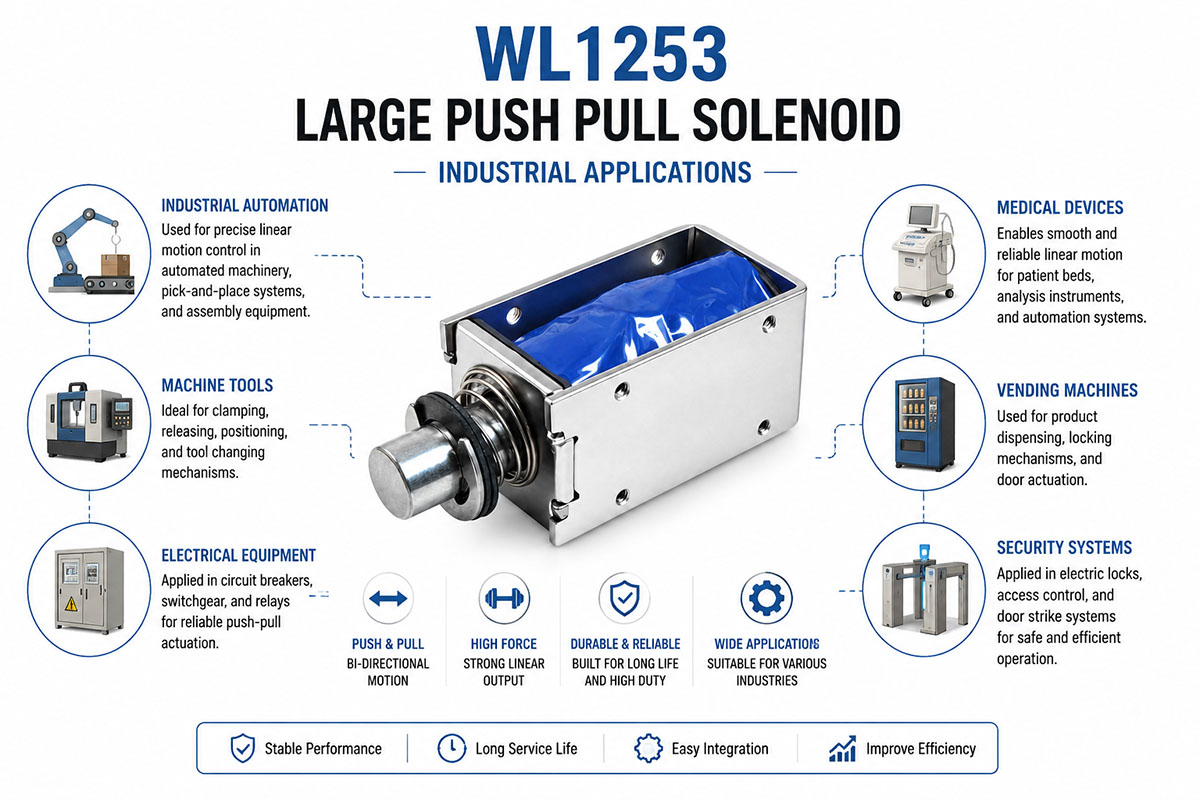
Compact Large Push Pull Solenoid Industrial Application

Large Push Pull Solenoid Industrial Application

The large push pull solenoid is widely used in industrial applications, where powerful and reliable linear motion is required.

In industrial automation they control mechanical motions, such as clamping, positioning, locking, and release operations. Large push-pull solenoids are used in automated assembly machines due to their precise movements and quick response.

These solenoids are also used in machine tools for fixture control, tool change systems, and mechanical positioning devices. They can generate high forces and can be incorporated into heavy duty industrial equipment

They are used in electric locks, access control devices, and door mechanisms in security systems. They provide reliable locking and unlocking operations.

Large push-pull solenoids are also being applied in medical devices for adjustable mechanisms, movement control, and positioning systems, where precision and reliability are critical.

Other applications are vending machines, industrial testing equipment, electrical cabinets, transport equipment, and special automation systems.

Due to their high force output, compact design, and easy electrical control, large push-pull solenoids are increasingly used as replacements for traditional mechanical actuators in modern industries.

How to calculate the large push-pull solenoid force for your automation project need

Large Push Pull Solenoid Force Calculation for Your Automation Projects

One of the crucial tasks in designing an automation system is determining the appropriate force for your large push-pull solenoid. If the solenoid is undersized, it won’t move the load. Oversizing the solenoid would increase its cost, power consumption, and installation area. Proper force calculation is necessary for reliability, increased service life, and efficient performance.

1. Understand Solenoid Force

Solenoid force depends on the total load force, which needs to be moved. The equation is as follows:

Required Solenoid Force = Load Force x Safety Factor

Typical safety factor:

For light-duty automation: 1.2 – 1.5

Industrial applications 1.5-2

In case of heavy vibration and impacts: 2-3

For instance:

For your automation mechanism, if the mechanical load force is

50 N

Safety factor to be used:

2.0

Solenoid force needed:

50N + 50N = 100N

You need to choose a solenoid with a fat leastess than 100N.

2. Determine Load Force

Load force includes the following:

2.1 Gravity Force

In case of vertical movement:

F = m * g

Where:

F = Force (N)

m = Mass in motion (kg)

g = acceleration due to gravity (9.8 m/s²)

For instance:

If the moving mass is:

5 kg

Gravity:

5 * 9.8 = 49N

This load requires more than 49N of force to be lifted.

2.2 Friction Force

For sliding mechanisms:

F = μN

Where:

μ = coefficient of friction

N = force normal

For example:

For mobile platform:

Loading: 100N

Coefficient of friction:

0.2

Force of Friction:

100 × 0.2 = 20N

2.3 Spring Force

Most push-pull solenoids operate against a return spring.

Spring force.

F = kx

Where?

k = spring rate (N/mm)

x = compression distance (mm)

For instance:

Spring rate:

5 N/mm

Compression:

10 mm

Spring force:

5 * 10 = 50N

3. Determine Solenoid force at different stroke positions

Important point in solenoid design:

The solenoid force varies along the stroke.

Generally speaking:

The maximum force is in the end position.

A large air gap decreases force.

The starting force is less than holding force

For example:

A large push-pull solenoid might have the following:

Stroke Position Force

0 mm – 150 N

5 mm – 100 N

10 mm – 60 N

15 mm – 30 N

Please pay attention to the force vs. stroke graph in solenoid specifications.

4. Determine Required Holding Force

In cases of:

Electric locks

Clamping devices

Position holding mechanism

It is the holding force that counts.

Calculation:

Holding Force > Static Load x Safety Factor

For example:

Required clamping force:

80N

Safety factor:

1.5

Holding force needed:

1.5 * 80 = 120N

Select a solenoid able to hold more than 120N.

5. Consider Duty Cycle and Heating

The coil temperature affects the force of large push-pull solenoids.

Greater force usually requires the following:

More turns of coil

Increased current

Greater power consumption

Continuous operation check:

Duty cycle formula:

Duty Cycle=ON Time/(ON Time+OFF Time)*100

For instance:

Solenoid ON:

5 sec

OFF:

20 secs

Duty cycle:

5 ÷ (5+20) × 100 = duty cycle 20 %

A 20% duty cycle solenoid cannot replace a 100% duty cycle one always.

6. Separate Push Force from Pull Force

Large push-pull solenoids have different

Force applied

Traction force

Because of changes in the magnetic circuit.

For example:

Solenoid specifications:

Pull force: 150 N

Thrust force: 80 N

If your device requires 120a push force of 120 N, this model will not fit, even withhigh pull force.

7. Example Calculation for Automation Equipment

Use:

Automatic locking system

Minimal requirements:

Load moving: 8 kg

Horizontal movement

Friction coefficient: .15

Spring force: 30 N

Safety factor: 2

Step 1: Determine friction

Support force:

8 kg * 9.8 = 78.4 N

Friction;

78.4 x 0.15 = 11.8N

Step 2. Add spring force.

Load:

1

11.8N + 30N = 41.8N

Step 3. Safety factor application

41.8 × 2 = 83.6 N

Recommended Solenoid:

≥100N Large Push-Pull Solenoid

8. Large Push-Pull Solenoid Selection: Parameters To Be Checked

Engineers should verify the following before choosing a model:

✅ Push force required (N)

✅ Pull force required (N)

Stroke distance (mm) ✅

✅ Operating voltage (12 VDC / 24 VDC / 48 VDC)

✅ Duty cycle (%)

✅ Frequency of operations

✅ Size of installation

✅ Operating temperature

✅ Connection way

9. Common Design Errors in Solenoid Force Calculation

9.1 Estimating the force by load weight only

Real force includes friction, spring force, and safety factor.

9.2 Ignoring stroke length

While a solenoid has a high holding force, it may have insufficient starting force.

9.3 Use of maximum force value

Always check the force at the required stroke length.

9.4 Duty cycle is ignored

Running a high-force solenoid for a long period makes it hot.

9.5 No consideration of push-pull discrepancy

Always be cautious and check both forces.

Conclusion

To determine the proper solenoid force, you need to analyze the whole mechanical system. Load weight, friction, spring force, stroke distance, and duty cycle are to be taken into account. When designing industrial automation systems, using a solenoid with an appropriate force margin and duty rating provides reliable movement, increased service life, and machine efficiency.


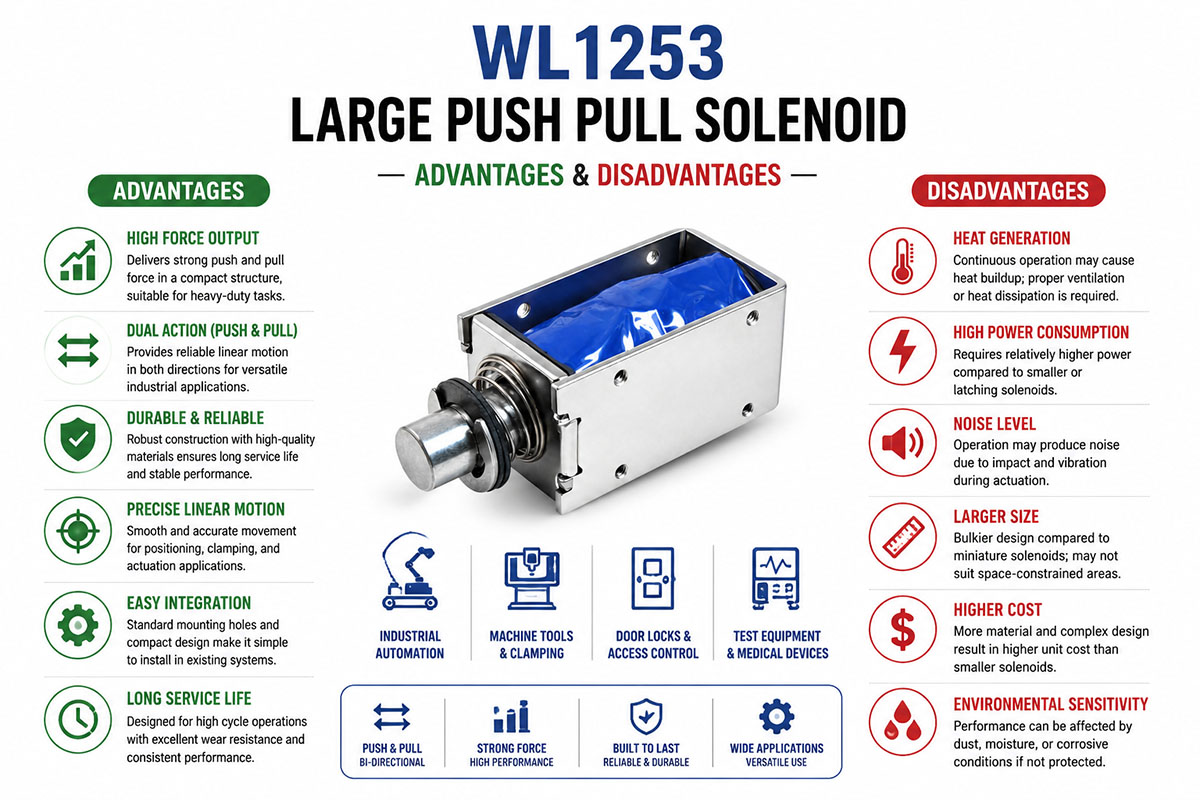
Compact Large Push Pull Solenoid Advantage and Disadvantage

Large Push Pull Solenoid Advantage and Disadvantage

Large Push Pull Solenoid Advantages

The large push pull solenoids generate powerful electromagnetic force in a small mechanical structure. The greatest advantage of the large push-pull solenoids is that they operate in two directions. You can push or pull with them. They provide high response speed, easy electrical control, and integration into automated systems.

Metal construction makes it very reliable for industrial environments. Fewer components and low maintenance requirements compared to pneumatic or hydraulic actuators.

They are highly customizable in voltage, force, stroke, and mounting.

Large Push Pull Solenoid Disadvantages

There are some disadvantages of large push-pull solenoids as well. Models with high force usually require larger coils, which consume more power and produce more heat. Additional cooling may be required when it is intended for continuous operation.

The stroke of the solenoid is usually shorter than the stroke of the pneumatic cylinder. Incorrect load matching, duty cycle, or environmental conditions may affect the performance.

The initial cost of such a switch may be higher than small solenoids, but the right design and selection will provide you excellent value.

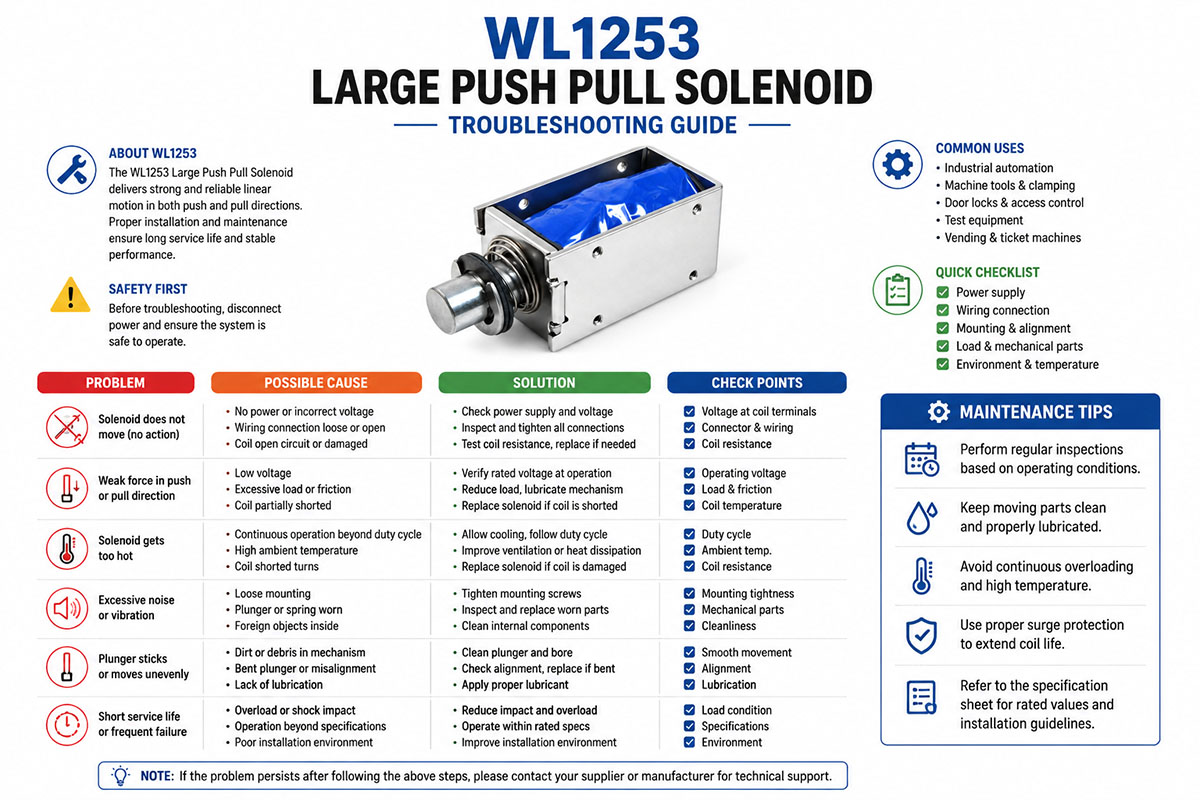
Large Push Pull Solenoid Troubleshooting  Guide

Large Push Pull Solenoid Troubleshooting Guide

Typical large push pull solenoid problems are electrical, mechanical, and installation issues.

The large push-pull solenoid does not work.

Possible causes:

No power supply

Wrong voltage

Loose wires

Damaged coil

Solutions:

Check input voltage.

Check the wiring connections.

Measure the resistance of the coil.

Weak Push/Pull Force

Possible causes:

Inadequate voltage

Over mechanical loading

Wrong stroke design

Solutions:

Check rated voltage.

Load reduction

Choose a suitable model.

Overheating

Possible causes:

Duty cycle running

Inadequate ventilation

Wrong voltage

Solutions:

Cut down operating time

Enhance cooling.

Parameters for electrical test

Vibration or Noise

Possible causes are

loose fitment

Mechanical friction

Internal wear

Solutions:

Tighten installation screws

Check the moving parts.

Apply good lubrication.

With regular inspections and proper operating conditions Large push-pull solenoids may be used for a very long period of time. ___

Frequently Asked Questions about Large Push Pull Solenoid

FAQ 1: What is a Large Push Pull Solenoid?

Large Push Pull A solenoid is an electromagnetic actuator designed for generating strong linear motion in either a push or pull direction. Large push-pull solenoids convert electrical energy into mechanical motion via the coil, magnetic core, and plunger structure. Large push-pull solenoids outperform standard solenoids in force output, stroke, and durability, making them perfect for industrial automation, machine tools, security systems, medical devices, and control applications.

FAQ 2: How does a Large Push Pull Solenoid work?

When the electric current passes the coil of the Large Push Pull Solenoid it generates a magnetic field. The magnetic field attracts or repels the inner plunger to generate linear mechanical motion. Depending on the design structure the plunger provides the force in push and pull direction. When the current stops the plunger returns to its original position with the help of a spring or an external mechanical load. The generated force depends on coil design, voltage, current, air gap, stroke distance and efficiency of magnetic circuit.

FAQ 3: What are the Major Applications of Large Push Pull Solenoids?

Large push-pull solenoids are widely used in industrial applications where reliable linear motion and high force output are required. Typical applications are Industrial automation equipment, CNC machines, assembly systems, electric locks, access control systems, vending machines, testing equipment, medical devices, electrical cabinets, and mechanical positioning systems. They are especially suitable for applications where fast response, precise movement, and extended service life are required.

FAQ 4: How do I choose the right Large Push Pull Solenoid?

There are several key points you should consider when choosing the right Large Push Pull Solenoid:

Force required to push and pull

Length of stroke

Supply voltage

Cycle ratio

Operating frequency

Dimensions for mounting

Environment

Mounting process

The solenoid should be selected according to actual mechanical load and not only according to its physical size. Experienced solenoid manufacturer will be able to help you to select the right Large Push Pull Solenoid. _____

FAQ 5: What’s the difference between a Large Push Pull Solenoid and a regular solenoid?

The major differences are the force capability, size and application range. Large push pull solenoids have bigger coils, more powerful magnetic circuits and more durable mechanical structure to produce higher force. Standard solenoids are used for small loads and simple control functions. Large push pull solenoids are used in industrial equipment where higher actuation force, higher reliability and longer operating life are required.

FAQ6: Can you run a large push pull solenoid continuously?

It depends on duty cycle and coil design. Some Large Push Pull Solenoids are rated for continuous duty (100% duty cycle) some – for intermittent duty only. As the coil generates heat during continuous operation, the correct selection of voltage, heat dissipation, and working environment should be considered. For continuous duty operation, you should select the Large Push-Pull Solenoid, specially designed for continuous duty applications.

FAQ 7: Why does a big push pull solenoid get hot when it is being run?

The electrical resistance of the coil produces heat as a normal by-product. But too high a temperature is an indication of such problems as

Power supply over-voltage

Working above the rated duty cycle

Over mechanical loading

Bad ventilation

Incorrectly specified coil

You should make sure that the large push-pull solenoid works under rated parameters and, to avoid overheating, enhance heat dissipation and select the correct coil design according to the application requirements. __

FAQ 8: Are Large Push Pull Solenoids Customizable?

Yes. Large push-pull solenoids can be manufactured according to the customer’s requirements. Custom options are:

Voltage (12VDC, 24VDC, 48VDC, etc. )

Force push and pull.

Stroke length

Mounting structure

Shaft design

Type of connector

Duty cycle

Materials —

Professional solenoid manufacturers can provide design support, prototype development, testing, and manufacturing for various industrial applications.

How To Select A Large Push- Pull Solenoid?

An appropriate large push-pull solenoid should be selected according to application requirements and operating conditions.

1. Determining the Required Force

First of all, you should calculate the required push and pull force. The solenoid should be capable of producing sufficient force to drive the mechanical load with safety margins taken into account.

2. Stroke Distance Assessment

Stroke is the distance the plunger travels while operating. A larger stroke usually requires a bigger-sized design and reduces the force capacity.

3. Check Operating Voltage

The most common are 12V DC, 24V DC, and 48V DC. Voltage has to be compatible with the power and control system.

4. Determining The Duty Cycle

The duty cycle is how often and how long the solenoid is energized. Special coil designs with efficient heat dissipation are needed for continuous operation.

5. Installation Space Considerations

Make sure you check mounting dimensions, shaft direction, fixing holes and other mechanical mounting requirements.

6. Environment Considerations

Its performance may be influenced by the following: temperature, dust, moisture, vibration, and corrosion. It is necessary to select the right protection level and the right materials.

7. Choose a reliable manufacturer

A professional solenoid manufacturer should provide you with technical support, a testing report, a customized design, and quality assurance.

The right large push-pull solenoid will give you better efficiency, extended service life, and reliable system performance.

Tips for a Large Push Pull Solenoid Design: Avoiding Common Mistakes

Do not select a solenoid based on its size. Force and stroke are important parameters.

Do not overlook the duty cycle requirements. Special coil design required for continuous operation.

Do not neglect the heat generation when working long hours.

Make sure the mechanical load is equal to the actual solenoid force.

Do not over-stroke, as this decreases the magnetic efficiency.

Verify installation space before finalizing the design.

Select appropriate materials according to the working environment.

Consider the return spring force for the total load.

Do not select the wrong voltage.

Prototype Development: Work together with an experienced solenoid manufacturer.

Get A Free Quote Now

Contact Form

Related Products

Related News

Scroll to Top

Get A Free Quote Now !

Contact Form
If you have any questions, please do not hesitate to contact us.
Weilong Solenoid Company Culture