Ferrite Magnetic Coil for Wireless Power Systems
Ferrite Magnetic Coil for Automotive Electronics
Ferrite Magnetic Coil High Frequency Power Solution
Ferrite Magnetic Coil for Energy Conversion Systems
Ferrite Magnetic Coil with Low Loss Performance
Ferrite Magnetic Coil Custom Solutions for Industry
Ferrite Magnetic Coil for Wireless Power Systems
Ferrite Magnetic Coil for Automotive Electronics
Ferrite Magnetic Coil High Frequency Power Solution
Ferrite Magnetic Coil for Energy Conversion Systems
Ferrite Magnetic Coil with Low Loss Performance
Ferrite Magnetic Coil Custom Solutions for Industry

WL0416 Ferrite Magnetic Coil for High Efficiency Industrial Use

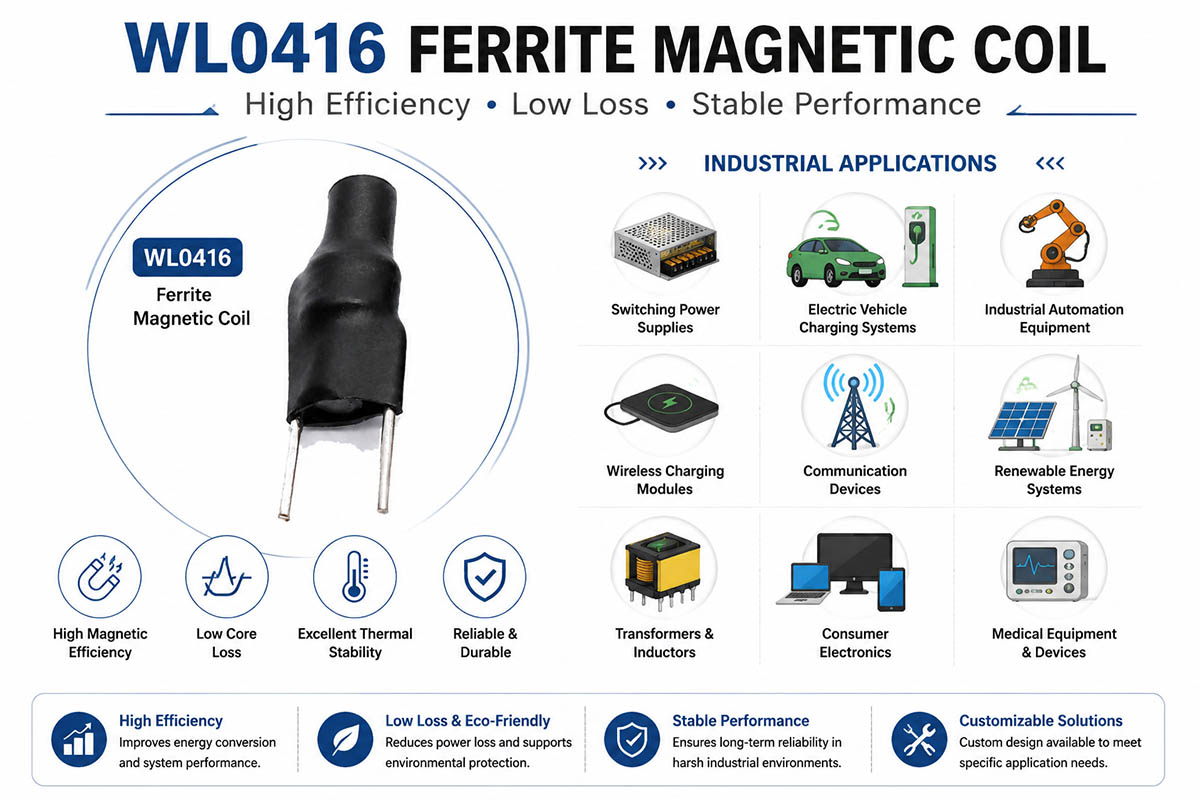
Ferrite Magnetic Coil is a high quality magnetic element for efficient energy conversion. This magnetic element combines the technology of copper winding and ferrite core materials to provide high inductance, low power losses, and excellent frequency response. The ferrite core increases the efficiency of the coil, decreases its size and weight. Ferrite Magnetic Coils find wide application in switching power supply, RF circuit, charging device, automotive electronics, communication equipment, industrial control system.

The Ferrite Magnetic Coils can be manufactured using advanced manufacturing technology and customized to different requirements on wire diameter, winding structure, inductance value, operating frequency and mechanical dimensions. They represent reliable solutions for engineers who look for compact, energy-efficient and stable magnetic components.

Ferrite Magnetic Coil Description

Ferrite Magnetic Coil is an electromagnetic device, produced from copper winding and ferrite magnetic core. The ferrite core helps to increase inductance of the magnetic coil, decrease the energy losses, and operate at higher frequency. The ferrite magnetic coils are widely used in transformers, inductors, antennas, wireless chargers, power converters and electronic circuits. Compared to traditional iron-core coils, ferrite coils are more effective, generate less heat, and have better frequency characteristics.

How Does Ferrite Magnetic Coil Work?

The Ferrite Magnetic Coil works according to the principle of electromagnetic induction. When the current flows through the copper winding, a magnetic field appears around the ferrite core. The ferrite material has a high magnetic permeability and can amplify and concentrate the magnetic flux.

The amplification of the magnetic field increases the inductance and helps the coil to store and transfer the electrical energy more effectively. The ferrite core reduces the magnetic losses and improves the high frequency response of the coil during the AC operation.

The Ferrite Magnetic Coil is used to transfer the electrical energy between the primary and secondary winding in the transformers. It helps to save energy and control the current flow in the inductors. It increases the sensitivity of the signal and electromagnetic response of the antenna systems.

Ferrite Magnetic Coil Video

Ferrite Magnetic Coil Detail Display

Ferrite Magnetic Coil Technical

Item Description
Ferrite Magnetic Coil Enameled copper wire
Wire Diameter 0.2 (AWG options available)
Winding Type Single-layer round or sectional  winding
Core Material  Magnetic Rod
Footprint length 16 mm
Encapsulation Optional varnish, epoxy, or coating
Mounting Through-foot / Custom

Electrical Specifications (Typical)

Parameter Description
Inductance Range 0.1 µH – 50 µH (customizable)
Inductance Tolerance ±2%, ±5%, ±10%
DC Resistance (DCR) Custom
Q Factor High Q, optimized for frequency range
Self-Resonant Frequency High, application-dependent
Operating Frequency kHz to MHz range
Rated Current Custom per design
Insulation Resistance ≥75 MΩ

Why Ferrite Magnetic Coil is becoming popular?

The Ferrite Magnetic Coil becomes popular because of the needs of modern electronic systems to be more efficient, smaller and have better frequency performance. The increasing penetration of electric vehicles, renewable energy systems, wireless charging, smart devices, and industrial automation increases the need for advanced magnetic components.

Ferrite materials have good high frequency properties, low energy losses, and reliable performance at competitive prices. They are critical for modern electronics because they can decrease electromagnetic interference and improve the power conversion efficiency.

With technology trends to become compact and energy saving, Ferrite Magnetic Coils will remain an important component in future electrical and electronic innovations.

Ferrite Magnetic Coil Applications

Ferrite Magnetic Coil Manufacturing Process Guide

The Ferrite Magnetic Coil finds wide application in many industries because of its good magnetic properties and high frequency performance.

The Ferrite Magnetic Coils are used in power electronics for increasing the energy conversion efficiency in switching power supplies, DC-DC converters, adapters and voltage regulation systems.

The coils are used in automotive electronics for supporting electric vehicle charging system, battery management system, ignition circuit and electromagnetic control module.

The Ferrite Magnetic Coils are widely used in communication equipment including antennas, RF circuits, signal filtering systems and wireless communication devices due to their strong electromagnetic response.

In consumer electronics they are used in smartphones, computers, televisions, chargers and audio equipment for noise suppression and power management.

The Ferrite Magnetic Coils are used for increasing the reliability of sensors, control systems, motor drives and measuring equipment in industrial automation.

The ferrite coil structures are also used in the wireless charging technology for increasing the magnetic coupling efficiency and decreasing the energy losses.

The Ferrite Magnetic Coils still remain one of the key elements of modern electronics and energy systems due to their low loss, compact design and high-frequency capability.

Ferrite Magnetic Coil Adv. & Disadv

Ferrite Magnetic Coil Applications and Advantages

Advantages and Disadvantages of Ferrite Magnetic Coil

Pros:

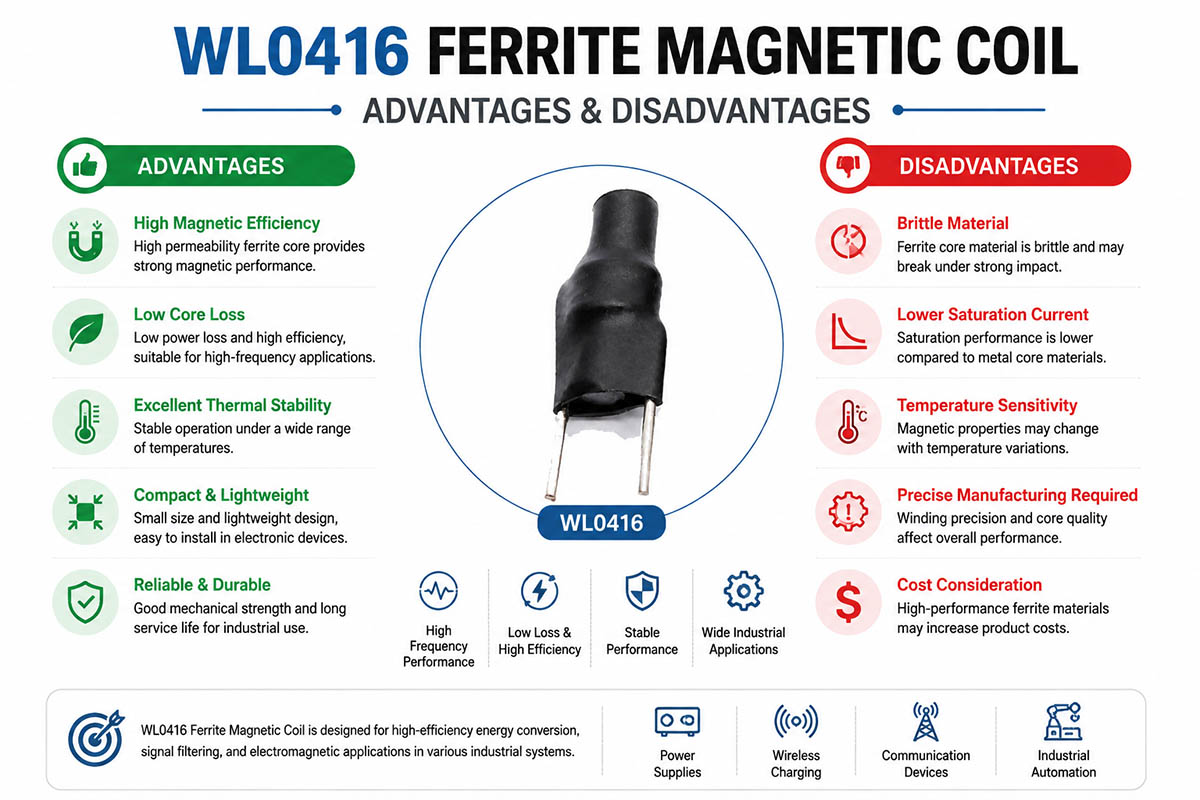
The Ferrite Magnetic Coil has many advantages, such as excellent high frequency performance, low magnetic loss, small size and high efficiency. The ferrite materials have high electrical resistance, so that the eddy current losses are reduced compared with metal cores. It allows using them for high frequency electronic applications and switching power supplies.

They have good thermal stability, reliable operation and tailoring flexibility. Their structure is light in weight, which reduces the size of equipment and makes it energy efficient.

Drawbacks:

Ferrite magnetic coils have many advantages, but they have some limitations too. The ferrite materials are rather brittle and may crack under mechanical impact . Their magnetic saturation ability is lower than some metal core materials, which limits high current applications.

The ferrite performance can also depend on the temperature and the material should be selected correctly. In manufacturing the precision is very important, because winding errors may influence inductance and efficiency.

Ferrite Magnetic Coils provide excellent performance for high frequency electronic systems, but they require proper design and matching to the application.

Ferrite Magnetic Coil Future Development Trends

Troubleshooting Ferrite Magnetic Coil

1.Small inductance value

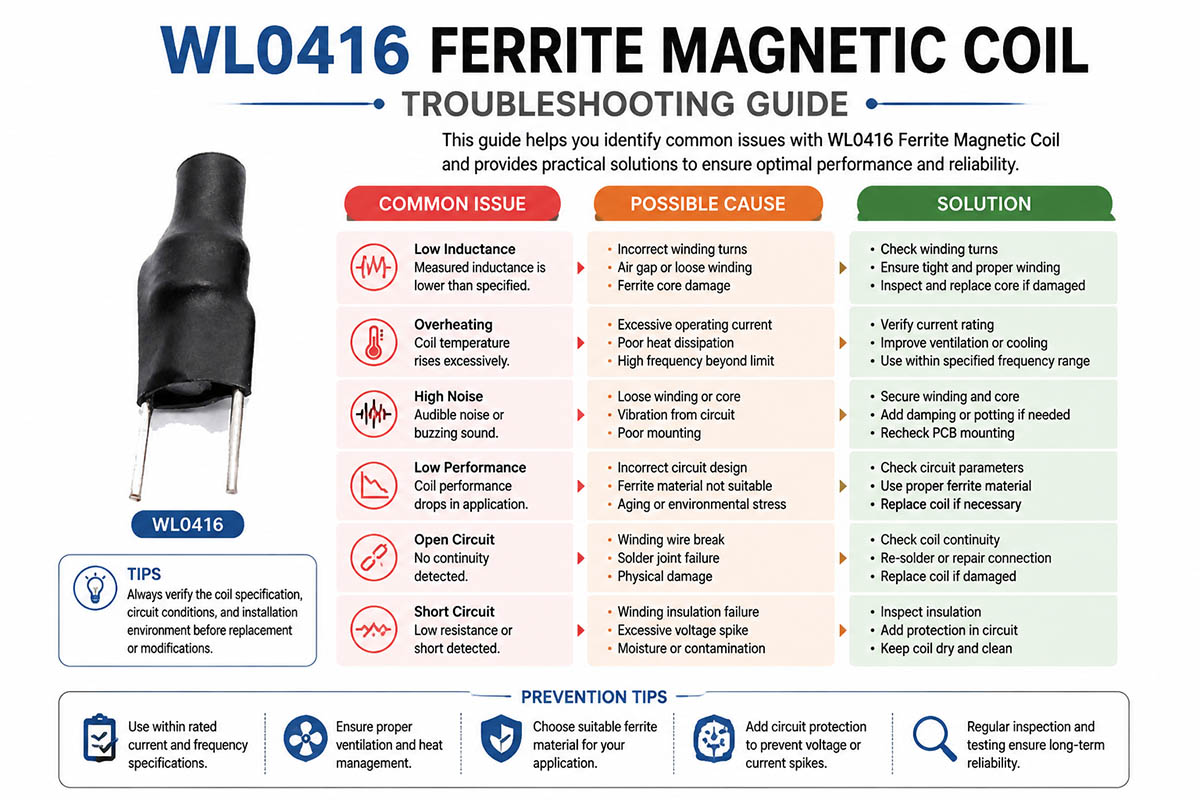
The probable causes are incorrect winding turns, damaged ferrite core, and unsuitable core material. It is necessary to check coil specs and production accuracy.

2.Overheating

Too much current . Too high frequency (beyond limits) . Wire diameter too small . It may cause overheating. It is necessary to check operating conditions and improve thermal management.

3.Magnetic Noise

Noise may be generated by loose winding, core vibration or improper circuit filtering. Better circuit design and mechanical fixings are required.

4.Lower Efficiency

Wrong ferrite material selection, high core loss or poor quality of winding may be the reasons of low efficiency. It is necessary to choose the right materials and fine tune the design.

5.Damage to the Body

The ferrite cores are brittle and may crack during assembly. Handle components carefully, check before installation.

It is necessary to conduct regular testing of inductance, resistance, temperature rise and magnetic performance to detect problems in advance and guarantee the reliable operation of Ferrite Magnetic Coil.

FAQ

1. For what purposes is the Ferrite Magnetic Coil intended?

The Ferrite Magnetic Coil is widely utilized in electromagnetic energy conversion, transmission, and noise suppression processes. It is frequently used in such fields as transformers, inductors, wireless chargers, power supply systems, antennas, automotive electronics, communication equipment, and industrial control equipment. With its help, the ferrite core improves the magnetic efficiency of the coil allowing the device to operate in high-frequency conditions.

2. What is Ferrite Magnetic Coil? How does the coil work?

The Ferrite Magnetic Coil works on the principle of electromagnetic induction. When the current goes through the coil winding made of copper, the magnetic field appears around the ferrite core. High magnetic permeability of the ferrite core increases and concentrates the magnetic flux increasing the inductance and efficiency of the energy transfer process. Therefore, it is good for signal and high-frequency power conversion.

3. Advantages of a Ferrite Coil

The advantages of Ferrite Coil include the following: low power loss, high-frequency capability, small dimensions, good magnetic efficiency, and reliability. Ferrites are efficient in reducing eddy currents and electromagnetic interference. These properties make them perfect for usage in modern electronic equipment that requires energy efficiency and reliability.

4. How to Select the Correct Ferrite Magnetic Coil?

The choice of the ferrite coil is determined by such parameters as inductance value, operating frequency, current rating, type of the ferrite material, temperature range, physical dimensions, and other application requirements. One needs to consider the connection of the specifications of the coil and circuit design.

5. In What Industries Are Ferrite Magnetic Coils Used?

Ferrite Magnetic Coils are utilized in different industries including consumer electronics, automotive industry, telecommunications, renewable energy devices, industrial control equipment, medical devices, and power electronics. Common applications include transformers, filters, RF circuits, wireless charging systems, sensors, and switching power supplies.

6. Can I Customize Ferrite Magnetic Coils?

Yes. Ferrite Magnetic Coils can be customized in accordance with customer requirements. Some modifications that may be made are: changing the size of the core, shape and winding of the coil, the diameter of the wire, inductance value, frequency characteristic, terminals, and mounting of the coil.

7. What Causes Failure of the Ferrite Magnetic Coils?

Ferrite Magnetic Coil can fail because of such reasons as the excessive current passing through the coil, overheating, wrong frequency operation, poor quality of the winding, mechanical destruction of the ferrite core, and bad choice of the materials.

8. Why Ferrite Magnetic Coils Are Used in High-Frequency Applications?

Ferrite Magnetic Coils are preferable for use in high-frequency applications because of high electrical resistivity and low core losses of the ferrite materials. They have better magnetic properties in the frequencies when the losses are higher for metal cores.

How to choose the right ferrite magnetic coil?

Choosing the right Ferrite Magnetic Coil depends on its electrical performance, environmental conditions and mechanical requirements.

1.Establishing the operating frequency

The ferrite materials are designed for different frequency ranges. For high frequency applications the appropriate ferrite cores with proper permeability and low core loss are required. For the best efficiency of the coil it is necessary to choose the appropriate material for its operating frequency.

2.Verifying inductance requirements

The inductance value influences the circuit performance directly. The engineer should choose the right Ferrite Magnetic Coil with correct inductance range according to voltage, current and circuit design requirements.

3.Verifying existing capacity

The coil winding must be able to carry the required operating current without any excessive temperature rise. For high current applications the larger wire diameter or special winding structure may be required.

4.Assessing core material

The magnetic properties of the ferrite depend on the material it is made of. It is necessary to choose materials depending on their permeability, saturation flux density, frequency range and temperature stability.

5.Verifying physical dimensions

The coil size, mounting method and terminal structure should be compatible with the design of the final equipment. For compact applications the optimized coil structure is required.

6.Quality and reliability of the tests

It is necessary to select the supplier with consistent manufacturing and electrical testing and quality control procedures.

7.Thinking about custom needs

The custom Ferrite Magnetic Coils are required in many industrial applications. It is possible to change the number of turns, wire type, insulation and connector design as parameters.

The right selection process will allow increasing the efficiency, reducing the loss, increasing the life time and reliability of electronic systems.

How to avoid common mistakes in Ferrite Magnetic Coil design

1.Do not select the ferrite material just because it is cheap, magnetic performance is more important.

2.Do not use the wrong inductance calculations that can lead to unstable circuit operation.

3.Think about the temperature, because the heat changes the properties of ferrite.

4.Do not undersize the wire, which can lead to overheating problems.

5.Operate the coil within the recommended frequency range.

6.Consider the electromagnetic interference at the design stage.

7.Prototyping test should be done before mass production.

8.Choose the professional manufacturer experienced in producing ferrite coils.

Get A Free Quote Now

Contact Form

Related Products

Related News

Scroll to Top

Get A Free Quote Now !

Contact Form
If you have any questions, please do not hesitate to contact us.
Weilong Solenoid Company Culture