

Chapter 1 : Introduction
An inductor is an electronic component that is commonly found in radio frequency circuits, power supplies, filters, transformers, audio equipment, and many industrial electronics. The performance of inductors is greatly influenced by their core material. Two common categories include air core inductors and iron core inductors.
While air core inductors use air, ceramic, and plastic inside their coils, iron core inductors use magnetic materials like ferrite, powdered iron, and laminated steel. This results in differences in inductance value, magnetic field strength, efficiency, saturation performance, and frequency range.
Air core inductors are more popular in high-frequency electronics because of their excellent signal clarity and magnetic saturation resistance. On the contrary, iron core inductors provide higher inductance and greater magnetic fields making them suitable for power electronics and low-frequency electronics.
Selecting the appropriate inductor type is extremely crucial for the performance of any circuit since it influences stability, energy efficiency, thermal behavior, and electromagnetic compatibility. This guide will compare the different inductor types to explain their features, operating principle, benefits, limitations, applications, and troubleshooting tips.
Chapter 2 : What Are Air Core Inductors?
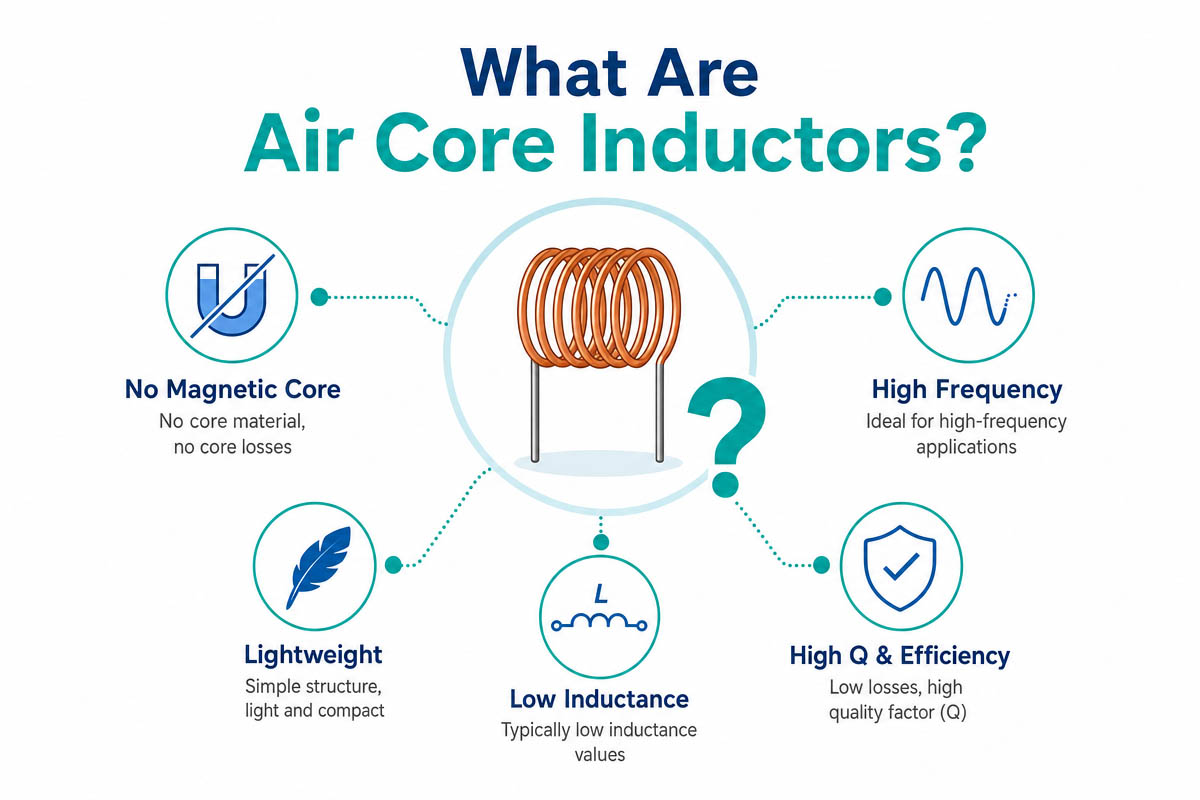
Air core inductors are inductors that use air and non-magnetic materials including ceramic or plastic as the core material for winding. As such, they do not experience magnetic saturation and hysteresis losses.
Features of air core inductors include:
Stable performance in high frequencies
Low core losses
Excellent linear behavior
High Q-factor
Low distortion
Applications include:
RF circuits
Telecom products
Wireless communication systems
Oscillators
Signal filters
Antennas
Chapter 3 : Construction of Air Core Inductors
Air core inductors are made by winding a copper wire around a structure that does not contain any magnetic material. These structures could be either air, ceramic tube, plastic bobbin, or fiberglass.
The inductance value is dependent on:
Number of winding turns
Diameter of the coil
Turn spacing
Length of the coil
Gauge of wire
Since they have no magnetic core, air core inductors do not have:
Core losses
Eddy current losses
Core saturation issues
Therefore, they can work efficiently up to a frequency of 1 GHz or higher.
Chapter 4 : How Air Core Inductors Work

When an electric current flows through a coil, it causes a magnetic field in and around the coil. For air core inductors, the magnetic field is distributed throughout the air instead of being concentrated in a magnetic core.
In absence of magnetic material:
Inductance value is constant
There is no magnetic saturation
Distortion is negligible
They exhibit improved performance at high frequencies
The drawback with this design is that without any core to concentrate the magnetic field, air core inductors require:
Many winding turns
Big inductor coils
Higher resistance
Chapter 5 :What Are Iron Core Inductors?
Iron core inductors use magnetic materials in their windings to create a stronger magnetic field.
Types of core materials include:
Ferrite
Powdered iron
Silicon steel
MnZn ferrite
NiZn ferrite
Nanocrystalline alloy
Characteristics of iron core inductors include:
High inductance
Strong magnetic field
Good energy storage capability
Small inductor size
Iron core inductors are commonly used in:
Power supply systems
Transformers
DC-DC converters
Audio systems
Industrial automation equipment
Chapter 6 : Construction of Iron Core Inductors
Manufacturing process of iron core inductors involves winding a copper wire around a magnetic core which could be toroid, rod, cylinder, or laminated.
Common Construction Techniques
Construction Type Function
Laminated Steel Core Reduces eddy current losses
Toroidal Core Minimizes EMI leakage
Powdered Iron Core High current capacity
Ferrite Core High-frequency performance
The presence of the magnetic core helps in concentrating the magnetic field leading to high inductance levels using less number of turns.
Chapter 7 :How Iron Core Inductors Work
The function of magnetic core is to provide a low resistance magnetic path where the magnetic field can pass. With a core present:
Inductance is increased
There is better magnetic coupling
Energy storage is improved
Inductor is smaller in size
Limitations include:
Core saturation
Hysteresis losses
Eddy current losses
Limited high-frequency capability
At high currents exceeding the saturation point, there is a dramatic drop in inductance value.
Chapter 8 : Air Core Inductors vs Iron Core Inductors
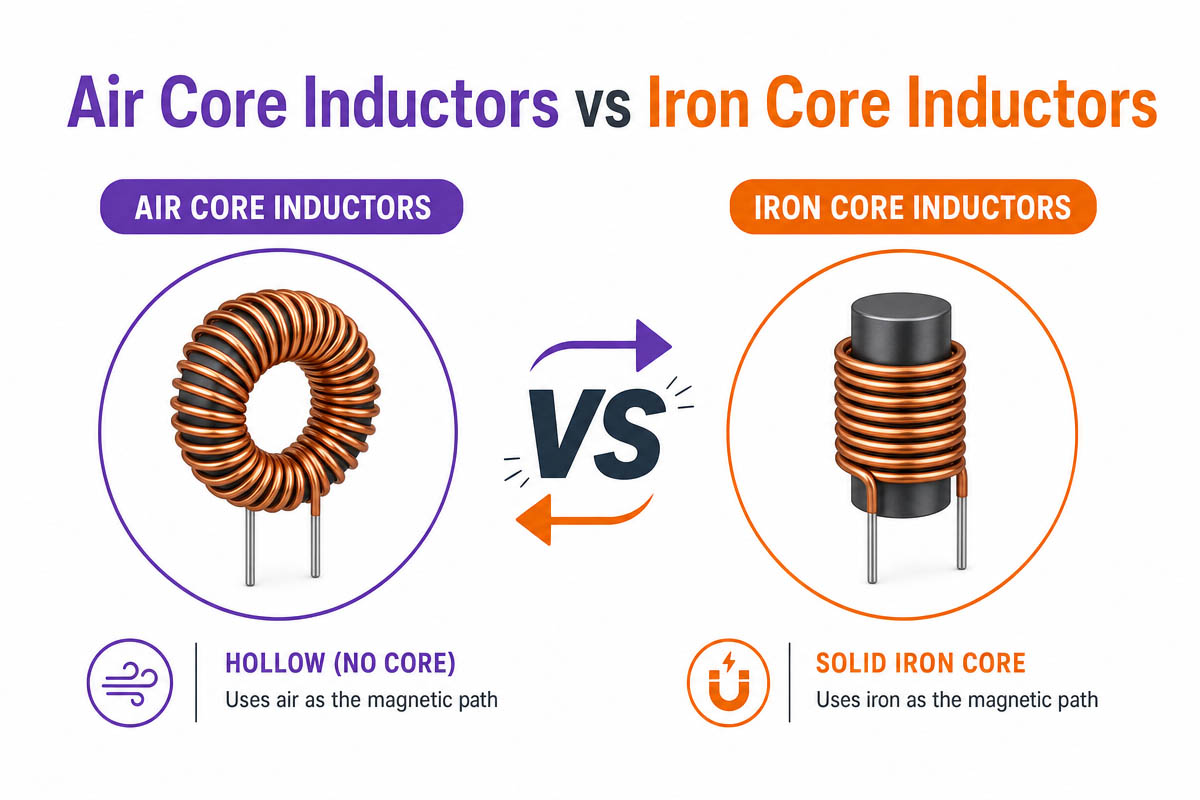
8.1 Frequency Performance
Feature Air Core Inductors Iron Core Inductors
Frequency Range Up to 1 GHz Below 100 MHz
Signal Clarity Excellent Moderate
Saturation No saturation Saturation occurs
Core Loss Zero Very low
Q-Factor High Low
Air core inductors outperform iron core inductors especially in RF and telecom devices.
8.2 Efficiency
Iron core inductors normally have better efficiency in power electronics due to high inductance levels achieved using less wire turns hence lower wire resistance.
On the other hand, air core inductors are resistant to core losses but have higher resistance.
8.3 Size & Weight
Iron core inductors tend to be:
Smaller
Lighter
Compact
Air core inductors have bigger coils to provide similar inductance level.
8.4 Cost
Inductor Type Relative Cost
Air Core Inductors Higher
Iron Core Inductors Low
Ferrite Core Inductors Medium
Air core inductors use larger amount of wire hence are relatively expensive.
Chapter 9 : Applications of Air Core Inductors
Air core inductors are common in high-frequency applications.
Examples of Applications
RF Circuits
They have constant inductance values and low distortion at high frequencies.
Wireless Communication
They are used in antennas, radios, transmitter and receiver units.
Oscillators
Produce stable oscillation at desired frequencies.
Audio Equipment
High-end audio crossover networks use air core inductors for distortion-free performance.
Electromagnetic Interference (EMI) Filters
Used to filter high-frequency electromagnetic interference.
Chapter 10 :Applications of Iron Core Inductors
10.1 Iron core inductors are mostly used in power electronics and energy storage.
Examples of Applications
Power Supplies
They are common in switch-mode power supplies and DC-DC converters.
Transformers
Iron core inductors help in producing high magnetic coupling for efficient operation.
Industrial Equipment
Industrial equipment uses iron core inductors in automation circuits and railway electronics.
Audio Systems
Iron core inductors are common in low-frequency crossover circuits.
Renewable Energy
Solar inverters and battery management systems use iron core inductors.
10.2 Advantages & Disadvantages
Air Core Inductors
Advantages
No saturation problems
Low core losses
High-frequency performance
High Q-factors
Low distortion
Limitations
Large inductor size
Expensive
Low inductance values
Higher DC resistances
Radiate EMI
10.3 Iron Core Inductors Advantages
High inductance levels
Compact design
Low wire resistance
Improved energy storage capability
Cost effective
Limitations
Susceptible to core saturation
Hysteresis losses
Eddy current losses
Less effective at high frequencies
Chapter 11 : How to Avoid Common Air Core Inductor Selection Mistakes
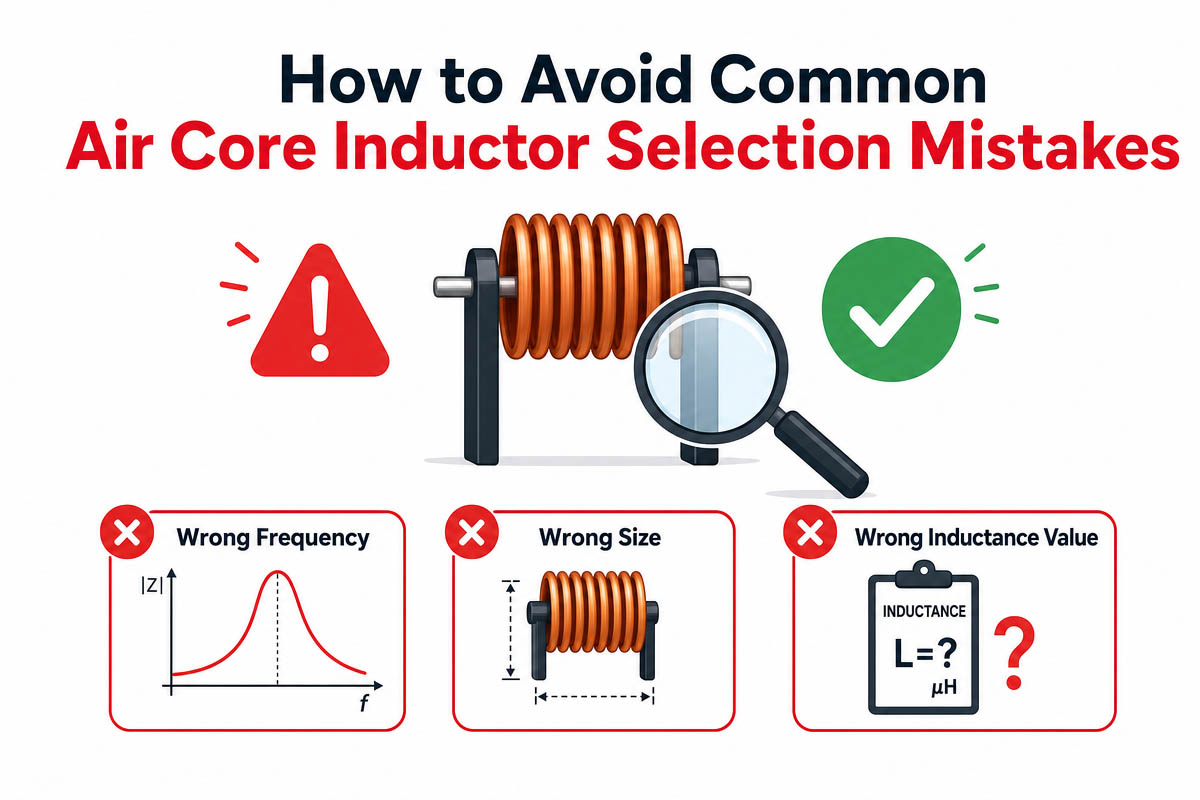
Choosing the incorrect air core inductor may cause your circuit to overheat, generate EMI interference, have distorted signals or become inefficient.
11.1 Neglecting Operating Frequency
It is a common practice among engineers to consider only inductance value when selecting an inductor.
Always remember to:
Confirm the operating frequency
Ensure that self-resonant frequency (SRF) is way above the circuit frequency
Q-factor is high
11.2 Selecting Wire of Thin Gauge
Small wire gauge leads to resistance heating.
Always consider thick wire when:
High current rating
Heat dissipation is essential
11.3 Not Considering EMI Interference
Air core inductors radiate more EM fields than shielded iron core inductors.
To minimize EMI:
Spacing between circuits
PCB grounding
Use toroidal air core inductors
11.4 Ignoring Heat Dissipation
High currents flowing through inductors cause excessive heat dissipation.
Always ensure:
Current rating is adequate
Thermal resistance is minimum
Operating temperatures are optimal
11.5 Not Checking Q-factors
Low Q-factors cause inefficient RF operation.
Always choose inductors with:
High Q-factors
Low equivalent series resistance
Chapter 12 : Air Core Inductors Troubleshooting Guide
12.1 Problem: Overheating
Possible Causes:
Over-current conditions
Resistance is too high
Poor heat transfer
Solutions:
Use thick wire
Reduce operating current
Improve cooling mechanisms
Problem: Signal Distortion
Possible Causes:
Wrong inductance value
Low Q-factor
High parasitic capacitance
Solutions:
Use high Q-factor inductors
Improve coil spacing
Minimize PCB interference
12.2 Problem: Electromagnetic Interference (EMI)
Causes:
Magnetic field interference
Unorganized PCB layout
Solutions:
Improve PCB layout
Use shields
Proper grounding of circuits
12.3 Problem: Frequency Changes
Causes:
Temperature variations
Vibrations
Ineffective coil mounting system
Solutions:
Use ceramic supports
Improve mechanical fixing system
Select high precision inductors
12.4 Tips for Engineer
Select Air Core Inductors When:
Operating frequency is high
Signal clarity is necessary
Core saturation is a problem
RF performance matters
Select Iron Core Inductors When:
Inductance value is high
Handling current is crucial
Limited space in circuit board
Desire power efficiency
Chapter 13 : Conclusion
Air core inductors and iron core inductors have unique features that make them suitable in various circuits. While air core inductors provide superior high-frequency capabilities, low signal distortion, and zero saturation, iron core inductors provide high inductance, low resistances, energy storage, and compact design.
As an engineer, you need to know how to choose the correct inductor based on your requirements of frequency, current rating, efficiency, EMI control, thermal management, and physical space.
Chapter 14 : FAQ
14.1 Where are air core inductors used?
Air core inductors are used in RF circuits, wireless communication circuits, antennas, and high-frequency filters.
14.2 Why are air core inductors free from core saturation?
They do not use magnetic materials which can saturate.
14.3 Are air core inductors good at high frequencies?
Yes. They have great performance in high frequencies because of high Q-factors.
14.4 What are the disadvantages of air core inductors?
They are bulky, expensive and have less inductance values.
14.5 Why iron core inductors have high inductance?
Magnetic core helps in focusing the magnetic field resulting in high inductance.
14.6 Can iron core inductors be used in RF circuits?
They are used in RF circuits but not in high frequencies.
14.7 How can one prevent EMI in air core inductors?
Appropriate PCB layout and grounding
Shielding the circuit
Spacious design
14.8 What happens during iron core inductor saturation?
There is rapid drop in inductance values leading to overheating, distortion and instability of operation.
14.9 What does Q-factor mean for inductors?
Q-factor indicates efficiency of an inductor.
14.10 How to select the right air core inductor?

