

Chapter 1 : Why Selecting the Proper Inductor Coil Manufacturer Counts
Apart from price, the selection of the proper inductor coil manufacturer by the buyer influences reliability, efficiency, heat performance and stability of supply.
Industries like automotive electronics, industrial automation, medical devices and smart appliances rely on consistency of performance of inductor coils. Low quality coils can cause loss of signal or overheat or even render the whole system ineffective.
This is why global buyers compare manufacturers like MEDA with other Asian and European ones, not only in terms of price, but also in terms of engineering capabilities, production consistency and customization options.
Chapter 2 : Inductor Coil Working Principle
The inductor coil is based on the principle of electromagnetic induction.
Electric current going through a coil:
Produces a magnetic field
Stores energy in magnetic fields
Opposes a change in current flow
Why buyers should pay attention:
Effectiveness of EMI suppression effects
Affects energy efficiency of circuits
Determines heat produced under load.
Affects switching stability in power electronics
Better design = better efficiency and lower risks of breakdown. In other words:
Chapter 3 : Buyer’s Guide to Different Types of Inductor coil
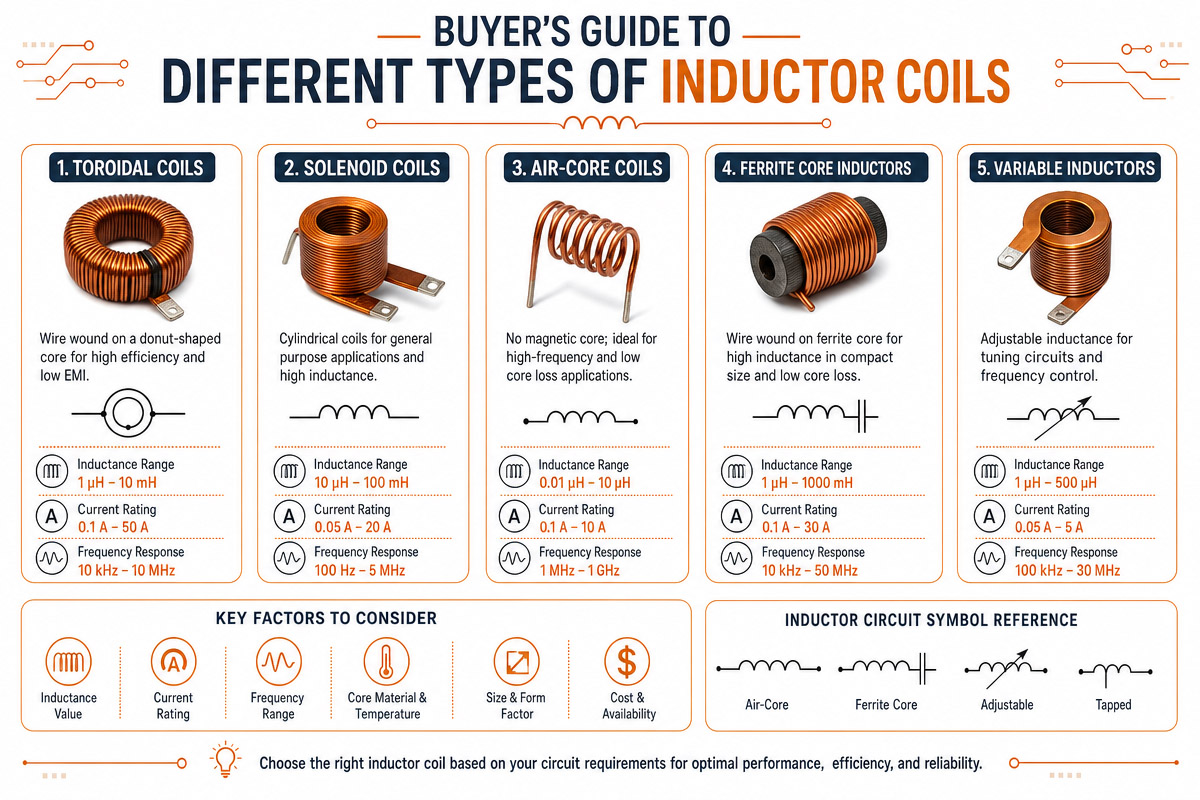
Understanding the different types of inductors is very important when buying from an inductor coil manufacturer. There are several types of inductors and using the wrong one can lead to overheating, EMI issues or low efficiency.
Below there is a buyer-oriented description of the major types of inductors.
3.1. Air-Core Inductors
Air core inductors use no magnetic core material, only the wound coil.
Key features:
- No core losses (no magnetic saturation)
- Ideal for high frequency applications
- Lower inductance than core type
What buyers should know:
- Ideal for RF circuits and precision signal applications
- Not suitable for high current power systems
- Larger coil size may be needed for more inductance
3.2. Ferrite Core Inductors
Ferrite core inductors are among the most popular types of inductors used in power electronics.
Key characteristics:
- High magnetic permeability
- High EMI suppression effect
- Energy efficient
Buyer considerations:
- Ideal for switch mode power supplies (SMPS)
- Risk of core saturation under high current
- Temperature stability depends on ferrite type
Such inductors are widely requested in industrial and automotive-grade designs.
3.3. Iron Powder Core Inductors
Iron powder core inductors use iron powder for making a core.
Key characteristics:
- Distributed air gap (lowers the risk of saturation)
- Excellent energy storage capabilities
- DC bias stability
What buyers should take into account:
- Widely used in DC-DC converters
- Higher saturation tolerance than ferrite
- Higher core losses at high frequencies
3.4. Toroidal Inductors
Toroidal inductors are wound on ring-shaped core.
Main features:
- Extremely low EMI leakage
- Energy efficient and compact
- Excellent magnetic confinement
What buyers should consider:
- Popular in medical, audio and precision systems
- More complicated and expensive to produce
- Ideal for noise-sensitive environments
3.5. Laminated Core Inductors
They are made of stacked laminated steel sheets.
Key characteristics:
- High current handling capabilities
- Long life in industrial loads
- Good for low frequency applications
What buyers should be aware of:
- Used in heavy electrical applications and power conditioning.
- More size and weight
- Not suitable for high frequency circuit
3.6. Surface Mount Inductors
Designed for today’s compact electronics.
Main features:
- Small size
- Compatible with automatic PCB assembly
- Inductances available in a wide range
What buyers should consider:
- Ideal for smartphones, IoT devices, wearables
Responsive to heat stress
- Requires tight manufacturing control
3.7. Rod Core Inductors
They use straight rod of ferrite or iron as the core.
Key features:
- Simple construction
- Economical design
- Intermediate inductance performance
What buyers should take into account:
- Widely used in consumer electronics and filters
- Inferior EMI performance compared to toroidal ones
- Good for budget applications
Chapter 4 : Major Applications of Inductor Coils
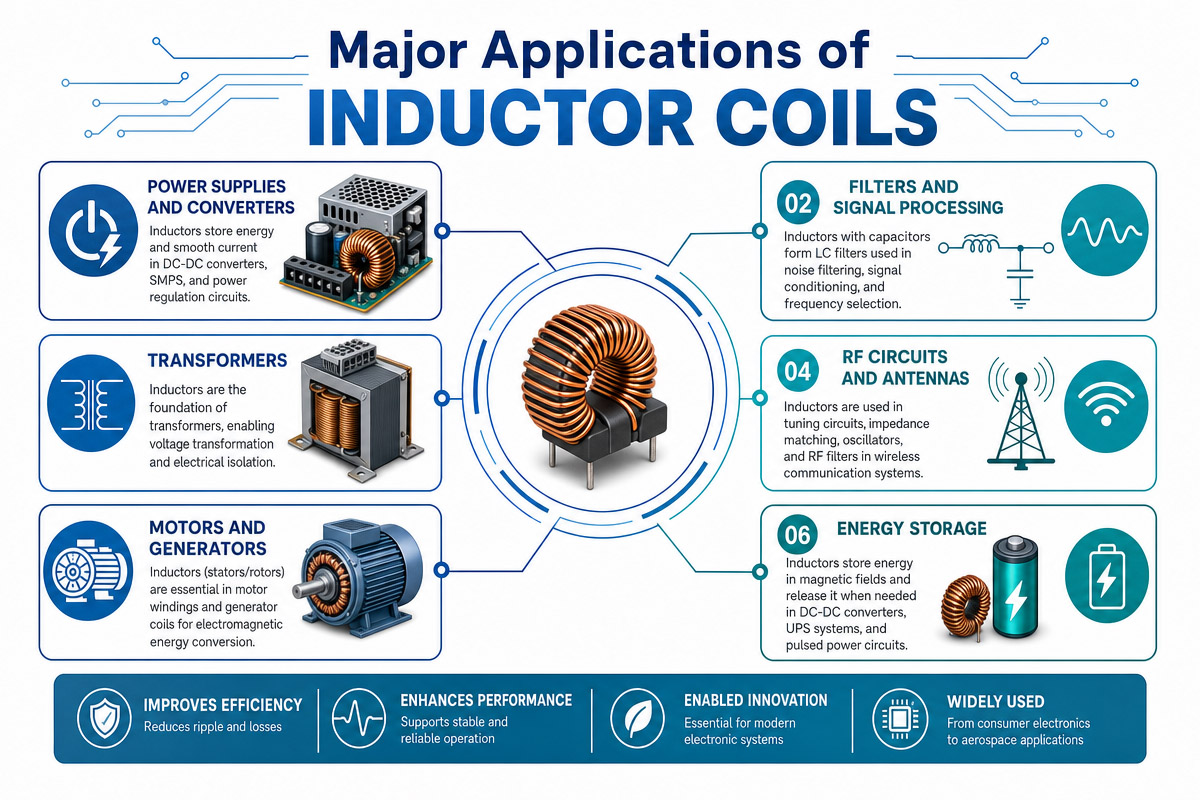
Inductor coils are among the most common passive electronic components in modern electrical and electronic systems. They are vital for energy storage, filtering and electromagnetic control in power conversion, communication and other applications.
Below there is a simple, buyer-oriented overview of the major applications of inductor coils.
4.1. Power Supply and Energy Storage Systems
One of the most important applications of inductor coils are in switch mode power supplies (SMPS) and DC-DC converters.
When current flows, inductor coils store energy in a magnetic field and release it when the current drops. This allows to:
- Lower voltage oscillations
- Raise conversion efficiency
- Stabilize the output power
What to consider:
- Laptop power bricks
- Rapid chargers for smartphones
- Industrial power modules
- Server power systems
4.2. EMI/RFI Noise Filter
Electromagnetic interference (EMI) is one of the major issues for modern electronics. EMI filters often use inductor coils to filter out high frequency noise.
This allows to:
- Minimize electrical noise
- Protect sensitive circuitry
- Improve signal integrity
Typical applications:
- Sound Equipment
- Medical devices
- Automotive Electronics
- Communication systems
4.3. RF Systems and Wireless Communications
Inductor coils are especially important in radio frequency (RF) circuits. Inductor coils are used along with capacitors to form LC circuits.
They are used for:
- Tuning signals
- Selecting frequencies
- Matching impedances
Applications are:
- Smart Phone
- Wi-Fi routers
- RFID systems.
- Radio transmitters and receivers
4.4. Automotive Electronics
Automotive electronics relies on inductor coils for ensuring electronic stability and safety in the modern car.
They are used for:
- Engine control units (ECU’s)
- Electric vehicle traction systems
- Battery management system (BMS)
- LED lighting systems »
Inductors guarantee reliable current flow in tough automotive environments, including temperature fluctuations and vibrations.
4.5. Industrial Automation Equipments
Inductor coils are used in control circuits and power regulation modules in industrial facilities and automation systems.
They are used for:
- Motor controls
- PLC systems
- Robots controlers
- Industrial sensing
They are ideal for continuous operation because they are reliable and durable
4.6. Electronics for the Home
At least one inductor coil is present in every consumer electronic device.
Examples are:
- TV’s and set-top boxes
- Gaming consoles
- Smart home appliances
- Wearables
Also they provide small electronic designs with compact power regulation and efficient energy use.
4.7. Renewable Energy Systems
Inductor coils are very important in solar inverters and wind energy systems where efficiency of power conversion is essential.
They are used for:
- Converting from DC to AC power
- Reliable power output from solar panels
- Improving grid stability
4.8. Medical Devices
High precision medical devices require reliability of the power system and noise-free operation.
Inductor coils are used in:
- MRI machines
- Patient monitoring systems
- Diagnostic imaging equipment
- Portable medical equipment
Key requirements here are reliability, low electromagnetic interference
4.9. Telecommunication Infrastructure
Inductor coils are very important for stable signal transmission in telecom systems.
They are used for:
- Base stations
- Switches and routers
- Optical communication modules
- Data Centers
They help to keep the signal clear and minimize the loss in long distance transmission.
Chapter 5 : 2026 Global Inductor Coil Market Share Insights
The global inductor coil market is moderately concentrated, featuring a small number of Asian manufacturers, especially Japanese companies, taking the lion’s share of the market and numerous Chinese and other foreign companies operating in the long tail.
Generally there are three factors driving the market:
- Demand for miniaturization (smart phones, IoT, wearables)
- High growth power (EVs, data centers, renewables)
- Asia Pacific manufacturing leadership
🔑 Market Structure (Global)
5.1. Major Players (Global 2,000+)
Industry analysts suggest that the market share of the top five suppliers represents a large share of the global market:
- Murata Manufacturing Co., Ltd. — 18 percent
TDK Corporation — ~16%
- Taiyo Yuden Co., Ltd. – ~8%
- Delta Electronics — ~6%
Sunlord Electronics — ~5%
- Others (Vishay, Sumida, Coilcraft, Panasonic, etc.) — ~47%
👉 This results in semi-concentrated market where top players dominate the high-performance segments (automotive, RF, high frequency power).
5.2 Regional Market Share Overview
The Asia-Pacific region, featuring electronics manufacturing ecosystems in China, Japan, South Korea and Taiwan, dominates production and consumption globally.
- Asia-Pacific: ~75%+ of world market
- North America: ~10–12%
- Europe: ~10-12 percent
- Other <
Why Asia Pacific Dominates
- Huge electronics OEM/EMS ecosystem
- Presence of Murata, TDK, Taiyo Yuden, Sunlord
- Concentration of EV and smartphone manufacturing
- Affordability of the supply chain integration
5.3 Market Characteristics
-
Technology department
- High power wire wound inductors (EV, Servers)
- Multilayer chip inductors (for mobile, RF and small electronics)
- Molded power inductors (industrial mid-power use)
-
Application drivers
- Consumer electronics (largest volume segment)
- Automotive electronics (greatest growth segment)
- Telecom & RF systems
- Power systems in industry
Chapter 6 : Advantages and Disadvantages of Inductor Coils
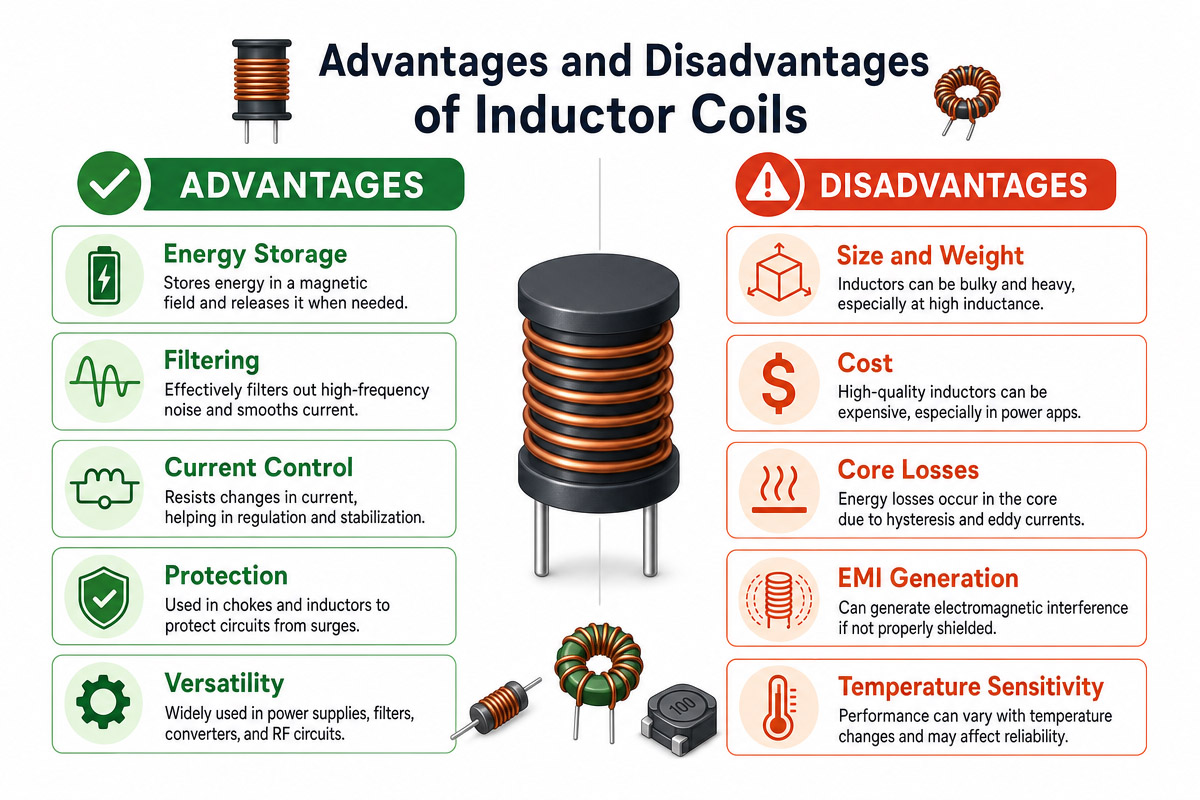
6.1 Inductor Coil Advantages
Inductor coils are widely used in electrical and electronic systems because of the possibility of storing energy in magnetic field and controlling current flow. The ability to store and filter energy very effectively is among the main advantages. They allow to smooth power supplies fluctuations, minimize electrical noise and increase the stability of the circuit. Inductor coils are also very reliable and durable and thus suitable for industrial and automotive applications thanks to having no moving parts. They are used in RF and communication systems for tuning of signals and control of frequencies for achieving stable performance. They also allow supporting high-power applications like electric vehicles, renewable energy systems and industrial automation.
6.2 Inductor Coil Disadvantages
But there are disadvantages of inductor coils. It makes the production of miniaturized portable devices difficult for high inductance values because of their bulky and heavy nature. They can also suffer from energy losses due to resistance (copper losses) and core losses which makes them inefficient at high frequencies. The disadvantage is electromagnetic interference (EMI) because poorly designed inductors can cause EMI. Another issue is sensitivity of inductor to the changes in temperature and core saturation at high currents. Finally, good quality inductor coils are often expensive, especially automotive, RF and precision electronics inductors.
Chapter 7: Comparing Inductor Coil Manufacturers
7.1 Inductor Coil Manufacturer performance, quality, cost and supply
Buyers evaluate inductor coil manufacturers in terms of performance, quality, cost and supply. The first factor is the electrical performance specifications which include inductance value, rated current, saturation current, resistance (DCR), and frequency response. Good inductor coil manufacturer should be able to provide stable performance within temperature and loading conditions.
Then buyers assess the quality of materials and manufacturing capacities. It includes core materials (ferrite, powder iron or alloys), winding precision and insulation technology. Such companies which produce their own tooling, stamping and winding automatically usually have better quality and less defects.
Quality certifications and testing standards are important too. International buyers prefer ISO 9001, IATF 16949 (for automotive) and RoHS compliance.
7.2 Inductor Coil Manufacturer performance, quality, cost and supply capacity and lead time
Another factor is production capacity and lead time. In such sectors as EVs and consumer electronics the stability of supply is very important and thus manufacturers with scalable production lines are preferred
Buyers evaluate the ability to customize, for instance, design inductors for particular applications like power supplies, RF circuits or automotive systems.
7.3 Inductor Coil Manufacturer global support and cost
Finally, buyers take into account the global support and cost competitiveness. Low price is attractive but reliability, technical support and after sales service are often more important.
7.4 The main evaluation criteria:
Choosing suppliers is not simply comparing datasheets from purchasing perspective.
-
Engineering capabilities
is the manufacturer able to tune inductance, resistance and form factor?
-
Quality of Materials
Purity of copper
Quality of ferrite cores
Insulation system reliability
-
Stability of production
Batch to batch stability
Defect rate control
-
Certificates
ISO 9001:2015
IATF 16949 (automotive)
RoHS / REACH compliance
-
Cost versus performance trade-off
Lowest price is not always the lowest total cost.
Chapter 8: How to Choose the Best Inductor Coil Manufacturer
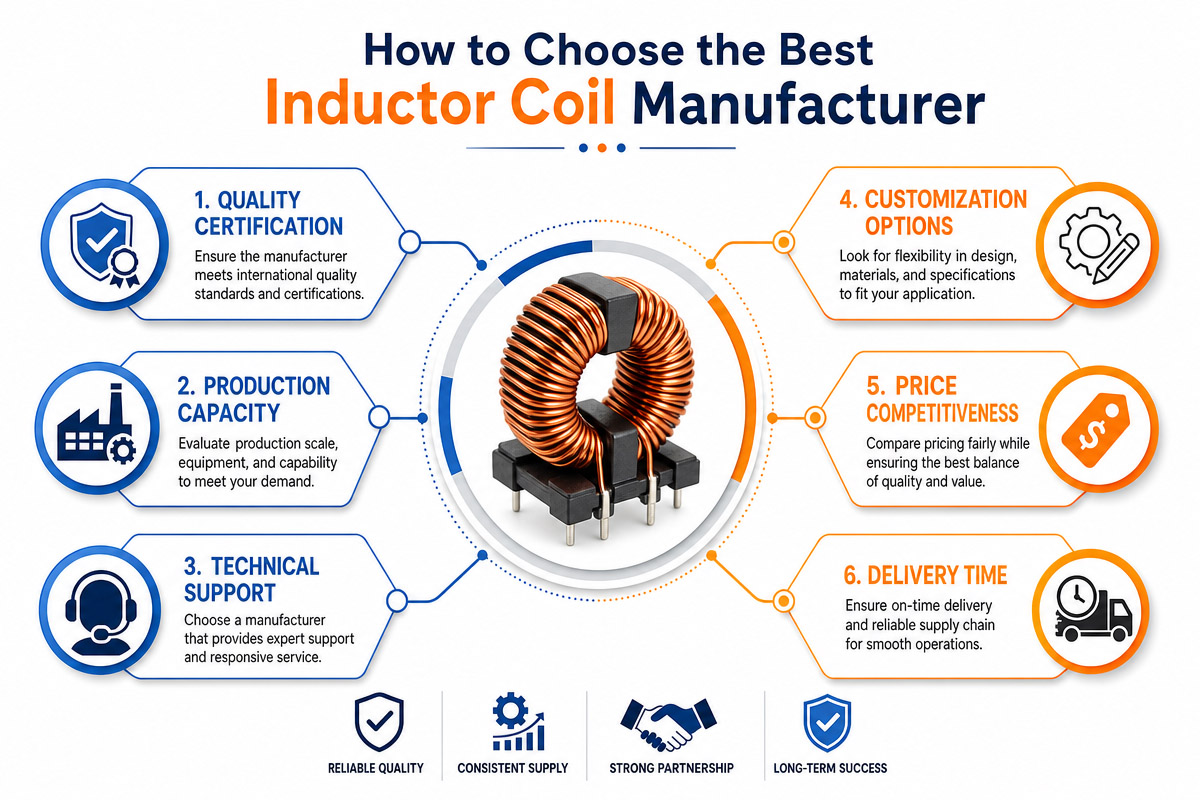
8.1 Inductor Coil Manufacturer technical capabilities and quality
When selecting inductor coil manufacturers, buyers should take into account their technical capabilities and quality consistency first of all. Reliable inductor coil manufacturer should be able to provide stable inductance values, low resistance losses and precise winding control. Buyers should ensure that the supplier uses high quality copper wire, ferrite core materials and automated manufacturing process. Compliance and reliability of inductors are also indicated by ISO and RoHS certificates. Knowledge of working principle of inductor coil and matching it with your application, power electronics, automotive or industrial control is very helpful to ensure the stability of performance.
8.2 Inductor Coil Manufacturer MOQ and Customization
In addition to technical specifications, buyers should compare pricing, MOQ, lead time and engineering capabilities. Reliable inductor coil manufacturer should be able to provide customization for inductance range, current ratings and coil types. Buyers should request samples and test them in real world conditions before placing bulk orders. MEDA and Weilong Technology are popular choices for many global clients because of their production stability and export experience. Finally, buyers should also estimate communication speed and potential of long-term cooperation. Both of them are very important for the efficiency of supply chain and product reliability.
8.3 Inductor Coil Manufacturer bottom line
The bottom line is that choosing the right inductor coil manufacturer guarantees fewer failures, increased efficiency and long term stability for your product whether it is for industrial or automotive purposes. Technical communication and quality testing standards further ensure the buyers around the globe regarding the supply chain.
8.4 Some practical tips from buyer’s perspective:
✔ Always request samples
Real load performance is more important than datasheets.
✔ Verify thermal performance
Heat is the number one failure mode.
✔ Verify personalization capability
A good supplier should evolve.
Wire Size
Material principal
Design of shapes
Mounting Method
✔ Verify communication speed
Often the speed of reaction of engineering department shows the maturity of production.
✔ Verify long-term stability of supply
Avoid the suppliers who cannot guarantee consistent scaling.
Chapter 9: The reasons why global buyers choose Weilong Technology for inductor coils
Weilong Technology’s integrated manufacturing and engineering support business model becomes more and more attractive to many global buyers.
The reasons are:
9.1 Complete production in-house
Winding, assembling and testing of coils, reducing dependence on external suppliers.
9.2 High degree of customization
Supported:
Inductors, high-frequency
Precision of wound coils
Industrial power inductors
9.3 Stable quality control system
Reduction of batch-to-batch quality variation reduces the risk of downstream assembly.
9.4 Engineering oriented approach
Not simply manufacturing, but rather application-level optimization.
9.5 Fast prototyping
Allows to reduce product development cycle.
What the buyer should know:
Weilong Technology is chosen not only for pricing but for engineering reliability + scalable production capabilities.
Chapter 10: Inductor coil Manufacturers like MEDA usually compete in:
Standard inductors
Supply chains for mass production
Cost-optimized solutions
Buyer comparison insights
MEDA-type suppliers: strong in standard volume manufacturing
Suppliers with engineering orientation (e.g. Weilong) – better at customization and application-specific solutions
Chapter 11: Common Buyer Questions (AFQs) on inductor coil manufacturer
Q1: When choosing an inductor coil manufacturer, what is the most important thing?
Price is important, but not as much as quality consistency and thermal stability.
Q2: How do I know if an inductor coil is good?
Tolerance of inductance, heat rise under load and stability of the core material should be checked.
Q3: Can any manufacturer build customized inductors?
No. Many of them only have catalog products. It requires engineering capabilities for real customization.
Q4: What is the major failure risk in inductors?
Overheating caused by bad winding design or bad core materials.
Q5: Why are prices so different between suppliers?
Quality of materials, degree of automation of production, and testing standards may vary greatly.
Q6: Ferrite or air-core? Which one is better?
Depending on frequency and application:
Ferrite EMI suppression & Power
AIR-CORE HIGH FREQUENCY CIRCUITS OF PRECISION
Chapter 12: the Conclusion of inductor coil manufacturer
Selection of inductor coil manufacturer is a strategic choice for buyers that influences performance, reliability and cost-efficiency of the product.
Comprehension:
Working principles
Genres
Applications
Market Organization
Supplier capabilities:
helps buyers to make better sourcing decisions.
In today’s global supply chain, companies like Weilong Technology and MEDA have different strengths.


