Chapter 1: Introduction to Increasing Demand for Professional Flat Air-Core Coil Manufacturers
Growing demand for sophisticated inductors occurs against the backdrop of rapid growth in the sphere of high-frequency electronics, wireless communication, medical devices, automotive electronics, renewable energy systems, and industrial equipment.
A professional flat air-core coil manufacturer is an indispensable link in the process of turning clients’ ideas into reality in terms of the creation of electromagnetic components. Custom flat air-core coils are not conventional inductors—they require special knowledge, advanced winding technologies, special material selection, and high-quality control.
For the engineers and buyers of Europe and the USA, choosing a competent manufacturer is essential. The coils are made according to drawings, but besides this, the manufacturer must provide additional engineering services, optimize design, ensure consistency in the process of manufacture, and guarantee stable supply in the long term.
Chapter 2: What is a Flat Air Core Coil?
A flat air-core coil is an electromagnetic coil, which uses air or any non-magnetic material instead of ferrite, iron powder, and other magnetic cores.
It is created via winding of conductive wire into a planar form. The form of the winding is determined by electrical requirements, available mounting space, and operating conditions.
Flat air-core coils differ from the conventional wound inductors with magnetic cores as follows:
High-frequency stability
Low core losses
Excellent linearity
Low parasitic effects.
Lightweight Frame Building
Geometry customizable
The absence of problems related to magnetic core saturation in applications, which require high frequency and high current.
The typical flat air-core coil includes:
1. Wire, Conductive
This wire is the key electrical component of the coil. The most common wires are
Enameled Copper Wire
Litz wire
Copper wire, silver-plated
Special high-temperature wire
The choice is based on:
Operation frequency
Today’s needs
Temperature range
Mechanical specifications
2. Coil Configuration
The shape of the coil has a direct impact on performance.
Typical configurations are
Flat spiral circular coils
Flat wound coils, rectangular
Square-shaped spiral coils
Custom shapes
3. Terminal Design
The client may customize the connections:
Wire leads, tin-plated
Pins
Solder pads
Connectors
Custom Terminals
The Professional Custom Flat Air-core Coil Manufacturer may optimize all parts in accordance with the final application.
Chapter 3: Advantages of Custom Flat Air-Core Coils
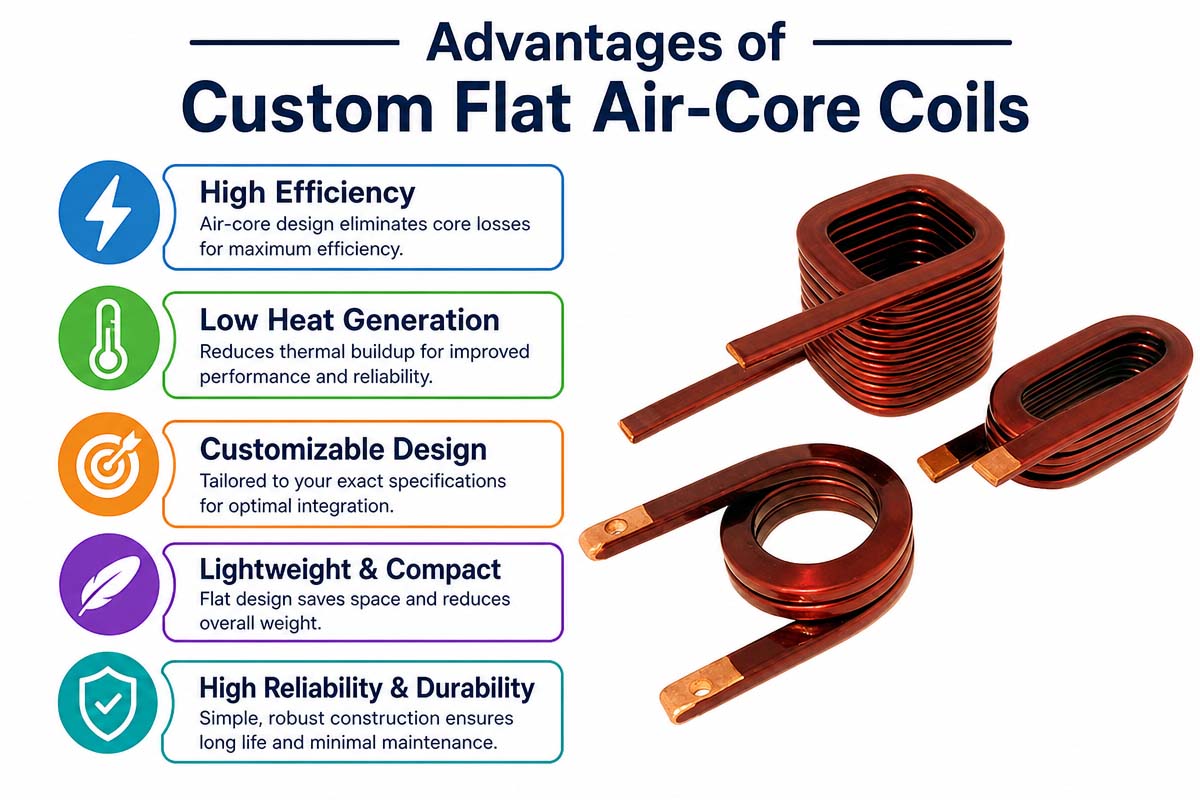
Excellent high-frequency response
The main advantage of air-core coils is high-frequency operation capability.
There are no problems related to the magnetic core, such as
Core losses
Magnetic saturation
Increase of temperature due to magnetic material
That makes flat air-core coils appropriate for use in:
Radio Frequency Circuits
Wireless charging systems
Communications equipment
Hi, frequency power electronics.
2. Compact and Space Utilization Design
Modern electronic products tend to be smaller and lighter.
Flat air-core coils are space-utilizers, as they may be very compact but still require inductance values.
They are used widely in the following spheres:
Mobile devices
Sensors
Medical electronics
Automotive modules
Professional Custom Flat Air-core Coil Manufacturer may customize:
Outside diameter
Inside diameter
Depth
Number of turns
Lead direction to fit the limited mounting space.
3. High reliability and long lifetime
Flat air-core coils without magnetic cores avoid many of the typical failure modes of conventional inductors.
Advantages are:
Electrical characteristics are stable.
Resistance to temperature changes is good.
Mechanical Reliability (sturdy)
High service lifetime
In industrial and automotive applications, initial cost is less important than reliability.
Chapter 4: Applications of Custom Flat Air Core Coils
The demand for custom flat air-core coils increases in various industrial spheres.
1. Wireless Charging Systems
Flat air-core coils are used extensively in wireless energy transfer systems.
Advantages are:
Effective electromagnetic coupling
Slimline 2.0
Wide choice of design options
Applications are:
Charging of consumer electronics
Industrial wireless power systems
Smart gadgets
2. Radio Frequency and Communications Equipment
High-frequency circuits require inductors with high performance and low electromagnetic interference.
Flat air-core coils are used widely in:
Antenna Matching Network
RF filters
Signal processing equipment
Communications modules
3. Medical Devices
Miniaturized and reliable electromagnetic components are often required in medical devices.
Applications:
Imaging devices
Sensors’
Tracking devices
Medical wireless networks
Custom designs of the coils allow engineers to create the desired electrical performance and keep the size small.
4. Electronics for Cars
The automotive industry is increasingly using complex electronic systems.
Flat air-core coils are used in:
EV charging systems
Battery Management Systems
Car sensors
Power control units
“Aerospace and automotive customers need to work with manufacturers that have robust quality systems and consistent production capability.”
Chapter 5: Flat Air-Core Coil Design Guide
The design of a custom flat air-core coil requires taking into account the numerous electrical, mechanical, and environmental requirements.
1. Identify Electric Requirements
The first step is determining the condition of the application.
The following parameters are important:
Inductance Range
Inductance is the property of the coil to store magnetic energy.
The engineer must determine:
Required inductance (uH or mH)
Inductance tolerance interval
Operation frequency
Rating
The coil must be able to withstand the expected current without overheating.
Current Capacity Considerations:
Wire diameter
Winding density
Heat dissipation
Environment
Frequency Range:
Coil performance depends highly on frequency.
At high frequencies special attention must be paid to:
Skin effect
Proximity effect
Capacitance parasitaire
All of the above parameters will be taken into account by a professional flat air-core coil manufacturer in the process of optimization of design.
2. Choose the Right Wire
Choice of wire has a huge influence on performance of the coil.
Copper Wire, Enameled
Advantages:
Value for money
Commonly available
Suitable for general-purpose applications
Litz Wire
Advantages:
Low AC resistance
Better high-frequency performance
Improved current distribution
Special Conductors Special Conductors
For advanced applications:
Silver-plate wire
High-temperature wire
Custom alloy conductors can be chosen.
3. Optimize Coil Sizing
Electrical performance of the coil depends greatly on its physical configuration.
The following design parameters are important:
Number of Turns
Usually more turns increase inductance but also increase resistance.
Spacing Between Turns
Good spacing helps reduce:
Capacity
Heat buildup
Interference signals
Coil Diameter
Coil diameter determines:
Distribution of the magnetic field
Efficiency of coupling
Installation compatibility
Professional Custom Flat Air-core Coil Manufacturer takes all these factors into account and finds the best design.
Chapter 6: Selection of Custom Flat Air-core Coils’ Wire
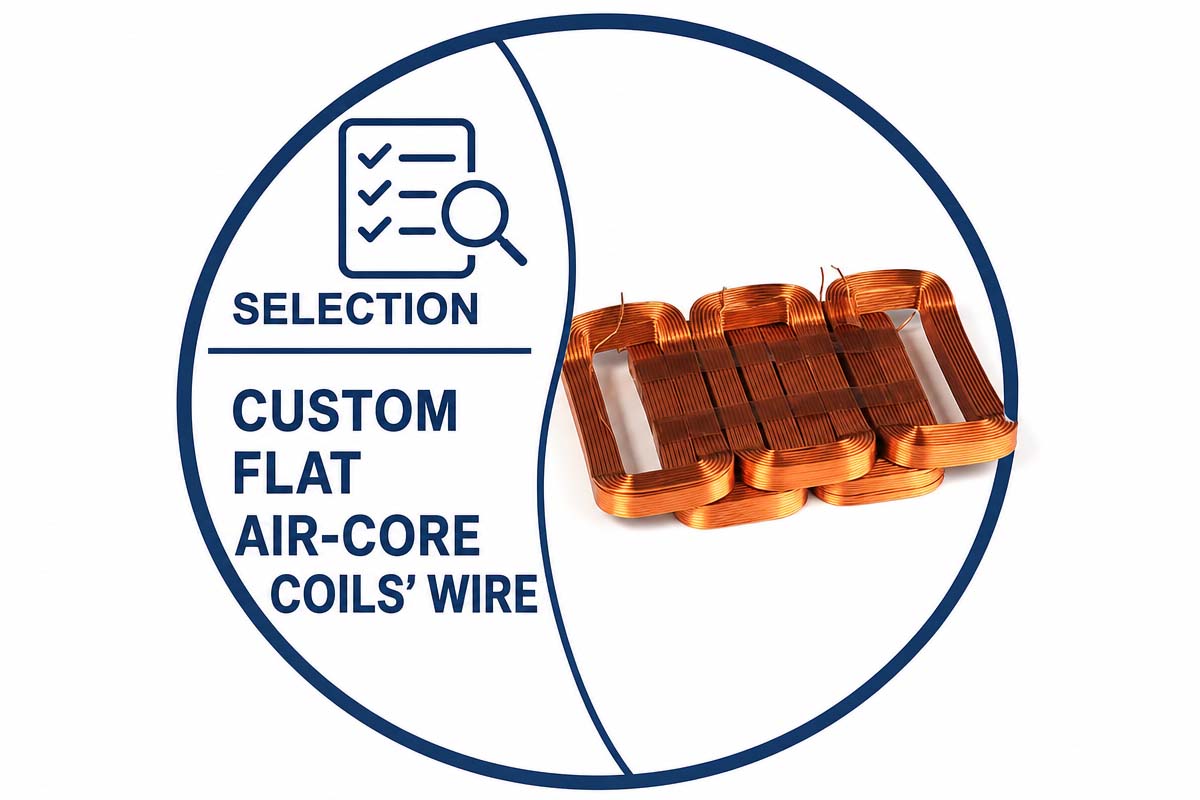
One of the most important steps in flat air-core coil design is the selection of the wire. The wire directly influences the performance of the coil, heat generation, mechanical characteristics, and manufacturability.
Professional Custom Flat Air-core Coil Manufacturer takes into account the requirements of application and selects appropriate conductor material and wire structure.
1. Copper wire, coated
Flat air core coils are most commonly created with enameled copper wire.
Advantages are:
Good electrical conductivity
Good mechanical strength
Cost-effective
widespread
Suitable for the automatic winding process
It may be used in the following applications:
Inductors in general
Detector
Low-frequency and medium-frequency circuits
Industrial electronics equipment
The diameter of wire must be chosen carefully, as it influences the following:
DC resistance
Capacity
Coil size
Increase in temperature
An increase in the diameter of the wire decreases the resistance but increases the size of the coil. Engineers have to balance electrical performance and space limitations.
2. Litz Wire
Litz wire is commonly used in high-frequency applications.
Litz wire is made of several thin insulated strands, which are twisted to minimize the skin effect and improve the current distribution.
Advantages of Litz wire are:
Less AC resistance
Higher efficiency at high frequencies
Lower heat generation
Improved electromagnetic performance
It is commonly used in
Wireless charging systems
Applications of RF
High-frequency power semiconductors
Energy Transfer Systems
Selection of the structure of Litz wire is very important in the design of a custom flat air-core coil to achieve significant efficiency improvements.
3. Silver-Plated and Special Conductors
For demanding applications, customers may require special conductor materials.
Examples of such materials are
Silver-plated copper wire
High-temperature-resistant wire
Special alloy wire
Such materials may have the following advantages:
Improved conductivity
Increased durability at high temperature
Increased environmental robustness
A professional custom flat air-core coil manufacturer should have experience in working with different types of wire materials.
Chapter 7: Flat Air-Core Coil Design Coil Optimization
After selecting the wire, it is necessary to optimize the coil design to obtain the required electrical performance.
1. Optimal number of turns
The inductance is proportional to the number of turns.
Generally, increasing the number of turns leads to:
Extra inductance
Magnetic field enhancement
More Wire
Extra resistance
So it is necessary for engineers to optimize the number of turns to get the balance between the required inductance and efficiency.
2. Optimized Coil Diameter
The electromagnetic properties of the coil are dependent on the diameter of the coil.
A bigger diameter can provide you:
Field distribution
Higher coupling efficiency
Superior performance in wireless applications
However, larger sizes can have difficulties in the installation.
It all depends on the following factors:
Space availability
Required inductance
Operating frequency
Environment of application
3. Winding Turns Spacing
The other important parameter of the coil is the spacing between turns.
It is necessary to control:
Capacitive parasitics
Heat accumulation
Electromagnetic interference
Too much spacing can lead to an increase in the coil size, and too little spacing can lead to a decrease in the efficiency.
Experienced manufacturers optimize the winding spacing using engineering knowledge and production practice.
4. Heat Control
It is necessary to control the heat in order to work with the coil properly.
The factors that affect the temperature are
Working current
Wire resistance
Frequency
Installation environment
Conditions for heat dissipation
The professional manufacturer considers the thermal performance during the design stage, not only electrical parameters.
Chapter 8: Flat air-core coil manufacturing process
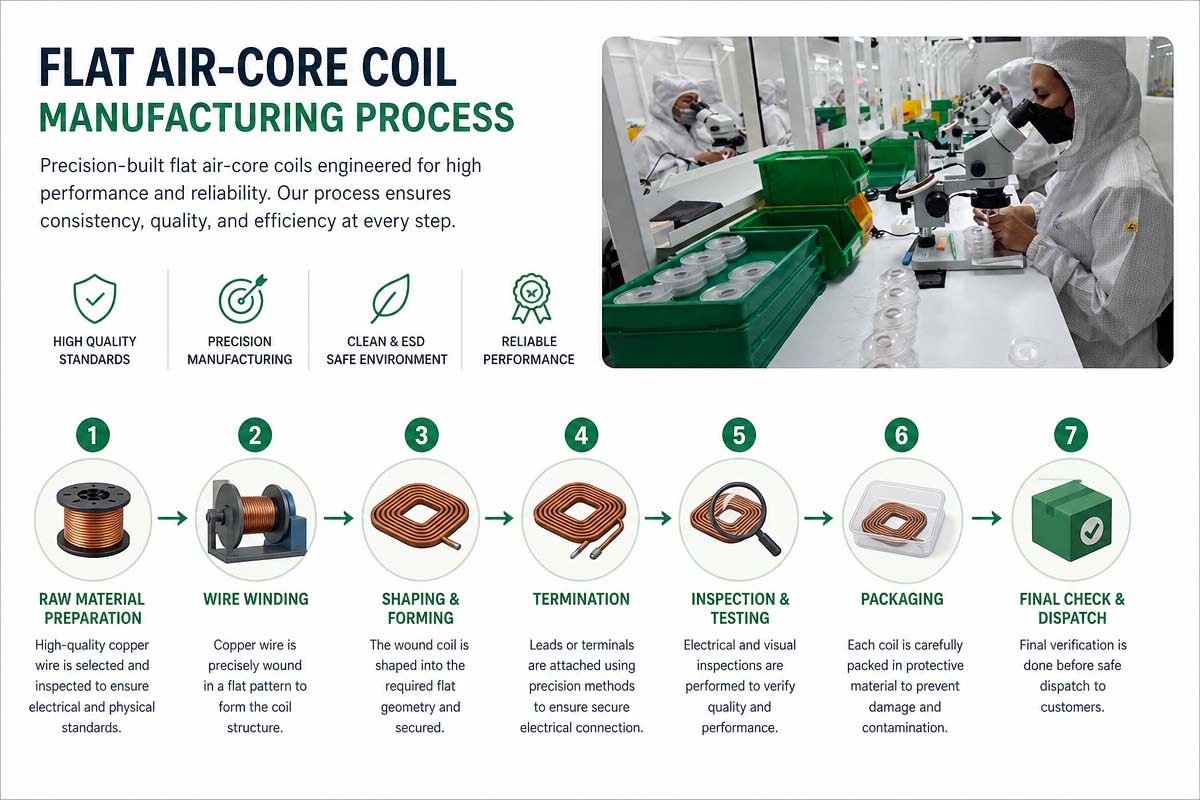
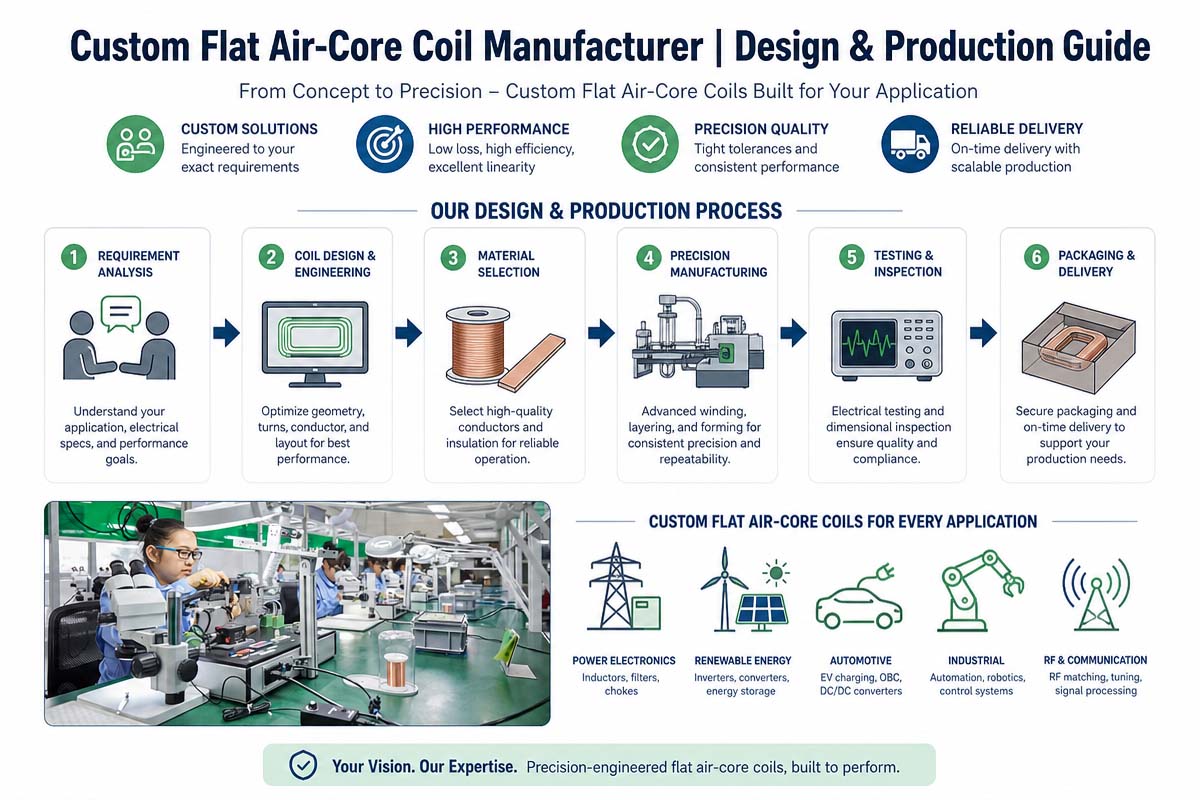
The manufacturing process of the reliable flat air-core coil manufacturer is the controlled process.
The typical process is as follows:
Step 1: Verification and Engineering Review
Before the manufacturing, engineers analyze the customer requirements, such as
Electrical specifications
Mechanical dimensions
Environment of application
Assembly requirements
Requirements for the tests
The engineering team makes the conclusion about the possibility of reaching the required performance by this design.
If it is necessary, manufacturers can suggest:
Enhancement of the wire selection
Optimizing the coil design
Reducing the production costs
Increasing the performance
The interaction between the engineers and customers allows obtaining the better product.
Step 2: Preparation of the Raw Material
The raw material for high-quality coils is prepared according to the approved design.
The material can be:
Wire, copper
Litz wire
Output at the terminals
Insulating materials
Adhesive materials
Incoming material is checked for conformance to specifications.
The important elements for checking are
Wire gauge
Specific conductance
Insulation values
Mechanical strength
Step 3: Precision Winding Operation
The shape of the coil and its electrical parameters are defined during the winding operation.
The modern flat air-core coil manufacturing includes:
High-precision winding machines
CNC machines
Custom tooling
Automation positioning systems
Some important manufacturing parameters are
Tension of winding
Pitch spacing
Correctness of the coil shape
Wire arrangement
The guarantees of the careful winding:
Constant inductance values
Dimension consistency
Electrical performance consistency
Step 4: Forming and Shaping of Coils
And after winding, coils may require additional forming operations.
They will allow obtaining:
Proper flat profile
Strong mechanical structure
Required dimensions
The manufacturer can create customized forming procedures for producing:
Coils of circular shape
Circular coils
Rectangular coils
Special-shaped coils according to the customer drawing.
Step 5: Terminal Processing
The terminals of the coil will be processed according to the requirements of the customer’s assembly.
Typical methods are
Wire stripping
Tin coating
Soldering
Adding in connectors
Lead forming
The proper terminal processing ensures:
Assembly efficiency
Connection reliability
Product lifetime
Chapter 9: Testing and Quality Control of Flat Air-Core Coil
The quality control is an important moment for choosing the professional flat air-core coil manufacturer.
The supplier must have the inspection procedure during the manufacturing process.
1. Tests on electrical performance
Electrical tests are performed to make sure that the coil meets the requirements of the design.
The tests are
Inductance Test
The ability of the coil to achieve the specified inductance value.
The parameters are
Inductance value
Accuracy to
Testing frequency
Resistance Test Checks:
Resistance, DC
Conductivity performance
Manufacturing defects
Q Factor Test
The Q factor shows the efficiency of the coil.
A high Q factor usually means:
Less energy losses
Higher efficiency
Better high-frequency performance
2. Dimension Inspection
The customer’s assembly must be made with the exact dimensions.
The items to check:
Outside diameter
Inside diameter
Thickness
Position at the end
General form
The advanced measuring equipment ensures the dimensional consistency.
3. Reliability Test
The reliability tests are required for the industrial and automotive customers.
The typical tests are
Test on temperature resistance
Mechanical strength test
Test de soudage
Aging test
The tests ensure the stable performance of the coil under long-term operating conditions.
4. Visual Inspection
The visual inspection will find:
Damages to cable
Defects in the insulation
Deformations
Defects on the surface
The thorough visual inspection to avoid any quality problems during customer assembly.
Chapter 10: The Importance of Quality Control in Choosing a Manufacturer
The flat air-core coil is often the important component of the larger electronic system.
Even a small manufacturing deviation can affect:
System performance
Signal reliability
“Product reliability”
Customer satisfaction
Thus, it is necessary to choose the experienced flat air-core coil manufacturer with good quality control.
The manufacturers that serve the European and USA markets usually have to meet the higher expectations for:
Consistent product
Documentation
Traceability—
Reliability of delivery
Technical Assistance
Weilong meets these requirements by combining its manufacturing capabilities with the quality control systems.
Chapter 11: How to Choose a Good Flat Air-Core Coil Manufacturer
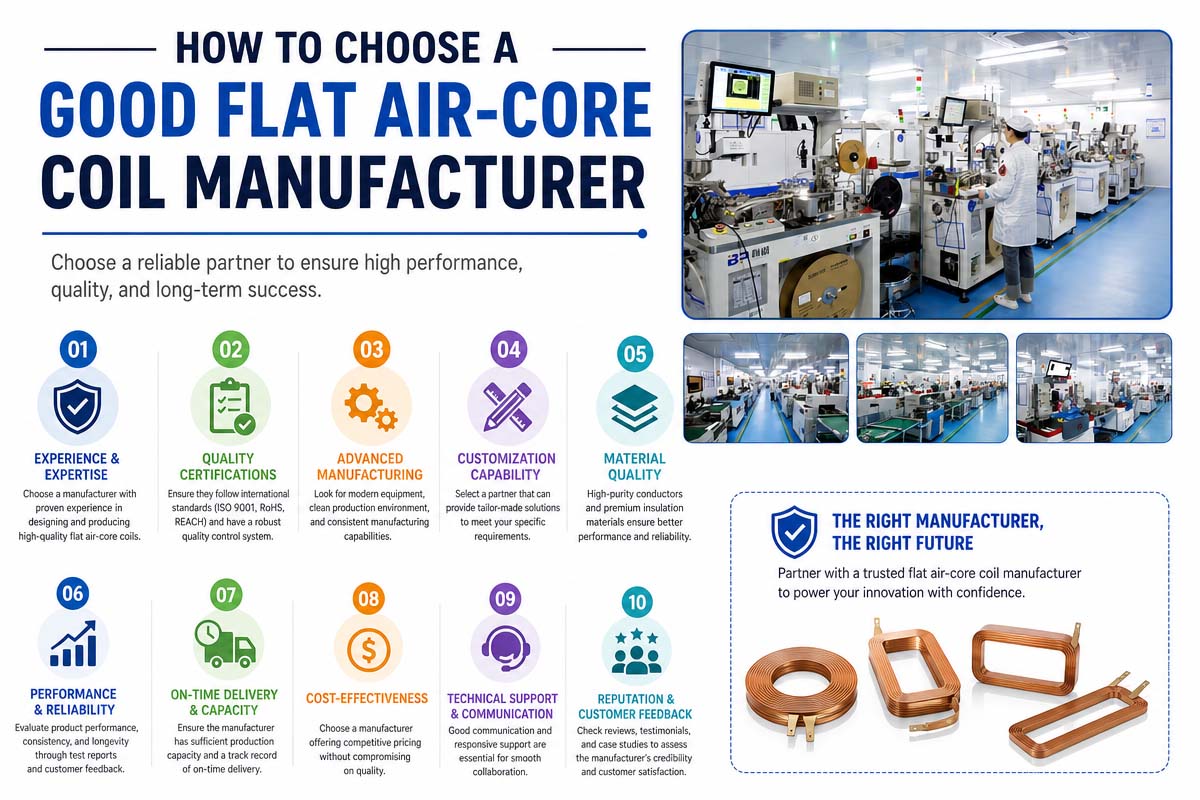
For engineers, purchasing managers, and product developers, it is an important decision to select the right flat air-core coil manufacturer. A good supplier does not only produce the coils according to the drawing but also provides engineering support, production consistency, quality, and long-term cooperation.
Choosing the supplier that supplies custom flat air-core coils, the customers should pay attention to some important aspects.
1. Engineering Capability and Design Assistance
A good manufacturer should have the engineering capability and assist the customer already from the design stage.
There are many technical aspects to be considered for flat air core coils, such as
Inductance requirements
Frequency of operation
Current capacity
Dimensions of the coil
Wire selection
Thermal performance
Installation mechanics
The experienced supplier will consider the customer’s requirements and will be able to suggest how to improve the product performance.
I am stunned. I am stunned.
Wire gauge
Coil distance
Number of revolutions
The winding structure could be the important factor for electrical performance and reliability.
The professional custom flat air-core coil manufacturer must be the technical partner of the customer, not only a production supplier.
2. Customization Capability
Different industries have different requirements for the coils.
The good manufacturer should have the flexibility for customization, such as
Customized coil diameter
Customized thickness
Customized inductance value
Tailored terminal design
Tailored wire materials
Tailored packaging solutions
The advanced electronic systems are often not able to use the standard products.
The wireless charging, RF communication, medical devices, automotive electronics, and many other applications often require custom coil solutions.
The manufacturer with the high customization capability will help to reduce the development time and to improve the performance of the final product of the customer.
3. Manufacturing Capacity and Manufacturing Facilities
Product consistency depends on the advanced manufacturing equipment.
The professional flat air-core coil manufacturer must have:
High-precision winding machines
Custom tooling for production
Automatic inspection equipment
Consistent manufacturing processes
Precision winding technology is the important parameter, as the small deviations in:
Wire placement
Turns spacing
Coil shape can affect inductance and electrical performance.
Modern coil winding technology aims at higher winding accuracy, higher material yield, and manufacturing consistency.
4. QC System
The quality is one of the most important factors for choosing the coil supplier.
The good manufacturer should have the quality control procedures for:
Incoming Material Receiving Inspection
Check:
Quality of copper wire
Diameter of wire
Insulation performance
Material Uniformity
Production Quality Control.
Surveillance:
Winding accuracy
Coil dimensions
End of processing
Production parameters
Final Product Testing Test:
Inductance value
Resistivity
Q-factor
Looks
Reliability performance
As the air-core coils do not use magnetic cores, the performance depends highly on the accurate design of the winding and manufacturing consistency. In general, coils that do not use magnetic cores are called air-core coils, which excludes the effects of magnetic saturation of the magnetic materials.
5. Worldwide Customer Experience
For the European and USA customers, the experience of international cooperation is an important factor.
The global supplier should know:
International quality standards
Export procedures 1.
Customer documentation needs
Communication rules
Shipping times
The manufacturers that have experience in international markets are usually better able to deal with the complex requirements.
Chapter 12: Weilong Is Popular in the World with Customers
Weilong has earned the trust of many customers seeking a reliable flat air-core coil manufacturer.
The advantage of Weilong is the combination of engineering experience, manufacturing flexibility, and customer service.
1. Advanced Custom Coil Design Ability
One of the main strengths of Weilong is its capability to develop the customized coil solutions according to the customer’s requirements.
Every application has its own unique electrical and mechanical challenges.
Weilong cooperates with the customers in order to optimize:
Coil design
Wire choice
Inductance performance
Dimensions
Manufacturing feasibility
The engineering-driven approach allows optimizing the performance of the products of the customers and reducing the development risks.
2. Manufacturing Flexibility for Different Applications
The European and USA customers often need customized products rather than the standard catalog ones.
Weilong offers flexible manufacturing solutions for various industries such as
Qi wireless charging
Medical electronic
Vehicle systems
Industrial machinery
Communication equipment
The flexibility of manufacturing helps to satisfy the needs of different project stages: the customers can need prototypes, small batches, or mass production.
3. Quality and performance consistent
The international customers expect consistent quality in long-term cooperation.
Weilong pays attention to:
Rigorous material selection
Consistent production practices
Precise electrical tests
Delivery performance reliability
In the industries where the failure of the coil affects the whole electronic system, the quality consistency becomes the important aspect.
4. Manufacturing Competitive Advantages
Weilong offers customers the balance of: Instead of many suppliers
Engineering Support
Capability to manufacture
Competitive pricing
Manufacturing efficiency
The aim is to reduce the purchase cost and increase the overall value.
5. Fast Communication and Customer Support
Fast communication is important for international cooperation.
The European and USA customers expect from the supplier:
Fast technological response
Open communication of the project
Fast quote response
Professional problem-solving
Weilong supports the customers at all stages:
From design discussion → prototype → manufacturing → delivery.
6. Experience in International Market Support
The international customers have high expectations for:
Product quality
Delivery reliability
Technical documentation
Manufacturing uniformity
Weilong understands these requirements and improves its production and service systems to serve international customers.
Weilong is known as a name among the overseas buyers, and it is one of the reasons for taking a customer-oriented approach.
Chapter 13: Common Issues in the Manufacturing of Flat Air-Core Coils and Solutions
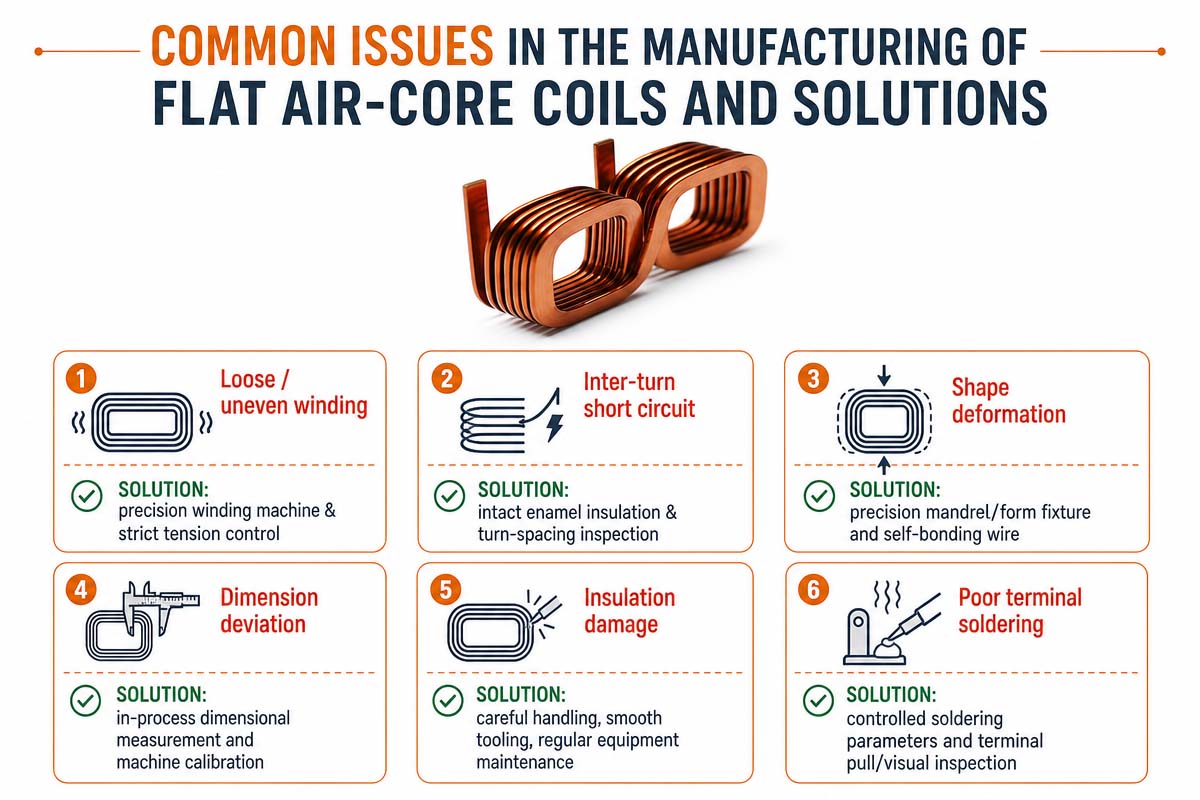
Problem 1 – Inductance requirement in a restricted space
“Modern electronic products have to be manufactured with small components; however, they have to function properly at the same time.”
Solution:
Optimization by engineers:
Shape of the coil
Diameter of the wire
Amount of rotations
Technique of winding
Problem 2: Heat generation control
Temperature rise is inevitable under conditions of high current and frequency.
Solution:
Improvement of thermal efficiency is achieved due to:
Proper wire selection
Optimized density of winding
Better heat dissipation
Problem 3: Consistency in the manufacturing process
Electrical performance might vary from batch to batch.
Solution:
Manufactured by professional suppliers:
Precision equipment
Process control
Automated testing
Quality control system
Chapter 14: FAQsonn Flat Air-Core Coil Manufacturer
Question 1: What is a flat air-core coil?
A flat air-core coil is an inductor made with a winding of conductive wire and has no magnetic core.
The core is either air or non-magnetic material, which makes its performance consistent at high frequencies and prevents any magnetic saturation.
Question 2: What’s the benefit of flat air-core coils?
The major benefits are
Excellent performance at high frequencies
Low electrical loss
Compact design
Consistent electrical performance
Customized structure
Question 3: Can a flat air-core coil manufacturer manufacture the coils on customers’ drawings?
Yes. Professional manufacturers offer the possibility to:
Customize size.
Customize values of inductance.
Select wire type.
Create specific terminal structures.
Design shapes on customers’ drawings.
Question 4: In what industries are customized flat air-core coils used?
Flat air-core coils are widely applied in:
Wireless charging systems
RF communication devices
Medical electronics devices
Car electronics
Industries control systems.
Question 5: What is the development time of customized flat air-core coils?
Development time depends upon:
Design tractability
Availability of materials
Test requirements
The number of prototypes
A professional manufacturer can offer support in the development and engineering.
Question 6: Why is Weilong a perfect supplier of flat air-core coils?
Customers prefer Weilong because of:
Customization capability
Production consistency
Flexibility of production
Technical assistance
Global CX (customer experience)
Chapter 14: Conclusion on Cooperating with a Professional Flat Air-Core Coil Manufacturer
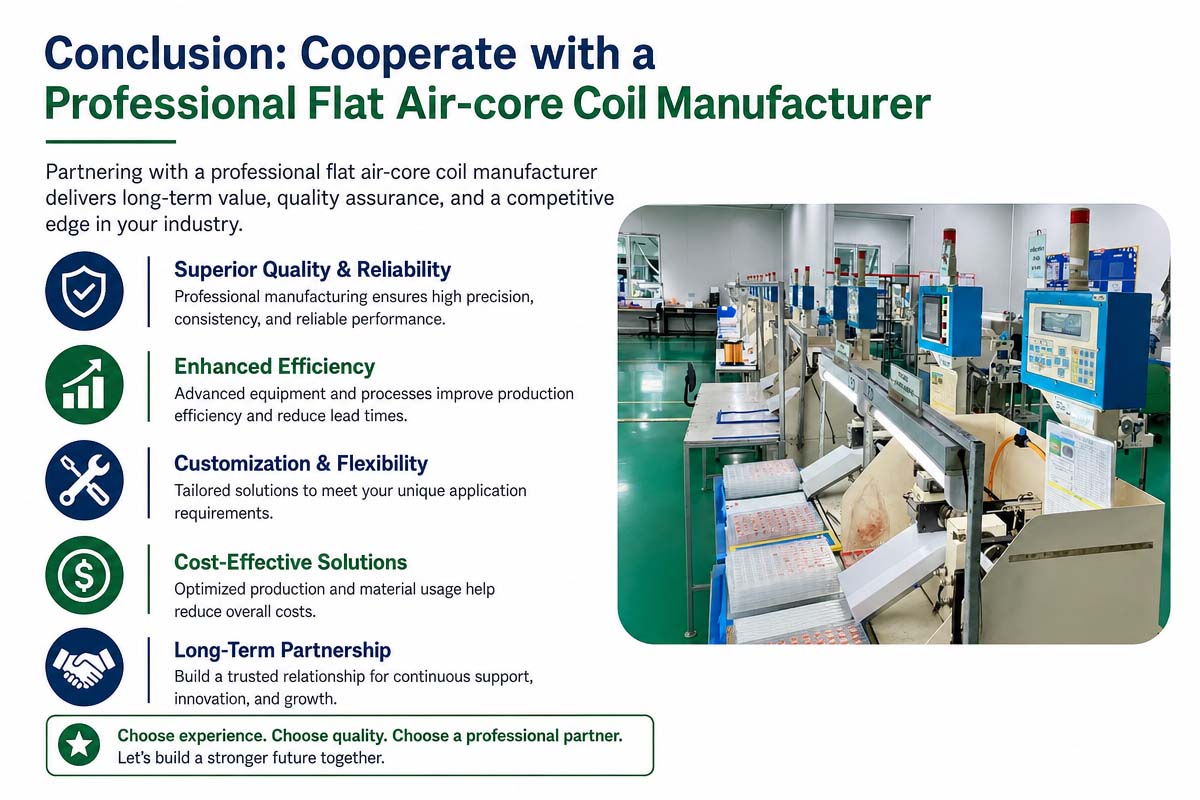
It is important to select thetot air-core coil manufacturer in order to provide the consistent performance of your product.
Just being able to manufacture the product is not enough for a professional supplier. The ideal partner should be:
Knowledgeable in engineering
Offer custom design assistance.
Have advanced manufacturing technology
Consistent quality control
Global services you can rely on
With rich experience in customized coil solutions and flexible production, Weilong is the perfect choice for European and US customers.
For companies that require the source of custom flat air-core coils, the cooperation with an experienced manufacturer would result in better performance and lower development risks.