Introduction
Choosing the right solenoid coil manufacturer is crucial for those applications where constant electromagnetic force, resistance, temperature rise, long life, and stable mass production quality are required.
While a solenoid coil may seem like a pretty simple component, there is a variety of interrelated factors that determine coil performance: magnet wire gauge, insulation system, winding turns, bobbin material, winding tension, terminal connections, overmolding material, temperature control, electrical testing, and process control.
A competent solenoid coil manufacturer offers much more to the OEM customer in terms of the development of hydraulic valves, industrial automation systems, automotive systems, agriculture machinery, pumps, fluid-control components, and other electromechanical devices than simple coil winding.
We support our customers from coil design and material selection to tooling, overmoulding, validation, and mass production. “We want to help customers design a custom solenoid coil that is reliable enough to be economically manufactured.” This guide will help you learn the most important aspects of solenoid coil manufacturing and what you should pay attention to when choosing a production partner.
1. Custom Solenoid Coil Design Should Start From Its Application
The success of the coil project arises from understanding its operating environment.
While working with a professional solenoid coil manufacturer, you shouldn’t select wire gauge or turns solely based on rated voltage. You should consider the application.
The important information may include the following:
Rated voltage
DC or AC operation.
Target ohmmeter
Operating current
Power consumption
Continuous or intermittent operation.
Environmental temperature
Maximum coil temperature
Required magnetic force
Available space for winding
Coil size
Plunger or magnetic circuit design
Terminal type
Lead wire requirements
Installation conditions
Chemical exposure
Moisture exposure
Vibration requirements
Product life requirement
Amount of production per year
For example, a hydraulic solenoid coil, which is used in mobile machines, may be exposed to oil, vibration, moisture, temperature changes, and continual outside usage.
Operating conditions of the solenoid in factory automation can be completely unique.
We consider all these requirements and propose winding specifications and materials. Our engineering-first approach helps to minimize design changes and eliminate inappropriate material choices, which can become problematic in production and operation.
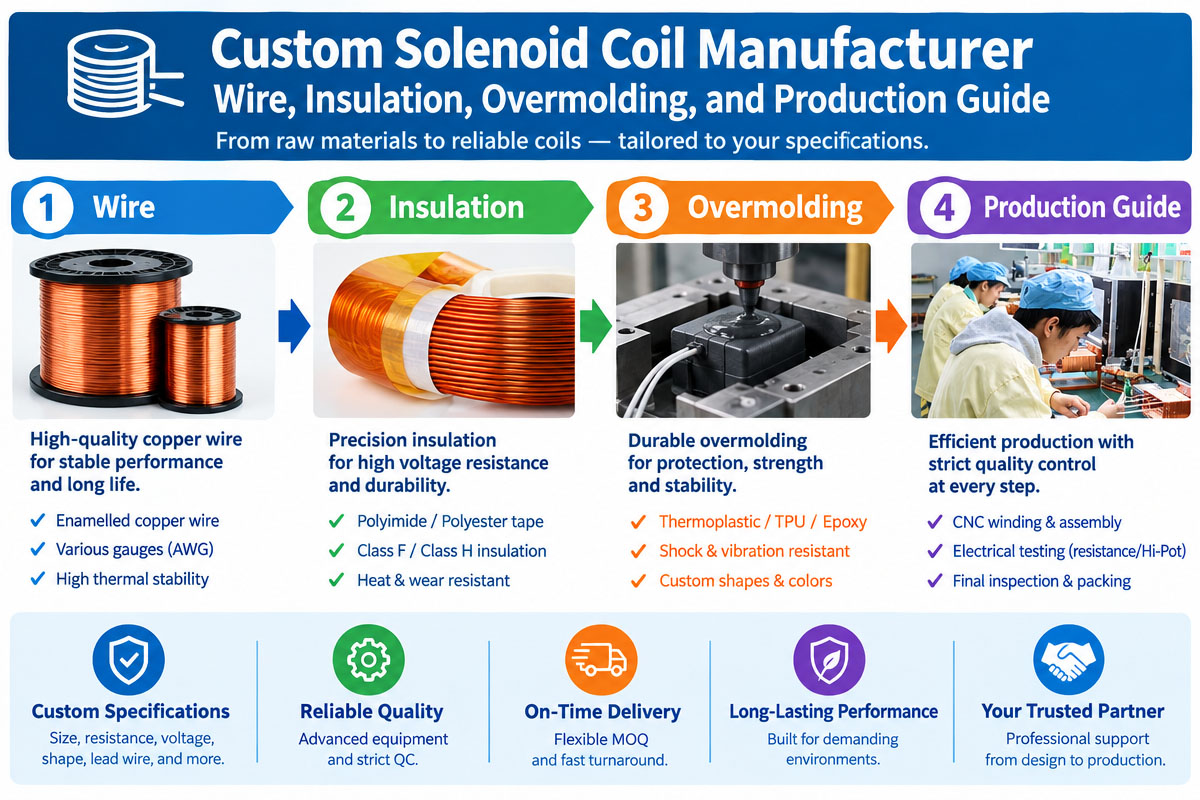
2. Choice of magnet wire for custom solenoid coil
Magnet wire is one of the most important materials used in any electromagnetic coil.
Copper wire is used frequently because of its excellent electrical and mechanical characteristics and winding performance.
But wire gauge is chosen through calculation.
Magnet Wire in Large Gauges
The bigger the gauge of copper wire is, the:
Lowest electrical resistance it has
The more current it can conduct
It produces lower heat at some operating conditions.
Higher mechanical strength it has
But the bigger wire will take more space and allow fewer winding turns in the coil.
Small-gauge magnet wire.
The smaller wire allows:
More winding turns
Higher turn density
Small coil design
But small-gauge wire has more resistance and may produce more heat at some operating conditions.
The competent solenoid coil producer has to consider wire gauge, turns, current, resistance, available winding space, and magnetic and thermal requirements.
WeiLong Technology considers all these parameters together.
It is especially important for custom solenoid coil design, where small changes in conductor gauge can affect winding, resistance, and magnetic performance significantly.
3. Insulation System for solenoid coil magnet wire
The insulation layer, which is covering the copper conductor, prevents turns from electrical shorting.
Various insulation systems can provide different resistance to moisture, abrasion, soldering, and thermal and chemical influences.
Typical insulation systems for magnet wireems include the following:
Polyurethane
Wire with polyurethane coating is widely used for small electromagnetic components and general-purpose solenoids.
Advantages may include:
Thin insulation layer
Good winding properties
High filling of winding
Easy cancellation
Good cost-effectiveness
Polyester fabrics
Polyester insulation has excellent electrical and thermal characteristics and provides better mechanical durability in many industrial applications.
Polyester imide
For high-temperature applications in tough industrial conditions, polyester-imide systems are used.
They can provide:
Excellent thermal characteristics
Good electrical insulator
Water-proof
Enhanced resilience
Polyamide imides
Polyamide-imide coatings have high resistance to heat, chemicals, and mechanical wear.
They are designed for heavy-duty solenoid valve coil applications in automotive, hydraulic, industrial, and high-temperature environments.
Proper insulation is much more than just proper temperature class.
When selecting the right solenoid coil manufacturer, you should consider winding tension, termination, operating conditions, overmolding temperature, chemical exposure, and compatibility of the whole insulation system.
Our choice of insulation is made taking into account the bobbin, terminal, lead wires, encapsulation, and overmolding material.
4. Bobbin Materials Selection and Design Solution
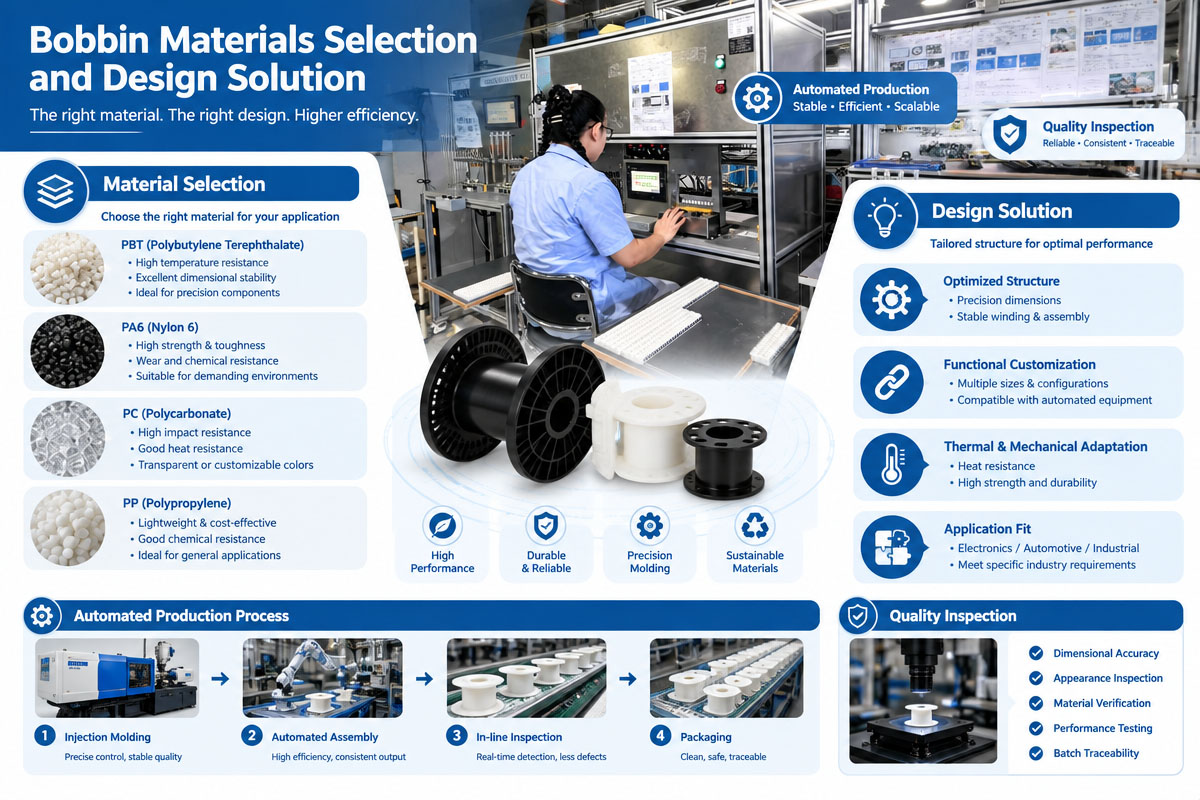
The bobbin (sometimes referred to as the coil former) serves to hold the winding and to determine coil geometry.
It helps to maintain:
Winding diameters
Electrical clearance
Final positions:
Coil alignment
Mechanical stability
Depending on operating conditions and temperature requirements, common bobbin materials may include engineering plastics, such as PBT, PET, PA, and LCP.
Bobbin design can considerably affect the production efficiency of OEM solenoid coils.
If the window is too small, winding is difficult. If the flange is too thin, it may be deformed due to the winding tension or the injection pressure. Poor terminal support can cause dimensional variation of the overmold.
In the design phase, we analyze the bobbin design to improve product reliability and production consistency.
5. Winding of Coils
Winding quality affects the electrical and magnetic performance.
The manufacturer has to control during production such parameters as
Number of turns
Tension of string
Speed of winding
Traverse speed
Uniformity of layers
Direction of winding
Location of start wire, location of end wire
Routing Lead
Diameter and height of coil
Precision winding ensures the same electrical resistance, inductance, magnetic properties, and external dimensions.
Automated winding equipment can provide better repeatability and less operator variation in the process of large production quantities.
We design the process of winding based on your specifications and production requirements, paying special attention to turn count and wire tension.
When manufacturing large quantities of solenoid coils, repeatability is as important as initial sample performance.
6. Connection of Terminals and Lead Wires
Another important aspect that determines the reliability of the coil is its electrical connection with fine magnet wire.
Possible methods of connection are
Soldering
Resistance welding
Fusion crimping
Terminals connected mechanically
The best way depends on wire gauge, insulation system, terminal material, current, volume of production, and environmental requirements.
The competent solenoid coil manufacturer has to ensure that the termination doesn’t damage the conductor and doesn’t provide excessive electrical resistance.
We can integrate the terminals, lead wires, connectors, and custom-specific connection structures in a custom solenoid coil assembly.
If needed, the quality of the connection can be verified through electrical and mechanical pull-force tests.
7. Solenoid Coil Overmolding
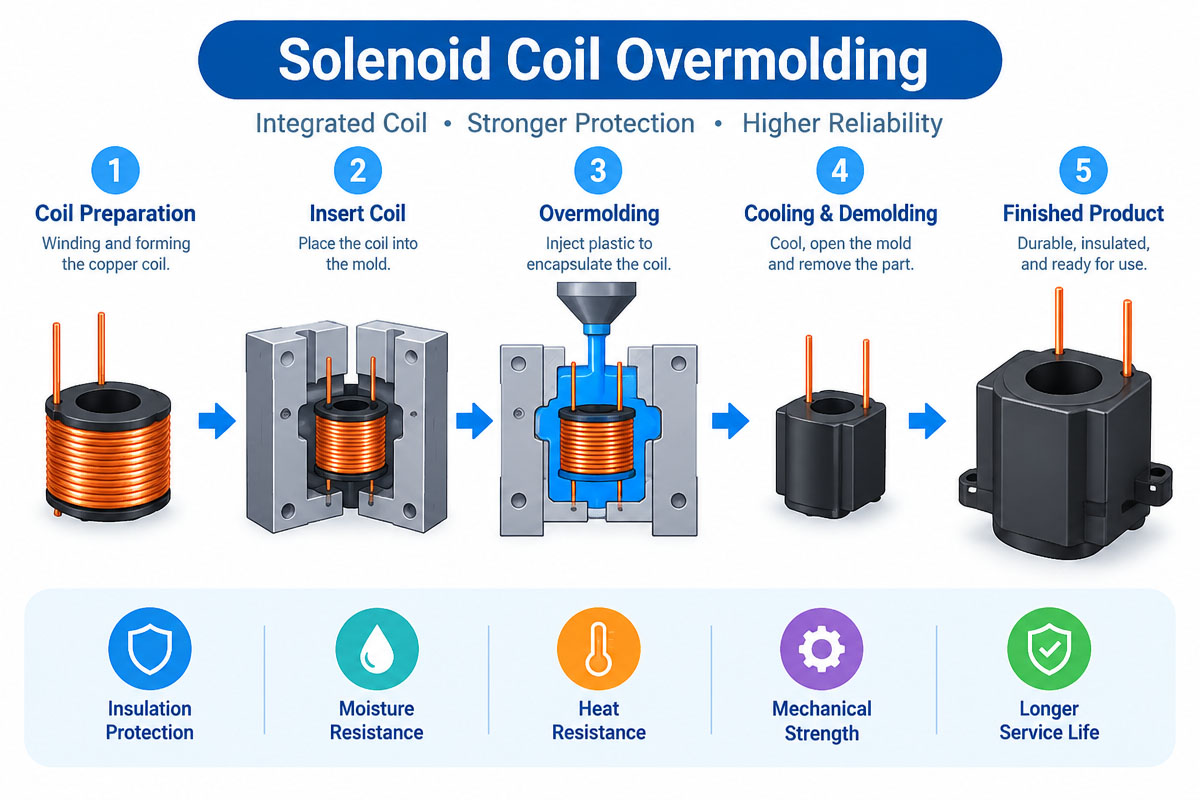
Overmolding provides mechanical and environmental protection and provides the coil its final shape.
The benefits of overmolded solenoid coils may include:
Protection from moisture
Electric insulator
Mechanical protection
Vibration-resistant
Chemical resistance
Durability
Connectivity integrated
Standard installation sizes
Professional finishing look
Selection of overmolding material is highly application dependent.
8. Most commonly used overmolding materials
PBT
PBT is widely used for electrical and industrial components due to the excellent combination of the following properties:
Electric insulator
Dimensional stability
Mechanical properties
Malleability
Cost-effective
Glass-fiber-reinforced PBT can provide additional rigidity and dimensional stability.
PET (polyethylene terephthalate)
PET has good heat and chemical resistance, low moisture absorption, and dimensional stability.
It can be used for demanding automotive, hydraulic, and industrial applications.
LCP (Last Contacted Person)
Often selected for components that require LCP are:
Thick walls
High precision
Good flow properties
High temperature resistance
It can be useful for miniature and precision solenoid valve coil assemblies.
Epoxy materials are commonly used for potting and encapsulation.
They can provide:
Good electrical insulators
Mechanical protection
Chemical resistance
Rigid encapsulation
The best resin is determined by temperature, pressure, vibration, chemical exposure, moisture, and dimensional requirements.
The smart solenoid coil manufacturer should select the overmolding resin depending on actual service conditions and not only on the price.
9. Why control the overmolding process?
Choosing the right resin is just one part of the process.
The parameters of overmolding have to be controlled precisely.
Too high an injection pressure may:
Distort the bobbin.
Move terminals.
Damage to winding insulation
Change connector location.
Resin can be improperly dried, thus reducing its quality.
Incorrect mold temperature or poor venting can cause the following:
Close-up shots
Voids or Flash
Surface defects
Dimensional defects
Based on our experience in winding and overmolding, we have developed a process of production that is applicable to the whole coil assembly.
It is especially true for hydraulic solenoid coils, since the final product may be exposed to oil, moisture, vibration, temperature changes, and continual operation of the equipment.
10. Solenoid Coil Temperature Control
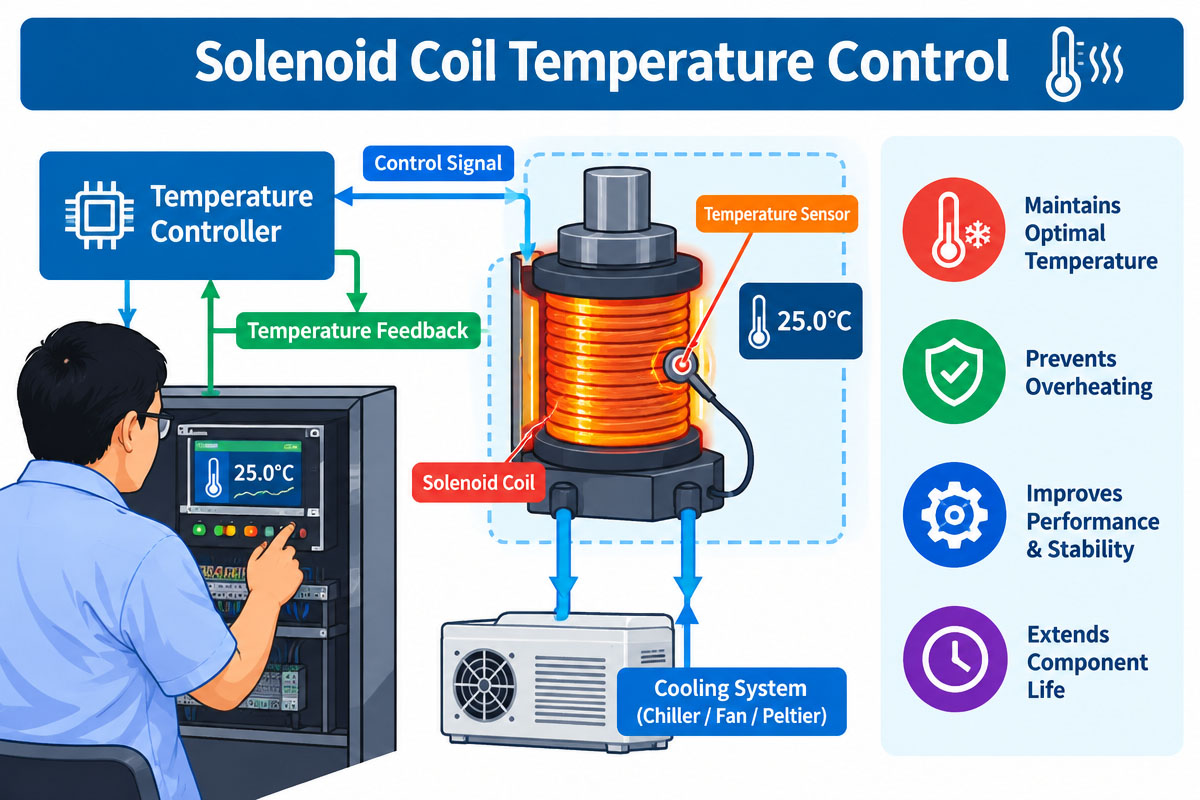
Temperature is one of the most important parameters influencing the life of solenoid coils.
Copper wire heats up when the current is flowing through it. It happens due to electrical resistance.
The resistance of copper is temperature-dependent. It can influence the current consumption and magnetic performance.
Coil temperature is defined by the following parameters:
Applied voltages
Electric resistance
Working cycles
Environmental temperature
Coil size
Metal casing
Heat dissipation
Air flow
Installation procedure
The professional solenoid coil manufacturer has to test the coil under the real operating conditions and not just measure resistance at room temperature.
In custom development, we can help our customers to optimize wire size, turns, resistance, power consumption, insulation material, and coil dimensions.
11. Electrical Tests During Production
A properly functioning good coil needs to be tested before shipping out.
Testing during production depends on customer specifications such as
Resistance test
Continuity testing
Insulation resistance
Dielectric strength test
Actual measurement
Inductance testing
Functional testing
Polarization test
Resistance testing is especially important for solenoid coil manufacturing.
Reasons for abnormal results could be:
Wrong turn count
Wrong wire gauge
Poor termination
Damage, coiling
Material/process variation
Test requirements depend on WeiLong Technology and are defined according to the drawing and customer’s specifications to ensure repeatable production quality.
12. Qualification: Environment and Reliability
OEM customers need to consider long-term reliability in addition to performance.
Validation may include (depending on application):
High-temperature test
Low-temperature test
Thermal cycling
Humidity test
Vibration test
Mechanical Impact Test
Chemical resistance
Oil-resistant test
Salt spray test
Water ingress test
Pull test of terminal
Long-distance cycling
For example, the environmental test of an automotive or mobile hydraulic solenoid coil may be more complicated than the one of a coil installed in the indoor protected equipment.
The solenoid coil manufacturer and customer will collaborate in the definition of validation of the coil based on its final application.
13. One-Stop Solenoid Coil Manufacturing From Prototype to Mass Production
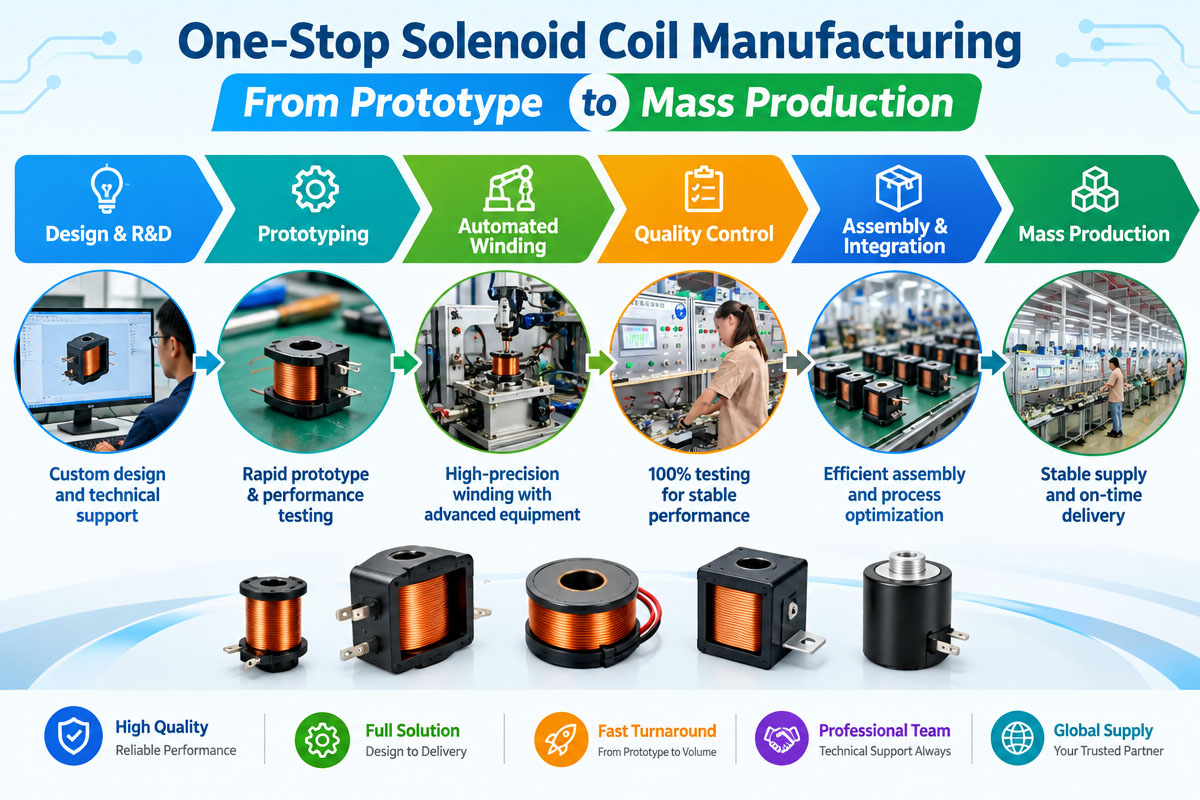
Prototyping is just the first step to success.
Commercial products must also be able to be produced in mass production in a stable and repeatable way.
Typical development flow at WeiLong Technology:
Analysis of customer’s requirements
Sample analysis and drawing
Assessment of solenoid coil design
Magnet wire selection
Insulation system selection
Bobbin designs
Terminals and connectors development
Prototype winding
Electrical testing
Overmolding development
Customer sample acceptance
Tooling optimization
Pilot production
Quality validation
Mass production
Such a systematic approach allows the solenoid coil manufacturer and the customer to identify all possible problems before the start of mass production.
14. Special Solenoid Coils for Various Industries
At WeiLong Technology we offer custom coil development for industrial applications.
Hydraulic solenoid coils
The hydraulic solenoid coil is the basic component in directional valves, proportional valves, cartridge valves, hydraulic manifolds, pumps, and mobile hydraulic systems.
This application may require high environmental protection and reliability in vibration and fluid environments.
Industrial Solenoid Valve Coil
In industrial valve systems, coils are used in:
Pneumatic machinery
Water handling
Automation
Process equipment
Fluid control systems
The solenoid valve coil could be customized for the needed voltage, connector, size, power, and duty cycle.
Solenoid Coils for Automotive Applications
For automotive applications the resistance to following could be required:
Heat
Vibration
Oil
FuelTM
Chemical substances
Moisture
Thermal cycling
This is why material select critical control is very important.
Mobile & Farm Equipment
Equipment for agricultural and construction industries works in tough outdoor conditions.
A rugged, overmolded solenoid coil will protect the winding from moisture, dirt, vibrations, and mechanical damage.
15. Why Choose WeiLong Technology as a Solenoid Coil Manufacturer?
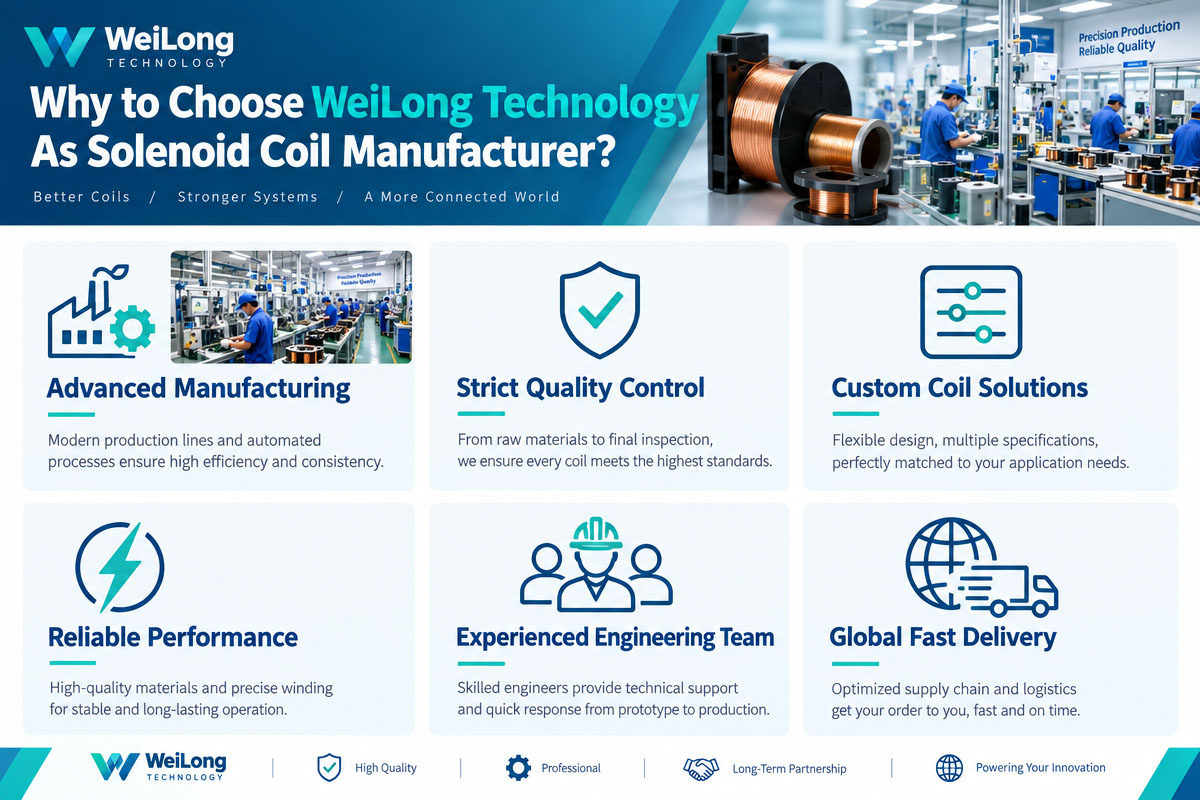
One cannot select a supplier based only on price per unit.
What customer should consider:
Engineering experience
Customization capability
Coiling Technology
Material knowledge
Design for mold
Overmolding
Electrical testing
Quality control
Traceability
Production capacity
technical writing jobs
WeiLong Technology offers to the customer a complete manufacturing solution with integrated coil winding, engineering plastics, terminal integration, overmolding, and production testing.
We are an experienced solenoid coil manufacturer and can support projects from conceptual development up to mass production.
Engineering Help – Custom
Design of the suitable custom solenoid coil based on the customer’s drawings, specifications, samples, and applications.
Integrated Manufacturing
Our manufacturing capabilities could provide:
Winding magnetic wire
Bobbin assembly
Terminal installation
Connection of lead wires
Overmolding
Encapsulation
Electrical testing
3D inspection
Final assembly
OEM & Custom Production
WeiLong Technology supports OEM solenoid coil projects with customizations in dimensions, resistance, voltage, connector configuration, materials, branding, and packaging.
Experience Hydraulic Solenoid Coil
Experience in the market of hydraulic solenoid coils helps us to understand performance requirements of valves, mobile equipment, hydraulic control, and other applications.
Production-Oriented Design
We do not concentrate only on production of the successful engineering sample.
We strive to produce the product and process that can be reproducible in terms of quality.
16. What Information Do You Need To Send For Quotation?
To get the correct quotation from a solenoid coil manufacturer, provide as much technical information as possible.
It could be helpful:
Product drawing
Sample in place
Sizes of coils
Rated voltage
Resistance
Current
Force
Duty cycle
Connector type
Operating temperature
Application description
Required certifications
Environmental conditions
Annual quantity estimation
If you do not have a complete drawing, sample of coil, valve drawing, or dimensions, this information will help our engineers to analyze the project.
17. Frequently Asked Questions
Do you manufacture custom solenoid coils?
Yes, at WeiLong Technology we can produce custom solenoid coils according to the customer’s drawing, sample, voltage, resistance, dimension, connector, material, application conditions, etc.
Are you a hydraulic solenoid coil manufacturer?
Yes. Our experience of coil manufacturing includes important hydraulic applications. We can support hydraulic solenoid coil projects for valves, manifolds, mobile hydraulic, industrial equipment, and other applications.
Can you produce overmolded solenoid coils?
Yes. We can develop an overmolded solenoid coil according to customer requirements for bobbin, winding, terminals, connector integration, and protective overmolding.
Can you replace a vendor for an existing solenoid coil?
Yes. Customers can submit drawings, electrical specifications, or existing samples for consideration. Our engineers can help with resistance, winding structure, materials, dimensions, connector design, and production requirements.
What voltages can be adapted?
Voltage could be adapted according to application. Typical projects could be 12V, 24V, 48V, 110V, 220V, and other customer-specific voltages depending on coil design and operating conditions.
Are you looking for OEM solenoid coil projects?
Yes, WeiLong Technology supports OEM solenoid coil programs with custom performance, dimensions, connectors, overmolding, labels, logos, packaging, and production specifications.
18 Become the Partner with WeiLong Technology for Your Next Solenoid Coil Project
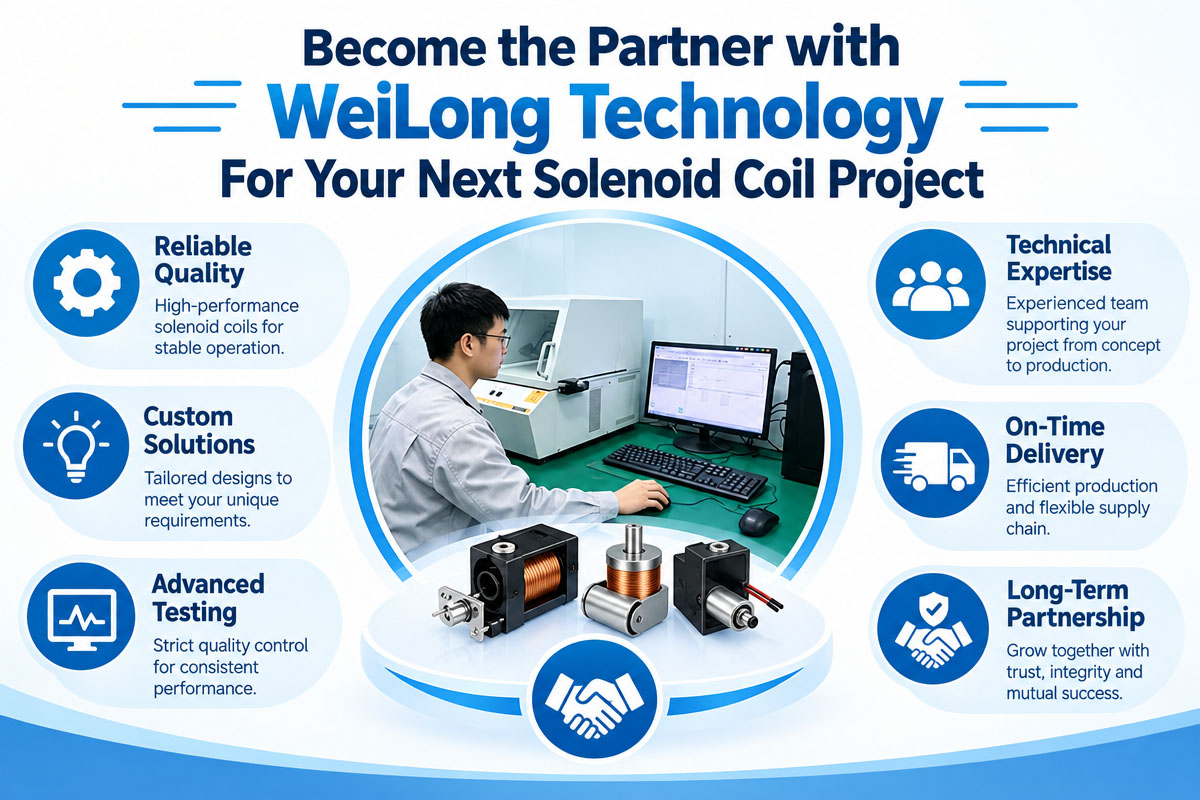
A reliable solenoid coil requires a right combination of wire, insulation, bobbin design, winding technology, terminal connection, overmolding resin, thermal management, and quality control.
Working with an experienced solenoid coil manufacturer in the early stages of the development process can help avoid unnecessary redesigns and ensure a smoother transition from prototype to volume production.
We have extensive experience in working with custom solenoid coils, hydraulic solenoid coils, solenoid valve coils, overmolded solenoid coils, and OEM solenoid coil projects.
If you design a new valve coil from scratch, want to change an existing vendor, improve temperature performance, change a connector, reduce product size, or prepare the design for higher production volumes, our team will review your application and will recommend a manufacturing solution.
Need to find a trusted solenoid coil supplier?
Please send us your drawing, technical specifications, existing sample, voltage, resistance requirements, application details, and annual quantity.
Our engineering team will review your project and will recommend magnet wire, insulation, bobbin materials, overmolding, electrical characteristics, manufacturing processes, and production feasibility.
For your next custom solenoid coil project, please contact WeiLong Technology and ask for an OEM quotation.