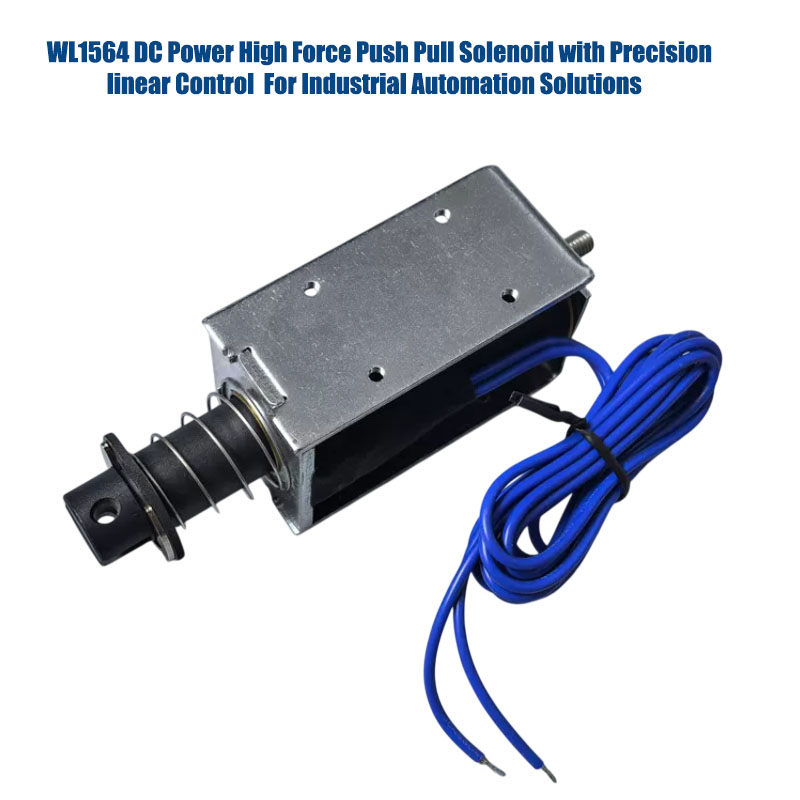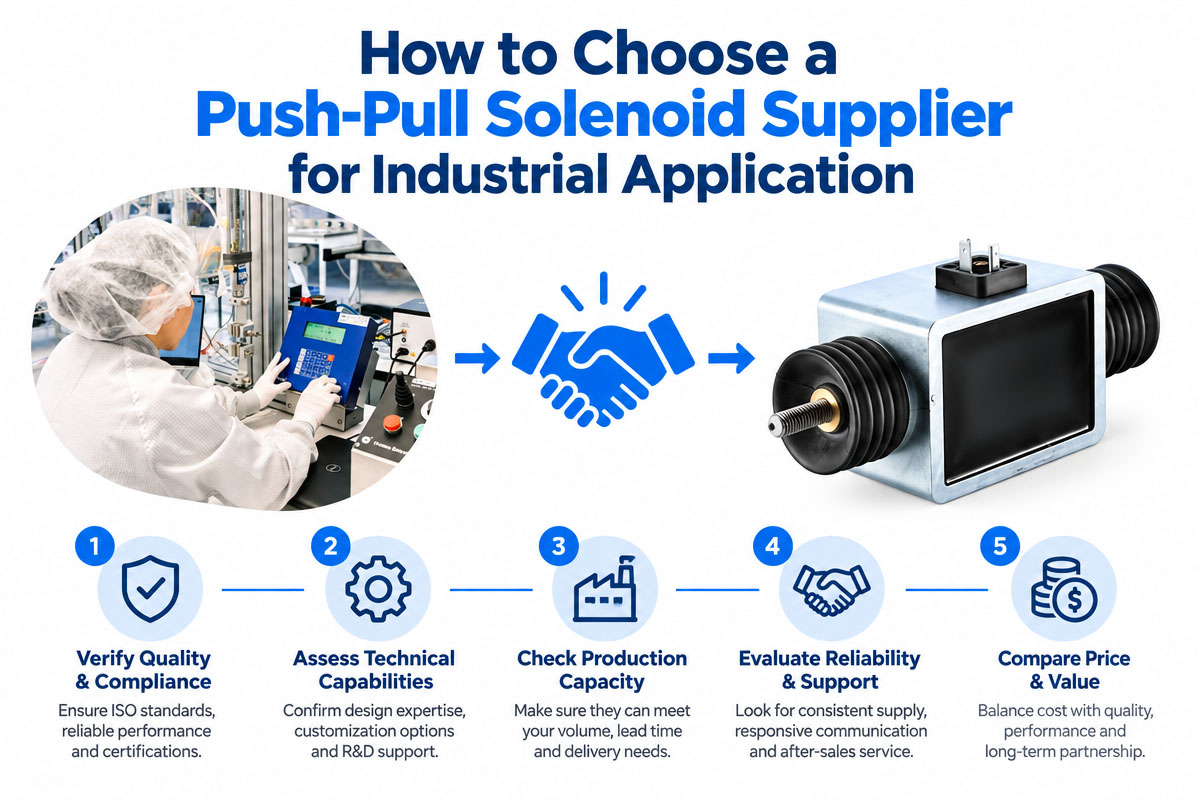
Introduction
Push-pull solenoids are widely used in industrial equipment in case of need to convert electrical energy into rapid and controlled linear mechanical movement. It can work as locking mechanisms, releasing devices, switches, gates, dispensers, safety mechanisms, automation equipment, and lots of other electromechanical devices.
A push-pull solenoid might be thought to be a rather simple device, but its correct selection is an important engineering problem.
The performance of the solenoid depends on such factors as force, stroke, voltage, duty cycle, temperature, frequency of operation, available space, lifetime, and operating environment conditions.
That is why for OEM manufacturers and designers of the industrial equipment, the choice of push-pull solenoid supplier should be based on much more than on price alone.
The supplier should know the application and provide the recommendation regarding the choice or even development of the required solenoid.
This guide provides an overview of the key technical and commercial considerations that should be taken into account when selecting the push-pull solenoid supplier.
1. Working principle of push-pull solenoid
A push-pull solenoid is the electromagnetic actuator that is responsible for the generation of linear movement.
The electrical current passing through the coil generates the magnetic field. The magnetic field acts on the movable plunger or armature.
According to the mechanical layout, the movement can be both pulling and pushing.
This explains the usefulness of the push-pull solenoids for the industrial applications in case there is a need to use rather simple and fast linear movement.
The technology is widely used in such applications as:
- Automation of industry
- Packaging machines
- Sorting equipment
Vending machines·
- Locking systems
- Safety mechanisms
- Entry control equipment
- Textile machines
- Agricultural machinery
- Testing equipment
- Automatic dispenser
- Industrial control systems
But one should not simply choose the solenoid because its generic description matches your application.
The real requirements of force and motion should be evaluated.
The qualified push-pull solenoid supplier will ask you about the purpose of using the actuator before providing you with the recommendation.
2. Definition of Industrial Application
The first thing to do is to define the purpose of the solenoid’s use.
For example, will it:
- Switch on? ·
- Unlock a locking pin? ·
- Release a spring-loaded mechanism? ·
- Operate a gate?” ·
- Trigger a switch? ·
- Operate a mechanical linkage? ·
- Small component placement? ·
- Trigger a safety mechanism? ·
Different purposes require different force and stroke values.
Engineering should provide the supplier with as much information about the whole mechanism as possible.
At least the following should be defined:
Working voltage: 12 VDC, 24 VDC, or others.
Stroke: How far does the plunger move?
Force: What force is required at the working point?
Push or pull: Is the useful movement push or pull?
Duty cycle: How long is the solenoid energized?
Frequency: How often is it operated per minute or per hour?
Life requirement: Total number of cycles?
Available space: What is the maximum installation envelope?
Environment: What temperature, dust, vibration, or humidity will the part be exposed to?
With this information the push-pull solenoid supplier will be able to recommend you a standard model or will understand that it is required to design the custom device.
3. Measure the push-pull solenoid force at the required stroke

There are many characteristics of an industrial solenoid, but the most important one is the force.
The force is also one of the most frequently misinterpreted solenoid characteristics.
The force of a solenoid depends on its plunger position. For instance, the statement “20 N solenoid” means that the device generates 20 N force only at a certain point of its stroke.
Say your industrial process requires:
Stroke: 10 mm
Starting force requirement: 15 N
Final force requirement: 25 N
If the solenoid is only able to generate 25 N force at the end of its stroke, it will not be able to initiate the process.
That is why engineers should require the force versus stroke data from the push-pull solenoid supplier.
When comparing the push-pull solenoid suppliers, ask about the availability of the force data for several plunger positions.
Also take into account the forces produced by the whole mechanism, including:
- Spring stiffness ·
- Friction
- Gravity
Linkage geometry
- Closure
- Mechanical clearances
- Acceleration
Contamination
- Also, the reasonable engineering margin should be considered to compensate for the production variation and changing of the operating conditions.
4. Select the correct stroke
Not the longer stroke automatically means the better performance.
The longer the stroke, the higher the requirements for getting the high force of a solenoid of the certain size and power.
That is why engineers should not set the travel distance greater than required.
If the application requires 5 mm of travel, designing around 15 mm stroke can lead to an increase in the size, power, or cost of the actuator.
Analyse the whole mechanism and find out the minimum reliable stroke.
The qualified push-pull solenoid supplier can also provide the recommendations concerning mechanical linkage modifications that could substantially improve the electromagnetic performance.
5. Match system to voltage, current, and power
The most industrial DC solenoids are available in 12 VDC and 24 VDC voltages, but other coil voltages can be designed.
But the voltage is not the only thing to consider.
Also, engineers should consider the following factors:
- Coil resistance ·
- Current consumption
- Energy consumption
- Power supply availability
- Voltage tolerance
Wiring
- Driver electronic
- Switching method
- The electrical system must provide sufficient energy for the reliable actuation of the actuator.
But at the same time the excess of coil power is unnecessary generation of the heat.
Please inform the supplier of the push-pull solenoid in advance about the current and power limitations of the equipment.
A qualified push-pull solenoid supplier can modify the coil winding, magnetic structure, or mechanical design of the actuator to obtain the desired force with limited electrical energy.
6. Mind the Duty Cycle
When choosing the industrial solenoid, the duty cycle is of great importance.
A solenoid energized for 200 milliseconds every 30 seconds has completely different thermal requirements compared to one energized for several minutes.
For example:
ON time: 2 sec
OFF time: 8 sec
Total cycle: 10 sec.
Duty cycle: 20 percent
Telling the supplier that the solenoid is used “intermittently” usually provides less information than giving the ON and OFF times.
The high coil power can sometimes be used to produce strong force for short-time applications.
But if the same coil operates continuously, it will generate too much heat.
When you talk to the push-pull solenoid supplier, provide him with realistic worst-case operating conditions.
Maximum cycling conditions: Industrial machines can operate faster than engineers think at the initial stages of the design.
7. Thermal performance and evaluation of the coil temperature
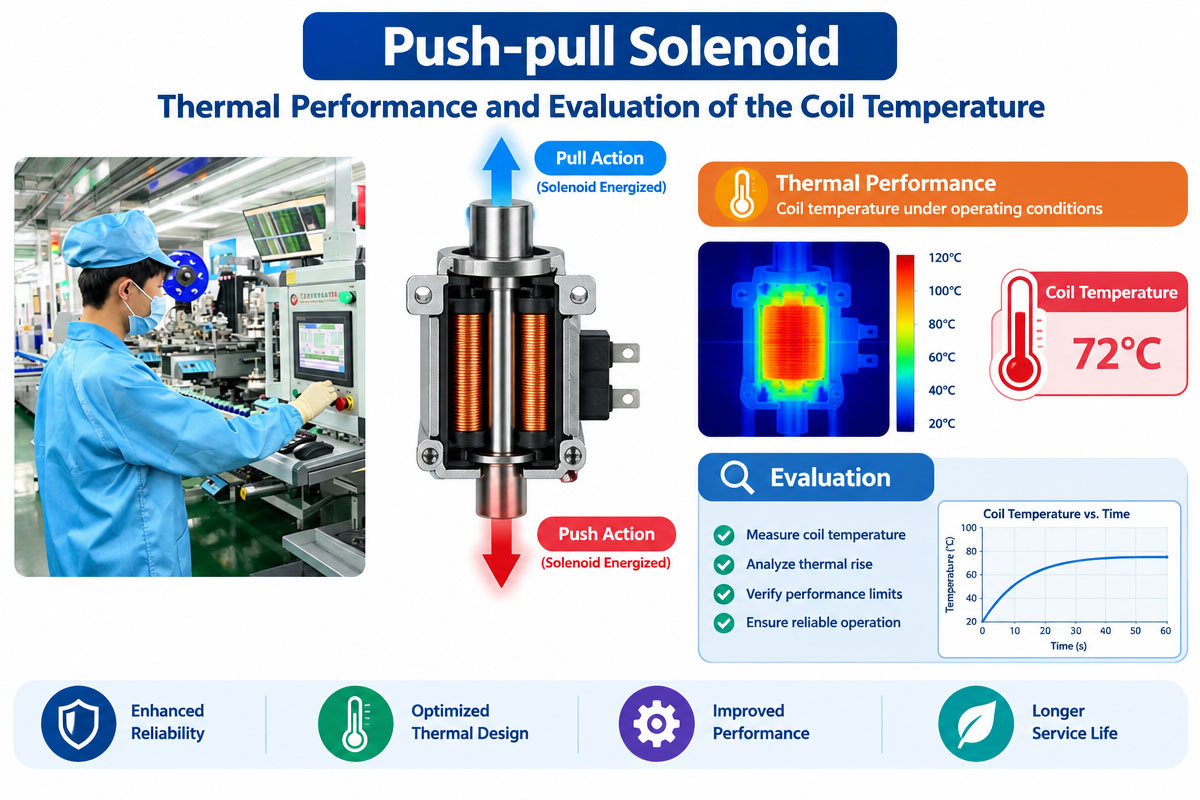
The heat influences the performance and life of the solenoid.
The electrical current flowing through the coil creates heat. An increase of the coil temperature leads to an increase of the electrical resistance of the coil and further changes of the current and electromagnetic performance.
Also, overtemperature occurs in such components as
- Coil insulation ·
- Connection wiring
- Plastic parts
- Springs
- Near electronics
- Lubricants
- Life cycle of the product
Ask the supplier how the temperature rise is measured.
Good questions to ask:
- What ambient temperature is assumed? ·
What is the coil temperature rise? ·
- What duty cycle was used in tests? ·
What insulation system was used? ·
- What is the maximum recommended temperature of use? ·
- Was the solenoid tested in air or in an enclosure?
The good push-pull solenoid supplier should be able to discuss the thermal limitations and not only provide voltage and force specifications.
8. Consider the industrial operating life
The industrial equipment can operate for several years.
A solenoid producing 1,000 operations per day will make about 365,000 operations in a year.
The fast automation can produce even more operations.
That is why the expected life should be determined before choosing the actuator.
The solenoid durability depends on:
Rodding material
- Surface treatment
- Guide design
- Mechanical stops
- Spring design.
- Lubrication
- Velocity of action
- Side loads
Coil temperature
Pollutants
- Assembly tolerances
- Ask the vendor of the push-pull solenoid whether the life tests were conducted and, if yes, in which conditions.
The statement, such as “one million cycles,” is only informative if you know the load, stroke, voltage, duty cycle, frequency, and environmental conditions during the test.
Life tests may be required for the critical industrial equipment for specific applications.
9. Analyze Response Time and Actuator Speed
Push-pull solenoids can be preferred since they can provide quick linear actuation.
However, the response time required depends on the application.
The requirements for a device that operates several times a second will be different from the requirements for an industrial safety latch that operates several times a day.
Factors affecting response time:
- Weight of Plunger
- Stroke
- Power of coil
- Cargar
- Force of spring
- mechanical friction
- Drive Circuit
- Power supply voltage
- If the response time is critical, determine the maximal acceptable actuation time.
An experienced supplier will analyze the complete mechanical and electrical system, not just provide a speed estimate based on unloaded laboratory conditions.
10. Evaluate the push-pull solenoid noise and mechanical impact effects
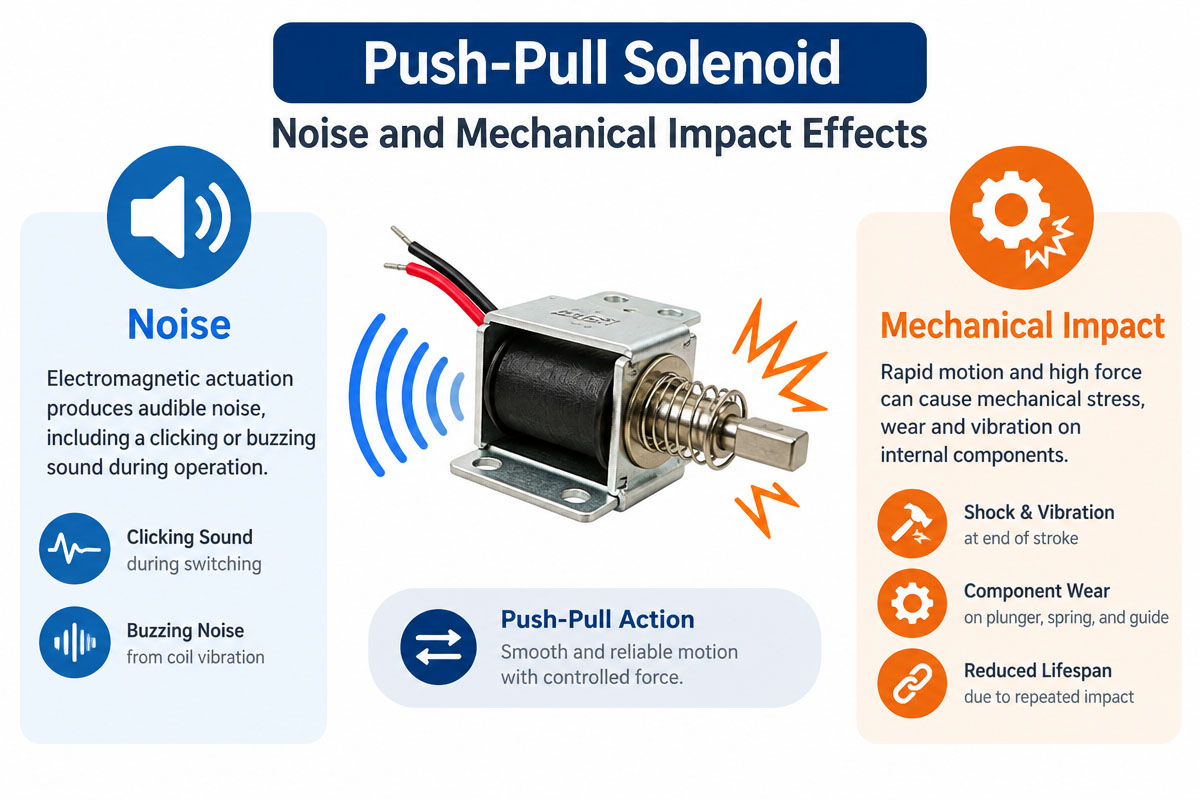
An industrial environment might be noisy, but the effects of actuator noise should also be taken into account.
The repeated impact of metal parts can indicate mechanical stress and contribute to wear.
Additionally, there are applications in laboratories, offices, medical equipment, vending equipment, or operator-controlled machinery that have increased requirements for noise generation.
Noise can be generated by the following factors:
- Plunger collision
- Mechanical end stops
- Too much clearance
- Spring action
- Connections
- Mounting structures
- vibration
- If the noise or impact is an issue, consult the push-pull solenoid supplier during the development process.
“The possible approaches to solve the issue may involve the control of plunger speed, modification of mechanical stops, clearance adjustment, application of an appropriate damping mechanism, and drive pulse optimization.”
11. Industrial Environment Analysis
A solenoid can work fine in a laboratory but might behave differently in an industrial environment.
An industrial environment can put the component through:
- Temperatures, high or low
- Oil
- Humidity
- vibrations
- Mechanical shock.
- corrosive environment
- Metallic debris
- Describe the actual operating environment to the supplier.
If the solenoid is enclosed in the machine, thermal management will be important. Plunger movement and mechanical clearance should be analyzed in case of a dusty environment.
An experienced push-pull solenoid supplier can help with environmental analysis in the design stage.
Environmental protection can be achieved with the solenoid, the enclosure of the equipment, or both.
12. Standard VS.: Custom Push-Pull Solenoids
Sometimes the quickest path is to use the standard product.
Advantages are
- Quick sample delivery
- Cost of development reduction
- Tools availability
- proven production process
- Ease of replacement
- However, the industrial equipment has specific mechanical requirements.
When the application requires a custom solution, a custom solenoid is justified:
- Voltage,
- Force/
- Myocardial Infarction
- Piston
- Push rod
- Springtime
- Bracket for mounting
- Linker
- Length of wire
- Housing
- Operating temp.
- ● Operating cycle
- When evaluating a push-pull solenoid supplier, inquire about the presence of engineering capabilities for customization.
Customization for customization’s sake is not an approach that should be used.
13. Check the push-pull solenoid supplier’s manufacturing and quality control capability
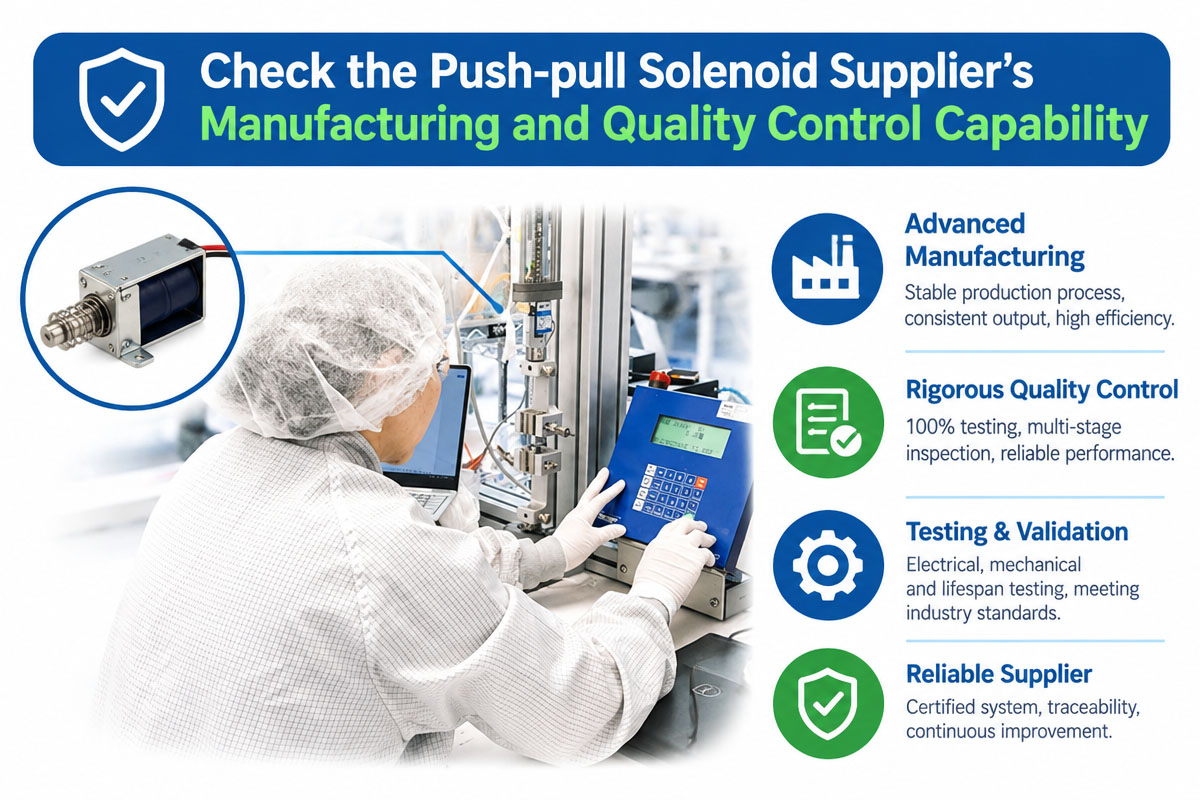
The best prototype will not be useful if the manufactured units have inconsistencies.
Industrial OEM buyers should perform manufacturing quality analysis of the supplier.
Key features might be
- Resistance of coil
- Consistency of winding
- Myocardial Infarction
- Coercion
- Measurement
- Plunger travel
- Characteristics of spring
- Isolation
- Electrical functionality
- Assembly Quality
- Ask the supplier about the control and reporting of these characteristics.
A professional supplier of push-pull solenoids will also have a change control process for engineering and materials.
The performance of the solenoid can be affected by changes in coil wire, magnetic materials, surface treatment, spring characteristics, or manufacturing tolerances.
The larger is the production quantity, the more important is the manufacturing consistency.
14. Development and Prototype Engineering Support
The engineering support can dramatically reduce the development time.
The first sample of a new industrial project can reveal some unexpected issues.
For example:
- The starting force can be too weak.
- Stroke is too long.
- The coil temperature is too high.
- The plunger can collide with a strong impact.
- Depending on the mounting position, there can be side loading.
- – The current consumption exceeds the limitation of the power supply.
- An experienced supplier will help with the root cause analysis and not only provide another sample.
The ideal development process looks like the following:
Requirements → engineering analysis → selection → prototype → testing → optimization → validation → pilot production → mass production.
Having responsive engineering support from the push-pull solenoid supplier can be more valuable than having a wide catalog.
15. Compare the Total Cost, Not Only the Unit Price
Unit price is the parameter that will always be compared by industrial purchasing departments.
However, unit price is only a part of total cost.
The low cost actuator can become quite expensive if it leads to:
- Production downtime
- Assembly problems
- Redesigning Engineering
- Excessive inspections
- Early failures
- Warranty claims
- Field Service
- Customer complaints
- Replacement cost
- Reliability is especially important if the solenoid is located deep inside the machine and its replacement is costly.
Analyze the technical capabilities, product consistency, delivery performance, quality control, engineering support, and price of the push-pull solenoid supplier.
The best buying decision is the one that reduces the total product risk and life-time cost.
16. Place Detailed RFQ
A detailed RFQ allows the supplier to provide a proper recommendation and estimate.
Please do not post only:
“Quote me a 24V push-pull solenoid.”
Do the following:
Application: Automation system for industry;
Function: Pull and release the lock lever.
Voltage: 24 VDC
Stroke: 8 mm
startforce: 18 N at 8 mm
Final force: 30 N ON Time: 1s OFF Time: 4s
Working frequency: 12 cycles/min
Ambient temperature: -10 to 60°C
(1,000,000 cycles) Life Expectancy
Space available: 45 x 30 x 25 mm
Installation: 2-hole flange
Annual volume: 80,000 units
When possible, include mechanical drawings, CAD files, photos, videos, or load information.
The information provided allows the push-pull solenoid vendor to analyze the specific application instead of making guesses based on the generic description.
17. Final Supplier Selection Checklist
Following are the issues to check before making a purchase decision for industrial production:
- Does the solenoid pull enough at the necessary stroke?
- Does the voltage match the industrial control system?
- Is the current consumption acceptable
- Is the duty cycle well defined?
- Has temperature rise been evaluated?
- Is the design compatible with the required operational life?
- Is the machine response time acceptable?
- Is the operating environment within the capabilities of the solenoid?
- Can the mechanical and electrical parameters be customized?
- Can the supplier support prototypes, engineering changes?
- Over the lifetime of the product, is the total cost acceptable?
18. Conclusions
Choosing the proper push-pull solenoid for industrial equipment is much more than a voltage, size, and price comparison.
Force should be measured at the actual working stroke. Duty cycle and temperature are not independent. The coil has to be tuned to the available power. The mechanical design has to match the expected operational life. The complete actuator has to work in real industrial conditions.
The proper push-pull solenoid supplier will be an engineering partner as well as the component manufacturer.
Work together with the supplier at the early stage of the OEM project. Define force, stroke, voltage, duty cycle, temperature, lifetime, and environmental and installation requirements. Validate the chosen solenoid in the real machine.
The right push-pull solenoid supplier will provide technical data, support prototype testing, identify potential issues in the application, provide proper customization, and ensure the manufacturing quality of the product in mass production.
By analyzing engineering capability and manufacturing reliability, industrial buyers will reduce development risks, increase the equipment performance, and achieve a reliable long-term supply solution.
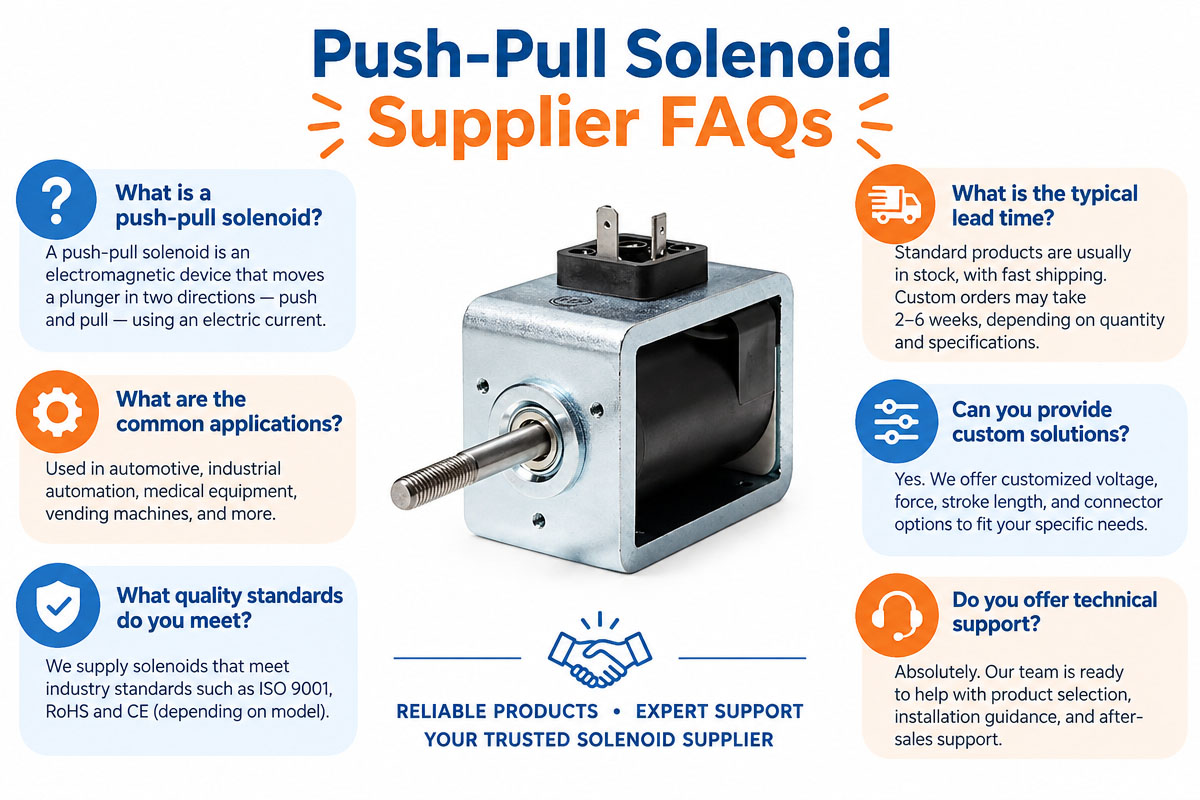
19. Push-Pull Solenoid Supplier FAQs
1. What does a push-pull solenoid do?
A push-pull solenoid is an electromagnetic actuator that transforms electrical energy into mechanical linear motion. Depending on the construction and mounting, the motion can be used to push and pull a mechanical element.
2. How do I select a push-pull solenoid supplier?
Select the push-pull solenoid supplier with the proper engineering capabilities, force and stroke data, coil design, thermal performance, operating life, manufacturing quality, customization capabilities, prototype support, and production capacity.
3. What information do I need to provide to the supplier?
Voltage, available current, required stroke, force at the stroke position, ON/OFF time, duty cycle, operating frequency, available dimensions, temperature range, expected life, environmental conditions, mounting requirements, and annual quantity.
4. How do I calculate the force needed for a solenoid?
Firstly, estimate the mechanical load. Then add the spring resistance, friction, gravity, link geometry, acceleration, and other resistive forces. Add the engineering margin. Then calculate the required force at the stroke.
5. Why does the force of the push-pull solenoid change with stroke?
The force of the solenoid is defined by the magnetic circuit and the air gap between the magnetic components. With the changing plunger position, the magnetic circuit changes, and thus the force changes.
6. Can I run the push-pull solenoid continuously?
The possibility depends on the design. Some designs are suitable for continuous operation, and some for intermittent duty. For continuous duty, you must consider the coil power, heat dissipation, ambient temperature, insulation, and force requirements.
7. Should you use a 12V or 24V industrial solenoid?
Neither of the voltages is better in terms of performance. The voltage selection depends on the power architecture of the equipment, the available current, control electronics, wiring, force requirements, and other system constraints. Most of the industrial control systems use 24 VDC, but the application will decide the final voltage.
8. Can a push-pull solenoid be customized?
Yes. The supplier might be able to customize the voltage, coil resistance, force, stroke, plunger geometry, springs, mounting brackets, wires, connectors, and dimensions. Customization is possible but depends on the technical requirements and production quantity.
9. What is the life expectancy of the industrial push-pull solenoid?
The life expectancy depends on load, stroke, operating frequency, impact, temperature, mechanical alignment, surface treatment, lubrication, and other parameters. The buyer should ask for the cycle-life data to be tested according to the specific application, not the general cycle-life claims.
10. Why is the duty cycle important for a solenoid selection?
The coil temperature depends on the duty cycle. The powerful solenoid designed for the short pulses might overheat if energized too long. The exact ON and OFF times allow the supplier to pick the right coil design.
11. Standard or custom solenoid? What to choose?
Select the standard product if it fits the force, stroke, voltage, size, duty cycle, and lifetime requirements. Customization: If the standard product does not fit the mechanical, electrical, environmental, or commercial requirement, consider customization.
12. What to expect from a push-pull solenoid manufacturer
Engineering support, documented performance data, prototype capability, manufacturing process, quality control, customization experience, life testing capability, change control, and the ability to support future production volumes.