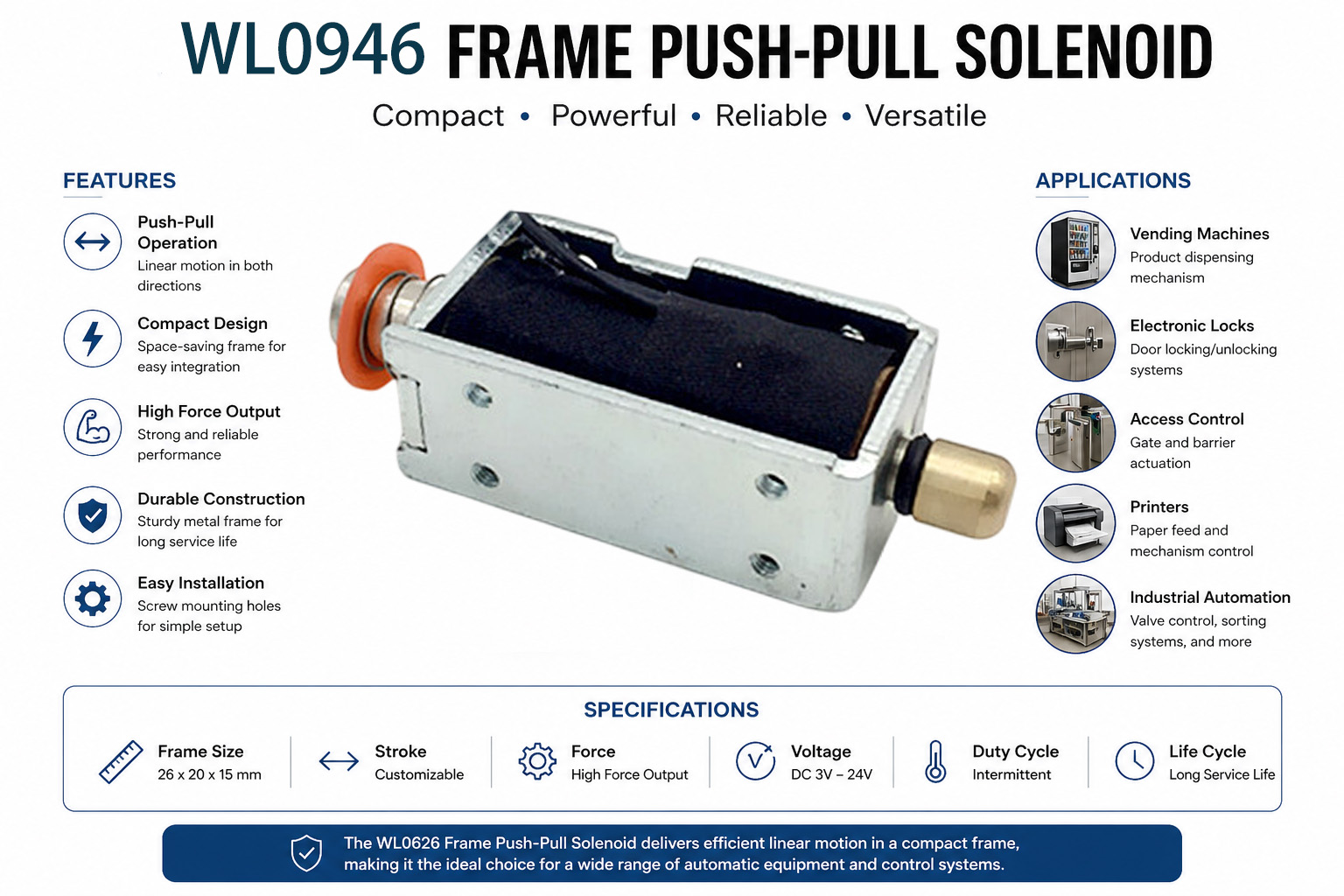

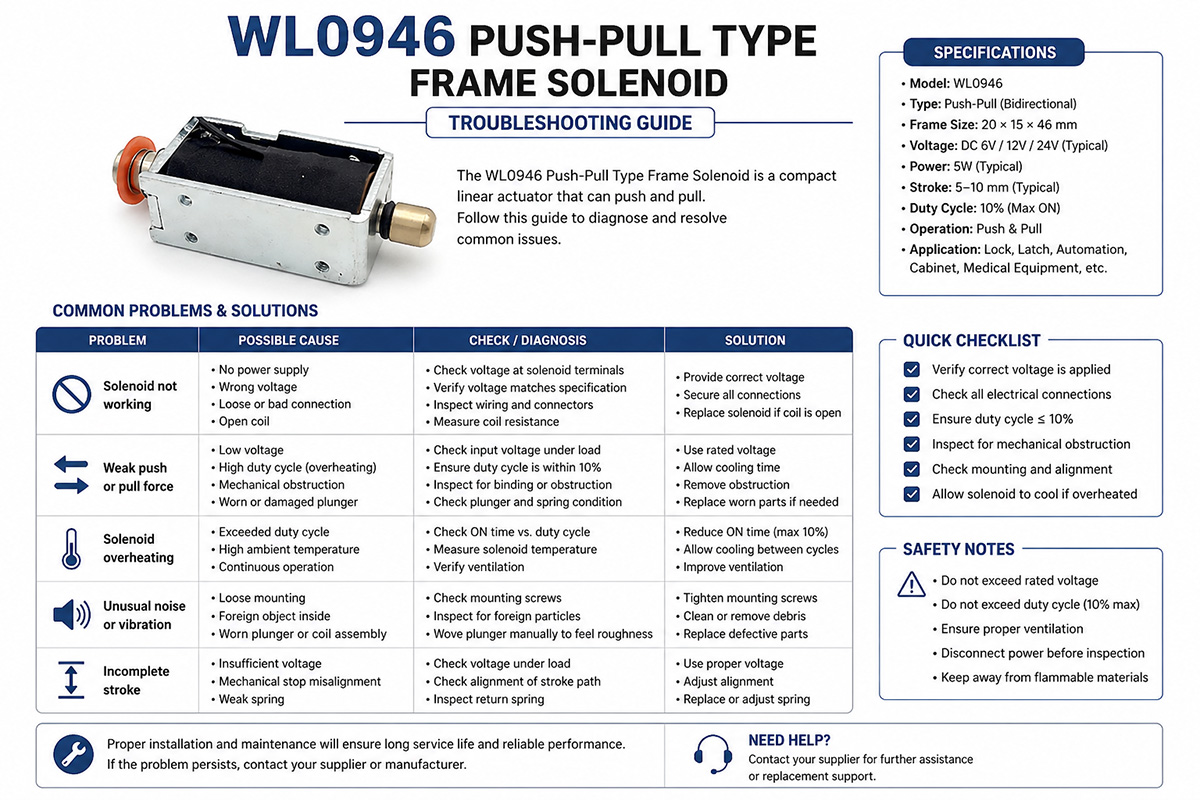
Selection Criteria of a Push-Pull Frame Solenoid
What does it mean to choose a right push-pull solenoid frame? You should understand that strength is not everything. To get a good balance between the cost and performance, you need to make sure that your choice will be adequate for real working conditions. This way, you won’t overestimate requirements and overspend money. At the same time, underestimation will lead to early failures. Here’s a step-by-step guide to choosing the most suitable push-pull type solenoid frame:
Step 1: Determination of the Needed Strength Force
Starting from load.
Calculating the minimum needed force, including friction, adding an additional 20-30% of safety.
Checking both:
Inward pulling force
Force moving outward – note that it is weaker than the pulling force.
Tip: Force rating refers to 0 mm stroke length provided by suppliers; stroke increase results in reduction in force.
Step 2: Calculation of Stroke Length
How long does the plunger need to travel?
Usual range for frame solenoids: 2-10 mm.
Longer stroke length equals less force availability.
Step 3: Compatibility of Solenoid with Voltage and Power Supply
Check solenoid compatibility with existing power system:
Voltages range: DC 6V, 12V, 24V.
Make sure of:
Stable and consistent voltage source
Availability of current capability
Voltage inconsistency may result in poor force generation or overheating.
Step 4: Duty Cycle
Very common mistake.
Solenoids have a duty cycle of around 10%-25%.
Example: ON – 1 sec., OFF – 9 sec. (10%)
Case of need for continuous operation:
Use a latching solenoid
Include a cooling design
Step 5: Pull-In/Release Time
If you need to operate rapidly (as in the case of lockers and vending machines):
Check pull-in and release times, especially if it should happen fast.
If needed, use a spring for faster return.
Step 6: Space Availability for Installation
Evaluation of the installation place:
Small dimensions of frame solenoids, but still consider:
Stroke clearance
Matching mounting holes
Provision of sufficient room for cables
Step 7: Environmental Conditions
Realistic estimation:
High temperature accelerates wear-out of coils
Humid environment, dust, etc. – need protection
Presence of vibration – solenoid needs sturdy mounting
For harsh conditions: choose IP-rated or hermetic solenoids.
Step 8: Lifespan & Reliability Requirements
Things to specify:
Cycle life, e.g., 100K-1M cycles
Class of insulation of the coil
Plunger & spring quality (high price means high quality)
The main reason for frequent failure in cheap models: poor coils winding and materials.
Step 9: Sound Requirements
Application cases:
Medical devices
Office equipment
Specify your preferences about dampers (rubber ones or soft landing mechanisms).
Step 10: Cost versus Quality
Just do not always opt for the cheapest version.
Comparative analysis:
Normalized force
Thermal properties
Reliability of manufacturer
A higher price may eventually decrease your expenses.
Why is the push-pull frame solenoid getting so popular in smart locking systems?
Push-pull frame solenoids have become one of the most popular actuators for smart locking systems. But it happens not by chance. Here’s how:
1. Quick response to control signal
The push-pull solenoid immediately converts the electrical impulse into the movement of the lock bolt
No gearboxes, shafts, and rotors are used
The stroke occurs at an angle of up to 90 degrees
It is ideal for implementing a quick response to the command in real-time
👉 In the case of a smart lock, this feature allows us to:
Reduce response time
Optimize synchronization with sensors and control units
2. Small size of the device
Smart locks are becoming smaller and thinner, which makes them suitable for use in various applications, including:
Glass locks
Frameless locks
Locks that do not require installation in the door jamb
Push-pull solenoids
Compact design
Fit perfectly into any lock body, even those that are difficult to reach
Enable handle-free locks operating by push-pull method
That is why push-pull solenoids are used in smart locks of all types, including:
Cabinet locks
Hotel locks
Office locks
3. Simple control
Solenoids are binary actuators:
Apply voltage -> move
Stop supplying voltage -> reset
Such simplicity of the actuator allows us to easily integrate it with:
Microcontrollers (ESP32, Arduino, etc.)
Implement various functions in a simple way
Reduce the likelihood of equipment malfunction due to software errors
Therefore, they are most commonly used in:
Home systems
Locks powered by batteries
Wireless locks
4. Strong clamping force with minimal energy consumption
Push-pull solenoids allow us to implement a strong clamping force while minimizing energy consumption
Short impulses to activate a solenoid
Ability to hold a door closed without continuous energy supply
As a result, the lock has:
Increased battery life
Reduced energy consumption
5. High reliability and long service life
When comparing solenoids and motors, we get the following advantages of solenoids for high-performance locks:
Simplification of construction
Reduction of the number of movable elements
Elimination of gear wear
Typically, such actuators provide millions of operating hours and require almost no maintenance.
6. Smooth and quiet user interaction
Push-pull solenoids work faster and quieter than many types of motors
In the case of smart locks, this feature provides:
Decrease noise level during unlocking
Increase comfort of use
Moreover, combined with push-pull door opening mechanism, users will only need to push or pull a door
7. Perfect solution for automated locks and smart ecosystems
Modern locks are integrated into:
Mobile applications
Cloud platforms
Smart home systems
In this case, push-pull solenoids are a great choice because they allow you to immediately respond to digital commands and implement additional functions such as:
Automatic locking/unlocking
Remote unlocking
Timed unlocking
8. Economical and convenient manufacturing
Manufacturing costs compared to motors and gear systems are lower
Assembly process is simpler
Customization options are increased
That is why they are widely used in smart products:
Smart lockers
Parcel boxes
Sharing access systems
9. Conclusion
Push-pull frame solenoids are increasingly being used in smart locks. The reason is obvious – they combine the best features of smart and automated locks: quick response, energy efficiency, compactness, easy control, reliability, and versatility.