Chapter 1: Introduction
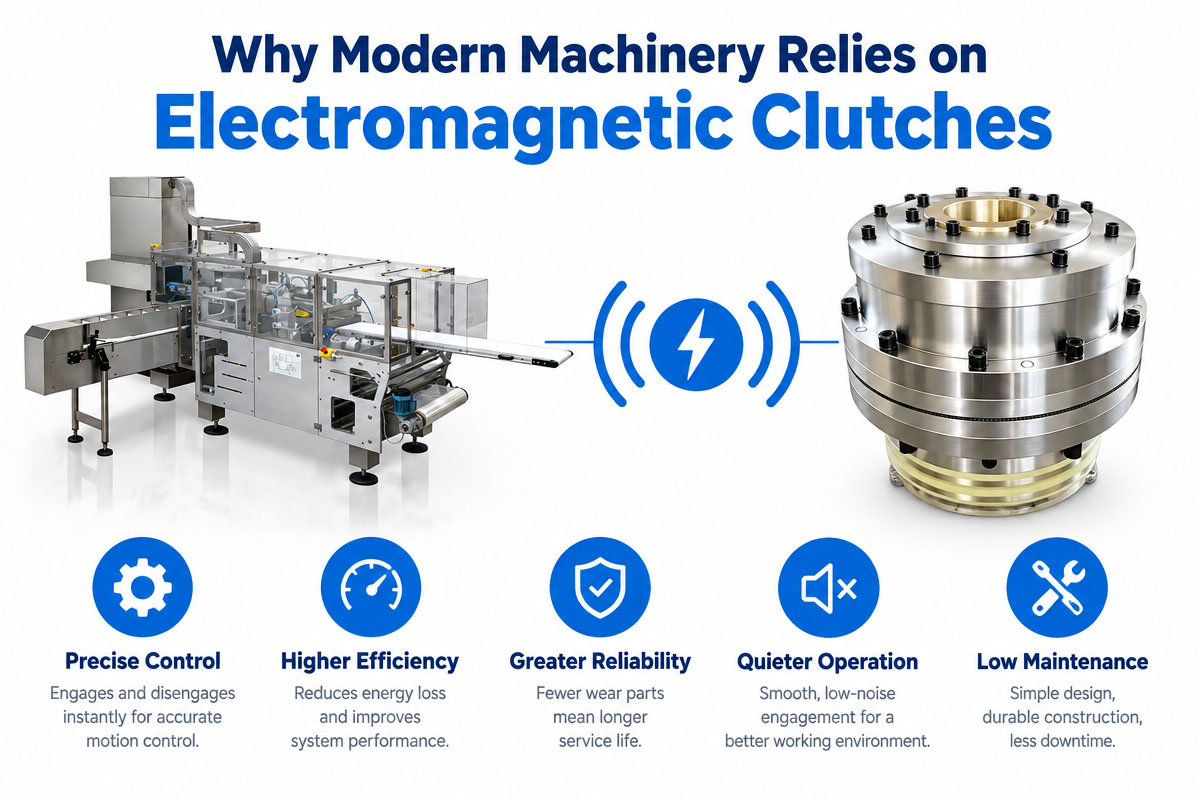
Modern machines should work fast, precisely, and efficiently. Precision control of rotation is essential for packaging lines, conveyors, printing, textile equipment, robotics, agriculture machines, and production facilities.
One of the parts responsible for this control is the electromagnetic clutch.
As opposed to a standard mechanical clutch, an electromagnetic clutch engages/disengages the transmission of mechanical power through electrical actuation.
This combination makes the clutch perfect for automated machinery.
Electrical control and quick response of electromagnetic clutches allow the equipment to be engaged/disengaged without stopping the motor.
These qualities of the electromagnetic clutch make them an indispensable part of modern industrial equipment used to increase productivity, repeatability, and control.
Chapter 2: What is the electromagnetic clutch?
An electromagnetic clutch is the device using electromagnetic energy to transmit or interrupt rotation between the driver and the driven element.
Engagement is performed electrically, but the torque is normally transferred mechanically through friction surfaces.
The typical electromagnetic clutch consists of several major parts: an electromagnetic coil, a rotor, an armature, a friction surface, a hub, bearings or mounting components, and a return spring.
Electricity flow generates a magnetic field, and the armature is attracted to the rotor due to magnetic force. Friction surfaces touch each other and torque transfers from the driver shaft to the driven shaft.
In typical power-on designs, absence of electricity interrupts the magnetic field, and the return system moves the armature from the rotor.
This principle of work is rather simple, but the ability to control it electrically allows the designer a lot of opportunities.
Chapter 3: Why electromagnetic clutches are right for modern automation
Industrial machines today are highly dependent on electronic controls like programmable logic controllers, sensors, relays, timers, and programmable machine controllers.
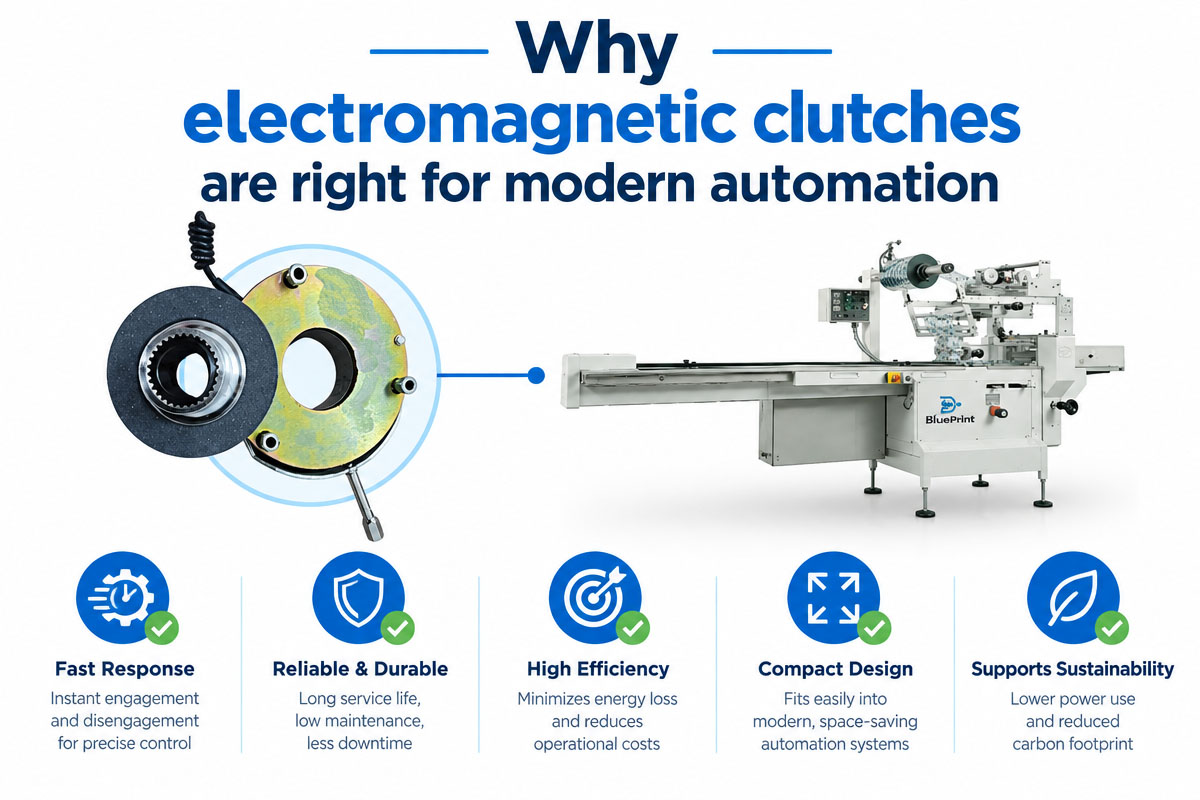
The electromagnetic clutch easily fits into these systems, as the engagement is controlled by an electrical signal.
Consider, for example, a packing line where the conveyor is working all the time, but the labeling mechanism starts only when a package reaches a particular sensor. The control system engages/disengages the electromagnetic clutch when it is needed instead of starting/stopping the main motor.
The different machines are controlled independently while they have a single drive system.
It means that modern machinery gains a lot because of electromagnetic clutches being a part of the control system. The sensors detect the position of a product, the PLC processes it, and then the electromagnetic clutch operates in order to provide/disrupt mechanical transmission as required.
The result is increased flexibility of the machine.
3.1 Quick engagement and precise motion control
The timing is a critical moment for automated machinery.
Packaging machines, printers, assembly equipment, indexing devices, and automated conveyors perform many repetitions during the production process. Even small variations in timing could influence the accuracy of the positioning, quality of the product, or production efficiency.
The properly selected electromagnetic clutch can engage fast and often.
As the clutch is actuated electrically, the machine controller is capable of determining the exact moment of the engagement.
An electromagnetic clutch is useful for applications requiring frequent start-and-stop operations, indexing, synchronized motion, feed mechanisms, and intermittent torque transmission.
However, the response time depends on such parameters as clutch design, air gap, voltage, electrical control, load inertia, and operating conditions. Thus, the clutch should be selected according to the real dynamics of the application and not the torque only.
3.2 Independent control without having to stop the motor all the time
One of the biggest advantages of the electromagnetic clutch is its ability to control the driven mechanism without having to turn the main motor on and off constantly.
Let us consider the example of the machine with different processes, all of them controlled by the same motor. Different sections should be working separately.
In this case, the manufacturer should either provide different motors, additional drives, or more complicated mechanical transmission without clutches.
The sections can be engaged independently with the help of properly designed electromagnetic clutches.
The motor works all the time, and the clutch changes the section that receives the torque.
This is extremely useful in manufacturing machinery where constant turning on and off of the motor is uncomfortable or inefficient.
It can simplify the mechanical system and improve the machine sequence control.
3.3 Compact design of machinery with space limitations
Industrial machines are becoming smaller and smaller.
Particularly in automated factories where the floor space is precious for the manufacturer, there is a desire to maximize productivity from the smallest machine footprint.
Control power can be transmitted with a compact assembly using an electromagnetic clutch. According to the configuration, the clutch can be integrated around a shaft, motor, pulley, gear, conveyor mechanism, or any other rotating assembly.
Thus, the compact design of the clutch helps the machine engineer to integrate the controlled engagement without big mechanical linkage systems.
However, size shouldn’t be considered separately. While selecting the right clutch, one should pay attention to torque capacity, rotational speed, heat dissipation, shaft size, bearing loads, installation clearance, and duty cycle.
3.4 Improved compatibility for PLC-driven machines
Programmable automation plays an increasing role in the modern factory.
That’s another reason why electromagnetic clutches are a good thing.
The clutch can be electrically engaged and becomes a part of the integrated machine control system. Depending on the system design, the function of the clutch can be integrated with PLC outputs, sensors, relays, safety controls, counters, timers, and other automation devices.
For example, a sensor detects the presence of the product on the workstation. The PLC energizes the electromagnetic clutch, and the proper mechanism performs a complete motion cycle.
When the motion cycle is finished, the PLC releases the clutch until the next product comes.
Weilong published the industrial clutch material, including 24V DC electromagnetic clutch configurations used in automation applications, describing integration with the PLC-controlled equipment.
Such integration is particularly useful in packaging, conveying, printing, automated assembly, and material handling systems.
3.5 Smooth and repeatable torque transfer
But speed isn’t the only parameter defining the performance of the machine. Smooth engagement is very important as well.
Sudden mechanical engagement can cause shocks, vibrations, noise, and additional stresses for shafts, gears, bearings, belts, and other transmission elements.
A properly selected electromagnetic friction clutch provides a controlled frictional engagement between the driving and the driven elements.
The behavior depends on the clutch design, load inertia and speed, friction material, voltage, and control strategy. Electromagnetic clutch systems can provide repeatable engagement characteristics if they are designed properly.
Every production cycle should work as consistently as possible. Repeatability is critical for automated machinery.
Stable clutch operation contributes to predictable machine timing and helps to reduce additional mechanical disturbances.
Chapter 4: Electromagnetic Clutch & Brake Systems
Disengagement of the load sometimes isn’t enough for the equipment. The rotating mechanism should also stop quickly when the clutch is disengaged.
This is when the electromagnetic clutch and brake combination is really helpful.
The clutch is the part controlling the moment when torque is transmitted to the driven mechanism; the brake is used for stopping or holding.
For example, an indexing machine. The clutch is engaged to index something into position, and then the brake stops it.
This kind of synchronized motion control is helpful in packaging, printing, textiles, conveyor, winding, and automated production equipment.
We provide published electromagnetic clutch and brake solutions taking into account their functions of controlled torque transmission and stopping.
This solution is particularly helpful for the machine process involving rapid start/stop cycling and positioning, as it provides the functions of the clutch and brake.
Chapter 5: Applications of Electromagnetic Clutches
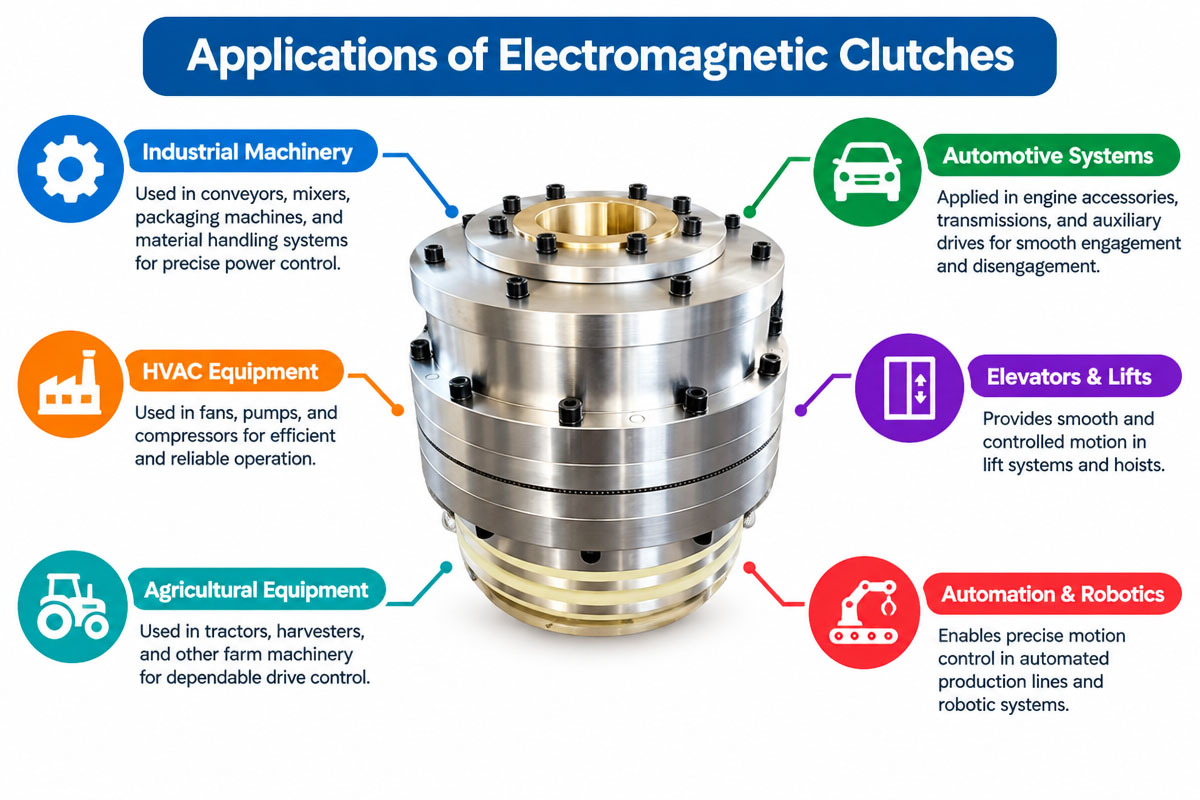
Electromagnetic clutch is a very versatile technology. It can be used in numerous machines.
On packaging machines, clutches are used to control feed, index, label, seal, cut, or position functions.
On conveyor systems, an electromagnetic clutch can disengage or engage selected conveyor sections as needed to meet production demand.
Clutches can be used on printing machines to synchronize rollers, paper-feed mechanisms, or other rotating components.
Engagement of winding and processing mechanisms may be required for textile machinery.
In industrial automation systems, electromagnetic clutches are used when one wants to electronically engage or disengage rotational motion.
Furthermore, electrically controlled clutches are used in robotics and assembly machines where repeatable motion and small installation space are necessary.
There are also other applications, which may include agricultural machines, vending machines, material handling systems, office machinery, automatic production machines, and specialty industrial machines.
Chapter 6: Selection of Electromagnetic Clutches
Selection of an electromagnetic clutch is not just an issue of finding a piece fitting the shaft.
When purchasing teams and engineers evaluate electromagnetic clutches, they have to take into account the following factors:
- Needed static and dynamic torque, speed and RPM, inertia of the load, voltage, engagement and release response, frequency of start/stop, duty cycle, allowed heat dissipation, shaft diameter, mounting configuration, installation space, life expectancy, temperature, exposure to dust or humidity, and vibration and whether an electromagnetic brake is also needed.
Torque is especially important. If the clutch is undersized, it may slip, overheat, wear out too quickly, or not transfer the load. Choosing the unit larger than necessary would result in increased size, weight, cost, and electrical requirements.
Heat generation is also to be considered. There may be some friction heat generation each time the clutch engages. There may also be heat generation by energized electromagnetic coils. Appropriate thermal consideration is necessary for machines operating with high speed or frequent clutch operations.
Voltage compatibility should be checked. Electromagnetic clutches for industrial applications are widely available for DC systems. But the designer has to choose a clutch compatible with the power supply and control system.
When choosing a clutch for the application, Weilong itself recommends considering torque, voltage, speed, duty cycle, shaft size, installation, and environment.
Chapter 7: Maintenance and Durability
A properly selected, installed, and maintained electromagnetic clutch can perform reliably, but it is not to be considered as a maintenance-free product.
Friction surfaces wear out. Too much heat affects performance. Improper air gaps decrease the engagement force. Oil, grease, dust, or contamination on friction surfaces leads to slipping and improper performance.
Therefore, maintenance should be performed according to the manufacturer’s recommendations.
Technicians should regularly check electrical connections, condition of the coil, mounting, friction surfaces, air gap (when applicable), temperature, engagement, and any abnormal noise and vibration.
When an electromagnetic clutch starts to slip, engineers have to find out the reason and not just increase voltage. It may be the overload, contamination, worn-out friction material, excess air gap, inappropriate duty cycle, or any mechanical problem.
Proper installation and application matching may be critical for proper performance.
Chapter 8: Why Choose Weilong as an Electromagnetic Clutch Solution Provider?

Choosing the appropriate electromagnetic clutch is not only a choice of the standard product. The provider has to be familiar with the required torque, electrical control, installation limitations, duty cycle, working conditions, and performance of the machine.
Weilong Technology manufactures electromagnetic products for industrial and automation applications. It provides a range of electromagnetic clutches and clutch brakes, such as 24V industrial designs and high-torque solutions.
Wider engineering capabilities in electromagnetic technology are the advantage of the company for the OEMs. The company claims that it is capable of designing, prototyping, tooling, testing, manufacturing electromagnetic components, and custom development.
It may be useful if the standard electromagnetic clutch does not fit the torque, voltage, size, mounting method, response time, or working environment of the machine.
Quality control is also a serious issue for industrial customers. According to Weilong, its quality program consists of design validation, a controlled manufacturing process, testing, and product verification. Weilong operates under ISO 9001 and IATF 16949 quality management systems.
For the OEMs, automation companies, equipment manufacturers, and industrial customers, the engineering-oriented approach means that Weilong can support the whole process from the application requirements and model selection up to prototyping and production.
Instead of choosing the electromagnetic clutch based on the size or price, the customer can go for the solution fitted to the operating conditions of the machine.
Chapter 9: Electromagnetic Clutches: The Future of Modern Machines
As the automation of manufacturing increases, machines will require precise electronically controlled motion.
Motors, VFDs, servos, sensors, PLCs, clutches, and brakes are all used in the design of the machine for different purposes. Electromagnetic clutches are especially good when designers need to connect or disconnect mechanical power quickly without necessarily stopping the driving source.
These clutches are useful in numerous industrial applications because of their simple operation principle, electrical controllability, quick response, compact construction, and compatibility with automated control systems.
They are not the right solution for all motion control applications. Some applications are better solved with servo drives, direct-drive motors, or pneumatic or hydraulic systems.
However, if the reliable and repeatable electronically controlled torque engagement is required, the electromagnetic clutch is still the good solution.
Chapter 10: Conclusion
Modern machinery relies on increasing coordination between electrical control systems and mechanical components.
One of the connections between these two areas is the electromagnetic clutch.
This clutch works due to the electrical signals, and torque is transferred to the driven mechanism due to mechanical friction. Thus, machines can control motion precisely and quickly without complex manual mechanical linkages.
Many manufacturers use electromagnetic clutches to control start/stop motion, indexing, synchronization, and selective power transmission for packaging, printing, automation, conveyors, textiles, assembly machines, and specialty industrial machinery.
The choice is right.
Before choosing an electromagnetic clutch, the following factors should be taken into consideration: torque, speed, inertia, voltage, duty cycle, response time, heat, mounting, and environment.
Product options and technical capabilities for industrial customers in search of electromagnetic clutch solutions with electromagnetic engineering and application support for modern automated machines.
Choosing the appropriate clutch for the operating conditions of the machine improves motion control, reliability, and machine performance.
Chapter 11: FAQ on Electromagnetic Clutches
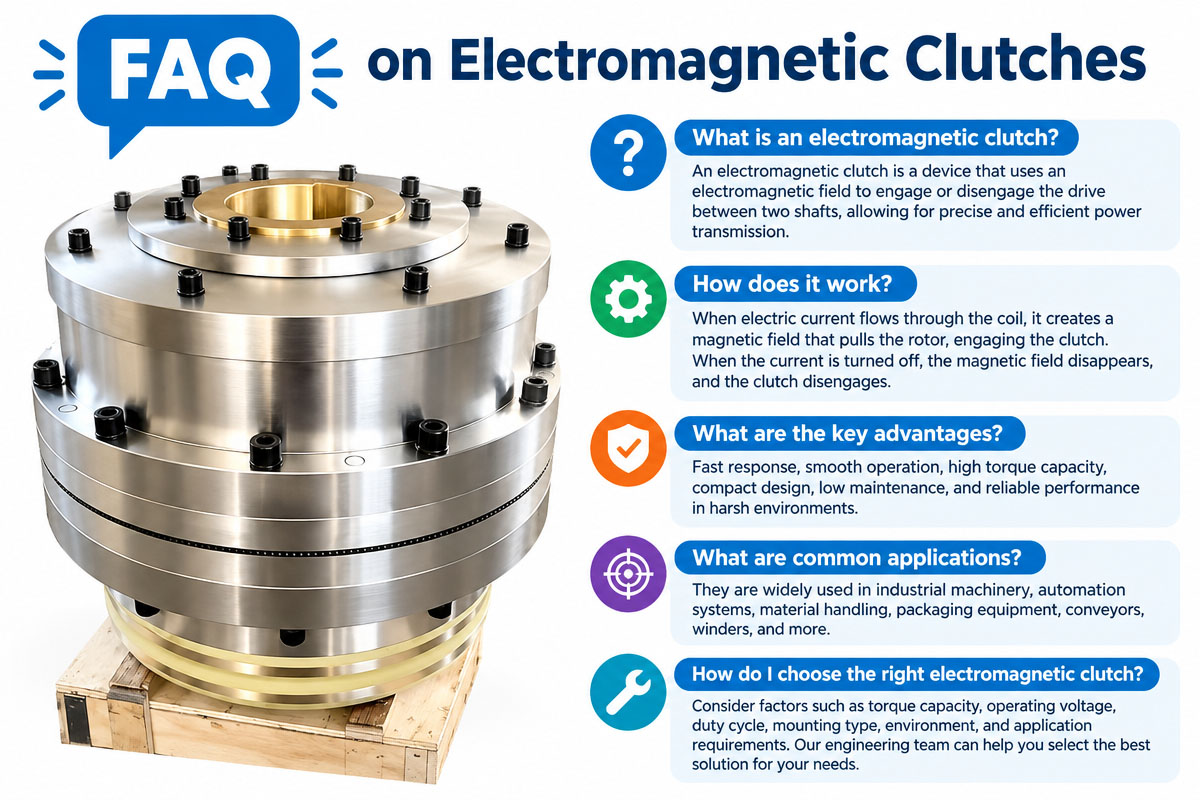
What is an electromagnetic clutch?
An electromagnetic clutch is a mechanical device powered by electricity for engagement or disengagement of the mechanical rotational power. A common friction-type design employs excitation of an electromagnetic coil to generate a magnetic field and pull the armature toward the rotating rotor. Then torque is transferred via friction surfaces.
How does an electromagnetic clutch work?
When an electromagnetic coil is powered with the specified electrical current, it generates a magnetic field. Magnetic force pulls the armature to rotate the clutch face. Torque is transferred to the driven shaft through friction surfaces. In the common power-on clutch, the power supply is turned off to release the armature and stop torque transmission.
What is the difference between an electromagnetic clutch & an electromagnetic brake?
The electromagnetic clutch is designed to connect driving and driven parts for torque transmission. The main function of the electromagnetic brake is to retard, stop, or hold a rotating part. Some industrial systems combine these functions in a clutch-brake assembly.
Common applications of electromagnetic clutches are:
Electromagnetic clutches are widely used in industrial automation, packaging machines, conveyors, printing machines, textile machines, material handling systems, automated production machines, agricultural machines, and other applications requiring controlled rotational power transmission.
Yes, a PLC can control an electromagnetic clutch.
Yes, electromagnetic clutches can be used in PLC-controlled machinery provided the electrical supply, driver circuit, voltage, switching requirements, and clutch specifications are properly matched. This allows using it for automated start-stop, indexing, positioning, and production sequencing applications.
What makes an electromagnetic clutch fail?
Common reasons for poor clutch performance are wrong voltage, damaged coils, excess load, overheating, worn-out friction surfaces, contamination, wrong air gap, wrong installation, or inappropriate duty cycle. For reliable performance it has to be properly sized, installed, electronically controlled, and maintained.
How do I choose the right electromagnetic clutch?
Factors to be considered are torque requirements, speed of operation, inertia of the load, voltage, frequency of engagement, duty cycle, response time, shaft diameter, mounting arrangement, environmental conditions, and available installation space. In many industrial applications the best way to find the right model is to give operating parameters to the clutch manufacturer.
Why select Weilong as an electromagnetic clutch manufacturer supplier?
Weilong combines the engineering of electromagnetic products with published industrial clutch and clutch-brake solutions. It can design, prototype, test, manufacture, and develop applications to help OEMs and machinery manufacturers select or develop an electromagnetic clutch for their equipment needs.