Electromagnetic Lifting Magnet Industrial OEM Equipment
Electromagnetic Lifting Magnet Industrial Safety Moving
Electromagnetic Lifting Magnet Industrial Solutions Use
Electromagnetic Lifting Magnet Industrial Guide Service
Electromagnetic Lifting Magnet Manufacturing Operations
Electromagnetic Lifting Magnet Operations Manufacturing
Electromagnetic Lifting Magnet Industrial OEM Equipment
Electromagnetic Lifting Magnet Industrial Safety Moving
Electromagnetic Lifting Magnet Industrial Solutions Use
Electromagnetic Lifting Magnet Industrial Guide Service
Electromagnetic Lifting Magnet Manufacturing Operations
Electromagnetic Lifting Magnet Operations Manufacturing

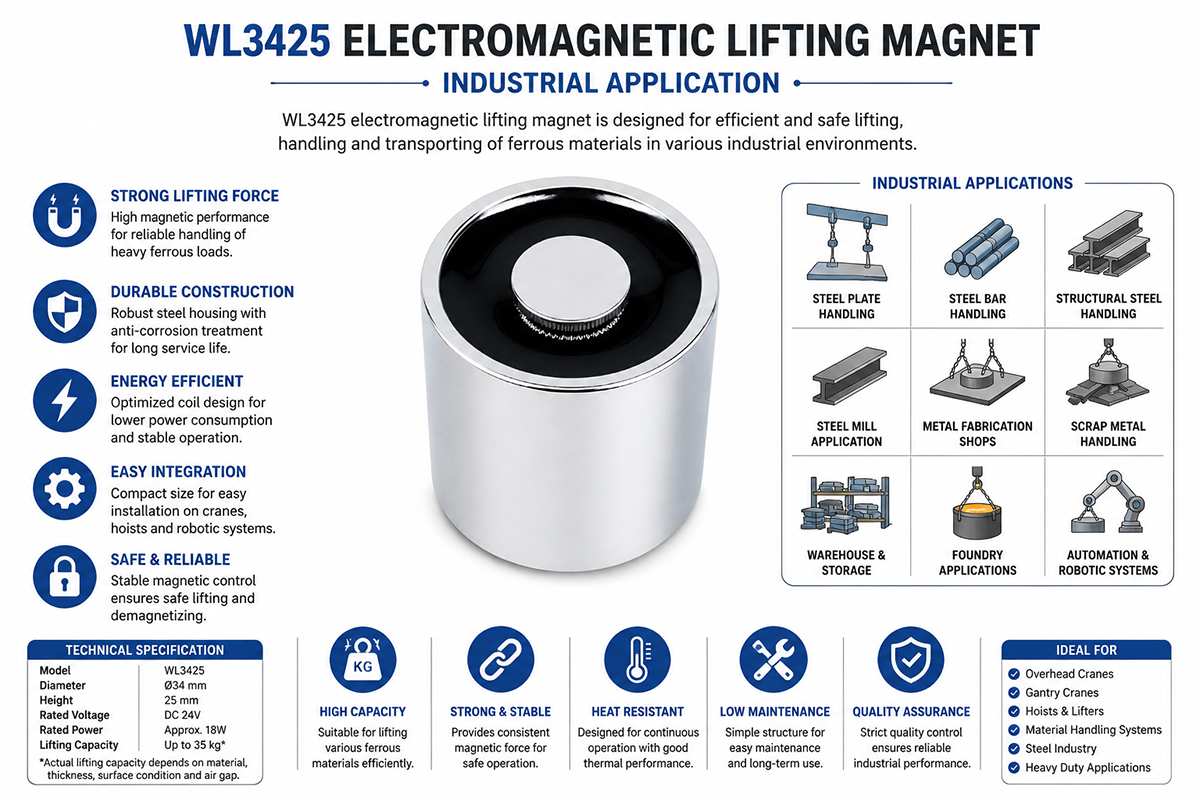
WL3425 Electromagnetic Lifting Magnet Industrial

Electromagnetic lifting magnet is a material handling device used in industries for lifting and positioning ferromagnetic loads through the application of magnetic force. It is widely used in handling steel plates, bars, pipes, sheets, blocks, scrap metal and other iron containing materials. Electromagnetic lifting magnets could increase the productivity, minimize the handling time and reduce the manual labor involved in manual handling. They can be installed on overhead cranes, gantry cranes, lifting systems, robots, and automated production lines. The performance of the magnet depends on the magnetic force, electrical input, load shape, material type, surface condition, air gap and the operating temperature. Industrial customers must select the magnet based on the actual load weight and geometry rather than the nominal lifting capacity. Electrical control, inspection, maintenance, and safe operation are other important aspects. In case of proper design and application, electromagnetic lifting magnets offer a workable solution for the material handling problem in industrial environments.

Electromagnetic Lifting Magnet Description

Electro-magnetic lifting magnet is a lifting equipment which uses the electrical current flowing through the electromagnetic coil to generate a magnetic force. The magnetic force attracts the ferromagnetic materials like iron and steel and hence heavy metallic parts can be lifted and moved without the need for the traditional methods of hooks, chains and clamps. Electro-magnetic lifting magnets are widely used in steel mills, metal fabrication plants, warehouses, foundries, machine shops, scrap recycling facilities, and construction industries. The lifting capacity of the magnet depends on its design, electrical power, contact area, material thickness, surface condition, air gap and the load geometry. Properly controlled attachment and release in appropriate lifting systems would be an effective means of industrial material handling, especially in the cases where steel products are lifted repetitively.


How an Electromagnetic Lifting Magnet Works?


Electromagnetic lifting magnet converts the electrical energy to magnetic force.


Electrical power is provided

The magnet coil is fed with a controlled DC or electrical input.

The coil produces magnetic force

The current flowing through the magnet coil produces the magnetic field around the magnetic core.

The magnetic force is concentrated by the magnetic circuit

The magnet design directs the magnetic flux towards the working surface.

The load is attached by the magnetic force

Once the magnet comes in contact with the suitable ferromagnetic material, magnetic flux passes through the load creating an attracting force.

The load is lifted and transported

The magnet remains energized while the crane, hoist or lifting equipment transports the load.

The load is detached

Once the electrical power or magnetic state of the magnet changes by the control system, the magnetic holding force of the magnet is minimized and hence the load is detached.


The real performance of the magnet is dependent on the material grade, thickness, contact area, surface condition, air gap, temperature, magnet condition and the electrical system. Safety controls have to be designed in such a way that it would not create any unacceptable load drop situation in the case of unexpected loss of power.

Electromagnetic Lifting Magnet Video

Electromagnetic Lifting Magnet Detail Display

Electromagnetic Lifting Magnet Technical

Brand Weilong Technology Model Number WL3530
Rated Voltage (V) DC 12V or 24V Rated Power(W) 1-9.6 W
Work Mode: Power on, Magnet on Holding Force (N) 25 Kgs
 working duty 100% Resistance 32  Ω
Service Life 300 Thousand Times Certification CE,ROHS,ISO9001,
Material Superior Magnet Carbon Steel Housing Lead Wire Length(mm) 200 MM
Install Style Screw Hole Tolerance of Dimension  +/-  0.1 MM
Water-proof  None Insulation Class B
Hi-Pot Test AC 600V 50/60Hz 2s Non-excitation Holding Force 0
Working Temperature -10°C-100°C Duty Cycle 1-100%
Thread Depth(mm) / Payment Term TT, or LC At Sight
Sample Order Yes Warranty 1 Year
MOQ 1000 pcs Supply Ability 2000 pcs per Week
Delivery Time 30 Days Port of Loading shenzhen

Reasons for the Increasing Popularity of the Electromagnetic Lifting Magnet

Electromagnetic lifting magnets are becoming popular with the increasing demand for fast, clean and controllable material handling by the industrial manufacturers. Manual placement of individual loads through the traditional chains, hooks, slings and clamps could increase the handling time and labor requirements. Operators could attach an electromagnetic lifting magnet to suitable ferromagnetic surfaces, thus, moving steel products effectively.

Another important reason is the automation. The electromagnetic lifting magnets could be used with overhead cranes, gantry systems, robots and automated production lines. It would be useful for the repetitive material movements where location is important.

Flexibility is another reason why the magnet is popular. The magnet could move plates, blocks, bars, pipes and other steel products. The industrial users could also request customized magnetic circuits, mounting structures, control system and dimension of the magnet.

However, popularity must not substitute engineering judgment. Capacity selection, safety controls, inspection, maintenance and application specific testing are the keys to reliable operation of the magnet.

Electromagnetic Lifting Magnet

Electromagnetic Lifting Magnet Maintenance Applications

Electromagnetic lifting magnets are extensively used in industrial applications for the effective material handling of ferromagnetic materials.

Steel mills: The magnet can be used for the material handling of steel plates, billets, slabs, bars and other steel products during manufacture and storage.

Metal Fabrication plants use electromagnetic lifting systems to move the steel sheets and plates, frames and fabricated components from one stage of the production process to the other.

Warehouses: The magnetic lifting equipment can be used for the organization and material handling of steel products in the warehouse.

Machine shops: The magnet could be used for the handling of heavy steel parts, work pieces, tooling structures and machined parts.

Foundries: They could be used for the handling of ferrous castings and metal products in difficult production environments.

Scrap recycling: Electromagnetic lifting systems could be used for the handling of ferrous scrap, steel products and processed metal materials.

Construction industry: The specially engineered lifting systems could handle steel plates, structural components and other ferromagnetic construction materials.

Crane systems: Electromagnetic lifting cranes could be added to overhead cranes, gantry cranes and other lifting systems for the handling of materials repetitively.

Automation: Electromagnetic magnets could be integrated with automated material handling systems and robotic applications for the handling of steel products.

The specific application has to be considered for the load material, weight, dimension, surface condition, duty cycle and safety.

Electromagnetic Lifting Magnet

Electromagnetic Lifting Magnet Applications Maintenance

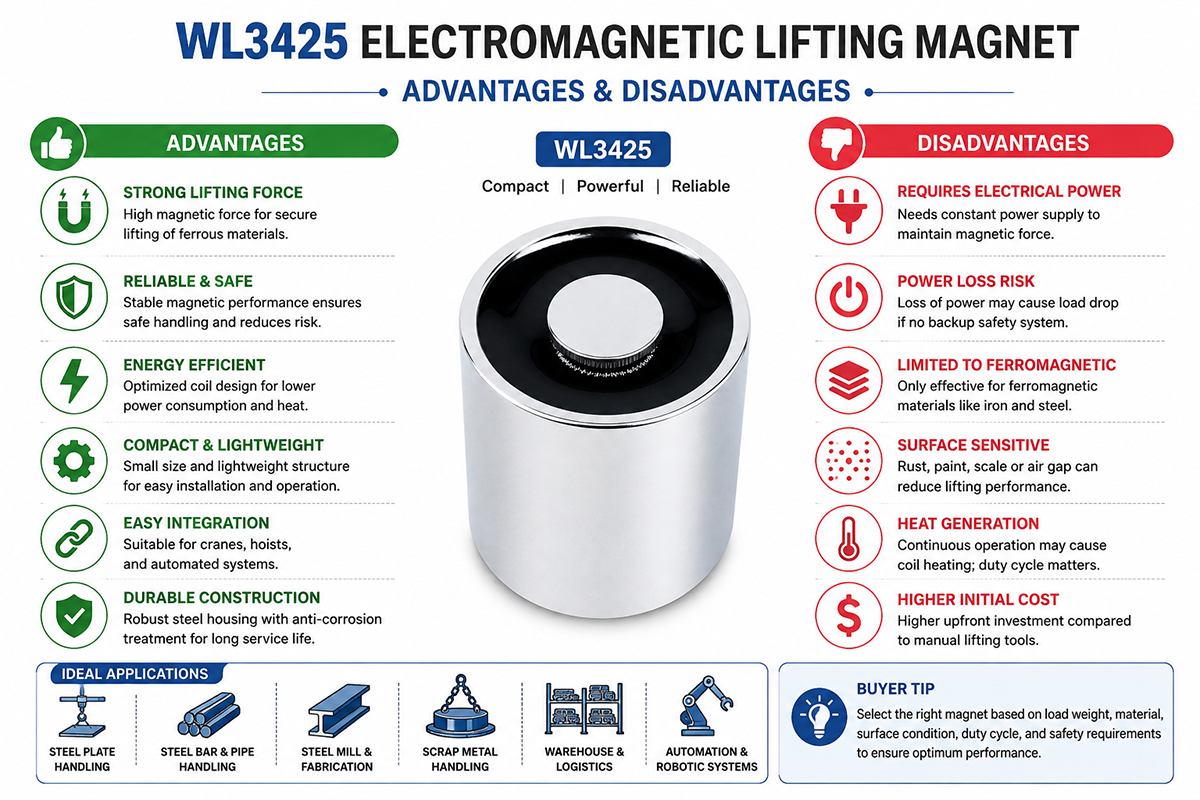
Advantages and Disadvantages of Electromagnetic Lifting Magnet

Advantages

Quick material handling: Electromagnetic lifting magnets can be quickly attached to suitable steel loads, reducing handling time.

Minimal manual labor: There is no need for operators to position conventional slings or chains around each load.

Suitable for automation: The magnets could be used along with hoists, cranes, robotic systems and automated production lines.

Flexible material handling: The magnets selected suitably could handle various shapes and sizes of ferromagnetic load materials.

Suitability for repetitive operations: They are highly suitable for operations where steel products have to be handled repeatedly.

Attachment from a compact area: The magnet can exert lifting force from a relatively compact area.

Shortcomings

Requires electrical power: Electromagnetic lifting magnets are dependent on a proper electrical and control system.

Power loss concerns: Without proper engineered protection, a sudden power loss can create serious safety hazards.

Material limitations: Mostly they are suitable for ferromagnetic materials and cannot be used for many non-magnetic metals.

Surface sensitivity: Rust, paint, dirt, scale, uneven surface and air gaps could reduce the holding force.

Heat generation: Continuous energization could increase the coil temperature, requiring proper duty cycle and thermal design.

More complicated initial system: The magnet requires electrical system, controllers, cables, safety devices and monitoring system.

Therefore, the above mentioned advantages could be achieved if the magnet is properly sized and incorporated into a proper lifting system.

Electromagnetic Lifting Magnet Industrial Factory Guide

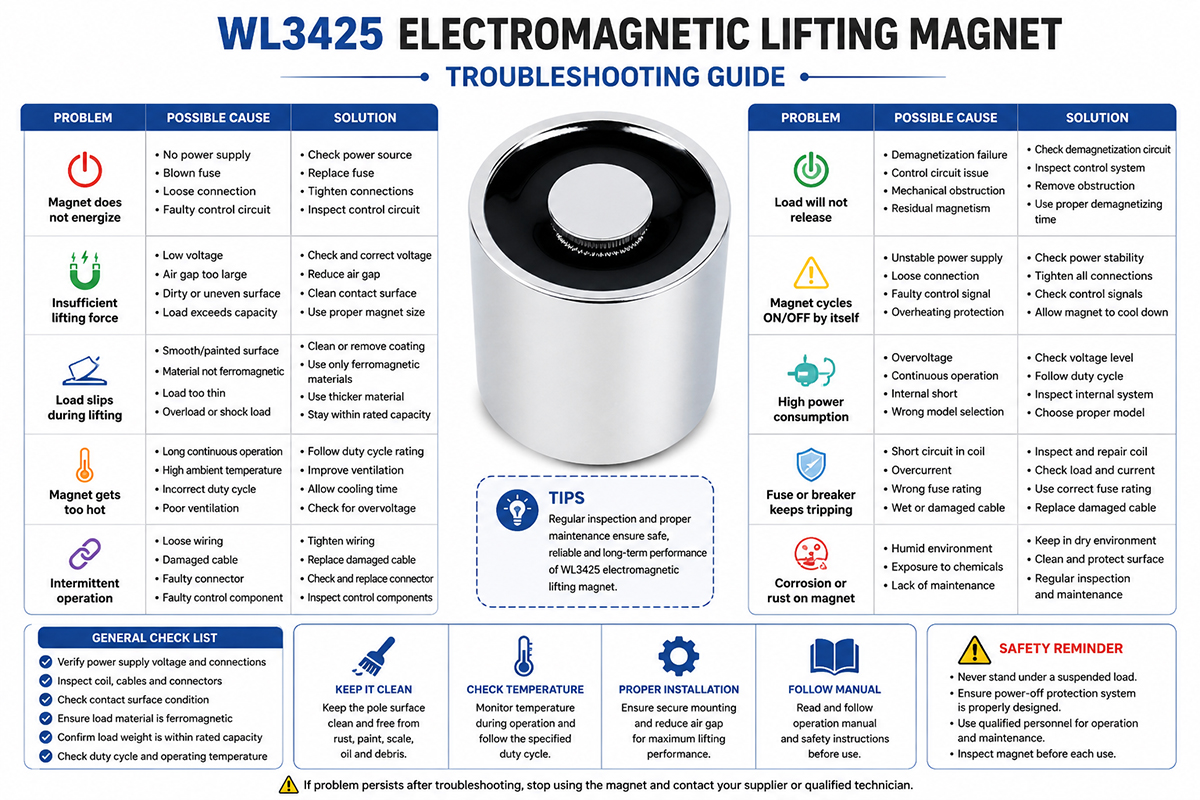
Troubleshooting of Electromagnetic Lifting Magnet

Systematically troubleshoot the electrical, magnetic, mechanical and operational issues with an electromagnetic lifting magnet which is not functioning properly.

Insufficient lifting force: Check electrical power supply, coil voltage, electrical connections, pole surface, load material, load thickness and air gap. Clean the rust, scale, dirt or other materials which hinder the proper magnetic contact.

Lack of energization: Check the incoming power, switches, fuses, wiring, connectors, control signals and coil continuity. In case of electrical system issues, the magnet and controller need to be inspected by the qualified personnel.

Load slips while lifting: Ensure that the load material is ferromagnetic and the operating conditions are within the rated limit. Ensure that the load is not too thin, warped, uneven, painted, rusty or soiled. Also, ensure that the magnet is completely attached to the load.

Magnet overheating: Check the duty cycle, operating frequency, voltage, ambient temperature and cooling conditions. Overheating would occur if it is used continuously beyond the rated duty cycle.

The load is not released: Check the demagnetizing circuit and control sequence. 6. Check for mechanical blockage or residual magnetic effect on the pole surface.

Interruption in the operation: Check the cables, connectors, switches, controllers and electrical terminals for loose or damaged connections.

Prior to the operation, a regular inspection must be conducted. Any magnet showing signs of structural damage, overheating, electrical fault and improper holding performance has to be taken out of service until it is thoroughly inspected and repaired by qualified personnel.

FAQ

1. What is an electro-magnetic lifting magnet?

Electromagnetic lifting magnet is a powered device which creates a magnetic field and uses it to attract and lift ferromagnetic materials, like steel and iron. It is used widely for industrial lifting.

2. How does an electro-magnetic lifting magnet work?

Electric current is applied to the coils, generating a magnetic field. Magnetic circuit is concentrating the field on the surface of the poles, forming an attractive force which is keeping suitable metal loads.

3. What can an electromagnet lift?

This lifting device is intended for the handling of ferromagnetic materials such as carbon steel, iron, steel sheets, bars, billets, pipes and suitable scrap metal. Usually it cannot handle nonmagnetic materials.

4. How to choose the appropriate electromagnetic lifting magnet?

When choosing consider the following: load weight, material, dimensions, thickness, surface condition, air gap, duty cycle, operating temperature, power source and lifting equipment. You should always choose it according to the real working conditions.

5. Can I use an overhead crane with a lifting magnet?

Sure. Electromagnetic lifting magnets can be installed on overhead cranes, gantry cranes, hoists and other suitable lifting devices. Electrical system and attachment should be designed properly.

6. What is the lifting capacity of an electromagnetic magnet?

The performance of the magnet may depend on the following factors: material type, load thickness, contact area, air gap, surface condition, load shape, magnet temperature, electrical input and magnet design.

7. What will happen if there is no power supply?

Depending on the magnet design, lack of electricity may affect the magnetic force, reducing or removing it. Therefore in critical cases the lifting magnet should have additional safety measures and engineering controls.

8. How to maintain an electromagnetic lifting magnet

Check regularly the coils, housing, cables, connections, pole surfaces, attachment and control system of the magnet. Keep the surfaces of contacts clean and check them for heating, corrosion, damage or abnormal performance.

How to Choose an Electromagnetic Lifting Magnet

Prior to selecting the electromagnetic lifting magnet, it must be properly matched with the maximum weight of the load and more. The complete lifting application must be evaluated prior to the product selection.

1. Load weight evaluation

Identify the minimum, mean and maximum weight of load. Use an appropriate capacity with appropriate safety margin in accordance with applicable standards.

2. Material identification

Electromagnetic lifting magnets are mostly used with ferromagnetic materials. Generally, magnetic attraction is possible with steel and iron materials, but stainless steels and alloys would have different magnetic properties.

 3.Evaluate the load dimensions

Length, width, thickness, diameter and shape evaluation of the load. A magnet which is specifically designed for the steel plates may not give the same result for the curved pipes, thin sheets, irregular and narrow bars.

4. Surface condition evaluation

Rust, paint, scale, dirt, moisture, gaps and unevenness could reduce the magnetic coupling. Consider the real surface condition of the load, not the laboratory performance.

5.Air gap consideration

Small air gaps between the magnet and the load could significantly affect the magnetic holding force. Select a magnet which is suitable for the real surface condition.

6. Electrical power requirement evaluation

Check the voltage, current, control method, duty cycle, cable requirements and the electrical supply available. The electrical power supply must be suitable for the magnet.

7. Operating frequency consideration

In the case of repetitive operations, consider the required duty cycle and thermal performance. More cooling and thermal protection would be required in the case of high frequency or continuous operation.

8. Lifting equipment compatibility

Consider the compatibility of the magnet with cranes, hoists, gantries, robotic arm and automated systems. Verify the magnet installation locations, total weight, size and controls.

9. Safety requirements evaluation

Evaluate the power loss characteristics, emergency release, backup systems, overload protection, monitoring and applicable lifting standard.

10. Personalization considerations

For special load or automated operations, the manufacturer could be consulted for special pole arrangement, mounting structure, control system, voltage options and dimensional requirements.

Common Mistakes During Electromagnetic Lifting Magnet Design Tips to Avoid

Don’t design only for the maximum load weight. Load geometry and material properties influence the magnetic holding force.

Don’t ignore the air gaps. This affects the magnetic force

Don’t ignore the surface condition issues. Such as paint, rust, scale, dirt and uneven surface conditions will reduce the magnetic holding force.

Don’t rely on the nominal capacity as the effective working capacity. Assess real operating conditions and safety margins.

Consider the temperature issues. Repeated lifting operations could increase the coil temperature.

Don’t make wrong choices in the power supply. Voltage, current, duty cycle and control has to be appropriate for the magnet.

Don’t ignore the load thickness issues. Thinner steel will have more magnetic force compared to the thick steel.

Demagnetization. Remember. Release has to be predictable and suitable for the application.

Don’t forget about the power loss protection. This is critical for the safe lifting operations.

Don’t underestimate the mechanical attachments. The lifting eye, brackets, housing and crane interface has to be able withstand the mechanical loads for which they are designed.

Testing Do not skip the testing. Testing of prototype and production units will validate magnetic performance, thermal performance, electrical operation and mechanical strength of the magnet.

Get A Free Quote Now

Contact Form

Related Products

Related News

Scroll to Top

Get A Free Quote Now !

Contact Form
If you have any questions, please do not hesitate to contact us.
Weilong Solenoid Company Culture
