

Permanent Magnetic Clamp for Industrial Machining Tasks
Permanent Magnetic Clamp for Industrial Metal Fabrication
Permanent Magnetic Clamp for Steel Structure Assembly
Permanent Magnetic Clamp for Industrial Inspection Tasks
Permanent Magnetic Clamp for Industrial Steel Fixtures
Permanent Magnetic Clamp for Steel Fabrication Projects
Permanent Magnetic Clamp for Industrial Machining Tasks
Permanent Magnetic Clamp for Industrial Metal Fabrication
Permanent Magnetic Clamp for Steel Structure Assembly
Permanent Magnetic Clamp for Industrial Inspection Tasks
Permanent Magnetic Clamp for Industrial Steel Fixtures
Permanent Magnetic Clamp for Steel Fabrication Projects

WL3229 Permanent Magnetic Clamp for Metal Processing Equipment

Permanent magnetic clamps can be used as work holding devices that don’t require continuous electrical power supply for their functioning. Permanent magnets and a properly designed magnetic circuit are used in it for generating a strong magnetic force to hold the work piece, which may be steel plates, pipes, frames or machine parts among others. Permanent magnetic clamps are compact and easy to use and remove. This helps it to be used in welding, fabrication, machining, assembling and inspection works. As the permanent magnetic clamps do not need continuous power for their functioning, they are easier to install and consume less electricity. Industrial type magnetic clamps come in different designs with respect to the magnetic force generated, the contact points used and the capacity. In order to select a suitable permanent magnetic clamp, it is important to consider the material, surface finish, thickness of the work piece, the load direction and the required clamping force along with the safety margin.

Permanent Magnetic Clamp Description

A permanent magnetic clamp is a mechanical device used to hold ferromagnetic work pieces using permanent magnets in its body. Unlike the electromagnetic clamps, it does not require continuous supply of electrical power. The magnetic circuit in the magnetic clamp can be turned off and on manually using levers and switches. It can be used with steel plates, sheets, pipes, frames and machine components for performing various applications such as welding, machining, assembling, inspection and maintenance. The performance of the clamp depends on the magnet, the contact area, thickness of steel, surface condition and load direction among other factors.

How does a permanent magnet clamp function?

A permanent magnetic clamp operates by directing the magnetic fields from permanent magnets to a controlled magnetic circuit.

Working Process:

Creation of magnetic field: In this step, a magnetic field is created without supplying continuous electrical power to the permanent magnets.

Formation of magnetic circuit: The internal magnetic elements are used to route the magnetic flux to the surface of the contact.

Contact with work piece: If the work piece is made of ferromagnetic materials, then the magnetic flux will be passed through the work piece.

Development of holding force: A magnetic connection is formed between the contact surface and the work piece.

Work Piece Positioning: The operator can easily position the work piece.

Clamp Releasing: The magnetic force is released by diverting or blocking the magnetic flux.

The air gap plays a major role in the holding performance. Presence of paint, rust, scale, dirt, uneven surfaces or thin material can reduce the magnetic contact and hence the holding force.

Permanent Magnetic Clamp Video

Permanent Magnetic Clamp Detail Display

Permanent Magnetic Clamp Data Sheet

Brand Weilong Technology Model Number WL3530
Rated Voltage (V) DC 12V or 24V Rated Power(W) 2-14.8 W
Work Mode: Power on, Magnet on Holding Force (N) 25 Kgs
 working duty 100% Resistance 32  Ω
Service Life 300 Thousand Times Certification CE,ROHS,ISO9001,
Material Superior Magnet Carbon Steel Housing Lead Wire Length(mm) 200 MM
Install Style Screw Hole Tolerance of Dimension  +/-  0.1 MM
Water-proof  None Insulation Class B
Hi-Pot Test AC 600V 50/60Hz 2s Non-excitation Holding Force 0
Working Temperature -10°C-100°C Duty Cycle 1-100%
Thread Depth(mm) / Payment Term TT, or LC At Sight
Sample Order Yes Warranty 1 Year
MOQ 1000 pcs Supply Ability 5000 pcs per Week
Delivery Time 30 Days Port of Loading shenzhen

Why Is The Permanent Magnetic Clamp Becoming So Popular?

There are some reasons for the increasing popularity of the permanent magnetic clamps. The main reason is that they do not require an electrical power supply to provide holding force. Therefore, they are convenient to use where easy installation, simplified wiring and energy saving is needed.

They also provide rapid positioning of the work piece. The operator can attach the clamp, find a steel part, perform some operations and release the work piece without complex mechanical systems.

Industrial producers prefer using them in welding, fabrication, machining, inspection, assembling and maintenance works. Their compact design can increase the flexibility of the workspace in comparison with larger mechanical fixtures.

Also they are versatile. There are different magnetic circuits and contact geometries for plates, pipes, beams, frames and other ferromagnetic work pieces.

But the popularity cannot replace proper engineering analysis. The buyer should still consider the material, thickness, surface condition, load direction, temperature and safety requirements before purchasing a permanent magnetic clamp.

Permanent Magnetic Clamp Applications

Permanent Magnetic Clamp for Metal Cutting Applications

The permanent magnetic clamps are widely used in industry for positioning, holding and aligning of ferromagnetic work pieces.

Welding & Fabrication

The permanent magnetic clamps can be used to hold steel plates, frames, brackets, pipes and structural elements before and during the welding process. They can speed up the setup of the work piece and minimize the usage of mechanical temporary fixtures.

Cutting

The magnetic clamps can help in positioning of the ferromagnetic parts during drilling, milling, cutting, grinding and other machining operations. The suitable clamp should be selected for the vibration and loading conditions.

Assembling

The permanent magnetic clamps can be used in industrial assembly operations when steel components should be held in place before applying bolts, fasteners, welds or other joining technologies.

Metalworking

The magnetic clamps can help with positioning and handling of the steel sheets, plates, profiles and fabricated parts.

Inspection

The magnetic clamps can hold components in the stable position during dimensional inspection, visual inspection, measurements and quality control operations.

Service

The service crews can use suitable magnetic clamps to hold steel parts, guards, brackets and other components temporarily for repairing.

Structural & construction work

The heavy duty clamps can be used to position the steel structures and fabricated assemblies.

The appropriate clamp should be always chosen with respect to the material compatibility, load requirements, surface condition, temperature and safety procedures.

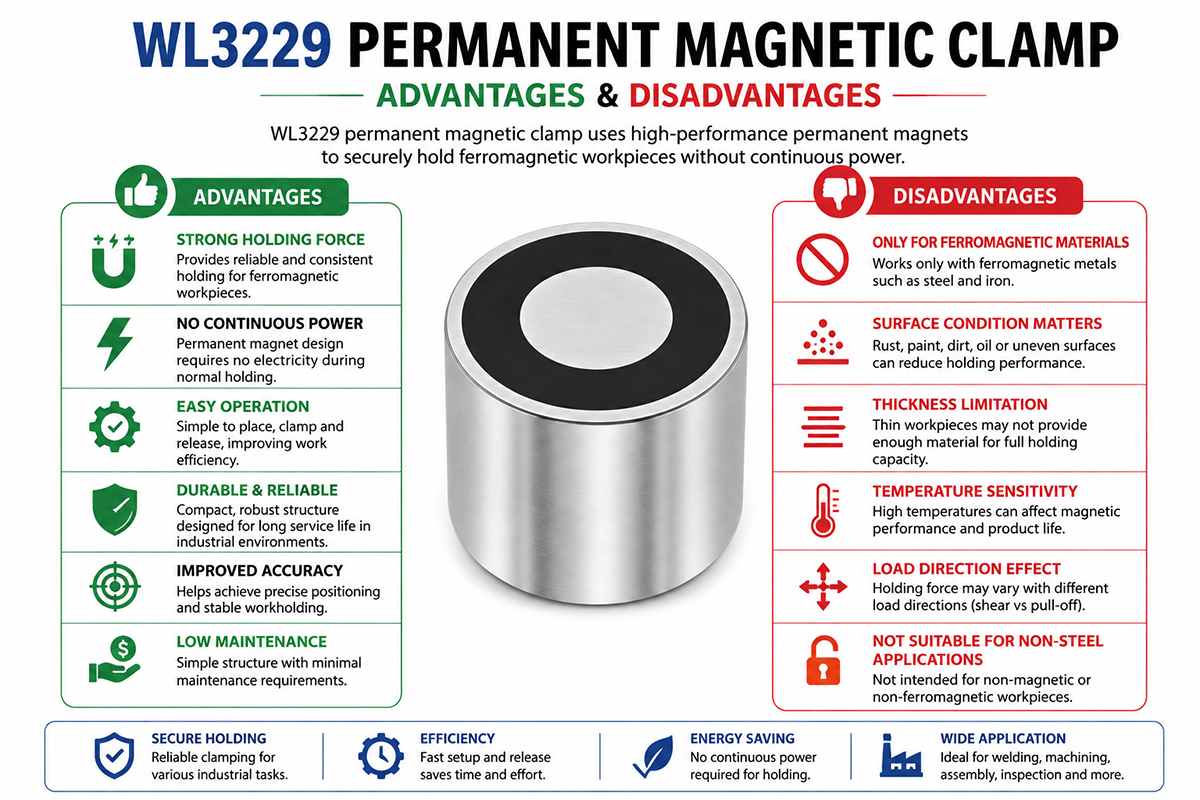
Permanent Magnetic Clamp Adv. & Disadv

Permanent Magnetic Clamp for Industrial Workshop Use

Permanent Magnetic Clamp Advantages and Disadvantages

Advantages

No continuous power required. Permanent magnets can generate holding force without drawing power continuously.

Quick operation. The mechanical ON/OFF mechanism can allow quick positioning and releasing of the work piece.

Easy installation. Many models require minimum wiring.

Compact design. With the help of the optimized magnetic circuit, it is possible to design a powerful clamp with a small size.

Flexible work holding. Proper models can hold steel plates, pipes, beams, sheets and fabricated parts.

Simple operation. Permanent magnetic clamps can have fewer electrical components compared to the electric clamps.

Good for industrial applications. Suitable for welding, fabrication, machining, assembling, inspection and maintenance.

Disadvantages

Limited material compatibility. Permanent magnets require ferromagnetic work pieces.

Surface condition is critical. Rust, paint, dirt, scale, air gaps may reduce the magnetic holding force.

Thin material may reduce performance. The clamp may not reach its rated capacity for thin steel.

Load direction is critical. Sliding or shear loads are different from the pull-off force.

Temperature limits. High temperature can damage permanent magnets and other components.

No automatic electrical monitoring. Basic magnetic clamps do not provide the holding state indication.

In general the permanent magnetic clamps are very useful devices, but the rated capacity should not be considered as universal for all work piece conditions.

Permanent Magnetic Clamp for Industrial Jig Applications

Troubleshooting of Permanent Magnetic Clamp

Problem 1: Clamp doesn’t grip well

– The work piece should be ferromagnetic. Then inspect the contact surface for rust, paint, scale, oil, dirt or any other material creating an air gap.

Problem 2: Holding Force is Less than Expected

Inspect the thickness and flatness of steel. The magnetic performance is reduced by the thin material, curves and uneven contact. Make sure that the load is rated for the capacity of the clamp.

Problem 3: Hold Slides During Operation

Inspect whether the applied force is shear or sliding and not pull-off. Make sure that the clamp is properly positioned and clean the contact surface.

Problem 4. Difficult to Remove Clamp

Inspect the ON/OFF mechanism for contamination or damage or obstruction. Do not force the clamp in case of the jamming of the mechanism.

Problem 5: Unequal Holdings

Inspect whether the magnetic poles completely contact the work piece. Any debris or uneven surface can prevent the magnetic coupling.

Problem 6 Change of Performance at High Temperature

Inspect the specification of the operating temperature of the product. High temperature may damage the magnets or other internal components.

Problem 7: Physical Damage

Periodically inspect the housing, the switching mechanism, the contact surfaces and fasteners. Repair any damaged parts before putting the clamp into service.

Maintenance tip: Clean the magnetic contact surfaces. Before critical operations, periodically inspect and test the holding force.

FAQ

1.What is the definition of permanent magnetic gripper?

Permanent magnetic clamps are holding devices that utilize the permanent magnets’ magnetic attraction power to firmly hold steel and other ferromagnetic material. The clamps do not require any electrical power supply to maintain the attraction force.

2. In which industries are permanent magnetic clamps used?

They can be used for such applications as welding, fabrication, machining, drilling, grinding, assembly, inspection, metal processing and maintenance when steel components need to be held reliably.

3. Will permanent magnetic clamp attract stainless steel?

It will depend on its type. Stainless steel can be magnetic, although there are also non-magnetic grades.

4. Does the condition of the surface of the material affect the performance of the permanent magnetic clamp?

“Yes.” If the material surface is rough, rusty, dirty, covered with paints or oils an air gap may form between the clamp and the material which decreases the strength of attraction significantly.

5. How to choose the right permanent magnetic clamp?

One needs to consider material of the part to be held, its thickness, weight, surface condition, contact area, direction of the load, required force of attraction, operating temperature and safety factor.

6. Does the permanent magnetic clamp require power?

No, usually. Permanent magnets do not require electrical power supply to work.

7. How to service the permanent magnetic clamp?

Clean the magnetic surface of the clamp from any metal debris, inspect the housing and switching mechanism of the device on the presence of corrosion or mechanical damages. Do not operate the device above the temperature specified by the manufacturer.

8. Can permanent magnetic clamps be used in heavy duty industrial applications?

Yes, properly designed clamps can be used for industrial fabrication, welding, machining, structural assembly and metal handling processes.

How to Choose a Permanent Magnetic Clamp

When choosing a permanent magnetic clamp, it is important to consider the size of the magnet and the material of the object you will be clamping. The size of the magnet will determine the weight it can hold, and the material of the object will determine the strength of the magnetic field required to hold it in place. When selecting a permanent magnetic clamp, it is important to choose one with a strong enough magnetic field to hold the object in place. The strength of the magnetic field will depend on the material of the object, so it is important to choose a magnet with a strength that is appropriate for the object you will be clamping. It is also important to consider the size of the magnet when selecting a permanent magnetic clamp. The size of the magnet will determine the weight it can hold, so it is important to choose one that is large enough to hold the object you will be clamping. Finally, it is important to consider the type of permanent magnetic clamp you need. There are many different types of permanent magnetic clamps available, so it is important to choose one that is appropriate for the object you will be clamping. To summarize, when selecting a permanent magnetic clamp, it is important to consider the size of the magnet, the material of the object, and the type of permanent magnetic clamp you need. By taking these factors into account, you can choose a permanent magnetic clamp that is strong enough and large enough to hold the object in place.

Choosing the right permanent magnetic clamp is more than just looking at the holding force advertised. The clamp should be selected for the material, work piece geometry, operating environment and direction of loading.

1. Check the material of the work piece

The permanent magnetic clamps are primarily used for ferromagnetic materials like carbon steel and some alloys that have iron content. The materials like aluminum, copper, brass and some stainless steels are not suitable unless they possess the magnetic property.

2. Calculate Needed Holding Force

First of all, calculate the expected load and then select the clamp having sufficient capacity. Do not rely only on the maximum rated capacity. The magnetic performance may be reduced in practical conditions and therefore a safety factor should be considered.

3. See the thickness of the material.

Thick steel will provide sufficient magnetic material to provide the full holding capacity of the clamp. Always compare the thickness of the work piece with the operation range of the clamp.

4. Surface Condition Check

The smooth and clean surfaces allow proper magnetic contact. The presence of rust, paint, scale, oil and surface irregularities can result in air gap and reduced holding force.

5. Assess Load Direction

The permanent magnetic clamp behaves differently under direct pull-off load and shear load. Be aware of the work piece loading during the operation.

6. Choose the Right Contact Geometry

Select a contact configuration that is suitable for plates, pipes, curves, beams or other work pieces. Poor contact reduces significantly the holding capacity.

7. Check operating environment

When using for welding, machining or outdoor operation, you should consider the temperature, moisture, metal debris, vibrations and contamination.

8. Think About Size and Portability

When positioning frequently, a compact clamp is useful, but if you have heavy work pieces, you might need a large industrial clamp.

9. Verify Safety Features

The clamp should have secure switching action, rugged housing, good contact surface and reliable information on the holding force.

10. Check Manufacturer Specifications

Before purchasing, check the dimensions, holding capacity, compatible material, temperature rating and recommended applications. Choose a clamp not only from the advertisement, but from the actual conditions of the use.

Common mistakes in designing permanent magnetic clamps and tips to avoid them

There are several design flaws that can lead to the reduction of holding reliability, safety and lifespan.

Don’t only consider maximum magnetic force. The actual performance can be reduced because of air gaps, material thickness, surface condition and load direction.

Don’t create too much air gap. A poor contact between the magnetic pole and work piece can seriously reduce the magnetic attraction.

Use correct magnetic material. The magnetic circuit must be designed for providing the effective conduction of magnetic flux to the contact surface.

Consider the workpiece thickness. The thin steel may not provide the rated performance of the clamp.

Think surface contamination. The rust, paint, scale and machining debris may interfere with magnetic contact.

Provide good ON/OFF switch. The operator needs a reliable way to turn on and off the clamp

Consider the heat exposure. High temperatures may affect the performance of permanent magnets and surrounding components.

Add the safety factor. The design should take into consideration the vibration, shock, irregular surfaces and variable loads.

Adapt contact geometry for the application. The different work piece shapes may require different magnetic pole configuration.

Test on real work pieces. Prototype testing should be performed on the actual material thicknesses, surface finishes and loading conditions.

Get A Free Quote Now

Contact Form

Related Products

Related News

Scroll to Top

Get A Free Quote Now !

Contact Form
If you have any questions, please do not hesitate to contact us.
Weilong Solenoid Company Culture
