Electromagnetic Locking Magnet for Access Control
Electromagnetic Locking Magnet Maintenance Guide Design
Electromagnetic Locking Magnet for Machine Protection
Electromagnetic Locking Magnet for Safety Doors Systems
Electromagnetic Locking Magnet for Industrial Doors Use
Electromagnetic Locking Magnet for Security Systems Use
Electromagnetic Locking Magnet for Access Control
Electromagnetic Locking Magnet Maintenance Guide Design
Electromagnetic Locking Magnet for Machine Protection
Electromagnetic Locking Magnet for Safety Doors Systems
Electromagnetic Locking Magnet for Industrial Doors Use
Electromagnetic Locking Magnet for Security Systems Use

WL12060 Electromagnetic Locking Magnet Industrial Door Control

Electromagnetic lock magnet is an electrically operated magnetic device used to lock doors, machine covers, cabinets and other industrial equipment.

Upon activation of the electromagnetic field by means of electricity, the magnet produces a powerful attractive force holding the ferromagnetic armature.

Depending on the design, the lock magnet allows locking but provides controlled release if the power supply is switched off or the control circuit is changed.

Electromagnetic Locking Magnet Description

Electromagnetic locking magnet is an electrically operated magnetic device used for holding and securing of a movable member relative to a fixed surface. It includes the copper coil, magnetic core, housing, armature and mounting structure. Upon applying the voltage to the coil, the electromagnetic field is activated. There is a magnetic attractive force between magnet and armature. This force locks a door, panel, cabinet, machine cover or other component. The electromagnetic field can be switched off with a change in the electrical control circuit of the device. Typical applications of electromagnetic locking magnets include factory automation, machine protection, access control and equipment security.


How Electromagnetic Locking Magnet Works


Operation principle of the electromagnetic lock magnet is based on converting the electrical energy into a magnetic holding force.


Power Supply: the electromagnetic coil is activated by an appropriate voltage as per its rated specifications.

Generation of magnetic field: the current flows through the copper winding producing the magnetic field around the magnetic core.

Armature Attraction: if there is a ferromagnetic armature or a steel mating surface attracting by the generated magnetic field.

Locking Action: The attraction produces a holding force locking a door, panel, machine cover or equipment component.

Electrical Control: The magnet can be controlled by relay, PLC, switch, sensor or access-control system.

Release: when the magnetic field is switched off or the control circuit is modified, the holding force drops, and the component unlocks.


For industrial applications the electrical control of the locking process shall be selected according to desired fail-safe or fail-secure behavior and machine safety requirements.

Electromagnetic Locking Magnet Video

Electromagnetic Locking Magnet Detail Display

Electromagnetic Locking Magnet

Brand Weilong Technology Model Number WL10043
Rated Voltage (V) DC 12V and 24V Rated Power (W) 10–41.3W
Work Mode: Power on, magnet on. Holding Force (N) 400 kg
working duty 10% Resistance 68 Ω
Service Life 100 Thousand Times Certification CE, RoHS, ISO9001,
Material Superior Magnet Carbon Steel Housing Lead Wire Length (mm) 200 MM
Install Style Screw Hole M10* 20MM Tolerance of Dimension ± 0.1 MM
Water-proof Yes, IP50 Insulation Class B
Hi-Pot Test AC 600V 50/60Hz 2s Non-excitation Holding Force 0
Working Temperature -10°C-100°C Duty Cycle 1-10%
Thread Depth (mm) M10 * Length 20 mm Payment Term TT, or LC at Sight
Sample Order Yes. Warranty 1 Year
MOQ 1000 pcs Supply Ability 5000 pcs per week
Delivery Time 30 Days Port of Loading Shenzhen

Why is the electromagnetic locking magnet so popular?

There are several reasons why electromagnetic locking magnets become more and more popular as they provide an easy way of controlled locking of industrial equipment.

One of the big reasons is that they can be easily integrated with PLCs, relays, switches, sensors and automated control systems.

The other great thing is the fast response of the electromagnetic lock. The magnetic holding force can be controlled by electrical circuit and turned on or off, thus making the technology suitable for automated machinery and production lines where quick operation is needed.

Compactness of construction is also beneficial because electromagnetic locking magnets can be installed on doors, covers, cabinets and panels without complicated mechanical locking mechanism.

Another factor is the trend towards the factory automation. Modern machinery often requires controlled access to moving parts, electrical areas and protected work zones. Properly engineered systems can incorporate electromagnetic locking technology.

Also, they are made more efficient due to OEM customization when the manufacturer can customize the voltage, dimensions, holding force, mounting configuration, connectors, etc.

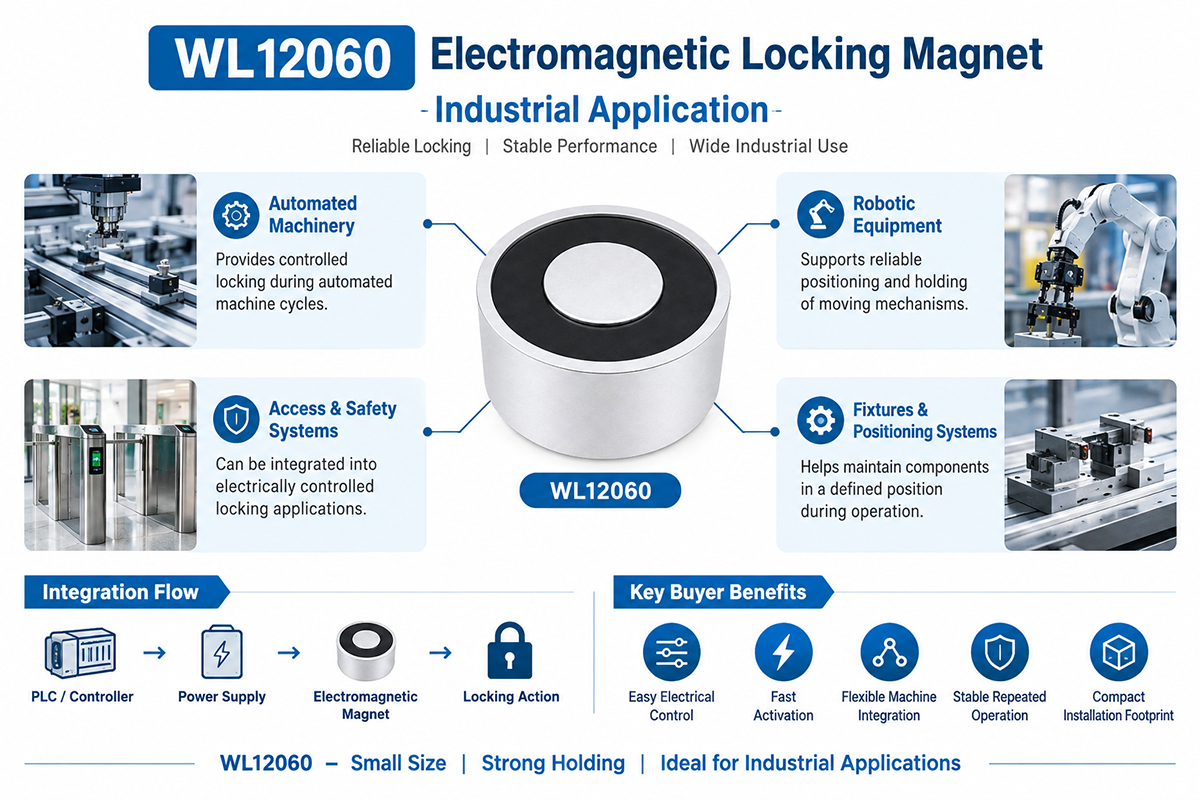
Electromagnetic Locking Magnet Applications

Electromagnetic Locking Magnet for Process Equipment

Many industrial and commercial applications that require controlled locking and positioning are solved with the use of electromagnetic locking magnets.

Industrial Machinery

They can lock-out machine doors, protective covers and access panels while the machine is working. The integration with machine control systems can help control access to protected areas.

Factory Automation

Electromagnetic locks can be used to control access doors, inspection covers and movable mechanisms on automated production machinery.

Electrical Cabinets

Electromagnetic locks can be used to lock electrical control cabinets and equipment enclosures where the controlled access is necessary.

Machine Safety Systems

They can be used as a component in an engineered safety system of machinery where the entire system is engineered to the safety requirements.

Access control in industrial controls

Electromagnetic locks can be used in factories, warehouses and restricted areas with equipment as a component of electronic access-control system.

Robotics

Electromagnetic locking components can be used for robotics equipment and robot cells for doors, panels and maintenance access.

Manufacturing Line

Automated manufacturing lines can require the repeatable locking and releasing of covers, gates or inspection areas.

Industrial Cupboards

Where electrical control is preferred over mechanical locks, removable panels and equipment covers can be locked with electromagnetic magnets.

The specific application determines the required holding force, the electrical behavior, the environmental protection, the mounting option and the safety architecture.

Electromagnetic Lock Adv. & Disadv

Electromagnetic Locking Magnet Performance Guide Design

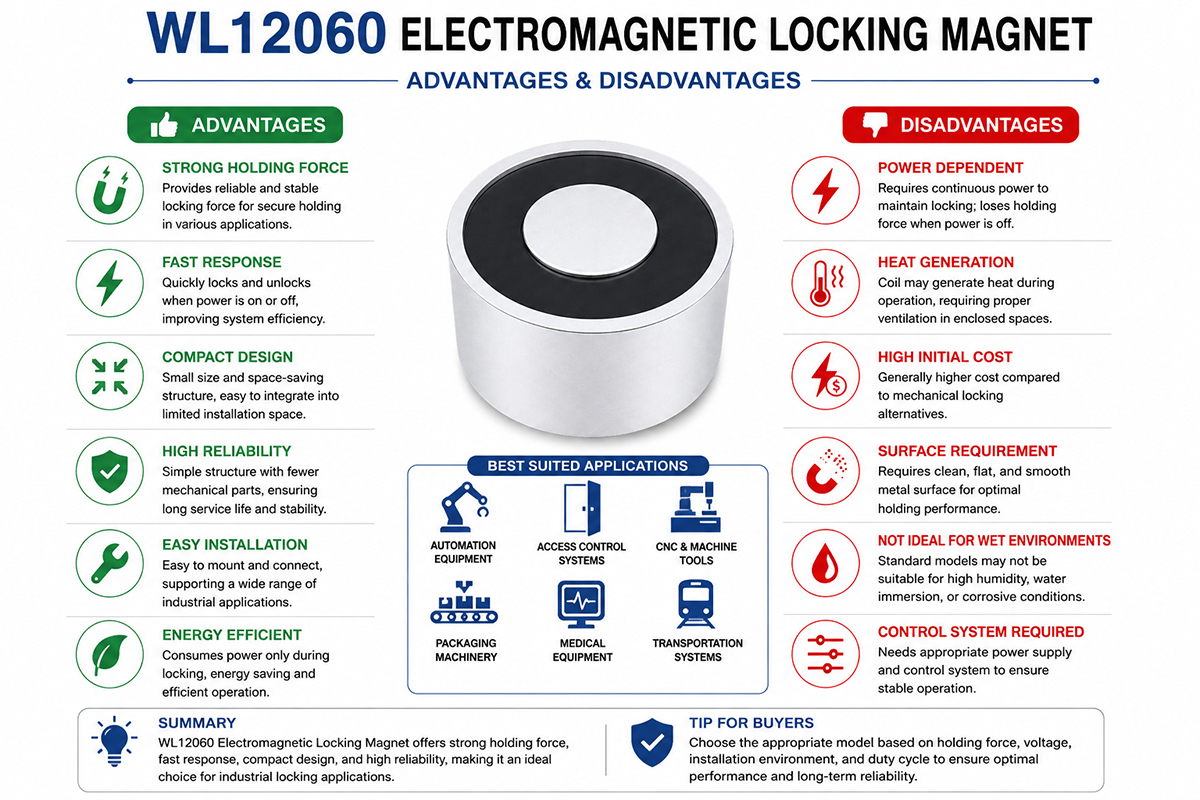
Advantages and Disadvantages of Electromagnetic Locking Magnet 200 Words

Pros:

Fast Operation: Electromagnetic locking magnets engage and disengage fast when operated by an electrical circuit.

Easy to control: They can be integrated with PLCs, relays, switches, sensors and access control systems.

Low Mechanical Complexity: Electromagnetic systems can utilize fewer moving parts than some mechanical locking systems.

Simple Automation: Electrical control makes them ideal for use in automated machinery and production equipment.

Flexible Installation: Various sizes, mounting and holding force options are available.

Repeatability: Correctly chosen units can operate through many cycles of locking and releasing.

OEM customization: Units can be customized in terms of voltage, dimensions, mounting and connector configurations for specialized industrial applications.

Cons

Power Dependency: Some designs depend on continuous electrical power supply to maintain the locking force.

Heat Generation: Continuous energization can lead to coil heating.

Air-Gap Sensitivity: Holding force can be influenced by dirt, paint, misalignment or surface deformation.

Power-Loss Behavior: The release behavior has to be considered carefully according to the safety requirements of the application.

Environmental Limitations: Units that are not properly selected may be subjected to moisture, dust, chemicals or temperature.

Electrical Wear: Electrical switching elements like relays require proper protection and sizing.

Electromagnetic Locking Magnet Troubleshooting Guide Use

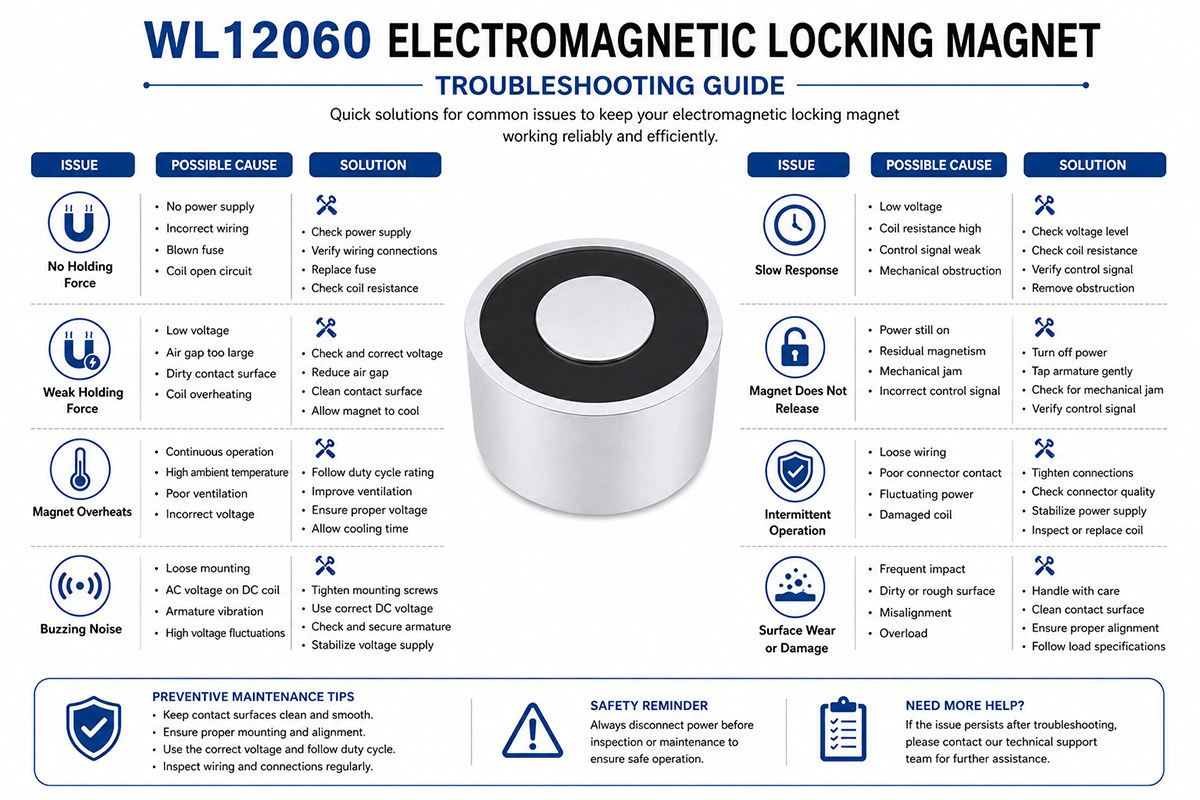
Electromagnetic Locking Magnet Troubleshooting

If an electromagnetic locking magnet malfunctions, it is necessary to check the electrical supply and mechanical alignment first.

Magnet Doesn’t Lock

Verify the voltage of the input using the measuring instrument and compare with the rated voltage. Check wiring, connectors, switches, relays and fuses. If the coil is energized by the proper voltage and there is no magnetic attraction, the coil or the magnetic circuit should be checked.

Weak Holding Force

Check the air gap between the armature and the magnet. Remove dirt, paint, rust or other material from the contact surfaces. Make sure that the armature is properly aligned and securely mounted. Also verify that the voltage being supplied is correct.

Overheating Coil

Make sure that the magnet is rated for the actual duty cycle. Check that the applied voltage is higher than the rated voltage. This condition can be caused by high ambient temperature or incorrect wiring.

Intermittent Locking

Inspect loose terminals, damaged cables, unstable power supplies and control relays. Vibrations can weaken mechanical and electrical connections over time.

Doesn’t Release

Make sure that the control circuit is switching off the power. Check relay contacts, PLC output and wiring. Also make sure that mechanical loading or misalignment does not prevent releasing.

The troubleshooting of safety critical machinery shall be carried out only by qualified personnel in accordance with the procedures of the equipment manufacturer.

FAQ

1. What is an electromagnetic locking magnet?

It is an electromagnetic magnetic device which is controlled by electricity to lock doors, machine covers, cabinet, panel, gate and other industrial equipment. With power on, magnetic attraction will be created.

2. What is a locking electromagnetic magnet?

A magnet that generates magnetic attraction due to the flow of electric current in a coil producing magnetic field and attracting a ferromagnetic armature.

3. Where can electromagnetic locking magnets be found?

They are commonly applied in machinery, factory automation equipment, electrical cabinets, access control system, robotic equipment, assembly line and other similar industrial devices.

4. How to select the right electromagnetic locking magnet?

Factors such as holding force needed, voltage, duty cycle, size, mounting technique, environmental considerations, temperature range, power consumption, locking and release characteristics have to be taken into account.

5. Is it possible to operate the electromagnetic locking magnets continuously?

There are continuous duty magnets as well as intermittent duty magnets. Make sure to choose the appropriate type according to your application needs.

6. What causes weak holding force?

Some of the common reasons causing malfunctioning are voltage mismatch, too much air gap, poor armature alignment, foreign materials in the contact surface, damaged mounting hardware or loads larger than the rated holding force of the magnet.

7. Are there any options to customize electromagnetic lock magnets?

Yes. The magnets can be designed according to industrial OEM requirements in terms of dimension, voltage, holding force, mounting holes, connectors, case design and other factors.

8. How can you take care of an electromagnetic locking magnet?

Regularly check its wiring and mounting hardware. Inspect armature alignment and surfaces. Check the coil temperature and operating performance of the device. Keep its surfaces free from any contamination and deal with unusual noises, heating, insufficient holding or release immediately.

How to Select an Electromagnetic Locking Magnet

When choosing an electromagnetic locking magnet, you cannot just take the unit with the highest holding force. The magnet must be selected taking into account mechanical, electrical and environmental requirements of the application.

1. Calculate Minimum Required Holding Force

Determine the required force to hold a door, cover, panel or machine component closed. Consider vibration, impact, movement and external forces. The magnet shall operate with safety margin rather than at the maximum holding force all the time.

2. Check Voltage Requirement

Verify the voltage of the control system, i.e. 12 VDC, 24 VDC or others. The magnet’s voltage rating should match the voltage of the power supply. Mismatched voltage can result in weak holding, overheating or coil burnout.

3. Determine the Duty Cycle

Find out whether the magnet will be operated continuously or intermittently. In case of the continuous duty application, the magnet’s coil should be designed to remain energized for the extended period with acceptable temperature rise.

4. Consider the Available Installation Area

Check the mounting hole diameter, dimensions of the magnet and the position of the armature and the available installation area. Alignment is crucial . If there is a non-uniform air gap, the magnetic holding force can be significantly reduced.

5. Assess Environmental Requirements

Select the appropriate housing and protection level for outdoor machinery or equipment in a factory where there is dust, moisture, oil or vibration. The operating temperature should be within the range of the manufacturer’s specifications.

6. Consider Release Requirements

Determine what happens to the system if the power fails. The locking configuration should correspond to the safety policy of the application. Safety critical machinery should not depend on the locking magnet itself but on the complete locking system.

7. Consider the Electrical Integration

Check compatibility with the PLC outputs, relays, sensors, switches and access control systems. Also check current draw and switching requirements.

8. Consider OEM Customization

Customized mounting hole diameter, dimensions, voltage rating, connector arrangement and magnetic performance will help improve installation and operation reliability for volume equipment.

Tips to Avoid Common Mistakes During Electromagnetic Locking Magnet Design

Avoid guessing the holding force. Calculate the actual mechanical force and apply a proper engineering safety factor.

Consider the air gap. Dust, paint, improper alignment of magnet and armature, deformation can significantly reduce the magnetic force.

Select the correct voltage. Always use the coil rating consistent with the control voltage.

Consider the heat generation. With continuous energization, coil temperature can increase and thermal behavior should be accounted for.

Consider the mounting hardware. The mechanical fastener has to withstand the expected vibration and loads.

Consider the power loss behavior. Determine whether a specific fail-safe or fail-secure configuration is needed for the application.

Check the alignment before installation. Armature must make a good contact with the magnet surface.

Consider the environment. Dust, moisture, oil and temperature can influence long-term reliability.

Do not design only the magnet. Evaluate the entire locking system including control and mechanical components.

Do not skip the prototype testing. The testing should determine holding force, temperature, cycle life and release behavior.

Get A Free Quote Now

Contact Form

Related Products

Related News

Scroll to Top

Get A Free Quote Now !

Contact Form
If you have any questions, please do not hesitate to contact us.
Weilong Solenoid Company Culture
