

Magnetic Clamp for Industrial Repair Uses Industry Uses
Magnetic Clamp for Welding and Assembly Uses Guide
Magnetic Clamp for Metal Assembly Applications Industry Guide
Magnetic Clamp for CNC Machining Applications Use Guide
Magnetic Clamp for Steel Fabrication Industrial Guide
Magnetic Clamp for Welding and Fabrication Industry Guide
Magnetic Clamp for Industrial Repair Uses Industry Uses
Magnetic Clamp for Welding and Assembly Uses Guide
Magnetic Clamp for Metal Assembly Applications Industry Guide
Magnetic Clamp for CNC Machining Applications Use Guide
Magnetic Clamp for Steel Fabrication Industrial Guide
Magnetic Clamp for Welding and Fabrication Industry Guide

WL1419 Magnetic Clamp for Industrial Metal Holding Industry

A magnetic clamp, or magnetic fixture, is an industrial workholding device that allows you to hold, position, and fix ferromagnetic metal parts during manufacturing operations. It attaches through magnetic attraction to a steel or iron metal part to hold it safely and firmly without any displacement while welding, machining, fabrication, assembly, and testing. Magnetic clamps are often mounted or adjusted without drilling holes or complex mechanical fixtures and increase the speed of setup, positioning precision, and operator productivity. Depending on the design, the magnetic clamps can use permanent magnets, electromagnets, or switchable magnetic systems. There are many types of magnetic clamps by size, holding capacity, design, and configuration, which are suitable for various applications. The proper workholding device is selected depending on the material, thickness, surface condition, required holding force, operating temperature, access, and direction of the load of the workpiece. Magnetic clamps, when installed and maintained properly, provide an efficient way of industrial workholding of metals.

Compact Magnetic clamp Product Overview

An electromagnetic clamp is a workholding device that uses magnetic attraction for clamping ferromagnetic materials (steel and iron). It provides a temporary holding and positioning of workpiece without holes, bolts, screws, or complex mechanical fixtures. Electromagnetic clamps are widely used in welding, machining, fabrication, assembly, testing, and manufacturing. Depending on the design, the permanent electromagnet uses either permanent magnets, electromagnets, or switchable magnetic mechanisms. The clamp magnetically attracts the contact surface of the workpiece to hold it safe and prevent unwanted movements during operations. Permanent magnets of different designs have different holding capacities, sizes, mounting designs, and releasing mechanisms. The permanent electromagnet is selected depending on the material, thickness, surface condition, load direction, and application requirements.

How Does a Magnetic Gripper Work?

The retangular electromagnet is based on the principle of magnetic attraction between the magnetic clamp and a ferromagnetic workpiece.

Working process (basic):

Magnetic field generation

The magnetic system in the clamp generates a magnetic field.

Contact of the workpiece

The clamp is brought into contact with the appropriate surface of steel or iron.

Magnetic circuit creation

The workpiece is introduced to the magnetic circuit so that the magnetic flux passes through the contact area.

Holding force development

The clamp is attracted to the workpiece with a magnet and develops holding force.

Workpiece Fixation

The clamp prevents the workpiece from movement, vibration, or displacement during welding, fabrication, machining, or assembly.

Releasing

Fast releasing can be performed with switchable or electromagnetic models by stopping or neutralizing the magnetic force.

Actual holding force depends on the design of the magnet, air gap, workpiece material, thickness, surface condition, contact area, and load direction. Rust, paint, scale, rough surfaces, or air gaps significantly reduce effective holding capacity.

Compact Magnetic clamping system Video

Compact Magnetic clamp Detail Display

Magnetic clamp Data Sheet

Brand Weilong Technology Model Number WL1419
Rated Voltage (V) DC 12V or 24V Rated Power (W) 5-10 W
Work Mode: Power on, magnet on. Holding Force (N) 3 kg
working duty 100% Resistance 100 Ω
Service Life 100 Thousand Times Certification CE, ROHS, ISO9001,
Material Superior Magnet Carbon Steel Housing Lead Wire Length (mm) 25 MM
Install Style Screw Hole Tolerance of Dimension ± 0.1 MM
Water-proof None Insulation Class B
Hi-Pot Test AC 600V 50/60Hz 2s Non-excitation Holding Force 0
Working Temperature -10°C-100°C Duty Cycle 1-100%
Thread Depth (mm) / Payment Term TT, or LC at Sight
Sample Order Yes. Warranty 1 Year
MOQ 1000 pcs Supply Ability 5000 pcs per week
Delivery Time 30 Days Port of Loading Shenzhen

Why is the magnetic clamping system so popular?

The manufacturers look for faster, more flexible, and more efficient workholding solutions, and magnetic clamps become more popular.

The traditional mechanical fixtures require bolts, screws, drilling holes, special tooling, or time-consuming setup. Ifyou use the proper ferromagnetic materiald, the magnetic clamps can save many of these requirements.

Another positive feature of electro-holding magnets is the ability to reposition them. The electro-holding magnet can be relocated without building the whole new fixture. This property is particularly useful for low-volume production, prototypes, and custom fabrication.

Another reason for increasing interest in magnetic clamps is accessibility. The electro-holding magnet with fewer mechanical parts around the workpiece can give the operator access to it for welding, testing, assembly, or machining.

Another aspect is automation. The switchable magnetic systems and electromagnetic workholding devices can be integrated into automated equipment where controlled holding and releasing is necessary.

Electro-holding magnet systems are compact, reusable, easily installed, and versatile and make them popular for many industrial applications. However, they should be selected taking into account the actual material, holding force, temperature, and safety requirements.

Compact Magnetic welding fixture Applications

Industrial Magnetic Clamp Applications and Benefits Guide

Magnetic clamps are widely used in the manufacturing and metal processing industries for temporary positioning and holding of ferromagnetic parts.

Welding & Fabrication

The magnetic clamps are used to hold steel plates, tubes, frames, brackets, and structural members in position during welding. They may improve the alignment and prevent unwanted movements.

CNC-machining

The magnetic workholding systems can also hold the suitable steel components during machining operations. They are especially useful when access to the workpiece may be limited by mechanical fixtures.

Processing of sheet metal

The magnetic clamps are used to hold the sheet metal during cutting, bending, drilling, forming, and assembly operations.

Car manufacturing

They are used to assist in the alignment of metal parts, fixtures, brackets, panels, and assemblies during manufacturing and repairing.

Steel fabrication,

The magnetic clamps are used by steel fabricators to temporarily position beams, plates, frames, and structural steel parts.

Assembly processes

The magnetic holding devices can hold metal parts in position while assembling; the operators install fasteners or weld joints, test components, or complete subassemblies.

Measuring and testing

During testing the magnetic clamps may hold gauges, sensors, indicators, fixtures, or workpieces in predefined positions.

Maintenance & Repair

The maintenance staff can use magnetic clamps to temporarily hold and position the equipment during repairing, welding, and modifications.

Automation

The switchable and electromagnetic magnetic clamps can be integrated into automated workholding and material handling systems.

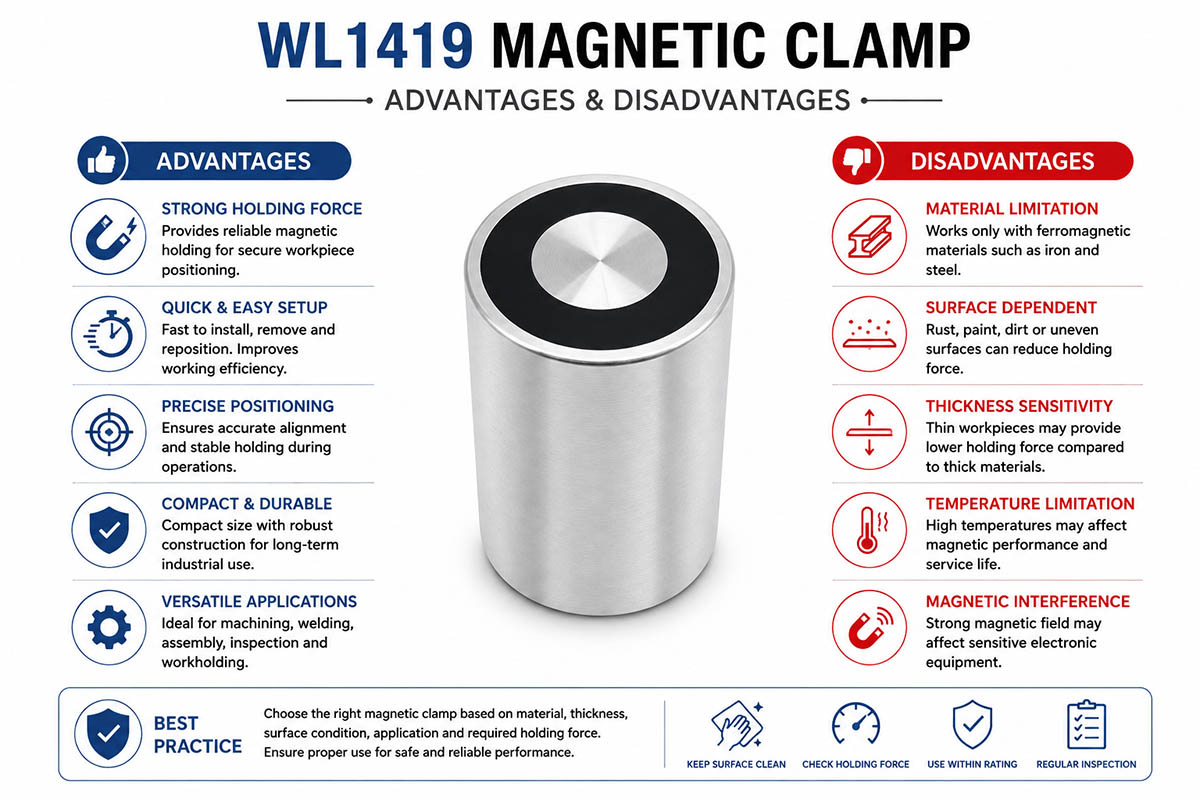
Compact Magnetic clamp Advantage & Disadvantage

Magnetic Clamp for Industrial Steel Holding Industry Guide

Pros and Cons of Magnetic Clamps

Pros

Fast installation: Magnetic clamps can be attached to steel surfaces very quickly.

Easy repositioning: The operator can reposition the magnetic clamp without drilling holes or modifying the workpiece.

Reduction of the fixture complexity: Magnetic holding can decrease the number of bolts, screws, and mechanical components.

Accessibility improvement: Small-sized magnets allow more space for work around the part.

Reusability: The magnetic clamp can be repositioned and reused for many operations.

Good for flexible production: Suitable for prototypes, repair, custom fabrication, and flexible production requirements.

Low or no continuous power requirement. Permanent magnetic clamps do not usually require continuous electrical power.

Cons

Material limitations: The magnetic clamps require ferromagnetic materials.

Surface sensitivity: The rust, paint, dirt, scale, and air gaps can reduce holding capacity.

Thickness limitation: The performance may be poor with thin workpieces.

Temperature limitations: High temperatures may affect magnetic materials and product components.

Limitations of loading direction. Holding capacity may be very different if the load is applied in pull as compared to shear directions.

Safety considerations: Magnetic connection should not be used instead of mechanical safety measures.

Interference with sensitive electronics. The sensitive electronic equipment or magnetic instruments may be affected by magnetic fields.

Magnetic Clamp for Sheet Metal Industrial Use Guide

Magnetic Clamp Problems

There are instances when the magnetic clamp may not offer the appropriate holding strength. This can be due to unstable grip or release problems. First, start by examining the contact surfaces of the magnet. Any dirt, oil, rust, metallic pieces, or any other substance on the surface can affect the magnetic power. It is recommended to clean both surfaces before use.

To ensure adequate holding strength, the material of the workpiece must be magnetic, such as mild steel or iron. Other metals such as stainless steel, aluminum, and copper may not offer sufficient magnetic attraction. Check the contact surface, and ensure it is large and flat enough for a good magnetic coupling.

In case the clamp is electromagnetic magnetic, first check the power supply, wiring, connector, and switch. You should also check the voltage to ensure that it is the same as the manufacturer’s specifications. Inconsistency in power supply results in poor holding ability.

In case the clamp is hot to touch, unplug the clamp and wait until it cools down before carrying out further checks. Excessive heat may mean that the clamp is overloaded or operating beyond its duty cycle.

Last but not least, look for signs of wear and tear on the clamp. If no improvement in the situation is made after cleaning the clamp, then stop using the clamp and refer it back to the manufacturer.

FAQ

1. What is the purpose of a electromagnetic clamp?

It is an industrial holding tool that utilizes magnetism to firmly fix metals, especially steel and iron. It is commonly used in the process of welding, machining, fabrication, assembly, positioning, and inspection.

2. How is a magnetic clamping system supposed to work?

The magnetic welding fixture creates a magnetic field that attracts a suitable metallic part towards its surface. The magnetic field serves to hold the part firmly so as to prevent movements.

3. What are the materials that can be held using a magnetic clamp?

The typical material is ferromagnetic, such as carbon steel, mild steel, cast iron and many iron alloys. Conventional magnetic clamps cannot effectively hold aluminum, copper, brass and many stainless steels.

4. What are magnetic fixture clamp used for?

They are used in welding, metal fabrication, CNC machining, sheet-metal processing, assembly, inspection, maintenance, fixture positioning, and industrial manufacturing.

5. What determines the holding force of a magnetic clamp?

It is determined by the magnet design, material of the workpiece, thickness of the workpiece, its surface conditions, contact area, air gap, and direction of the load. Factors like rust, paint, dirt, scale, and roughness reduce the holding force.

6. Is it possible to use magnetic clamping system for welding?

Yes. The welders and fabricators usually use magnetic clamps to temporarily position and hold steel parts in place while performing welding operations. You need to consider size, welding environment, temperature, and holding force of the workpiece.

7. How do you select a magnetic fixture clamp for CNC machines?

Consider the material and thickness of the workpiece, required holding force, load direction, surface condition, operating temperature, dimension of the magnetic clamp, and whether you need permanently or electrically powered magnets.

8. How do I service a magnetic clamping system?

Regularly check for any form of dirt, including rust, metal chips, paint, and any other type of contaminant on the surface of the magnet. Ensure that there is no problem with the housing, release mechanism, contact face, wiring, and mounting parts.

How to Choose a Magnetic Clamping System

Selection of a magnetic clamping system is not only a matter of selecting the model with the maximum advertised holding force. The magnetic clamp should be suitable to the workpiece, operating conditions, load direction, and safety margin.

1. Material of the workpiece identification

Magnetic clamps work best on ferromagnetic materials such as carbon steel and ferrous materials. Stainless steel, aluminum, copper, brass, and other nonferromagnetic materials may not be magnetic enough.

2. Material thickness

The thickness of the workpiece influences the magnetic circuit and holding capacity. Thin metal may have much less holding capacity than the thick steel plate.

3. Surface condition

Flat metal provides the best magnetic contact if it is clean. Rust, paint, dirt, welding spatter, scale, and air gaps influence the magnetic performance.

4. Calculation of holding force required

Estimate the forces developed during welding, cutting, machining, assembly, or handling of the workpiece. Don’t select a magnetic clamp only because it has the maximum lab holding capacity. Apply a safety factor to the estimated value for the intended application.

5. Load direction assessment

Pull-off force and shear force can give different results. A magnetic clamp that holds well against being pulled apart may behave differently under sliding or lateral forces.

6. Choosing the operating mechanism

Convenient if you don’t want to maintain a power supply continuously. Permanent magnetic clamps Electromagnetic clamps can be used for electrical control, and switchable permanent magnets provide fast and easy activation and release.

7. Dimensions & Access Check

Make sure that the magnetic clamp can physically access the surface you require and doesn’t interfere with tools, welding torches, cutting torches, fixtures, or machine components.

8. Operating temperature

Operating temperature may influence magnetic performance and materials of the magnetic clamp. Select the magnetic clamp for your operating temperature range.

9. Mounting requirements assessment

Check the mounting holes, angles, contact surfaces, cables, switches, and other mounting details.

10. Maintenance and safety

Select the magnetic clamp of durable design, which can be conveniently inspected and cleaned. Always follow the manufacturer’s rated capacity and operating instructions.

Tips for Avoiding Common Mistakes in Magnetic Clamp Design

The magnetic clamp performance can be worsened, or safety hazards can appear from several design mistakes.

Don’t undersize the magnetic system.

Never design for the minimum holding force required. Allow the adequate safety margin for realistic operating conditions.

Don’t forget the air gap.

The small air gap can significantly reduce the magnetic force because of paint, rust, dirt, scale, or surface irregularities.

Workpiece thickness

The magnetic circuit designed for thick steel may work poorly with thin sheet metal.

Magnet pairing with the material

Consider always magnetic permeability. The magnetic circuit can’t be formed by nonmagnetic materials such as carbon steel.

Direction of the load consideration

Consider both pull-off and sliding loads, not only the advertised vertical holding force.

Don’t operate at high temperatures.

There are temperature limitations for magnetic materials and surrounding components. Design for maximum operating temperature.

Provide enough contact area.

The poor contact geometry may result in the decreased effective magnetic coupling.

Magnetic surface protection

The magnetic contact surface should be protected from wear, contamination, and mechanical damage.

Consider the release requirements.

In the production environment the industrial magnetic clamp should be operable by the operator for activation and release.

Provide inspection provisions.

The good design should allow inspection of the magnet, contact surface, housing, wiring, and switching mechanism.

Get A Free Quote Now

Contact Form

Related Products

Related News

Scroll to Top

Get A Free Quote Now !

Contact Form
If you have any questions, please do not hesitate to contact us.
Weilong Solenoid Company Culture
