Ferrite Rod and Coil for Industrial Magnetic Applications
High Performance Ferrite Rod and Coil Manufacturer
Ferrite Rod and Coil Used in Industrial Electronics
Ferrite Rod and Coil Design for RF Applications
Reliable Ferrite Rod Coil for Signal Transmission
Ferrite Rod and Coil for Wireless Communication
Ferrite Rod and Coil for Industrial Magnetic Applications
High Performance Ferrite Rod and Coil Manufacturer
Ferrite Rod and Coil Used in Industrial Electronics
Ferrite Rod and Coil Design for RF Applications
Reliable Ferrite Rod Coil for Signal Transmission
Ferrite Rod and Coil for Wireless Communication

WL1210 Ferrite Rod and Coil Application Solutions

Ferrite rod and coil assemblies are essential magnetic components for modern electronic systems that require stable inductance and high efficient signal transmission. The ferrite rod acts as a magnetic amplifier that increases the coil inductance and makes the component size smaller. The coils are designed by winding copper wires around high quality ferrite rods with precise electrical characteristics.

The industrial ferrite rod coils are used extensively in RF receivers, AM antennas, sensors, control equipment, communication modules, electromagnetic filtering systems and etc. They have high magnetic permeability, low power losses and high frequency performance, which makes them suitable for compact electronic designs.

The manufacturer can customize the ferrite material, the dimensions of the rod, the diameter of the wire, the number of winding turns and the electrical parameters depending on the application. Ferrite rod and coil solutions ensure reliable operation in harsh industrial environments

Ferrite Rod and Coil Product Overview

Ferrite rod and coil products are precision magnetic components that provide efficient electromagnetic performance. They are made from high quality ferrite rods and copper wire windings that are manufactured for meeting the application requirements. They come in various sizes, materials, inductance values and frequencies to meet a wide range of industrial applications. Ferrite rod coils have high signal receiving, stable electrical characteristics and decreased electromagnetic interference. Professional manufacturers can provide custom solutions, including coil winding design, ferrite material selection and electrical tests. These products are widely used in communication systems, sensors, industrial controls and electronic devices for providing reliable magnetic solutions.

How does a Ferrite Rod & Coil work?

The principle of the operation of the ferrite rod and coil based on electromagnetic induction. The ferrite rod is covered with copper coil. The magnetic field is created when current flows through the coil. Ferrite materials have high magnetic permeability and thus ferrite rod increases this magnetic field.

The increased magnetic flux increases the inductance of the coil and allows better signal receiving or energy transfer. In the case of antenna application, the electromagnetic wave produces the variable magnetic field around the ferrite rod, which induces electrical signals in the coil. These signals are processed by electronic circuitry.

The ferrite core helps to decrease energy loss, improve frequency response and reduce electromagnetic interference. The final electrical performance of the assembly depends on the number of coil turns, the type of ferrite material and the frequency.

Features of Ferrite Rod and Coil

Ferrite Rod and Coil Products have a number of important advantages for Industrial Electronic applications. The advantages include high magnetic permeability, inductance stability, compact structure and good electromagnetic coupling. Ferrite materials help to increase signal sensitivity and have low power losses at high frequencies. These parts allow different winding structures, various ferrite types and various frequency ranges. Ferrite rod coils also have good temperature stability, mechanical strength and long service life. Their small size and high performance make them excellent for RF communication, antenna systems, sensors, filtering circuits and industrial electronic equipment.

Compact Ferrite Rod and Coil Video

Ferrite Rod and Coil Detail Display

Ferrite Rod and Coil Technical Datasheet

Item Description
Ferrite Coil Inductor Enameled copper wire
Wire Diameter 0.1 (AWG options available)
Winding Type Single-layer round or sectional  winding
Core Material  Magnetic Rod
Footprint length 8 mm
Encapsulation Optional varnish, epoxy, or coating
Mounting Through-foot / Custom

Electrical Specifications (Typical)

Parameter Description
Inductance Range 0.1 µH – 100 µH (customizable)
Inductance Tolerance ±2%, ±5%, ±10%
DC Resistance (DCR) Custom
Q Factor High Q, optimized for frequency range
Self-Resonant Frequency High, application-dependent
Operating Frequency kHz to MHz range
Rated Current Custom per design
Insulation Resistance ≥100 MΩ

Why Ferrite Rod and Coil Are Getting So Popular?

The ferrite rod and coil technology is becoming increasingly popular as the modern electronic systems require smaller, more efficient and reliable magnetic components.

The demand for compact RF and signal processing solutions is stimulated by the growth of wireless communication, IoT devices, automotive electronics, industrial automation and smart equipment. Ferrite rod coils provide good magnetic performance in combination with small size and low cost.

They are useful in various industries because they can increase signal sensitivity, reduce electromagnetic interference and operate at various frequencies.

Manufacturers also benefit from various customization options that allow them to design ferrite rod coils for specific application requirements. With the increasing miniaturization and intelligence of electronic devices, ferrite rod and coil components will remain an important solution for future industrial technologies.

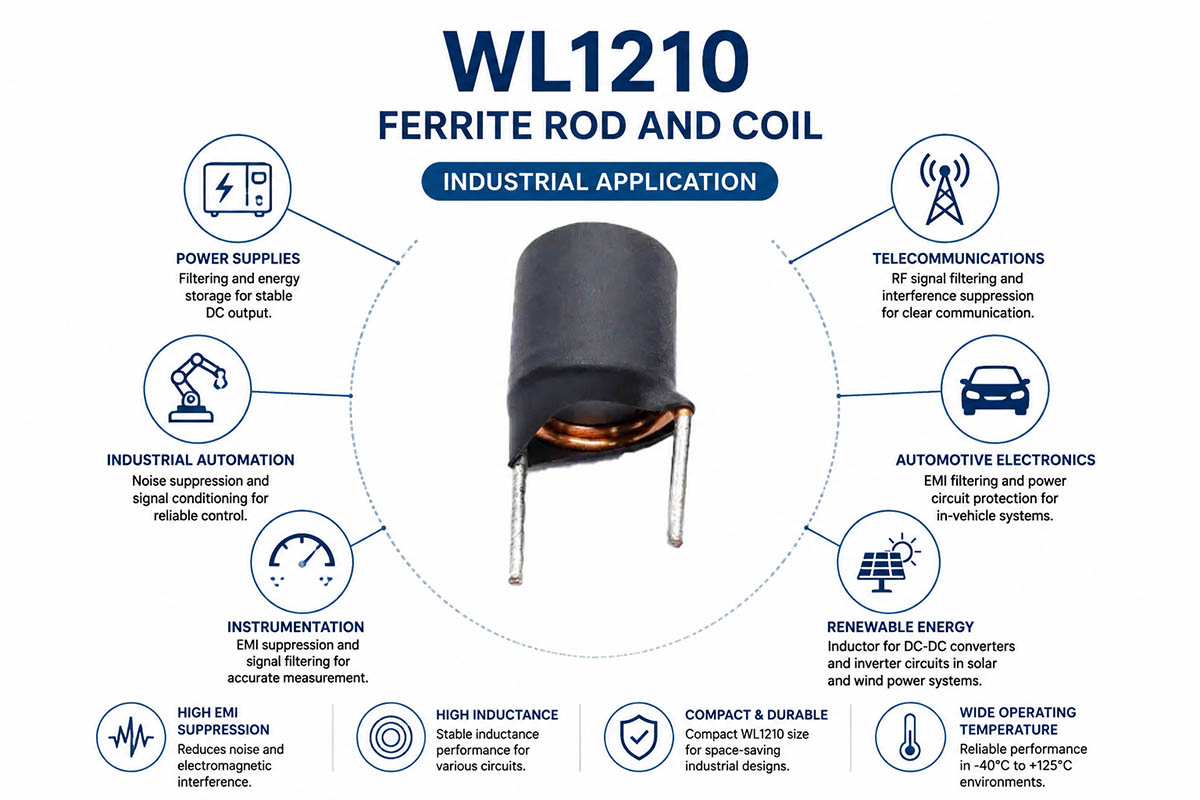
Ferrite Rod and Coil Industrial Application

Ferrite Rod And Coil Industrial Application

Ferrite rod and coil components are used in industrial and electronic applications that require reliable magnetic performance.

The ferrite rod coils are extensively used in AM receivers, RF antennas, wireless modules, and signal transmission equipment in communication systems. They help to enhance magnetic coupling to increase receiving sensitivity and signal quality.

The ferrite rod coils are used in industrial automation in sensors, control devices, monitoring systems and detection equipment. They help to ensure reliable signal processing and accurate operation.

In power electronics, the ferrite rod coils are used for filtering, inductive circuits and suppression of electromagnetic interference. The ferrite materials help to reduce unnecessary noise and enhance the efficiency of the circuit.

The ferrite rod coil technology is also used in medical equipment, automotive electronics, smart devices and IoT products due to their small size and reliable electrical characteristics.

Industrial manufacturers use customized ferrite rod and coil solutions for various requirements such as frequency adjustment, environmental resistance and size limitations. Due to the increasing demand for wireless communication and miniaturization of electronics, ferrite rod coils are gaining importance as components of modern electronic systems.


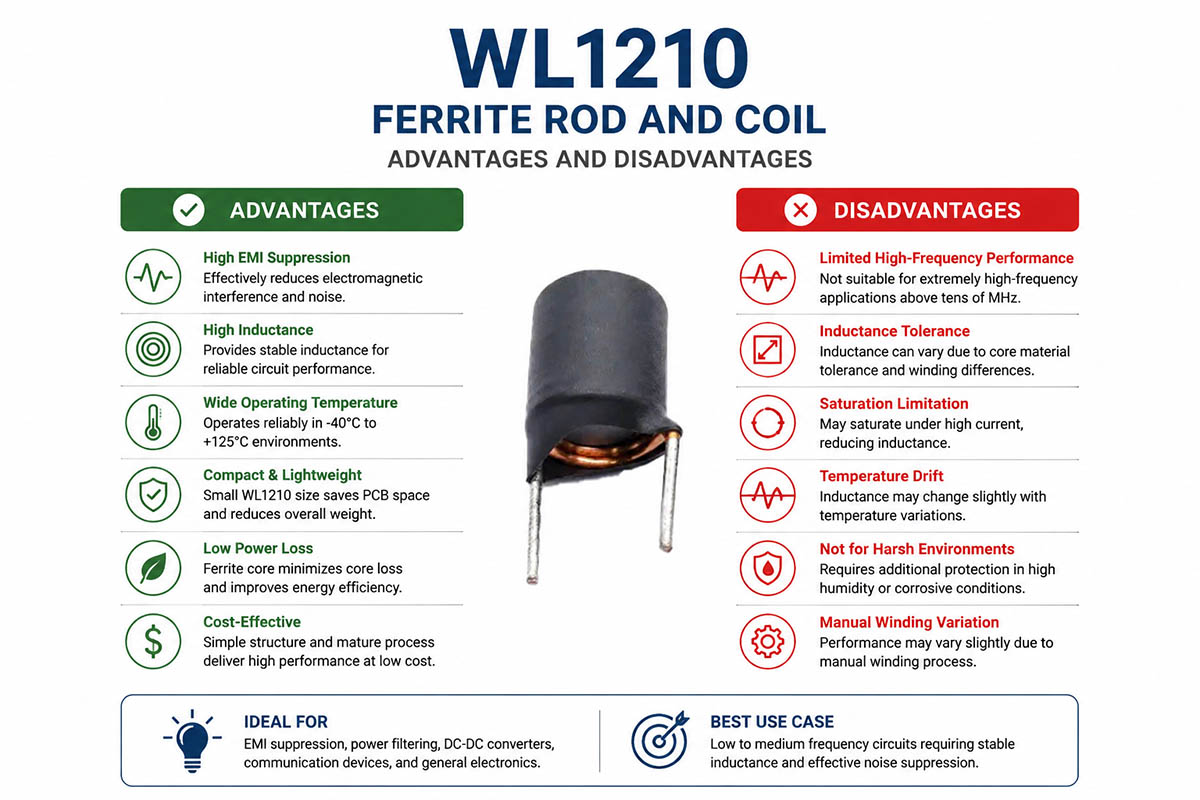
Ferrite Rod and Coil Advantage and Disadvantage

Ferrite Rod And Coil advaantage and disadvantage

Ferrite Rod and Coil Advantages:

Ferrite rod and coil components have excellent magnetic performance in a small size. Their high permeability ensures increased inductance efficiency and allows designing smaller electronic designs. Ferrite rod coils have low energy losses, good frequency characteristics and reliable operation in RF and communication applications.

Ferrite materials are light, corrosion resistant and economical as compared to many metal magnetic materials. Their design is versatile and can be adjusted to different frequencies, inductance values and applications.

Ferrite Rod and Coil Disadvantages:

The ferrite materials are relatively brittle and may break under mechanical impact. The assembly requires careful handling and appropriate mounting.

Ferrite rod coils may fail when used at very high power levels because the ferrite material becomes saturated. Moreover, use of inappropriate ferrite grades leads to poor frequency response or reduced efficiency.

However, the advantages of ferrites in electronic applications exceed the disadvantages and ferrite rod and coil technology is widely used.

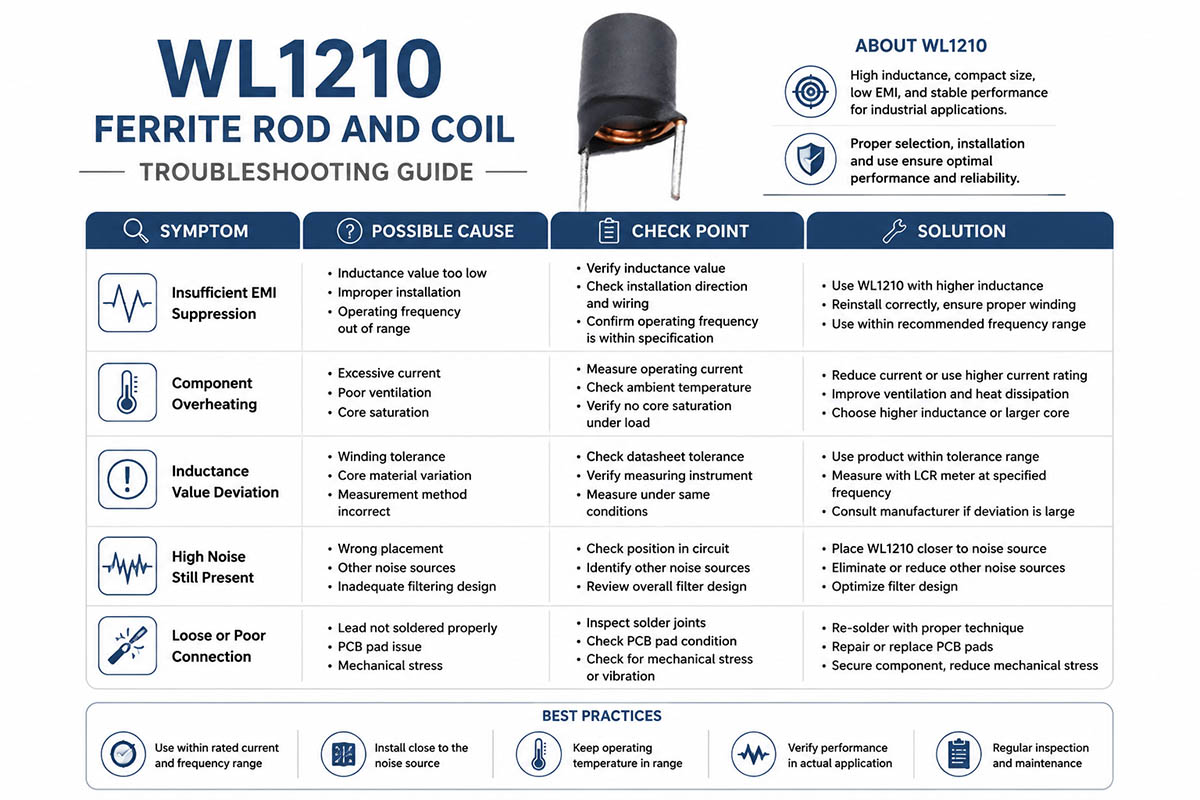
Ferrite Rod and coil Troubleshooting Guide

Ferrite Rod And Coil troubleshooting guide

1.Weak Signal Strength

Causes may be incorrect winding of the coil, damaged ferrite material or improper installation. Check the coil connections and quality of ferrite.

2.Incorrect Inductance Value

If the inductance value measured is not as specified, check the number of turns of winding, wire diameter and ferrite core selection.

3.Too much Noise or Interference

Electromagnetic interference may occur due to poor shielding and improper circuit matching. Improved filtering and grounding design.

4.Problems with Temperature Performance

Magnetic properties may be affected by high temperature operation. Choose ferrite materials that are intended for the required temperature range.

5.Mechanical Damage

If the ferrite rod is cracked, it negatively affects the magnetic performance. Repair damaged parts and increase protective measures.

6.Unreliable Quality of the Production

Unreliable performance occurs due to variability of winding tension, ferrite material and manufacturing processes. Cooperation with professional suppliers and quality control procedures.

Problems with ferrite rod and coil can be avoided by regular inspection, electrical testing and proper design techniques.

8 FAQ for Ferrite Rod and Coil

1. What is a ferrite coil?

Ferrite coil are mainly used in electromagnetic signal receiving, inductance control and magnetic coupling applications. They are widely used in RF receivers, AM antennas, wireless communication equipment, sensors, industrial control systems and electronic filter circuits . The ferrite rod increases the magnetic permeability and the coil provides higher inductance and improved signal sensitivity than an air-core coil. Ferrite coils are used in industry for their stable performance, compact size and reliable operation in various electronic environments.

2. How does a ferrite coil work?

The ferrite rod and coil operate on the principle of electromagnetic induction. As the current flows through the copper wire winding it creates the magnetic field around the ferrite rod. The ferrite material “concentrates” the magnetic field and increases the coil inductance.

When the electromagnetic waves are applied, they create the variable magnetic fields around the ferrite rod that induce electrical signals in the coil. Generated signals are processed by electronic circuits. The ferrite material increases the sensitivity, reduces energy loss and improves frequency performance.

3. What are the advantages of a ferrite rod coil?

Ferrite rod coils have several advantages:

High magnetic permeability •

Compact and light design

High signal sensitivity

Low electromagnetic energy loss

Stable inductance characteristics

Excellent frequency response

Good EMI noise reduction capabilities

Flexible customization options

These advantages make ferrite rod and coil components suitable for industrial electronics, communication systems, sensors and compact electronic devices that require high magnetic efficiency.

4. What is the correct ferrite rod and coil?

Selection of the right ferrite  coil depends on a number of factors:

Operating frequency range

Required inductance value

Type of ferrite material

Coil winding specifications

Physical dimensions

Temperature requirements

Environmental influences

Application object

Generally, NiZn ferrite materials are selected for high-frequency applications, whereas MnZn ferrite materials are selected for lower-frequency applications. The manufacturer should consider the electrical parameters and provide a customized design for the operating environment.

5. What is the difference between a ferrite rod coil and an air-core coil?

The difference is in the magnetic core material. The ferrite coil uses a ferrite magnetic core to increase the permeability and inductance. The air-core coil has no magnetic material inside.

The advantages of the ferrite rod coils As compared with air coils:

Smaller package with higher inductance

Improved magnetic coupling

Improved signal reception

Frequency efficiency is higher

However, air-core coils may be better suited for some high power or very high frequency applications where magnetic saturation is an issue.

6. Can I customize ferrite rod and coil products?

Yes. Ferrite coil products can be customized according to customer requirements. Manufacturers can change:

Ferrite Rod Size and Material

Number of winding turns

Diameter of wire

Inductance value

Operating frequency

Terminal structure

Fixation method

Electrical performance

Customized ferrite rod coils are extensively designed for industrial automation equipment, communication modules, sensors, automotive electronics and various RF applications.

7. Why does ferrite rod coil burn out?

Ferrite coil performance degrades for one or more reasons:

Incorrect ferrite material selection

Damaged or cracked ferrite core

Incorrect winding design

Temperature exceeds rated limits

Bad electrical contact

Electromagnetic interference

Incorrect installation

Good electrical testing, proper component selection and mechanical protection can help to achieve stable performance and long service life.

8. For which industries ferrite coil components are used?

Ferrite and coil components are used in various industries including:

Communication Industry: RF receivers, antennas, wireless modules

Industrial automation – sensors, control systems, monitoring equipment

Automotive Electronics: Communication and detection systems for cars

Consumer Electronics: Radios, smart devices, electronic products

Medical Equipment: Signal processing and monitoring equipment

IoT Applications: Wireless sensors and connected devices

Due to the growing demand for compact and efficient electronic systems, ferrite rod and coil technology remains an important part of modern industrial applications.

How to choose a ferrite rod and coil?

Choosing the appropriate ferrite rod and coil requires balance of electrical, mechanical and environmental factors.

1. Determine the Operating Frequency

The first step is to define the operating frequency range. Various ferrite materials have different magnetic characteristics. The ferrite materials for high frequency applications are manufactured for low loss and stable performance.

2.Determine the Right Ferrite Material

The ferrite materials like manganese-zinc (MnZn) and nickel-zinc (NiZn) have different magnetic properties. The MnZn ferrite is suitable for lower-frequency applications, whereas the NiZn ferrite is suitable for higher frequencies.

3.Consider Inductance requirements

The coil winding design affects the inductance. The number of turns, wire diameter and winding design should be as required by the circuit. Incorrect selection of inductance will negatively affect the signal performance.

4.Physical Dimensions Check

The ferrite rod dimensions should match the installation space. Prior to production, check the diameter, length, mounting technique and mechanical strength.

5. Temperature and Environmental Conditions Check

When using for industrial purposes, temperature resistance, humidity conditions, vibration and mechanical load should be taken into consideration. Choose appropriate materials for the operating environment.

6.Test Quality Standards

Select suppliers that can provide consistent quality of ferrite materials, accurate winding, electrical tests and custom manufacturing capabilities.

7.Consider Custom Design Requirements

Various applications require custom ferrite rod coils. Consultations should be held about the frequency range, inductance value, type of wire, terminal design and other performance requirements with manufacturers.

Higher efficiency, stable operation and longer product life will be achieved through proper selection in industrial electronic systems.

Tips to Avoid Common Mistakes During the Design of Ferrite Rod and Coil

Poor Ferrite Material Selection

Ferrite materials should be selected according to the frequency range and magnetic requirements.

Incorrect coil winding design

The inductance accuracy is affected by improper turns or winding design.

Operating Temperature-Ignoring

Changes in temperature can affect the magnetic performance and reliability.

Mechanical fix – bad

It is necessary to secure the ferrite rod to prevent vibration damages.

Ignoring EMI effects

EMI should be assessed during the design phase.

Not enough testing

Inductance, resistance, frequency response and environment performance testing is always required.

Ignoring Manufacturing Tolerances

Control tolerances for mass production.

Get A Free Quote Now

Contact Form

Related Products

Related News

Scroll to Top

Get A Free Quote Now !

Contact Form
If you have any questions, please do not hesitate to contact us.
Weilong Solenoid Company Culture