
 Chapter 1 : Introduction
Magnetic force is one of the key forces that are used in modern electricity and mechanics. It makes it possible for machines to move and operate with accuracy and precision. There are numerous everyday devices and equipment powered by magnetic force: electric motors, electromagnetic valves, magnetic locks, relays, various types of sensors and many others. For engineers working in the industry, it is crucial to understand the principles of magnetic force and its role in electromagnetic systems. For manufacturers of solenoids and other electromagnetic components, magnetic force is a very important parameter. It depends on a number of factors: coil turns, current, magnetic material, air gap and mechanical construction.
This article explains what magnetic force is, how it works, how it can be calculated and how engineers optimize magnetic force in industrial applications.
Chapter 2: What Is Magnet Force?
Magnet force is the force which is created by the action of magnetic field upon magnetic materials, electric currents or charges.
When there is electric current flowing in the conductor or in the coil, it creates the magnetic field. When this magnetic field acts on iron, steel or any other magnetic material, magnetic force is created.
In electromagnetic devices, the energy of electricity is converted into mechanical movement via magnetic force.
For instance:
- A solenoid converts electrical energy into linear movement.
- A relay uses magnetic force to switch electrical contacts.
- An electromagnetic valve uses magnetic force to regulate liquid/gas flow.
- An electromagnetic actuator uses magnetic force to push or pull mechanical load.
The amount of magnetic force determines the effectiveness of these devices.
Chapter 3: How Does Magnet Force Work?

The working principle of magnet force lies in the electromagnetic induction.
Electric current passing through the coil creates the magnetic field. Iron core located in the coil enhances the magnetic field since magnetic materials have a lot higher permeability then air.
The magnetic field creates attraction between the movable plunger and the fixed core.
The main working process is the following:
Electric current flows through the coil.
The coil creates the magnetic field.
The magnetic field passes through the iron magnetic circuit.
Metal component is attracted.
Mechanical movement is created.
In DC solenoid, the magnetic force pulls or pushes the plunger to create linear movement.
Chapter 4: Magnet Force Formula
Magnet force is the force which is created by magnetic field acting upon magnetic material, current-carrying conductor or actuator. During solenoid and electromagnet design, the magnetic force formula can be used to calculate the attracting or holding force created by the coil.
4.1 Basic Electromagnetic Force Formula
In case of an electromagnetic solenoid, the approximate magnetic force can be calculated as:
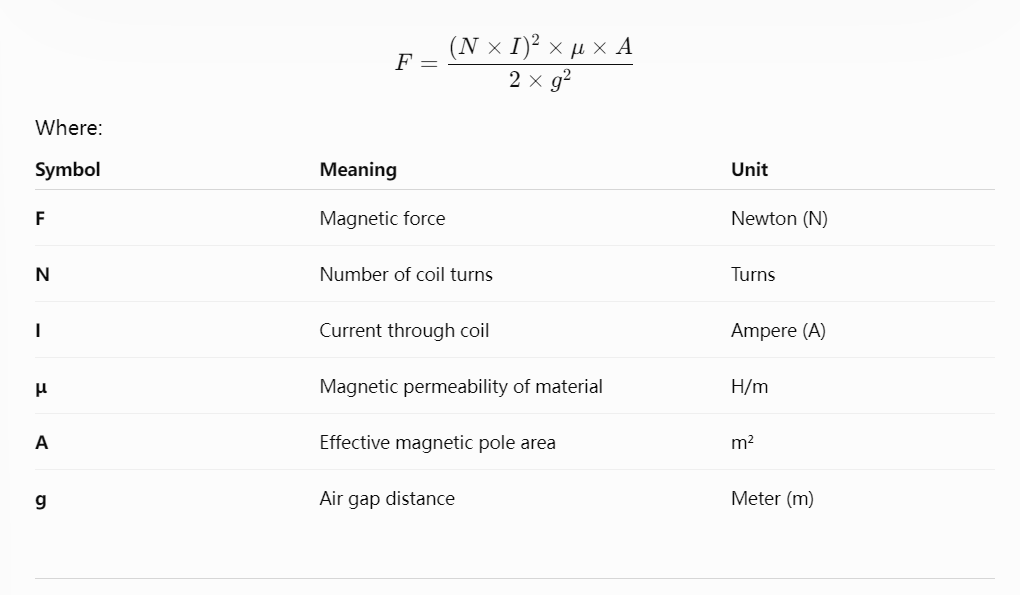
4.2 Simplified Solenoid Force Formula
For DC solenoid design, engineers usually use the simplified formula:
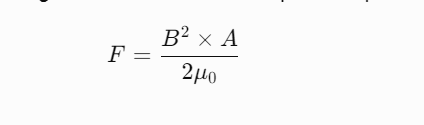
Where:
F = Magnetic force (N)
B = Magnetic flux density (Tesla)
A = Pole face area (m²)
μ₀ = Vacuum permeability (4π × 10⁻⁷ H/m)
This formula shows the dependency of magnetic force on magnetic flux density.
If the magnetic field intensity is doubled:
F∝B2F \propto B^2F∝B2
The magnetic force becomes four times greater.
4.3 Magnet Force Formula for Solenoid Design
In case of a tubular solenoid:
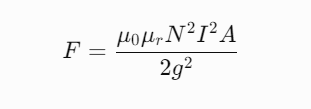
Where:
μ₀ = Vacuum permeability
μᵣ = Relative permeability of magnetic core
N = Coil turns
I = Coil current
A = Plunger/core cross-sectional area
g = Air gap
This formula helps to explain why solenoid designers try to optimize:
*Amount of force:
✅ More coil turns
✅ Higher current
✅ Larger magnetic area
✅ Better magnetic material
✅ Smaller air gap
- Reduction of force:
❌ Large air gap
❌ Magnetic leakage
❌ Low-permeable core material
❌ Bad coil design
4.4 Example Calculation
Let’s assume:
N = 500 coil turns
I = 2 A
Magnetic area: A = 100 mm² = 0.0001 m²
Air gap: g = 1 mm = 0.001 m
Magnetic permeability: μ = 4π × 10⁻⁷
The force can be calculated as:

The result gives the theoretical electromagnetic attracting force.
In practice, the real force is lower due to:
- Magnetic saturation
- Friction losses
- Spring resistance
- Air leakage
- Manufacturing tolerance
4.5 Relationship between the magnet force and air gap
Air gap plays a huge role in the creation of force.
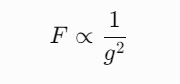
It means that:
Reduction of air gap by twice increases force dramatically.
Increase of stroke distance lowers the amount of available force.
For instance:
- 1 mm air gap = high force
- 5 mm air gap = very low force
That’s why solenoids usually create maximum force at the end of stroke
4.6: Magnet Force Calculation in Solenoid Applications
When engineers are designing the solenoid, they usually take into account the following parameters:
Parameter Effect on Force
Coil current Higher current results in increased force
Coil turns More turns create a stronger magnetic field
Core material Higher permeability increases force
Plunger diameter Larger area creates more force
Air gap Small air gap results in increased force
Stroke distance Longer stroke decreases the amount of force
Duty cycle Higher power results in increased heat
4.7 Practical Formula Used by Solenoid Manufacturers
In real industrial solenoid design, manufacturers usually combine:
Electromagnetic calculation + magnetic simulation + force testing
since the theoretical formulas can’t predict completely:
- Magnetic saturation
- Mechanical tolerance
- Material properties
- Influence of temperature
Professional solenoid manufacturers test force through:
- Pull force testing
- Stroke-force curve testing
- Temperature testing
- Life cycle testing
Knowledge of magnet force formula can help engineers to design DC solenoids, tubular solenoids, push-pull solenoids, latching solenoids and electromagnetic valves with optimized force, energy consumption and durability.
Chapter 5: Factors Affecting Magnet Force
5.1 Coil Turns
The number of turns in an electromagnetic coil affects magnetic field strength.
Higher number of turns creates a stronger magnetic field, since more magnetic flux is created.
However, increasing the number of turns also increases:
Coil resistance
Energy consumption
Heat generation
Component size
Engineers have to balance force requirements and thermal performance.
5.2 Electrical Current
Current is another very important parameter affecting magnetic force.
Higher current creates stronger magnetic field, resulting in the increase of electromagnetic force.
However, too high current can cause:
Coil overheating
Reduction of lifespan
Insulation damage
Excessive energy consumption
Therefore, industrial solenoid manufacturers carefully design the coil resistance and operating voltage.
5.3 Air Gap Distance
Air gap between the plunger and core affects magnet force.
Small air gap results in a stronger magnet circuit and higher force output.
However, mechanical tolerance is also very important, since:
Small gap can result in sticking.
Manufacturing deviation might affect force.
Residual magnetism increases after usage.
Therefore, precise machining is necessary to provide stable magnetic force.
5.4 Magnetic Material Selection
The magnetic material affects the efficiency of electromagnetic force creation.
Popular materials are:
Low carbon steel
Electrical steel
Pure iron
Stainless magnetic alloys
Higher permeability material increases magnetic flux concentration and force output.
Industrial solenoid manufacturers choose materials depending on:
Force requirements
Working temperature
Operating cycle
Corrosion resistance
5.5 Coil Design
The design of the coil affects the performance of electromagnetic force.
Important parameters of coil design:
Wire diameter
Winding type
Coil length
Resistance value
Insulation quality
Good coil design can provide:
Higher magnetic force
Less heat generation
Higher service life
Better energy efficiency
Chapter 6: Magnetic Force in Solenoid Applications
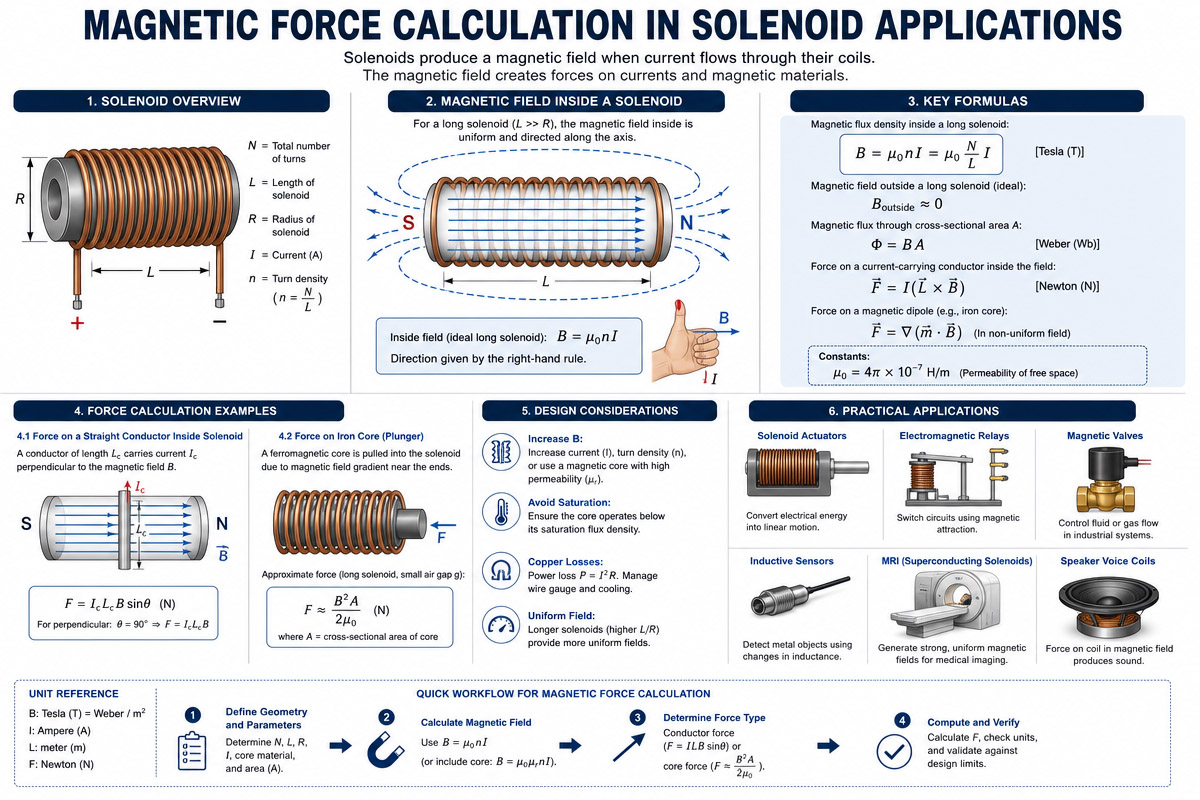
When designing a solenoid, engineers normally consider:
| Parameter | Effect on Force |
|---|---|
| Coil current | Higher current increases force |
| Coil turns | More turns increase magnetic field |
| Core material | Higher permeability improves force |
| Plunger diameter | Larger area increases force |
| Air gap | Smaller gap increases force |
| Stroke distance | Longer stroke reduces force |
| Duty cycle | Higher power increases heat |
Chapter 7 : Tips for Increasing Magnet Force
Increasing of the magnetic force requires the optimization of electrical, magnetic and mechanical designs.
Typical methods are:
7.1 Increasing of Coil Power
Increasing voltage or current is effective way of increasing force output.
However, thermal management should be taken into account.
7.2 Improvement of Magnet Circuit Design
Optimal magnetic circuit reduces magnetic losses.
Improvements can include:
Optimized iron core geometry
Decreased leakage flux
Improved pole design
7.3 Reduction of Air Gap
Reducing the air gap increases magnetic efficiency.
Precision manufacturing helps to maintain constant performance.
7.4 Usage of Better Magnetic Material
High quality magnetic steel increases magnetic flux concentration and force output.
7.5 Optimization of Coil Geometry
Properly designed coil optimizes:
Magnetic field distribution
Heat dissipation
Energy efficiency
Chapter 8: Magnetic Force Testing Methods
Manufacturers have to test magnetic force to ensure high product reliability.
Common testing methods include:
Pull Force Test
It measures the maximum attracting force created by an electromagnet.
Stroke Force Test
It measures force output at different movement distances.
Temperature Test
It evaluates coil temperature during continuous operation.
Life Cycle Test
It checks the performance after thousands or millions of operating cycles.
For industrial solenoids, the force testing is usually performed at specific:
Voltage
Stroke distance
Duty cycle
Temperature conditions
Chapter 9: Industrial Applications of Magnet Force
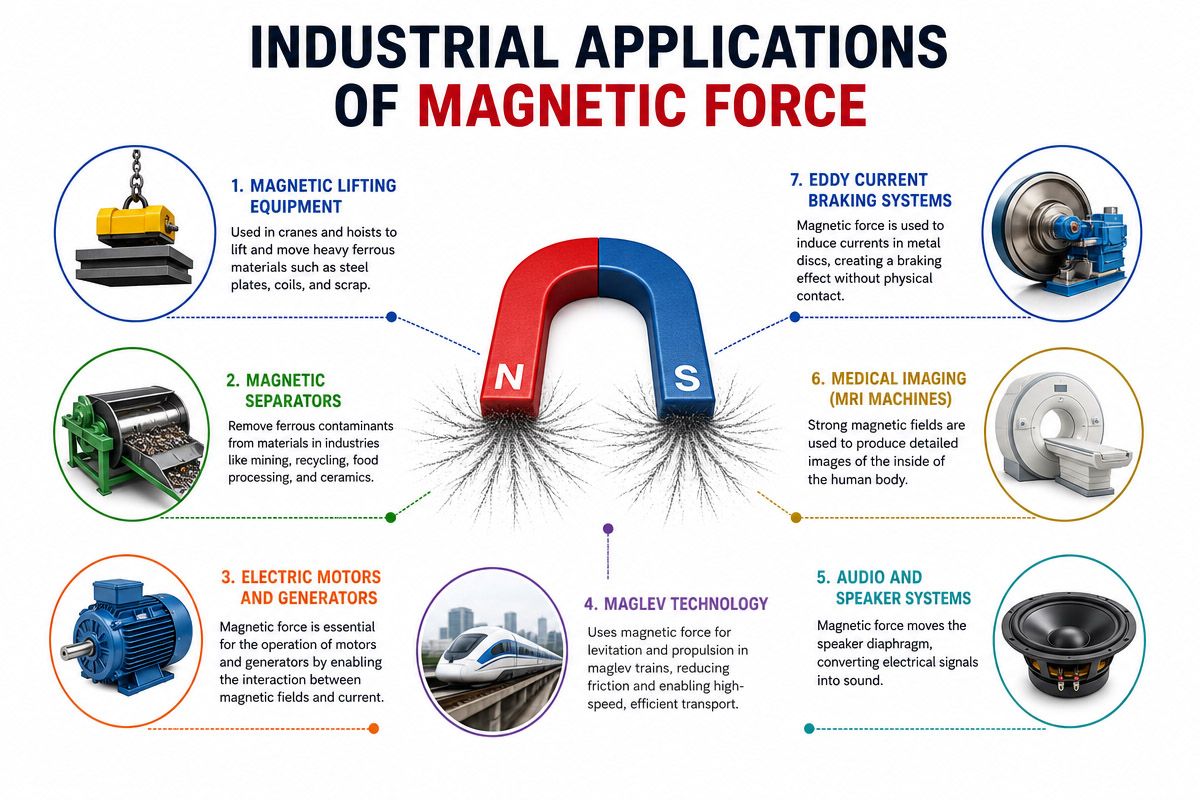
Magnetic force technology is widely applied across many industries.
Automation Industry
Applied for:
Robotic mechanisms
Machine control systems
Positioning devices
Medical Equipment
Includes:
Pumps
Valves
Diagnostic equipment
Automotive Industry
Used in:
Door locks
Transmission systems
Fuel control systems
Security Systems
Includes:
Electronic locks
Access control systems
Consumer Products
Used in:
Appliances
Printers
Smart devices
Chapter 10 : Magnet Force vs Mechanical Force
Magnetic force has many advantages compared with traditional mechanical systems.
Advantages:
Fast response
Precise control
Compact design
Low maintenance
Easy electrical control
Disadvantages:
Heat generation
Limited stroke distance
Force decreases with larger air gaps
Engineers have to choose the appropriate electromagnetic design according to the requirements of the application.
Chapter 11: Why Magnet Force Is Important in Solenoid Manufacturing

For professional solenoid manufacturers, controlling magnetic force is critical.
Good solenoid requires:
Accurate electromagnetic calculation
Optimized coil winding
Appropriate magnetic materials
Precision machining
Reliable testing
At the design stage, engineers have to consider:
Required force
Stroke length
Voltage
Duty cycle
Operating environment
Expected lifespan
A properly designed electromagnetic system can achieve high performance while having low energy consumption and long service life.
Chapter 12 : FAQs
12.1 What is magnet force?
Magnet force is a force which is created by magnetic field and which attracts or repels magnetic materials, electric currents or charges. In electromagnetic devices, magnetic force converts electrical energy into mechanical movement.
Popular applications include:
Solenoids
Electromagnetic valves
Motors
Relays
Magnetic actuators
Industrial automation equipment
12.2 Why does magnet force decrease when air gap increases?
Magnetic force depends greatly on air gap distance.
Relation is approximate:
F∝1g2F \propto \frac{1}{g^2}F∝g21
It means that larger air gap creates higher magnetic resistance, decreasing magnetic flux and magnetic force output.
For example:
Maximum force of a solenoid is achieved when plunger is close to the core.
Force decreases when plunger moves farther from it.
12.3 How is magnet force measured?
Magnetic force is usually measured with the help of force testing equipment.
Popular tests are:
Pull Force Test
Measures the maximum attracting force between magnetic core and plunger.
Stroke Force Test
Measures the force output at different distances of movement.
Holding Force Test
Measures the force which is needed to separate magnetic surfaces.
Life Cycle Test
Measures if the force performance stays stable after repeated operation.
12.4 What is the difference between magnet force and electromagnetic force?
Magnetic force is a general term which describes the force created by magnetic fields.
Electromagnetic force describes magnetic force which is created by electrical current.
For example:
Permanent magnet = magnetic force
DC solenoid coil = electromagnetic force
Electromagnetic valve = electromagnetic force
12.5 How does solenoid create magnet force?
Solenoid creates magnetic force by using electromagnetic induction.
The process is:
Electric current flows through the coil.
The coil creates the magnetic field.
The iron core concentrates the magnetic flux.
Plunger is attracted by the core.
Mechanical movement is created.
This principle allows solenoids to control the movement in industrial machines, valves and automation systems.
12.6 What materials are best for creating magnetic force?
Popular magnetic materials are:
Pure iron
Low carbon steel
Electrical steel
Magnetic stainless steel
A good magnetic material should have:
High magnetic permeability
Low magnetic losses
Good mechanical strength
Corrosion resistance
Industrial solenoid manufacturers choose materials depending on force requirements and operating conditions.
12.7 Why is magnet force important in solenoid design?
Magnetic force determines the performance of the solenoid, including:
Pulling force
Holding force
Stroke capability
Response speed
Energy efficiency
During solenoid design, engineers have to optimize:
Coil structure
Magnetic circuit
Plunger geometry
Air gap
Operating duty cycle
12.8 Can magnet force work without electricity?
Yes. Permanent magnets can create magnetic force without electricity.
However, electromagnetic devices like solenoids require electricity to create magnetic force.
Examples:
Permanent magnetic force:
Magnetic holders
Magnetic clamps
Electromagnetic force:
Solenoid actuators
Solenoid valves
Electromagnetic locks
12.9 What is the difference between pulling force and holding force?
Pulling Force
Force which is created when magnetic component attracts and moves the load.
Holding Force
Force which is required to separate two magnetic surfaces after full engagement.
For solenoid applications:
Pull force is important during movement.
Holding force is important for position maintaining.
12.10 How do engineers test magnet force in industrial solenoids?
Professional solenoid manufacturers test magnetic force using:
Computer magnetic simulation
Prototype testing
Force-stroke curve measurements
Temperature testing
Continuous operation testing
Such testing ensures that solenoid is capable to achieve required:
Force
Stroke
Duty cycle
Lifetime performance
12.11 Why is magnet force calculation important for manufacturers?
Accurate magnet force calculation helps manufacturers to create products with:
Proper force output
Lower power consumption
Longer lifespan
Greater reliability
Smaller size
For custom solenoid projects, engineers usually combine theoretical calculation, magnetic simulation, prototype testing and production validation to achieve proper performance.
Chapter 13 : Conclusion
Magnet force is the basis of modern electromagnetic technology. Using magnet force allows transforming electrical energy into mechanical movement and powering a large number of industrial devices.
Knowing the factors which affect magnetic force (coil design, current, magnetic material, air gap), is important for engineers who are designing solenoids, actuators and other electromagnetic components.
Using advanced design technologies and precise manufacturing processes allows optimizing magnetic force to achieve better performance, efficiency and lifespan in industrial applications.
For companies which develop custom solenoids or electromagnetic actuators, choosing a professional manufacturer with good engineering capabilities is an important step towards obtaining reliable magnet force performance.


