Micro Solenoid Pump in Smart Home Devices
High Precision Micro Solenoid Pump Solutions
Micro Solenoid Pump for Cleaning Machines
Micro Solenoid Pump for Coffee Machines
Micro Solenoid Pump for HVAC Systems
Micro Solenoid Pump in Smart Home Devices
High Precision Micro Solenoid Pump Solutions
Micro Solenoid Pump for Cleaning Machines
Micro Solenoid Pump for Coffee Machines
Micro Solenoid Pump for HVAC Systems

WL38DCB Micro solenoid pump for medical devices

What is a micro solenoid pump? A micro solenoid pump is an electromagnetic pump that is able to precisely control or transfer small amounts of fluids. A micro solenoid pump is able to generate precise amounts of fluids through an electromagnetic coil. A micro solenoid pump is widely used in applications that need precise amounts of fluids due to its compact size, fast response time, and high reliability.

A micro solenoid pump is able to pump a number of fluids, such as water, chemicals, and light oils, using a DC voltage source. A micro solenoid pump is compact in size and is thus widely used in applications with space constraints. A micro solenoid pump is an ideal choice for precise amount applications due to its high reliability and low power consumption.


Overview of the Micro Solenoid Pump Product

The micro solenoid pumps are small, accurate fluid control products for contemporary automated systems. For precise and reliable performance, the pumps combine effective mechanical engineering with electromagnetic technology. These pumps are extensively used in the medical, food, automotive, and laboratory sectors. These pumps are ideal for small-scale fluid handling and dosing applications, especially for their long lifespan and customization.


WL38C\DCB Micro Solenoid Pump Video

Micro Solenoid Pump Detail Description

WL38 DCB Micro Solenoid Pump Datasheet

AC 220V Solenoid Pump

Brand Weilong Technology Model Number WL 38DCB
Rated Voltage (V) DC 220V, 60 HZ Rated Power(W) 25W
PWM 30 ms Kpa As the specification
Stroke(mm) 2-3 MM Customized Reset Time(s) 1 S On,9 S OFF
Flow Rate: 500 ML/ Per Minute Certification CE,ROHS, ISO9001,
Material Cartbon Steel and Plastic Lead Wire Length(mm) 200 MM
In and out Port As the specification Tolerance of Dimension  +/-  0.1 MM
Water-proof Yes Insulation Class Ip 65
Hi-Pot Test AC 600V 50/60Hz 2s Non-excitation Holding Force 0
Working Temperature -10°C-100°C Duty Cycle 1-80%
Thread Depth(mm)  15 mm Payment Term TT, or LC At Sight
Sample Order Yes Warranty 1 Year
MOQ 1000 pcs Supply Ability 500 pcs per Week
Delivery Time 30 Days Port of Loading shenzhen

Key Elements  of Micro Solenoid Pump

Micro solenoid pumps have earned a good name for their quick response, precision, and small size. These pumps ensure precise dosing, which is quite repeatable. Micro solenoid pumps are quite easy to integrate into any system. These pumps have high reliability, a long lifespan, and high performance, all thanks to their simple design. Micro solenoid pumps can handle water, chemicals, and light oil, among other liquids. Micro solenoid pumps can function well even under intermittent operation, thanks to their quick start-stop feature. Micro solenoid pumps have wide application in various industries due to their lightweight design and adjustable parameters.


WL38DCB Micro Solenoid Pump Applicaitoni

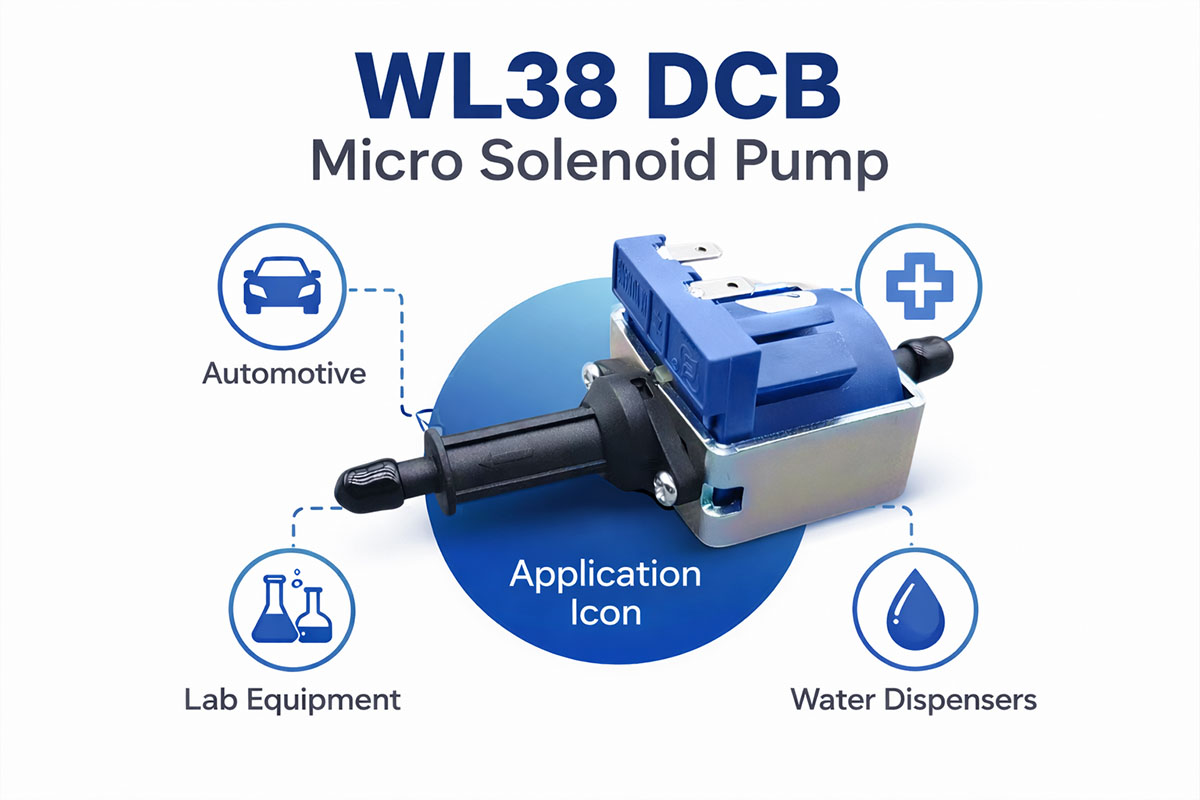
WL38 DCB Micro Solenoid Pump Application

Micro solenoid pumps, due to their precision and small size, have found extensive use in many different industries. Micro solenoid pumps have found critical application in various medical devices, such as infusion pumps, drug delivery systems, and testing devices, where precise fluid dosage is critical. Micro solenoid pumps have found use in laboratory settings, where precise reagents, sampling, and chemical testing take place.

Micro solenoid pumps are also used in coffee makers, beverage dispensers, and flavor injection systems. The quality of the product is ensured by the pumps’ ability to pump regular quantities. The micro solenoid pumps are also used in the industrial automation sector for the cooling system, chemical dosing system, and lubrication system. The fuel system, emission system, and fluid circulation system are the uses of the micro solenoid pumps in the automobile industry. The micro solenoid pumps are also used in the agriculture sector for the irrigation system and the pesticide spraying system. The micro solenoid pumps are also used for the efficient use of fluids in household devices such as water dispensers, humidifiers, and air purifiers. The micro solenoid pumps are an important part of modern fluid control systems because of the pumps’ versatility, accuracy, and reliability.


Advantages and Disadvantages of WL38 DCB Solenoid Pump

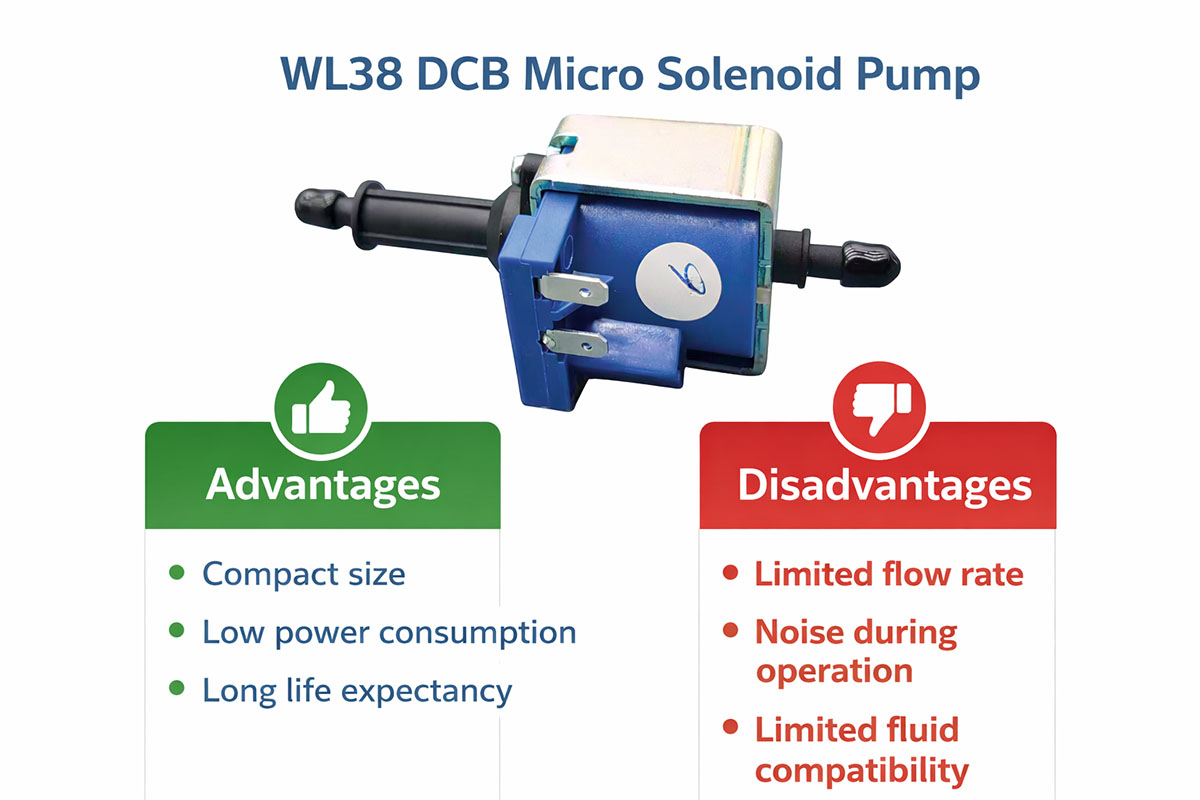
WL38 DCB Micro Solenoid Pump Advantage and Disadvantage

The Benefits of Micro Solenoid Pump

The micro solenoid pumps are the best for dosing applications because they are accurate for controlling fluids. The pumps are also small in size and are easy to integrate into small devices. The pumps are also accurate and reliable. The pumps are also efficient because they are easy to use and require less maintenance. The pumps are also versatile and are easily adaptable for use in different applications.

The Cons of Micro Solenoid Pump

The micro solenoid pumps have some disadvantages despite the advantages. The pumps may also vibrate and make noise because of the electromagnetic movement. The pumps are not efficient for use in applications where a high volume of fluids is required because the pumps have a low flow rate compared to other pumps. The pumps may also generate heat because of the constant movement and may affect the performance and longevity of the pumps. The pumps may also not be effective for use with fluids that are thick and have a lot of particles.

Troubleshooting Guide for Micro Solenoid Pumps

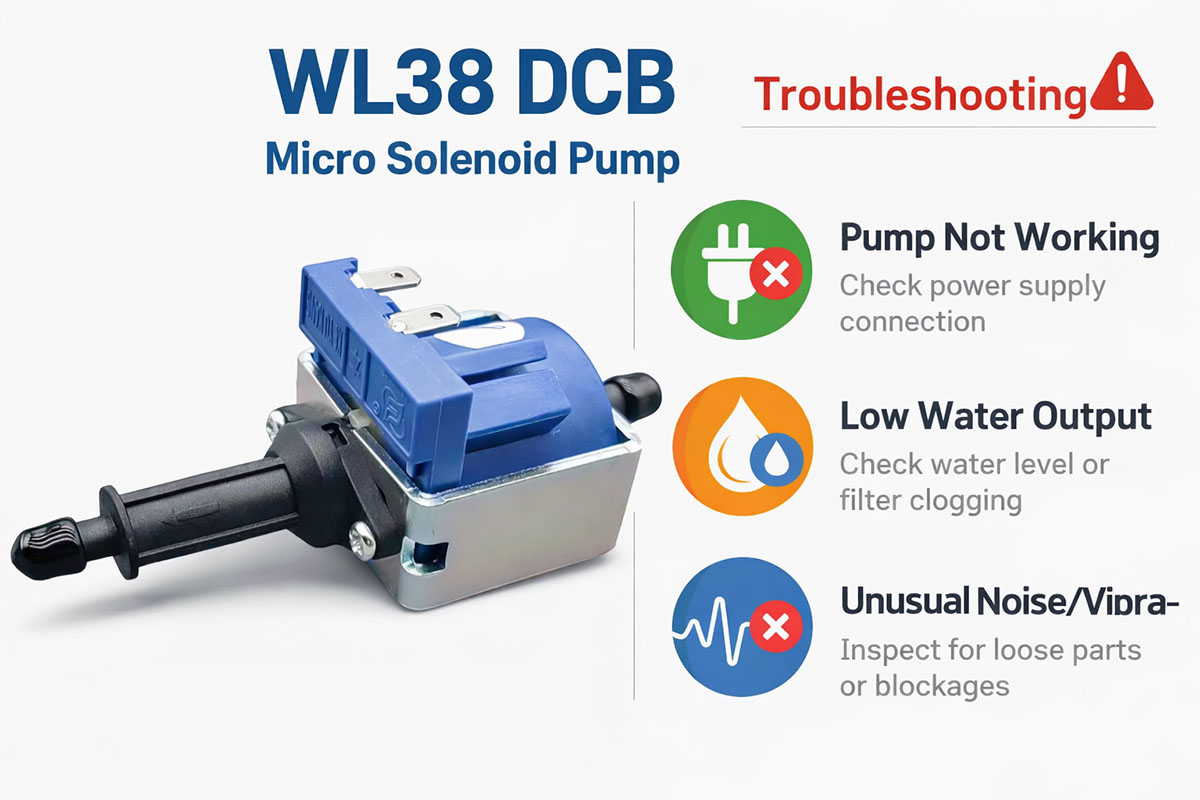
1. Pump Failure (No Reaction)

Possible Reasons:

Insufficient voltage supply or incorrect voltage

Wiring issues

Faulty coil

Driver failure

Remedy:

Verify if the voltage, e.g., 12V DC, is appropriate for the pump

Verify if the wiring is correct

Verify if there is a problem with the coil

Verify if there is a problem with the driver

2, Minimal/Non-Existing Flow Output

Possible Reasons:

Blocked outlet or inlet

Trapped air in the pump

Worn-out internal parts

Insufficient voltage supply

Remedy:

Verify if there is a problem with filters

Verify if there is a problem with inlet/outlet

Verify if there is a problem with trapped air in the pump

Verify if there is a problem with worn-out internal parts

Verify if there is a problem with voltage supply

3. No Fluid Transfer Despite Pump Operation

Possible Reasons:

Verify if there is a problem with valve failure

Verify if there is a problem due to incorrect installation

Verify if there is a problem due to excessive leakage

Remedy:

Verify if there is a problem with inlet/outlet valves

Verify if there is a problem due to incorrect flow direction

Verify if there is a problem due to internal structure

4. Excessive Vibration/Noise

Possible Reasons:

Verify if there is a problem due to insufficient mounting

Verify if there is a problem due to excessive operating frequency

Remedy:

Verify if there is a problem due to excessive operating frequency

Verify if there is a problem due to insufficient mounting

Verify if there is a problem due to worn-out internal parts

5. Possible Reasons for Overheating:

Verify if there is a problem due to constant operation

Verify if there is a problem due to excessive voltage supply

Verify if there is a problem due to insufficient ventilation

Remedy:

Verify if there is a problem due to constant operation

Verify if there is a problem due to excessive voltage supply

Verify if there is a problem due to insufficient ventilation

Add a design for heat dissipation

6. Leakage of Fluid

Potential Reasons: Damaged diaphragm or seal

Connectors that are loose

Remedy for cracked housing:

Change the diaphragm or seal.

Tighten the tubing and fittings.

Replace the housing if it is damaged.

For chemicals, it is recommended that the materials used be compatible.

7. Intermittent Operation

Potential Reasons: Inconsistent power source

Electrical connections that are loose

Remedy for coil overheating protection triggering:

Ensure that the power source is consistent.

Ensure that all electrical connections are secure.

Give yourself time to cool down in between cycles.

8. The Pump Is Not Self-Prime

Potential Reasons: Suction line air leakage

Too high of an installation height

Worn diaphragm

Remedy:

Ensure that the suction line is air-tight.

Adjust the suction height so that it is not too high.

Change the diaphragm

Pump chamber pre-fill

9. Shortened Pump Life

Potential Reasons: Frequently running dry

Handling of unclean or corrosive liquids

Overduty cycle

Remedy:

Prevent the pump from running dry.

For handling unclean or corrosive liquids, it is recommended that filters be used.

Ensure that the materials used can withstand corrosion.

Ensure that the limits of usage are adhered to.

10. Unreliable Flow Rate

Potential Reasons: Variations in voltage

Unusual control signal

Remedy:

Ensure that the voltage is consistent by using a regulated power source.

Ensure that the PWM/control signal is steady.

Replace any worn-out parts

11. Easy Maintenance Advice 🔍

Regularly clean the filters and flow channels.

Regularly inspect the wiring and connectors.

Prevent overloading and avoid running the pump non-stop.

Ensure that the materials used are compatible with the fluid.

Regularly inspect the pump every three to six months.

WL38 DCB Micro Solenoid Pump Trouble Shooting


FAQ of WL38 DCB AC Solenoid Pump

1. What voltage is used by a micro solenoid pump?

The majority of micro solenoid pumps operate using DC voltage supplies such as 6, 12, or 24 volts. This is based on the design and requirements.

2. Is it possible for a micro solenoid pump to operate non-stop?

Yes. This is based on the duty cycle. Many micro solenoid pumps are designed to operate sporadically. If they are not designed for continuous use, they may overheat.

3. Can chemicals be handled by micro solenoid pumps?

Yes. This is based on the compatibility of the chemical with the diaphragm and seals. Before using the pump for this purpose, you should check the specifications.


4. How is the flow rate managed?

The voltage supply, pulse frequency, or a PWM controller may be used.


5. Can a micro solenoid pump be self-starting?

Yes. Many micro solenoid pumps are designed to be self-priming. This enables them to suck fluids within a specified height without any manual priming.

6. Why is there noise coming from my pump?

Due to the electromagnetic action, the pump may be making noise. However, excessive noise may be an indication of worn-out parts or high frequency and loose mounting.

7. How long does a micro solenoid pump last?

It may last hundreds of thousands or even millions of cycles.


8. Is any maintenance required for a micro solenoid pump?

There is minimal maintenance required for a micro solenoid pump. Regular checks for obstructions, leaks, and electrical connections are recommended for optimal performance.


How to Choose the Best Micro Solenoid Pump

For proper performance, long lifespan, and precise control of fluids, it is important to choose the appropriate micro solenoid pump. Here is a comprehensive guide for selecting the appropriate pump:

1. Determine the required flow rate—most important

Calculate the required amount of liquid you need to pump. This may be in milliliters/minute or liters/minute.

Think about the actual working conditions and not just the free flow rate. 👉 Crucial point:

It is important to test the pump under load because the rate at which the pump operates is reduced as the pressure increases.

For example, in a laboratory environment, the rate should be between 1 and 10 milliliters/minute.

Coffee maker—20-50 milliliters/minute

2. Examine the working pressure

Determine the system pressure in bar or psi.

The pump should be able to deliver the required pressure.

👉 Crucial point:

The working as well as the maximum operating pressure should be within safe limits. • Advice:

For standard micropumps—low operating pressure

For reinforced or industrial design—high operating pressure

3. Choose power & voltage

Common options—AC220V or DC—6V/12V/24V

It should be an exact fit for your power system. 👉 Incorrect voltage may lead to:

Imprecise or poor performance

Damage to the coil or overheating

✏ When choosing a pump for compatibility reasons, standard voltage is recommended.

4. Determine the type and compatibility of fluids

Find out what type of fluids you will be pumping—food grade, water, chemical, or oil.

Is the fluid thick, or does it corrode?

👉 Crucial point:

For example, water-plastic housing is okay

Chemicals—PTFE or stainless steel is required

5. Assess the duty cycle – mode of work

Periodic (ON/OFF cycles)

Continuous operation 👉 Crucial: If a pump is not designed to operate continuously, overheating may occur. Therefore, always ensure:

Duty cycle rating

Rise in coil temperature

6. Installation space and size

Check type of mounting:

Ported (direct tubing)

Foldable mount

👉 Small footprint pumps are required for compact devices, e.g., coffee makers and medical devices.

Also, ensure the type of connection and port size.

7. Precision & Control Method

PWM (pulse control for flow adjustment)

ON/OFF control ✏ To ensure precise dosing, ensure:

Choose pumps with high repeatability.

Constant frequency response

8. Requirements for noise and vibration

Crucial: Medical devices

Home appliances ✏ To ensure low noise, choose:

Minimal noise design

Mounting rubber

Operation with lower frequency

8. The surroundings

Check if the environment is suitable:

Operating temperature range

Exposure to water and humidity

Exposure to dust or vibration: Industrial – IP protection, etc.

Waterproof design: Outdoor use

10. Durability & Dependability

Check cycle life:

Millions of cycles, etc.

Review:

Durability of seal

Coil quality

✏ If pumps are not chosen properly, there may result:

Leakage

Flow instability

Early failure

Quick Selection Checklist: Required flow rate (ml/min); Working pressure (bar/psi); Voltage (6V, 12V, 24V, AC); Fluid type (water, chemical, oil, etc.); Duty cycle (continuous/intermittent); Size, type of installation; Noise requirement: Material compatibility; Lifespan requirement

Get A Free Quote Now

Contact Form

Related Products

Related News

Scroll to Top

Get A Free Quote Now !

Contact Form
If you have any questions, please do not hesitate to contact us.
Weilong Solenoid Company Culture
