Efficient Drip Irrigation Solenoid Valve Control
Automatic Drip Irrigation Solenoid Valve Guide
High Performance Drip Irrigation Valve Solutions
Smart Farming Drip Irrigation Solenoid Valve
Durable Drip Irrigation Solenoid Valve Systems
Precision Drip Irrigation Solenoid Valve Control
Efficient Drip Irrigation Solenoid Valve Control
Automatic Drip Irrigation Solenoid Valve Guide
High Performance Drip Irrigation Valve Solutions
Smart Farming Drip Irrigation Solenoid Valve
Durable Drip Irrigation Solenoid Valve Systems
Precision Drip Irrigation Solenoid Valve Control

WL1033 Drip Irrigation Solenoid Valve Guide

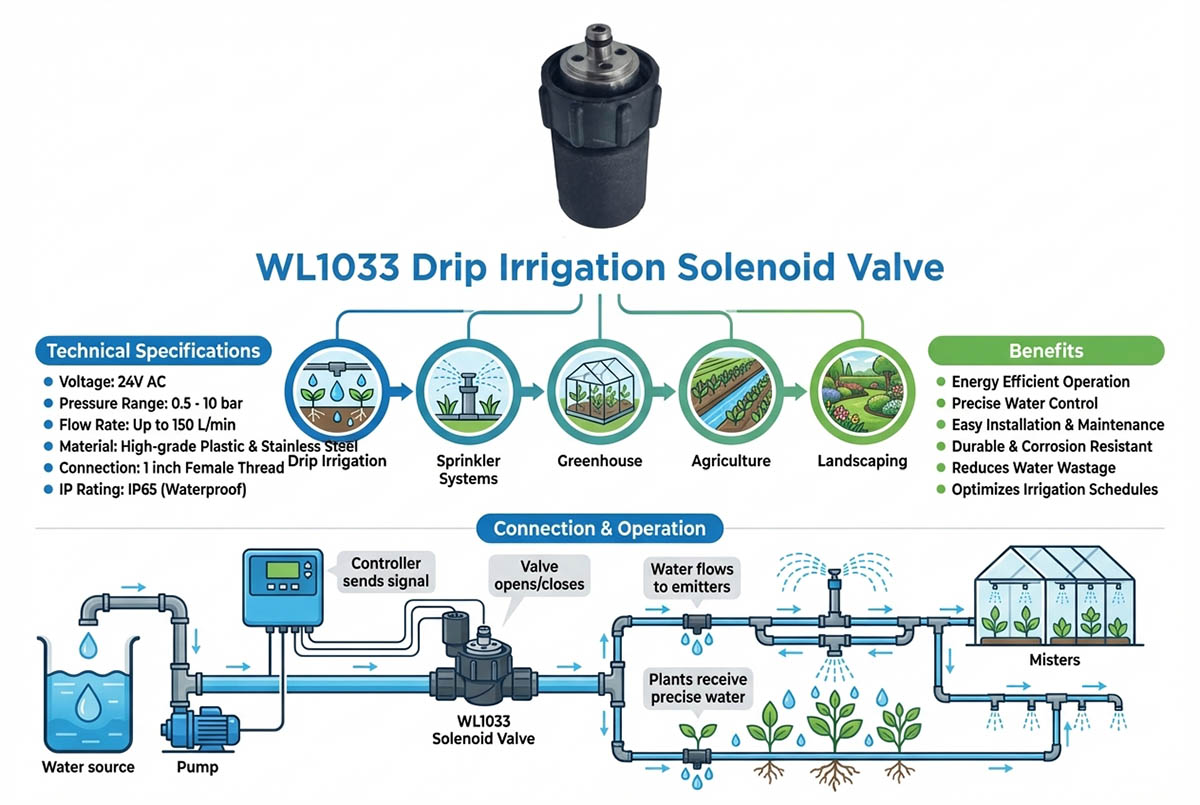
The drip irrigation solenoid valve is an electronic valve used to control water distribution in the drip irrigation system. Once the electromagnetic coil becomes active, the valve opens or closes. These devices play a pivotal role in controlled irrigation systems, allowing farmers to adjust the quantity of irrigation water in accordance with the plants’ needs. They can operate on either AC or DC power sources and are frequently coupled with timers, sensors, or other controllers. Drip irrigation solenoid valves significantly reduce water consumption, increase irrigation efficiency, and ensure uniform plant development through targeted water delivery to root zones.

Automated irrigation systems can implement drip irrigation solenoid valves to provide efficient water flow regulation. These products feature rapid response times, low power consumption, and durable construction. You may find them in a variety of voltages, including DC and AC, and use them with numerous controllers and advanced irrigation systems. Small size makes it easy to install in tight spots, and strong materials help resist rust and damage from outside, ensuring they work well even in tough conditions. Drip irrigation solenoid valves minimize water loss and optimize operations by providing precise water flow control. Additionally, they enable programmable operation, which makes them an ideal choice for modern agriculture, landscaping, and greenhouse irrigation.

WL1033 An Overview of the Drip Irrigation Solenoid Valve

A drip irrigation solenoid valve is a vital component of automated irrigation systems as it provides quick and accurate water flow control. This product leverages electromagnetic forces to control water flow, facilitating scheduling of irrigation in line with the plants’ needs. Agriculture, landscaping, and greenhouse professionals often use these valves to conserve water. They differ in size, material, and voltage options and can serve a variety of purposes. Robust construction ensures long-term operation, even under challenging outdoor conditions. Drip irrigation solenoid valves promote agricultural efficiency and reduce water consumption while facilitating sustainable farming techniques.

WL1033 Drip Irrigation Solenoid Valve Video

WL1033 Drip Irrigation Solenoid Valve Detailed Display

WL1033 Drip Irrigation Solenoid Valve Technical Datasheet

Product name: Drip Irrigation Solenoid Valve
Mode: WL1033
Rated Voltage (V): DC12v
type Normally closed type
Response Time (ms) on ≤ 0.15
off ≤ 0.5
Working Pressure (Mpa) 0.02-0.5
Flow Characters 0.05 Mpa ≥ 3 L/min
0.1MPa ≥ 5L/min
0.8MPa ≥ 7L/ min
Medium Temperature(℃): 1-75
Media: Water
Resistance (Ω): 27Ω±0.5
Lifespan (times): ≥ 500 000
Application: vegetable irrigation valve, etc.
Material: Stainless Threads, POM, and Brass Solenoid

WL1033 Drip Irrigation Solenoid Valve Application

WL1033 Drip Irritagion Solenoid Valve Application

Many enterprises requiring precise water regulation resort to using solenoid valves for drip irrigation. They play an integral role in agriculture since they facilitate targeted water delivery to plant roots, increasing agricultural yields while minimizing water wastage. Farmers use them in large-scale irrigation systems to create scheduled irrigation programs and ensure water distribution throughout the farmland.

Drip irrigation solenoid valves are crucial in greenhouse environments, as they maintain optimal moisture levels required for fragile plant cultivation. These components work in tandem with climate control systems to provide appropriate irrigation based on temperature, humidity, and soil conditions.

Moreover, the drip irrigation solenoid valve proves invaluable in landscaping applications since it is used in gardens, parks, and residential irrigation programs. Thanks to their programmable operation, they allow for creating automated irrigation programs and eliminating manual labor.

Finally, drip irrigation solenoid valves are widely applied in nurseries, orchards, and vertical farming systems. They represent an indispensable element of modern precision agriculture, offering extensive compatibility with timers and advanced controllers. In addition, these valves promote water conservation, thus making them suitable for areas with water scarcity. Drip irrigation solenoid valves play a pivotal role in efficient and eco-friendly irrigation management.

How a solenoid valve for drip irrigation works

The electromagnetic principle drives the functionality of a drip irrigation solenoid valve:

1. Power Supply On

Once you activate the power source, the electrical current flows into the solenoid coil.

2. Magnetic Field Generation

Activation of the coil generates a magnetic field.

3. Plunger Movement

Under the influence of magnetic energy, the armature (plunger) moves up.

4. Valve Operation

This motion opens the valve and allows water to pass through the irrigation system.

5. Power Supply Off (Valve Closure)

Once the power supply is cut off, a spring returns the plunger to its initial position, thus closing the valve.

This simple yet efficient device enables fast and reliable automated water flow regulation.


Advantages and Disadvantages of Drip Irrigation Solenoid Solenoid

Drip Irrigation Solenoid Valve Advantage and Disadvantage

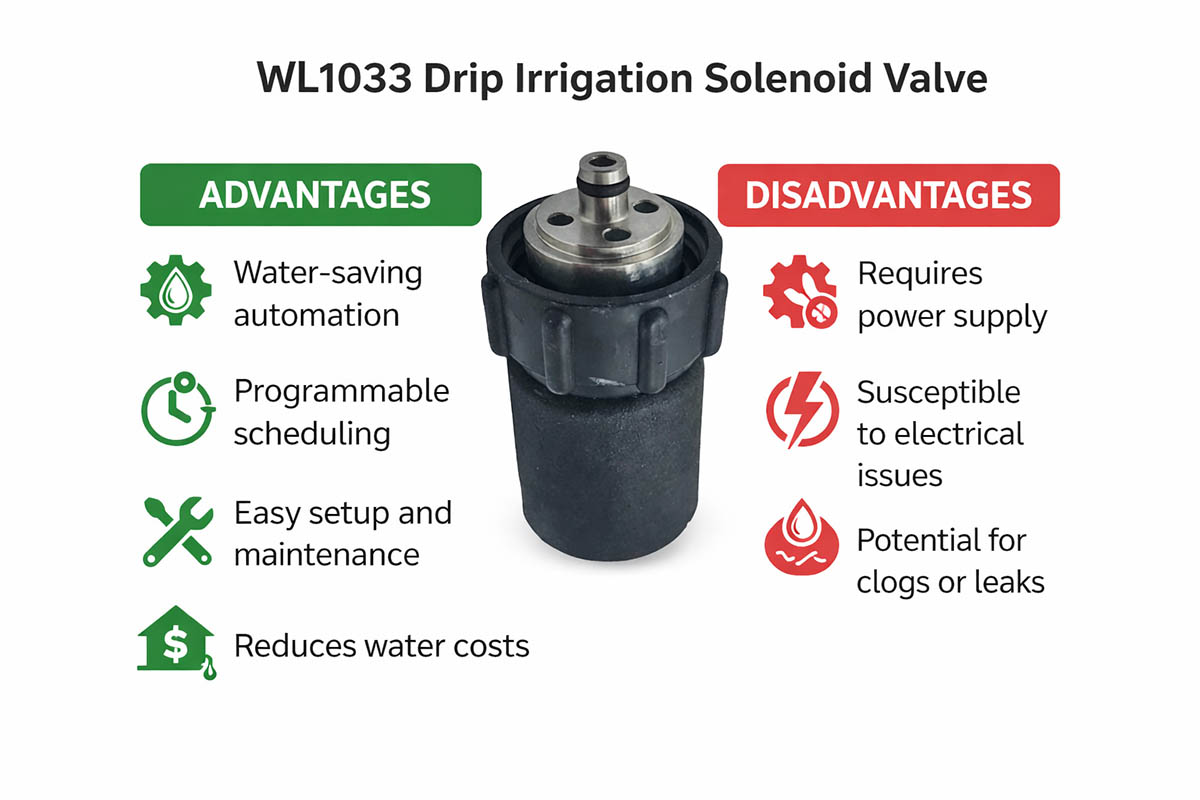
Advantages of using a solenoid valve for drip irrigation
1. Full Control of Water
Allows for precise control of the flow of water on and off
Great for irrigation systems that work in zones
Helps water get straight to the roots of plants
2. Ability to automate
Works well with controllers and timers
Works with IoT and sensor-based smart irrigation systems
Reduces a lot of work that needs to be done by hand
3. Efficient Use of Water
Not as much water is wasted as with manual valves.
Works well with drip systems that don’t use a lot of water
Important for farming that uses less water
4. Fast response time
Electromagnetic actuation opens and closes quickly.
Makes the timing of watering more precise
5. Small and simple to put together
The small size fits well into plans for irrigation.
Easy to connect wiring and plumbing
6. Doesn’t use much power
Works best with designs that have DC or latching solenoids
Great for solar-powered irrigation systems

❌ Problems with the Drip Irrigation Solenoid Valve
1. Sensitive to the quality of the water
Rough, dirty, or trashy.


Drip Irrigation Solenoid Valve Troubleshooting Guide

1. The valve won’t open.
Possible reasons and how to fix them:
No power source
Check the controller, wiring, and voltage with a multimeter.
Bad coil in the solenoid
Check the resistance and change it if it is broken.
Blocked diaphragm or inlet
Clean the inside parts and flush the system.
There isn’t enough water pressure.
Check to see if the minimum operating pressure is met.
2. The valve won’t shut
Possible Causes and Solutions:
Debris stuck in the diaphragm
Take the valve chamber apart and clean it.
A broken diaphragm
Install a new rubber diaphragm.
There was no manual override.
Tighten the solenoid or close the bleed screw.
Signal for power all the time
Check the settings on the irrigation controller.
3. Possible Causes and Fixes for Water Leaks:
Worn-out seals or O-rings
Change the parts that seal
Fittings that don’t fit snugly
Tighten up the threaded connections.
The valve’s body is cracked.
Replace the entire valve
4. Flow that isn’t strong or steady Possible reasons and fixes:
Partially blocked (filter or valve)
The clean filter and valve go into this.
Changes in pressure
If you need one, put in a pressure regulator.
Valve size is wrong
Make sure the flow rate is set right.
5. The valve makes a buzzing or chattering sound.
Possible Reasons and Ways to Fix Them:
AC voltage that isn’t stable
Check that the power supply is stable.
Coil or parts that are loose inside
Make parts tighter
Things stuck in the valve
Make sure to clean well.
6. The coil gets too hot. Possible reasons and fixes:
The voltage was wrong.
The coil rating should be the same, like 24VAC / 12VDC.
Duty cycle that is higher than the rating
Look at the duty cycle’s specifications.
Short circuit in the coil
Replace the coil in the solenoid
7. Slow response time
Possible Causes and Solutions:
The pilot hole is blocked.
Clean out small passages inside
Low pressure or flow
Increase the system’s pressure
Parts inside that are worn out
Change the spring or diaphragm. 🛠️ A quick checklist for diagnosing

✔ Look at the voltage at the solenoid’s terminals ✔ When the solenoid is turned on, listen for a “click.” ✔ Look for leaks or trash ✔ Look at how the upstream filter is doing ✔ Check the settings on the controller ✔ Check the coil’s resistance

Advice for Professionals
To keep things from getting stuck, put a filter (≥120 mesh) upstream.
Flush the drip lines often.
Use pressure regulators to keep things going smoothly.
Have extra diaphragm kits and coils on hand so you can fix things quickly.


FAQs Of Drip Irrigation Solenoid Valve

1. What is the role of a drip irrigation solenoid valve?

A drip irrigation solenoid valve system allows controlling the volume of the water supplied by the system automatically. Thus, it helps regulate how fast plants obtain the needed amount of water at their roots.

2. What types of voltages are used in solenoid valves for drip irrigation?

Usually, a solenoid valve works with AC voltages such as 24V AC. However, battery or solar-powered systems require the usage of 12V DC or 24V DC solenoid valves.

3. Is it possible to use a solenoid valve together with a timer or other irrigators' controllers?

Yes, a solenoid valve can be used with irrigation controllers. They allow automating the irrigation process and regulating it from a distance.

4. Why won't my solenoid valve open?

There may be no power supply available, broken wiring, a burned-out coil, or debris stuck in the valve. Inspecting and cleaning the valve usually resolves the issue.

5. Why does my valve keep leaking or fails to close?

It might happen due to a damaged diaphragm, worn seals, or any kind of contamination. Normally, cleaning and replacing some parts will help solve the issue.

6. How long does a drip irrigation solenoid valve work for?

On average, a properly maintained valve can serve for 3–5 years or even more if the water it operates in is clean. Nevertheless, the durability of the valve mostly depends on its usage frequency and weather conditions.

7. Are solenoid valves compatible with hard or dirty water?

They are quite tolerant concerning small pieces of dirt and contaminants or minerals; however, an excessive number of these can create obstructions. It is highly recommended to place a filtration system before installing a valve.

8. What factors should be considered when choosing the right solenoid valve?

Pipe diameter, voltage type and capacity, flow rate, maximum operating pressure, materials, and other characteristics of the valve need to be taken into account.

How to Choose a Drip Irrigation Solenoid Valve

Selecting an appropriate drip irrigation solenoid valve requires understanding its requirements. The two major factors you should consider include the flow rate and the pressure. Calculate the water volume required by your drip emitters per zone and select the corresponding valve size. Excessive narrowing of the valve can inhibit water flow, whereas oversized valves make irrigation control more complicated.

The second step involves selecting compatible pipe and valve sizes. To maintain smooth water flow and prevent pressure loss, the valve’s inlet and outlet diameters should match those of your pipeline. As a rule of thumb, the valve’s size should equal or slightly exceed the diameter of your piping.

Furthermore, consider the voltage and the type of power supply. While most irrigation systems operate on 24V AC solenoid valves, battery or solar-powered solutions are better suited to DC-based valves, including 12V or 24V products. Make sure that your irrigation controller is compatible with it.

In addition, pay close attention to the pressure rating of the valve. The valve should tolerate the maximum pressure within the system. Opting for a valve with a higher pressure rating compared to the operating pressure level would guarantee safety and longevity under changing conditions.

Material selection is equally crucial. For outdoor and farm use, consider materials that resist corrosion, such as brass, stainless steel, and high-quality plastic (PVC). These compounds extend product life in a variety of water and soil compositions.

Moreover, inspect the water quality. Purchase a solenoid valve that tolerates impurities or minerals in your water, or incorporate filters upstream of your irrigation system to minimize the risk of blockage and subsequent valve damage.

Last but not least, determine the type of programming and control options you want. Generally, drip irrigation entails the use of normally closed valves since they remain shut when de-energized, minimizing water wastage.

To maximize irrigation performance, you need to find an appropriate valve by balancing flow, pressure, compatibility, material, and environmental conditions.

Get A Free Quote Now

Contact Form

Related Products

Related News

Scroll to Top

Get A Free Quote Now !

Contact Form
If you have any questions, please do not hesitate to contact us.
Weilong Solenoid Company Culture
