Electric Solenoid Pump 220V AC
220V Solenoid Pump - Industrial Grade
Industrial Solenoid Pump 220V AC Buying guide
High Flow 220V Solenoid Pump Solution
220V Solenoid Water Pump Industrial Use
Tips for select the Dosing Solenoid Pump 220V
Electric Solenoid Pump 220V AC
220V Solenoid Pump - Industrial Grade
Industrial Solenoid Pump 220V AC Buying guide
High Flow 220V Solenoid Pump Solution
220V Solenoid Water Pump Industrial Use
Tips for select the Dosing Solenoid Pump 220V

WL55 DCB Solenoid Pump 220V Buying Guide

A Solenoid Pump 220V is a pump that works with electricity and uses a magnetic coil (solenoid) to move a plunger or diaphragm, which makes the fluid move. These pumps need a standard 220-volt AC power supply to work. They are very important for applications that need precise, intermittent, or continuous fluid dosing. Solenoid pumps are better than centrifugal pumps because they are more accurate and can start themselves.

Precision Dosing: Provides flow rates that are very accurate and can be repeated, making it perfect for metering. Self-Priming: Able to pull fluid from a level below the pump without help from outside sources.

Dry-Run is not Capable: Unlike many centrifugal pumps, this one can not run without fluid for short periods of time without breaking. Compact Design: The small size makes it easy to fit into tight spaces in machinery. High Pressure: Even though it is small, it can create a lot of outlet pressure. Corrosion Resistance: Parts that get wet can be made of engineering plastics like PTFE and PVDF to handle harsh chemicals. Low Power Consumption: An efficient electromagnetic design uses less energy when in use.

Long Life: Fewer moving parts mean less wear and a longer life for the machine.


WL55 DCB Solenoid Pump 220V Product Overview

This range of 220V solenoid pumps is perfect for the safe and accurate handling of fluids in business and industrial applications. These pumps are accurate and reliable and feature a strong electromagnetic coil that operates a diaphragm or piston. This means that the pumps offer precise amounts and pressures in a very compact package. They are made of the very best in elastomers and engineering plastics that will not rust and will handle a wide range of things, including water, mild chemicals, and light oils. These pumps have different rates of flow and pressures and are easy to integrate into automated systems. They will function for a very long time without any maintenance, even in harsh environments 24/7.

WL55 DCB Solenoid Pump 220V Video

WL55 DCB Solenoid Pump 220V Product Detailed Description

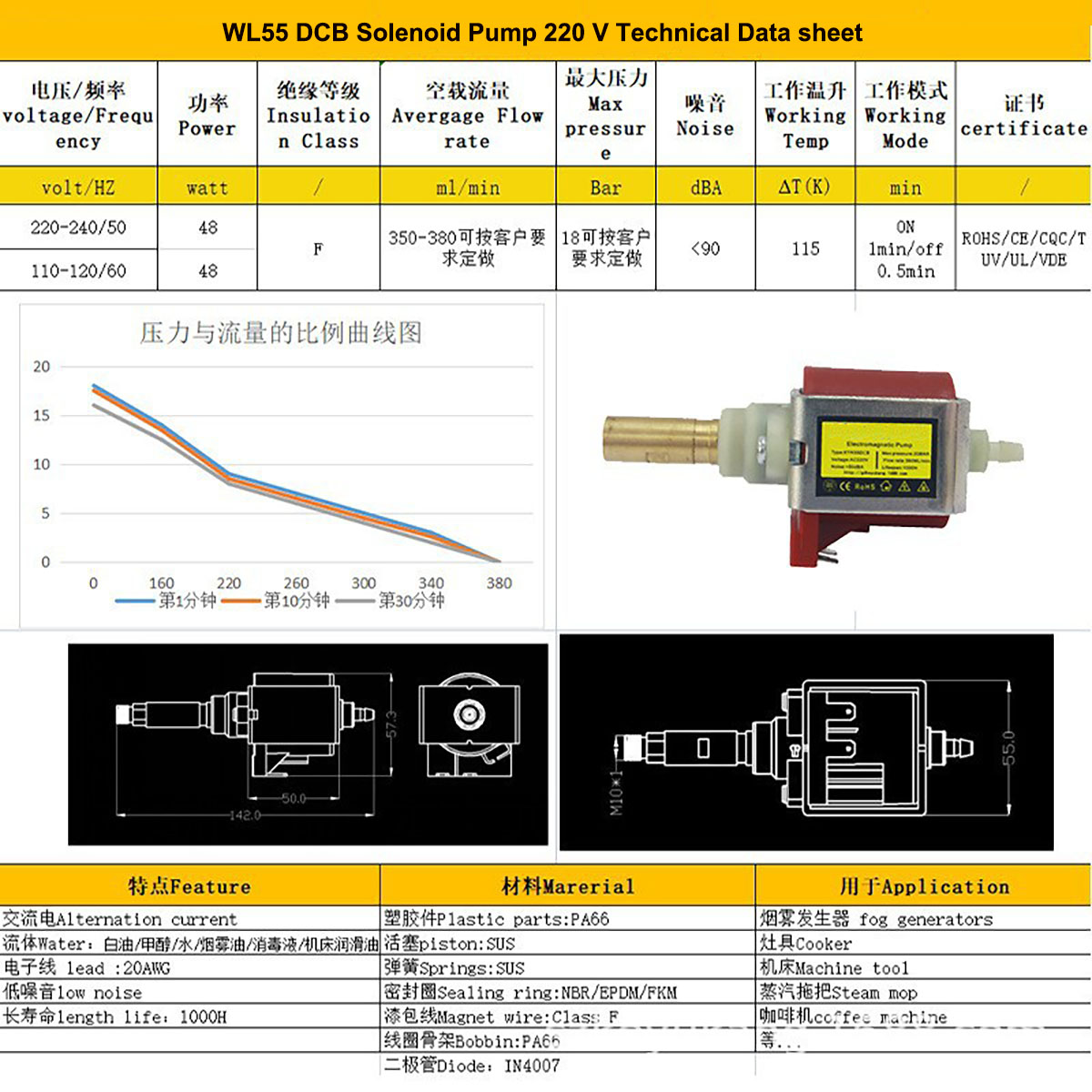
WL55DCB Solenoid Pump 220V Datasheet

WL55 DCB Solenoid Pump 220 Datasheet

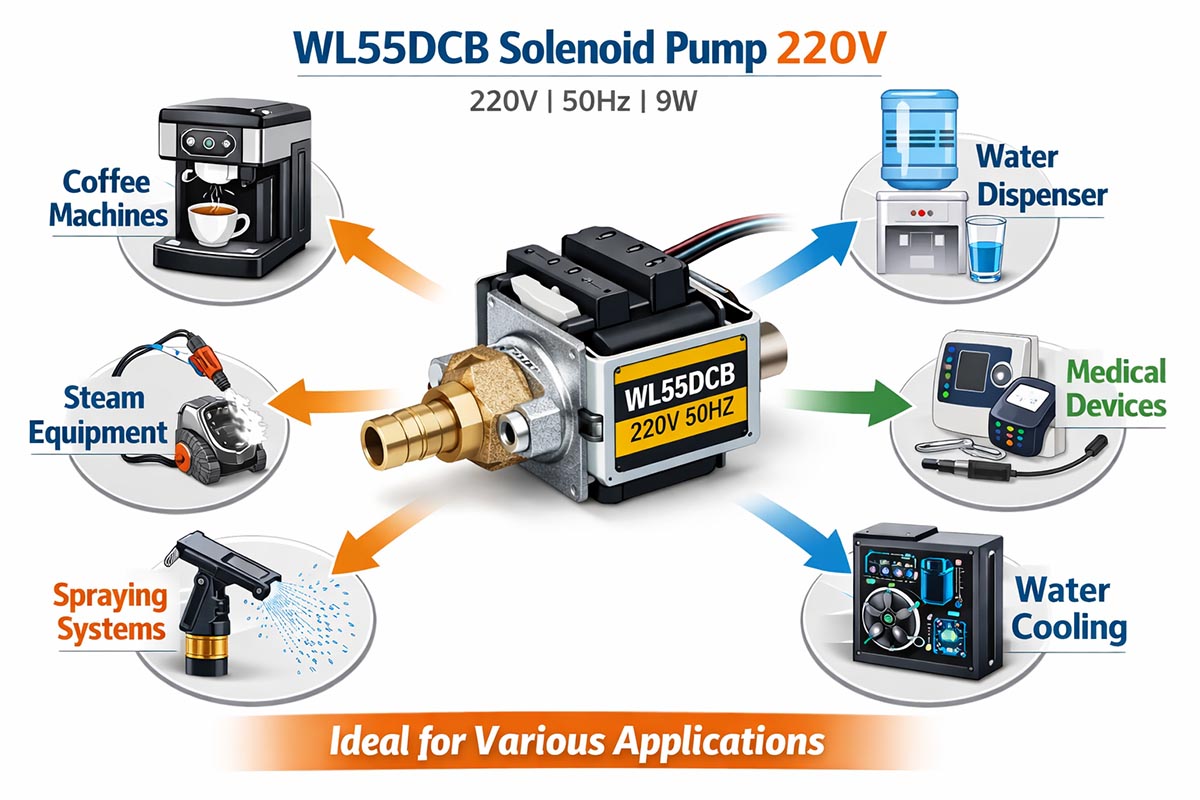
WL55 DCB Solenoid Pump 220V Application

WL55 DCB Solenoid Pump 220V Industrail Application


The WL55DCB Solenoid Pump 220V Application

Because it has a precise control system and a strong power supply, the 220V Solenoid Pump can be used in many different fields.

Water Treatment: Adding the right amount of chlorine, pH adjusters (acids/bases), and flocculants to municipal or wastewater systems.

Agricultural and Hydroponics: Putting fertilizers and nutrients into irrigation lines to make sure plants grow as well as possible.

Industrial Manufacturing: Adding fragrances, colorants, or additives to production lines; moving coolants or lubricants in CNC machines.

Medical and Laboratory: Used in analytical devices, dialysis machines, and fluid handling systems that need to have clean and accurate flow.

Commercial Equipment: This includes vending machines that mix concentrates, commercial coffee machines that inject water exactly, and car wash soap dispensers.

HVAC systems: To keep them working well, biocides and anti-corrosion chemicals are added to cooling towers and boiler systems.

Printing Industry: Moving inks and glues in fast printing presses.

Automotive: Moving small amounts of oil, fuel, or urea (DEF) in testing equipment or at service stations.


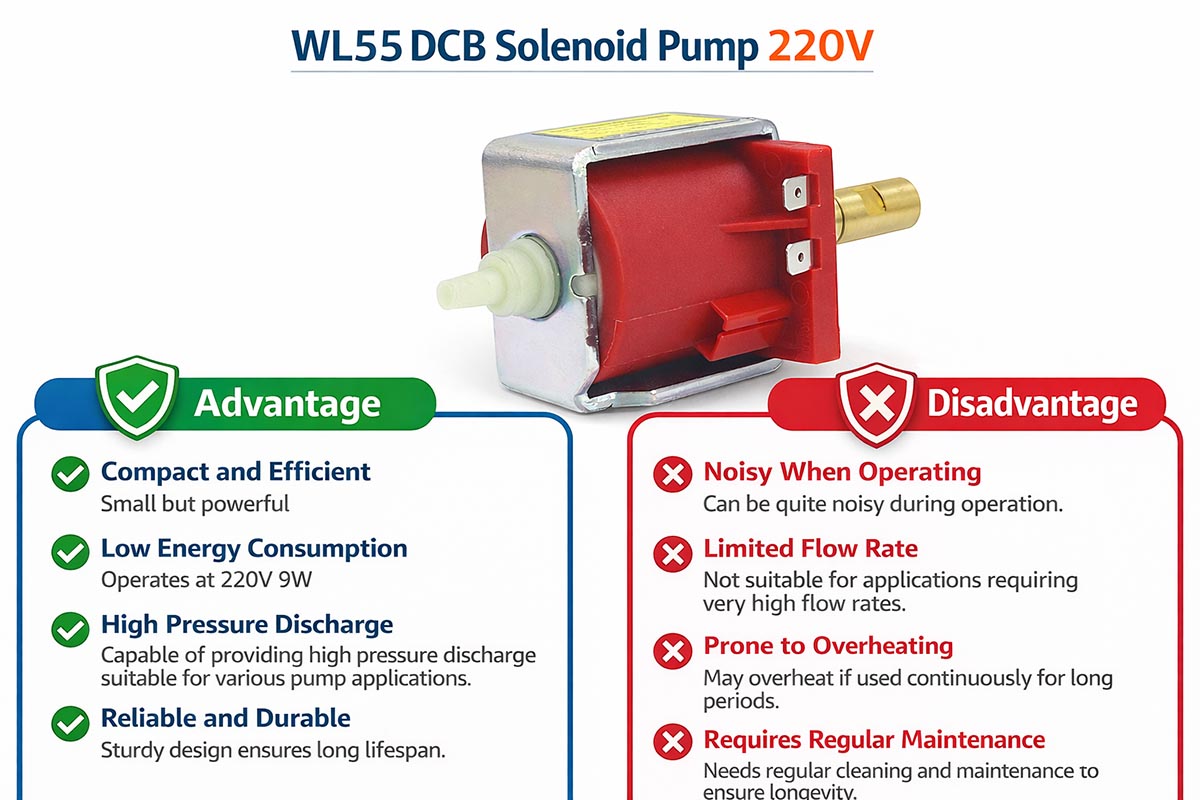
Advantages and Disadvantages of WL55 DCB Solenoids Pump 220V

WL55 DCB Solenoid Pump Advantages and Disadvantages

Pros and Cons of the Solenoid Pump 220V

Solenoid Pump 220V Pros:

Electrical Simplicity: It runs directly on mains power (220V), so you don’t need a separate transformer or DC power supply, which makes installation easier.

High Force: 220V AC coils usually have a stronger magnetic pull than low-voltage DC coils. This means they can handle more viscous fluids and produce higher pressure outputs.

Precision: Perfect for batch dosing and metering when exact amounts are very important.

Reliability: These pumps have a simple design and are built to last, so they need very little maintenance.

Compared to motor-driven pumps, Compact Power pumps deliver high pressure in a small package.

Drawbacks of Solenoid Pump 220V

Pulsed Flow: The output is naturally pulsed, not a smooth, steady stream. It can be helpful for mixing, but some uses may need a pulsation dampener.

Noise and Vibration: The plunger’s fast back-and-forth motion can make a hum and vibration that can be heard, which may not be good in quiet places.

Duty Cycle Limitations: Many solenoid pumps are only meant to work for short periods of time (like 25% or 50% of the time). If they are used continuously without the right design specifications, they may overheat.

Flow Rate Limitations: These pumps are best for low to medium flow rates. For very high volume transfers, a centrifugal or gear pump is better.

Sensitivity to Particles: Dirty fluids can clog the small internal clearances and check valves, so pre-filtration is often suggested.

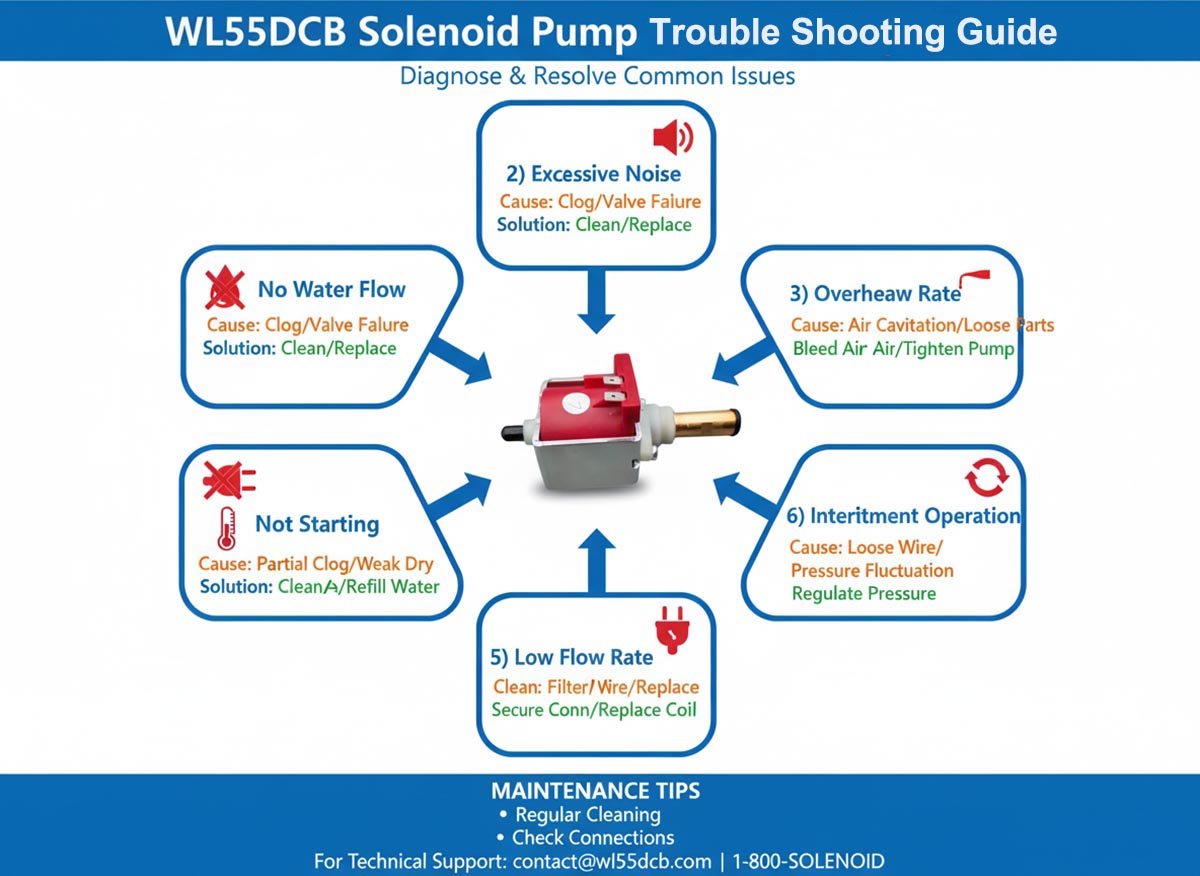
Fixing the Solenoid Pump 220V Problem

The pump is unable to start or is only humming.

Possible cause: No power, blown fuse, or a burnt-out coil.

The solution is to check the power and voltage. Use a multimeter to check the resistance of the coil. If it is infinite, it is broken. If it is broken, change it if you want.

The pump is humming but unable to pump fluid:

Possible cause: The plunger is stuck, either because of dirt or rust, or there is an air lock in the system.

The solution is to take the plunger and chamber apart and clean them. Check for any drops in voltage. Ensure that the inlet lines are sealed and ready for use.

The flow rate is low:

Possible cause: The filter at the inlet is clogged, the valves are worn out, or the plunger is stuck but only partially.

Solution: Ensure that the filter at the inlet is cleaned or changed. Ensure that the check valves are clear of dirt and damage. Ensure that the valves are cleaned or changed if damaged.

The pump is leaking from the head:

Possible cause: The O-ring is not working, the bolts are loose, or the diaphragm is worn out or broken.

Solution: Ensure that the bolts on the head are tightened properly. If it is still leaking, change the O-ring and diaphragm seals.

The pump is cycling but is unable to suck:

Possible cause: Air leak in the suction line, or the check valves are installed backwards or stuck open.

Solution: Ensure that all the fittings are tightened properly. Ensure that the valves are clean and installed correctly in the flow direction.

The pump is too hot:

Cause: Too much duty cycle, too much ambient temperature, and wrong voltage.

Answer: Allow the pump to cool down. Either decrease the amount of time it takes to get there or increase the amount of time it takes to get there. Also, make sure there is sufficient air flow.

WL55 DCB Solenoid Pump Trouble Shooing Guide


FAQs Of WL55 DCB Solenoid Pump 200V

1 Q: Is it possible for a 220V solenoid pump to work with 110V?

No. In order to have a proper magnetic field, a 220V solenoid pump must have 220V electricity flowing into it at all times. If it does not have this amount of electricity, it will not work well or at all. On the other hand, a 110V pump will burn out immediately if it is hooked up to 220V.


2 Q: Does a solenoid pump start itself?

A: Yes, most 220V solenoid pumps will start themselves and will be able to lift water straight up several meters.


3 Q: Is it possible for it to run dry?

A: Many solenoid pumps will run dry without any trouble, especially diaphragm-type pumps. However, a 220V solenoid pump like this is not allowed to dry run without any liquid or water. If it does not have this lubrication, it will stop working in a hurry.

4 Q: What do I need to do to change the flow rate?

A: You may be able to change the flow rate by adjusting the stroke length or by changing the pulse frequency.

5 Q: How does a solenoid pump differ from a motor pump?

A: A solenoid pump moves the piston back and forth using an electromagnetic coil, which pulses the fluid. A motor pump rotates the impeller or gear using a rotating electric motor, which produces a constant flow.


6 Q: What kinds of liquids can I pump?

A: It depends on the materials that are wettable. Standard pumps are for water use. Pumps with a PVDF body and Viton seals are for weak acids and chemicals. Be sure to check the chart on the ways that chemicals interact with one another.


7 Q: What makes the pump hot?

A: The resistance of the coil makes it normal for the pump to be hot. However, too much heat means the pump is running too long, the voltage is too high, or the outside temperature is too high.


8 Q: What does the term "Duty Cycle" mean?

A: It is the ratio of the time the device is on compared to the total time the device is running. For example, a duty cycle of 25% means the pump needs to be on for 15 seconds and then turn off for 45 seconds so the pump doesn’t get too hot.

How to Choose the Best Solenoid Pump 220V ?

To ensure the 220V solenoid pump performs well and has a long lifespan, it is very important to choose the right one. Here is how to go about it:

Know the Fluid: Before anything else, it is important to know the kind of fluid that is to be pumped. What is the solvent? What is the acid? What is the oil? What is the water? What kind of pump is most appropriate for the kind of fluid involved? What kind of wetted parts (body, seals, and valves) will function perfectly with the involved fluid?

What is the Power? What is the main power? What is the voltage? What is the frequency? The main power should be 220V AC. The frequency should be either 50Hz or 60Hz. The pump should be exactly like this. No more, no less. This is the standard and the only standard. Don’t even think of anything else. Just this and only this. The pump should not be more and should not be less. Just exactly the same. No variations. No exceptions. Just the standard. This is the only standard. Don’t even think of anything else. Just the standard. This is the standard. Don’t even think of anything else. Just the standard. This is the standard. Don’t even think of anything else. Just the standard. This is the standard. Don’t even think of anything else. Just the standard. This is the standard. Don’t even think of anything else. Just the standard. This is the standard. Don’t even think of anything else. Just the standard. This is the standard. Don’t even think of anything else. Just the standard. This is the standard. Don’t even think of anything else. Just the standard. This is the standard. Don’t even think of anything else. Just the standard. This is the standard. Don’t even think of anything else. Just the standard. This is the standard. Don’t even think of anything else. Just the standard. This is the standard. Don’t even think of anything else. Just

Connection Size: Verify that the inlet and outlet ports of the pump are compatible with your existing tubing or piping system (for example, 1/4″ NPT or 3/8″ Barb).

Check Certifications: Verify that the pump has the appropriate certification (CE, UL, etc.) for selling the pump to specific industries or for export.


Get A Free Quote Now

Contact Form

Related Products

Related News

Scroll to Top

Get A Free Quote Now !

Contact Form
If you have any questions, please do not hesitate to contact us.
Weilong Solenoid Company Culture
