24V Tubular Solenoid for Automotive Actuation Systems
24V Tubular Solenoid for Smart Medical Device System
24V Tubular Solenoid for Locking and Access Control Solution
24V Tubular Solenoid for Vending Machine Mechanisms solution
24V Tubular Solenoid for Automotive Actuation Systems
24V Tubular Solenoid for Robotics and Motion Control Solution
24V Tubular Solenoid for Automotive Actuation Systems
24V Tubular Solenoid for Smart Medical Device System
24V Tubular Solenoid for Locking and Access Control Solution
24V Tubular Solenoid for Vending Machine Mechanisms solution
24V Tubular Solenoid for Automotive Actuation Systems
24V Tubular Solenoid for Robotics and Motion Control Solution

WL2540 24V Tubular Solenoid for Smart Medical Device Solutions

A 24V tubular solenoid is a compact linear electromagnetic actuator that provides reliable mechanical movement in automated equipment. It is powered by a 24V DC power source and generates magnetic force that drives an internal plunger in a precise linear movement. The tubular design is efficient in installation space terms and allows designers to tailor key parameters such as stroke, force, mounting dimensions, shaft configuration, connector, and duty cycle.

A 24V tubular solenoid can be designed to perform pulling, pushing, or bi-directional mechanical actuation, depending on the requirements of the application. Typical applications include medical devices, smart locks, vending machines, automation machinery, robotics, dispensing equipment, appliances, and industrial control equipment.

For OEM projects, the selection of the solenoid should be made considering the required force, stroke, frequency, duty cycle, temperature, installation space, and lifetime.

Compact 24V Tubular Solenoid Product Overview

A 24V tubular solenoid is a cylindrical electromagnetic actuator that converts 24V DC electrical energy into controlled linear motion. The compact tubular design makes it suitable for installation in equipment where flexible installation of the conventional rectangular solenoids is impossible. This product can be tailored for push or pull operation and designed to suit your requirements for force, stroke, mounting dimensions, shaft configuration, and return method. The standard design includes a metal casing, coil assembly, magnetic plunger, and optional spring. Electromagnetic circuits can be optimized for the required force, response, and duty cycle depending on the application. Suitable for automation machinery, medical devices, locking systems, vending equipment, and OEM mechanisms.

How does a 24V tubular solenoid work?

The principle of operation is the electromagnetic force.

Step 1—Power Supply 24V DC

When the control circuit powers the solenoid coil by 24V DC, electric current passes through the copper winding.

Step 2 — Generation of Magnetic Field

A magnetic field is generated in the tubular magnetic circuit by the energized coil.

Step 3 — Movement of the Plunger

The magnetic field attracts the ferromagnetic plunger into the ofa with high magnetic flux. The plunger moves linearly inside the tubular housing.

Step 4 – Mechanical Movement Is Generated

This movement is transferred to the customer’s mechanism via the plunger or shaft.

Step 5—Return

Depending on design, the plunger returns back due to a return spring, an external spring, gravity, or any other mechanical force.

Working Sequence Basics

24V DC → Coil Energized → Magnetic Field → Plunger Movement → Mechanical Movement

For OEM applications, the magnetic circuit should be optimized for the required force vs. stroke curve instead of specifying only maximum force.

The Best Features of 24V Tubular Solenoid

This 24V tubular solenoid provides controlled linear actuation in a compact design. It features 24V DC operation, a cylindrical design, efficient magnetic force generation, and a variety of mounting options.

Depending on application, it can be designed as a push, pull, or push-pull actuator; OEM solenoids can be tailored in stroke length, output force, shaft length and diameter, spring characteristics, connector placement, housing size, and electrical parameters. Tubular design is especially effective when the installation space is limited. High-quality products provide repeatable actuation, stable electrical performance, and long service life. Applications include industrial automation, medical equipment, locks, vending, robotics, and intelligent machinery.

Compact 24V Tubular Solenoid Product Video

Compact 24V Tubular Solenoid Product Detailed Display

Compact 24V Tubular Solenoid Technical Datasheet

Brand Weilong Technology Model Number WL 2540
Rated Voltage (V) DC 12 or 24 V Rated Power (W) 10–15 W
Work Model 100,000 Lifespan Cycles Push Pull Force (N) 1000 Gf
Stroke (mm) 3-5 MM Reset Time(s) 1 S 3S Off


Service Life 300 Thousand Times Certification CE, ROHS, ISO9001,
Material Carbon Steel Housing with Zinc-Plated Coating Lead Wire Length (mm) 200
Install Style both sides with three mounted screw holes for easy setup Tolerance of Dimension ± 0.1 MM
Water-proof None Insulation Class F. Cel. 150 Degree
Hi-Pot Test AC 600V 50/60Hz 1 s Non-excitation Holding Force 0
Working Temperature -10°C-100°C Duty Cycle 1-100%
Thread Depth (mm) / Payment Term TT, or LC at Sight
Sample Order Yes. Warranty 1 Year
MOQ 500 pcs Supply Ability 5000 pcs per week
Delivery Time 30 Days Port of Loading Shenzhen

Tubular push solenoid versus tubular pull

solenoid

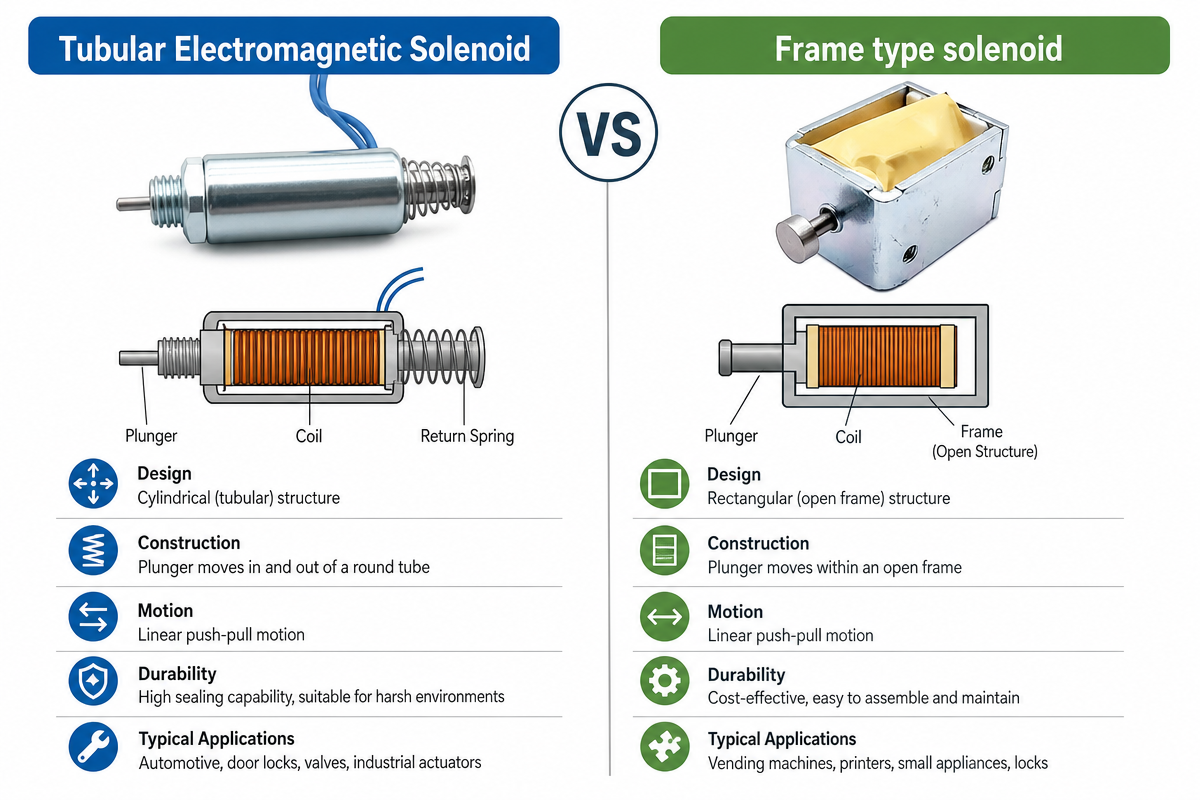
Tubular vs Frame Type Solenoid Comparison Infographic (1)

The only difference is that the useful mechanical output while the solenoid is energized occurs in the opposite direction.

Feature Tubular Push Solenoid Tubular Pull Solenoid
Main Motion The plunger moves outward. The plunger moves inward.
Typical Action Pushes mechanism Pulls mechanism
Common Use Release, pressing, switching Locking, pulling, latching
Return Method Often spring return Often spring return
Installation Behind the mechanism In front/around mechanism
Typical Application Push buttons, valves, switches Locks, latches, clamps
Design Priority Outward force Inward pull force

Push-Type Tubular Solenoids

The tubular push solenoid is configured in a way that energization of the coil produces useful outward movement of the plunger or shaft. It is useful for those applications where the solenoid has to push something.

Typical applications are

Mechanical switch

Release Mechanisms.

Distributed systems

Valves

Automatic pressing mechanisms

Tubular Pull Solenoids

The tubular pull solenoid is provided, which is intended to produce useful inward movement on energizing. It is usually used in applications where the solenoid has to pull something.

Typical applications include:

Electronic Lock

Locking mechanisms

Clamps…

Security systems

Release mechanisms

Which to choose?

Choose depending on the required direction of motion, force at the required stroke, return mechanism and available space for installation.

The most useful specifications for OEM development are not simply “24V push” or “24V pull.” Provide the manufacturer the following data:

24V DC + required force + stroke + duty cycle + operating frequency + installation size + return mechanism + lifetime.

That data allows the engineering team to recommend or design the proper tubular solenoid configuration.


Com[act 24V Tubular Solenoid Industrial Application

24V Tubular Solenoid Industrial Application Guide

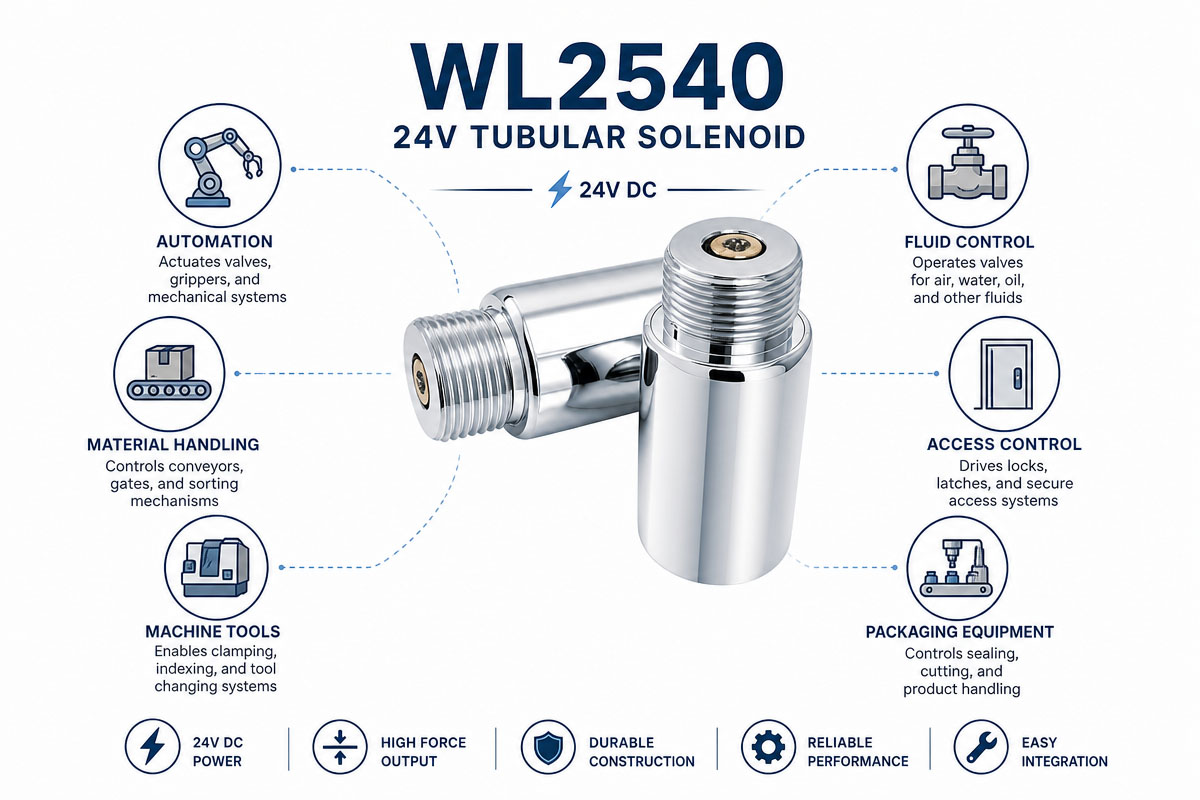
A 24V tubular solenoid is widely used when electrical control is necessary to generate compact and repeatable linear mechanical movement. In industrial automation they can operate locks, clamps, mechanical switches, gates, dispensers, and machine control parts.Their cylindrical design makes them especially effective in equipment with limited installation space..

Intelligent medical devices employ 24V tubular solenoids for positioning, locking, opening, dispensing, and controlled movements. Designers can select customized force, stroke, and duty cycle characteristics to suit the requirements of the equipment.

In access control and security equipment, tubular solenoids can be used for controlled locking or unlocking movement. They are also used in vending machines, kiosks, POS equipment, and automatic dispensing systems, where reliable mechanical actuation is required.

Other applications include robotics, laboratory equipment, HVAC, packaging machinery, printing equipment, appliances, elevators, agricultural equipment, and OEM machinery.

For each application, designers should estimate required force, stroke, operating voltage, duty cycle, response time, temperature rise, installation dimensions, and lifetime. Using an appropriately selected 24V tubular solenoid, it is possible to get a compact and economical solution for automated linear motion.

Why 24V Tubular Solenoids Are the Preferred Option for Smart Medical Device Automation Solutions

24V tubular solenoids are highly popular in automation solutions for modern medical devices because of their small size, linear movement, which is controllable, and ease of integration with electrical components.

Medical equipment increasingly requires automation in order to implement locking, positioning, dispensing, opening, closing, switching, and controlled mechanical movement. This movement is produced by the tubular solenoid without a complicated motor and gear assembly.

Here are the main reasons:

Compactness of Integration

Medical equipment usually has limited room inside. Tubular design is compatible with narrow mechanical structure.

Electrical Control

A 24V DC power supply is easy to control with relays, MOSFETs, PLC output, or a dedicated drive circuitry.

Repeatable Linear Motion

The plunger produces repeatable mechanical motion for actuation of a discrete mechanism.

OEM Customizable

Custom force, stroke, mounting dimensions, connector configuration, and duty cycle may be required in medical equipment applications.

Low Mechanical Complexity

A solenoid produces direct linear actuation with fewer mechanical components in comparison with a motor-driven mechanism.

Automation Compatibility

The solenoid can be actuated by a controller according to sensors, software commands, or a predefined operating sequence.

However, voltage alone is not enough criteria for selection of a medical device solenoid. Medical devices have to be evaluated for force, stroke, temperature, duty cycle, noise, materials, cleanliness, reliability, and other factors.

Compact 24V Tubular Solenoid Advantage and Disadvantge

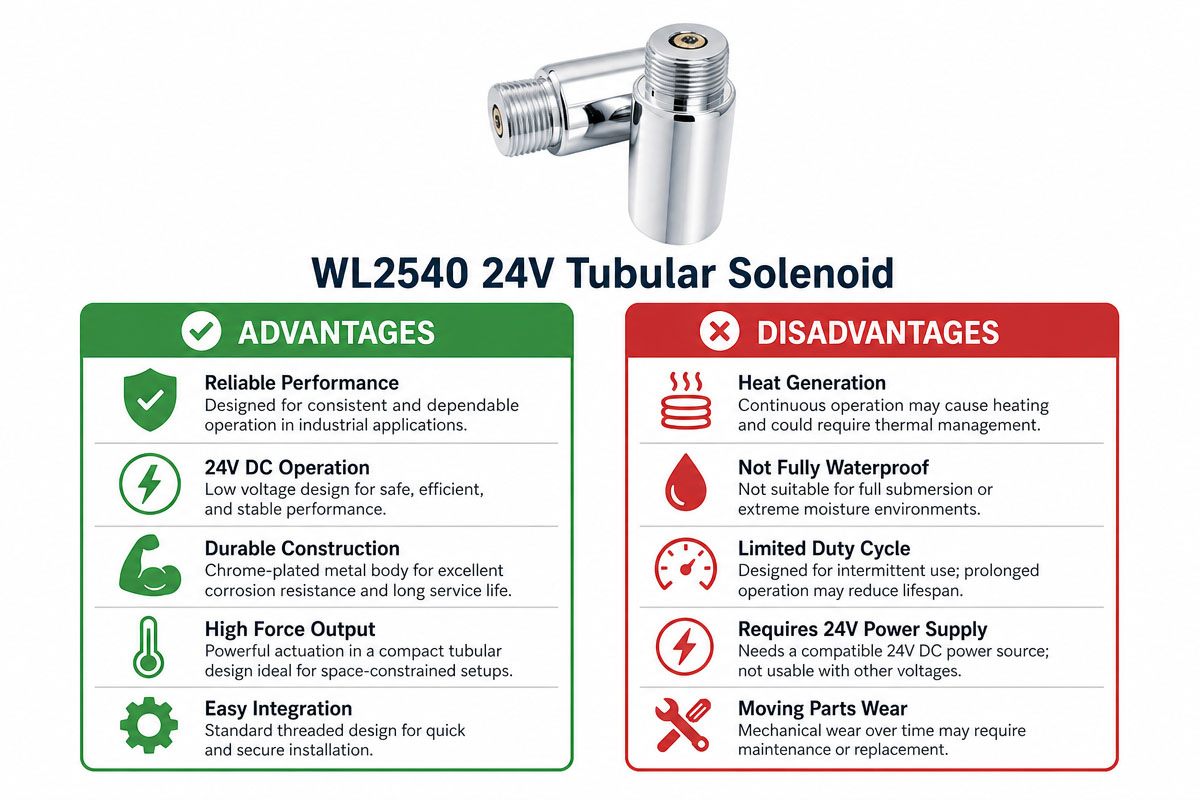
24V Tubular Solenoid Advantages and Disadvantages

Compact 24V Tubular Solenoid Advantage

Main advantage of 24V tubular solenoid is ability to produce linear movement from simple electrical actuation. The tubular housing provides compact package that is suitable for installation in equipment with limited space. 24V DC power supply is widely used in industrial automation and control.

Other advantages include simplicity of control, fast electromagnetic actuation, adjustable force and stroke, versatile mounting and relatively easy integration with electronics controllers. Various actuators can be created using push, pull and spring return designs.

Compact 24V Tubular Solenoid Disadvantages

Main disadvantage of a solenoid is strong dependence of its performance on stroke, duty cycle, voltage, temperature and mechanical load. Although a solenoid may have high initial force, at larger stroke it produces much less force.

The second issue is coil heating during high duty or continuous operation. Increased electrical energy. This may lead to increase in temperature and energy consumption. Moreover, the plunger will produce mechanical noise when reaching end of stroke.

The third problem is that the tubular solenoid is made for linear movement. Other types of actuators should be used in case of requirements for rotary motion, accurate servo positioning or continuously variable force.

It makes important to properly select and test the engineering application to ensure the balance of force, speed, temperature, size, power consumption and lifetime.

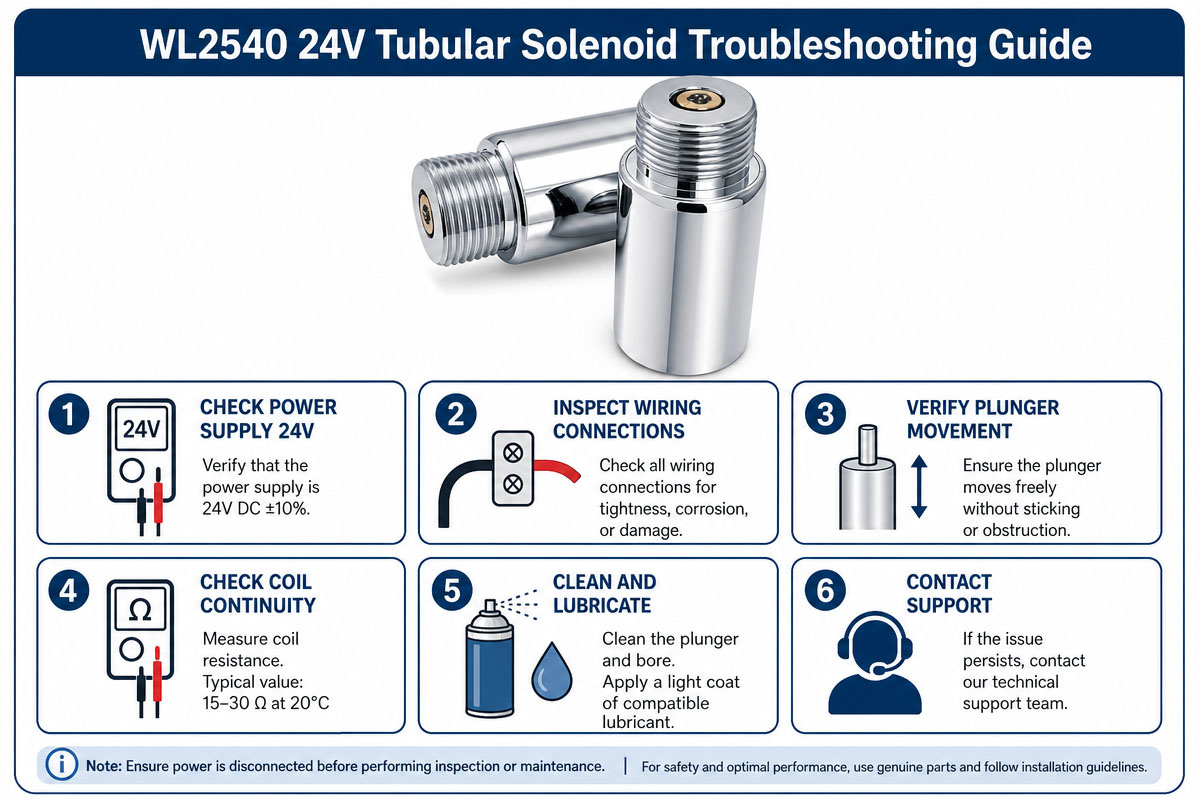
Troubleshooting Guide of a 24V Tubular Solenoid

24V Tubular Solenoid Troubleshooting Guide

If a 24V tubular solenoid does not operate properly, troubleshooting should start from electrical supply and then move toward mechanical and thermal issues.

Solenoid Will Not Operate

First confirm that the coil does indeed receive 24V DC. Inspect the power supply, the connector, the wiring, the controller, and the fuse. Then inspect the coil resistance for open or short circuits.

Lack of Force

Make sure that the actual voltage is lower than the required value. Make sure that the mechanical load does not exceed the required force and the stroke is within the design range. Effectively output force can be decreased due to mechanical friction or misalignment.

Overheating

Inspect the operating frequency and duty cycle. Continuous energization of an intermittent duty solenoid may cause a significant temperature rise. Inspect that the actual voltage exceeds the rated one.

Slow Motion

Slow response may be caused by low voltage, excessive mechanical load, mechanical friction, or a weak return spring. Instead of inspecting the solenoid itself, inspect the entire mechanical system.

Sticking Plunger

Inspect the plunger and housing for dirt, warping, or misalignment. Make sure that the tubular housing is not subjected to excessive mechanical loads due to the mounting design.

Limited Lifetime

Inspect operating load, stroke, duty cycle, temperature, and mechanical impacts. Excessive mechanical impact at the end of stroke results in increased wear.

Best practice: While troubleshooting, make records of voltage, current, resistance, force, stroke, and temperature to identify the true cause of failure.


8 Frequently Asked Questions About 24V Tubular Solenoids

1. What is tubular solenoid 24V?

A 24V tubular solenoid is an electromagnetic linear actuator that can be used with a 24V DC power supply. Energizing the coil produces a magnetic field, which moves the internal plunger to generate linear push/pull motion. It is widely used in industrial automation, medical devices, locking systems, vending machines, robotics, and other automated devices.

2. How does a 24V tubular solenoid operate?

Energizing the coil of a 24V tubular solenoid with 24V DC produces a magnetic field, which attracts a ferromagnetic plunger and slides it inside the tubular housing. This linear motion can be used for actuation of various mechanical mechanisms such as locks, valves, switches, clamps, or others. The plunger can be returned by spring, gravity, or an external mechanism.

3. What are the applications of 24V tubular solenoids?

4V tubular solenoids are widely used in many different industries, including industrial automation, smart medical devices, access control systems, vending machines, robotics, dispensing equipment, HVAC systems, packaging machinery, appliances, and laboratory equipment. They are very useful when there is limited installation space due to their compact cylindrical design.

4. What’s the difference between a 24V push/pull tubular solenoid?

A 24V push solenoid produces useful outward motion of the plunger upon energization, and a 24V pull solenoid produces inward motion of the plunger. A 24V push solenoid is used with pressing, releasing, or switching mechanisms, and a 24V pull solenoid is used with locks, latches, clamps, and release mechanisms. The configuration depends on the required direction of motion and mechanical design.

5. How to choose the right 24V tubular solenoid?

It is necessary to define required force, stroke, duty cycle, operating frequency, installation dimensions, return mechanism, and lifetime. Also, it is necessary to inspect the actual 24V DC supply and environment. The force of the solenoid varies depending on the plunger stroke, so it is necessary to define the force at the required stroke.

6. Are we able to customize a 24V tubular solenoid for OEM applications?

Yes. OEM 24V tubular solenoids can usually be customized according to the requirements of the equipment. Parameters that can be customized include stroke, force, housing diameter, overall length, shaft dimensions, spring characteristics, coil resistance, connector, mounting configuration, wire length, and duty cycle. Providing a 2D drawing, 3D model, sample, or detailed specs helps to accelerate the development process.

7. Why does a 24V tubular solenoid get hot while working?

Mostly heat is produced due to the electrical resistance of the coil. Temperature rise depends on voltage, current, duty cycle, energizing time, frequency of operation, ambient temperature, and heat dissipation. A 24V tubular solenoid intended for intermittent operation should not be changed into continuous operation automatically. For OEM applications, thermal testing in actual operating conditions is recommended.

8. How to extend the service life of a 24V tubular solenoid?

Choose a solenoid with proper force, stroke, duty cycle, load, and operating frequency to increase lifetime. Avoid excessive mechanical impact at the end of the stroke. Minimize plunger misalignment. Control coil temperature and operating voltage. Testing the prototype under actual use conditions is one of the best methods to guarantee long-term reliability.

How to Choose a 24V Tubular Solenoid

Choosing the proper 24V tubular solenoid is not only about the voltage. OEM designers should take into account all mechanical, electrical, and environmental requirements.

1. Check Voltage

The first parameter is the electrical supply. The nominal voltage for this application is 24 VDC. You should verify the actual range of the voltage provided by the control system.

2. Define Required Force

Identify whether the application requires pull force, push force, or holding force. The force should be evaluated at the actual stroke required, not at the beginning of the travel.

3. Describe Stroke

Demonstrate the distance the plunger should move. A longer stroke typically changes the available force, power consumption, and size of the solenoid.

4. Check Duty Cycle

Specify the duration and frequency of the required operation. Typically, the intermittent and continuous duty ratings are specified. Continuous duty increases the temperature of the coil.

5. Inspect Installation Space

Measure the available diameter and length. Also specify mounting holes, shaft size, connector orientation, and installation tolerance.

6. Select Push or Pull Configuration

Pull configuration is suitable for applications where the mechanism needs to move towards the solenoid. In cases where actuation away from the housing is required, a push-type or spring-return design can be used.

7. Operating Temperature

Evaluate ambient temperature, temperature rise of the coil, and heat dissipation into adjacent components.

8. Service Life Requirement

Represent the number of expected operating cycles. For industrial applications, the cycle life should be verified under actual load and duty cycle conditions.

9. Establish Response Requirements

If you are evaluating high-speed applications, you should look for energizing and de-energizing times, not for the force.

10. Prototype Testing Request

It is recommended to test samples before mass production under actual conditions of voltage, load, stroke, working frequency, and temperature.

The best solenoid is the one that fits the whole application—not the one with the highest force.

How To Avoid Common 24V Tubular Solenoid Design Mistakes

1. Never say “force” without “stroke.”

The force of a solenoid depends on the plunger position. Therefore, always specify the force at a particular stroke.

2. Do Not Ignore Duty Cycle

A properly working solenoid can be used for short pulses but will overheat in continuous operation.

3. Do Not Oversize the Coil

A larger coil does not necessarily mean a better coil. The excess power consumption causes excessive heating.

4. Verify the Total Mechanical Load

Take into account the friction, spring force, gravity, linkage losses, and external resistance.

5. Evaluate Return Method

Specify whether the plunger returns using an internal spring, an external spring, gravity, or any other method.

6. Consider Manufacturing Tolerances

The mounting interface should not be designed for zero clearance. Take into account the assembly tolerances.

7. Test in the Actual Application

Prototype testing should simulate actual voltage, load, stroke, working frequency, and ambient temperature.

8. Include End-of-Stroke Conditions

Avoid excessive plunger pressure on mechanical stops, as it increases noise and wear.

9. Double Check the Connector & Wire Requirements

Specify cable length, type of connector, wire gauge, and orientation in the design stage.

10. Check the Thermal Performance

Do not rely only on theoretical calculations; measure the coil temperature under actual duty.

Get A Free Quote Now

Contact Form

Related Products

Related News

Scroll to Top

Get A Free Quote Now !

Contact Form
If you have any questions, please do not hesitate to contact us.
Weilong Solenoid Company Culture