Industrial Tubular Push-Pull Solenoid for smart device System
Mini Tubular Push-Pull Solenoid for Precision Control
Tubular Push-Pull Solenoid for Industrial Actuator
Tubular Push-Pull Solenoid for Industrial Robotics
Tubular Push-Pull Solenoid for Industrial Solution
Tubular Push-Pull Solenoid for Industrial Equipmnt
Industrial Tubular Push-Pull Solenoid for smart device System
Mini Tubular Push-Pull Solenoid for Precision Control
Tubular Push-Pull Solenoid for Industrial Actuator
Tubular Push-Pull Solenoid for Industrial Robotics
Tubular Push-Pull Solenoid for Industrial Solution
Tubular Push-Pull Solenoid for Industrial Equipmnt

WL1632 Tubular Push-Pull Solenoid Automation System Solutions

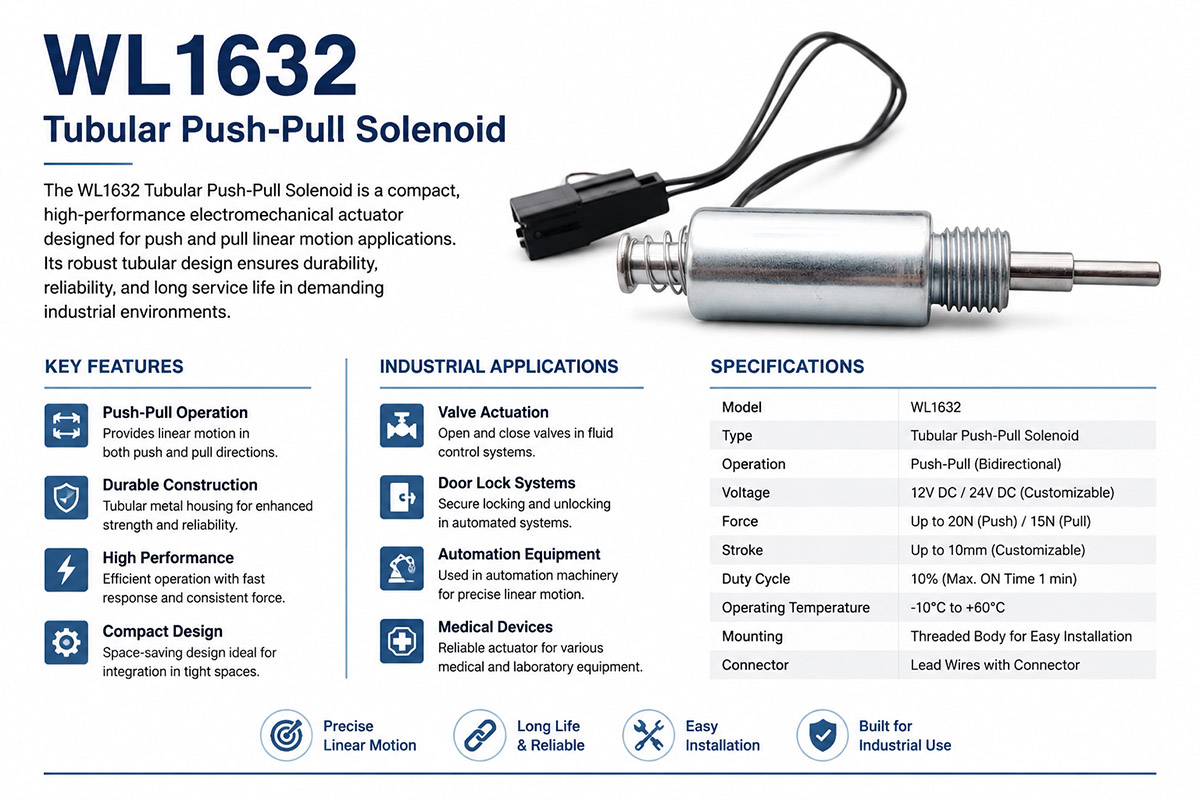
The tubular Push-pull solenoid is an electro-mechanical actuator that transforms electrical energy into linear mechanical movement. It consists of a tubular metal cylinder in which a coil of wire is wound. There is a moving metallic rod (the plunger) inside. When energized, the coil creates a magnetic field that attracts or repels the plunger, creating a pulling or pushing effect. Tubular Push-pull solenoid enclosure helps to confine the magnetic flux, ensuring effective performance. The tubular Push-pull solenoid  has a compact structure and generates a force similar to the one of bigger solenoids.


Tubular Push-Pull Solenoid Product Overview

A tubular push-pull  solenoid is a small high-performing electro-mechanical actuator. It is an enclosed metal tubular device in which there is a wire coil and a moving plunger. When the coil is energized, the plunger moves inside or outside of the solenoid, producing the push or pull effect. They are built for standard DC voltages (6-24V) and have both push and pull configurations. The stroke lengths of a push-pull solenoid are typically in the range of 5-30mm. The tubular construction ensures less magnetic flux leakage in comparison with open frame designs. They are constructed of durable materials and have life cycles exceeding 2 million operations. These characteristics of tubular push-pull solenoid make them great for demanding industrial, medical and automotive applications requiring precise linear actuation.

How a Tubular Push Pull Solenoid Works

The working principle of a tubular push-pull solenoid is based on the laws of electromagnetism. A coil of wire is wound on a bobbin and there is a movable steel plunger inside. Upon application of direct current (DC) to the coil, the magnetic field appears and attracts the plunger to the centre of the coil. If a push solenoid is energized, the plunger is pulled inside the coil. For the push configuration, a non-magnetic shaft is attached to the plunger that protrudes from the other side of the coil, causing the pushing motion. After de-energizing the solenoid, the plunger usually returns to its initial position due to the spring. When moving the plunger deeper into the coil towards the fixed pole, an increase in force is achieved.

Main Characteristics of Tubular Push-Pull Solenoid

The main features of tubular push-pull  solenoids are the following:

Enclosed tubular metal case for reduced magnetic flux leakage and increased performance;

Push & Pull actuation in a small form factor;

Various voltage ratings (6V, 12V, 24V DC);

Long operational life up to 25 millions cycles;

Stroke lengths from 5mm to 30mm;

Forces from grams to several kilograms.

They are made of solid steel for increased durability, have spring-return action and continuous or intermittent duty options.


Tubular Push-Pull Solenoid Video

Tubular Push-Pull Solenoid Detailed Display

Automotive Tubular Push-Pull Solenoid Datasheet

Brand Weilong Technology Model Number WL1632
Rated Voltage (V)  12 V or 24 V Rated Power (W) 3-5 W
Work Model Tubular Push-Pull Type Holding Force (N) 0.1 to 0.3 N
Stroke (mm) 3-5 MM Reset Time(s) 30 ms
Service Life 100,000 shots Certification CE, RoHS, ISO9001,
Material Carbon Steel Housing with Zinc Plated Coating Lead Wire Length (mm) 200
Holding Force:  1.8 Kgs Tolerance of Dimension  +/-  0.1 MM
Water-proof  None Insulation Class F
Hi-Pot Test AC 600V 50/60Hz 2s Non-excitation Holding Force 0
Working Temperature -10°C-100°C Duty Cycle 1-100%
Working Duty 10%–30% Payment Term TT, or LC At Sight
Sample Order Yes Warranty 1 Year
MOQ 1000 pcs Supply Ability 5000 pcs per Week
Delivery Time 30 Days Port of Loading shenzhen

What is the different between tubular push and tubular pull solenoid ?

The basic distinction between a tubular push-pull solenoid is the direction of travel of the plunger and the type of mechanical output it offers. Both are based on the same electromagnetic principle. When energized, the plunger is always pulled inward .

The difference is in how that pulling action is interpreted by your application:

Pull Solenoid The end of the plunger that is pulled into the coil is directly attached to the load. When energized, it pulls the load in the direction of the solenoid .

Push Solenoid This is essentially a pull solenoid with a non-magnetic pushrod (or shaft) added to the inner end of the plunger. A rod extends from a hole in the back of the solenoid. Pulling the plunger in moves the rod out, creating a pushing motion away from the solenoid body.

Key Differences in a Nutshell

Feature Pull Solenoid Push Solenoid
Mechanism Attach load to the exposed plunger end. A pushrod is added to the plunger inside the coil.
Motion Plunger (and load) is pulled into the solenoid. Pushrod is pushed out the back of the solenoid.
Common Applications Door locks, latching mechanisms, valves  Ejecting items, pinball machine kickers, opening valves 
Force & Stroke Typically longer stroke length than push solenoids  Peak force occurs at the end of the stroke when the plunger is fully pulled in 

Key Clarifications
Reverse the polarity of the electricity and a solenoid will push , rather than pull . It ‘s a common misconception . This is not the case with normal DC solenoids. The magnetic field pulls the ferromagnetic plunger in regardless of the direction of the current. The mechanical action is determined only by the physical design (with or without the pushrod).

You’d need a more complicated design if you want a single solenoid that can push and pull from the same end . A bi-directional solenoid with two coils for example.

Tubular Push-Pull Solenoid Industrial Application

Custom Tubular Push Pull Solenoid Industrial Application

Industrial Automation uses tubular push-pull solenoids of this type extensively. On the production line, they are used as actuators in sorting machines, automated assembly lines and packaging machines. They are also widely used in locking and access control systems such as door interlocks, electronic locks and gates. Medical devices such as blood analyzers, laboratory equipment and testing devices use them as actuators for precision and controlled movements.

Automotive systems use these solenoids for door locks, steering systems and fuel control systems. Tubular Push-pull solenoid findsapplications in office equipment and business machines for paper handling, vending machine dispensing mechanisms and current limiting switches. They are used in heating, ventilation and air conditioning (HVAC) systems for valve operation and fluid control. Other applications include mechanical valves, brakes and plumbing systems, where precise bidirectional control in a compact space is required.

Tubular Push-Pull Solenoid Advantage and Disadvantage

Tubular Push-pull Solenoid Advantage and Disadvantage

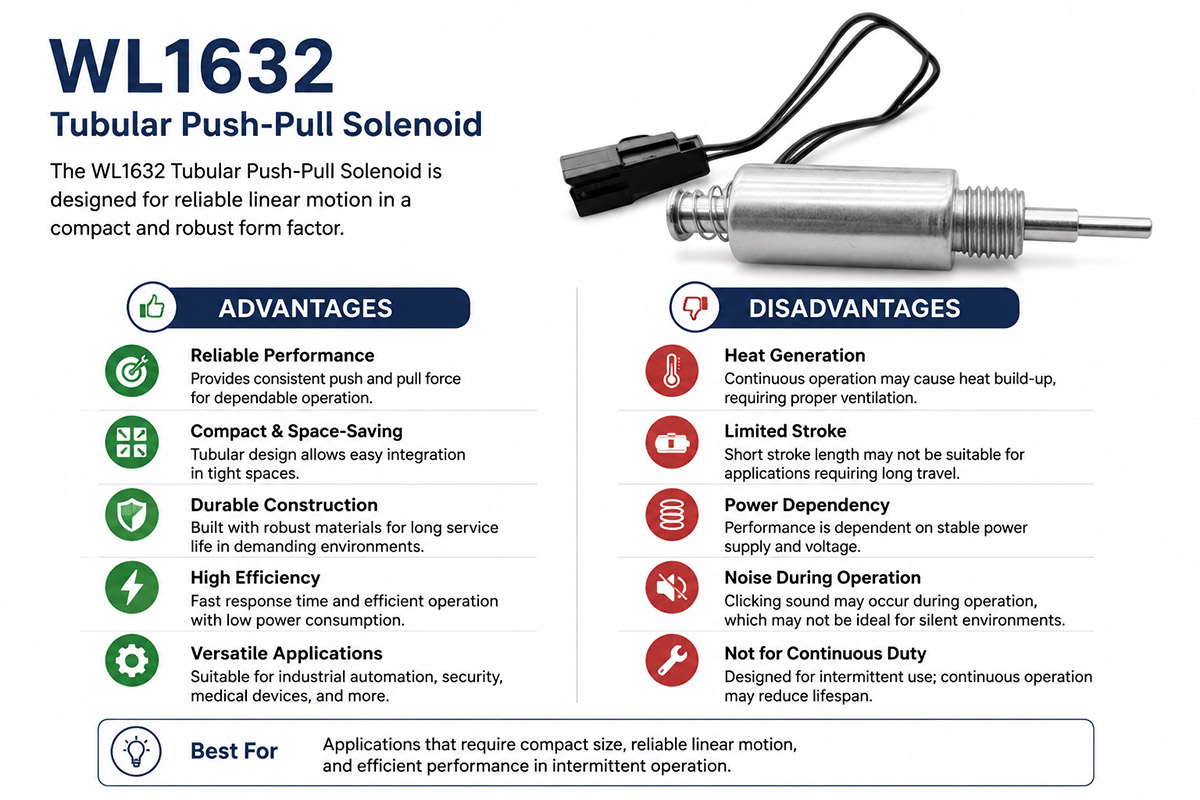
Tubular Push-Pull Solenoid  Advantages:

High force density in a small package, comparable to the C/D frames;

This type of solenoid reduces magnetic leakage, thus increasing efficiency and preventing interference with surrounding electronics;

They have a high life cycle, reaching 25 million cycles;

A wide voltage range (6-24V DC) allows easy integration with your system;

The tubular design ensures high structural strength and corrosion resistance in steel or stainless steel construction;

Same footprint provides both push and pull configurations;

Low acoustic noise.

Tubular Push-Pull Solenoid  Advantages: Disadvantages:

The force output decreases sharply with increasing stroke, so they are used mainly for short strokes;

Heat dissipation is a problem and may require thermal management for continuous duty solenoids in a closed environment;

Limited stroke length;

Long-stroke designs (30 mm) decrease the force for gaining stroke length;

The voltage increase means more power consumption and heat generation;

Rotary solenoids create rotations, tubular solenoids can generate only linear motion;

May be initially more expensive than simple open frame alternatives, but high life cycle compensates this price.

Troubleshooting of Push Pull Tubular Solenoids

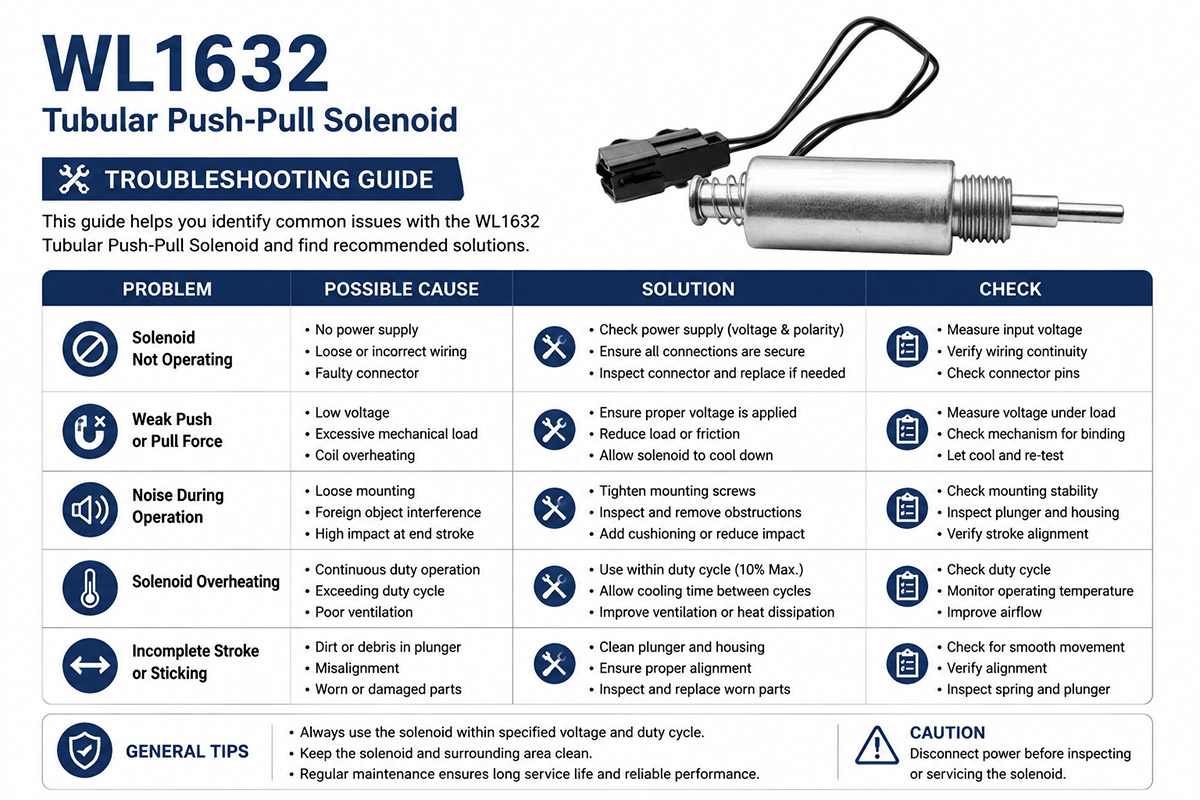
1. The Solenoid does not work

Check the power supply voltage at the coil terminals, low voltage (less than 85% of rated) causes inability to operate. Check the electrical continuity, coil resistance must be within the specification (e.g., 85Ω for 24V, 6.7W continuous).

Broken wires and bad connections. In case of 24V continuous solenoids the resistance is around 85Ω, significant deviation means damaged coil

Weak or intermittent force

Stable voltage at the rated level when operating; clean the plunger and bore (contamination leads to increased friction). Check for the mechanical bind in the load path. Force decreases with stroke length – check whether the stroke requirements are met.

Overheating or burning smell

Generally, it means exceeded duty cycle. Use continuous duty rated solenoids for unlimited operation or leave enough time for cooling the intermittent ones. Measure the ambient temperature, operation outside the specified range (-5 °C to +40 °C) reduces the LIF. Insulation resistance test, should be more than 50 MΩ at 500 V DC.

Excessive noise or chatter

Loose mounting or worn parts – check the mounting and see if there are any loose parts; use regulated power supply. In case the return spring fails it may cause irregular motion.

Reduced life expectancy

First, check that the application load is within the limits. Protection against ingress contamination, dusty environment, IP00 units – 1. If the environment is harsh consider IP67 units.

The increasing popularity of tubular push-pull solenoids

Tubular push-pull solenoids became increasingly popular because of their high power-to-size ratio. Enclosed tubular design reduces magnetic flux leakage and provides performance similar to or better than larger, open frame designs. They are indispensable where space is critical.

Their versatility across different industries makes them very popular. Tubular solenoids are the perfect solution for applications ranging from medical devices requiring precise and silent actuation to automotive and industrial automation requiring durable and high-cycle performance. Their life expectancy up to 25 million cycles makes maintenance costs much lower which is important for industrial applications.

Both push and pull configurations are available from the same compact footprint, providing additional design freedom. The product is certified according to the international standards of safety (CE, RoHS, UL), allowing its global deployment. Customization options include voltage, stroke length, force output, mounting and anti-rotation options. Extended stroke up to 30mm is another option for long travel applications.


8 Common Questions about Tubular Push-Pull Solenoid

1. What is the difference between a push type and a pull type tubular solenoid?

The basic principle of their work is identical. Under the influence of the magnetic field, the plunger is pulled inward. In the pull type this inward movement is the direct actuation of the load, e.g., in a locking mechanism. In the push type the plunger has a shaft attached to it which moves the load outward through the hole in the casing.


2. How do I choose the correct voltage and power for my application?

The DC voltages are typically 6V, 12V, 24V and 48V   24V DC is the reliable choice for industrial applications. Power (wattage) determines the force and heat generation. Low power (1-5W) is appropriate for intermittent tasks such as smart locks. High power (20W+) is intended for heavy duty applications requiring high force. Make sure the power supply corresponds to the coil specifications.

3. What is duty cycle and why it matters?

Duty cycle is the percentage of time a solenoid is energized in relation to the total cycle time  ON time / (ON time + OFF time) . This parameter is important since it sets the limits to the thermal behavior of the solenoid. E.g., 25% duty cycle means that the solenoid can be powered for 25% of the time, the remaining 75% are left for cooling. Exceeding the duty cycle will cause overheating and coil burning.

4. Is a tubular push-pull solenoid suitable for continuous operation?

Yes, but you have to use a continuous duty model specifically designed for that. Such solenoids are designed to have good heat dissipation capabilities, allowing energizing forever without burning up. The thermal management is important for frequent and continuous operation and may include heatsinks or even pulse-width modulation (PWM) to reduce the holding current.


5. What are the common causes of solenoid failure and how to troubleshoot them?

The common failure causes are poor wiring (loose or corroded connections), burnout of the coil (because of overheating or voltage mismatch), and loose iron core (reducing the magnetic force). Troubleshooting of the solenoid includes checking connections, measuring the coil resistance with a multimeter and tightening fasteners. Proper maintenance of the solenoid, including regular inspection for wear and cleaning, can help to avoid these problems.


6. Does the tubular solenoid have a return spring and is it needed?

As a rule, standard tubular solenoids do not have a return spring. It is needed to return the plunger to its original position after the de-energizing. Return force is provided by the load itself or an external mechanism in many cases. Otherwise, it is necessary to design a spring-return mechanism or order the solenoid with it.

7. Environmental protection options

You can choose the tubular push-pull solenoid with various Ingress Protection (IP) ratings for harsh environment. Rated at IP54 it is dust- and water-splash resistant for general industrial applications. IP65 is dust tight and protected from low pressure water jets. IP67 rated for temporary immersion in water. Ideal for humid or outdoor applications.

Tips on How to Avoid Common Design Mistake

The most common mistake is ignoring the duty cycle. Overload of the duty cycle leads to overheating and premature failure. Estimate the actual time intervals for on and off states and choose accordingly. The force at full stroke is usually underestimated, therefore the actuation will be weak. Always estimate the force-stroke curve, not just holding force. Heat dissipation will degrade the insulation. Make sure that there are no problems with heat dissipation. Not all solenoids have spring return, so neglecting the need for return spring may lead to necessity to implement an external solution. The performance depends on the mounting position, tubular solenoids are mounted from the actuating end including nuts and lockwashers. The voltage drop at the coil lowers the force, so make sure the voltage is adequate. Lack of protection for the environment will lead to corrosion if the solenoid is used in a dusty or humid environment.

How to Choose a Tubular Push-pull Solenoid

Choosing the correct tubular push-pull solenoid requires an analysis of the particularities of your application.

First, determine the direction of the motion – pull or push. When energized, the pull type solenoid pulls the plunger into the coil and moves the load toward the solenoid. A push solenoid has a plunger with an attached shaft that moves the load away from the solenoid. Both solenoids work the same way electrically, it is just the direction of the motion you need.

Second, specify the stroke length and force requirement. Stroke is the distance moved by the plunger. Force requirements are:

Starting force – required to move the load from the rest position

Holding force – to hold the load in the particular position

Force curves usually demonstrate that the force decreases when the stroke increases. You have to ensure that the solenoid provides enough force at the full stroke.

Third, set the duty cycle. Continuous-duty solenoids can be powered infinitely, whereas intermittent-duty units provide increased force but have to be cycled with cooling intervals. Typically, the intermittent duty cycle consists of 180 seconds of activation and at least 540 seconds of downtime. The duty cycle plays an important role in setting power rating and thermal management.

Fourth, specify voltage and power. The common voltage ratings are 6V, 12V and 24V DC. Higher voltages mean more force and more speed, but also more heat. See the available power and the environment

Fifth, consider the environment. In case of harsh conditions, pay attention to the enclosure with IP rating for dust/moisture protection and safety certification (UL, CE, RoHS).

Special options may include magnetic latching units (remain in the selected state without constant power supply), anti-rotation mechanisms, and special mounting options. Finally, pay attention to life expectancy. High-quality tubular push-pull solenoid can reach 25 million cycles and are perfect for continuous industrial operation.

Get A Free Quote Now

Contact Form

Related Products

Related News

Scroll to Top

Get A Free Quote Now !

Contact Form
If you have any questions, please do not hesitate to contact us.
Weilong Solenoid Company Culture
