Compact Tubular Solenoid for Smart Automation Systems
Compact Tubular Solenoid for Precision Motion Control
Compact Tubular Solenoid for Automated Equipment
Compact Tubular Solenoid for Industrial Machines
Compact Tubular Solenoid for Medical Automation
Compact Tubular Solenoid for Robotics and Automation
Compact Tubular Solenoid for Smart Automation Systems
Compact Tubular Solenoid for Precision Motion Control
Compact Tubular Solenoid for Automated Equipment
Compact Tubular Solenoid for Industrial Machines
Compact Tubular Solenoid for Medical Automation
Compact Tubular Solenoid for Robotics and Automation

WL30100 Compact Tubular Solenoid for Automation Solutions

A compact tubular solenoid is an electromagnetic actuator for space-saving applications requiring precise and reliable linear motion. The coil, magnetic circuit, plunger, guiding parts, and the housing are assembled in a compact cylindrical housing.

Depending on the application requirements, the actuator can be configured for push, pull, or push-pull operation. Voltage, stroke, force, duty cycle, response time, mounting, connector, shaft configuration, return spring, and materials can be chosen by engineers.

A compact tubular solenoid is especially suitable for equipment with limited installation space due to its compactness. Applications are typical for medical devices, automation equipment, laboratory instruments, access control, robotics, dispensing, valves, and industrial mechanisms.

For OEM applications, customized magnetic circuits and mechanical interfaces are provided to meet the requirements of force, stroke, temperature performance, lifetime, and installation dimensions.

Compact Tubular Solenoid Product Overview

Compact Tubular Solenoid – Tubular form factor with efficient electromagnetic actuation. It features a compact size, axial plunger motion, flexible stroke choices, and push or pull action. The tubular magnetic circuit can provide a good force-to-volume ratio, making it suitable for space-constrained equipment.

Depending on the design, the manufacturer can customize voltage, power consumption, force, stroke, duty cycle, shaft dimensions, mounting configuration, connector, spring characteristics, housing material, and surface treatment. Compact tubular solenoids can be designed for continuous or periodic operation. OEM applications can benefit from customized mechanical and electromagnetic designs.

Compact tubular solenoid Working Principle Explained

A compact tubular solenoid is based on the interaction of an energized electromagnetic coil with a movable ferromagnetic plunger.

Basic process of operation

  1. The electrical input DC voltage is applied to the solenoid coil.

  2. Creation of magnetic fields

The copper windings have current flow through them, creating a magnetic field.

  1. Piston movement

Electromagnetic forces are created due to a magnetic field, attracting the plunger to the magnetic center.

  1. Linear mechanical output

Depending on the mechanical configuration, the plunger moves along the central axis, providing push or pull linear motion.

  1. Return movement

The power is turned off, and the plunger returns to its starting position, using a return spring, an external device, gravity, or any other magnetic system.

The major parameters affecting the force are

The force achieved is the function of: Current flowing in the coil Number of turns of the coil Design of Magnetic Circuits Material of the plunger air gap Heart attack supply voltage Coil resistances are magnetically saturated. Temperature

For applications requiring high holding force, quick response time, and low power consumption, it is preferable to develop the magnetic circuit and the coil together rather than select components individually.

Basic Properties of a Compact Tubular Solenoid

Compact Tubular Solenoid – Tubular form factor with efficient electromagnetic actuation. It features a compact size, axial plunger motion, flexible stroke choices, and push or pull action. The tubular magnetic circuit can provide a good force-to-volume ratio, making it suitable for space-constrained equipment. Depending on the design, the manufacturer can customize voltage, power consumption, force, stroke, duty cycle, shaft dimensions, mounting configuration, connector, spring characteristics, housing material, and surface treatment. Compact tubular solenoids can be designed for continuous or periodic operation. OEM applications can benefit from customized mechanical and electromagnetic designs.


Compact Tubular Solenoid Product Video

Compact Tubular Solenoid Product Detailed Display

Compact Tubular Solenoid Product Datasheet

Brand Weilong Technology Model Number WL 30100
Rated Voltage (V) DC 12 or 24 V Rated Power (W) 20–100 W
Work Model 100,000 Lifespan Cycles Push Pull Force (N) 10–30N
Stroke (mm) 10–20 MM Reset Time(s) 1 S 3S Off


Service Life 300 Thousand Times Certification CE, ROHS, ISO9001,
Material Carbon Steel Housing with Zinc-Plated Coating Lead Wire Length (mm) 200
Install Style both sides with three mounted screw holes for easy setup Tolerance of Dimension ± 0.1 MM
Water-proof None Insulation Class F. Cel. 150 Degree
Hi-Pot Test AC 600V 50/60Hz 1 s Non-excitation Holding Force 0
Working Temperature -10°C-100°C Duty Cycle 1-100%
Thread Depth (mm) / Payment Term TT, or LC at Sight
Sample Order Yes. Warranty 1 Year
MOQ 500 pcs Supply Ability 5000 pcs per week
Delivery Time 30 Days Port of Loading Shenzhen

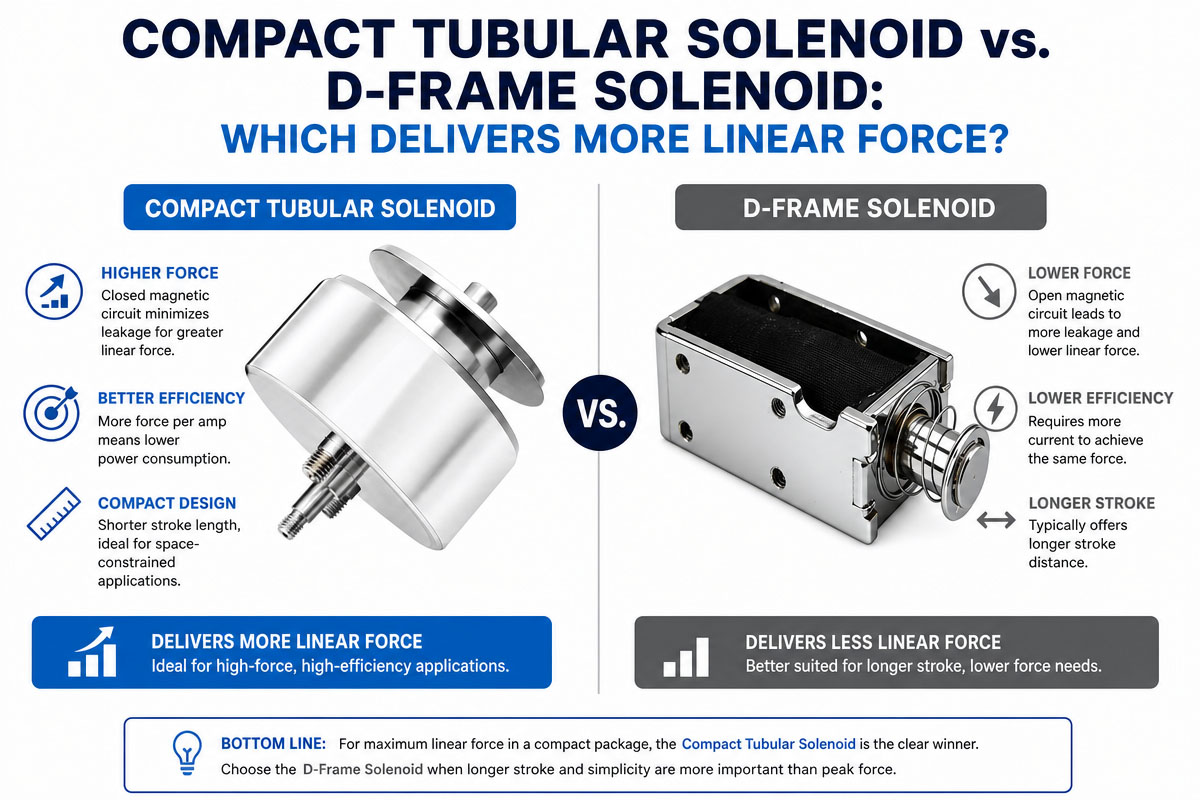
Compact Tubular Solenoid vs. D-Frame Solenoid—Which One Provides More Linear Force?

Compact Tubular Solenoid vs D-Frame Solenoid

For the compact tubular solenoid and D-frame solenoid, there is no universal winner. The choice depends on the required force, stroke, installation space, duty cycle, and mechanical configuration.


Feature Compact Tubular Solenoid D-Frame Solenoid
Shape Cylindrical D-shaped/open-frame style
Motion Primarily axial Typically linear
Space efficiency Excellent for cylindrical spaces Good for flat mounting areas
Force-to-size Often high Depends on magnetic design
Mounting Inline/axial integration Surface/bracket mounting
Stroke Customizable Customizable
Push/Pull Available Available
OEM customization High High
Best use Compact enclosed mechanisms General industrial mechanisms


Which provides more linear force?

It depends on the magnetic circuit and stroke, not just the design of the frame.

Well-designed compact tubular solenoid provides excellent axial force in relatively small diameter. The enclosed magnetic circuit becomes especially handy in case the actuator should be installed in a cylindrical or confined space.

D-Frame Solenoid may become a better choice if the equipment has a flat mounting surface or the mechanical design requires different force direction and mounting configuration.

Recommendation for the buyer

Use a compact tubular solenoid in case of:

  • Limited or cylindrical installation space
  • Axial movement is preferable
  • Compact packaging matters
  • A customized shaft is required

The actuator needs to be installed directly in the mechanism.

Use the D-Frame Solenoid to:

  • Easy flat mounting
  • Available space suits D-frame better
  • Industrial mounting is preferable as standard
  • The application can have large lateral dimensions

The best comparison should be made at the needed stroke, not just maximum rated force.

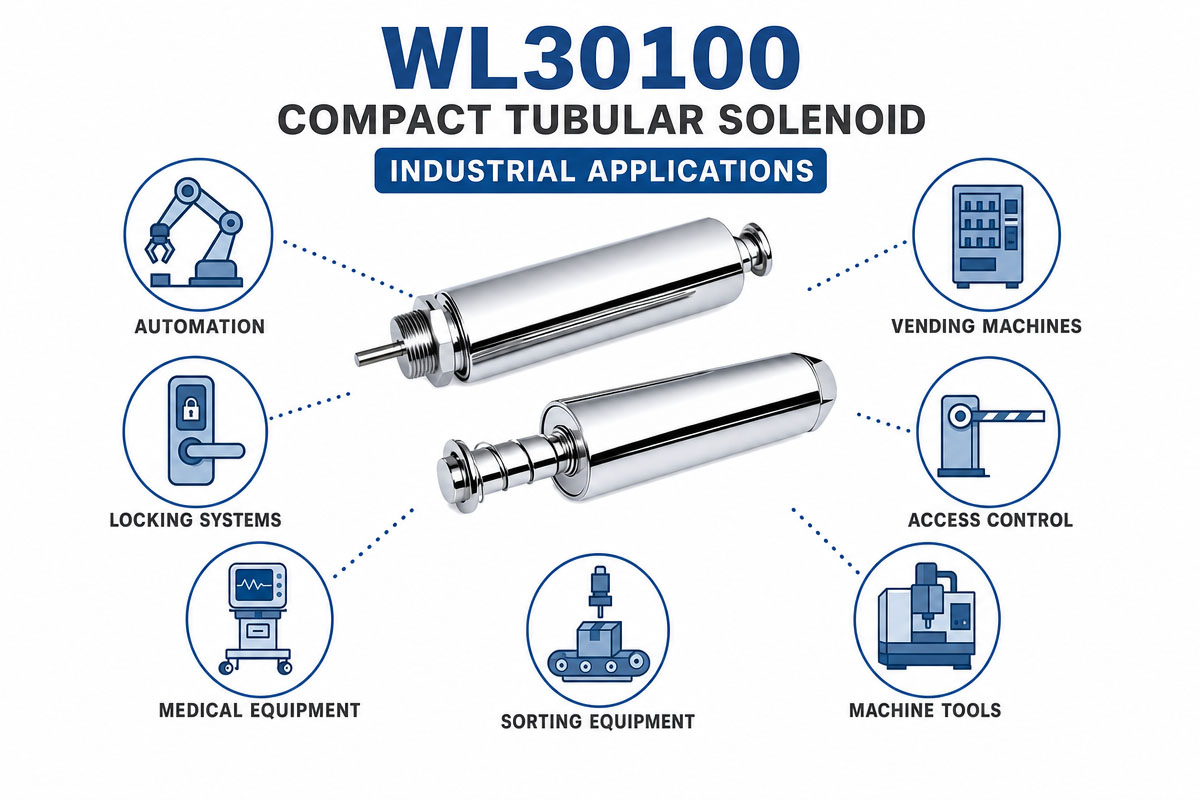
Compact Tubular Solenoid Industrial Application

Compact Tubular Solenoid Industrial Application

Compact tubular solenoids are widely used in many applications where the automated equipment requires controlled linear motion in limited space.

It can be used for clamps, locks, gates, diverters, positioning devices, feeders, and mechanical interlocks in industrial automation. The axial movement makes the compact tubular solenoid suitable for machines where the actuator must work along a linear axis.

Compact tubular solenoids can be used in medical devices like analyzers, diagnostic instruments, sample handling, pumps, valves, dispensing, and automated positioning systems. Compact dimensions are especially useful in cases when many actuators are used in one machine.

In laboratory automation solenoids are used to control reagent mechanisms, sample movement, tube handling, locking mechanisms, and automated dispensing systems.

In robotics and motion control equipment the short-stroke actuation of the solenoids is used for gripping, locking, releasing, indexing, and positioning.

Other applications are Machines (vending) Printer access control Machinery for packaging Automatical doors, textile machinery Automotive systems, valve systems Test equipment: Intelligent appliances

The most appropriate design depends on force, stroke, response time, duty cycle, available space, voltage, operating temperature, and expected service life.

Why is the compact tubular solenoid getting so popular as an option for medical device automation solutions?

Compact tubular solenoids become more popular to automate medical devices due to the combination of limited internal space and difficult motion control requirements of medical equipment.

Modern diagnostic and laboratory instruments are usually equipped with many automated mechanisms in a relatively small enclosure. The actuators should perform opening, closing, clamping, releasing, positioning, locking, or dispensing of various parts using minimal space.

The tubular form factor becomes especially valuable due to the fact that the actuator provides axial linear motion, which allows it to be positioned exactly along the axis of required movement.

The most important advantages of the compact tubular solenoid for medical automation are

  • Small installation size
  • Precise linear movement
  • Repeatable actuation
  • Stroke selection variety
  • Simple electrical control
  • Custom Mounting Configurations
  • OEM Mechanical Customization

Integration with automated sample preparation systems

But the choice should not be based only on the size and force for medical devices. Engineers should take into account temperature rise, noise, lifetime, materials, reliability, cleanability, and electrical safety, as well as all regulatory requirements associated with the application.

This means that medical automation system developers usually involve solenoid manufacturers in the early stage of the design process. So the actuator could be optimized for available space, movement profile, duty cycle, and the machine’s expected lifetime.


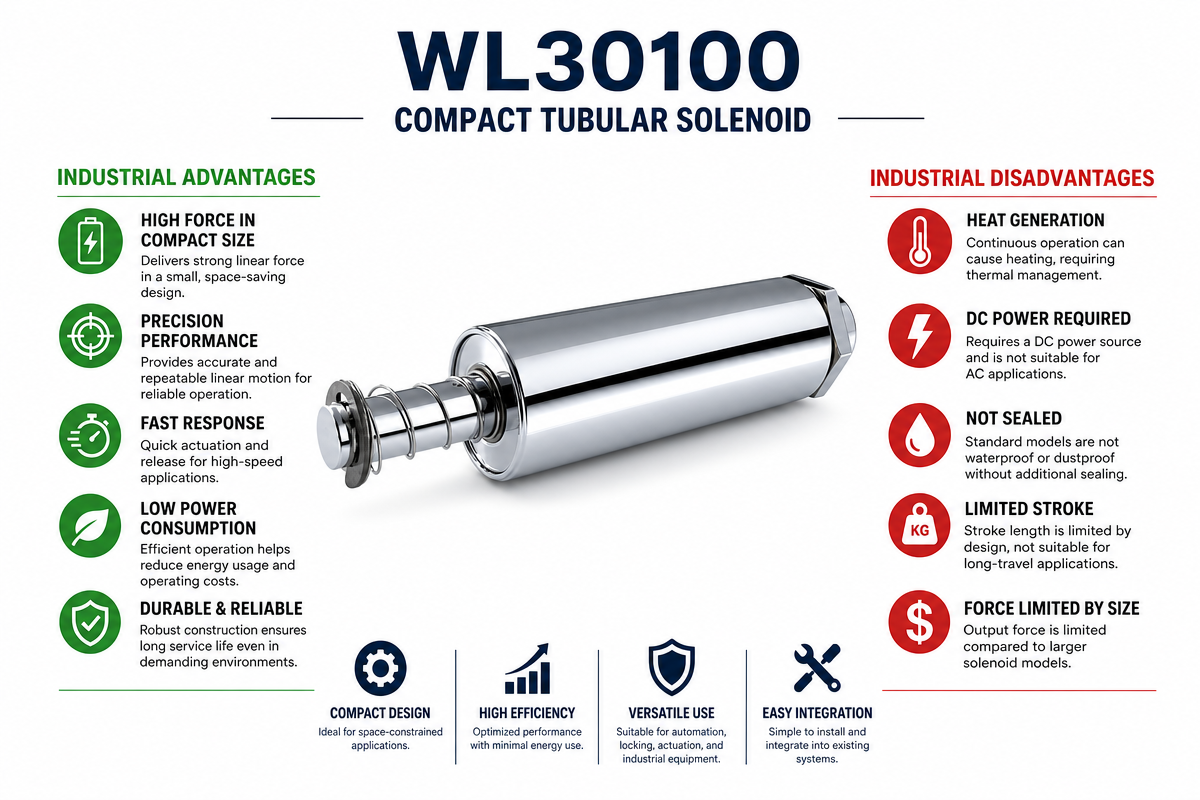
Compact Tubular Solenoid Advantage and Disadvantage

 Compact Tubular Solenoid advantage and disadvantage

The primary benefit of the compact tubular solenoid lies in its space-saving installation. Due to the cylindrical design, the actuator can be installed in any cramped and confined equipment. The axial linear motion ensures simple operation of the actuator and may allow for mechanical integration.

Among the other benefits of the compact tubular solenoid, we can mention:

  • Small design
  • Excellent strength-to-size ratio
  • Simple electrical control

Quick reaction

  • Configurations of push or pull or push-pull
  • Individual stroke and force choices
  • Fast integration with automated systems
  • OEM customization is possible

Tubular design provides a relatively clean mechanical interface due to the linear motion of the plunger along the axis.

Drawbacks

Of course, some limitations should also be mentioned. The electromagnetic force varies depending on plunger location, so the force may drop significantly at long strokes. Coil heating may become an issue when the actuator is operated continuously at high power.

Other considerations include:

  • Reduced force at long stroke
  • Heating
  • Power consumption
  • Magnetic saturation
  • Potential mechanical wear
  • Noise while operating
  • Influence of temperature on performance

So a compact tubular solenoid should be chosen, taking into account the whole cycle of operation and not just maximum force or size.

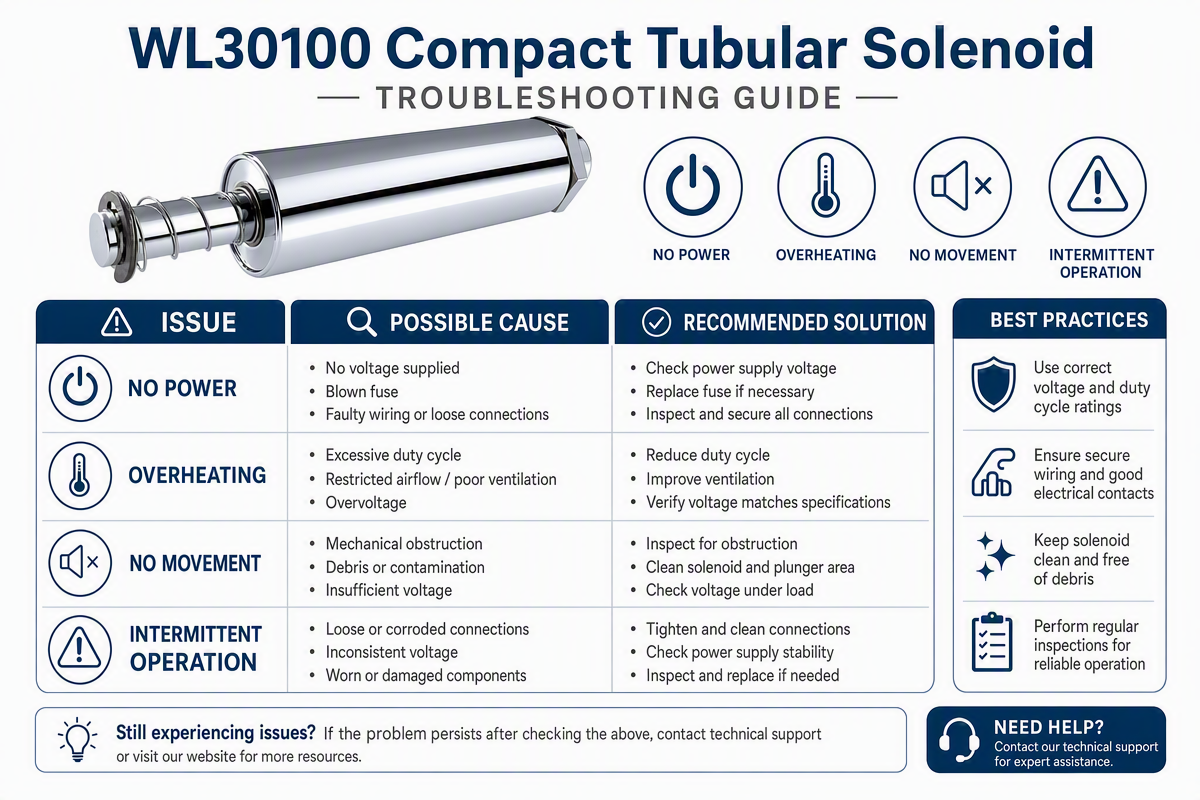
Compact Tubular Solenoid Troubleshooting Guide

WL30100 Compact Tubular Solenoid Troubleshooting Guide

In case of improper operation of the compact tubular solenoid, troubleshooting begins with electrical and mechanical examination.

The solenoid does not move.

Look at:

  • Supply voltage

Wiring and connector

  • Coil resistance
  • Driver output
  • Plunger blockage
  • Mechanical loading

If the voltage is fine and the plunger does not move, examine the magnetic circuit and mechanical adjustment.

Solenoid too hot

Extra heating may occur due to:

Operating voltage above nominal

  • Incorrect duty cycle
  • Coil power too high
  • Insufficient heat dissipation
  • High ambient temperature

– Continuous operation of the intermittent duty model

Measure the coil temperature during actual operating conditions.

Not enough force

See whether the load exceeds the specified force at the stroke. Air gaps, plunger alignment, supply voltage, and mechanical friction should be checked.

Sorry for the delayed response.

Potential reasons include low voltage, too high load, high mechanical friction, wrong spring force, or wrong magnetic circuit.

Too much racket

Plunger alignment, mechanical impact, rigidity of mounting, return spring characteristics, and switching conditions should be checked.

Short life span

Look at overheating, excessive mechanical impact, contamination, excessive side loading, and incorrect stroke and operation beyond the specified duty cycle.

For OEM projects, the best troubleshooting is the consideration of electrical, magnetic, thermal, and mechanical performance.

6 Frequently Asked Questions of Compact Tubular Solenoid

1. What is Compact Tubular Solenoids' function?

Compact tubular solenoids are used in industrial automation, medical devices, laboratory equipment, robotics, locking systems, dispensing machines, valves, printers, testing equipment, and automated machines. They are perfect actuators for applications that require reliable push, pull, or push-pull movement.

2. Is it possible to customize Compact Tubular Solenoids?

Yes. OEM manufacturers can customize the voltage, stroke, force, dimensions, shaft, return spring, mounting configuration, connector, coil power, duty cycle, materials, and surface treatment according to the requirements of the equipment.

3 Can Compact Tubular Solenoid be used for continuous operation?

Some models are designed for continuous duty 100%, while other models are designed for intermittent operation. The coil will be heated when energized continuously, so check the temperature rise and duty-cycle rating before selecting a model.

4. Push vs Pull Compact Tubular Solenoids

In the process of activation, the pull solenoid creates force for the plunger pulling inward, while the push solenoid creates force for the plunger pushing outward. Depending on the mechanical design, you can use a push-pull configuration to get controlled movement in both directions.

5. How do I increase the service life of Compact Tubular Solenoid?

Proper voltage and duty cycle usage, avoidance of heavy mechanical loads and side loading of the plunger, proper alignment of the plunger, and good heat dissipation. In the case of high-cycle applications, the solenoid should be tested under actual load, stroke, temperature, and operating conditions.

6. Why use Compact Tubular Solenoid for automation equipment?

The most valuable benefits of Compact Tubular Solenoid include its compact, cylindrical design; axial linear movement; efficient use of the mounting space; the possibility to choose individual force and stroke; and OEM customization opportunities. This makes the compact tubular solenoid very convenient for industrial and medical automation equipment with limited space.

How to choose a compact tubular solenoid for your project needs?
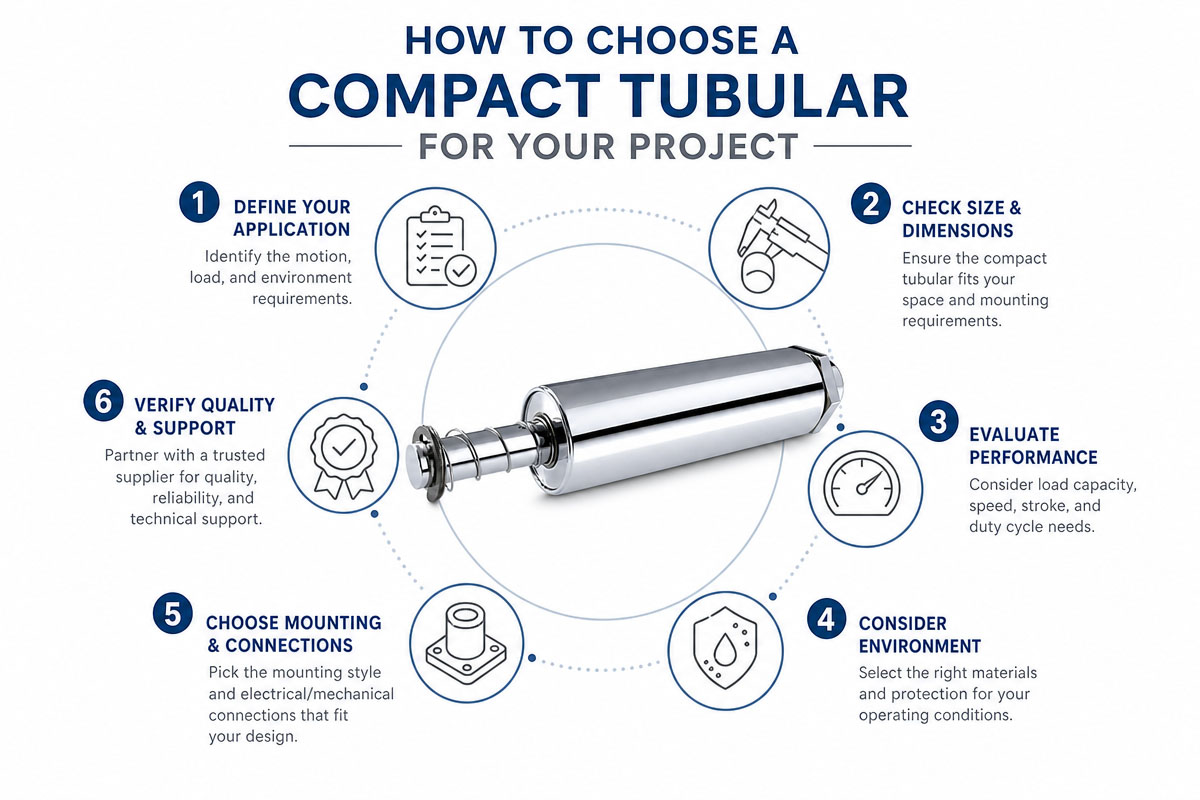
How to choose a Compact Tubular solenoid


Selection of the right compact tubular solenoid is not just selection of voltage and physical dimensions. The right actuator must be chosen based on the total requirements of the application: mechanical, electrical, thermal, and environmental.

1. Find the force needed

Evaluate the minimum force required at the actual working stroke. Pull and push forces can be very different, so in case of necessity, specify both.

2. Stroke length definition

Identify the stroke length (the distance the plunger travels). The available force usually changes depending on the stroke length and may require a different magnetic circuit.

3. Check operating voltage.

Specify the actual power supply, e.g., 24 VDC or other voltage. Also identify voltage variations that are acceptable.

4. Check the duty cycle.

Define if the solenoid operates continuously or periodically. More power will generate a lot of heat while continuous operation.

5. Consider response time

If your application requires fast automation cycles, specify energizing and release response times.

6. Installation space evaluation

Identify the overall diameter, length, mounting position, shaft size, connector position and available clearances. Smaller actuator does not always mean that it can provide the necessary force.

7. Define the return mechanism

Specify if the design requires return spring, gravity return, external load or any other return mechanism.

8. Consider environmental factors

Operating temperature, humidity, dust, vibration, corrosive environment and possibility of fluid contact must be taken into account.

9. Determine the service life

Specify the required number of operational cycles. The lifetime testing of industrial equipment must be representative for the actual load, stroke, voltage and duty cycle.

10. Discuss personalization early in the design

For OEM applications, provide the manufacturer with a 2D drawing, 3D model, force/stroke requirements, voltage, duty cycle, installation constraints, and target lifetime. It allows the supplier to optimize the design of the electromagnetic and mechanical part of the device rather than just adapt existing standard products.

Tips to Avoid Common Design Mistakes

There are several design mistakes that can reduce the performance of a compact tubular solenoid or increase the development cost.

Pitfalls to avoid

1. Voltage selection only

Since the machine works on 24 VDC, it does not automatically mean that it is a good match for a 24 VDC solenoid. Also the stroke, duty cycle, power, and force must be matched.

2. The real blow: neglecting the force

Always consider the force at the required working position, not only the initial pull force.

3. Too much power

More is not always better in the matter of watts. Excess power can cause the rise of temperature and reduction of coil life.

4. Ignoring duty cycle

The solenoid designed for intermittent duty cycle can overheat during continuous operation.

5. Inadequate mechanical clearance

Check the full travel of the plunger, the shaft extension, the mounting tolerance and the surrounding parts.

6. Tolerance stack-up

Remember that the housing, shaft, mounting holes and machine components must be with the appropriate dimensional tolerances.

7. Heat dissipation is ignored

Compact medical or automation equipment can trap the heat near the actuator.

8. Only unloaded operation test

The performance must be tested under real mechanical load and working conditions.

9. Free-plunger magnetic analysis

The magnetic performance is directly related to plunger dimensions and materials.

10. Waiting too long to call the manufacturer

Early discussion with the manufacturer will help to avoid costly tooling and redesigning problems.


Get A Free Quote Now

Contact Form

Related Products

Related News

Scroll to Top

Get A Free Quote Now !

Contact Form
If you have any questions, please do not hesitate to contact us.
Weilong Solenoid Company Culture