Custom Metering Solenoid for Fluid Control Systems
Industrial Metering Solenoid Design and Manufacturing
Reliable Metering Solenoid Supplier for OEM Projects
Metering Solenoid Technology Trends and Future Growth
Compact Metering Solenoid for Automation Equipment
Metering Solenoid for Medical Equipment and Devices
Custom Metering Solenoid for Fluid Control Systems
Industrial Metering Solenoid Design and Manufacturing
Reliable Metering Solenoid Supplier for OEM Projects
Metering Solenoid Technology Trends and Future Growth
Compact Metering Solenoid for Automation Equipment
Metering Solenoid for Medical Equipment and Devices

WL6940 Metering Solenoid Manufacturer for Industrial Control Solutions

The metering solenoid is a specialized electromagnetic element designed to provide precise control of industrial and commercial equipment. The solenoid provides precise linear motion control with the help of controlled magnetic field. These products are available in various types of voltage, size, stroke and force depending on the application requirements.

Modern metering solenoids are characterized with compact design, quick response, low power consumption and long service life . The products are widely used in automation equipment, medical devices, fluid management systems, fuel control units and laboratory instruments. To design a good metering solenoid one needs to optimize magnetic design, use durable materials, precise manufacturing and performance testing. Customized solutions can help to increase system efficiency and reliability for engineers.

Compact Metering Solenoid Product Overview

A metering solenoid is an electromagnetic control device intended to provide precise mechanical motion for controlling the fluid, gas or process systems. An electromagnetic control device transforms electrical energy into linear motion by using a magnetic field generated by the coil. Voltage is applied to drive internal plunger to control the opening, closing or adjusting of metering mechanism. Unlike common solenoids, metering solenoids are made to be precise, repeatable and controllable. They are widely used in medical equipment, automation systems, fuel control, analytical devices and industrial machinery where precise flow regulation and reliable performance are needed.

How Does the Metering Solenoid Work?

The metering solenoid works on the principle of electromagnetism. The solenoid consists of the copper coil surrounding magnetic core and moving plunger.

When the electricity is supplied to the coil, a magnetic field is created. The magnetic field generates an electromagnetic force that pushes or pulls the plunger to move to the magnetic core.

The connected mechanism is driven by the motion of the plunger, e.g.:

Valves opening or closing

Fluid flow adjustment

Gas flow control

Creating the mechanical parts

When the power supply is cut off, the plunger returns to the initial position with the help of the spring or magnetic force.

The performance of the metering solenoid depends on:

Coil design

Magnetic circuit efficiency

Air gap distance

Materials of the plunger

Working voltage

The length of stroke

The well-designed metering solenoid will provide accurate, repeatable and stable control.

Metering Solenoid Main Features

The metering solenoid has the features of high precision movement, quick response, small size and reliable operation. The products provide precise electromagnetic control in applications requiring stable positioning and flow regulation. The special designs help to optimize the coil winding, magnetic circuit and mechanical parts to increase efficiency and reduce the heat generation. Metering solenoids are available to meet customers’ requirements for various voltage, stroke and force outputs. The products are reliable and have long lifespan in industrial conditions. Custom designs help manufacturers to develop solutions for medical equipment, automation systems, fluid control devices and other precise applications.

Compact Metering Solenoid Video

Compact Metering Solenoid Detailed Display

Compact Metering Solenoid Technical Data Sheet

rand Weilong Technology Model Number WL 6940
Rated Voltage (V) DC 12 or 24 V Rated Power(W) 10–60 W
Work Model  100 000 Lifespan Cycles Push PUll Force (N)  1-60N  at stroke distance of  0–2 mm
Stroke(mm) 3–10 MM Reset Time(s) 1 S 3S Off


Service Life 300 Thousand Times Certification CE,ROHS,ISO9001,
Material Carbon Steel Housing with Zinc Plated Coating Lead Wire Length(mm) 200
Install Style both side with three mounted Screw Holes for easy setting up Tolerance of Dimension  +/-  0.1 MM
Water-proof  None Insulation Class F  Cel.  150 Degree
Hi-Pot Test AC 600V 50/60Hz 1 s Non-excitation Holding Force 0
Working Temperature -10°C-100°C Duty Cycle 1-100%
Thread Depth(mm) / Payment Term TT, or LC At Sight
Sample Order Yes Warranty 1 Year
MOQ 500 pcs Supply Ability 5000 pcs per Week
Delivery Time 30 Days Port of Loading shenzhend

Why is the metering solenoid becoming popular?

The increasing accuracy, automation and energy efficiency of the modern industry is driving the popularity of the metering solenoids.

The industrial equipment goes towards the more sophisticated control system, for which precise electromagnetic components are crucial. The metering solenoids are compact, maintenance free, reliable and fast responding.

The increase in:

medical apparatus

intelligent manufacturing

industrial automation

fluid handling systems

energy saving technologies

is the driver of the precision control components demand.

In comparison with the conventional mechanical systems, metering solenoids are easy to control electronically and integrate with the intelligent systems.

The product performance is improved through the use of the tailored manufacturing technology, allowing engineers to design solenoids for the specific application.

The further development of automation and smart devices will make metering solenoids still relevant solution for future industrial control systems.

Compact metering solenoid Industrial Application

Compact Metering Solenoid Industrial Application

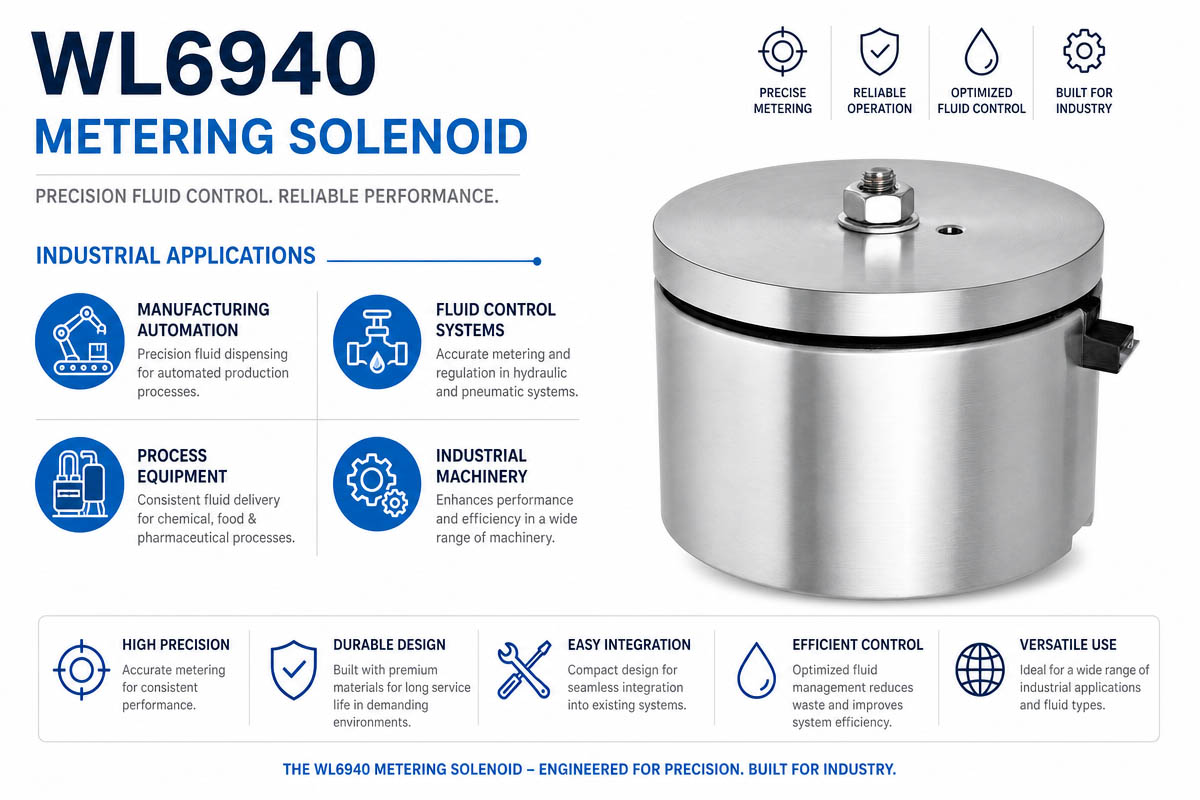
The metering solenoids are widely used in industries requiring precise electromagnetic control.

Medical Devices

The medical devices require precise and reliable fluid control. The metering solenoids are used in oxygen equipment, diagnostic devices, infusion systems and laboratory analyzers.

Industry Automation

The automation systems use metering solenoids to control pneumatic mechanisms, dispensing systems, robotic equipment and production machines.

Energy and Fuel systems

The fuel injection equipment and energy management systems require accurate control of liquid or gas flow. The metering solenoids provide quick response and stable operation.

Water and Fluid Management

The water treatment equipment, pumps, dispensing machines are another example of metering solenoids that control the flow and increase efficiency of the system.

Laboratory Equipment

The laboratory instruments require repeatability and precise control of the process. The metering solenoids are used to guarantee accurate measurement.

Smart Machines

The modern smart machines require compact and energy efficient elements. The metering solenoids are proved to have low power consumption and flexible integration.

The precision, durability and customizability of the metering solenoids make them necessary components of advanced industrial systems.

Compact Metering Solenoid Advantage and Disadvantage

Metering Solenoid Advantages and Disadvantages

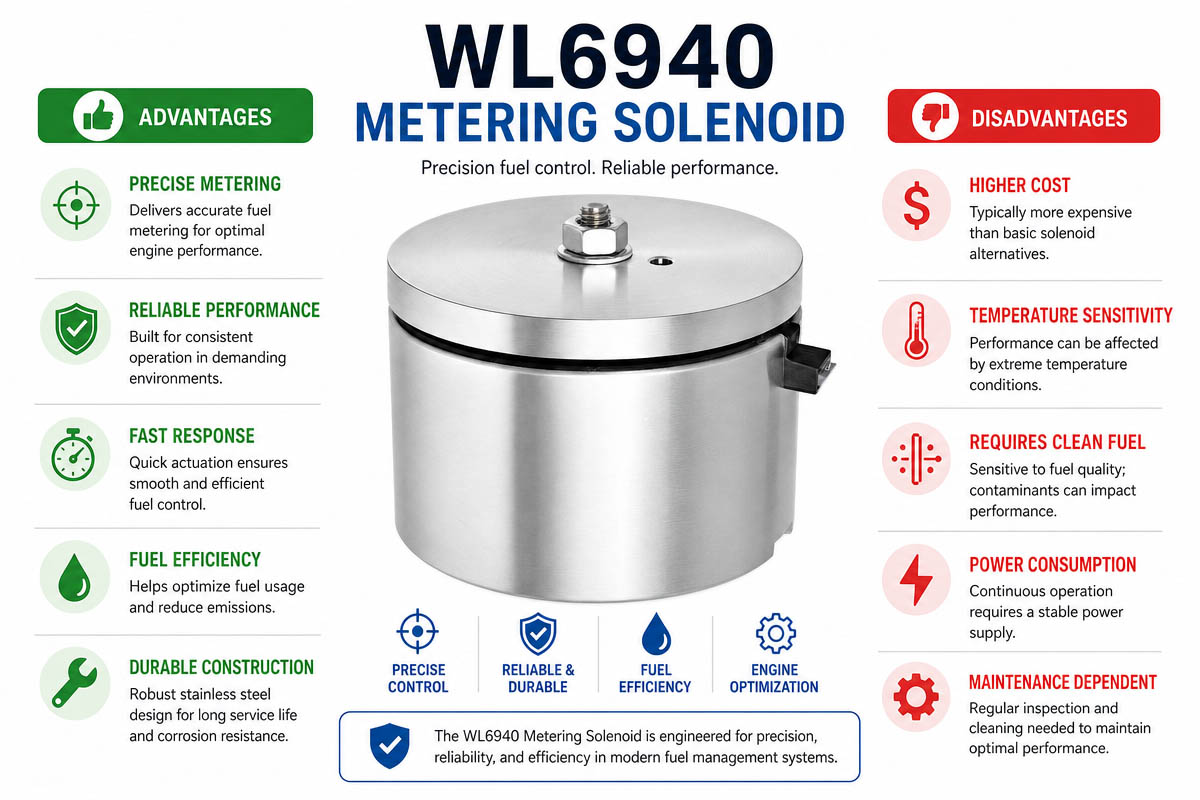
Compact Metering Solenoid Advantages

High Precision

The metering solenoids are suitable for precision applications; they provide accurate and repeatable motion.

Quick Response

The electromagnetic operation allows the quick switching and fast response.

Small Size

Because of small size, they are suitable for equipment with limited space.

Easy Integration

They are directly controlled by electrical systems.

Customization

Voltage, force, stroke and structure are adjustable by the manufacturer.

Compact Metering Solenoid Disadvantages.

Heat Generation

The continuous operation causes heating (the coil resistance).

Limited Strokes

The stroke length of the solenoid is usually less than some mechanical actuators.

Power Consumption

The electrical energy consumption during continuous holding operation.

Force and Distance Dependance

The magnetic force decreases with the increase of the air gap.

Environmental limitations

The special protection may be required in extreme temperature or corrosive environment.

But the proper design and selection can reduce the above disadvantages and improve performances.

Trouble Shooting Guide for Metering Solenoid

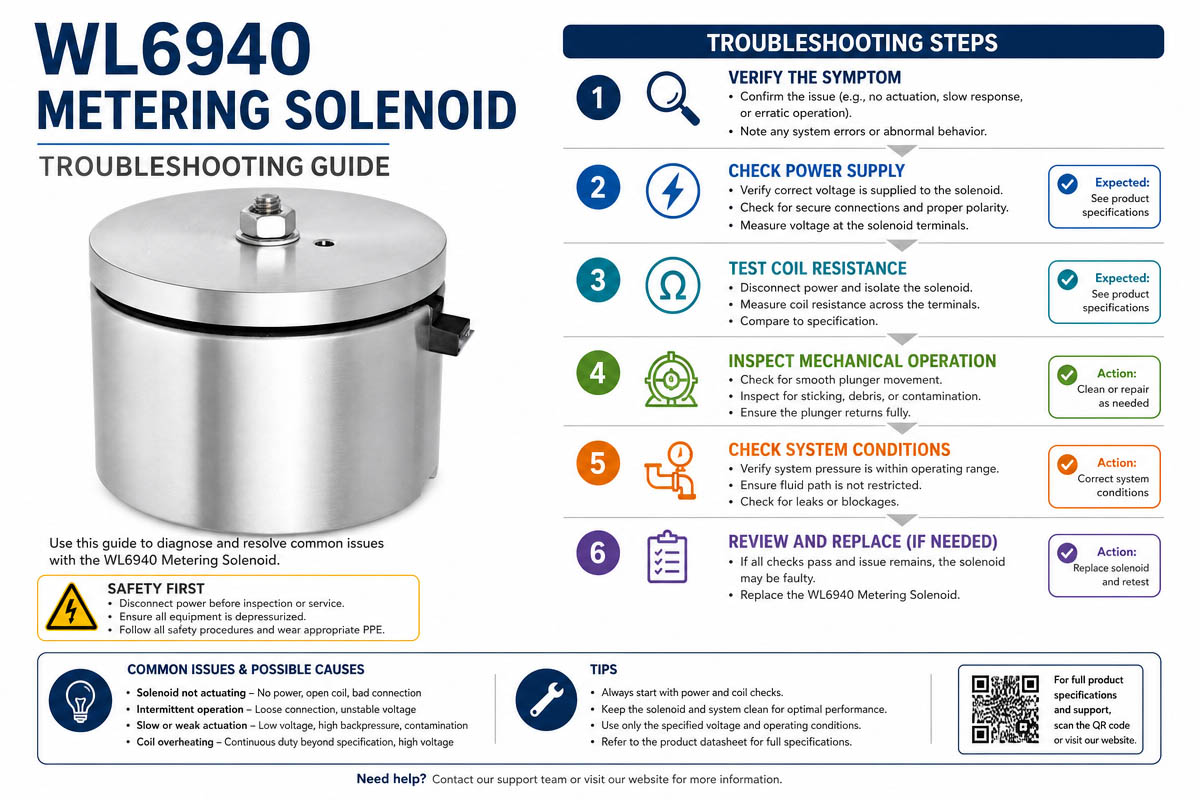
Metering Solenoid Troubleshooting Guide

1 .The Solenoid Does Not Operate

Possible reasons:

The wrong voltage

Failure of the coil

The wiring issue

Failure of the controller

Solutions:

Check the power supply and measure the resistance of the coil.

2. The Weak Nuclear Interaction

Possible reasons:

The low voltage

The incorrect coil specification

The overload of the mechanical stress

Large air gap

Solutions: 1.

Check operating conditions Design the magnetic circuit properly.

3. Overheating

Possible Reasons:

The wrong duty cycle

Over voltage

The bad heat dissipation

Solutions: 1.

Choose the appropriate voltage and improve thermal management.

4. Late Response

Possible Causes:

The mechanical friction

The dirty plunger

The improper spring design

Solutions:

Test the mechanical motion, increase the component precision.

5. Short Lifespan

Possible Causes:

Wear of the materials

Wrong load

Poor manufacturing quality

Solutions:

Use better materials and perform the life cycle testing.

The regular maintenance and the proper choice of products will ensure stable metering solenoid performance.

FAQs of Compact Metering Solenoid

1. What does the metering pump solenoid do?

The metering  pump solenoid allows the accurate electromagnetic control of mechanical motion in industrial systems. It converts electrical energy into linear motion to operate valves, fluid flow, gas flow, dispensing mechanisms and other precision components. The metering solenoids are widely used in medical equipment, laboratory instruments, automation systems, fuel control systems, water treatment equipment and industrial machines where accurate and repeatable operation is required.

2. How does the metering pump solenoid work?

The metering pump solenoid works through the generation of electromagnetic force in the coil. The DC voltage is applied and the current flows through the copper winding . The magnetic field is created. The magnetic field repels or attracts the inner plunger and generates linear motion . The connected mechanism is operated through the motion of the plunger (e.g. to open or close the valve, to adjust the flow). When you cut the power supply, the spring or the return mechanism pushes the plunger to its initial position.

3. What is the difference between the metering solenoid and the normal solenoid?

The main difference is the level of precision and the application of the solenoid. The common solenoid is primarily designed for ON/OFF operation. The metering pump solenoid is focused on the precision, repeatability and stable operation. Usually, the magnetic circuit of the metering solenoids is optimized, the mechanical parts are precise and the stroke and force are precisely controlled. They are ideal for applications where you need to adjust the precise fluid, gas or mechanical device. The common solenoids are usually used for switching.

4. How to choose the correct metering solenoid for your application?

When choosing the correct metering solenoid, the engineers should take into consideration the following factors:

Operating voltage (6V, 12V, 24V DC etc.) required

Required force out

The length of stroke

Duty cycle

Operating frequency

Area for installation

Environmental conditions

Lifetime required

The load characteristics and the safety margin should be taken into consideration as well. The cooperation with the experienced solenoid manufacturer will help you to optimize your design and avoid performance issues.

5. What affects the performance of the metering solenoid?

The performance of the metering solenoid depends on:

Coil design and quality of copper wire

Magnetic materials selection

Air gap distance

Plunger surface finish

Spring force *

The steady operating voltage

The temperature specifications

Mechanical alignment

Good magnetic circuit design and accurate manufacturing process improve the force output, response time, energy efficiency and lifespan.

6. Is the metering solenoid a continuous duty solenoid?

Yes, some metering solenoids are designed for continuous operation, but you have to design for the duty cycle you need. The solenoid is always operating. Due to the resistance of the coil, it heats up. In 100% duty cycle operation, the coil winding, magnetic materials and heat dissipation design are optimized by the manufacturers to reduce the temperature rise. For the intermittent application the small and energy efficient designs can be used. Always consider the duty cycle requirements when selecting a solenoid.

7. What are the most frequent problems with metering solenoids?

The most frequent metering solenoid problems are:

The solenoid doesn’t move:

Wrong voltage

Coil failure

Electrical problems

Low force production:

Low voltages

Loading calculation incorrect

Problems with magnetic circuit

Overheating:

Wrong duty cycle

Wrong voltage

Bad heat dissipation

Short life span:

Wear & tear

Bad material choice

Wrong application conditions

Most failures can be prevented by the proper design, testing and maintenance.

8. Can the metering solenoids be customized for OEM applications?

Yes. Most of the industrial metering solenoids can be customized to OEM requirements. The producers can customize:

Voltage.

Force production

Stroke length

The coil resistance

Size of housing

Connector type

Mounting frame

Plunger material

Security level

Custom solutions will allow engineers to increase the system integration, reliability and cost performance for specific applications. The design support from prototype development to mass production is also available from the professional solenoid manufacturer.

How to Choose the Metering Solenoid?

To choose the correct metering solenoid, you need to know both the application requirements and the technical specifications.

1. Definition of Application Requirements

Firstly, you need to define what you want the solenoid to control. Consider:

Fluid type

Operating environment

Space for installation

Operating frequency

Desired lifetime

The mechanical and electrical design depends on the application.

2. Select the Correct Voltage

The possible voltage values are:

6V DC

12V D.C.

24VDC

The effect of voltage on the power consumption, temperature and magnetic force should be studied.

3. Required Force Check

The solenoid needs to provide enough force to produce the desired movement.

The key factors are:

The load requirement

Frictional force

Safety buffer

Operation position

If the force chosen is too low, the operation will be unstable.

4. Determine the Stroke Distance

The stroke is the distance that the plunger moves.

The longer stroke usually requires:

Larger magnetic structure

More power consumption

Larger product size

5. Assess the Duty Cycle

The duty cycle impacts the heat generation.

If the solenoid is used:

All the time

Often

Sometimes and sometimes not

6. Lifetime Requirements Evaluation

The many industrial applications require more than 100,000 operations. Evaluate the following criteria.

Material quality

Spring endurance

Wear resistance

7. Choose a reliable supplier

The successful supplier should be able to provide:

Engineering support

Prototype testing

Quality inspection

The ability to design to order

Choosing the right metering solenoid will increase system reliability, reduce maintenance expenses and improve product performance.

How to Avoid Common Metering Solenoid Design Mistakes

Do not select the force without considering the loading conditions.

Do not design the solenoid without calculating the heat correctly.

Ignoring the duty cycle requirements is a mistake.

“Don’t choose a stroke longer than necessary.

The installation tolerances cannot be overlooked.

The environment should always be considered:

thermal

humidity

dust on floor

corrosion corrosion.

The magnetic circuit can be designed to avoid low efficiency.

Test the prototypes before mass production.

Choose the appropriate materials for the plunger and housing.

Work with the experienced solenoid manufacturers to design the solenoid.

Get A Free Quote Now

Contact Form

Related Products

Related News

Scroll to Top

Get A Free Quote Now !

Contact Form
If you have any questions, please do not hesitate to contact us.
Weilong Solenoid Company Culture
