Chapter 1: Introduction
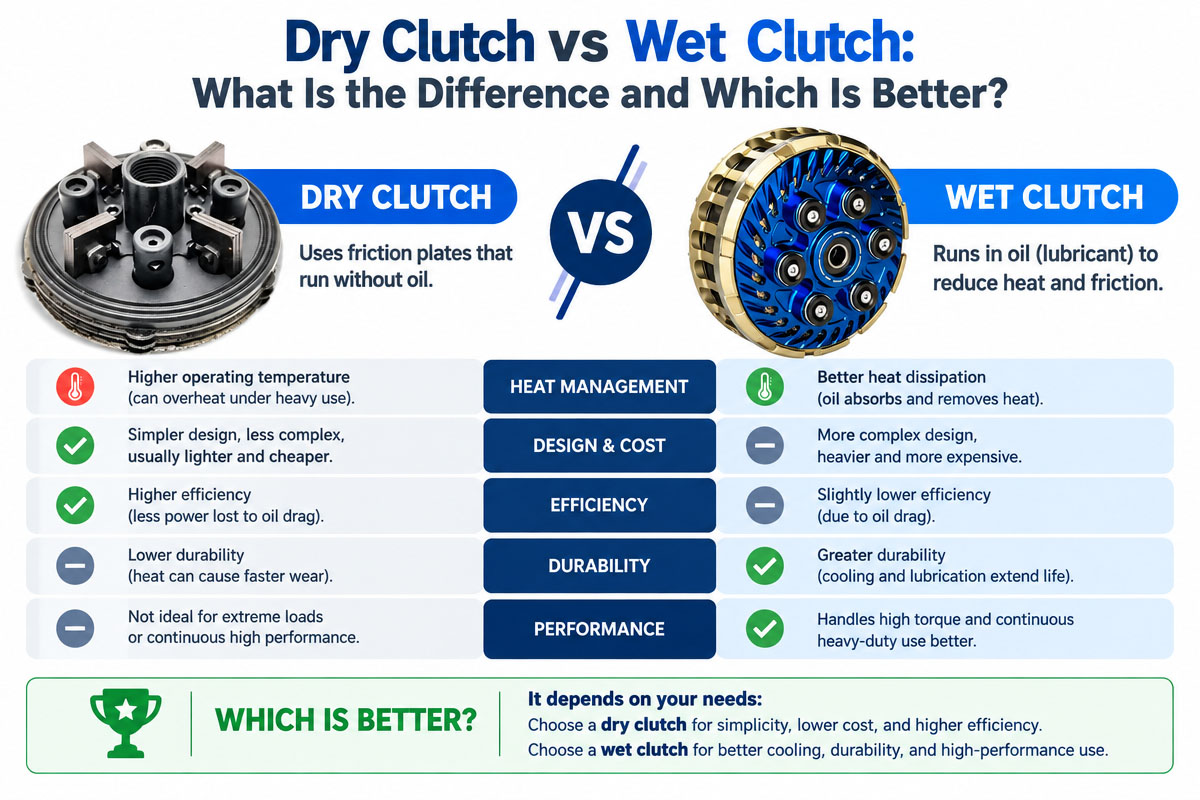
This is a very common question arising when talking about different kinds of clutch systems: what is the difference between a dry clutch and a wet clutch, and which is better?
The key distinction is that the latter is lubricated. A dry clutch system operates without any oil baths for the friction surfaces. A wet clutch uses its friction surfaces lubricated and cooled by the oil.
However, the differences are far beyond just lubrication. They affect heat management, friction properties, torque capacity, mechanical efficiency, noise, durability, maintenance, and overall vehicle/machine design.
The dry clutch does not operate in an oil bath and thus features reduced fluid drag and provides a good mechanical coupling. But it requires air and other components for heat dissipation and can overheat if it is slipping too much.
The wet clutch is lubricated and cooled by the oil on the friction surfaces. Thus, it is suitable for frequent engagement, slipping, and tough heat conditions. Wet clutches also tend to be smoother and quieter. The downside is increased fluid drag and greater dependence on the lubricant.
So what is better: dry clutch or wet clutch?
Neither of these systems is better per se. What will be better depends on the vehicle, transmission design, torque requirements, operating conditions, installation space, and cooling requirements.
This guide uncovers key distinctions between dry and wet clutches to help you understand the reason why the particular type of clutch is chosen.
Chapter 2: Dry Clutch vs. Wet Clutch—Which One Is Better?
Here is the simplest way to see the difference:
Dry clutch: Does not work in an oil bath with lubricating friction surfaces.
Wet clutch: Lubricating oil is used to bathe the friction plates.
A dry clutch will typically provide:
Reduced fluid drag
Personal contact
Good mechanical efficiency
Easy to use in correct applications
A wet clutch will provide:
Better heat management
Simplified onboarding
Less mechanical noise
Better performance with frequent operations
Multi-plate compact design
There is no universal best system.
Chapter 3: What Is a Clutch?
Before comparing wet clutch and dry clutch, it is important to understand what the purpose of the clutch is.
A clutch is a mechanical device that connects and disconnects the power transmission from the driving shaft to the driven shaft.
In a normal car the clutch connects and disconnects the engine from the transmission.
With an engaged clutch, the torque of the engine is transmitted through the clutch to the transmission and finally to the drive wheels.
With a disengaged clutch, the power transmission is interrupted. It allows changing gears or stopping the car without stopping the engine.
Torque transmission takes place via friction clutches.
When the friction surfaces are pressed together with enough force, they rotate together and transmit torque. When the clamping force is removed, the surfaces are free to rotate separately, and torque transmission is interrupted.
The main difference between wet and dry clutches lies in the way of lubricating and cooling these friction surfaces.
Chapter 4: What Is a Dry Clutch?
A dry clutch is a clutch with its friction surfaces not immersed in the lubricating oil.
The vast majority of conventional manual transmission cars use a dry single-disc clutch. Dry multi-plate clutches are also found in some motorcycles, racing cars, some performance vehicles, and some transmission systems.
A dry clutch, with its engagement, presses the friction surfaces against each other.
The produced friction allows the engine to transmit the torque through the clutch into the transmission.
A dry clutch provides a strong and direct mechanical connection with minimized fluid resistance since there is no continuous oil flow between the friction surfaces.
That helps with one of the main advantages of the dry clutch system: reduced fluid drag.
However, the lack of oil cooling leads to one of the main disadvantages: poor heat management.
If a clutch is slipping or partially engaged, mechanical energy is converted into heat.
If the dry clutch is slipping repeatedly, making hard launches, driving in stop-and-go traffic or operating in harsh conditions, it can get hot rather fast and, without oil circulation to cool it, can overheat.
Chapter 5: How Does a Dry Clutch Work?
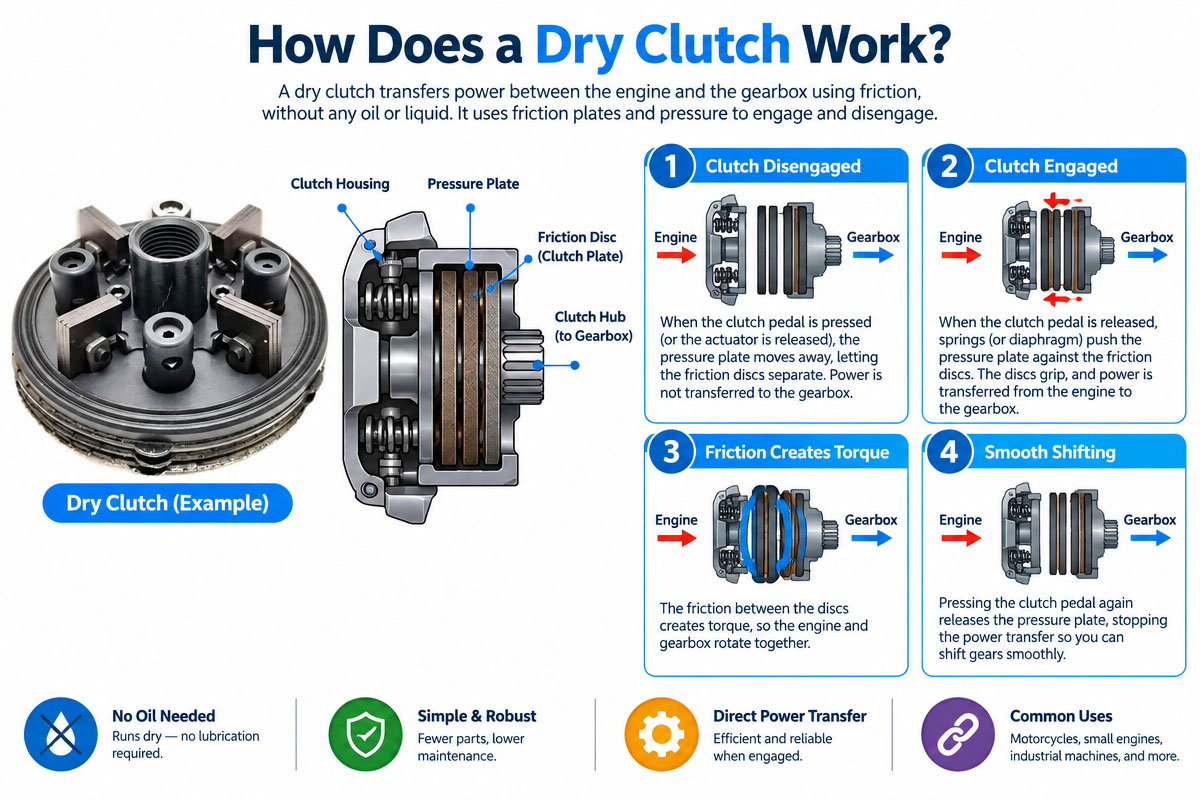
A typical dry clutch in the manual-transmission car consists of the following components:
Flywheel:
Friction disk
Pressure pads
Clutch cover
Release mechanism
The friction disk is put between the pressure plate and the flywheel of the engine.
With the clutch engaged, the pressure plate presses the friction disk tightly against the flywheel.
The friction between these components allows the engine torque to be transmitted through the clutch disk into the input shaft of the transmission.
When the driver presses the clutch pedal, the release mechanism decreases the pressure on the friction disk.
Then the disk moves far enough from the flywheel to interrupt power transmission.
This system works very well because the friction surfaces can transmit a large amount of torque without any oil bath.
But do not slip the clutch too much.
The longer time the clutch is partially engaged, the more frictional energy is converted into heat.
That heat can cause wear and, in the end, glazing, distortion, slipping, or decreased performance of the clutch.
Chapter 6: What Is a Wet Clutch?
wet clutch n. A clutch in which the friction plates are immersed in or lubricated with oil.
Wet clutches typically have multiple alternating plates of steel and friction material instead of one large friction disk.
This multi-plate design provides a large total friction surface in a compact clutch assembly.
Wet multi-plate clutches are common in:
Motorbikes
Vehicles, powersports
Automatic transmissions
Dual-clutch gearboxes
Farm machines
Industrial equipment
High-performance powertrains
The oil around the clutch performs several important tasks.
It allows to:
Provide lubricant to parts.
Manage the friction characteristics.
Decrease mechanical noise.
Reduce wear of certain parts.
Dissipate heat from the clutch.
One of the major benefits of the wet clutch design is its heat management capability.
Wet clutches are particularly useful when the clutch is frequently engaged and disengaged because the oil can dissipate the heat produced by the clutch.
Chapter 7: How Does a Wet Clutch Work?
A wet clutch works on the same principle as the dry clutch—friction, but the friction surfaces are bathed in the lubricating oil.
There are multiple friction plates and steel plates, placed alternately one on another.
Pressing the clutch pack presses the plates together.
As the plates lock each other, they start rotating as a unit, transmitting torque from the engine or power source into the transmission.
With the removal of the clutch pressure, the plate pack can slip enough to interrupt or decrease torque transmission.
During operation, the oil circulates around the clutch components.
The lubricant absorbs frictional heat and transfers it from the clutch assembly.
Chapter 8: Dry Clutch vs. Wet Clutch: Key Differences
|
Feature |
Dry Clutch |
Wet Clutch |
|
Lubrication |
Operates without an oil bath |
Friction plates operate in oil. |
|
Cooling |
Mainly through air and surrounding components |
Oil helps absorb and remove heat. |
|
Fluid Drag |
Generally lower |
Some energy lost through oil drag |
|
Engagement |
Can feel direct and sharp |
Usually smoother and more progressive |
|
Heat Management |
More sensitive to repeated slipping |
Better suited to repeated thermal loads |
|
Noise |
Can be louder |
Usually quieter |
|
Construction |
Often single-plate in manual cars |
Frequently multi-plate |
|
Common Applications |
Manual cars, racing, some DCTs |
Motorcycles, DCTs, automatic systems |
|
Maintenance |
Wear and overheating are major concerns. |
Oil condition and specification are important |
And that’s not the main thing that makes them differ.
It influences the cooling capacity, friction characteristics, efficiency, noise, packaging, maintenance needs, and durability in repeated operations.
Chapter 9: Advantages of a Dry Clutch
9.1 Reduction of Fluid Drag
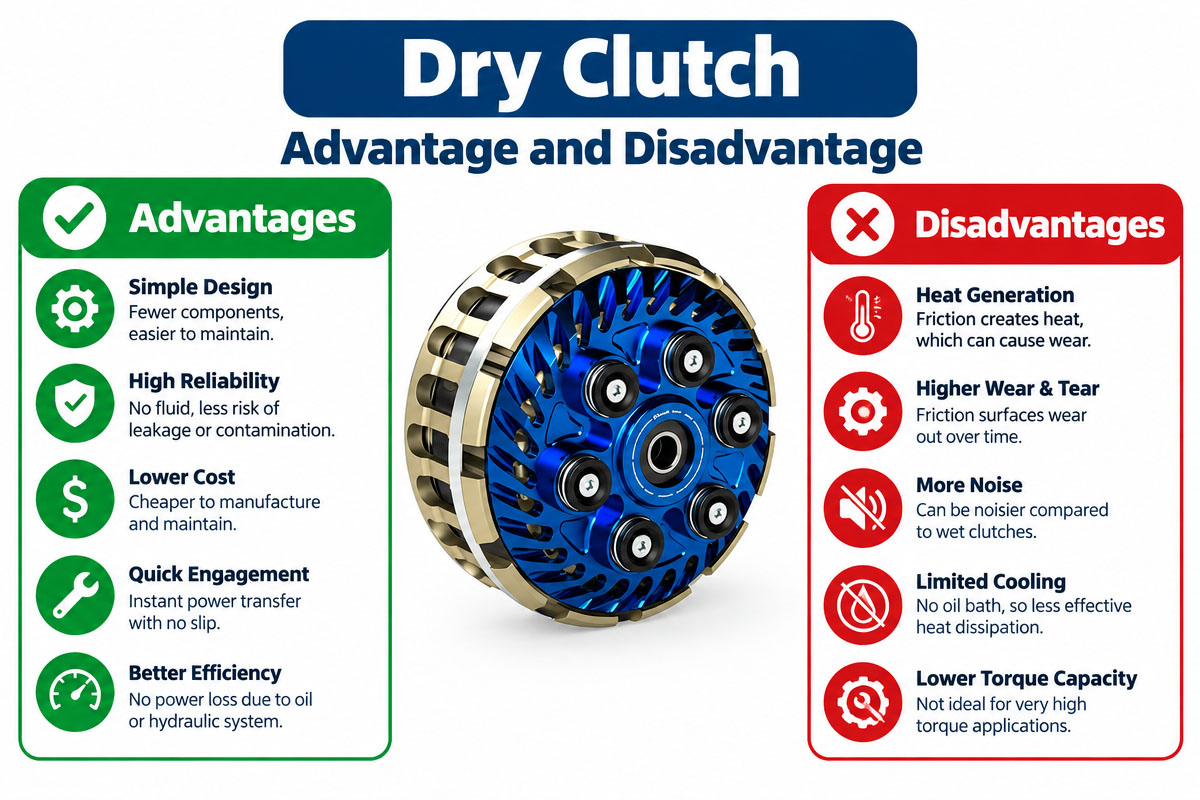
The main benefits of a dry clutch are low fluid drag.
The clutch doesn’t operate in an oil bath, thus requiring less energy to overcome the resistance of the viscous lubricant.
This can increase the mechanical efficiency under similar conditions as a wet clutch system.
9.2 Instant Engagement
Dry clutches can provide a very instant feeling of engagement.
This feature can be beneficial in manual transmissions and some performance applications where instant torque transfer is needed.
There is no oil film between the primary friction surfaces. It is good for the direct mechanical coupling.
9.3 Simple and Efficient Design
Manual transmission vehicles have successfully used the conventional dry single-plate clutch design for decades.
The design is relatively simple and works well in applications where the clutch is mostly fully engaged.
A dry clutch has normally very small friction wear when it is fully engaged, unlike when it engages.
9.4 Doesn’t share oil with the friction materials of the clutch
In applications where the dry clutch is isolated from the engine lubrication system, the friction material generated by the wear of the clutch is not circulated through a common engine oil supply.
It can reduce the lubrication requirements compared to systems where the clutch shares the oil with other mechanical parts.
Chapter 10: Disadvantages of a Dry Clutch
10.1. Poor Heat Handling
The biggest disadvantage of a dry clutch is the question of heat handling.
Slipping of the clutch generates heat.
A dry clutch doesn’t have any oil flowing across the friction surfaces to cool them. The temperatures can rise quickly in repeated slipping.
10.2 Sensitive and intensive use
Difficulties with the dry clutches can occur in:
Heavy stop-and-go traffic lots
Intensive launches
Repeated hill starts
Towing service
Competition
Repeated slipping of the clutch
Excess heat can increase the wear of the friction material and even cause glazing, deformation, clutch fade, or slipping.
10.3 Can Produce Noise
Dry clutches can produce more noise than wet clutches.
Dry multi-plate clutches of motorcycles are known for their distinct mechanical sound, as there is no oil to dampen vibrations and noise.
Chapter 11: Advantages of a Wet Clutch
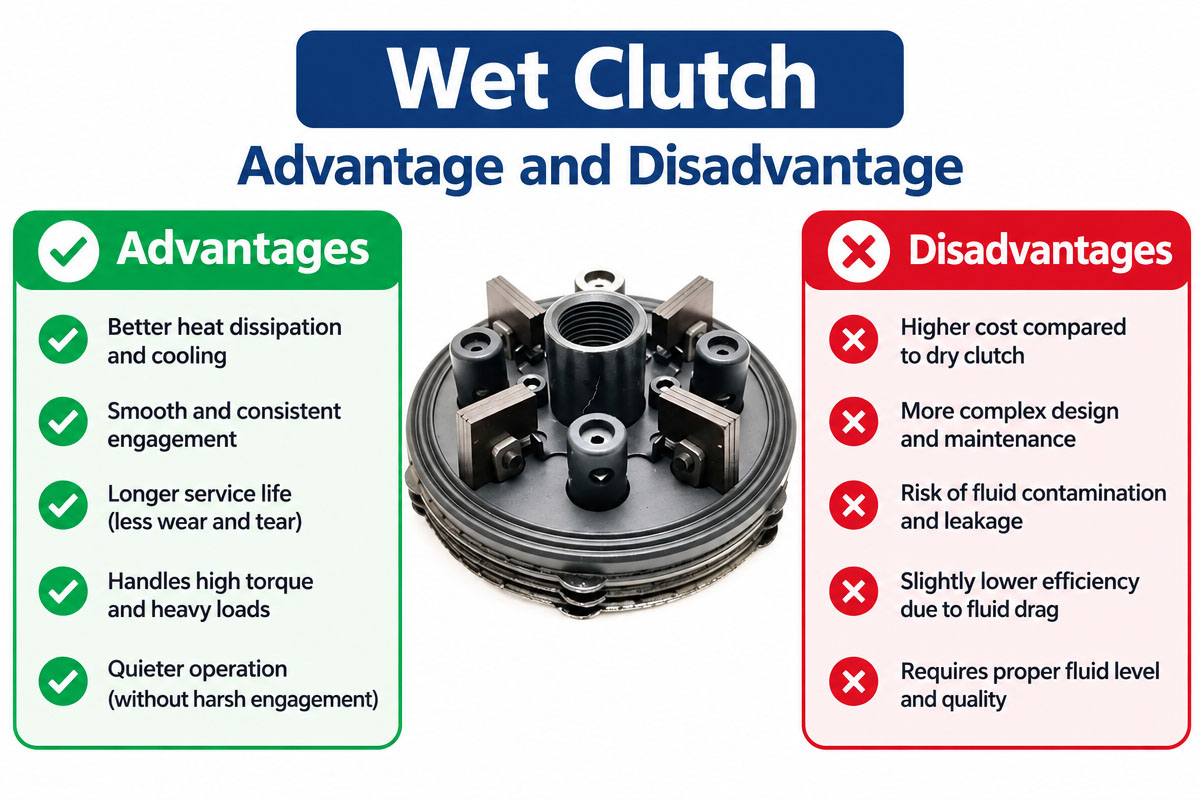
11.1 Improved Thermal Management
The main advantage of a wet clutch is the heat dissipation.
The oil absorbs the heat generated by the friction plates and dissipates it from the surfaces of the clutch.
Therefore, wet clutches are normally able to endure repeated engagement and slipping better than corresponding dry systems.
11.2 Easy Engagement
Wet clutches usually provide smooth, gradual engagement.
The friction surfaces engage with the help of the lubricant and can be used to regulate the torque transfer.
This feature is especially beneficial for motorcycles and automatic transmission systems.
11.3 Reduced Noise
The oil damps mechanical vibrations and noise.
Therefore, wet clutch systems are generally less noisy than dry clutch designs of similar performance.
11.4 Multi-plate Compact Design
Wet clutches are usually made of several smaller plates.
It allows a large total surface area of friction without an excessively large clutch diameter.
This compact design is especially useful for motorcycles and other equipment with restricted installation space.
Chapter 12: Disadvantages of a Wet Clutch
12.1 Fluid Drag
The biggest drawback of a wet clutch is the increased drag of the oil.
They work like clutch parts rotating in a lubricant, experiencing fluid drag.
This results in some parasitic losses of energy compared to a dry clutch working outside the oil bath.
12.2 Oil Selection Is Important
The selection of lubricant is especially important for wet clutches.
Many motorcycles use the same oil in the engine, transmission, and clutch.
Therefore, the lubricant must be able to provide the needed protection and at the same time have the necessary friction properties for the clutch.
Poor functioning or slipping of the clutch can be caused by improper lubricant selection.
11.3 Lubrication needs of greater complexity
Wet clutches can require more complex lubrication compared to a simple dry clutch system.
Chapter 13: Dry Clutch vs. Wet Clutch: Which One Has a Longer Service Life?
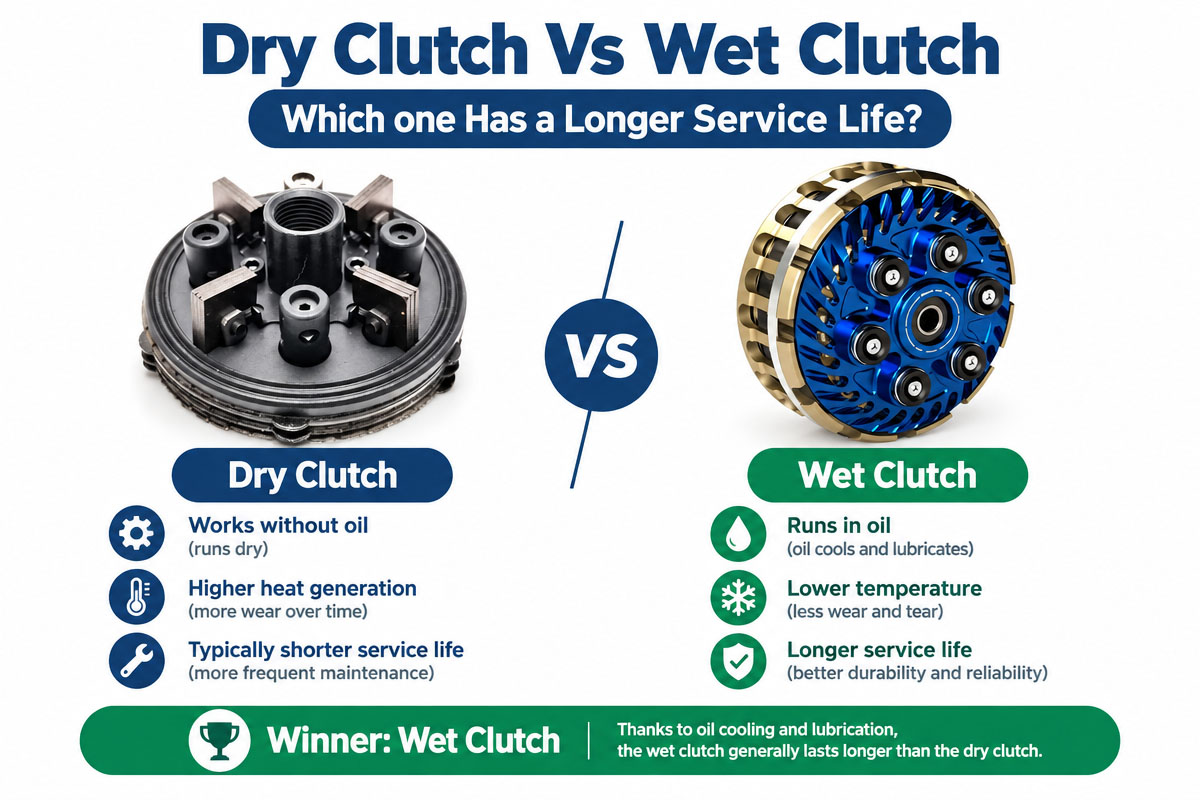
There is no straightforward answer as for which clutch lives longer.
The service life of a clutch is influenced by such factors as
Clutch Design Materials
of Friction Engine’s
Torque Vehicle Weight
Operating Temperature Range Maintenance Driving Conditions
Driving Technique
In case of repeated engagements producing significant heat, a wet clutch has one important advantage: the oil handles the operating temperature.
This doesn’t mean that the dry clutch will necessarily have a short lifespan.
The dry clutch in a manual car, if used properly, can have a long lifespan, as it wears only insignificantly while fully engaged.
Almost all of the clutch wear is occurring during slipping.
Thus, proper operating technique can significantly prolong the lifespan of a dry clutch.
Chapter 14: Why Wet Clutches Are Popular in Motorcycles
Many motorcycles employ wet multi-plate clutches because they are compact and have good heat management.
There is little room inside a motorcycle engine and transmission assembly.
To achieve the needed torque capacity, instead of one large friction disc, the engineers can use several smaller friction plates.
Motorcycle drivers might also use the clutch intensively during:
Slow-speed riding traffic starts, stops, and maneuvers.
Gear shifts: These conditions are perfectly met by the oil cooling of the wet clutch.
The wet clutches also work smoothly and are relatively quiet.
But not all the bikes use wet clutches. Dry clutches are also successfully used in some performance-oriented motorcycles.
Chapter 15: Why Are Dry Clutches Used in Cars?
Dry clutches are usually used in conventional passenger cars with manual transmissions, as the clutch doesn’t need to slip constantly in regular driving.
While the vehicle is moving and the clutch is fully engaged, the flywheel, clutch disc, and pressure plate rotate almost as one piece.
There is little frictional wear until the clutch is disengaged and engaged again.
Also, one relatively large dry friction disc can be successfully installed between the engine and manual transmission.
For such applications, the dry clutch is an optimal solution because of its simplicity, efficiency, and direct torque transfer.
However, as nowadays the vehicles use a variety of transmission technologies, it should be noted that not all the vehicles have a dry clutch.
Chapter 16: Dry Clutch and Wet Clutch in Dual-Clutch Transmissions
Another important aspect of the discussion of dual-clutch transmissions, commonly called DCTs, is the comparison between dry clutch and wet clutch.
Dual-clutch transmissions have two clutches, each controlling a certain set of gears.
The manufacturers can use dry or wet clutch packs depending on the transmission design.
DCT Dry Clutch
Dry-clutch DCT systems provide:
Lower fluid drag Good mechanical efficiency Compact design for adequate torque levels They are generally designed for applications where the torque and thermal requirements are within the system’s capabilities.
Wet-Clutch Dual-Clutch Transmission
Benefits of wet-clutch DCT systems include:
Oil cooling: superior heat management Ability to operate in severe thermal environments High torque application potential But the transmission performance depends on the entire engineering design.
Only the type of clutch cannot determine whether a particular DCT is reliable, smooth, or efficient.
Chapter 17: Is a Wet Clutch Better for High Torque?
Wet multi-plate clutches can be engineered to be relatively compact and yet to handle a substantial torque.
The additional friction surfaces allow increasing the torque capacity without a considerable increase in the clutch diameter.
The oil cooling also helps with temperature regulation under harsh conditions.
But the dry, multi-plate clutches can also be engineered for high torque.
The torque capacity depends on the entire clutch design, consisting of:
Friction material diameter of plate Number of friction surfaces Retaining force cooling system temperature work Duty cycles: This doesn’t mean that the wet clutch is stronger just because it operates in oil.
Chapter 18: Performance selection guide for the dry clutch vs. the wet clutch
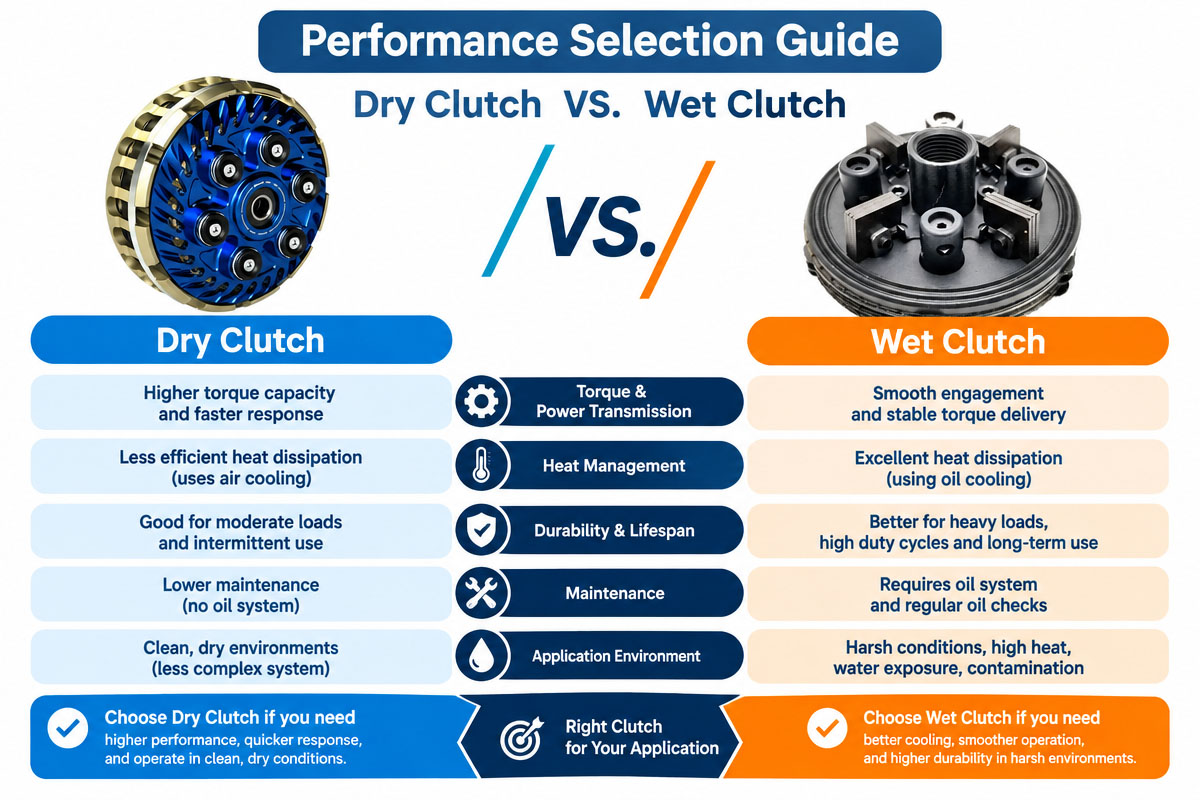
A dry clutch can be advantageous in terms of direct mechanical efficiency and instant engagement, as it reduces some drag associated with rotation in the oil.
The wet clutch can be advantageous in repeated launching, frequent clutch operations, slipping, and severe thermal conditions due to superior heat management.
That’s why both clutch types are used in performance applications.
The engineers choose the clutch depending on the system’s requirements, such as
Output Torque, Rated Torque, Cooling, Packaging, and Durability Weight Engagement Features Mechanical Efficiency.
Which is Better, a Dry Clutch or a Wet Clutch?
There is no clear winner in the dry clutch vs. wet clutch comparison.
A dry clutch is usually suitable for applications where:
Low fluid drag is required. Attention is paid to the mechanical efficiency.
Instant engagement is required. The clutch doesn’t slip constantly
And in case when the wet clutch is especially appropriate:
Heat management is the critical factor. Frequent operations are required. Smooth engagement is desirable. The compact multi-plate design is advantageous. Repeated thermal loads are expected. The best clutch is the one designed for the particular needs of the vehicle or machine.
Chapter 19: FAQs on Dry and Wet Clutches
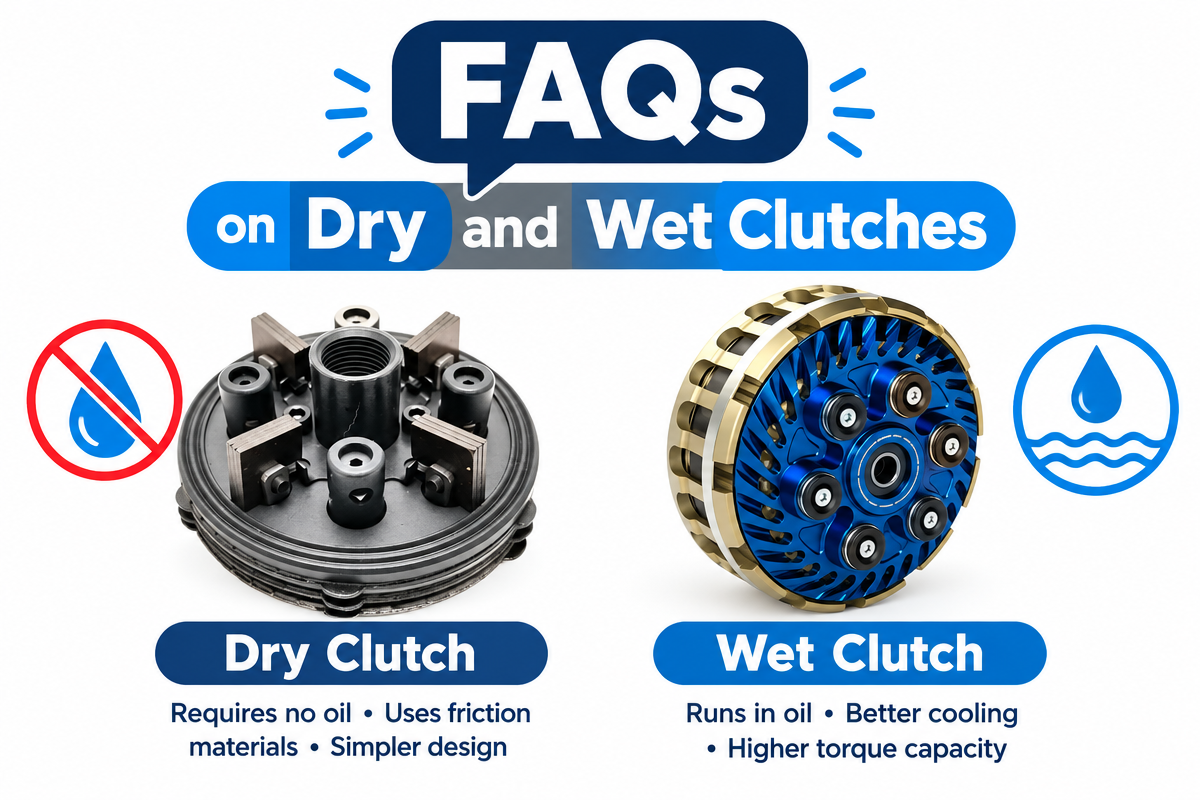
1. Is a wet clutch better than a dry clutch?
Not really. Wet clutches are oil-cooled. The clutch life is determined by the design, maintenance, conditions, heat, torque, and driving/riding technique.
2. Why are wet clutches used in motorcycles?
Wet, multi-plate clutches are compact, provide good heat dissipation, can handle high torque, and provide smooth engagement.
3. Why do dry clutches exist in manual cars?
In a conventional manual car the clutch is engaged a lot of the time while it is being driven, so it doesn’t always require oil cooling. The dry clutches can also provide direct torque transfer.
4. Can a wet clutch fail?
The oil does cool, but yes, a wet clutch can overheat if it slips too much or is subjected to thermal loads exceeding the design limits.
5. Can a dry clutch overheat?
Yes. In dry clutches, there is no oil flowing to directly cool the friction surfaces, so they are especially sensitive to heat generated from slipping.
6. Do I need a special oil for a wet clutch?
The proper lubricant selection is important for wet clutch operation. Always use the oil type and specification recommended for your particular vehicle.
7. Is a dry clutch more efficient?
The dry clutches, not operating in the oil bath, can have reduced drag. But the overall system efficiency depends on the design of the entire powertrain.
8. Can I use a dry or wet clutch in a performance vehicle?
Yes. Both dry and wet clutches can be engineered to be performance-oriented. The selection is determined by torque, cooling, packaging, efficiency, and operating requirements.
Chapter 20: Conclusion on Dry Clutch vs. Wet Clutch Explained
The principal difference between a dry and a wet clutch is the lubrication, cooling, and performance characteristics.
A dry clutch doesn’t use an oil bath, thus having less fluid drag and often providing higher efficiency and direct torque transfer. But it provides less help in heat dissipation and can be subjected to accelerated wear in case of repeated slipping or overheating.
In a wet clutch, the friction plates are located in oil. This allows better cooling, easier engagement, and less mechanical noise. The trade-offs are the additional fluid drag and the need for proper lubricant.
So, in the case of dry clutch vs. wet clutch, which is better? There is no universal solution.
The dry clutches are perfect for many manual vehicles and performance uses. The wet clutches are ideal for many motorcycles, dual-clutch transmissions, and powersports vehicles and applications requiring frequent clutch operation and heat management.
The most important thing is to choose the clutch technology appropriate for the particular application.
Knowing the differences allows us to understand why the manufacturers may choose the different clutch technologies and why the proper operation, lubrication, cooling, and maintenance are key to the best performance and service life of the dry or wet clutch.