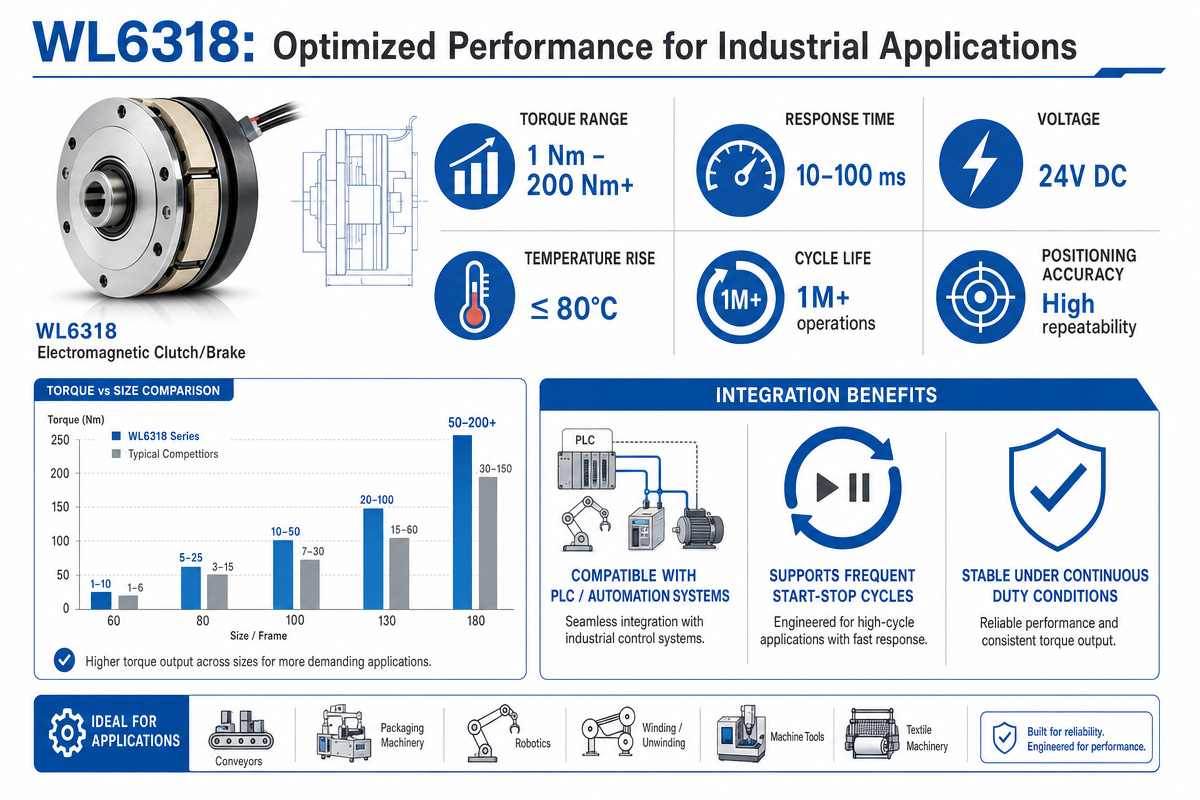
24V Electromagnetic Clutch for Automation Use
High Performance 24V Electromagnetic Clutch
24V DC Electromagnetic Clutch Reliable Power
24V Electromagnetic Clutch for Machinery
Compact 24V Electromagnetic Clutch Solution
Durable 24V Electromagnetic Clutch Systems
24V Electromagnetic Clutch for Automation Use
High Performance 24V Electromagnetic Clutch
24V DC Electromagnetic Clutch Reliable Power
24V Electromagnetic Clutch for Machinery
Compact 24V Electromagnetic Clutch Solution
Durable 24V Electromagnetic Clutch Systems

WL6318 Industrial 24V Electromagnetic Clutch Guide

A 24V electromagnetic clutch is an electromechanical device that uses the direct current of 24 volts to operate in order to regulate the transfer of the motor torque via connecting two rotating shafts. The electromagnetic actuation occurs through the energizing of the internal coil, thus creating the magnetic force, which draws the armature plate and puts it in contact with the rotor, allowing motion transmission. In case of cutting off the power, the clutch automatically switches off, disengaging from action. High precision in motion control makes these types of clutches indispensable in industrial automation systems, conveyors, packaging machines, robotics, and other areas.

Key Features of 24V Electromagnetic Clutch

Reliability and fast response are the main advantages of 24V electromagnetic clutches, making them perfect for use in industrial automation. They operate under the 24V DC voltage, which is energy-saving and harmless. Due to its compactness and solid construction, it allows integrating this device in almost any machine. It generates torque steadily and without noise or vibrations. Besides, it can withstand a high duty cycle and has an outstanding life time due to durable friction materials. Compatibility with a PLC system helps to automate the production processes.

Reliability and low maintenance costs have turned the 24V electromagnetic clutches into an integral part of modern machinery

24V Electromangetic Clutch Product Overview

The 24V electromagnetic clutch is an important element in motion control systems. Designed specifically for industrial automation, it possesses many useful features, including fast and accurate engagement. Being powered from a 24V DC source, it can safely operate within PLC systems. Compact size and robust construction make it suitable for integration in various applications, including conveyors, packaging machines, and robotics. 24V electromagnetic clutches are the best choice for enhancing efficiency and productivity in manufacturing.

24V Electromagnetic Clutch Product Video

24V Electromagnetic Clutch Detailed Display

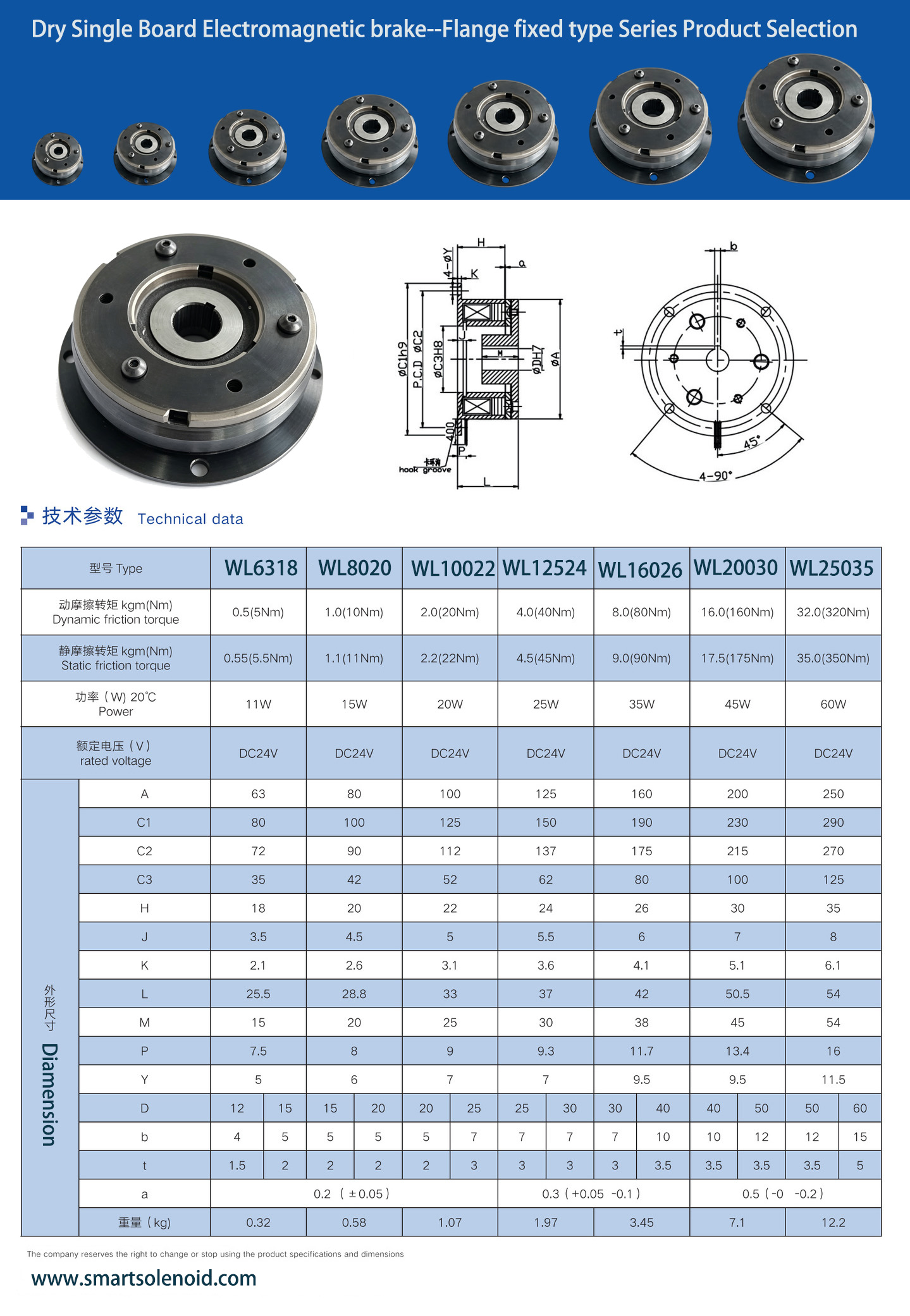
24V Electromagnetic Clutch Technical Data Sheet

24V Electromagnetic Clutch Technical Specification
Brand Weilong Technology Model Number WL6318
Rated Voltage (V) DC 24 V Rated Power (W)  5.8 W
Work Model Power on to hold Holding Force (N)  1500 GF
Electromagnetic clutch  Flange Fixed Type Reset Time(s) 0.3 sec. on, 0.3 sec. Off
Service Life a hundred thousand times. Certification CE, RoHS, ISO9001,
Material Carbon Steel Housing with Teflon-Plated Coating Lead Wire Length (mm) 200
Install Style Adjustable Screw Tolerance of Dimension  +/-  0.1 MM
Water-proof  None Insulation Class F   155 Degrees
Hi-Pot Test AC 600V 50/60Hz 2s Non-excitation Holding Force 0
Working Temperature -10°C-100°C Duty Cycle 1-100%
Thread Depth (mm) / Payment Term TT, or LC At Sight
Sample Order Yes Warranty 1 Year
MOQ 1000 pcs Supply Ability 5000 pcs per Week
Delivery Time 30 Days Port of Loading shenzhen


24V Electromangetic Clutch Industrial Application

24V Electromagnetic Clutch Industrial Application Guide

The 24V electromagnetic clutches are highly effective in many industries due to their reliable performance. Motion control and coordination of machine parts are crucial in automation systems; that is why they should be carried out precisely. The clutches are able to perform smooth start-stop processes and efficient conveyance.

Packaging machinery with 24V clutches can achieve high precision while working, improving production efficiency and minimizing scrap. 24V electromagnetic clutches are also employed in controlling the rotational motion of CNC machines with the aim to increase their accuracy. Robotics needs controlled movements and fast responses, which the 24V electromagnetic clutches provide.

This type of clutch proves to be efficient when used in printing presses, textile machinery, and food processing equipment where torque is generated constantly. Additionally, it is a valuable element of the automotive industry, especially compressor systems.

Due to its performance in harsh conditions, the 24V electromagnetic clutch is optimal for modern production facilities. Moreover, it is able to be integrated in PLC systems in order to enhance the automation processes.

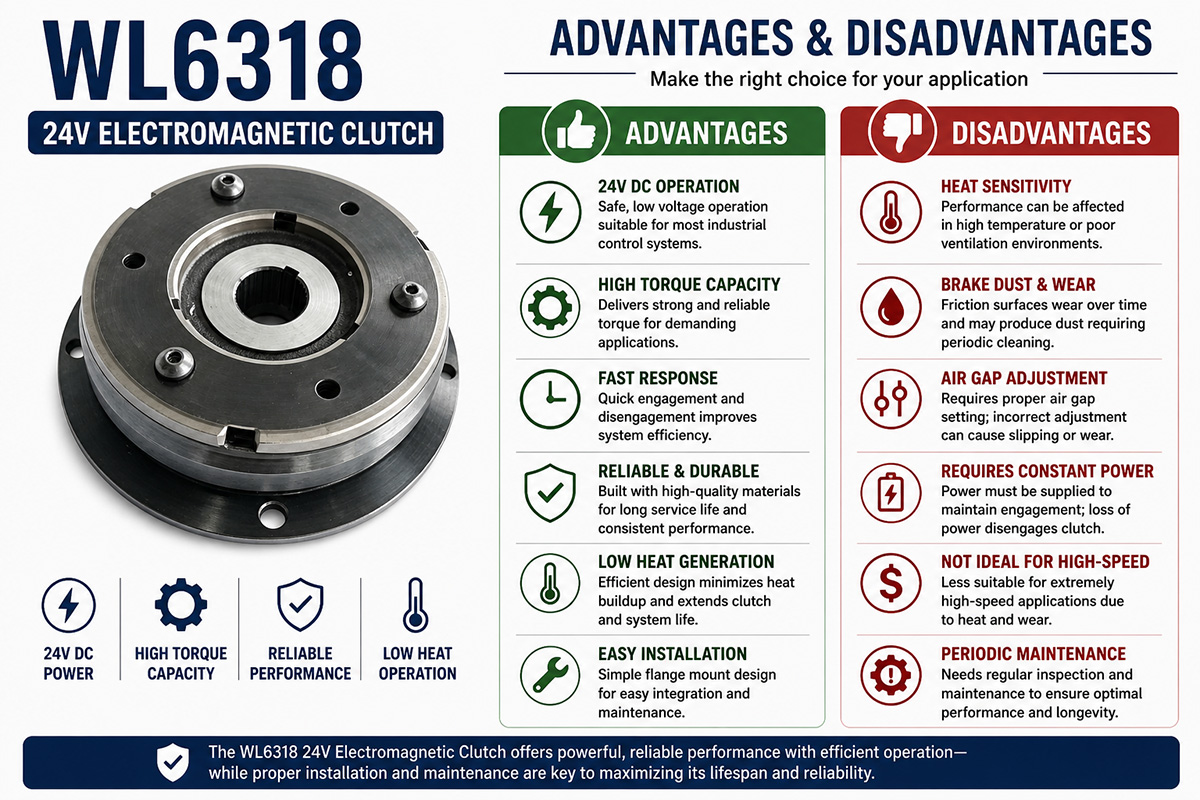
24V Electromagnetic Clutch Advantage and Disadvantage

24V Electromagnetic Clutch advantage and disadvantage

24V electromagnetic clutches provide many benefits, making them an excellent choice for industrial applications. Firstly, these devices possess high responsiveness, allowing quick engagement. They offer precise motion control, which makes it possible to use in automation systems. The 24V DC voltage ensures energy efficiency and safety. Furthermore, its compact size makes it easy to install, and low-noise operation improves the work environment. In addition, 24V electromagnetic clutches require little maintenance and have a long service life.

However, they have some limitations too. They create a lot of heat in case of frequent usage, so it is necessary to provide ventilation or cooling for the clutch. Friction materials wear over time and have to be replaced. Limited capability in transmitting torque requires the use of bigger models. Moreover, stable voltage is crucial for proper operation, and fluctuation might decrease effectiveness. Improper installation might cause decreased efficiency or premature wear-out.

Therefore, 24V electromagnetic clutches should be selected and installed carefully in order to ensure high performance.

Troubleshooting Guide of 24V Electromangetic Clutch
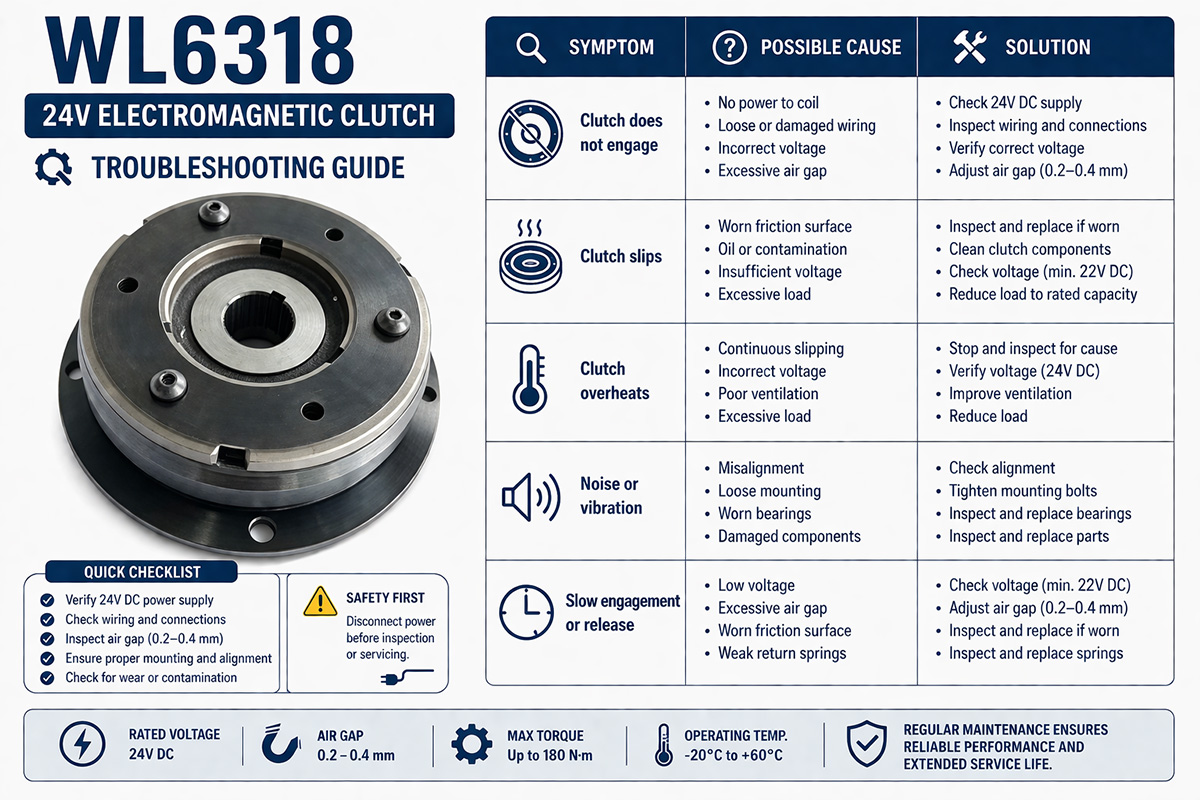
24V Electromagnetic Clutch Troubleshooting Guide

Troubleshooting electromagnetic clutches operates in 3 main areas: the electrical supply, the mechanical parts, and overheating conditions. Below is a guide on how to troubleshoot common problems.

Electrical System Troubleshooting

Most clutch problems arise from electrical faults in the coil. The coil requires an adequate 24V supply for proper functioning -2-5.

Supply Voltage Check:

Verify voltage at the clutch connector when it is supposed to be ON. Normal voltage ranges between 24V ±5% -1. Variations outside this range may cause malfunctioning, resulting in slippage -5. Connection/Ground Check: Poor or corroded grounding may prevent the engagement of the clutch. Ensure there is a continuous connection between the ground and the frame -1-7.

Perform a Continuity Test: Disconnect the clutch and use an ohmmeter to perform a continuity test.

Infinite (Open) Reading: Open internal coil connections; Replace the unit -7.

Low Reading (near 0 ohms): Shorted coil; Replace clutch.

Normal Reading (~25 ohms): Indicates that the coil is in good condition -3. 🔧 Mechanical & Physical Checks

If the power supply is normal, check the clutch for mechanical problems.

Air Gap Check: Excessive wear may lead to an excessively wide air gap. Adjust: Adjust according to manufacturer’s guidelines -10.

Inspect for Contamination: Presence of oil, grease or moisture on the friction surfaces leads to slippage -8. Clean the friction surfaces with brake cleaner if found contaminated.

Physical Inspection/Damage Check: Check for any signs of physical misalignment or damage. Ensure that the field coil is centrally mounted.

Overheating Problems 🌡️

Improper installation may lead to off-center alignment that leads to rotors striking each other, producing debris which quickly destroys the clutch -8

Though clutches are meant to generate heat in the process of operation, excess heat causes premature failure.

Normal vs. Abnormal Heat

The coil is designed for a particular temperature rise (e.g., 40°C above ambient temperature). If the clutch feels hot, chances are high of malfunction -5. Causes of overheating:

Low Voltage Supply: Excessive current flow in an attempt to start results in overheating -8.

Slippage: Inadequate engagement caused by contamination or excessive loads results in overheating

Continuous Operation: Some units require intermittent duty cycles, and their continuous use may result in overheating.

High Ambient Temperature: Ensure there is sufficient airflow. Do not place near any heat source.

💡 Preventative Maintenance Recommendations

To avoid unexpected downtime:

Keep the clutch clean regularly: Prevent dust from getting into the air gap -5.

Regularly inspect electrical connections for tightening -5-8. If needed, apply thread locking adhesive if recommended.

Air Gap Measurement: Regularly measure and adjust the armature stroke/air gap -10. If these recommendations are not helpful, then find a specific maintenance manual for your equipment. Disassembly procedures vary depending on the make and model. If you would like to share any readings/measurements, then I can help further narrow down the possible causes of your problem.


FAQS of 24V Electromagnetic Clutch

1. What is the normal reading for the coil resistance of a 24V electromagnetic clutch?

Normal resistance: 20 to 30 ohms at ambient temperature.

Broken Coil Resistance: Infinite (OL) → open circuit.

Shorted Coil Resistance: Below 5 ohms.

2. Why does my 24V electromagnetic clutch not work when supplied with voltage?

Possible reasons:

Ground Return: Missing or high resistance grounds are among the most common.

Air gap too wide: Weakens magnetic attraction.

Contaminated friction surfaces: Oil/grease/rust prevents proper engagement.

Voltage under load: Voltage drops to below 20V in use.

3. Can I use a 24V clutch with a 12V or 48V system?

Using 12V will result in too weak a magnetic field that may cause slipping or no engagement.

Using 48V will cause coil burning.

Use only 24V DC (±10%) or 21.6 to 26.4V.

4. Why is my clutch overheating to the point where I cannot touch it?

Normal temperature range is up to 80-100°С (176-212°F) for some clutches.

Common overheating problems:

Low voltage → overheating

Continuous operation of an intermittent clutch

Slip due to overloading

No air gap remaining (armature drags).

5. What is "air gap" and how frequently should I check mine?

A: Distance between the rotor and armature when not connected. Typical values: 0.3-0.7 mm (0.012-0.028″).

Check every 500-1000 operating hours or if there is any slippage problem.

Too Big Gap = Weak Engagement.

Too Small Gap = Overheating.

6. My clutch engages, but slips after applying load. What shall I check?

Probable Reasons:

Clutch voltage – measure when loaded

Oil on friction faces

Type of friction material used

Wrong air gap settings.

Poor Power supply and relay.


7. Can a 24V electromagnetic clutch fail intermittently?

Yes. Common intermittent clutch failures include:

Connector pins or wires

Intermittent ground return (due to vibrations)

Thermal shut-down of the coil (coil gets hotter → coil resistance increases → magnetic force lowers).

Cracked solder joint inside clutch connections.

8. How do I extend the life of a 24V electromagnetic clutch?

Recommendations to prolong lifespan:

Keep the friction surfaces clean and dry.

Proper air gap setting.

Stable 24V supply (no voltage drops).

Do not over speed the rotor.

“Don’t exceed rated duty cycle

Right alignment of the rotor and armature.

How to Choose a 24V Electromangetic Clutch

Choosing the appropriate 24V electromagnetic clutch is crucial for successful functioning in your application. At first, it is necessary to estimate torque requirements. It is necessary to calculate the value of torque required under the service conditions and choose a clutch that exceeds this value by at least 20-30% to avoid overload.

Then, you need to check if your voltage source is compatible with the clutch. Note that 24V electromagnetic clutches can operate only under the 24VDC source. Then, it is necessary to think about a duty cycle, since these devices are highly efficient when stopped or started frequently. In this case, you need to pay special attention to the possibility of adequate heat dissipation in the clutch.

It is essential to choose an appropriate mounting configuration, which is going to match your equipment, as well as shaft dimensions. A fixed flange type is preferable for stable applications; however, check the space availability for installation. Environmental factors play an important role in choosing a 24V clutch. Dust, moisture, and high temperatures might affect its performance negatively.

As for the applications involving precise movements and fast responses, you need to pay special attention to response time. It influences the process efficiency greatly. Consider wear life and maintenance to reduce downtime.

Remember that it is important to purchase from the trusted manufacturer in order to ensure the highest quality and durability.

Dry single borad electromagnetic brake series product

Get A Free Quote Now

Contact Form

Related Products

Related News

Scroll to Top

Get A Free Quote Now !

Contact Form
If you have any questions, please do not hesitate to contact us.
Weilong Solenoid Company Culture