Magnet Powder Clutch Advantages
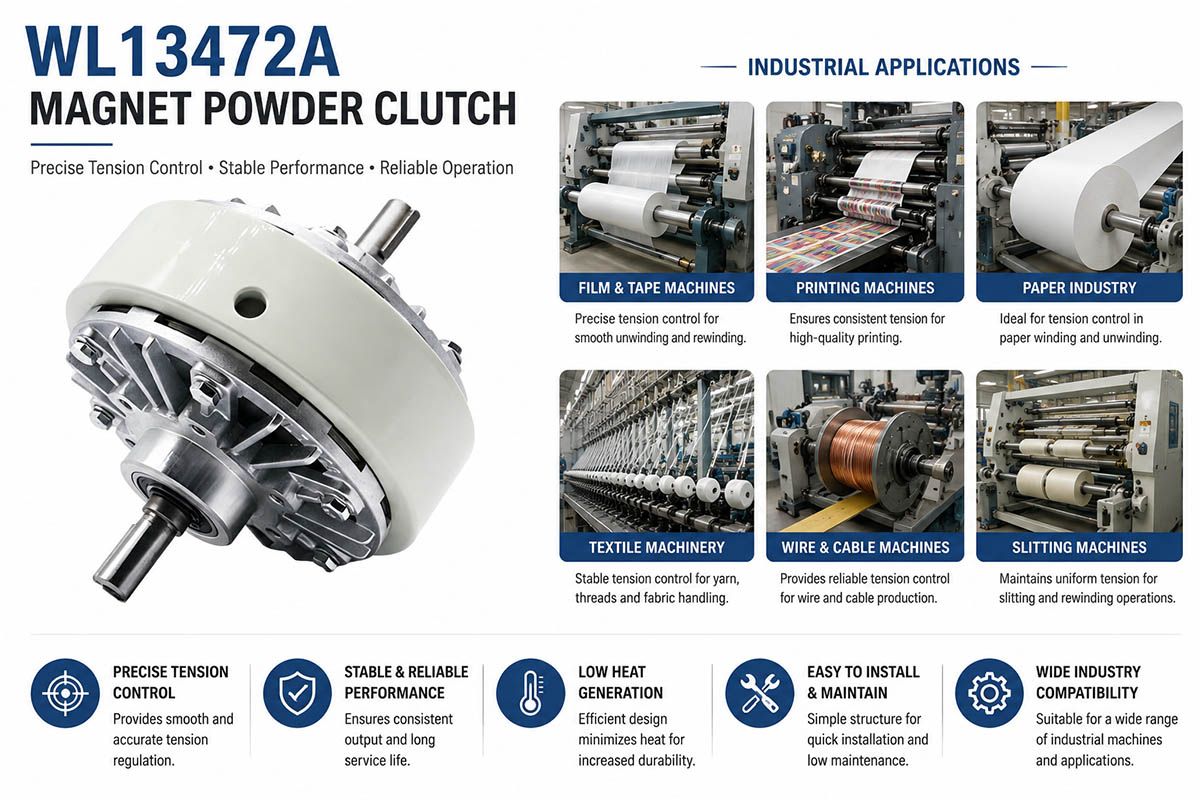
Thanks to current control in the electromagnetic coil, magnetic powder clutches have very accurate torque control. As a result, torque is transmitted without any mechanical shocks and smoothly. Thanks to their prompt response rate, they are ideal for automatic machinery that needs precise tension control and synchronization.
Smooth, engaging characteristics help avoid vibrations and improve machine stability. Another advantage of magnet powder clutches is their compactness, straightforward installation, and applicability for continuous industrial operation. Reliable for tough industrial operations such as printing, winding, textile, and packaging machinery owing to high durability and a long service life.
Low noise level and high repeatability under the continuous production process.
Magnet Powder Clutch Disadvantages
One drawback is that heat generation occurs in case of continuous operation with high load levels. It may be necessary to install adequate cooling or ventilation systems for performance stabilization.
Magnetic powder wears out gradually, which leads to decreased torque performance and maintenance needs. Another disadvantage is that magnet powder clutches have a higher price compared to standard friction clutches.
An improper torque range, duty cycle, or operating speed reduces efficiency and shortens the product life span. Therefore, proper sizing and application engineering are crucial for the product’s performance.
Magnet Powder Clutch Troubleshooting
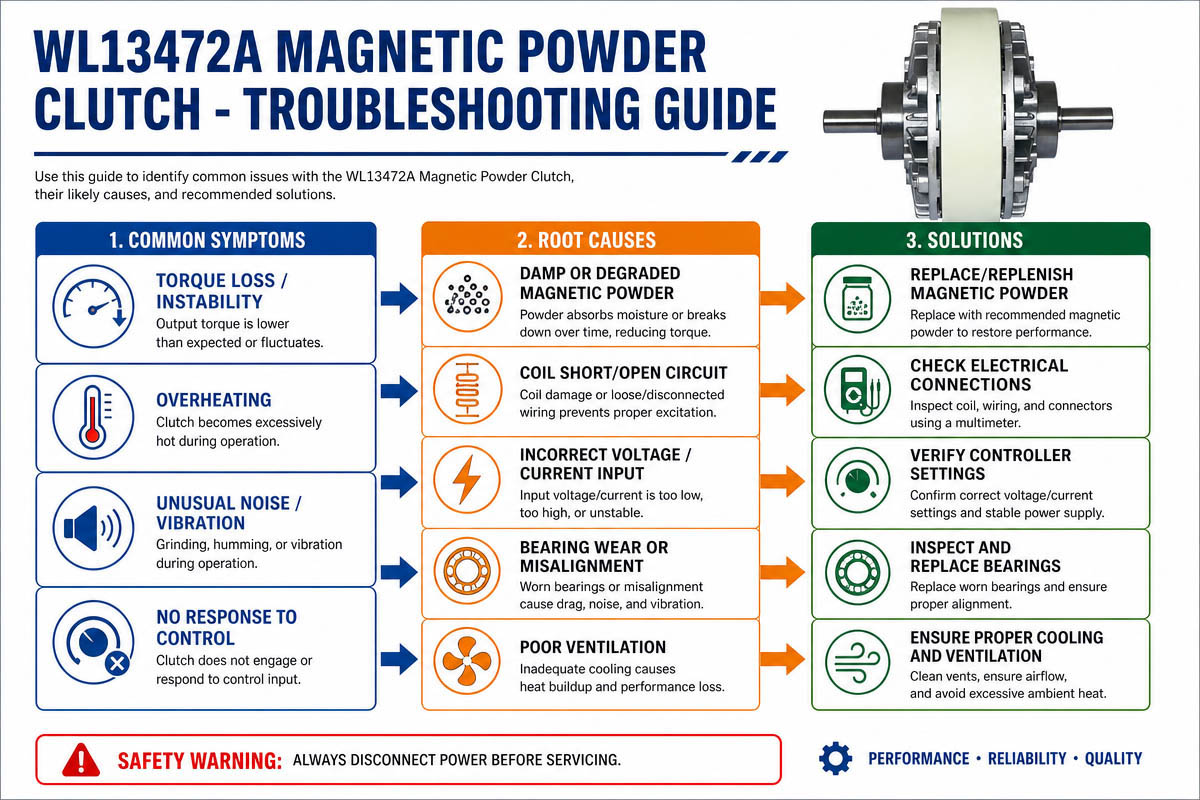
Magnet powder clutch issues may arise due to such factors as incorrect installation, overheating, high load, or electrical problems. Good troubleshooting can help improve the performance and prolong the service life of your product.
Another common problem may be insufficient torque output. Some of the possible reasons include low current, worn-out magnetic powder, coil malfunction, or mismatched voltage supply. Checking the power source, coil resistance, and controller settings would help to solve the problem.
Another issue to solve is overheating during continuous operation. Overduty cycle, overloading, or poor ventilation leads to temperature increases. Additional cooling fans and lower loading should help to dissipate excess heat.
Another issue that may arise is bearing wear, shaft misalignment, or damage to internal parts resulting in abnormal noise or vibrations. Bearings should be checked and properly lubricated.
Failure to engage smoothly may occur due to contamination with magnetic powder or uneven distribution of the powder. Internal parts cleaning and magnetic powder replacement may solve the problem.
Erratic torque transmission may also be the result of problems with electrical connections. It should be inspected closely for loose wires, broken connectors, or unstable controllers.
Proper maintenance, correct working conditions, and proper clutch selection are crucial for avoiding failures and stable industrial operation. Compliance with manufacturers’ specifications regarding torque, voltage, and duty cycle will ensure high reliability and long service life.