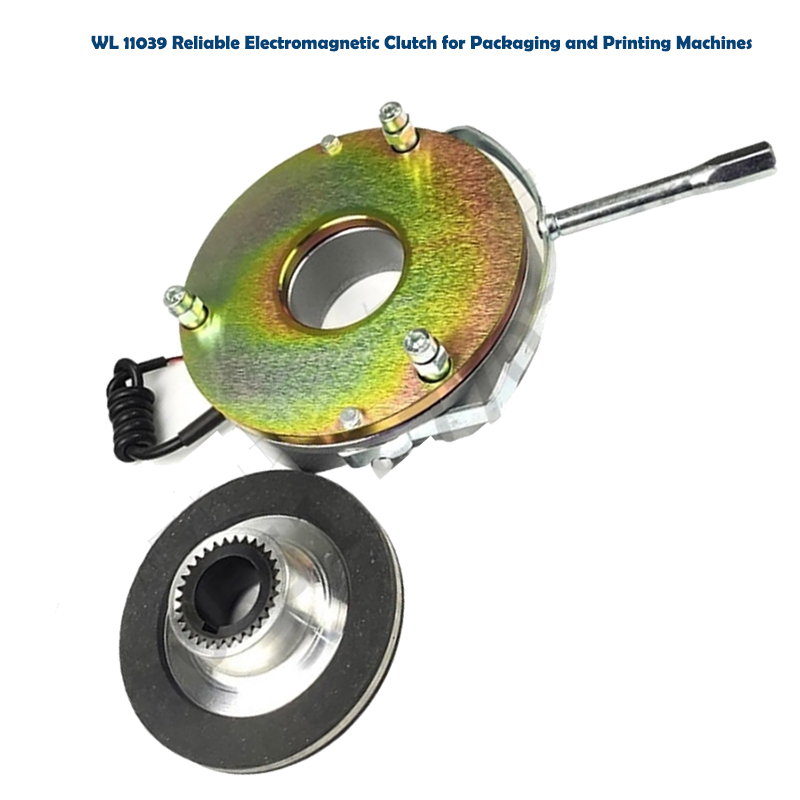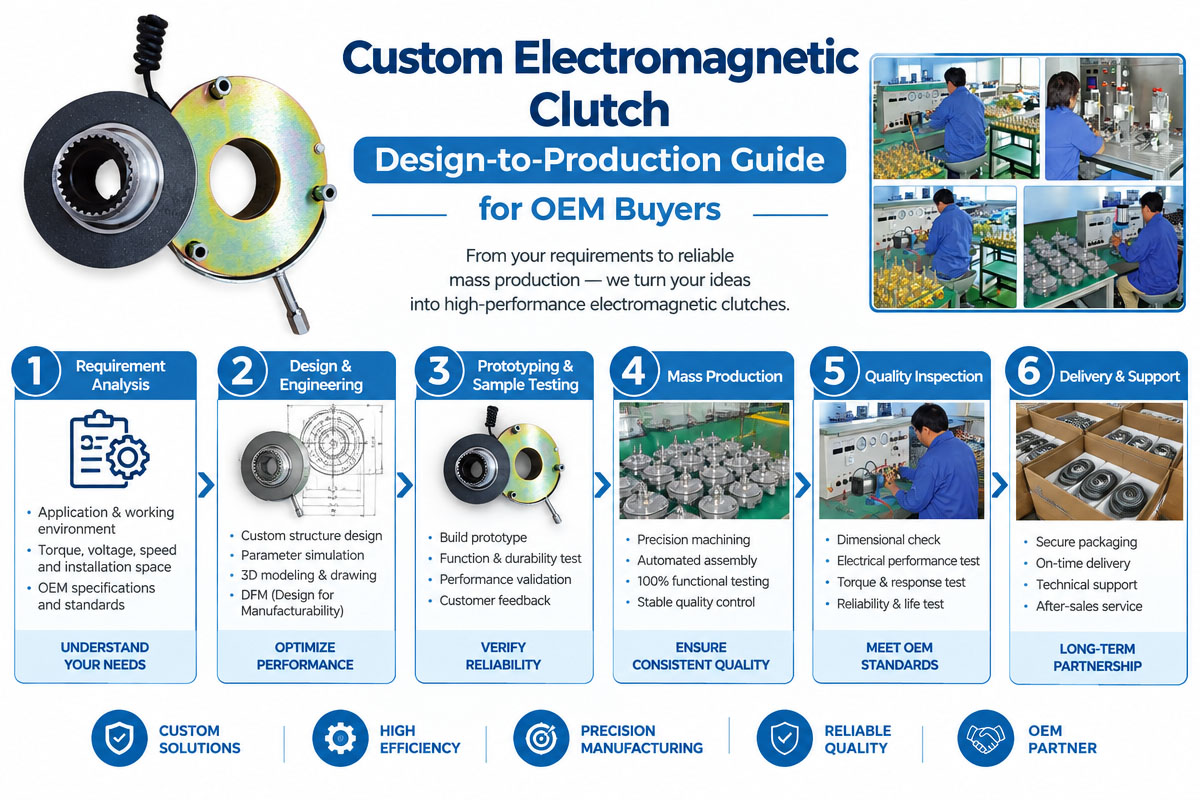
Introduction to Custom Electromagnetic Clutch
Just choosing the custom electromagnetic clutch with suitable voltage and torque rating as the standard product is not enough for the OEM equipment manufacturer. It is necessary to integrate the clutch in the whole mechanical system: motor, shaft, pulley, belt, gearbox, load, control circuit, mounting structure, and environment.
When the off-the-shelf clutch cannot satisfy the torque, dimension, mounting, duty cycle, speed, pulley arrangement, and environmental conditions, then the custom electromagnetic clutch is to be developed. In this case the clutch manufacturer optimizes the electromagnetic system, friction system, rotor, armature, bearing, pulley, hub, coil, and housing.
But the questions for the buying department and engineers will arise in this case too:
Which information to supply to the clutch manufacturer?
How to calculate the required torque?
How to define the dimensions of the shaft and pulley?
What performance parameters need to be checked?
What is the time period of the development?
What to check before production?
The guide is designed to answer the above-mentioned questions.
1. What is an electromagnetic clutch?
The electromagnetic clutch is the electromechanical device that is used to engage and disengage rotational power. Engaging the electromagnetic coil generates the magnetic field that attracts the armature, and friction surfaces are engaged. Depending on the clutch configuration, the clutch disengages when the power supply stops.
The Custom Electromagnetic Clutch is developed according to the customer application and not selected from the standard catalogue.
The customization can include:
Rated voltages
Power and Resistance of Coil
Torque of engagement
Maximum speed
Outside diameter.
Axial thickness
Bore/shaft dimensions
Keyway Design
Dimensions of pulleys
Tooth profile of the timing belt
Mounting holes
Cable/connector.
Roller Bearing Design
Material for friction
Armature Geometry.
Roter Design
Duty cycle.
Thermal performance
Environmental protection
The customization is particularly useful when it comes to OEM applications with tight installation areas or integrated clutches in transmission systems.
2. Why OEM Buyers Opt for Custom Electromagnetic Clutch Development
The main benefit of the standard electromagnetic clutch is its availability. But the standard product can be a compromise when used in the specialized machine.
2.1 Limited installation space
OEM may have only a certain radial or axial envelope available. A standard clutch that provides the sufficient torque may be of large size.
The customized design will optimize the clutch diameter, thickness, shaft interface, mounting structure, and electromagnetic components, taking the available space into account.
2.2 Special torque requirements
The torque requirements can vary significantly from application to application.
The clutch may:
Load rotate.
Carry a load.
Transfer torque continuously
Work with intermittent overload.
Prevent the excessive torque in the drivetrain.
Engage quickly.
Disengage reliably
Therefore, the required torque should be calculated based on the operating conditions, not just estimated from the motor power.
2.3 Specifications of pulley
Some OEM machines can require the clutch to have a timing pulley, V-belt pulley, gear, sprocket, or other transmission part.
It is an important point since the clutch design depends on the pulley diameter, tooth profile, pitch, width, belt tension, and center distance.
The clutch manufacturer should consider the whole interface of the transmission system but not mount the pulley on the standard clutch.
2.4 Special requirements for voltage or control system
The OEM equipment can use 12 VDC, 24 VDC, or another DC voltage source. Also, the control system can limit the coil current, power consumption, engagement time, or thermal loading.
Therefore, the electromagnetic system should be designed for the real electric system.
3. Information to be provided to OEM buyers
The quality of the initial technical information greatly influences the efficiency of the development.
Buyers should ideally provide the following information prior to requesting a quotation.
Mechanical Specifications
Outside maximum diameter
Maximum length (axial)
Diameter of shaft
Bore size
Shaft clearance
Dimensions of keyway
Mounting-hole pattern
Installation space available
Pulley type
Pulley distance
Teeth number
Belt width
A stroke or air gap is required.
“Rotation direction
Performance Criteria
Torque (rated)
Start-up torque.
Holding Torque (if applicable)
Max velocity
Engagement time
Disengagement time
Duty cycle: .
Operations per hour
Expected life span
Inertia of Load
Continuous or discontinuous running
Electrical Specifications
Nominal voltage
Voltage span
Resistance of Coil
Max current
Maximum power draw
Control technique
Operating state—energized or de-energized
Environmental Requirements
Operating temp.
Storage temp.
Humidity
Exposure to dust
Contact with water
Oil, chemical exposure
Vibration Vibrations
Corrosion requirements
2D drawings, 3D models, and samples of existing clutch or complete assembly drawings can help to eliminate misunderstanding during the engineering phase.
4. How to Calculate the Custom Electromagnetic Clutch Required Torque
Torque is one of the main parameters in custom electromagnetic clutch development.
The basic formula of power, torque, and speed correlation is
T = 9550 x P / n, where T = torque in N.m., P = power in kW, and, and n = rotational speed in rpm.
For example, a 3.7 kW motor with 1,500 rpm has a theoretical continuous torque 23.6 N·m.
However, the clutch should not be specified just by this torque value.
The OEM engineers should take into account:
Initial Load
Speed
Load Inertia.
Transmission Efficiency
Impact load
Change in friction
Heat
Safety factor
The required torque value can exceed the calculated motor torque value.
Torque is not the only parameter to be considered.
A clutch with a high torque rating can still be the wrong choice if:
Diameter is too large.
The clutch is too stiff.
Rotation velocity is too high.
Heat generation is too high.
The pulley is not strong enough for belt tension.
The mounting structure is not suitable.
The reaction to engagement is too long.
Therefore, the whole mechanical system should be analyzed.
5. Custom Electromagnetic Clutch System Design
The electromagnetic system generates the magnetic force that is needed to engage the clutch.
The design variables are:
Winding of coils
Copper wire diameter
Turns
Resistance of coil
Magnetic circuit
Geometry of the pole
Material type of armature
Air gap
Operating Voltage
Coil temperature
The air gap is the most important parameter. The larger gap means the greater magnetic force that should be applied to ensure reliable attracting, and the magnetic circuit should be optimized to avoid the excessive power consumption.
Also, the coil should be tested under electrical and thermal conditions.
For example, the coil working continuously at 24 V consumes noticeably higher power than intermittently. It is not enough to test only the ability to generate magnetic force.
The manufacturer should verify the following:
Live
Coil temperature increase
Reliability of engagement
Holding Behavior
Insulation properties
Thermal stability in the long term
6. Custom Electromagnetic Clutch Friction system and torque transferring
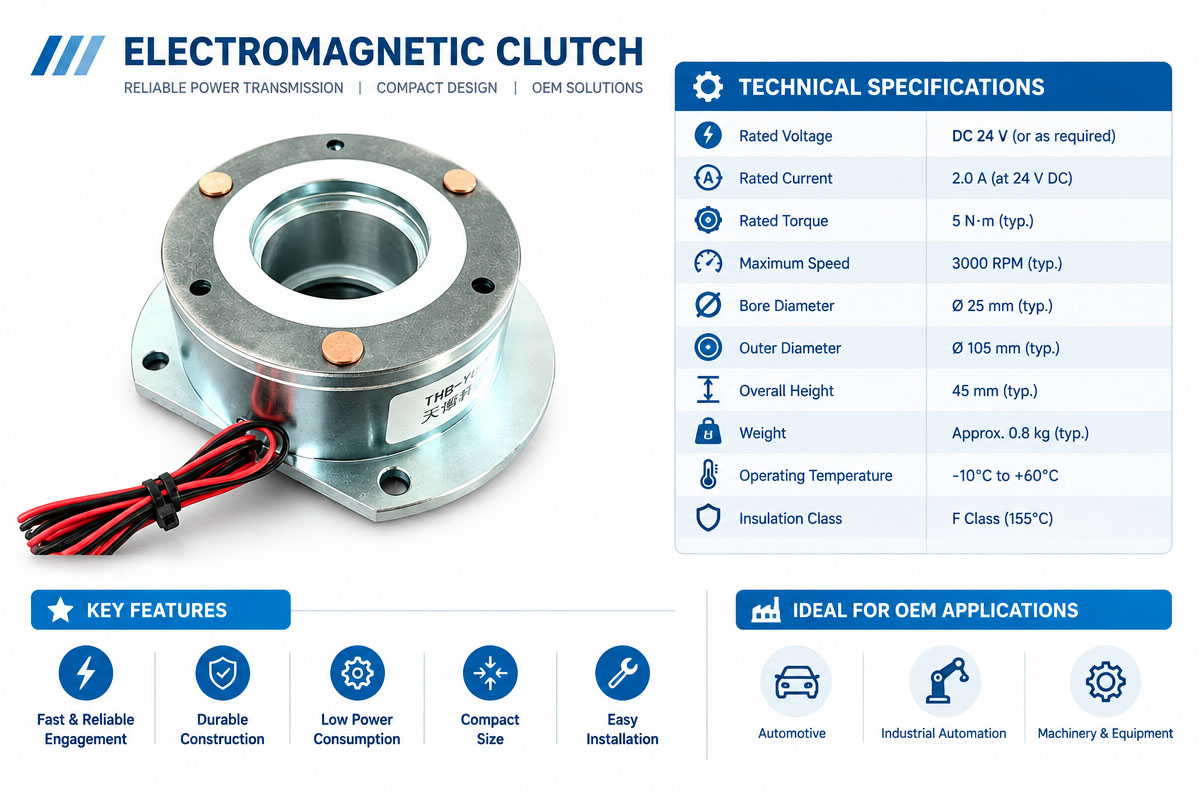
The custom electromagnetic clutch force engages the friction surfaces, while the friction system transfers mechanical torque.
The design variables are:
Material of friction
Contact zone
Surface roughness
Coefficient of friction
Contact pressure value
Number of friction surfaces
Flatness of armature
Rotor geometry
Operating Temperature
The Custom Electromagnetic Clutch friction system should ensure consistent engagement without excess slip.
The excess slip leads to:
Heat generation
Wearing of friction material
Torque reduction
Surface damage
Reduced Life Span
The thermal performance is very important in applications with frequent engagement and disengagement.
7. Integration of belt and pulley
If the electromagnetic clutch is supposed to have a pulley, then OEM buyers should try to provide the whole belt specification.
For the timing belt applications, the useful information is:
Belts Manufacturer
Belt Series
Bowl ball
Tooth morphology
Teeth number
Sheave width
Belt Width
Bore required
Flanged requirements
Center-to-center distance
Tension Belts
The pulley should not be tested alone except for the clutch.
For example, the timing pulley with a certain tooth number has a certain pitch diameter. The outside diameter does not have to be equal to the pitch diameter. Using these diameters interchangeably leads to a wrong clutch-pulley interface.
Therefore, a 3D model of the pulley or the real sample of the pulley can be useful in custom electromagnetic clutch development.
8. Custom Electromagnetic Clutch Prototype Design
Usually the manufacturer develops the preliminary design from the reviewed specification.
The engineering process can include:
Requirement analysis
Mechanical design
Electromagnetic calculations
Material Selection
Design of friction system
Bearing selection
Pulley or hub design
Drawing of Prototype
Engineering review:
Prototype manufacture
Performance testing
In complex applications it may be needed multiple design iterations.
The OEM buyers should understand the difference between a prototype sample and a production-approved sample.
The prototype proves the concept, but the production-intent sample proves the final design, materials, dimensions, and performance.
9. What Should Be Tested for Custom Electromagnetic Clutch?
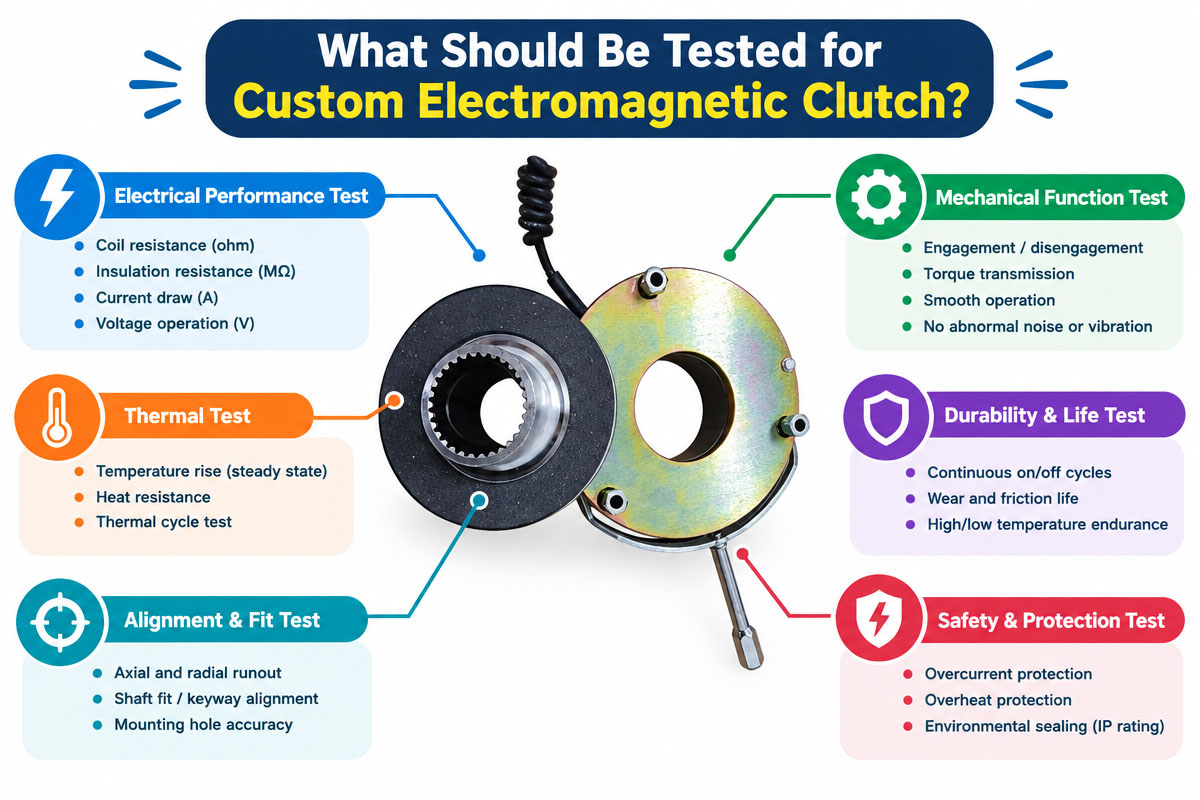
The custom electromagnetic clutch needs to be tested against application-specific requirements and not only checked for dimensional inspection.
Typical validation elements include:
Torque testing
Engagement torque at specified voltage, speed, temperature, and air gap conditions
Electrical Tests
Check
Resistance coil
Current flow
Energy consumption
Insulation
Dielectric strength
Engagement test
Time required for the clutch to engage after electric activation
Disengagement test
The clutch disengages when power is switched off.
Temperature test
Measuring coil and clutch temperature in duty cycle
Test of life
Operation of the clutch for evaluation of wear and performance
Dimension inspection
Checking
Bore
Outside diameter
Axial sizes
Mounting holes
Keyway
Pulley geometry
Air gap.
Acoustic & vibration
Acoustic and vibration performances are also important in the automotive, medical, automation, and precision machinery industries.
10. Custom Electromagnetic Clutch Quality Assurance Before Mass Production
Clear inspection criteria must be agreed upon with OEM buyers before mass production approval.
A typical quality-control process may include:
Incoming inspection -> In-process inspection -> Assembly inspection -> Electrical test -> Torque test -> Final dimension inspection -> Packaging inspection
Critical dimensions need to be supplied with tolerances.
For example, the OEM buyer should not define only:
Bore 20 mm
The exact tolerance and fitting requirements may need to be provided on the production drawing, depending on the shaft and the way of assembly.
The same thing is valid for:
Air gap
Location of mounting hole
Dimensions of pulleys
Concentricity of shafts
Similarities
Impedance of coil
Torque.
Clear tolerances allow reducing conflicts between OEM and supplier.
11. Custom Electromagnetic Clutch Material and Manufacturing Capability
Usually, a custom clutch requires a lot of different manufacturing operations.
Depending on the design, they might be:
Metal Stamping Process
CNC machining
Twisting
Grinding
Heat-treatment
Winding of coil
Injection Molding Grinding
Surface Finishing
Set of bearings
Electromagnet assembly
Functionality tests
Having several operations internally in the supplier can help manage projects better.
It can also help to avoid extra communications between separate subcontractors and makes it easier to implement engineering changes.
For OEM buyers it would be useful to ask:
What operations are performed in-house?
What components are outsourced?
How are critical dimensions controlled?
What test equipment is available?
How are engineering changes treated?
“Quality certifications being maintained?
12. Cost of Prototype versus Production Cost
The cost of prototypes of custom products is always higher than standard ones.
Prototype cost can include:
Engineering Development
Tooling,
CNC Milling
Special Materials
Coil development
Assembly of prototype
Test Assessment
Engineering Changes
But once the design is finalized, the cost of mass production can be much cheaper.
Therefore, OEM buyers should evaluate quotations not only for prototype and production unit prices.
Professional quotation should contain:
Sample size
Cost of sample
Tooling costs
Development charges
Production Min. Qty
Cost per unit of output
Lead time:
Terms of Payment
Packaging & Shipping
Shipping terms
Warranty or quality replacement policy
13. How long does custom electromagnetic clutch development take?
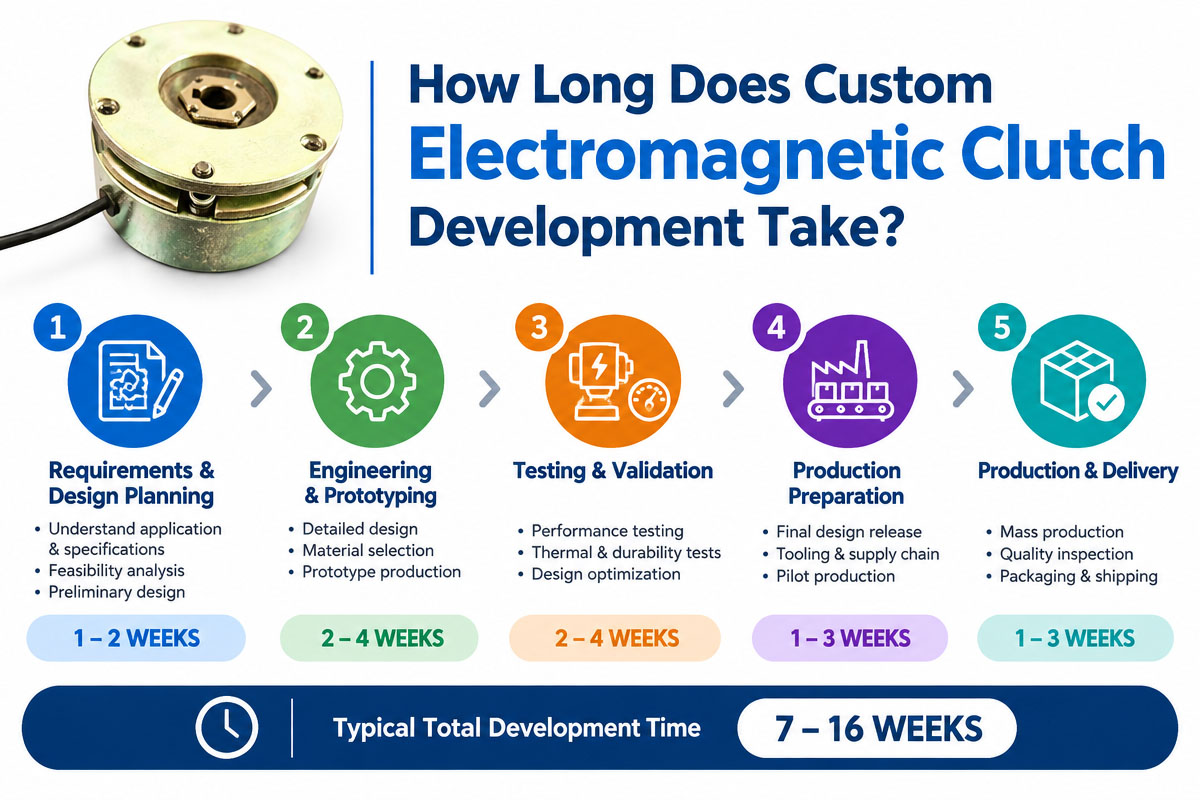
Time required will depend on the complexity of the design.
Somewhat simple changes can take a few weeks, but a new clutch with a pulley, electromagnetic circuitry, or extensive life testing can take much longer.
A typical project can be structured as:
Specification → Design → Drawings Approval → Tooling → Prototype → Testing → Revision → Final Approval → Mass Production
One of the best approaches for an OEM buyer to save some time on development is to provide all the technical information up front.
The last-minute changes of the pulley, mounting dimensions, voltage, torque, or installation envelope can lead to redesigning of the clutch.
14. What OEMs Should Look For When Choosing Electromagnetic Clutch Suppliers
Price should be one of the criteria, along with technical and production capabilities.
When selecting suppliers, buyers should consider:
Engineering Skills
Is the supplier able to design the clutch according to the application requirements rather than simply modify a standard clutch?
Production Capability
Does the supplier have control over critical manufacturing processes such as machining, stamping, winding of coil, and assembly?
Test Capabilities
Can the supplier perform tests of torque, current, temperature, life, and electrical performance?
Communications
Can the supplier provide the clear technical restrictions before developing a prototype?
Quality Management
Does the supplier have a documented inspection and traceability process?
Production Scalability
Does the supplier provide consistent product performance during the order increase from tens of prototypes to hundreds or thousands of units?
These factors may be more important than the sample quotation.
15. Typical Custom Electromagnetic Clutch OEM Design Errors
There are some common mistakes that cause delays on custom clutch projects.
Mistake #1: Stating Only Motor Power
Clutch requirements cannot be defined by the motor power alone. Speed, torque, acceleration, load inertia, and duty cycle should also be considered.
Mistake #2: Outer Diameter of the Pulley Only
For timing belt systems, pitch, tooth profile, tooth count, width, and belt specification also matter.
Mistake #3. Ignoring Thermal Conditions
Even if the clutch meets torque requirements at room temperature, it can exhibit performance variations due to heat at the coil and friction surfaces.
Mistake #4: Dimension changes after start of tooling
Late mechanical changes can impact tooling, increase cost, and increase the lead time of the prototype and production.
Mistake #5: Testing of only one parameter
Torque is not the only indicator of long-term reliability. Electrical, thermal, dimensional, engagement, disengagement, and life performance should also be considered.
Mistake #6: Viewing the clutch as a stand-alone component
The clutch is connected with the motor, shaft, pulley, belt, housing, bearings, and controls. Therefore, the system level integration should be considered in the design.
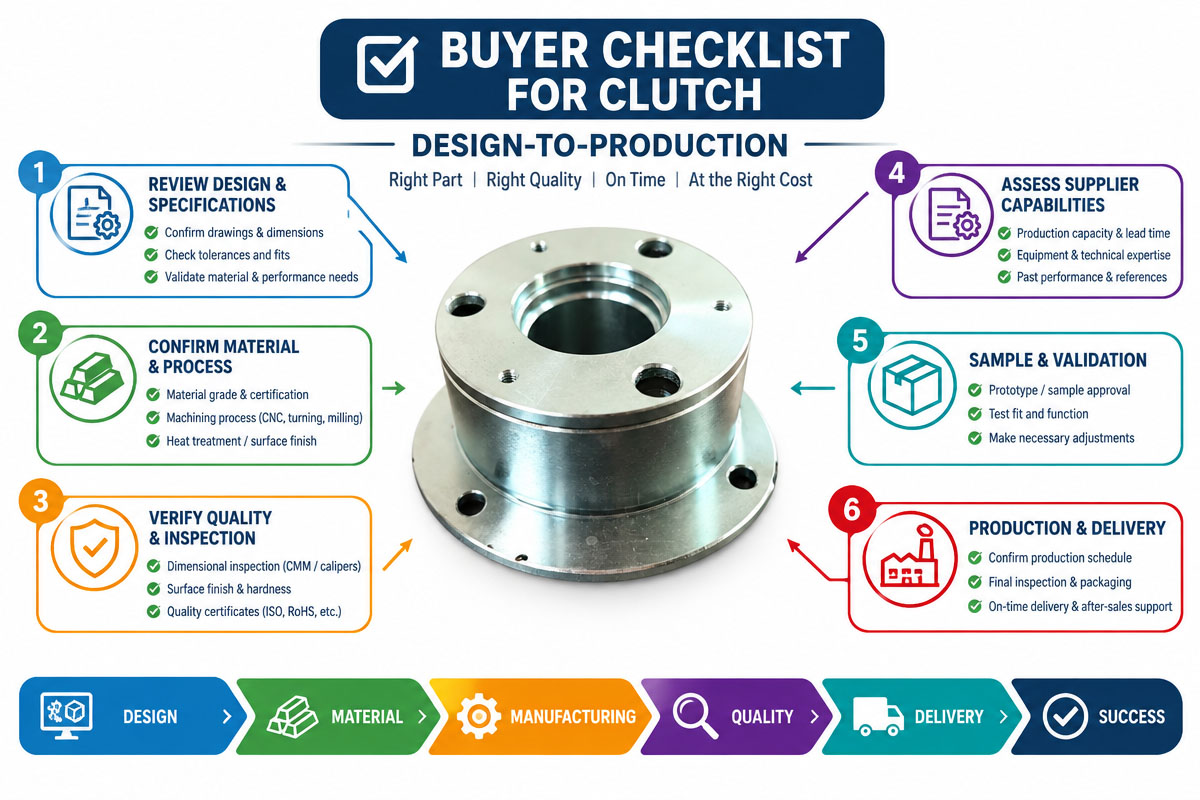
16. Buyer Design-to-Production Checklist
Prior to going into mass production with a custom clutch, OEM buyers should confirm the following:
Mech
The outer meter is approved.
Axial length is accepted.
Bore and shaft fit is confirmed.
Keyway is confirmed.
The mounting pattern is verified.
The pulley shape is approved.
Definition of air gap
Rotation direction is confirmed.
Performance
Torque rating is approved.
Maximum speed is confirmed.
Engagement time is confirmed.
Disengagement time is verified.
The duty cycle is confirmed.
Life requirement is verified
The temperature requirement is confirmed.
Electricity
Nominal voltage is verified.
The operating voltage range is confirmed.
Coil current is verified.
Power consumption is confirmed.
Insulation requirements are verified.
Connector/cable configuration is confirmed.
Quality is good.
Drawings are approved finally.
The standard for inspection is approved.
The sample test report is reviewed.
Critical dimensions are identified.
The production audit schedule is confirmed.
Packaging is approved.
A change control procedure is established.
17. Custom Electromagnetic Clutch Engineering Sample to OEM Supply
The last step of the Custom Electromagnetic Clutch project is not the delivery of the first production order. The supplier should demonstrate its capability to replicate the design.
OEM buyers should provide a clear transition from prototype to production.
The reference should be the approved sample for
Size
Materials
Coil properties #
Torque,
Air gap
Pulley geometry
Surface finishing
Assembly process
Performance, electrical
All Custom Electromagnetic Clutch engineering changes should be reviewed and approved before implementation.
In long-term OEM programs buyers should also consider supplier capacity, raw materials availability, production lead time, quality traceability, and contingency planning.
Summary and Conclusion
A custom electromagnetic clutch is an engineering project and not just a component buy. The clutch should be designed considering the mechanical, electrical, thermal, and environmental requirements of the OEM application.
Complete specification is the main starting point and should include torque, speed, voltage, duty cycle, dimensions, shaft interface, pulley requirements, operating environment, and service life.
A typical design-to-production process includes:
Application Analysis → Specification → Electromagnetic and Mechanical Design → Prototype → Test → Design Validation → Production Approval → Mass Production → Quality Control
Early technical communication is one of the best ways to minimize development risks for OEM buyers. A 2-D drawing, 3-D model, pulley information, and sample of existing component or whole assembly information can help the manufacturer to understand the actual requirements.
The right supplier should be able to provide more services than manufacturing. Engineering design, tooling, machining, stamping, winding of coil, assembly, testing, quality control, and OEM customization can help in implementing the design to production.
If the torque, dimensions, transmission interface, electrical characteristics, and operating conditions exceed the parameters of a standard clutch, a custom approach can become very effective.
18. Common Questions of Custom Electromagnetic Clutch
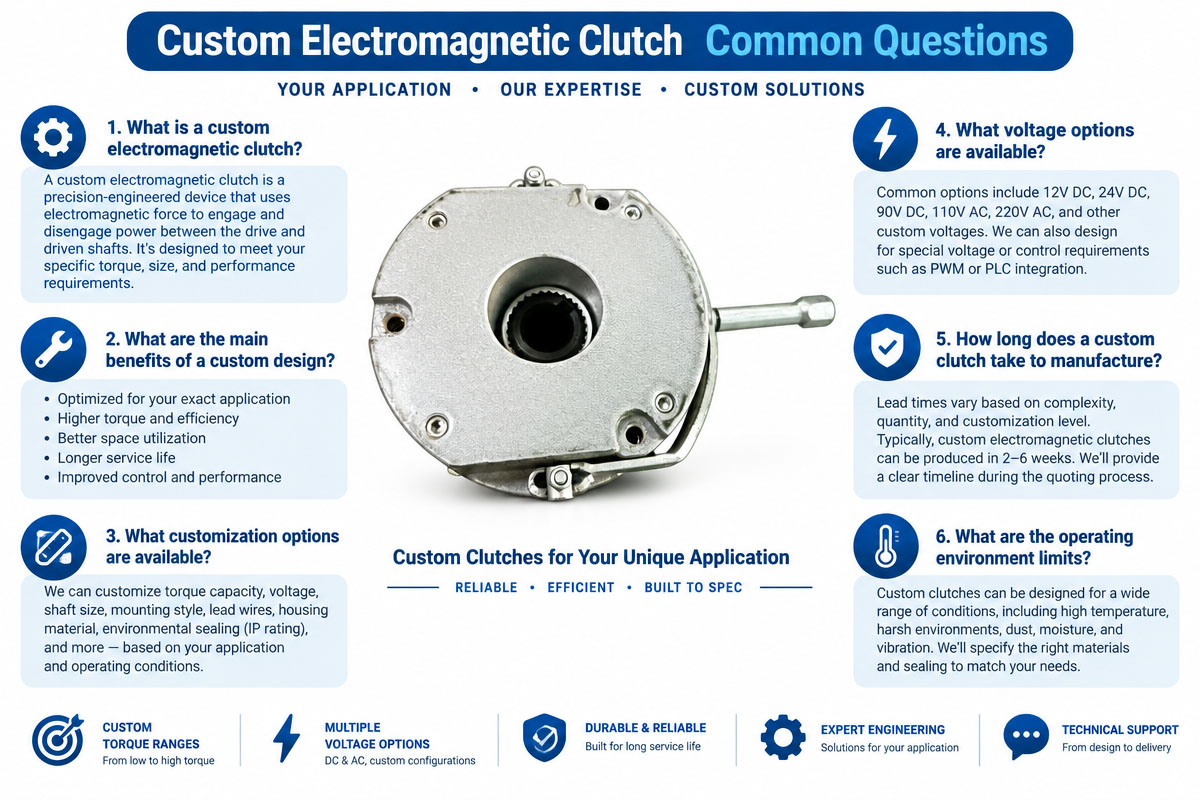
1. What should I prepare when I request a custom electromagnetic clutch?
Torque, rotational speed, voltage, duty cycle, operating temperature, outside dimensions, space requirements, shaft/bore size, mounting pattern, pulley requirements, and required service life. Highly recommended: 2D drawing or 3D model.
2. Is it possible to add a timing pulley to a custom electromagnetic clutch?
Yes. If the belt type, pitch, tooth profile, tooth count, belt width, pulley width, bore, and mounting requirements are known, the clutch can be designed with the integrated timing pulley.
3. How to calculate the required clutch torque?
The basic torque requirement is based on the motor power and rotational speed. Then the acceleration, load inertia, transmission efficiency, shock loads, friction losses, and safety margin are also to be considered.
4. Can the clutch operate continuously?
The torque depends on the coil design, electrical power, thermal conditions, friction system, and torque required. The continuous operation should be especially evaluated and cannot be assumed by nominal voltage.
5. How long does it take to get a custom clutch prototype?
Time required depends on design complexity, tooling needs, machining, material availability, and testing. A simple change can be faster than the complete redesign with an integrated pulley and life testing.
6. What tests do I need to request before mass production?
Typical validation includes torque, coil resistance, current, power consumption, engagement and disengagement performance, temperature rise, dimensional inspection, insulation test, and life cycle test.
7. Are custom clutches more expensive than standard ones?
Prototype and tooling costs are higher as engineering and development efforts are required. However, production pricing is likely to be cheaper once the design is finalized and production volumes grow.
8. How can I minimize time to develop the OEM clutch project?
Provide all technical details up front. Drawings, 3-D models, data on pulleys, torque requirements, voltage, speed, duty cycle, environment, and installation conditions. Defining non-negotiable dimensions and performance requirements will also help.