

Introductory
Modern smart electronic gadgets are becoming more compact, advanced, and multifunctional. From smart locks and vending machines to automated appliances, office equipment, access-control systems, and intelligent consumer devices, producers need compact actuators that could ensure reliable mechanical movement while being easy to control electronically.
Frame solenoids appear to be an increasingly popular solution in this respect. A frame solenoid is an electromechanical actuator that can convert electrical energy into linear mechanical motion. A frame solenoid consists of a coil that generates a magnetic field under an electric current to move a plunger or armature. Due to the simplicity of this principle of operation, frame solenoids can enable precise and repeatable mechanical movements in many smart electronic gadgets.
Unlike the motor-driven mechanisms, frame solenoids can provide direct linear movement and can be customized according to voltage, stroke, force, size, mounting method, and operating cycle.
So, why are frame solenoids so popular in modern intelligent electronic gadgets? Besides being compact, reliable, controllable, customizable, and cost-efficient.
1. Small-size design for products with limited space
One of the major advantages of the frame solenoids is the compact design. Modern electronic products are designed for installation in limited internal space. Consumers expect smart devices to be compact and attractive without sacrificing their functional capabilities.
Due to its compact size, an electromagnetic actuator can be installed in the tightest spots and still produce sufficient force to perform mechanical work.
For example, a smart lock may require an actuator to operate a locking pin. A vending machine may need a product dispensing mechanism. An automated appliance may need a small actuator to open, close, push, pull, or release any component.
Frame solenoids are offered in various sizes and configurations so that engineers can choose or customize a design for a limited installation space.
This makes frame solenoids especially suitable for compact smart electronics where every millimeter of the internal space is important.
2. Basic Electromagnetic Operating Principle
The operating principle of frame solenoids is rather simple. A typical actuator consists of a coil, a magnetic frame, a plunger or armature, a spring or return mechanism, and other mechanical parts.
Upon applying voltage to the coil, electrical energy is converted into a magnetic field. This magnetic field pulls the plunger to a certain position. Depending on the design, this movement can be performed in the form of a push or pull.
Once the power source is switched off, the plunger can be returned to its initial position by means of a spring or some other mechanical mechanism.
This simple conversion of electrical energy into mechanical energy makes frame solenoids simple to integrate with an electronic control system. Depending on the operating requirements of the product, the solenoid can be controlled by a microcontroller, relay, transistor, or control board.
It means that for smart electronic products, the actuator does not require a complicated control system just to perform simple linear movement.
3. Rapid Response and Direct Linear Movement
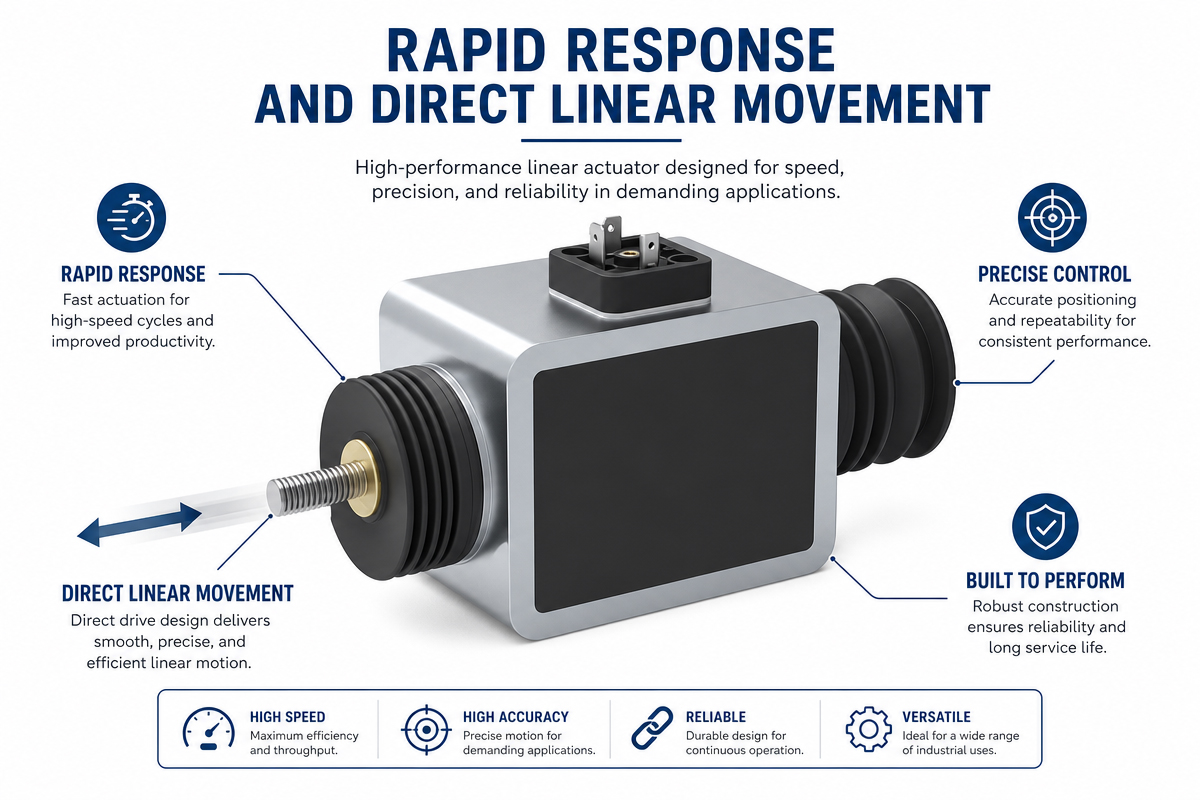
Many intelligent gadgets require rapid mechanical movement in response to an electrical input. Frame solenoids can perform relatively fast electromagnetic actuation and are suitable for applications that require rapid locking, releasing, pushing, pulling, or switching actions.
A solenoid will always produce direct linear movement, unlike a motor-based mechanism. You do not need gears, cams, belts, or screw mechanisms to convert rotary movement to linear one.
This direct drive reduces the complexity of the mechanical structure.
For example, in an electronic locking application, the actuator can move a locking bolt. In an automatic dispenser, it can directly push a release mechanism. With an office machine, it can place a mechanical component at a proper position.
It also means that there will be fewer mechanical components in the drivetrain, which simplifies assembly and reduces mechanical points of failure.
4. Simple electronic control
There is another major reason why frame solenoids are popular—they can be controlled by an electronic control system.
Most smart products use control boards, sensors, processors, and software. Therefore, the actuator should respond to the electrical signal provided by the control system.
An appropriate driver circuit can turn the actuator on and off. The control system will trigger the actuator depending on the sensor signals, user commands, programmed sequences, or interaction with other electronic components.
For example, a smart access control system can receive an authentication signal and will activate the actuator to release the mechanism. Then the control system can deactivate the actuator after a predetermined time and lock the lock again.
The integration is basic so that frame solenoids are suitable for many intelligent electromechanical systems.
5. Reliable operation for repeating applications
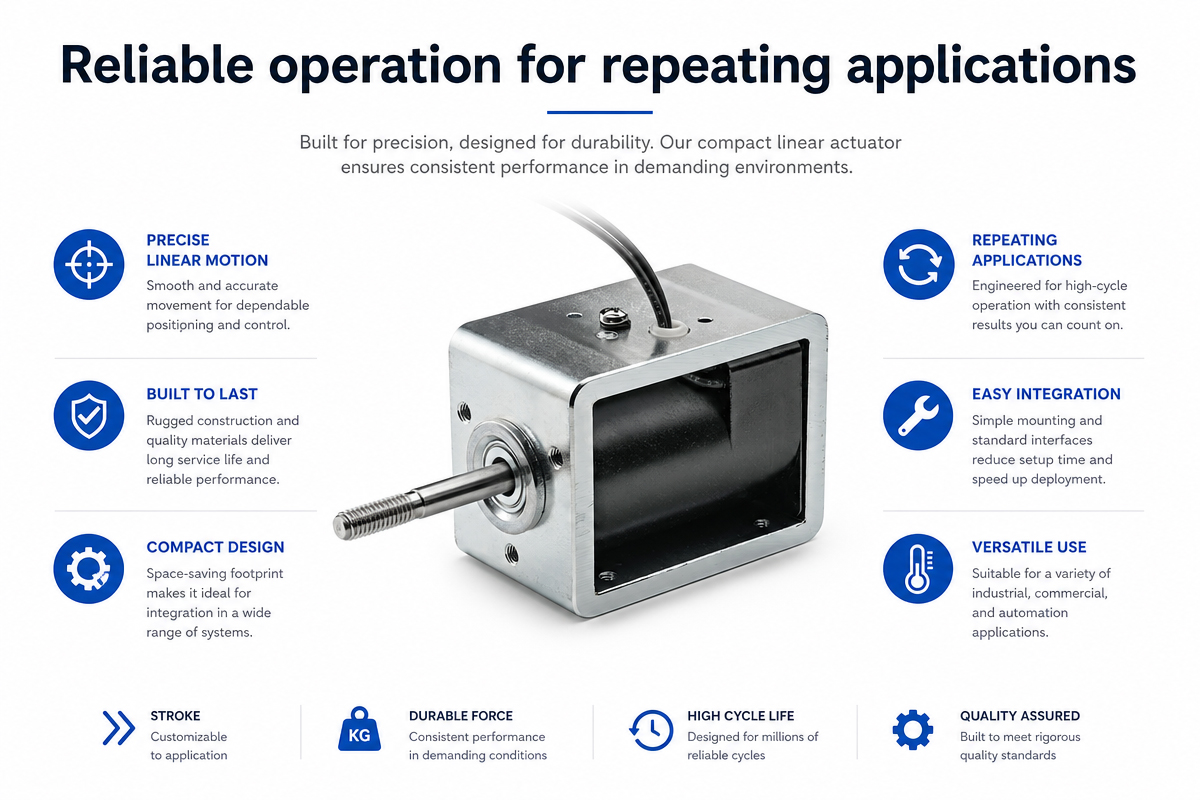
Reliability is a critical characteristic of smart electronic gadgets. A mechanical-moving component should perform the movement repeatedly with stable performance through a large number of operating cycles.
Properly designed frame solenoids can be manufactured for repetitive operation. The life of the actuator depends on many factors, such as material selection, coil construction, magnetic circuit design, plunger geometry, surface treatment, and mechanical tolerances.
For industrial and commercial products, manufacturers can set up the required operating cycle, duty cycle, stroke, force, voltage, and operating conditions during the design phase.
Many applications, including automated dispensers, access-control equipment, ticketing machines, vending machines, and office automation systems, may require thousands or even hundreds of thousands of operating cycles.
For such applications, selection of an actuator with an appropriate duty cycle and operating conditions is critical for ensuring reliable performance.
6. Flexible Voltage and Performance Options
Smart electronic products are usually designed with many different power architectures. Some use low-voltage DC power supplies, while others use higher DC voltages.
Frame solenoids can be designed for various electrical requirements, such as 5 VDC, 12 VDC, 24 VDC, or other customized voltage requirements.
The coil can also be designed according to the requirements of the force, stroke, response time, resistance, power consumption, and duty cycle.
This makes it possible for engineers to choose an actuator that will match the electrical architecture of their product without having to redesign the entire control system.
Energy consumption is especially important for battery-powered intelligent products. Engineers can evaluate coil parameters such as resistance, activation time, holding force, and control strategy to reduce unnecessary power consumption.
7. Suitable for smart locking mechanisms
Electronic locking is one of the major application fields of frame solenoids.
Smart locks and access-control products need a way to physically lock or release a door, compartment, cabinet, drawer, or other component. The required mechanical movement cannot be performed electronically.
A compact actuator makes a link between electronics and mechanics.
The control system can send an electrical signal to the solenoid once the authorized user is identified. The actuator will move the locking mechanism to grant the access. After the unlocking procedure, a spring-loaded mechanism or some other mechanical arrangement can re-lock the lock.
It makes frame solenoids suitable for smart cabinets, electronic locks, parcel lockers, access control systems, hotel equipment, and other intelligent security devices.
8. More affordable alternative to complex mechanisms
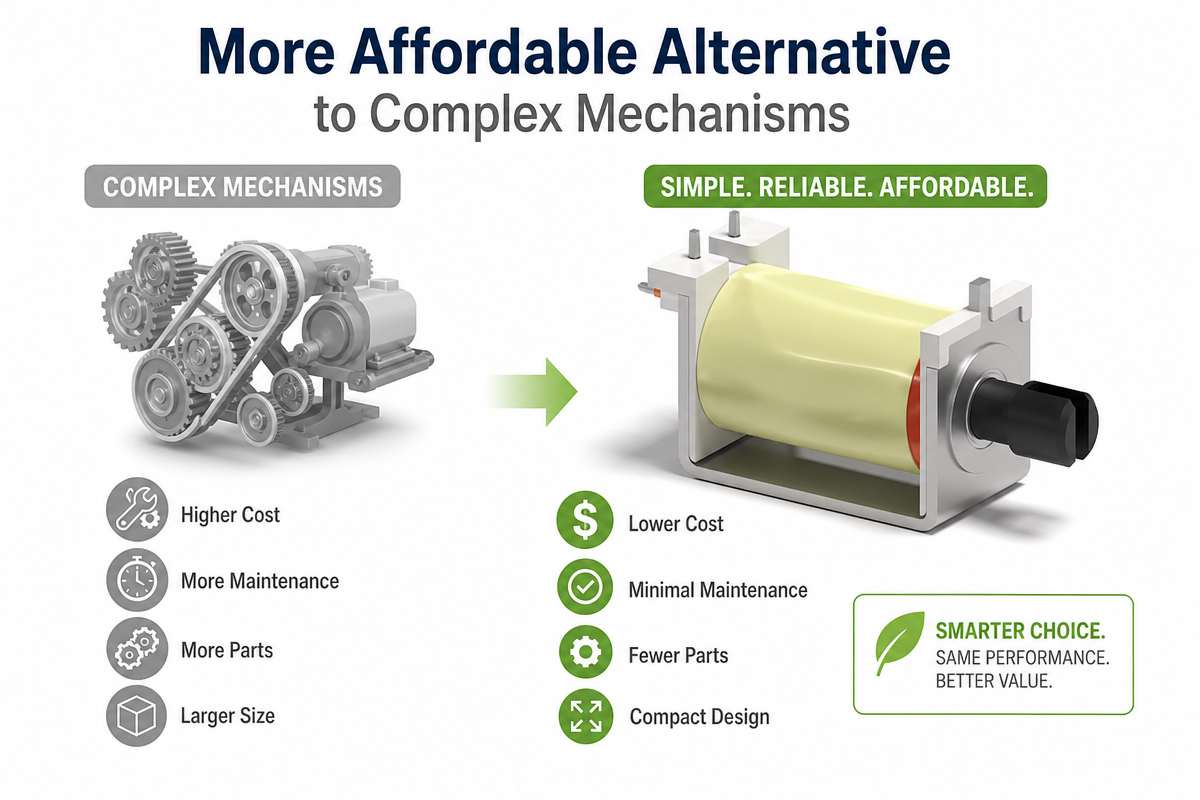
Manufacturers of smart products need to maintain a balance between performance and production cost. Although the highly advanced actuator can provide advanced functionality, it can increase the cost of the component, assembly time, and maintenance requirements.
The frame solenoid provides a relatively simple solution for applications requiring basic linear movement.
The compact design reduces the number of components necessary for the actuator mechanism. Fewer mechanical parts also simplify assembly.
In high-volume consumer and commercial products, even a small reduction in the cost of a component can significantly affect the overall manufacturing cost.
This feature is especially valuable for products that are produced in high volumes, such as automated dispensers, smart appliances, access-control equipment, and electronic machines.
9. Product development with customization
There is also another reason why frame solenoids are popular— their ability to be customized.
The standard actuator may not fit the installation space or mechanical performance required. For this reason, manufacturers can create customized products according to the client’s specifications.
Typical customization parameters include:
General dimensions
Mounting holes and mounting brackets
Coil voltage.
Resistance of coil
Length of stroke
Pulling force
Pushing force
Dimensions of plunger
Return spring force
Connection/lead wire
Cycle of duty
Operating temperature
Surface treatment
Material for housing
Customization makes it possible to incorporate the actuator into the design from the very beginning.
This is especially valuable for smart electronic products since the actuator has to operate within the compact internal structure.
10. Applications in Intelligent Electronic Products
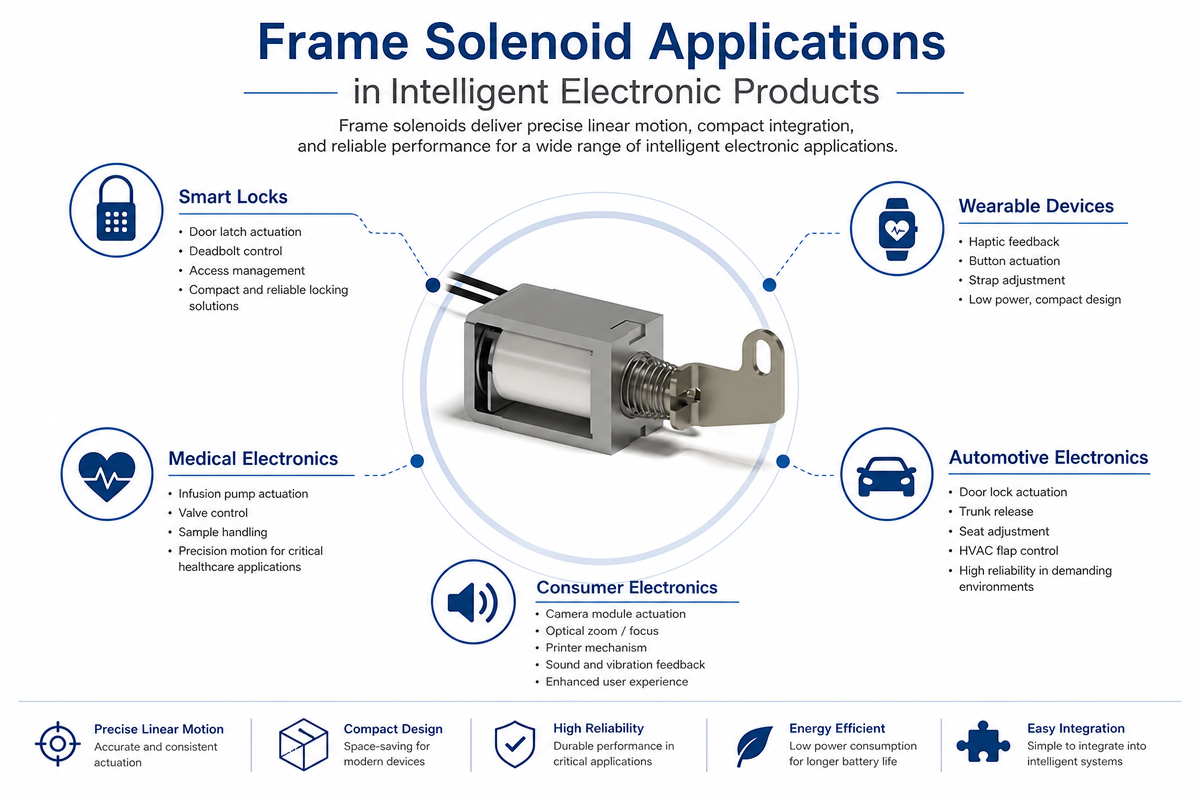
The versatility of frame solenoids makes it possible to use them in numerous applications.
Smart Locks
They can activate locking and unlocking mechanisms in electronic locks, cabinets, lockers, and access-control systems.
Vending Machines
An actuator can release products, operate doors, control mechanical gates, or activate dispensing mechanisms.
Intelligent Appliances
Intelligent appliances can use solenoids for controlling doors, latches, valves, switches, or internal mechanical mechanisms.
Office Automation Equipment
Electromagnetic actuators can control paper paths, locks, gates, and mechanical parts in printers, copiers, document handling systems, and other office equipment.
Automated dispensing machines
Actuators can be used in medical, retail, and commercial dispensing machines to release or control products.
Access Control Systems
Electronic access-control systems can combine sensors, processors, and frame solenoids to perform automatic locking and releasing functions.
Smart Industrial Equipment
Compact solenoids can be used in industrial automation systems for repetitive mechanical operations like positioning, clamping, releasing, and switching.
11. How do engineers choose a frame solenoid?
There are many advantages of frame solenoids, but choosing the right model is a task that requires thorough consideration.
First, the engineers need to determine the required stroke length. The actuator should move sufficiently to perform the mechanical operation without overtravelling.
Secondly, the required force should be determined at the real operating stroke and not at the maximum force.
Third, the electrical characteristics should be compatible with the control system. You need to estimate voltage, current, resistance, power consumption, and duty cycle.
Environmental conditions also matter because temperature, humidity, vibrations, dust, operating frequency, and service life influence actuator performance.
Finally, engineers should consider whether the standard product can meet the requirements or if a customized product will better integrate into the design.
12. The Future of Frame Solenoids in Smart Electronics
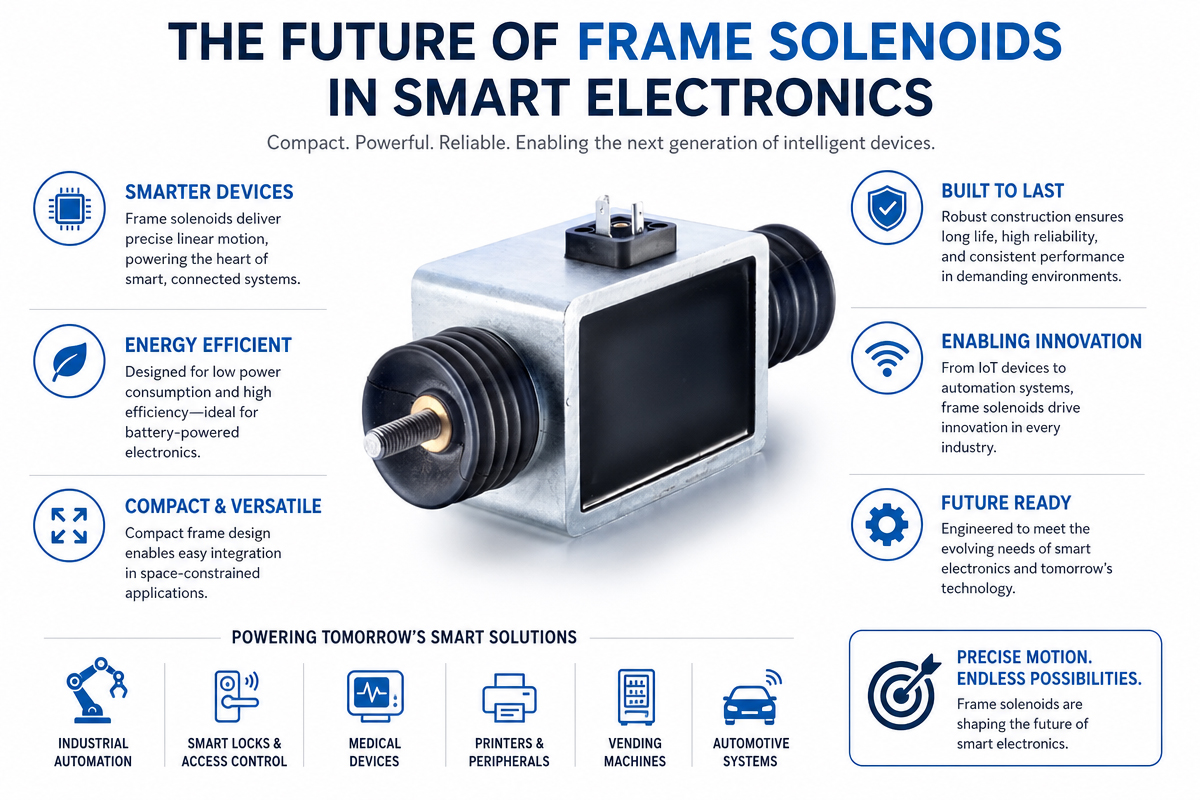
The demand for compact electromechanical components will only grow due to the further development of intelligent electronic products.
Further products are likely to become more integrated, energy efficient, and compact. This makes it possible for manufacturers to create smaller frame solenoids with improved magnetic efficiency, optimized coil design, reduced power consumption, better thermal performance, and increased operating life.
Customization will also become increasingly popular. Instead of simply choosing an off-the-shelf actuator, the product designers can collaborate with solenoid manufacturers to create a customized actuator that will be optimal for the particular mechanical system.
This design approach can improve the product reliability while reducing the unnecessary space and component costs.
13. CONCLUSIONS
Frame solenoids are popular in smart electronic products due to their capability of performing simple, reliable, and controllable linear movements in a compact body.
These actuators have several advantages: small size, direct electromagnetic actuation, fast response, simple electronic control, flexible electrical specifications, reliable repeating operation, low cost, and the ability to be customized.
These actuators help convert electrical commands into mechanical actions in smart locks, vending machines, automated appliances, office equipment, access-control systems, and industrial automation.
The key for product designers is not simply to choose the smallest and the cheapest actuator. The best solution should match the required force, stroke, voltage, duty cycle, installation space, and operating conditions


