

Chapter 1: Introduction on Custom Solenoid Valve
One of the key elements of modern fluid control systems is the custom solenoid valve. A custom solenoid valve is used extensively in industrial automation, manufacturing machines, HVAC systems, water treatment facilities, medical devices, automotive systems, and home automation systems.
Solenoid valves are considered to be the optimal solution for fluid switching, flow control, pressure regulation, and directional control due to the fast response speed, reliable electromagnetic control, compact structure, and easy integration with automatic control systems.
However, improper solenoid valve selection, wrong installation, unsuitable conditions of work, and insufficient maintenance may cause equipment breakdowns, fluid leaks, unstable performance, and decreased lifetime of the valve.
The complete guide to solenoid valves will help you get the necessary information about solenoid valves, including such topics as what a solenoid valve is, how does a solenoid valve work, types of solenoid valves, applications, manufacturing process, troubleshooting, how to select a solenoid valve, future trends in solenoid valve technology, etc.
If you are an engineer, machine designer, procurement manager, or just a consumer, then understanding the basics of solenoid valves may increase system reliability and decrease maintenanexpensessts.
Chapter 2: What Is a Custom Solenoid Valve?
A custom solenoid valve is an electromagnetically controlled valve. It is used to control the flow of liquids, gases, oil, or other mediums using electromagnetic force.
The basic principle of work is basic: an electric impulse activates an electromagnetic coil and generates a magnetic field, which opens and closes the passage by moving a plunger or valve core. The opening and closing actions allow controlling the fluid.
In other words, a solenoid valve is an element, which creates the connection between the electrical control system and the fluid control system. The valve converts electrical energy to mechanical movement in order to control the fluid automatically without manual intervention.
Solenoid valves provide the following advantages compared to traditional manually or pneumatically controlled valves:
Faster response time
Greater control
Compact size
Simpler integration with automation system
Less maintenance needs
That is why solenoid valves are used widely in high-frequency and fully automated applications.
Chapter 3: How a Custom Solenoid Valve Works
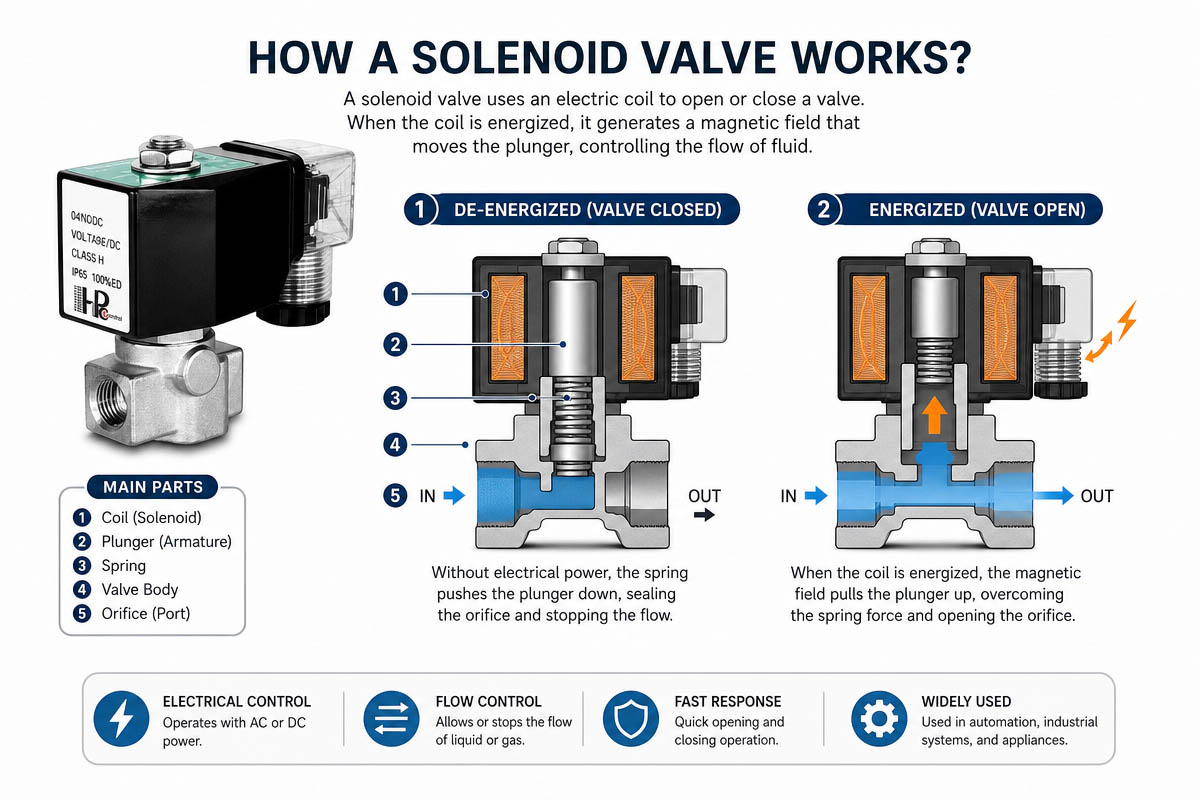
A solenoid valve works using electromagnetic induction and mechanical movements.
Applying a voltage to the coil generates an electric current in the winding of copper wire and creates a magnetic field that pulls the armature or plunger to change the position of the valve core.
Depending on the valve design, this movement allows the following:
Opening the fluid channel.
Closing the fluid channel
Reversing the flow direction
Pressure control
“You turn off the power, and the magnetic field disappears. The fluid pressure and the internal spring’s force return the valve core to its initial position.
Main Types According to Working Principle
Solenoid valve, direct-acting
Direct-acting solenoid valve: The valve core is moved directly by the electromagnetic force.
Advantages:
Fast response
Simple construction
Operates with no pressure difference
Used for low-flow applications
Typical applications
Water coolers
Medical equipment.
Miniature pneumatics
Domestic appliances
Pilot Operated Solenoid Valve
A pilot-operated solenoid valve uses electromagnetic force to operate a small pilot port to move the main valve due to fluid pressure.
Advantages:
More pressure resistant
Best for large flows
Low power consumption.
Typical applications:
Industry pipelines
Air compressors
Hydraulic and pneumatic systems
Equipment for chemical processing
Chapter 4: Construction of a Solenoid Valve
The solenoid valve consists mainly of two assemblies:
4.1 EM Assembly
The electromagnetic assembly converts electrical energy to mechanical movement.
Main components include:
Solenoid coil
Magnetic core
Armature
Plunger
Return springs
Coil case
The coil affects the following:
Magnetic pressure
Response period:
Temperature rise
Lifetime
4.2 Valve Body Assembly
The valve body assembly controls the flow path of the fluid.
Main components include:
Body Valve
Valve seat
Valve core
Seal ring
Inlets/outlets ports
The most important among these components are the valve core and sealing components, as they affect
Leakage prevention
Reliability of switching
Lifetime
Chapter 5: Types of solenoid valves most used
Solenoid valves may be classified according to their structure, operating mode, and environment of usage.
5.1 Classification by Operating Condition
Normally Closed Solenoid Valve
If the solenoid is not powered, the valve is closed, and when the valve is powered, it opens.
Applications:
Water control systems.
Safety shut-off systems |
Industrial automation
Normally Open (NO) Solenoid Valves
If the valve loses power, the valve opens, and when it is powered, the valve closes.
Applications:
Cooling systems
Emergency shut-down systems
Solenoid Valve Holding
A latching solenoid valve holds its position without a constant power supply.
Advantages:
Low power consumption
Perfect for battery-operated devices
Long lifetime
5.2 Classification by Channel Design
Common designs are:
2-way solenoid valve
3/2 solenoid valve.
4-way solenoid valve
Multifunction directional solenoid valve
They are used for:
Fluid switching
Flow distribution
Cylinder control
Direction control
5.3 Classification by Medium
Different mediums, different sealing solutions, and different materials:
water solenoid valve
air solenoid valve
oil for solenoid valve
solenoid valve for steam
anti-corrosion solenoid valve
high-temperature solenoid valve
Chapter 6: Applications of Custom Solenoid Valve
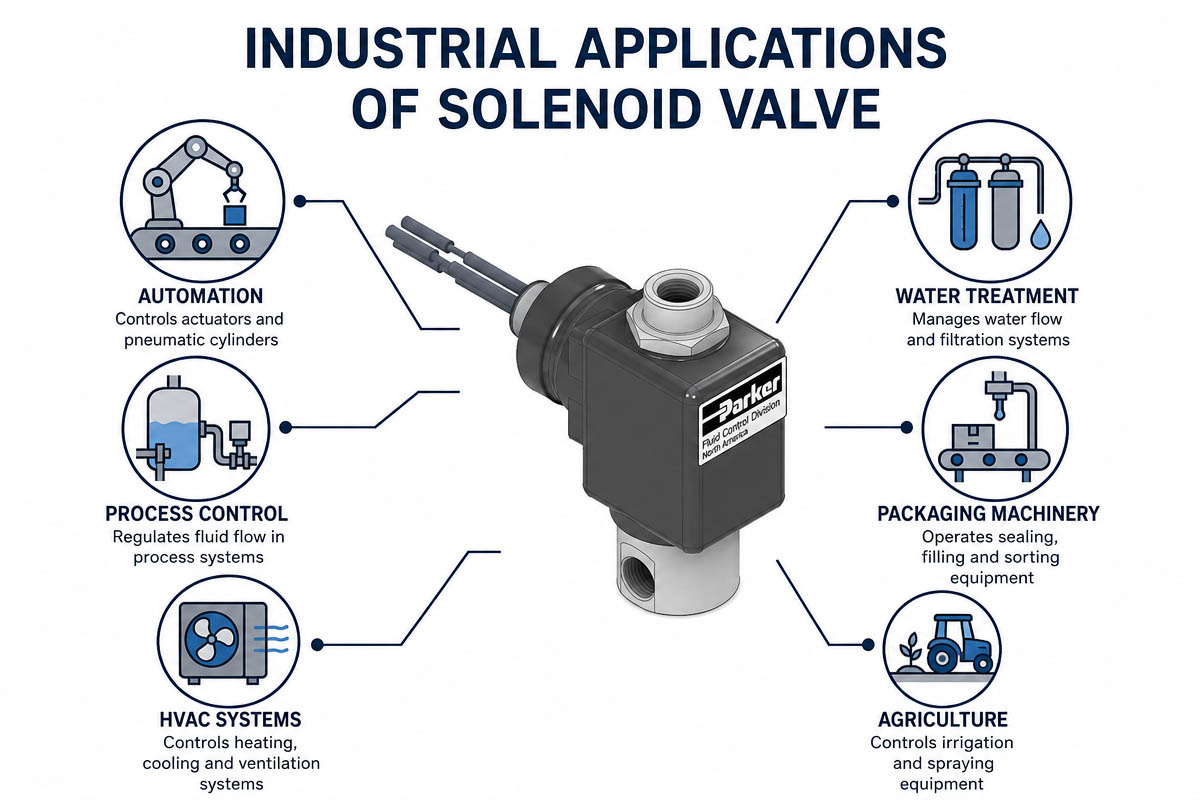
Automation Industry
Solenoid valves are used extensively in:
Production lines:
Robotics
Packaging machinery.
Systems – Pneumatic
They provide accurate and rapid control of liquids.
HVAC System
Applications:
Cooling systems
Air conditioning systems
Heating equipment.
Water Treatment Equipment
Typical usages:
Water purification systems
Irrigation equipment
Drinkware equipment
Medical Devices
Examples:
Oxygen control system
Laboratory equipment
Diagnostic equipment
Applications in the automotive industry
Used at:
Fuel systems
Transmission lines
Emissions control systems
Chapter 7: Advantages and Disadvantages of Solenoid Valves
Because they provide fast and reliable automatic control, solenoid valves find wide use in industrial automation, fluid control systems, HVAC equipment, medical devices, and smart machines. However, like any mechanical and electrical component, solenoid valves have some limitations to consider at the stage of selection.
Advantages of Solenoid Valves
7.1 Quick reaction speed
One of the major advantages of a solenoid valve is that it reacts fast. Most of the solenoid valves are able to open or close within milliseconds, and that makes them suitable for high-frequency and automated applications.
7.2 Automatic simple control
Solenoid valves can be controlled directly by electrical impulses from PLC systems, sensors, or controllers, and that is why they can be controlled remotely and be a part of intelligent equipment.
7.3 Easy installation and compact design
The solenoid valve is smaller and less complex in size and design than many traditional valves, and that makes it perfect for equipment with limited installation area.
7.4 Long Lifetime and High Reliability
A well-designed solenoid valve with high-quality coils, sealing materials, and manufacturing precision will provide reliable operation and long operational cycles.
7.5 Multiple applications
There are solenoid valves for water, air, oil, gas, steam, and chemical medium.
7.6 Disadvantages of Solenoid Valves
7.7 Low pressure and flow capacity
Some small direct-acting solenoid valves are not suitable for high-pressure or large-flow applications.
7.8 Energy Consumption and Heat Production
Constant powering may lead to greater energy consumption and heating of the coil, especially in applications with a 100% duty cycle.
7.9 Contaminant sensitivity
The dust, particles, or impurities in the fluid may block the valve core or damage the sealing elements and affect the valve performance.
7.10 Wrong Selection May Cause Problems
Selection of the wrong voltage, pressure range, temperature rating, or solenoid valve type may cause leakage, overheating, or premature failure of the valve.
In conclusion, the solenoid valves have excellent automation properties and reliability, but correct selection depending on operating conditions is vital to achieve maximum lifetime.
Chapter 8: Manufacturing process of Solenoid Valves
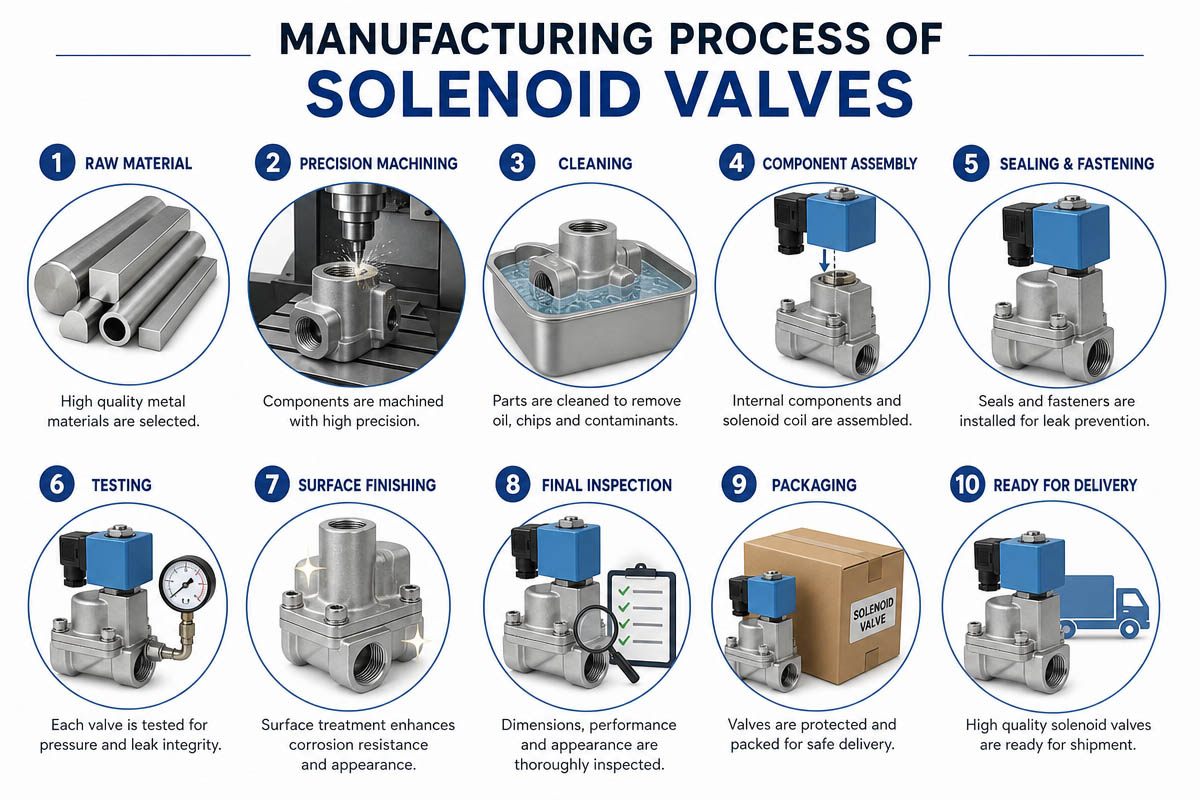
The quality of a solenoid valve is extremely dependent on the accuracy of manufacturing.
8.1 Precise machining
Manufacturing using CNC machining:
valve-bodies
Magnetic core
Plunger parts
High machining accuracy ensures that:
Fluid flow
Low leakage
Reliable performance
8.2 Coil winding
Using high-quality copper wire tightly wound to provide the following:
Stable electro-magnetic properties
Insulation
High temperature resistant.
8.3 Assembly
The components are:
Ports
Valve stems
Sealing rings
Coils are manufactured according to exact standards.
8.4 Performance Test
Professional manufacturers do the following tests:
Pressure test
Leakage test
Voltage test
Measurement of response time
Life cycle test
Chapter 9: Common problems with solenoid valves and how to solve
9.1 The solenoid valve does not work
Reasons:
Incorrect voltage
Burnt coil
Loose wiring
Valves, core, blocked
Solutions:
Check the power supply
Measure the resistance of the coil
Cleaning from contamination inside
Wiring repair
9.2 The valve does not close completely
Reason:
Broken seals
Contamination of valves
Wear of valve core
Solutions:
Replacement of seals
Cleaning of internal parts
Installation of filtering equipment
9.3 Overheating of the coil
Reasons:
Incorrect voltage
Too high switching frequency
Poor heat dissipation
Solutions:
Verification of rated voltage
Choosing appropriate duty cycle
Improvement of cooling conditions
9.4 Leakage
Leakage can be of two types:
inside leakage
External leakage
Solutions:
Replacement of leaking seals
Checking install torque
Checking valve body connection points
Chapter 10: Choosing the Right Solenoid Valve
There are several important criteria to consider when choosing the right solenoid valve.
10.1 Verifying the medium
Check whether the valve will be used for:
Water
Air
Oil & Gas
Chemical media (liquid)
Various media require different seals and materials.
10.2 Verifying the pressure and temperature
Always check the following:
Service pressurization
Maximum pressure
Operating temperature
10.3 Choosing the Correct Type of Valve
Choose depending on your needs:
Normally closed /
NO (normally open)
Direct acting
Latching
Pilot-operated
10.4 Taking into account the working frequency
For high-frequency operations:
High-temperature coils
Valve cores that will last long
Long-life materials
10.5 Matching the port size
Incorrect sizing results in:
Low flow rate
Pressure drop
Low system performance
10.6 Considering the environment
Choosing solenoid valves for special environments:
Waterproof solenoid valves
Explosion-proof Solenoid Valves
Corrosion-resistant valves
Chapter 11: Solenoid Valve Technology Future Technology Trends
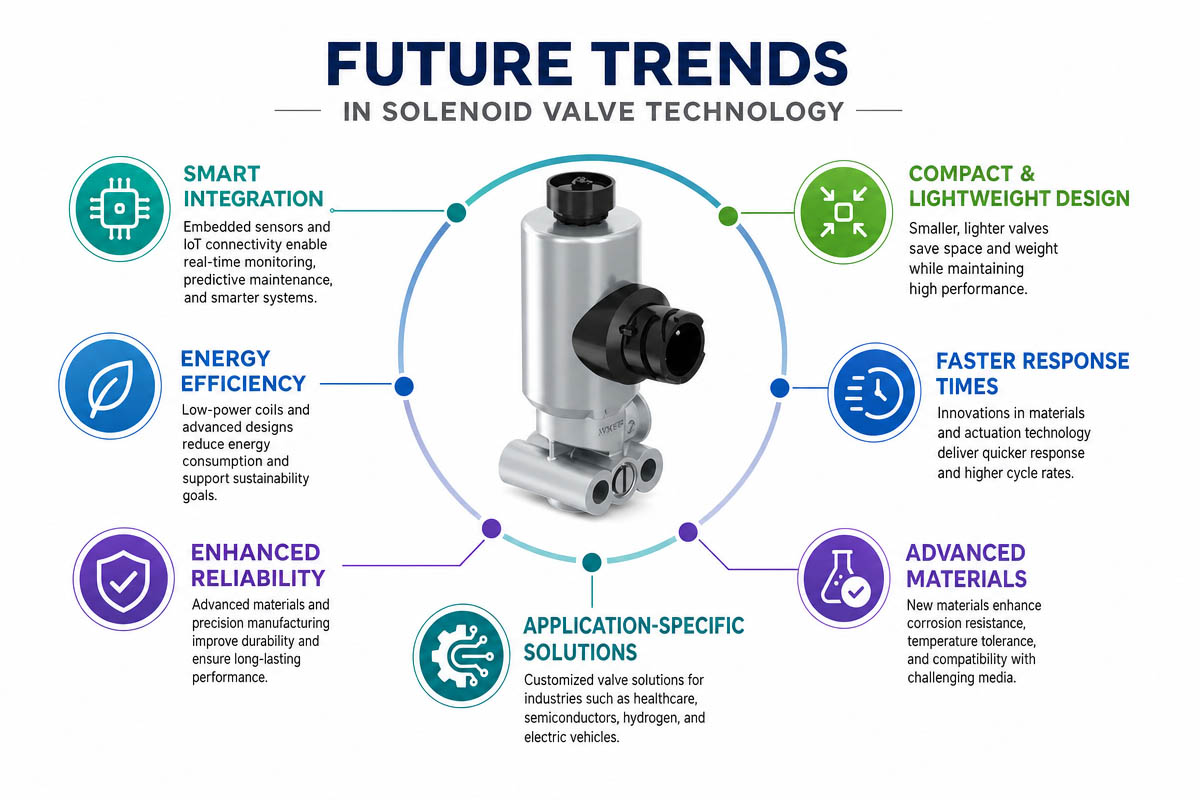
Industry 4.0 and the emergence of smart manufacturing make solenoid valves smarter, smaller, and more energy-efficient.
Future trends are :
Smart solenoid valves
Will integrate with:
Sensors »
Communication module
A digital control system will allow the following:
Real-time monitoring
Maintenance prediction
Remote control
Energy-saving technologies
There will be more popularity of latching solenoid valves and low-power coil designs
Material
Using new materials improves:
Heat resistance
Corrosion resistance
abrasion resistance
Modular design
Using modular solenoid valves will allow you to:
Easy maintenance
Easy replacement
Flexible and customizable
Chapter 12: FAQs About Solenoid Valves
12.1 What is the function of a solenoid valve?
A solenoid valve is a device that uses an electromagnetic force to automatically open, close, or switch the flow of liquids or gases through fluid passages.
12.2 What is the difference between a normally closed and a normally open solenoid valve?
A normally closed solenoid valve is closed without power and opens when powered. Normally open solenoid valve (power off, open; power on)
12.3 What is the average life of a solenoid valve?
It depends on the design and operation conditions. Solenoid valves of high quality can reach hundreds of thousand switching cycles.
12.4 Solenoid valve failure?
Incorrect voltage, dirty fluid, incorrect sizing, overpressure, burnout of the coil, and aging of seals are the most common causes.
12.5 How to choose the right solenoid valve?
When selecting a solenoid valve, it is necessary to consider the following:
Type of the fluid
Pressure range:
Heat
Flow rate
Voltages.
Operating frequency
Installation environment
12.6 Is the solenoid valve able to control water and air?
Yes. However, water solenoid valves and air solenoid valves have different internal construction and different sealing material and pressure ratings.
12.7 What is the difference between a direct-acting and a pilot-operated solenoid valve?
Direct-acting valves operate on the principle of applying electromagnetic force directly. Pilot-operated solenoid valves are assisted by the fluid pressure.
Chapter 13: Conclusion
The construction of the solenoid valve is simple, but it performs an important function in modern fluid control systems.
“The correct selection, installation, and maintenance of equipment have a direct bearing on its reliability, operating efficiency, and service life.”
This knowledge about types of solenoid valves, their functioning principles, applications, manufacturing processes, and troubleshooting can help make the right decisions and avoid failures.
Choosing the right manufacturer of the solenoid valve is the key to stable and long-term performance of the industrial automation and fluid control systems.


