Custom Toroidal RF Coil for Electronic Equipment
Toroidal RF Coil Used in Communication Devices
High Performance Toroidal RF Coil Manufacturer
Toroidal RF Coil Custom OEM Manufacturing
Toroidal RF Coil for Advanced RF Technology
Toroidal RF Coil for High Frequency Filtering
Custom Toroidal RF Coil for Electronic Equipment
Toroidal RF Coil Used in Communication Devices
High Performance Toroidal RF Coil Manufacturer
Toroidal RF Coil Custom OEM Manufacturing
Toroidal RF Coil for Advanced RF Technology
Toroidal RF Coil for High Frequency Filtering

WL50025 Toroidal RF Coil in High Frequency Equipment

A toroidal RF coil is a special magnetic component used in high-frequency signal processing, filtering, and energy transfer applications. The core is ring-shaped with tightly wound conductive wire, so the magnetic efficiency is high, the level of electromagnetic interference is low, and the performance of RF is stable. Toroidal RF coils are usually found in wireless communication equipment, radio systems, antenna matching networks, RF amplifiers, medical electronics, and industrial control systems. The closed magnetic path allows minimizing the leakage flux and improving signal quality and reliability. Toroidal RF coils can be manufactured in various core materials and winding designs and can be customized to particular frequency ranges, impedance requirements, and power. Their compact size and high electrical characteristics make them a crucial solution for the modern high-frequency electronic design.

Compact Toroidal RF Coil Product Overview

A toroidal RF coil is a radio frequency coil that uses a circular toroidal magnetic core with wound conductive wire to provide inductive properties at high frequencies. The core is closed-looped to provide an efficient magnetic path and minimize the leakage flux. Toroidal RF coils are designed to work in applications that require stable inductance, high Q-factor, low loss, and good noise suppression. They are often used in RF communication equipment, antenna systems, signal filters, and high-frequency electronic circuits. Engineers can select from a variety of core materials, winding techniques, and dimensions to optimize the performance according to the frequency, impedance, and application.

How does a toroidal RF coil work?

An alternating current flowing through the wire winding of a high-frequency RF coil causes the creation of a magnetic field. The toroidal core accumulates the magnetic flux in the closed circular path to allow efficient energy transfer and storage.

During the RF operation, the coil provides the function of inductance, impedance matching, and filtering to control frequency characteristics of the signal. The RF signal interacts with the magnetic field created by the winding to suppress unwanted noise and ensure stable signal transmission.

A closed magnetic structure provides the limitation of electromagnetic radiation and interference, so toroidal RF coils are useful for sensitive high-frequency applications such as communication systems, antenna circuits, and RF amplifiers.

Compact Toroidal RF coil manufacturer Video

Compact Toroidal RF coil manufacturer Detailed Display

RF toroidal inductor Technical Data sheet

Sendust Toroidal Coil Model Catalog 1

| Parameter | Typical Value |
| ——————— | ——————– |
| Core Material | Sendust (Fe-Si-Al) |
| Inductance Range | 1 µH – 10 mH |
| Rated Current | 1A – 50A |
| Saturation Current | Up to 80A |
| Operating Frequency | 10 kHz – 300 kHz |
| Operating Temperature | -40°C to +125°C |
| Insulation Type | Enameled Copper Wire |
| Core Shape | Toroidal |

Why Toroidal RF Coil Is Gaining So Much Popularity?

Toroidal RF coils have become popular recently, as modern electronic systems require high frequency performance, good signal quality and low electromagnetic interference.

The rapid development of wireless communication, IoT devices, 5G networks and smart electronics has caused the increased demand for compact and reliable RF components. Toroidal RF (radio frequency) coils have high magnetic efficiency, stable inductance and low signal interference.

Their support for advanced communication systems in compact size and high reliability is attractive for engineers and manufacturers.

RF toroidal inductor Technical will continue to be an important component for future RF communication, industrial electronics and wireless applications.

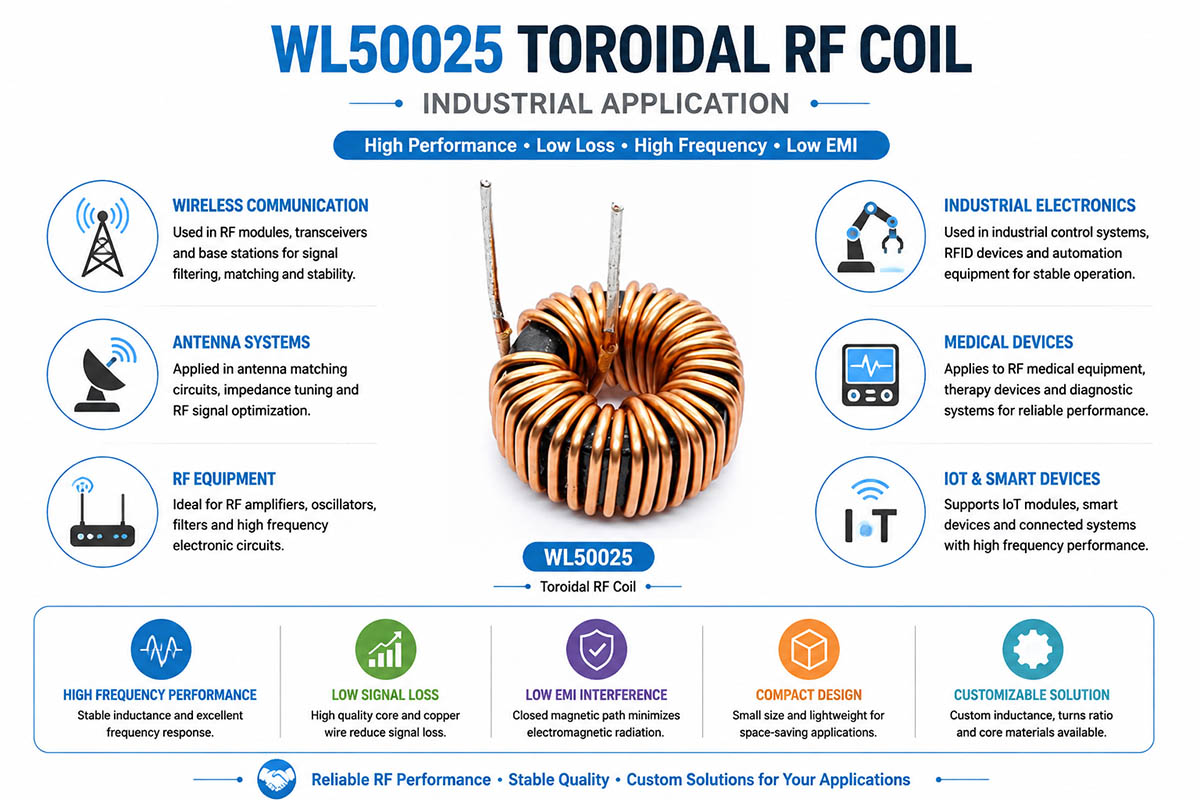
High Frequency RF coil Industrial Applications

Toroidal RF Coil for High Frequency Applications

Toroidal RF coils are often used in high-frequency electronic systems requiring signal stability, low interference, and good magnetic performance.

RF coils with a toroidal shape are used in wireless communication equipment for signal conditioning, filtering, and impedance matching. They are used in radio transmitters, receivers, base stations, and communication modules to improve signal quality.

Toroidal RF coils are also used in antenna systems for tuning circuits and frequency control. Their low leakage flux provides accurate RF performance and reduces unwanted electromagnetic interference.

RF amplifiers, testing equipment, automation systems, and control devices all use toroidal RF coils in industrial applications. They provide stable operation where reliable signal transmission is required.

The compact design and high reliability of the RF coil technology make it attractive for usage in medical electronics, aerospace equipment, and precision measurement systems.

With increasing adoption of wireless technology, IoT devices, 5G communication and smart electronics, toroidal RF coils continue to provide crucial solutions for high-frequency circuit design.

Toroidal RF Coil Advantage and Disadvtage

Advanced Toroidal RF Coil Manufacturing Process

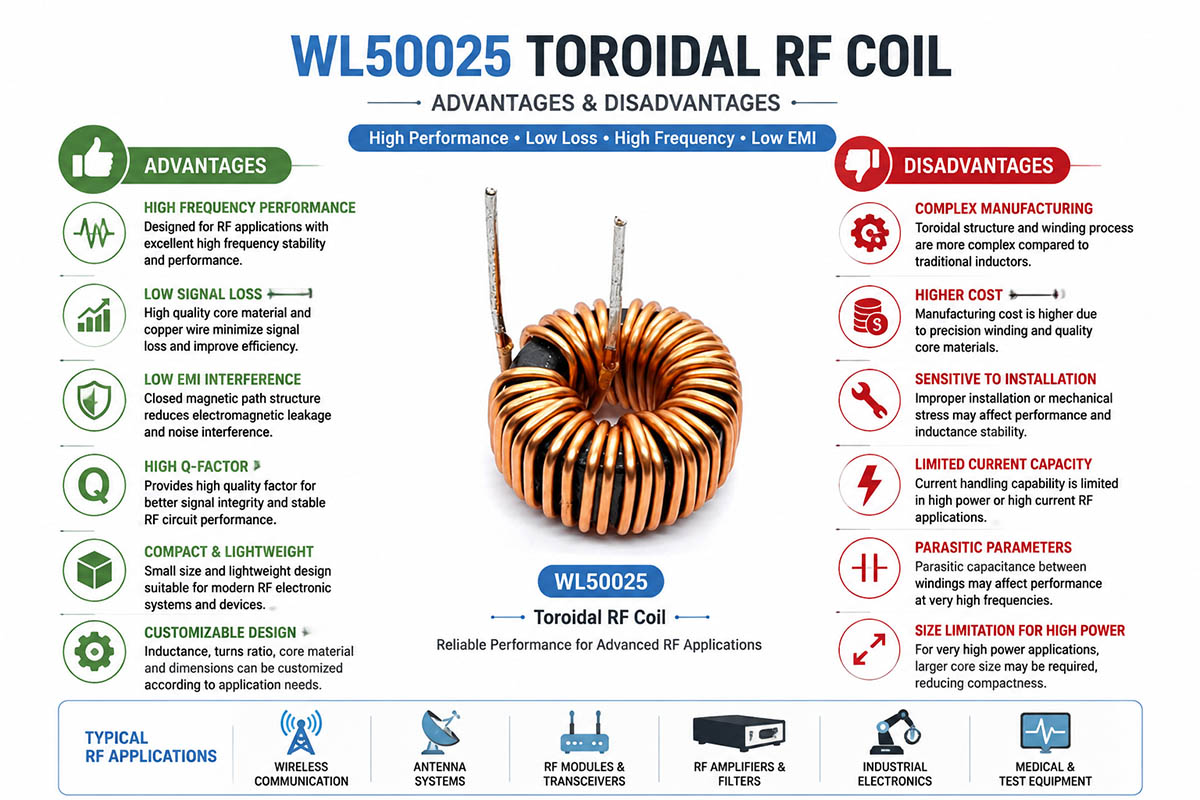
Advantages and Disadvantages of High-Frequency RF Coils

Benefits

Toroidal RF coils have excellent electromagnetic performance because their closed magnetic path reduces leakage flux and interference. They provide stable inductance, low signal loss, and high efficiency for high-frequency circuits. Compact design saves space and provides reliable RF characteristics.

They have excellent noise suppression performance and are suitable for sensitive communication systems. Toroidal structures also provide shielding performance and reduce undesired radiation.

Disadvantages

However, high-frequency RF coils have some limitations. Manufacturing may be more complicated, as the winding should be precise around the round core, which may increase manufacturing cost in comparison with traditional coils.

Toroidal RF coils may be difficult to install due to their shape, limiting the mounting options. The wrong core material and winding design may have a negative impact on the frequency response.

In ultra-high frequency applications, the parasitic capacitance between turns may have an influence on the performance, and an optimized design should be provided.

Toroidal RF coils are generally advantageous for modern RF applications where efficiency, stability, and low interference are important.

Industrial Toroidal RF Coil Design and Solutions

Troubleshooting Toroidal RF Coil

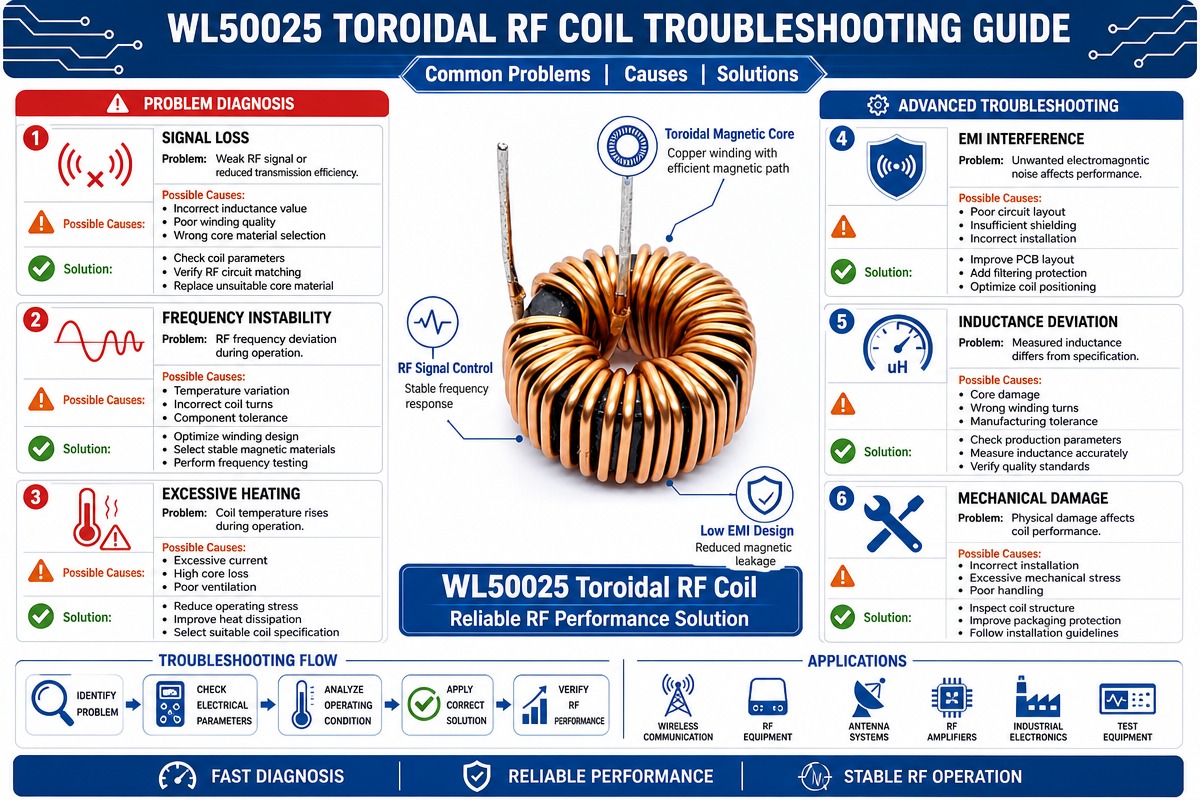
The common issues with toroidal RF coils are frequency stability, signal loss, overheating, and sudden impedance changes.

1. Signal Attenuation

Reasons Might Be:

Wrong inductance value

Wrong core selection

Curling problems

Solutions:

Check the coil specifications

Check the core material.

Check the winding quality.

2. Frequency Deviation

Possible reasons:

Incorrect number of turns

Temperature fluctuations

Component tolerances

Solutions:

Change the winding design.

Use materials that are stable at temperature.

Test frequency response and

3. Overheating

Causes may include:

High current

Loss core

Poor ventilation

Solutions.

Ease the operational stress.

Select appropriate core material.

Improve thermal design

4. EMI problems

Possible reasons:

Bad circuit layout

Incorrect shielding (shielding)

Solutions:

Optimize PCB design.

Add filter protection.

Stable toroidal RF coil performance depends on regular testing and proper component selection.

FAQ

1. What is the application of High Frequency RF?

The High Frequency RF are commonly used in high-frequency electronic circuits to filter signals, match impedances, transfer energy and prevent noise. This product is extensively used in wireless communication equipment, antenna systems, RF amplifiers, radio devices, IoT equipment and RF applications in industry.

2. What are the advantages of Toroidal RF Coil compared to traditional RF Coil?

The magnetic performance is the advantage of the toroidal RF coil, as its magnetic flux is enclosed within the core due to the closed-loop core structure. Compared to conventional RF coils, it is characterized by low leakage, low EMI, high efficiency, stable inductance, and high-quality signal.

3. How can RF toroidal inductor optimize the performance of RF signal?

The toroidal RF coil can optimize RF signals through precise inductance, impedance matching, and filtering capabilities. Due to the closed magnetic path, the coil reduces the electromagnetic radiation and interference, thus optimizing the performance of RF signals.

4. How to Choose RF toroidal inductor for RF applications?

When choosing toroidal RF coils for RF applications, the operating frequency, inductance value, Q factor, core material, current rating, impedance, dimensions, and temperature conditions should be considered. Matching of these parameters with RF application will provide maximum efficiency and performance.

5. What are the core materials of Toroidal RF Coil?

The common materials of the core are ferrite, powdered iron, and alloy magnetic materials. Ferrite cores are used in RF applications at high frequencies due to low power losses and frequency characteristics. Powdered iron cores are used in applications requiring high energy storage and stable inductance.

6. Do Toroidal Coils minimize the level of EMI?

Yes. The circular shape of the core creates the closed magnetic field, which significantly reduces the leakage and magnetic fields. Toroidal RF coils can be applied in communication systems, RF filters, and electronic equipment to reduce EMI.

7. Why the performance of Toroidal Coils may be problematic?

Incorrect selection of core material, winding design, current overload, temperature changes, and circuit matching may cause problems. Checking the inductance values, frequency response, installation, and operating conditions will allow solving problems of toroidal RF coils.

8. Can Toroidal Coils be customized?

Yes. The toroidal RF coils are available in accordance with the application specifications. It means that core size, core material, wire type, turns number, inductance, frequency range, impedance properties, and mounting can be modified depending on the requirements of a certain RF application.

How to Choose a Toroidal RF Coil?

Selection of the right toroidal RF coil requires a careful analysis of electrical, mechanical, and application requirements.

First, determine the operating frequency range. RF coils should be designed for the target frequency since their performance is highly dependent on the core materials and winding structures.

Secondly, select the right core material. Ferrite cores are widely used in high-frequency applications due to low losses and good magnetic properties. However, for high-energy-handling applications, powdered iron cores may be used.

Another important thing to consider is the inductance value required. Engineers should calculate the required inductance for filtering, tuning, or impedance matching circuits.

Current handling capacity is also an important parameter. The coil should be able to withstand the operating current without overheating or loss of performance.

The Q-factor is also an important parameter. It represents the efficiency and quality of the coil. Higher Q-factor values usually result in better RF performance.

Physical dimensions to fit the available installation space. Before selection, coil size, mounting method, and environmental conditions should be considered.

Stability to temperature is also an important parameter in industrial applications. Selection of the material capable of operating well at the expected operating temperature should be done.

Manufacturers can customize the product for particular applications:

Diameter of Center

Diameter of wire

Number of turns

Insulating materials

Frequency properties

Prototyping should be done before mass production to verify the electrical performance.

Proper selection of the toroidal RF coil improves the signal quality, reduces the interference, and increases the system reliability.

Common Mistakes in Designing Toroidal RF Coils—Tips to Avoid

Do not ignore the operating frequency requirements.

“Don’t choose the wrong core materials.

Consider the impact of temperature on magnetic performance.

Make sure the number of turns in the winding is correct for the inductance.

Don’t apply excessive current, resulting in overheating.

– Consider the impedance matching requirements.

Don’t add any parasitic capacitances.

Do RF testing before production.

Consider EMI requirements in the layout design.

Consider mechanical installation conditions.

Get A Free Quote Now

Contact Form

Related Products

Related News

Scroll to Top

Get A Free Quote Now !

Contact Form
If you have any questions, please do not hesitate to contact us.
Weilong Solenoid Company Culture
