Chapter 1: Introduction to Ferrite Coil Technology
Efficient electromagnetic components are required for electrical energy control, magnetic field generation, and operation of modern electronic devices. Coils are very important when it comes to the conversion and handling of electrical energy in different industries, including the automotive industry, power supplies, industrial automation, and electromagnetic actuators.
There are many magnetic components in electronic engineering; ferrite coils are among the most important of them due to high frequency, minimal energy losses, and wide application of the components.
Actually, ferrites are used in many devices such as inductors, transformers, filters, electromagnetic interference (EMI) suppression components, and various electromagnetic systems. The magnetic properties of the materials allow using them in places where electrical efficiency, small size, and stability are required.
Ferrite coils are different from solenoid coils. However, both technologies use the principles of electromagnetic devices. Solenoids may also be improved by studying ferrite materials and their technology of production by engineers for creating such items as linear push-pull solenoids for industrial and electronic applications. In this article, we will speak about ferrite coil technology and its properties, materials, manufacturing processes, advantages, applications, and difference from solenoid coils.
Chapter 2: What Is Ferrite Coil Technology?
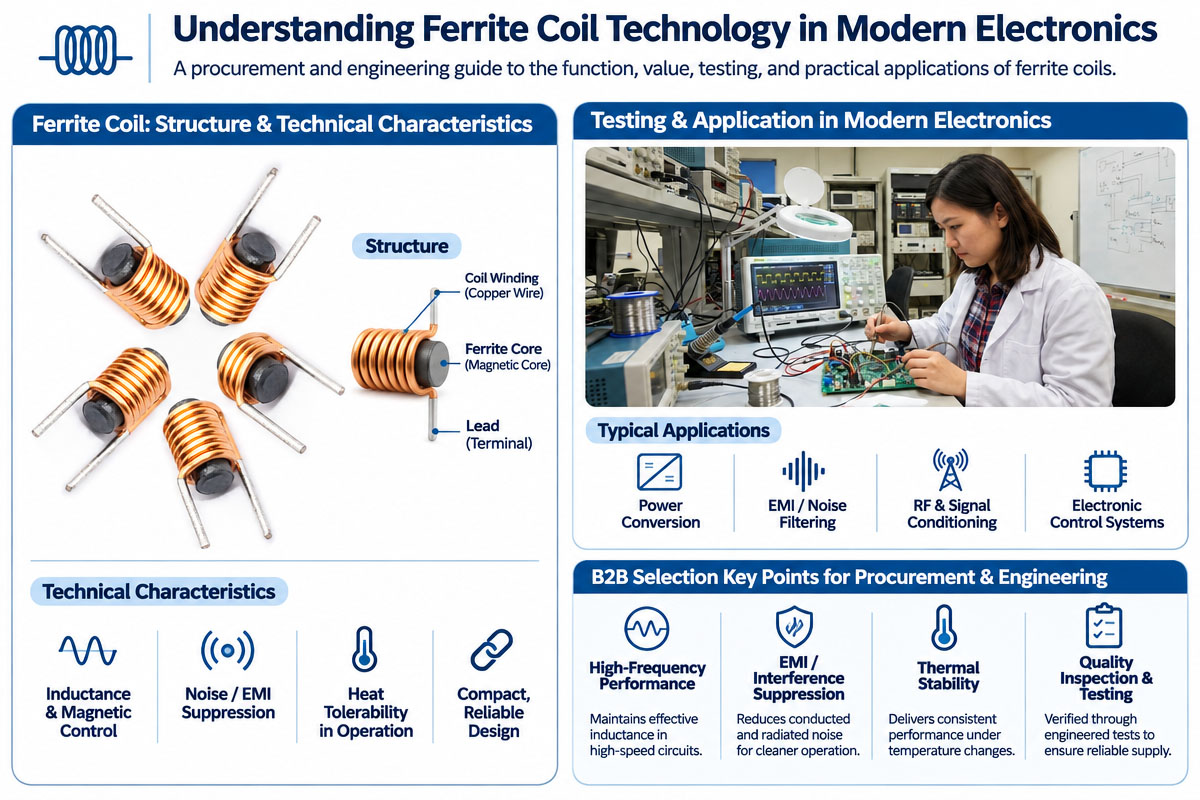
Ferrite coil technology uses electrically insulating magnetic ferrite materials for cores or magnetic structures of electronic components with coils.
There are three basic elements of a ferrite coil:
Ferrite core: A ceramic magnetic element that provides a controlled magnetic path.
Copper winding: Insulated copper wire wrapped on the ferrite core for generation or receiving of magnetic field.
Insulation and housing: Special materials that provide electrical insulation, mechanical protection, and environmental protection.
The passage of electrical current through the copper winding produces a magnetic field in the coil. A ferrite core helps direct and focus the magnetic flux and thus improves the magnetic performance of the component.
The main composition of ferrite materials is oxides of iron, manganese, zinc, and nickel.
Ferrites have relatively high electrical resistivity in comparison with the conventional metallic magnetic materials. This allows minimizing eddy current losses, especially for high-frequency applications.
This is why ferrite magnetic components are widely used in modern switching power supplies, communication equipment, electronic filters, and electromagnetic systems.
Chapter 3: How does a ferrite coil work?
A ferrite coil works on the principles of electromagnetic induction and magnetic flux.
As a result of the movement of current through the copper winding, a magnetic field is generated. A ferrite core provides a proper magnetic path with high permeability in order to conduct magnetic flux better.
The work of a ferrite coil may be subdivided into several steps.
Step 1. Winding becomes excited with electric current.
When a coil gets electric current, it passes through the copper winding.
Current creates a magnetic field in accordance with Ampère’s law.
The magnetic field intensity depends on the number of turns of the winding and current passing through it.
In a simple magnetic circuit, the formula for calculating the magnetomotive force (MMF) is:
MMF = N × I
Where:
N – number of turns of winding
I – electric current.
MMF – magnetomotive force.
The magnetic excitation is increased in proportion to the increase in turns of the winding or in current passing through it.
Step 2. Ferrite Core Directs the Magnetic Flux
The magnetic field is produced in the copper winding and passes through the ferrite core.
Ferrites provide a more effective magnetic path, having comparatively high magnetic permeability in comparison with air.
It results in the increase of the coil inductance.
The specific magnetic performance of the device depends on the core geometry, ferrite material, frequency of application, and operational temperature.
Step 3: Magnetic Energy Storage / Transmission
Depending on the circuit design, the ferrite coil may store energy, transmit energy between circuits, and filter electrical signals.
For example:
Energy is stored in the magnetic field of inductors.
Energy transmission occurs in transformers as a result of change in magnetic flux between two windings.
Ferrites in the EMI suppression component help in the reduction of high-frequency electrical noise.
Step 4: Changing of Magnetic Field Depending on Electric Current
As the electric current varies, the magnetic field changes.
Depending on the design of the device, the changing magnetic flux may be used to generate voltage on the same winding or the second near winding.
It is the basis of many electronic systems for power conversion and signal processing.
Chapter 4: Ferrite Coil Materials and Common Types
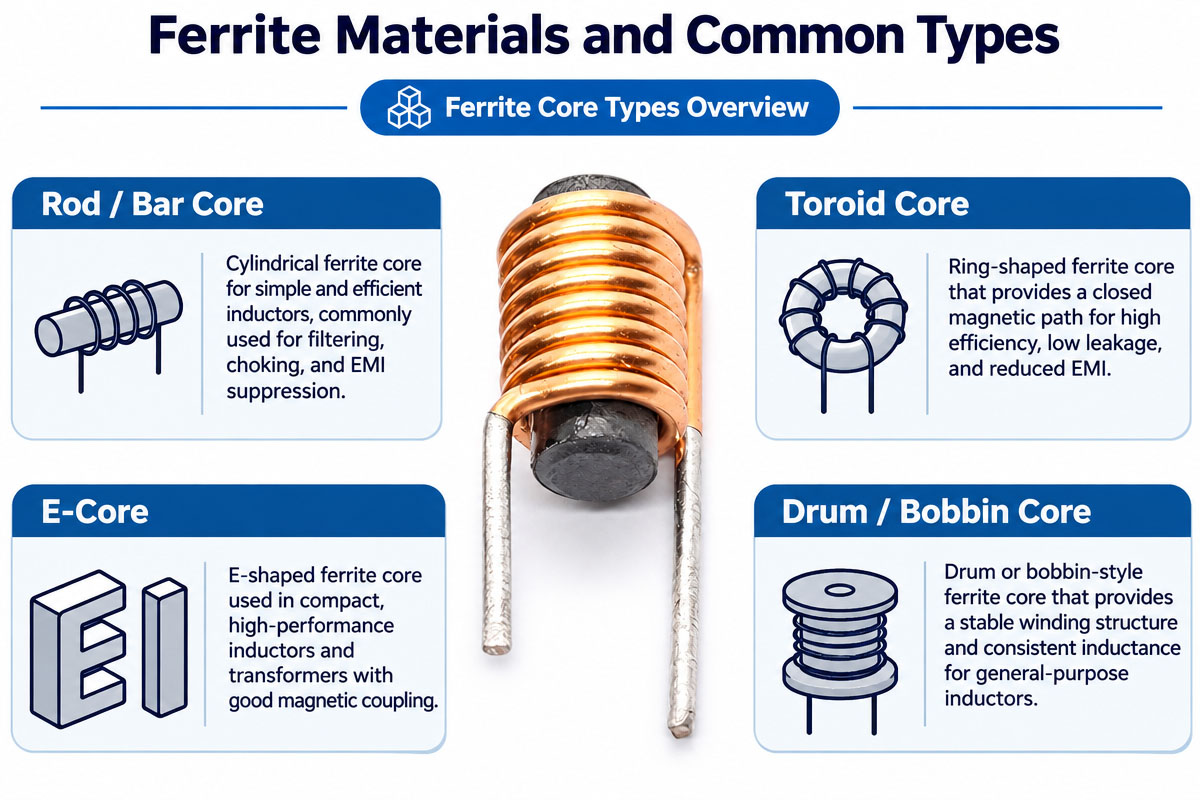
Ferrite materials have different magnetic performance. Thereby, these are suitable for various electronic applications.
The two most popular types of ferrites are
nickel-zinc ferrite and manganese-zinc ferrite.
4.1. Manganese Zinc Ferrite (MnZn)
Manganese zinc ferrite is commonly used in power electronics and magnetic components operating at low and medium frequencies. The main characteristics of MnZn are
relatively high magnetic permeability.
high magnetic flux density capability.
good performance in a power transformer.
good characteristics for power inductors.
relatively low core losses.
It is used in switching power supplies, power transformers, inductors, and common mode chokes.
4.2. Nickel Zinc Ferrite (NiZn)
Nickel-zinc ferrite has higher electrical resistivity in comparison with MnZn.
It is used in such applications as:
EMI suppression.
high frequency filters.
communication devices.
radio frequency components.
suppression of noise in electronic circuits.
It has different magnetic permeability and saturation in comparison with MnZn, and the appropriate material should be selected depending on frequency and application.
4.3 Choosing the Appropriate Ferrite Material
It is very important to choose the right ferrite material, and the following parameters should be considered by an engineer:
operational frequency.
magnetic susceptibility initially.
flex density saturation.
features of the core losses.
operating temperature.
geometry and core dimensions.
electrical and mechanical features.
Choosing the right ferrite material is very important for the stability of the inductance, energy losses, and reliability of the product.
Chapter 5: Basic Electrical Characteristics of Ferrite Core Coils
The performance of a ferrite coil is influenced by many electrical and magnetic parameters.
This data is of great significance for designing electronic circuits and components.
5.1. Inductivity
The inductance is the resistance of a coil to a change in the electric current through the magnetic field of the coil.
Its SI unit is the henry (H).
In the ideal magnetic circuit, the formula is simplified as follows:
L= N² × μ × A / l
Where:
* L = inductance.
N = turns of wire.
μ = permeability of free space.
A = effective cross-sectional area of the core.
l = effective length of magnetic circuit.
The real inductance is also dependent on the air gaps, leakage flux, winding geometry, and material features.
5.2. Core Loss
Core loss is the energy that is lost in the magnetic material while working.
The core loss is caused mainly by hysteresis losses and eddy current losses.
Ferrites are advantageous in high-frequency applications because of their high electrical resistivity, reducing the eddy-current losses.
But core loss is a function of frequency, magnetic flux density, waveform, and temperature.
5.3. Flux density at saturation
In case of approaching the saturation state of the ferrite core, the magnetic flux density does not grow proportionally with the growth of magnetic excitation.
This phenomenon reduces the inductance.
Thereby, it is very important for an engineer to make sure that the chosen ferrite core meets magnetic parameters.
5.4 Betriebstemperature
Temperature influences magnetic permeability and saturation as well as core losses.
The temperature characteristics of ferrite materials differ by types of ferrite.
While designing the components for automotive and industrial applications, it is necessary to take into account the whole operating temperature range and not just room temperature.
Chapter 6: Ferrite Coils and Conventional Copper Coils
Ferrite coils and conventional copper air-core or iron-core coils are used for different purposes.
Their performance depends on the features of the magnetic material, frequency, geometry, and electrical features.
Ferrite Coil Air Coil
Magnetic core ferrite ceramic No magnetic core Magnetic metallic material
Electrical resistivity: High N/A Typically lower
Losses in eddy currents No core eddy-current losses Relatively low, maybe significant
Magnetic permeability is fairly high. Roughly the same as air Usually high
Typical uses: high-frequency electronics, RF, and high-frequency circuits Devices of electromagnetism and power
Primary design considerations Saturations and core losses Winding geometry and inductance Core loss and saturation
Ferrite cores may be very useful in high-frequency electronic applications.
But not necessarily the optimal material for every electromagnetic device.
For example, a linear push-pull solenoid requires a magnetic circuit that is able to produce sufficient mechanical force with a certain stroke.
In these applications the engineers use appropriate soft magnetic metallic materials for the moveable plunger and magnetic housing.
The correct material is chosen by magnetic force, mechanical strength, operational frequency, and thermal conditions
Chapter 7: Application of Ferrite Coil Technology in Modern Electronics
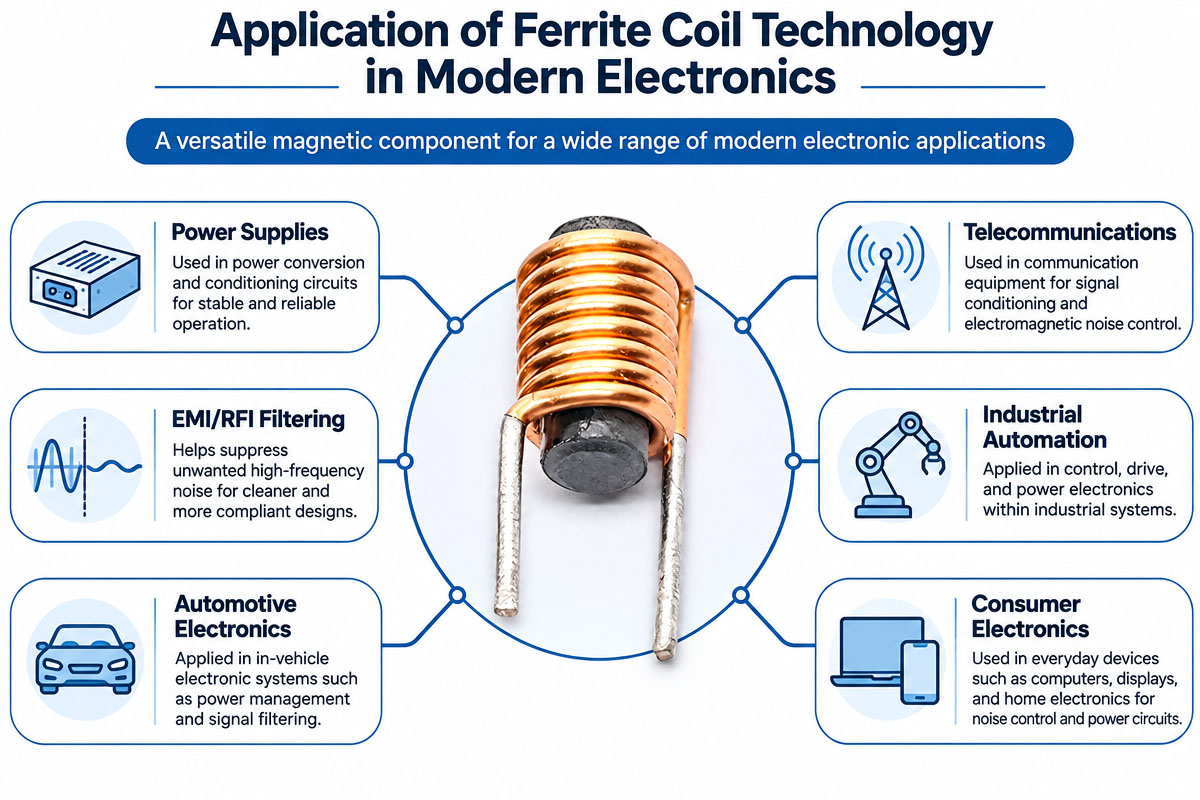
Ferrite coils are used in many electronic devices because of the above features.
7.1. Switching Supplies
Transformers and inductors are used in the power supplies for effective conversion of electricity.
Ferrite cores are used in this case, as they reduce the magnetic loss at the switching frequency.
They are used in chargers, industrial and computer power supplies, and other electronic devices.
7.2 Reduction of Electromagnetic Interference
The electronic devices are producing unwanted electrical noises.
Ferrite beads are used widely for suppressing the high-frequency interference in power lines and signal lines.
The ferrite beads and common-mode chokes are used for providing the electromagnetic compatibility.
7.3. Electronic Components for Automobiles
Modern automobiles have many electronic systems, including battery management systems, ECUs, sensors, and communication modules.
All of them use ferrite magnetic components in power conversion and noise suppression circuits.
The material selection for automotive applications is very difficult because of the temperature variations, vibrations, and reliability.
7.4. Wireless Charging System
The wireless power transfer is the transferring of energy between transmitting and receiving coils using a magnetic field.
The ferrite sheets and ferrite magnetic structures are used for directing the magnetic flux and limiting the undesired magnetic coupling of the nearby conductive elements.
The wireless power transfer is widely used in the wireless charging devices and consumer electronics.
7.5. Automation in Industry
Such components as power electronics, communication equipment, sensors, and electromagnetic actuators are used in industrial control systems.
The ferrite parts are used in this case in order to increase the power conversion efficiency and reduce electromagnetic interference.
The electromagnetic actuator systems may be used along with electronic systems, for example, a custom linear push-pull solenoid.
Chapter 8: What materials are used in ferrite coils?
The quality of the manufacturing process plays an important role in the performance and reliability of ferrite products.
The manufacturing process normally consists of several steps.
Step 1: Preparing of ferrite materials
Raw materials are mixed according to the material composition, e.g., iron oxide and other metal oxides.
The mixture is processed to ensure uniform chemical and physical properties.
Step 2: Processing and forming the powder
The ferrite powder is formed according to the shape of the core.
Depending on the design, the core can be pressed and formed in any other suitable way.
Step 3: Sintering
The ferrite elements are formed and sintered under special conditions at increased temperatures.
This process forms the ceramic structure and fixes the magnetic properties of the material.
Step 4: Forming the Core
The ferrite core can be ground, finished to size, and tested for compliance with the specified tolerance.
Step 5: Wrapping the Copper Coil
According to the design, the necessary number of turns, wire diameter, and winding configuration are wrapped on the ferrite core with insulated copper wire.
Automated winding machines can increase the manufacturing consistency and efficiency.
Step 6: Assembly and Testing.
After the assembly of the element, it undergoes testing.
The common inspection items include:
Inductance.
DC Resistance.
Insulation Resistance.
Dielectric Strength.
Basic Dimensions.
Temperature Properties.
Electrical Properties.
Depending on the application, other types of tests may be performed to check the performance under real operating conditions.
Chapter 9: The Relationship Between Ferrite Technology and Next-Generation Electronics
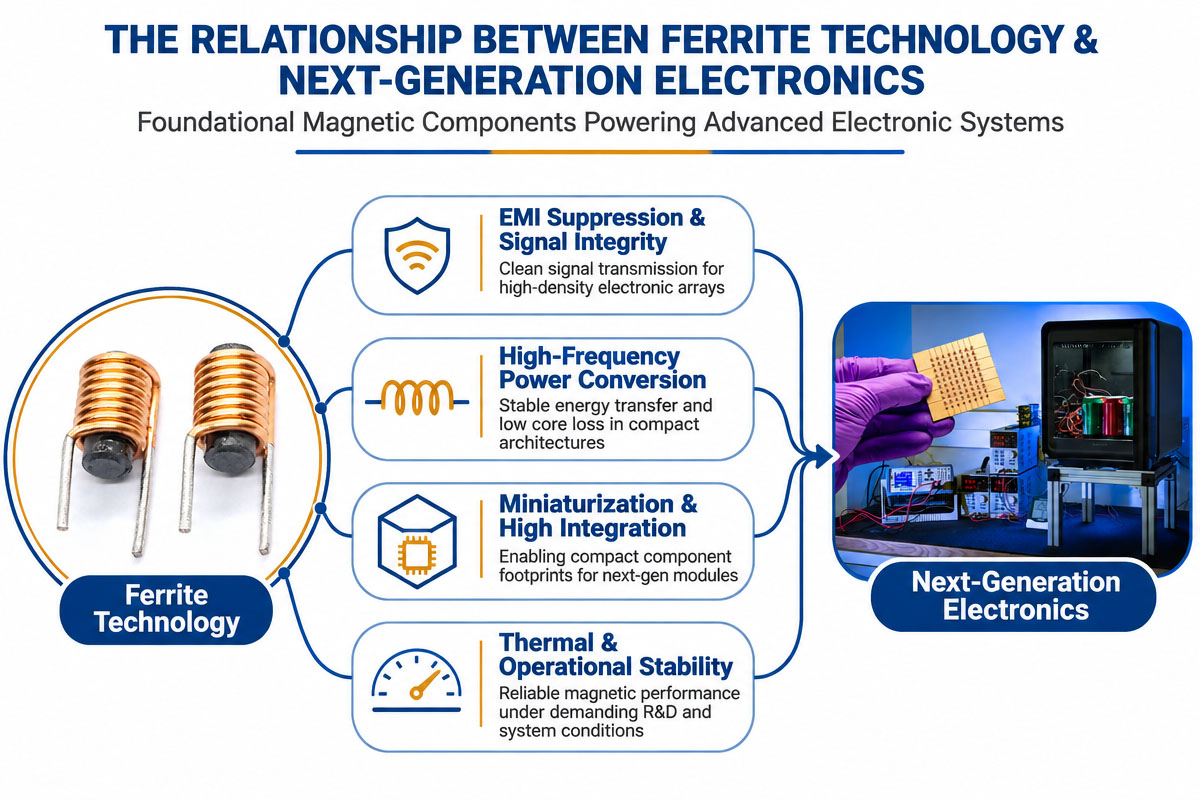
As electronic devices become smaller, faster, smarter, and more energy efficient, the demand for advanced magnetic materials is steadily growing. Ferrite technology is becoming more important to meet these requirements. Ferrite materials are critical components in the development of next-generation electronics, serving roles from power management and EMI suppression to wireless charging and high-frequency communication.
Ferrites are ceramic magnetic materials, basically iron oxide combined with other metal oxides such as manganese, zinc, nickel, or magnesium. Their excellent magnetic properties, high electrical resistivity, and relatively low energy losses make them particularly suitable for modern electronic applications.
9.1. Miniaturization with Ferrite technology
Miniaturization is one of the biggest trends in next-generation electronics. Demand is growing for small components that don’t compromise on performance for smartphones, wearables, medical equipment, and IoT products.
Ferrite materials have good magnetic properties in relative small volumes. They find widespread application in inductors, transformers, magnetic cores, and electromagnetic coils for efficient energy conversion and control of signals.
With continuing advances in ferrite material composition and manufacturing processes, engineers are able to develop smaller magnetic components with improved performance, enabling the design of thinner, lighter, and more compact electronic products.
9.2. Enhancing Power Efficiency in Contemporary Electronics
Energy efficiency is another important requirement for next-generation electronic systems. Electric vehicles, renewable energy systems, fast chargers, and industrial automation equipment need reliable power conversion solutions.
Ferrite cores are often used for high-frequency transformers and inductors due to their high electrical resistivity and relatively low eddy-current loss.
These features improve power conversion efficiency, reduce heat generation, and enable more compact power supply designs.
Especially the manganese-zinc (MnZn) and nickel-zinc (NiZn) ferrites have different frequency and application requirements. This enables engineers to select suitable magnetic materials for certain operating conditions.
9.3. Enable High Frequency Communication
The rapid development of 5G, advanced wireless communication, and IoT technology has increased the demand for effective electromagnetic control.
Ferrite materials are widely used in EMI suppression components and noise filters and high-frequency magnetic devices. They help to reduce unwanted interference from electromagnetic sources and increase signal stability in the increasingly complex electronic environment.
With the increasing number of wireless functions in electronic systems and the operation at higher frequencies, advanced ferrite materials will continue to play an important role for reliable signal transmission and electromagnetic compatibility.
9.4. Wireless Charging and Smart Device Compatibility
Wireless charging technology is getting more and more popular in smartphones, wearable electronics, electric vehicles, and smart home products.
Ferrite sheets and magnetic materials direct magnetic flux, improve energy transfer, and reduce unwanted interference with nearby electronic components.
They are also useful for wireless power transfer applications where good magnetic coupling is important due to magnetic properties.
9.5. Ferrite Technology in the Future
The future of ferrite technology is strongly tied to the next generation of semiconductors, AI, e-mobility, and industrial automation.
Future development will concentrate on high-frequency performance, lower magnetic losses, better temperature stability, material consistency, and custom magnetic structures.
The selection of the right ferrite material and magnetic structure will become more important to manufacturers of these components for ensuring reliable product performance as inductors, transformers, electromagnetic coils, and solenoids become more complex.
This component design will offer new opportunities to provide more efficient, compact, and reliable solutions for the technologies of tomorrow.
Chapter 10: Why choose Weilong for custom electromagnetic coil solutions?
Weilong Intelligent Technology (Dongguan) Co., Ltd. specializes in the manufacture of solenoid coils and inductor coils since 2007.
Based on many years of experience in the electromagnetic components industry, Weilong provides custom electromagnetic solutions for industrial automation, automotive equipment, medical devices, security systems, and other OEM applications.
We are able to manufacture:
Metal stamping and tooling.
Injection Molding of Plastic.
CNC Milling.
Winding of Copper Coil.
Solenoid Assembly.
Product Testing and Product Performance Evaluation
We combine multiple manufacturing processes under one roof to control product dimensions, winding quality, assembly quality, and the entire manufacturing process.
Our engineering team designs electromagnetic products meeting strict customer requirements for voltage, current, inductance, resistance, force, stroke, duty cycle, operating temperature, and installation dimensions.
We can evaluate custom inductor coil requirements and electromagnetic actuator projects for the customers designing electronic equipment.
Also, we manufacture customized linear push-pull solenoid products for applications requiring custom mechanical movement, force output, and installation dimensions.
We are ISO 9001, IATF 16949, CE, RoHS, and REACH certified for quality management and product compliance.
If you need a custom electromagnetic coil, industrial solenoid, or OEM electromagnetic actuator, Weilong can work with your team to evaluate the technical requirements and provide an appropriate manufacturing solution.
Contact Weilong Intelligent Technology today to discuss your electromagnetic coil & solenoid projects.
Website: https://www.smartsolenoid.com
Email: [email protected]
Chapter 11: Frequently Asked Questions (FAQs) on ferrite core coil
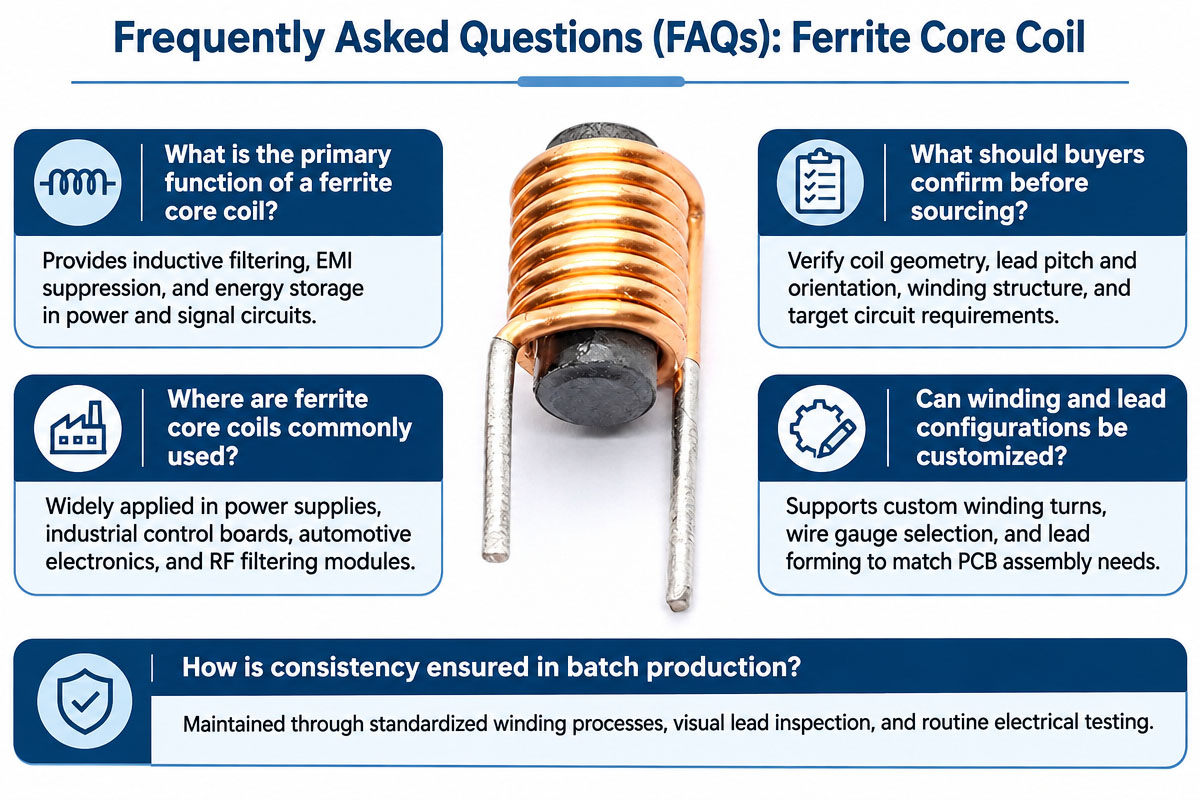
Q1: What is a ferrite core coil?
Ferrite coils are electromagnetic devices, which are manufactured by winding insulated copper wire on a ferrite magnetic core. Ferrite coils are widely used for inductors, transformers, filters, and electromagnetic interference suppression devices.
Q2: What is the biggest advantage of a ferrite core coil?
The main advantage of ferrite core coils is that they have relatively high electrical resistivity, which allows reducing eddy-current losses in high-frequency applications. They have useful magnetic permeability and can be formed in various shapes and sizes.
Q3: What is the difference between an MnZn ferrite coil and a NiZn ferrite coil?
MnZn ferrite usually has higher magnetic permeability and is used in power transformers and inductors. NiZn ferrite usually has higher electrical resistivity and is widely used in high-frequency applications and EMI suppression.
Q4. Can a ferrite coil be used for high-frequency applications?
Yes. Ferrite materials are often used in high-frequency electronic components because of their high electrical resistivity, allowing them to reduce eddy current losses. The choice of the material depends on the working frequency, the flux density, and the temperature.
Q5: Are ferrite core coil suitable for solenoids?
Some electromagnetic designs can use ferrite materials, but conventional linear solenoid designs use soft magnetic metallic materials for the plunger and housing due to the mechanical strength and magnetic performance requirements.
Q6: What affects ferrite coil performance?
Important parameters are the core material, permeability, number of turns, copper wire diameter, operating frequency, core shape, magnetic flux density, and temperature.
Q7: How can ferrite coil losses be reduced?
Core losses can be reduced by proper selection of the ferrite material, optimization of the operating frequency and magnetic flux density, and proper design of the core geometry. Proper sizing of the wire and design of the winding will reduce copper winding losses.
Q8: Does Weilong manufacture custom electromagnetic coils?
Sure. Weilong provides electromagnetic coils, inductors, and solenoids customized according to customers’ requirements. Our team can evaluate electrical specifications, mechanical dimensions, operating conditions, and production quantities to develop OEM solutions.
Chapter 12: Conclusion
The technology of ferrite coils is very important in the modern electronics industry. It can provide useful magnetic properties with relatively low high-frequency core losses, which are useful for power conversion, electromagnetic interference suppression, automotive electronics, wireless charging, and industrial control systems.
Understanding ferrite materials, magnetic properties, winding configurations, and manufacturing processes allows engineers to choose the right components for electronic products.
At the same time, electromagnetic actuator applications have their own design requirements. For example, a linear push-pull solenoid should be designed according to the required mechanical force, stroke, electrical performance, and operating life.
Weilong Intelligent Technology has a wide experience in the manufacture of electromagnetic coils and solenoids, providing custom solutions for demanding industrial and electronic applications to OEM customers.
Looking for a reliable manufacturer of electromagnetic coils or solenoids? Contact Weilong to discuss your next project.