




How to Select a Push-Pull Magnetic Solenoid
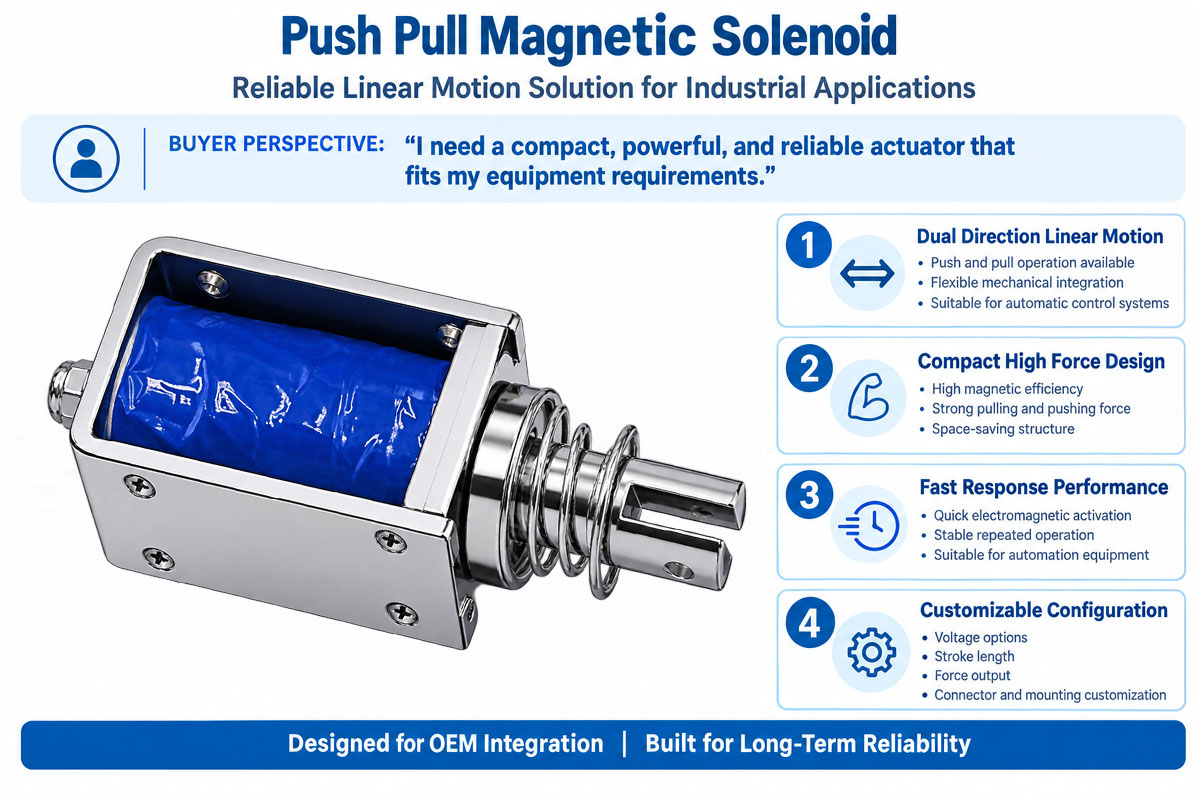
The selection of the appropriate push-pull magnetic solenoid is not only a question of voltage and size. The actuator should provide sufficient force for the required working stroke but should not exceed acceptable electrical and thermal limitations.
First, estimate the stroke required. Estimate the distance the plunger travels to operate the mechanism. Don’t make the stroke longer than it should be, as the electromagnetic force falls off with increasing initial air gap.
Then, estimate the force at the actual stroke position. Then, add friction, spring resistance, gravity, mechanical load, and an appropriate engineering safety margin. Don’t select the solenoid based on the maximum or holding force only.
Also, check the operating voltage and the available current. The DC voltage is usually 12 V or 24 V, but it depends on the control system and power supply.
Duty cycle is also an important parameter. A solenoid operated for a fraction of a second each minute has very different thermal requirements than the one energized for long periods. High ON time can increase coil temperature and decrease insulation life.
Also, consider the response time and the operating frequency. In the case of high-speed automation, you may need low moving mass, proper spring force, optimal stroke, and a suitable driver circuit.
Also, consider the operating environment, including ambient temperature, moisture, dust, vibration, shock, corrosion, and possible contact with oils or chemicals.
Finally, check the installation space, plunger orientation, return mechanism, electrical connection, noise requirements, expected cycle life, and mechanical tolerances.
For the OEM project, provide the solenoid manufacturer with the following: voltage, stroke, required force vs. position, ON/OFF time, frequency of operation, ambient temperature, available dimensions, mounting requirements, load characteristics, and target service life. With such information you can select or modify your solenoid more accurately.
How to Avoid Common Mistakes in Designing a Push-Pull Magnetic Solenoid
The first mistake in the design of a push-pull solenoid is to select a solenoid based on the maximum force, without estimating the force at the desired stroke. The force of the solenoid varies with the plunger position, and thus, you should always check the force vs. stroke graph.
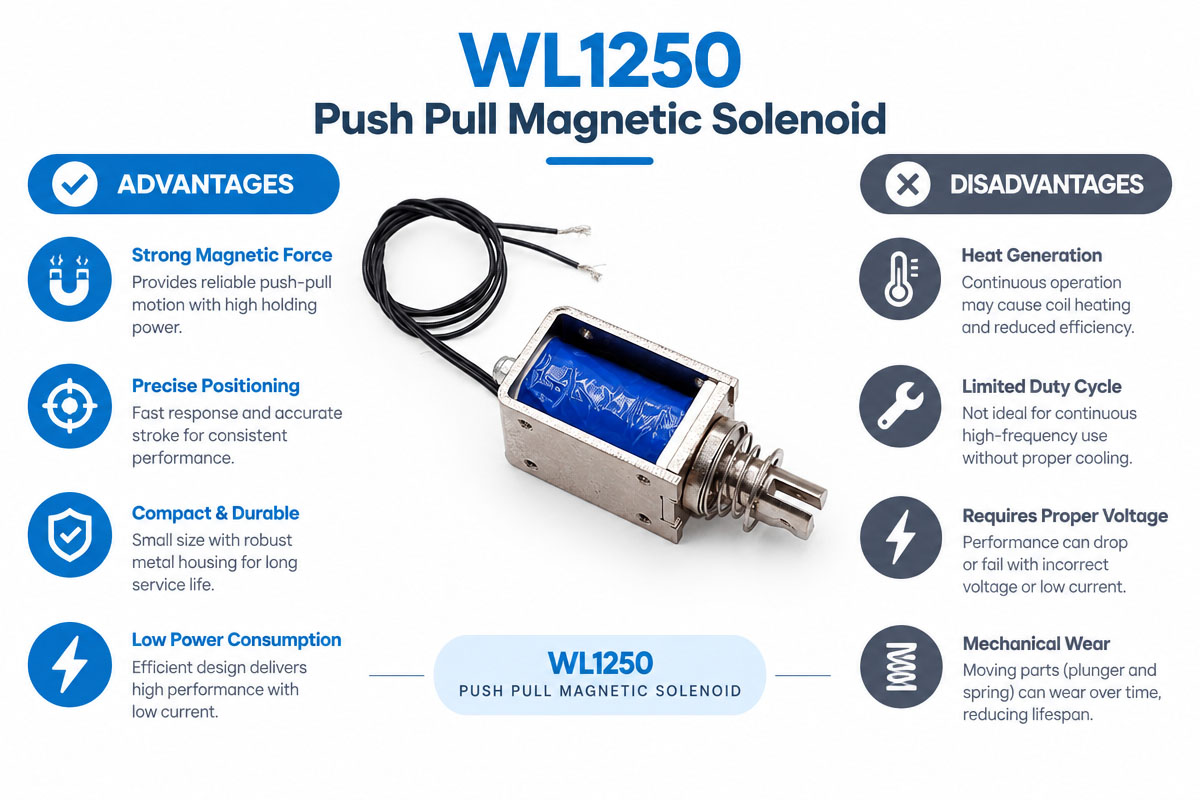
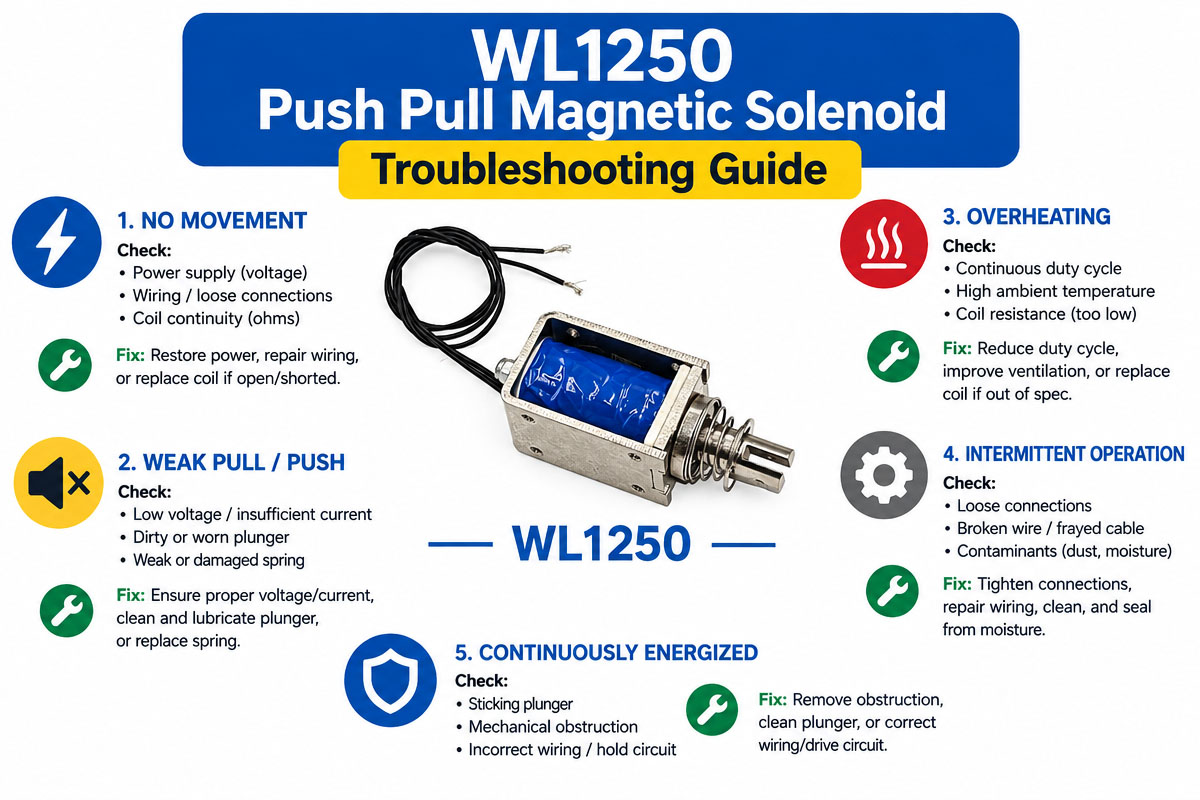
Second, don’t ignore the duty cycle. The continuous energization of the intermittent-duty solenoid can result in the high coil temperature, degradation of insulation, poor performance, or early failure.
Don’t use long strokes. In general, the increase of the air gap requires more magnetic energy and can reduce the starting force.
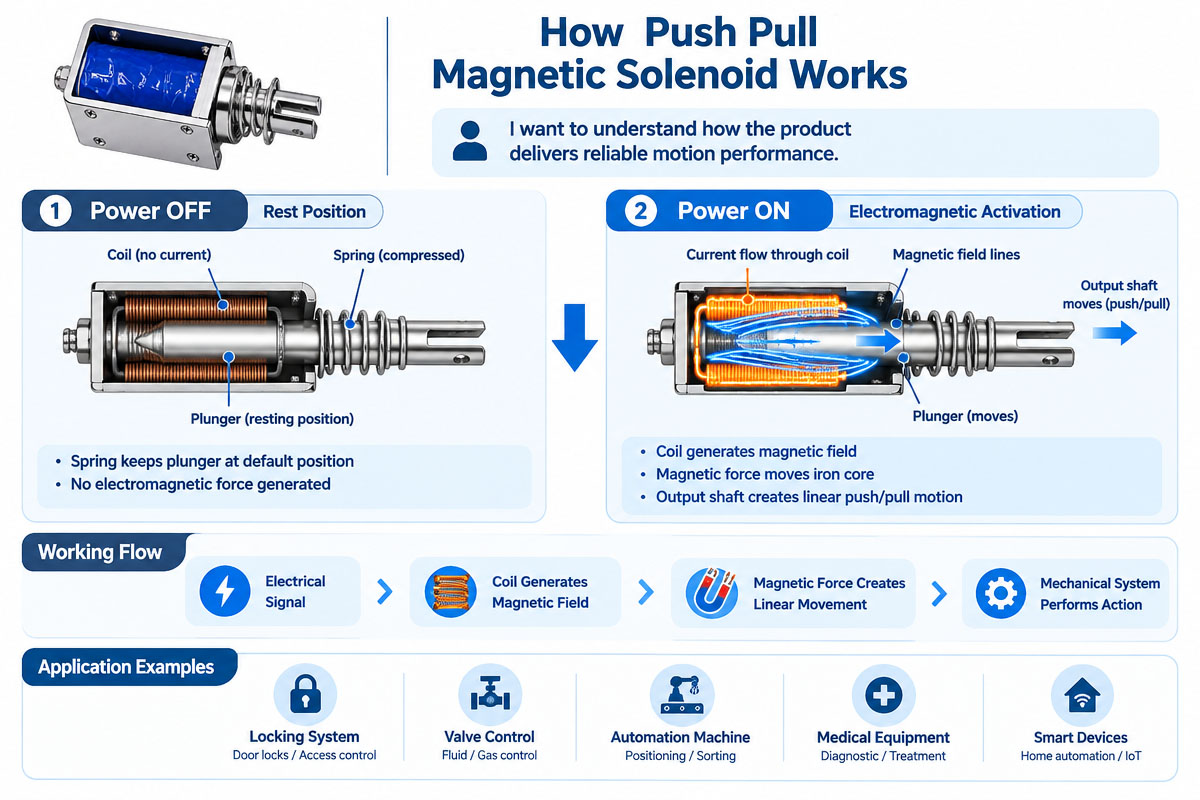
You should also pay attention to the return spring. A spring that is too strong reduces the usable output force, and a spring that is too weak may fail to return the mechanism.
Don’t forget about the voltage tolerance and power-supply capability. The current and operating force can be decreased due to voltage drops in wiring, switching devices, or undersized power supplies.
The alignment of the mechanics is also an important factor. Side loading, misaligned linkages, excess friction, and contamination of the plunger surfaces can prevent smooth motion.
In addition, the engineer should consider the coil heating, ventilation, ambient temperature, switching frequency, flyback protection, mounting tolerances, noise, vibration, and expected cycle life in the design stage.
Above all, the solenoid should be tested under realistic load, temperature, voltage, stroke, orientation, and duty cycle conditions before the final design is completed.