

Chapter 1: Introduction to Custom Tubular Solenoid
Custom tubular solenoids are becoming increasingly popular in automation, the automotive industry, medicine, smart locks, valves, and motion control equipment due to their small size, large force, quick reaction, and reliability.
Custom tubular solenoids (as opposed to generic off-the-shelf solenoids) can be designed specifically for particular applications depending on requirements to force, stroke length, voltage, duty cycle, dimensions, way of mounting, environment, and service life.
A well-designed tubular solenoid is the device that allows for efficient linear motion control while saving space and improving reliability. Incorrectly selected design, on the other hand, can result in underperformance, overheating, short life, or installation issues.
This ultimate guide covers construction, principles of operation, types, advantages, applications, design aspects, selection criteria, the OEM ordering process, and important factors to consider when choosing a custom tubular solenoid.
Chapter 2: What’s a Tubular Solenoid?
A tubular solenoid is an electromagnetic actuator that converts electrical energy to linear motion.
It is the tubular case with a coil assembly and a cylindrical plunger, which moves upon application of electric current through the coil.
Depending on the design, the plunger can be used to perform:
Pull motion
Push motion
Push-pull motions
Hold function
The basic performance characteristics of a tubular solenoid are
Operating voltage
Output force
Stroke length.
Coil resistance
Power consumption
Duty cycle
Reaction time
Temperature range
Thanks to the efficient magnetic circuit design, tubular solenoids can produce higher force compared to many conventional electromagnetic actuators of similar size.
Chapter 3: Tubular Solenoid Construction and Working Principle
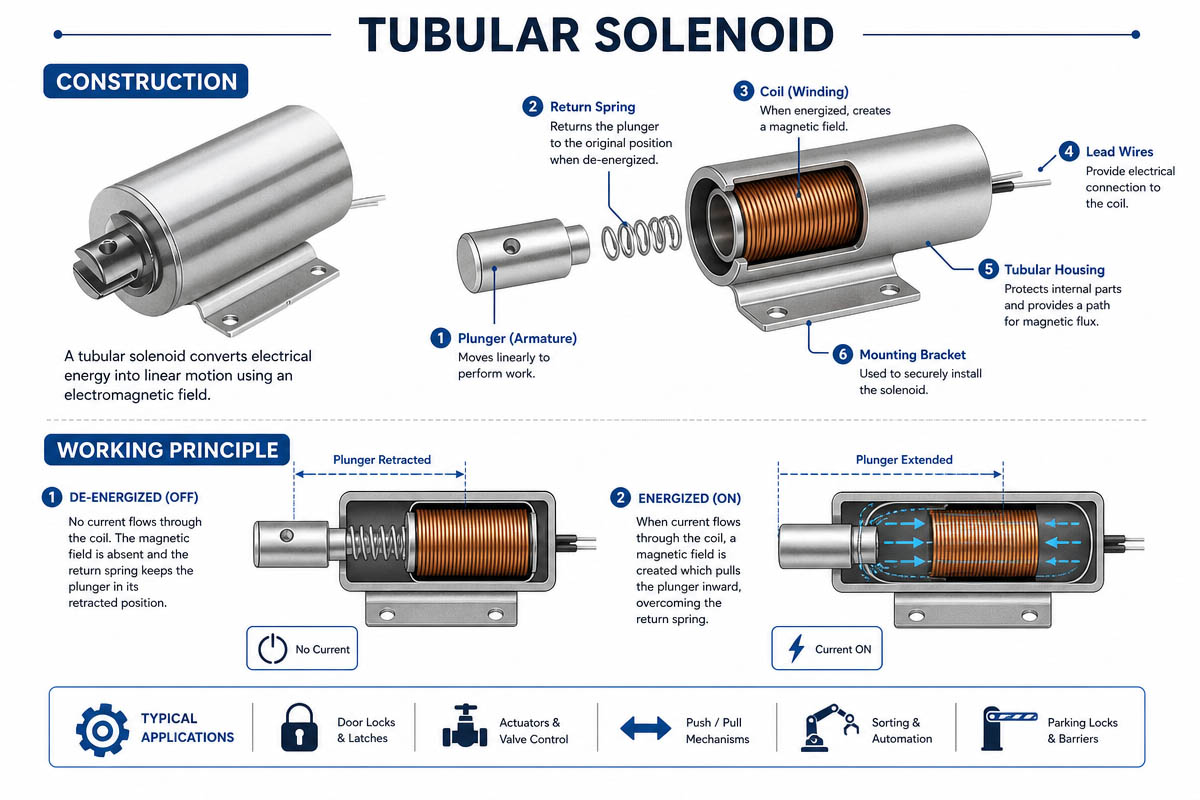
A typical custom tubular solenoid includes the following components:
3.1 Copper Coil
The driving element of an electromagnetic actuator is the copper coil.
Current flowing through the coil winding creates a magnetic field. The magnetic force is determined by the following parameters:
Coil turns number
Current value
Wire diameter
Coil resistance
Magnetics efficiency
Quality of copper wire and advanced winding technology contribute to performance and minimize heat generation.
3.2 Magnetic Core
The magnetic flux is conducted via the magnetic core.
Typical materials:
Low-carbon steel
Ferroalloy
Stainless steel, magnetic
A properly designed magnetic core can increase magnetics efficiency and output force.
3.3 Plunger
There is a moving element in a tubular solenoid called a plunger.
It is usually made of magnetic materials and is designed to move in a linear way.
The important characteristics are
Plunger width
Surface treatment
Hardness of Materials
Design of air gap
Stroke length
3.4 Spring Return
A return spring can be used in tubular solenoids.
The spring is used to:
Return the plunger after de-energizing the solenoid.
Maintain a stationary position.
Control returning force
The spring selection depends on the required stroke and operation force.
3.5 Housing
Housing provides protection to the internal elements and serves as a mechanical support.
Typical materials:
Steel, stainless steel
Aluminum
Nickel plating or zinc-nickel coatings can improve the corrosion resistance.
3.6 How does it work?
The operation sequence is as follows:
Current flows into the coil.
The coil produces a magnetic field.
The core and plunger conduct the magnetic flux.
The plunger is moved by the magnetic force.
Mechanical movement accomplishes the required action.
Optimization of the electromagnetic force is performed through variation of:
Coil design
Magnetics material
Airgap
Plunger design
Operating voltage
Chapter 4: Special Types of Tubular Solenoids
4.1 Pull Tubular Solenoid
A pull solenoid pulls the plunger into the coil when powered.
Applications:
Electromagnetic lock.
Security equipment
Mechanical switches
4.2 Push-Tube Solenoid
A push solenoid pushes the plunger out when energized.
Applications for:
Control valve
Factory equipment
Automation systems
4.3 Push-Pull Tubular Solenoid
Push-pull design allows moving in two opposite directions.
Advantages:
Freedom in mechanical design
More applications
Suitable for complex mechanisms
4.4 Latching Tubular Solenoid
Position of a latching solenoid: no power is needed to keep the position.
Advantages:
Minimal Power Consumption
Energy conservation
Battery-powered applications
Applications:
Intelligent locks
Portable equipment
IoT (Internet of Things) devices
Chapter 5: Custom Tubular Solenoid Advantages and Disadvantages
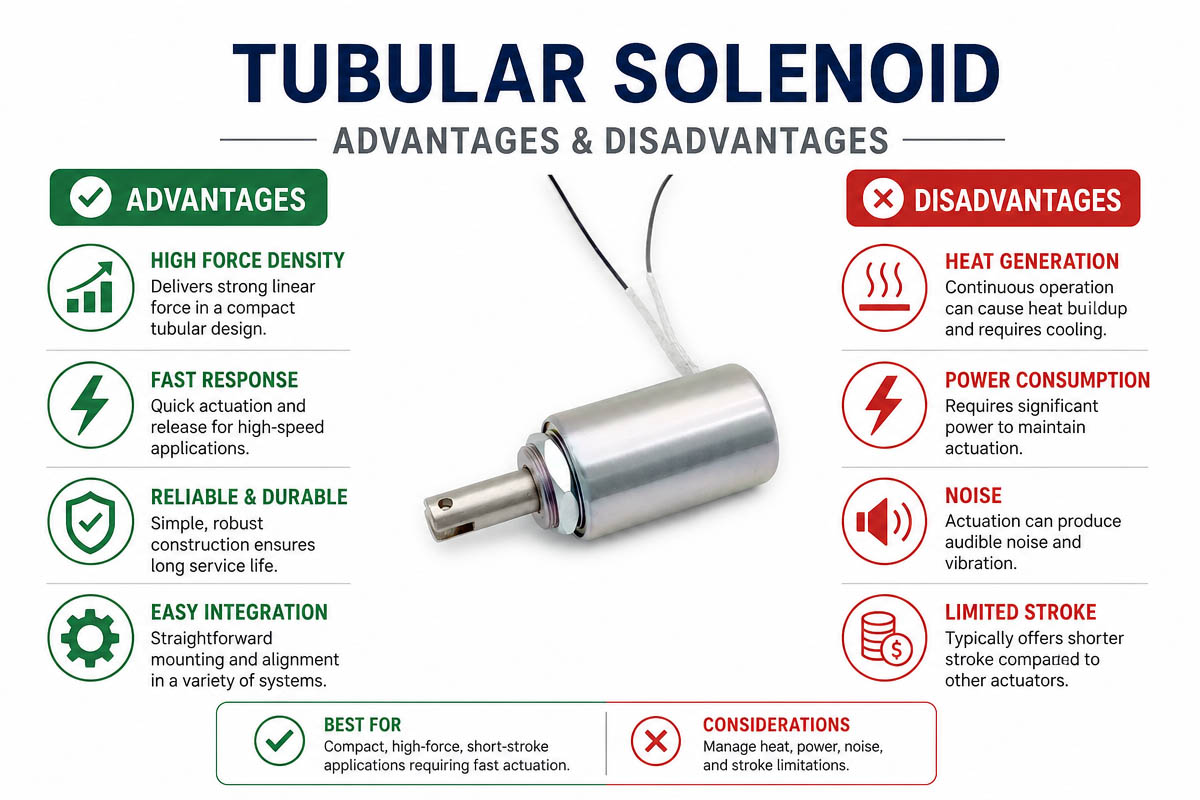
Custom Tubular Solenoid Advantages
5.1 Compact Shape
The tubular shape reduces the mounting space and allows easy integration into compact equipment.
5.2 High Power Output
Tubular solenoids generate relatively high magnetic force compared to many small actuators.
5.3 Quick Reaction
With the application of power, the plunger moves quickly, making them suitable for use in automation applications.
5.4 Reliability
A relatively low number of mechanical elements results in high reliability and long life.
5.5 Personalization Capability
The manufacturer can customize the following elements:
Dimensions
Power
Voltage
Connector
Stroke
Coatings
Custom Tubular Solenoid Disadvantages
5.6 Limited Stroke
The stroke of a tubular solenoid is usually shorter than in motors or cylinders.
5.7 Heat Generation
Thermal design is necessary to dissipate the heat generated in the coil during continuous operation.
5.8 Magnet Interference
Application in sensitive equipment can be interfered with by external magnetic fields. _
Chapter 6: Applications of Custom Tubular Solenoids
Custom tubular solenoids are commonly used in the manufacturing of industrial equipment that needs a linear motion control. Tubular solenoids allow for fast reaction times, compact design, and reliable electromechanical actuation. It is also easy to integrate the tubular solenoid due to its cylindrical form factor that allows for high forces in a small space.
Tubular solenoids find application in automation and manufacturing equipment for mechanical locking, positioning, clamping, sorting, and feeding operations. In addition, tubular solenoids are very fast and can accurately control movement in automated production lines and robotics applications.
Custom tubular solenoids are commonly used in the medical and healthcare industry in diagnosis equipment, pumps, medical analyzers, and fluid control devices. They are able to perform in a very stable way, while you can set stroke and force individually. This is why tubular solenoids are suitable for precision applications.
Tubular solenoids are used in fluid and valve control systems as pinch valves, pneumatic valves, and liquid control systems where they provide reliable actions for opening and closing.
Tubular solenoids are used in the security and access control industry as electronic locks, vending machines, cabinets, and safety devices. High holding force and fast activation characterize them.
Other areas of application include automotive applications, laboratory instrumentation, office automation, and intelligent device technology. The configuration of the tubular solenoids to voltage, stroke length, pulling force, mounting, and duty cycle will allow the creation of solenoids that meet all requirements of industrial applications.
Chapter 7: Avoiding Common Mistakes Throughout the Design Phase
Many failures of tubular solenoids are caused by incorrect decisions at the stage of design.
Error 1: Requirements to force were not taken into account.
Solution:
Calculation of the required force taking into account such parameters as
Load weight
Friction
Spring force
Safety factor
Error 2: Incorrect Selection of Voltage
Incorrect voltage can lead to the following problems:
Weak force
Burnout
Coil destruction
Checking is required of:
Voltage
Current
Resistiveness, resistance
Mistake 3: Ignoring the Duty Cycle
Special design is required for continuous operation.
If the duty cycle is chosen improperly, it can lead to overheating.
Mistake #4: Not Taking Into Account the Environment
Taking into account such parameters as
Temperature
Humidity
Dustiness
Corrosion
Error 5: Building Without Prototype Testing
Prototype testing helps to verify the following:
Output force
Stroke
Increase in temperature
Lifetime
Chapter 8: Choosing the Right Tubular Solenoid for Your Application
Needs to think about:
8.1 Force Requirement Definition: Pull force
Push force, gripping force
8.2 Stroke length
Confirmation of the distance of movement required.
8.3 Volts
Popular values:
12VDC 12VDC 24VDC 48VDC
8.4 Duty Cycle
Selection according to the operating frequency.
8.5 Available Installation Space
Check the following parameters:
Diameter
Length
Way of mounting
8.6 Environment
Selection of the appropriate parameters:
Waterproofing rating
Coating
Material
Chapter 9: How to Choose the Right Tubular Solenoid OEM
Manufacturer

You should choose a reputable OEM manufacturer that can supply:
Engineering Capability
Review:
Product design capability
Magnetics simulation
Prototype development
Production Capability
Main capabilities:
CNC machining
Coils winding
Metal stamping.
Production lines
Test equipment
Quality Control
Look for:
Force testing.
Life testing.
Temperature testing
Inspection reports
Experience in customization
The supplier should allow:
Small sample orders
Mass production
Custom tooling
Chapter 10: Why the Custom Tubular Solenoids Are Becoming Popular
Tubular custom solenoids have become increasingly common over time due to the unique properties that come with their use. They are small and are shaped like cylinders, which means that they provide the maximum force-to-weight ratio and can support long strokes.
Another factor that makes them highly sought after is the customizability option. These products are highly customizable in terms of voltages and plunger styles as well as mounting styles, which means that they can be used in different industries and for diverse purposes such as locks, medical equipment, and automation. Moreover, the design may include such elements as stainless steel sleeves and Teflon coatings that increase their mechanical life by reducing friction. In addition, they feature an entirely enclosed case that prevents dust and dirt from penetrating the interior of the solenoid. The main market drivers of custom tubular solenoids are the automation initiatives that have started in the world and, in particular, in the Asia-Pacific region.
This region is the leading one as of now, and it contributes to the growth of the market significantly. The future outlook is positive and stable. In conclusion, custom tubular solenoids are a solution to many engineering problems.
Chapter 11: Troubleshooting Guide for Custom Tubular Solenoids
Custom tubular solenoids have numerous applications in automation, machinery, medical equipment, locks, valves, robotics, and various control systems. The malfunction may be related to electricity, mechanical, or design issues. Below you will find some of the troubleshooting tips, which may help to detect possible problems and solve them.
11.1 The solenoid does not work
Possible causes:
There is no power supply/voltage; it is not adequate.
The electrical connection is faulty or poor.
Damaged coil or coil burned out
Heating caused by improper duty cycle
Solutions:
Make sure there is a power supply and the voltage is right for this particular solenoid.
Inspect electrical wiring and connection terminals.
Measure coil resistance using a multimeter and make sure that its value is within the normal range.
Do not exceed the solenoid operating duty cycle.
11.2 Insufficient Pull or Push Force
Causes of the problem:
Voltage is not adequate, or current is insufficient.
Excessive space between plunger and core.
Improper choice of spring force
Excessive mechanical load.
Solutions.
Make sure the correct voltage and current are used.
Inspect the stroke length and plunger assembly.
Reduce excessive mechanical resistance.
Refer to solenoid specifications for stroke length and force value.
11.3 Solenoid Overheating
Reasons for overheating:
Operation in continuous service beyond the rated duty cycle
Overvoltage at the input
Faulty heat dissipation
Voltage change induced by high temperature
Solutions:
Make sure the solenoid is designed for continuous duty operation.
Use the right voltage.
Improve heat dissipation or increase ventilation.
Consider redesigning the coil in order to improve its ability to resist higher temperatures.
11.4 Slow or Erratic Motion
Possible causes:
Internal contamination in the tube
Misalignment of the plunger and friction
Inadequate lubrication
Broken return spring.
Solutions:
Clean the internal parts and make sure the plunger operates properly.
Check plunger assembly and mechanical alignment.
Replace defective springs or choose better specifications.
11.5 Noise or Vibrations
Causes:
Impact of the plunger at the end of the stroke
Free mounting system
Resonance of magnetic circuit
Solutions:
Use cushioning or change the stroke pattern.
Tighten mounting screws to secure a stable mounting system.
Improve magnetic circuit design to minimize vibrations.
For custom tubular solenoids, it is useful to discuss important information like voltage, stroke, force requirements, duty cycle, operating temperature, and installation conditions to prevent problems.
11.6 Troubleshooting Guide for Custom Tubular Solenoids
| Problem | Possible Cause | Solution |
| The solenoid does not move. | No power supply | Check voltage connection. |
| Weak force | Incorrect voltage or overload | Verify specifications. |
| Excessive heat | Wrong duty cycle | Improve coil design. |
| Slow movement | Mechanical friction | Check plunger alignment. |
| Noise during operation | Loose parts | Improve mechanical assembly. |
Chapter 12: Tubular Solenoids FAQs

Q1: What is a custom tubular solenoid?
A custom tubular solenoid is an electromagnetic actuator designed to satisfy specific requirements of an application.
Q2: What information should I provide to order a custom solenoid?
You should provide the following information:
Voltage
Force
Stroke
Duty cycle
Dimensions
Usage
Q3: Is it possible to use tubular-type solenoids for continuous duty?
Yes, sir. Continuous-duty tubular solenoids have optimized coil design and heat management.
Q4: What are the industrial applications for tubular solenoids?
They are used widely in automation, automotive applications, medical equipment, home appliances, and security systems.
Q5: What is the life of a tubular solenoid?
Dependent on the design and operating conditions, many tubular solenoids can achieve hundreds of thousands of cycles.
Chapter 13: Conclusion
Custom tubular solenoids are an efficient and reliable solution for applications requiring precise control of linear motion. Their compact size, high force, quick reaction, and possibility to be customized are making them more popular in many industries.
Proper selection of a tubular solenoid requires consideration of force, stroke, voltage, duty cycle, environment, and installation requirements.
Working with an experienced custom tubular solenoid manufacturer provides better performance, acceleration of the development process, and OEM production. Custom tubular solenoids are one of the best solutions for today’s industrial applications.


