Automotive SCR Solenoid for Diesel Systems Pro
标题 High Performance Automotive SCR Solenoid Valve 说明文字 描述 文件 URL: https://www.smartsolenoid.com/wp-content/uploads/2026/05/High-Performance-Automotive-SCR-Solenoid-Valve.jpg 复制网址至剪贴板 必填项已用 * 标注 PP - Custom Link UAE - Custom Link UAE - Categories (Ex: Cat1, Cat2) Exclude this attachment from sitemap 选择媒体动作选择 未选择任何文件
Reliable SCR Solenoid for Automotive Industry
Precision Automotive SCR Solenoid Control Unit
Automotive SCR Solenoid for Emission Systems
Advanced Automotive SCR Solenoid Technology
Automotive SCR Solenoid for Diesel Systems Pro
标题 High Performance Automotive SCR Solenoid Valve 说明文字 描述 文件 URL: https://www.smartsolenoid.com/wp-content/uploads/2026/05/High-Performance-Automotive-SCR-Solenoid-Valve.jpg 复制网址至剪贴板 必填项已用 * 标注 PP - Custom Link UAE - Custom Link UAE - Categories (Ex: Cat1, Cat2) Exclude this attachment from sitemap 选择媒体动作选择 未选择任何文件
Reliable SCR Solenoid for Automotive Industry
Precision Automotive SCR Solenoid Control Unit
Automotive SCR Solenoid for Emission Systems
Advanced Automotive SCR Solenoid Technology

WL109531 Automotive SCR Solenoid Solutions

An automotive SCR solenoid is a solenoid valve that acts in an automobile’s Selective Catalytic Reduction systems. Such systems are installed in diesel engines in order to decrease nitrogen oxides produced by the diesel engines. By using an electric current, the solenoid converts electrical energy into mechanical energy in order to control the flow of Diesel Exhaust Fluid into the SCR catalyst systems. SCR solenoids are applied in trucks, commercial buses, construction equipment, agricultural equipment, industrial diesel engines, and other machinery. SCR solenoids are designed to work efficiently in harsh environmental conditions, including high temperatures and vibrations. High-quality SCR solenoids are used in order to achieve better control over emission pollution and comply with environmental requirements like Euro 5 and Euro 6. Furthermore, SCR solenoids help to increase the performance and fuel efficiency of the engine.

Features of Automotive SCR Solenoid

The Automotive SCR solenoid acts by using electromagnetic principles. Thus, they allow for quick reaction and precise control of the fluid flow rate. They are made from materials which resist high temperatures and corrosion. Besides, the solenoids have a good sealing design which increases its lifespan. Most SCR solenoids are known for reliable continuous-duty performance in severe working conditions. Their compact size makes it easy to install them in diesel exhaust systems. Among the main characteristics of SCR solenoids are also low power consumption, waterproof properties, anti-vibration design, and compatibility with various DEF dosing systems. Some of the premium solenoids offer more precise flow control and higher performance for commercial vehicles and industrial applications.

Automotive SCR Solenoid Product Overview

The automotive SCR solenoid is high-performance valves which operate in selective catalytic reduction systems in diesel engines. With the help of solenoids, Diesel Exhaust Fluid can be effectively metered in order to decrease nitrogen oxide levels in diesel engines. In order to ensure reliable operation under severe conditions, SCR solenoids are manufactured with high-quality materials, including high-resistance copper coil, high-strength stainless steel plunger, sealing material, and heat resistance housing. Commercial vehicles usually use DC 12V and DC 24V SCR solenoids. The solenoids’ design allows achieving quick switching time, precise dosing control, low energy consumption, and increased service life. Many models of these solenoids feature waterproof and dustproof construction that make them fit for outdoor applications. Automotive SCR solenoids are used for heavy-duty trucks, buses, agricultural equipment, construction machinery, generators, and industrial diesel engines. They are available in OEM and customized products in various sizes and specifications, depending on flow rates, duty cycles, mounting options, and connector specifications.


Automotive SCR Solenoid Valve Video

Automotive SCR Solenoid Valve Detailed Display

Automotive SCR Solenoid Technical Datasheet

Brand Weilong Technology Model Number WL109531
Rated Voltage (V) DC12V  or 24V Rated Power (W) 10-15W
Work mPA 0.01–0.3 mPa Port Gate 10 MM
Stroke (mm) 3-6 MM Customized Reset Time(s) 1 S On,3 S OFF
Service Life 200 Thousand Times Certification CE, RoHS, ISO9001,
Material Valve coper Lead Wire Length (mm) 200 MM
Install Style Flange Tolerance of Dimension  +/-  0.1 MM
Water-proof  None Insulation Class B
Hi-Pot Test AC 600V 50/60Hz 2s Non-excitation Holding Force 0
Working Temperature -10°C-100°C Duty Cycle 1-100%
Thread Depth (mm) / Payment Term TT, or LC At Sight
Sample Order Yes Warranty 1 Year
MOQ 1000 pcs Supply Ability 5000 pcs per Week
Delivery Time 30 Days Port of Loading shenzhen

Why do we require an automotive SCR solenoid in our vehicles?

An automotive SCR solenoid serves in reducing the NOx or nitrogen oxide emissions of diesel engines through the proper metering of Diesel Exhaust Fluid (DEF), also known as AdBlue into the emission system of the vehicle.

Why Vehicles Require An SCR Solenoid:

1. Reduce Pollution

Contemporary diesel vehicles need to abide by strict government policies regarding pollution as set by the European Union and other agencies like the EPA emission standards. The SCR solenoid is responsible for regulating the correct flow of DEF into the exhaust of the vehicle thus reducing the emissions of dangerous gases.

2. Effective regulation of fluid

Being an electronic valve, the SCR solenoid works by opening and closing rapidly. Through this process, it regulates:
• Amount of fluid
• Timing of fluid flow
• Pressure at which fluid enters Thus resulting in accurate metering of fluid thus lowering emissions while saving fluid.

3. Increase Engine Efficiency

Selective catalytic reduction systems are more advanced and effective compared to the traditional systems such as EGR due to:
• Improved fuel economy
• Enhanced engine performance
• Decreased production of soot in the combustion chamber This efficiency needs to be balanced in the SCR solenoid.

4. Meet the set Government Standards

In case the SCR solenoid fails to function well:
• The vehicle will fail the emission test
• ECU warning lights will come on
• Enter limp mode
• Some regions may ban operation of the engine

5. Extended life span assistance.

An effective automotive SCR solenoid helps:
• Prevents crystallization issues
• Consistent fluid injection performance
• Avoid damage to SCR catalyst
• Prolongs exhaust system life
Uses
Common uses of automotive SCR solenoids include in:
* Truck
• Bus
• Construction Equipment
• Agricultural machines
• Modern diesel vehicles
Working Principle
An SCR solenoid receives electrical signals from the ECU of the vehicle. It then acts as a valve allowing a predetermined amount of DEF to enter the exhaust system.
The control relation can be expressed as:
N O _ { x } + N H _ { 3 } \rightarrow N _ { 2 } + H _ { 2 } O NOx+NH3→N2+H2O
Conclusion
The automotive SCR solenoid plays an important role in ensuring accurate injection of DEF, minimization of pollution, improvement of diesel engine efficiency, and compliance with current emission regulations.

Automotive SCR Solenoid Application

WL109531 Automotive SCR Solenoid Application

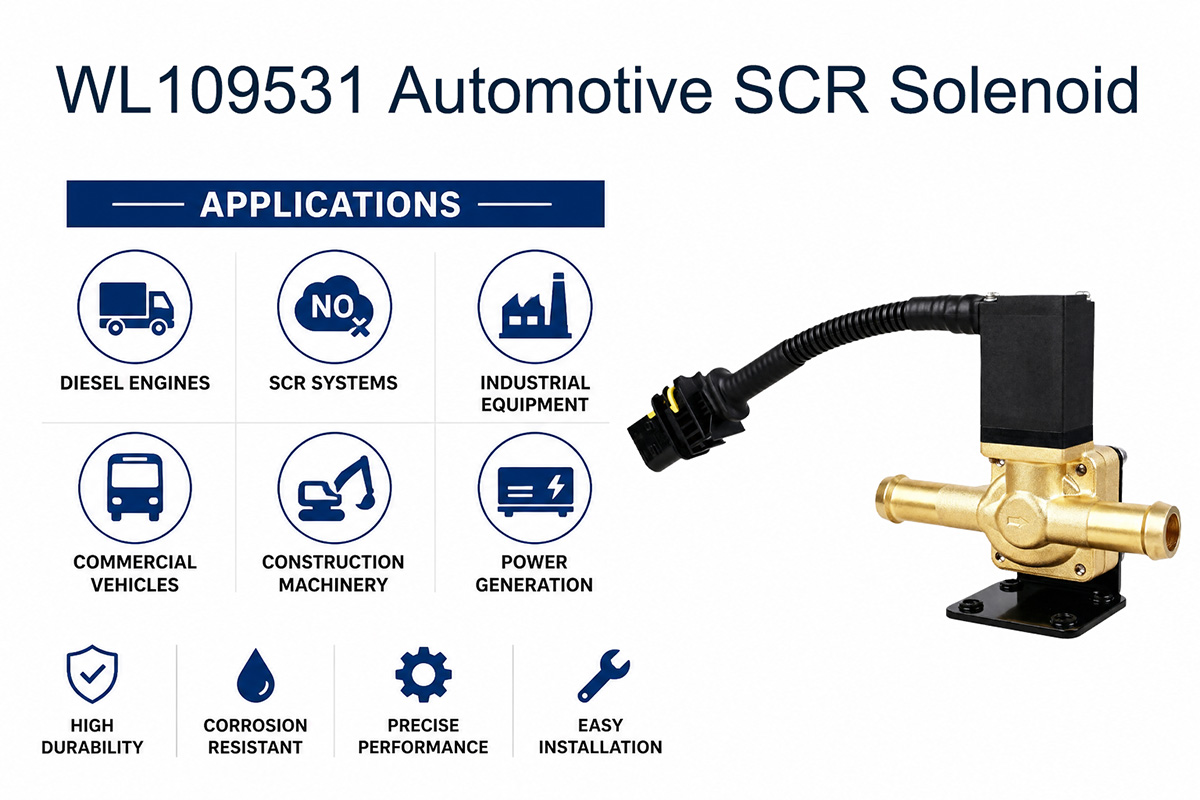
In general,  Automotive SCR solenoid is used in diesel engines for controlling NOx pollution. the Automotive SCR solenoid is also widely used in emission control systems for diesel engines in various industries. Automotive SCR solenoids perform the function of metering the injection of Diesel Exhaust Fluid in the SCR system. Automotive  SCR solenoid is utilized in a wide range of vehicles including heavy-duty trucks, commercial buses, agricultural tractors, mining and drilling equipment, construction machinery, marine diesel engines, and industrial generators. SCR solenoids help to keep up with strict environmental laws such as Euro 5, Euro 6, EPA, and China VI emission standards. SCR solenoids are also widely used in industrial applications where they allow minimizing NOx emissions and maintain the efficiency of engines. Agricultural and construction equipment are especially equipped with SCR solenoids for their ability to operate reliably in vibration and high temperature. Automotive SCR solenoids are used both in original equipment manufacturer engines and in aftermarket SCR systems. As a result of precise fluid regulation, SCR solenoids can improve catalytic conversion, emission reduction, and enhance engine systems reliability. With growing environmental restrictions, a automotive SCR solenoid will become more common in the future.

Advantages and Disadvantages of Automotive SCR Solenoid

Automotive SCR Solenoid Advantage and Disadvantage

Advantages & Disadvantages of Automotive SCR Solenoid

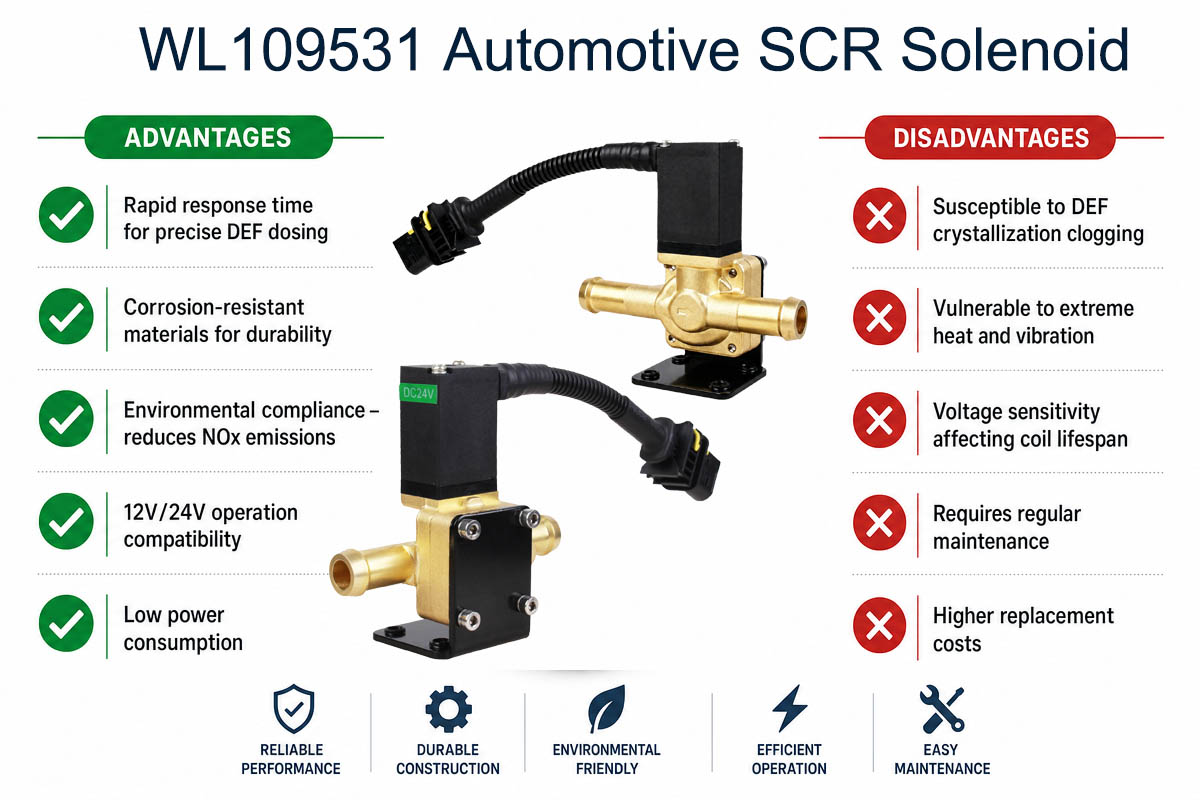
One of the most important advantages of Automotive SCR solenoids is that they allow for precise DEF injection and, thus, more effective NOx reduction. Another benefit of these solenoids is that they have quick responses and stable electromagnetic performance, besides their low power consumption and reliability. Moreover, these solenoids are very compact and easy to integrate into the engine system. In addition, the best SCR solenoids can endure high temperatures, corrosion, vibration, and severe operational conditions. Another advantage of SCR solenoids is improved fuel economy due to optimizing engine combustion process. Nowadays, SCR solenoids require relatively low maintenance and have a long life cycle.

Despite numerous benefits, SCR solenoids have some disadvantages as well. It should be noted that maintaining high DEF fluid quality is necessary for the solenoid valve to operate effectively because the solenoid might be damaged by fluid crystallization. In case of severe conditions, such solenoids might fail in time. Moreover, SCR systems complicate the overall vehicle system and, thus, add to maintenance costs. Moreover, freezing of the DEF may affect the solenoid in case of insufficient heating.

Trouble Shooting Guide for Automotive SCR Solenoid

Automotive SCR Solenoid Troubleshooting Guide

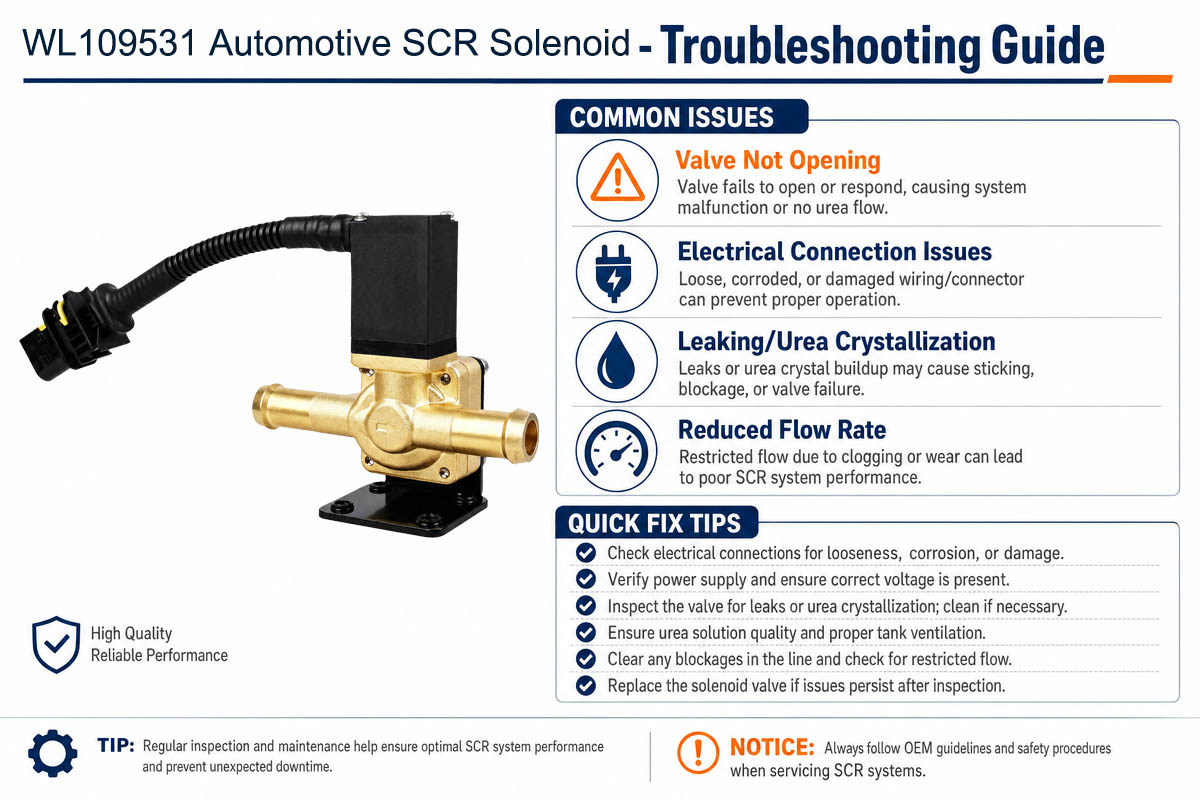
1. Malfunction of the solenoid valve

Possible reasons:

– Absence of power supply;

– Coil damage;

– Loosely connected electrical components;

– Loss of ECU control.

Solutions:

– Check supply voltage;

– Test resistance of test coil;

– Check the electrical connection;

– Control ECU signal output.

2. DEF injection failure

Possible reasons:

– Sticking solenoid valve;

– DEF fluid crystallization;

– Dirty filter/nozzle;

– Decreased DEF pressure.

Solutions:

– Clean or replace the solenoid valve;

– Regular flushing of the DEF system;

– Replenish DEF with fresh fluid;

– Check DEF pump’s performance.

3. Delay in response time

Possible reasons:

– Contamination inside the valve;

– Damage of plungers’ components;

– Unstable operation voltages.

Solutions:

– Clean valve internal parts;

– Replace damaged components;

– Ensure stable supply of voltage;

– Enhance heat dissipation.

4. Overheating of the solenoid valve

Possible reasons:

– Continuous overvoltage;

– Overduty cycle operation;

– Damaged coil insulation;

– Lack of adequate cooling.

Solutions:

– Check voltage rating;

– Perform correct duty cycle;

– Replace damaged coil;

– Increase cooling capacity.

5. Leaks

Possible reasons:

– Seals’ wear;

– Fittings looseness;

– Housing damage;

– Excessive system pressure.

Solutions:

– Change seal components;

– Tighten all fittings;

– Replace damaged housing;

– Adjust system pressure.


FAQs of Automotive SCR Solenoid Valve

1) What does an SCR solenoid valve do?

This is the injector valve that injects AdBlue into the exhaust stream. The valve quickly opens and closes to initiate the chemical reaction converting nitrogen oxides into nitrogen and water.

2) Why and how does an SCR solenoid valve fail?

Breakdown of the valve occurs when its mechanical or electrical parts get damaged. Common failure reasons are AdBlue crystallization leading to clogged nozzle or stuck pintle, corrosion due to improper fluid quality and valve’s construction, faulty electronics, and contamination with debris.

3) Can clogged SCR solenoid valve be cleaned?

This depends on the extent of contamination. Light contamination can be easily solved with the help of soaking the valve in hot water to dissolve crystals or using ultrasonic cleaning method. However, it won’t work if the seals got damaged or there were electrical failures detected during the diagnostic testing.

4) How do I make sure the solenoid valve works?

Typically, this test can only be done using a professional diagnostic tool. The active testing with a scan tool is a best practice. In case there’s no opportunity, you can conduct a functional test using the oscilloscope to test resistance or pressure gauge to measure the decrease of pressure while the solenoid valve opens and releases AdBlue.

5) If I have an SCR solenoid valve failure while driving?

The car won’t immediately stop. In response to the malfunction, the vehicle will go into derate/limp home mode, illuminate the Check Engine light and reduce the torque of your engine.


6) What does P2814 diagnostic code mean?

The problem with the SCR solenoid valve? Not necessarily. Most often, this code applies to the problems with the transmission’s pressure control solenoid. Before performing diagnostics on the SCR valve, you need to identify the exact meaning of the code for your particular vehicle.

7) Do I need to heat the solenoid valve?

Not directly, since the valve stays in the exhaust where temperatures are pretty high. Yet, the AdBlue needs to be thawed prior to being injected, otherwise the injection process becomes impossible. There are special heated lines, supply modules, and tanks used to provide the needed thawing.

8) Can I use any industrial valve instead?

No. Industrial solenoid valves won’t suit since the operating conditions for such valve differ greatly. You need a specialized automotive SCR valve with the right seal material, appropriate electrical resistance, and ability to withstand high temperatures and corrosive AdBlue.


How to Choose the Right Automotive SCR Solenoid Valve, Detailed Version

Selecting an automotive SCR solenoid valve entails making several very important decisions. Since the valve will operate in tough environmental conditions and exposed to the corrosive urea solution (AdBlue) and temperature extremes ranging from freezing to the heat produced by exhaust, proper selection is vital for durability and efficiency. Here’s a detailed explanation of the five key aspects you need to consider when choosing your valve.

1. Fluid compatibility (AdBlue challenge)

This parameter is responsible for most of the failures. Being a highly corrosive liquid, AdBlue (urea solution) will attack common metals like zinc and carbon steel. Therefore, it is important to pay attention to the material your valve is made of.

– Body material: Select brass or stainless steel valves to ensure proper protection from AdBlue’s corrosive properties. Don’t consider cast iron and aluminum valves for urea service;

– Sealing material: It should withstand contact with urea. Consider elastomers like EPDM (cold resistant and good with urea) and FKM/Viton (heat resistant).

2. Electrical parameters (voltage and connectors)

It is crucial to understand that there’s no single voltage and connection type that would apply across all vehicles. You should know what your vehicle uses.

– Voltage: Most cars (including SUVs and trucks) have 12-volt electrical systems. Commercial vehicles with SCR systems usually operate on 24V;

– Protection level: The valve needs to be protected from splashes, rain, dust, etc. Aim for an ingress protection of IP67 and above;

– Connectors: Different manufacturers use different automotive wiring standards. Pay attention to the type of valve connector to make sure it’s compatible with your harness (Deutsch, AMP, etc.)

3. Pressure and flow requirements

Proper atomization depends on the fluid flow rate and pressure.

– Supply pressure: Unlike in the industrial applications, diesel SCR operates at certain pressure levels. Typically, the valve needs to resist a supply pressure of up to 9 Bar (130 psi);

– Dosing: Depending on your engine size, the urea dosing is measured in grams per hour or liters per minute. Make sure your valve’s Kv equals the fluid flow rate in your SCR setup.

4. Temperature range (frost protection)

In cold weather, AdBlue freezes at -11°C (12°F). Once it’s frozen, the standard valve can fail catastrophically.

– Heater presence: Most modern valves feature an embedded heating system or are made specifically for operation together with heated lines, supply modules, and other components aimed to unfreeze the urea before injection.

– Operational temperature range: The valve needs to withstand ambient temperatures between -40°C and +85°C for the solenoid coil and up to 100°C and more for the return line hot fluid.

5. Valve type

There are two main types of valves for SCR systems: dosing valves and heating valves. You should clearly understand which of these you need.

– Dosing valve (injection valve): The valve positioned directly in the exhaust pipe of the engine. High-frequency valve used to spray AdBlue in the form of a fine mist into the exhaust;

– Heating valve (coolant side valve): Placed in the engine coolant line. Open and closed valves used to let hot engine coolant enter the urea tank.

Selection checklist (shortened)

– Fluid type: AdBlue → Brass or Stainless Steel body and seals made of EPDM or FKM;

– Voltage: 12V in cars and 24V in trucks;

– Pressure: At least 9 Bar;

– Temperatures: Resistant to both cold ambient and engine exhaust temperature and able to withstand fluid up to 100+°C;

– Valve type: either dosing valve for exhaust injection or heating valve for coolant side operation.

Important note on Industry standards

For replacement of the valve installed in a modern diesel vehicle equipped with Bosch Denoxtronic, Cummins Ecofit, or any other SCR system, it is recommended to choose an OEM-specific replacement part. In such modern systems, the Engine Control Unit (ECU) carefully controls operation and the valve needs to perfectly match in flow rate and Ohm value to avoid the malfunction and Check Engine warning lights.

Get A Free Quote Now

Contact Form

Related Products

Related News

Chapter 1 : What is a Metal Stamping Die? Metal stamping die (also called stamping tool, press tool or metal die) […]

Scroll to Top

Get A Free Quote Now !

Contact Form
If you have any questions, please do not hesitate to contact us.
Weilong Solenoid Company Culture
