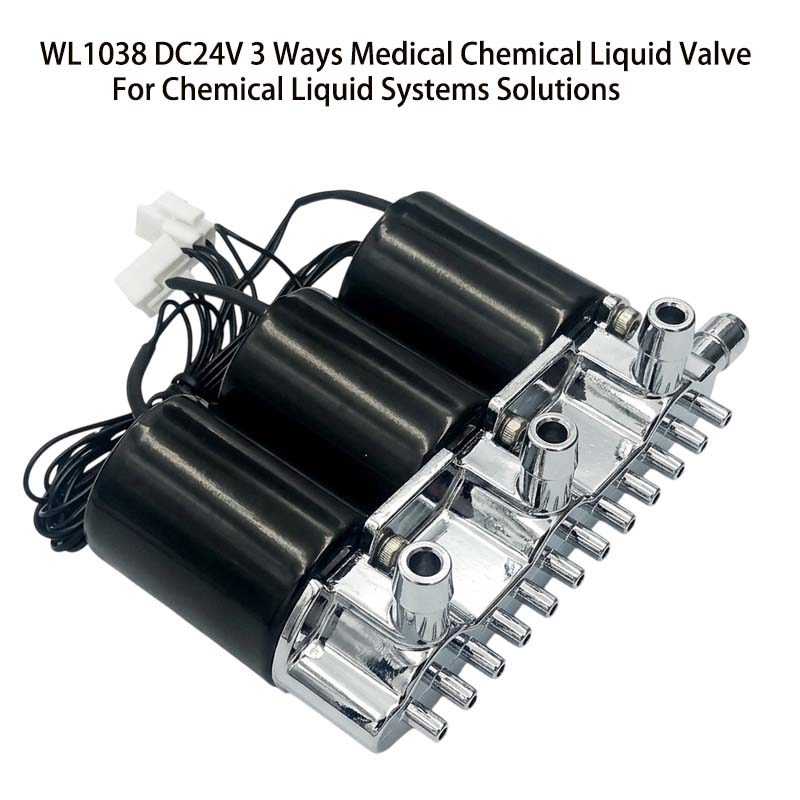
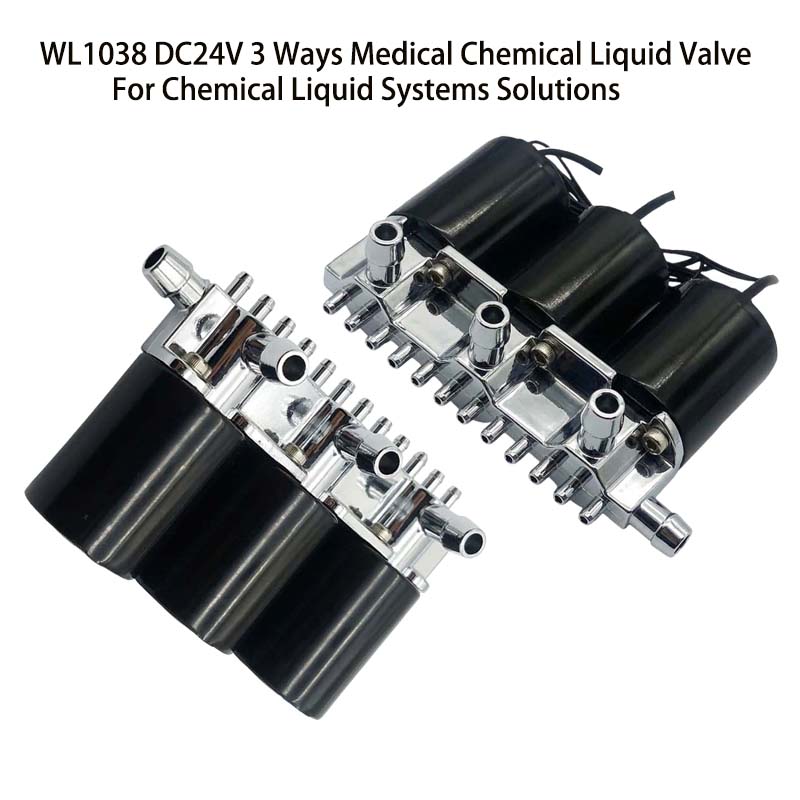
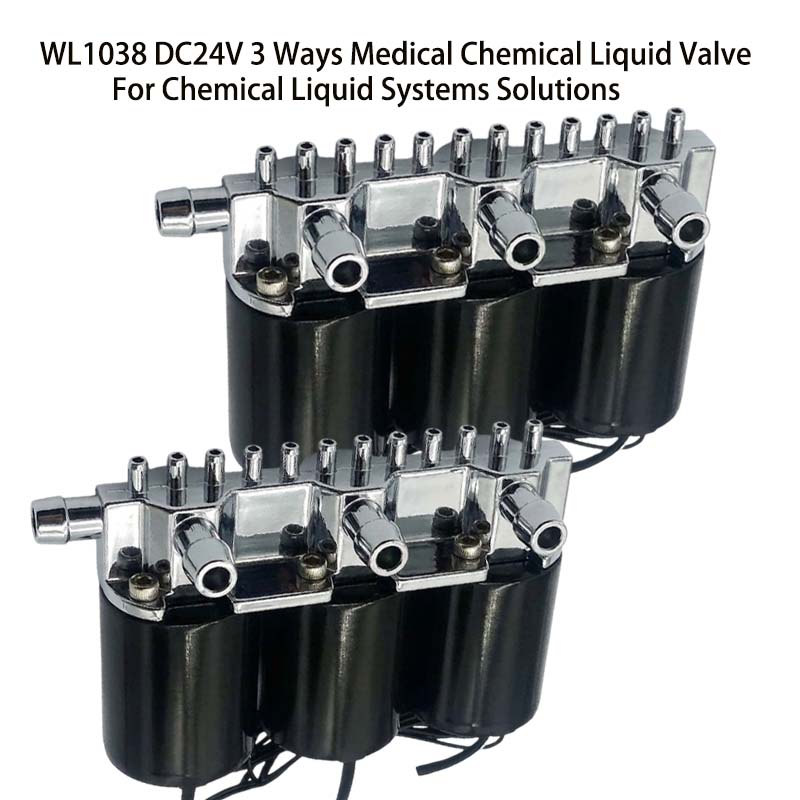
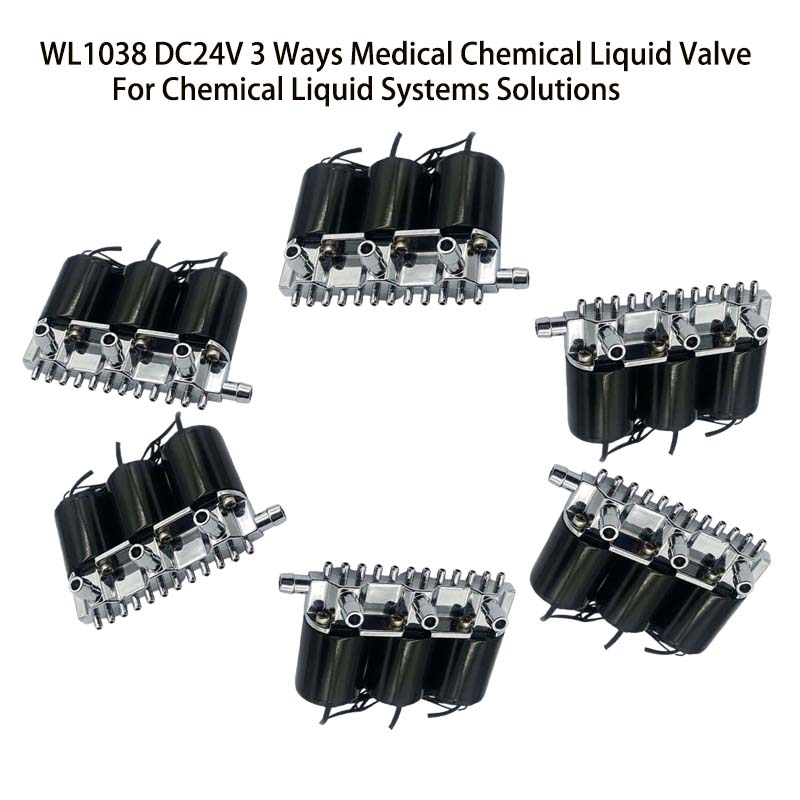
Medical Chemical Liquid Valve for Medical Equipment
Medical Chemical Liquid Valve for Fluid Control Systems
Medical Chemical Liquid Valve for Medical Devices solutions
Medical Chemical Liquid Valve for Diagnostic Equipment
Medical Chemical Liquid Valve for Precision Flow Control
Medical Chemical Liquid Valve for Chemical Flow Control
Medical Chemical Liquid Valve for Medical Equipment
Medical Chemical Liquid Valve for Fluid Control Systems
Medical Chemical Liquid Valve for Medical Devices solutions
Medical Chemical Liquid Valve for Diagnostic Equipment
Medical Chemical Liquid Valve for Precision Flow Control
Medical Chemical Liquid Valve for Chemical Flow Control

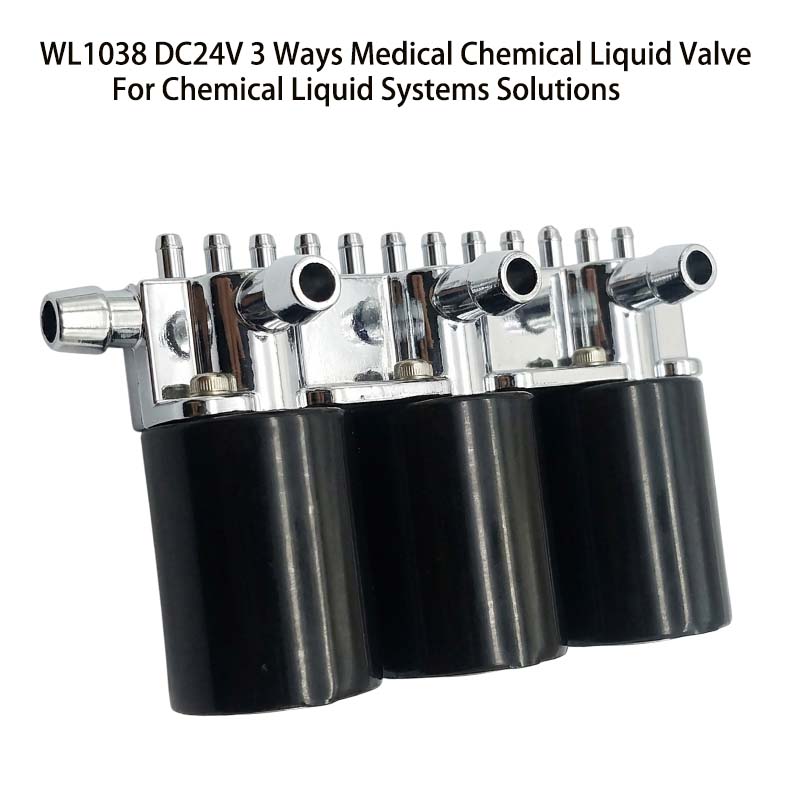
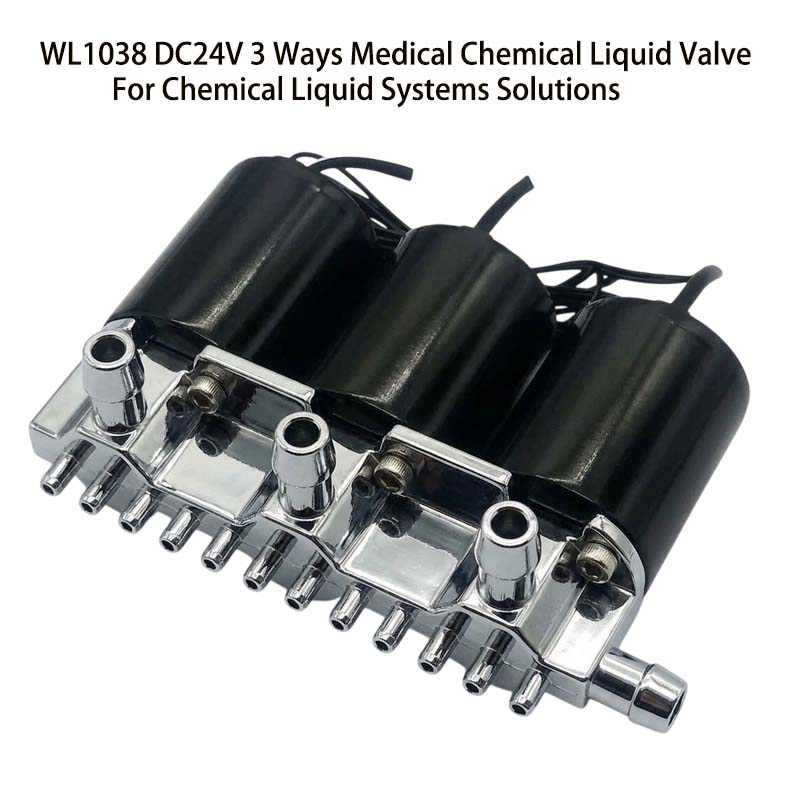
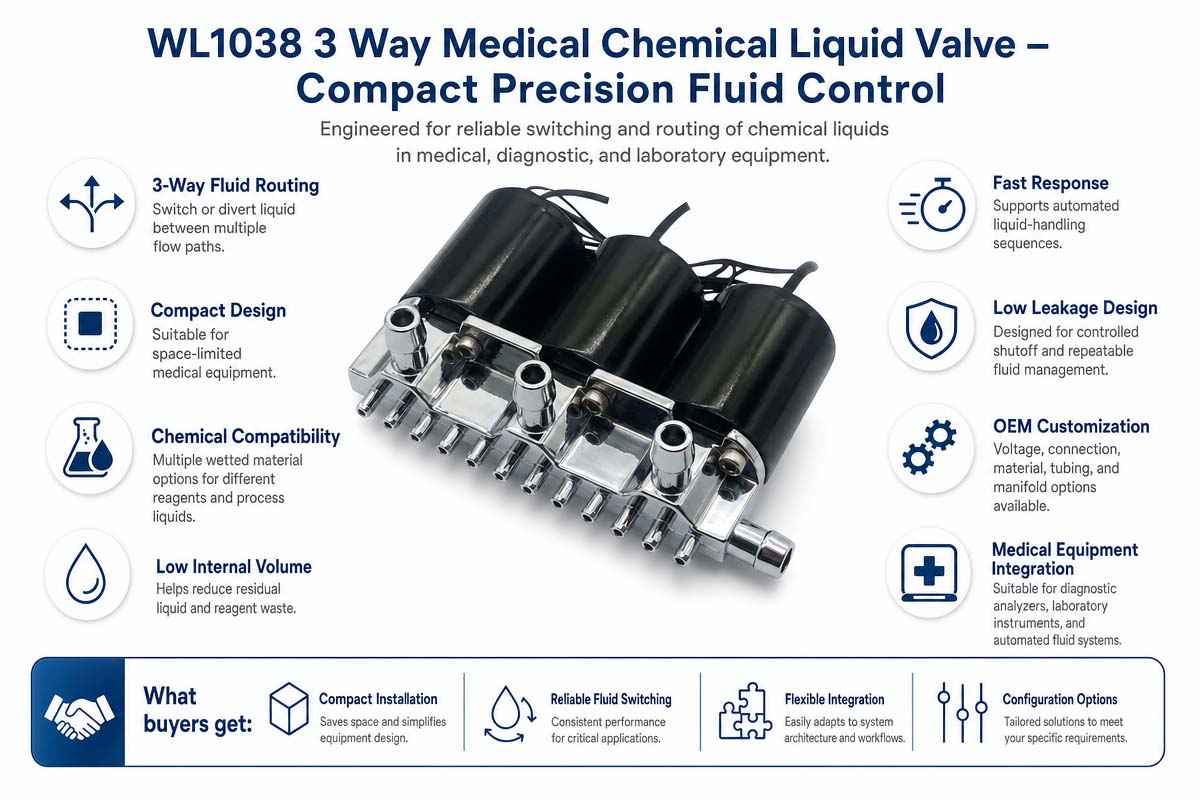
WL1038 Medical Chemical Liquid Valve for Chemical Flow Control Solutions

A medical chemical liquid valve is intended for controlled operation of liquid chemicals in medical, laboratory, diagnostic, and analytical equipment. Its basic functions are liquid shutoff, switching, dispensing, routing, isolation, and flow control. According to the application, the medical valve can be used for reagents, buffers, cleaning solutions, calibration solutions, or other process fluids.

Such valves are compact, and they are applicable in equipment that requires limited installation space. The designers can choose different configurations, actuation, connection, orifice, and wetted materials according to the requirements of the system. Operating pressure, flow rate, chemical compatibility, temperature, leakage requirements, response time, and expected lifespan are the aspects that should be considered when choosing a valve. Medical Chemical Liquid Valve, if it is properly chosen, can provide repeatable fluid control, as well as good integration of this component into automated medical fluid-management systems, diagnostic analyzers, laboratory instruments, and other OEM medical equipment.

Custom Medical Chemical Liquid Valve Product Overview

Medical Chemical Liquid Valve is a specialized component used for control of chemical and process liquids in medical, diagnostic, laboratory, and analytical equipment. The following product configurations are possible: 2-way or multi-way, normally closed or normally open operation, and different actuation technologies. The orifice size, flow coefficient, pressure rating, voltage, electrical connection, port design, sealing material, and wetted body material may differ among available options. The selection should be based upon the actual fluid composition and operating environment. Parameters for evaluation include chemical compatibility, leakage, pressure, temperature, response characteristics, dead volume, cycle life, cleanliness, installation dimensions, and equipment-level regulatory requirements.

Medical Chemical Liquid Valve Operation

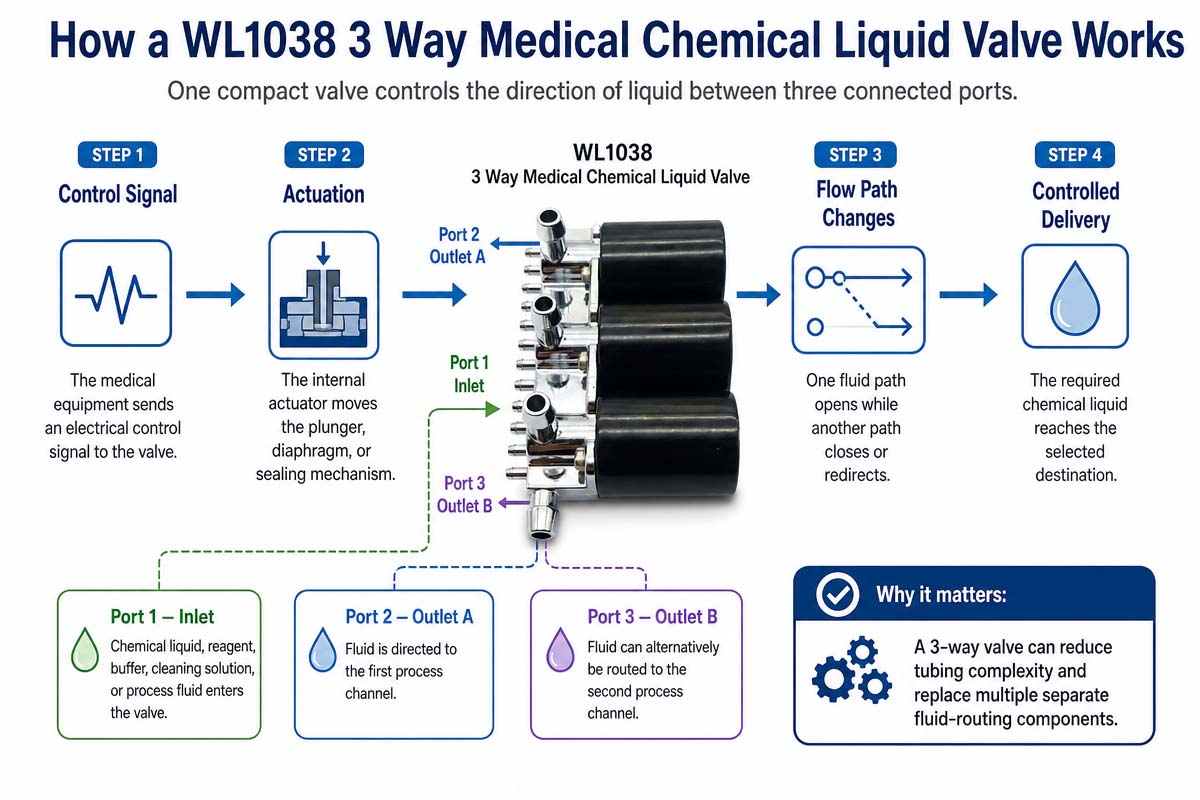
The medical chemical liquid valve is intended for controlling the liquid pathway by switching, opening, closing, or proportionally restricting the flow path. During operation of a valve with electrical actuation, an electrical signal activates an actuator such as a solenoid, motor, or piezoelectric element. This actuator moves an internal sealing element, diaphragm, plunger, or another moving mechanism.

The flow path allows the passing of liquid through the valve when the sealing element is spaced from the valve seat. If it returns to the valve seat, the pathway is blocked. Multi-port valves can divert liquid from one channel to another.

The exact operation principle depends on the valve design. Some medical valves have actuators that are isolated from the process liquid by a diaphragm, while others are direct-acting. Correct operation of the valve is determined by such aspects as pressure, voltage, media compatibility, cleanliness, and installation.

Main Features of Medical Chemical Liquid Valve

A medical chemical liquid valve is usually small, provides precise fluid switching, has low leakage, and is made of chemically compatible wetted materials. Depending on the valve technology, such features as fast response, low internal volume, low power consumption, multiple port configurations, normally open or normally closed operation, and good equipment integration are also possible. Chemically resistant materials can be selected according to the particular liquid reagent or process fluid. Miniature design is preferable in compact diagnostic and laboratory instruments. The other important features may be repeatable operation, controlled flow paths, pressure capability, temperature resistance, electrical compatibility, and long cycle life. Such performance should be verified according to application specs and validation requirements.

Custom Medical Chemical Liquid Valve Product Video

Custom Medical Chemical Liquid Valve Product Detailed Display

Custom Medical Chemical Liquid Valve Product Data Sheet

rand Weilong Technology Model Number WL 1038
Rated Voltage (V) DC 12V or 24V Rated Power (W) 7–15 W
Work Mode Chemical Liquid Control Valve Working Pressure (MPa) 1 MPa
Air Flow Rate 0-1 L/minute Reset Time(s) 1 S On, 2 S Off
Service Life 200 Thousand Times Certification CE, ROHS, ISO9001,
Pipe Gate Outside Dia.: 8 mm, inside: 6 mm Type Single Tube Normal Open
Install Style Screw Tolerance of Dimension ± 0.1 MM
Water-proof None Insulation Class B
Hi-Pot Test AC 600V 50/60 Hz 2s Non-excitation Holding Force 0
Working Temperature -10°C-100°C Duty Cycle 1-100%
Thread Depth (mm) / Payment Term TT, or LC at Sight
Sample Order Yes. Warranty 1 Year
MOQ 1000 pcs Supply Ability 5000 pcs per week
Delivery Time 30 Days Port of Loading Shenzhen

How to Compare Medical Chemical Liquid Valves for Your Application

How to compare medical chemical liquid valves for your application

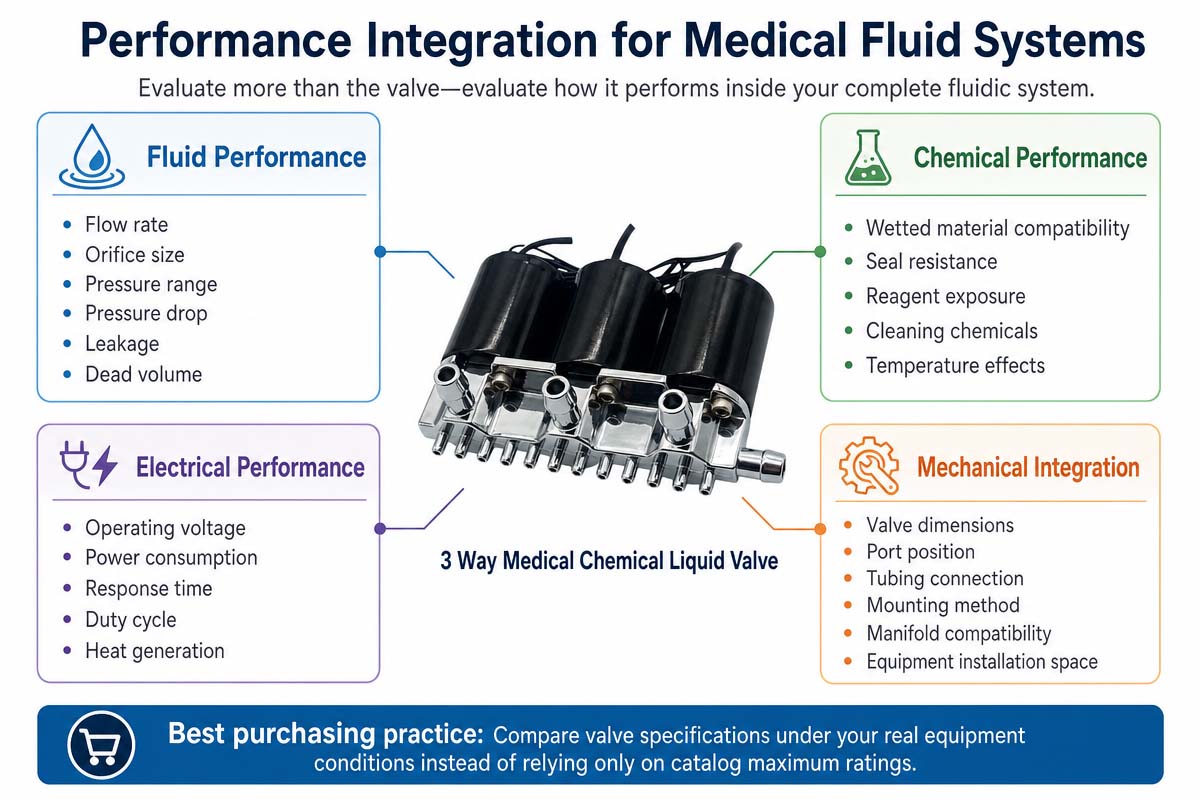
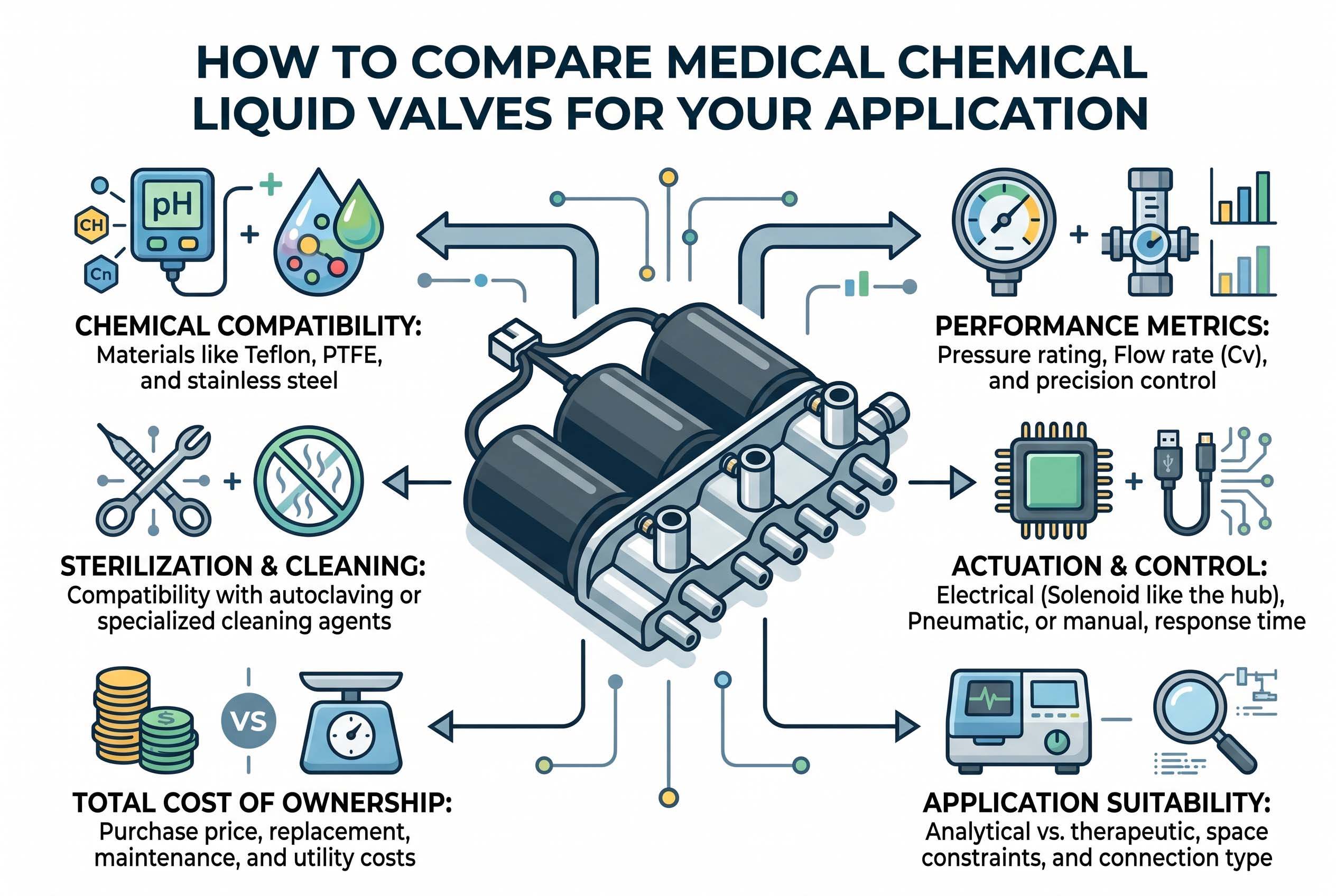
When comparing medical chemical liquid valves, you have to consider not only the price, size, and maximum pressure. The best valve is one that corresponds to the actual medical equipment in materials, fluidic performance, actuation characteristics, reliability, and integration requirements.

First, chemical compatibility. – Create a list of all fluids that will come in contact with the valve during normal operation, cleaning, calibration, servicing, and foreseeable abnormal conditions. Compare these fluids to all wetted parts in each candidate valve. Consider concentrations, pH levels, temperatures, and chemical mixtures. In case of uncertainty about compatibility data, it is better to test the actual liquid than to refer to generic compatibility charts.

Comparison of the fluid performance. Compare orifice diameter, flow coefficient, operating pressure range, differential pressure requirements, internal leakage, external leakage, and response characteristics. The best valve is not always the one with the highest flow capacity. It can be advantageous to reduce the internal volume and carryover for diagnostic and reagent handling applications.

Compare valve construction. Compare direct-acting, diaphragm-isolated, pinch, rocker, solenoid, motorized, or any other suitable technology. The optimum architecture depends on fluid chemistry, isolation required, pressure, response time, power availability, and contamination requirements.

Electric performance evaluation. Compare for electrically operated valves the operating voltage, current, power consumption, duty cycle, response time, heat generated, connector design, and control requirements. Low-power operation can be especially important for compact, portable, or temperature-sensitive medical equipment.

Consider reliability. Compare the expected cycle life under conditions typical for the actual application. Laboratory cycle life results may not predict the performance with aggressive reagents, deposits, high temperatures, or unusual pressure profiles. Understand how suppliers establish their reliability specifications.

Review mechanical integration. 4. Compare footprint, weight, mounting method, port configuration, tubing or manifold interfaces, installation orientation, and service accessibility. A slightly more expensive valve can decrease the total system cost through simplification of the manifold, tubing layout, assembly process, or maintenance.

Consider cleanliness and contamination control. The dead volume, internal geometry, particle generation, extractables, carryover, flushing characteristics, and manufacturing cleanliness should be considered as appropriate for sensitive analytical or diagnostic applications.

Refer to supplier support and documentation. Review drawings, material information, test reports, change-notification practices, traceability, quality-system information, and customization capabilities as appropriate for your program.

Finally, prepare a comparison matrix and assign weights to each criterion depending on the application. “Chemical compatibility, safety, and reliability should generally be more heavily weighted than unit price alone. Select a few valves and prototype-test them with actual liquids, pressure conditions, temperatures, electrical duty cycles, and operating sequences. The final selection should be based on risk management, verification and validation, and applicable regulatory requirements—not just catalog specifications.

Medical Chemical Liquid Valve Medical Requirement Application

Custom Medical Chemical Liquid Valve Medical Application

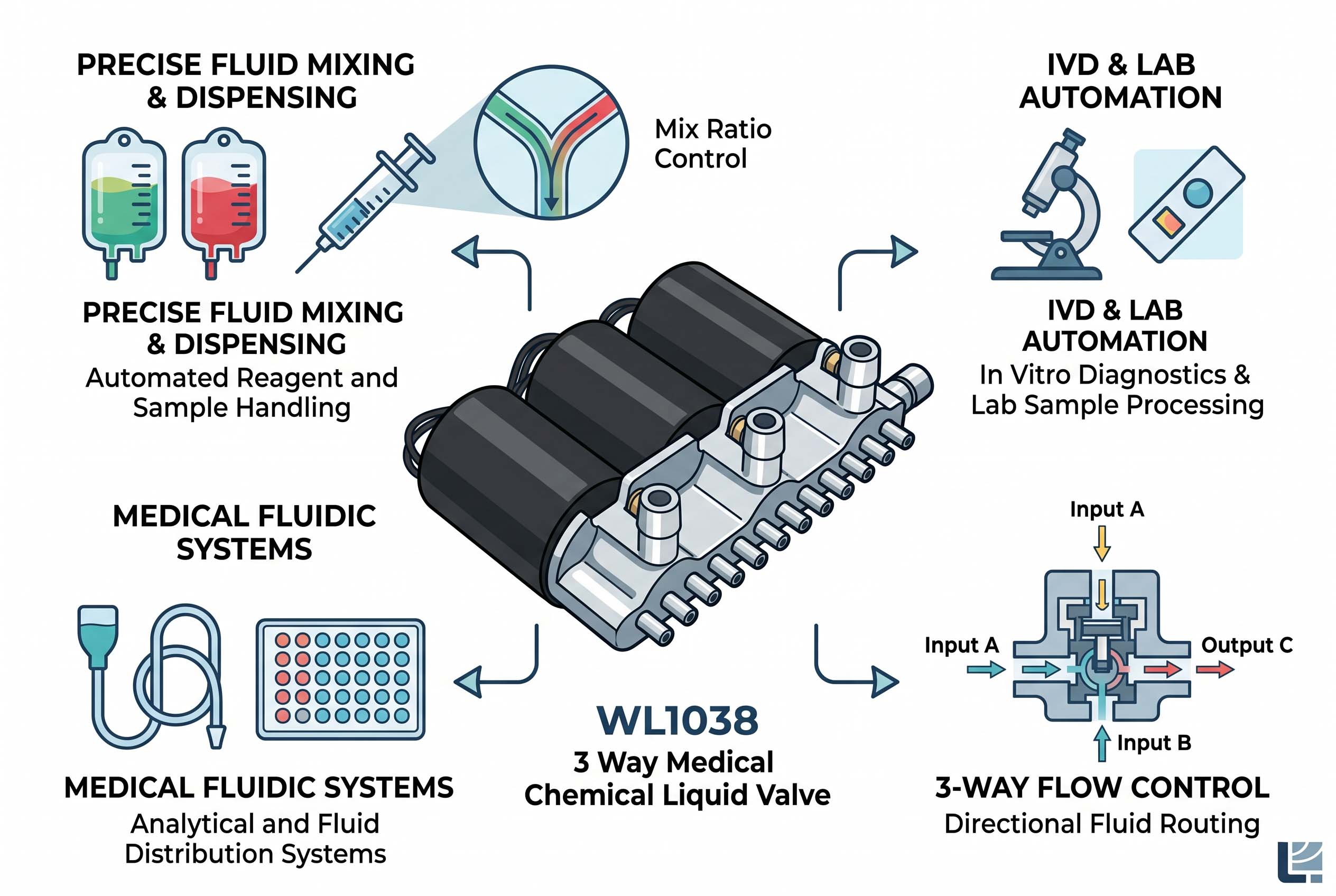
A medical chemical liquid valve is used in equipment where process liquids have to be controlled in movement, isolated, switched, dispensed, or routed. One of the major applications is in-vitro diagnostic equipment, where the valves may be used for controlling reagents, buffers, washing liquids, calibration solutions, and waste-fluid pathways.

These valves can be used in clinical chemistry and immunoassay analyzers for automation of liquid routing between reservoirs, pumps, reaction areas, washing stations, and waste containers. Laboratory automation systems use miniature valves to control sample-preparation or reagent-handling processes.

Valves with chemically compatible wetted materials can be used in cleaning, disinfection, sterilization support, and fluid conditioning subsystems of medical and life science equipment. Other applications include analytical instruments, liquid dispensing modules, reagent management equipment, laboratory fluidics, and OEM medical device platforms.

Choice of the valve depends significantly on the liquid chemistry and equipment architecture. Such aspects as wetted materials, pressure, temperature, flow requirements, leakage allowance, dead volume, cleaning procedure, connection design, actuation method, and expected valve cycle life are important for engineers. For medical products, the finished device manufacturer should perform risk management, verification, validation, and regulatory assessment of this component.

Why is the Medical Chemical Liquid Valve a Preferred Choice for Medical Device Solutions?

Fluid handling is becoming increasingly automated in the medical devices industry. This increases the demand for compact components, which can provide accurate control over reagents and other process fluids.

Medical chemical liquid valves help to automate the processes of fluid isolation, switching, routing, dispensing, washing, and waste management. Moreover, miniature valve technologies allow engineers to incorporate multiple fluid channels into compact diagnostic instruments.

Another important point is the automation’s growing importance in the laboratory and diagnostic workflows. In automated analyzers, fluid-control components must be repeatable to coordinate pumps, reservoirs, sensors, reaction chambers, and waste channels.

The newest valve designs provide a wider selection of wetted materials, actuation technologies, electrical characteristics, connection methods, and manifold configurations. Such flexibility allows OEM engineers to customize fluidic architectures for specific applications.

However, their appropriateness depends on the specific application. A valve for medical devices has to be tested for the actual fluid chemistry, operating conditions, reliability requirements, risk controls, and applicable regulatory requirements


Custom Medical Chemical Liquid Valve Advantage and Disadvantage

Medical Chemical Liquid Valve Advantage and Disadvantge

Custom Medical Chemical Liquid Valve Advantage

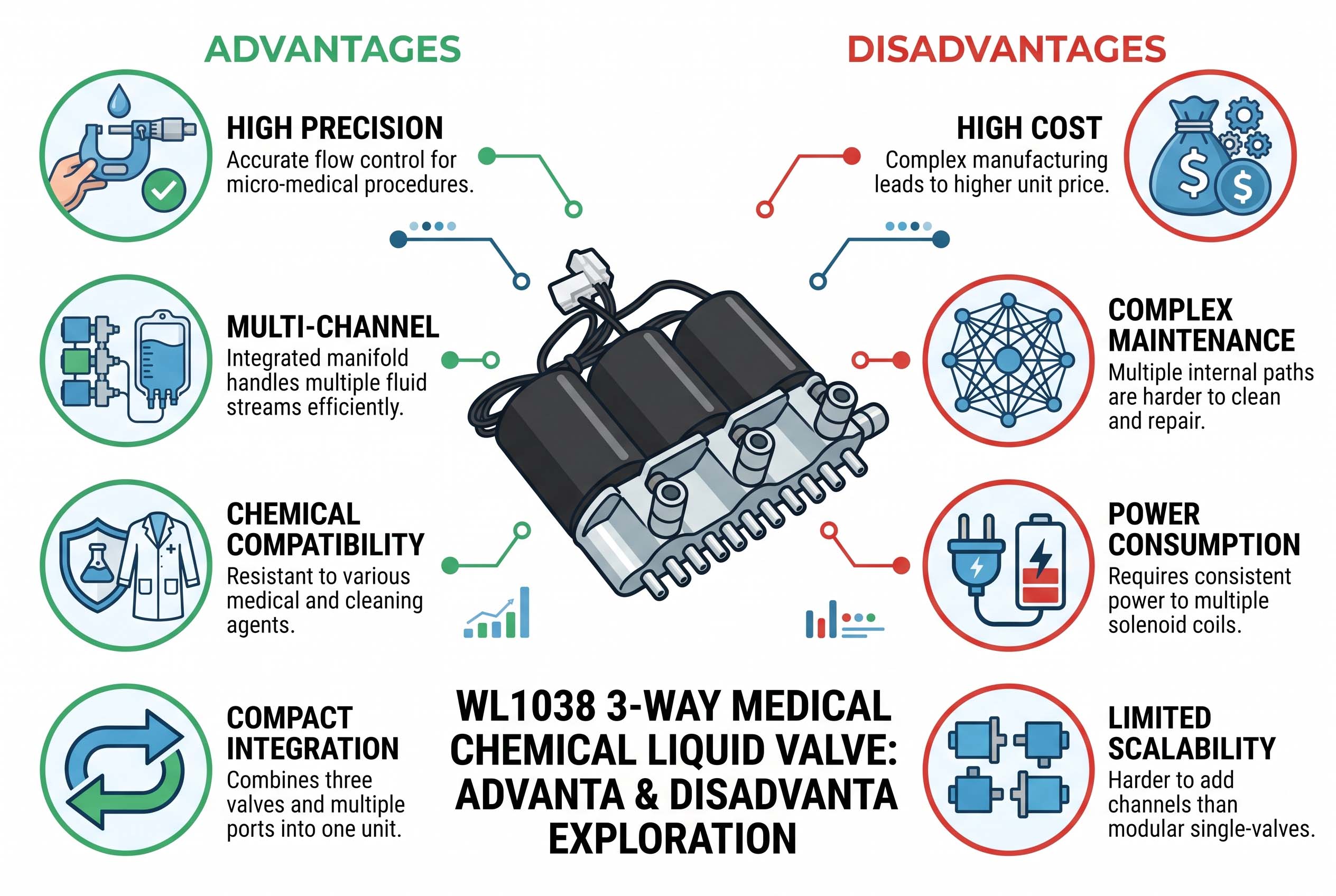
Medical Chemical Liquid Valves for Medical Device Fluid Systems – Advantages: The small size allows for the incorporation of complicated diagnostic and laboratory equipment. Automated valves make possible for the equipment to route electronic control of fluids, allowing the equipment to perform repeatedly the dispensing, washing, calibration, and reagent management operations. Correct valve designs can result in low leakage, quick switching, low internal volume, and repeatability. Engineers can choose between a wide variety of wetted materials to ensure chemical compatibility.

Custom Medical Chemical Liquid Valve Disadvantage

These valves also have some drawbacks. The chemical compatibility can be tricky as aggressive liquids may attack seals, diaphragms, valve bodies, adhesives or metallic components. Particle formation, crystallization, or deposits can interfere with the small flow paths. Models with solenoids can generate heat and use energy during the long term operation. Dead volume or pressure drops can also occur.

Valves requiring exotic materials, very low leakage, long cycle life, custom manifolds, or extensive documentation can increase the cost. Thus, choosing the valve should be a balance between performance, reliability, integration, validation requirements and total system cost.

Medical Chemical Liquid Valve Troubleshooting

Medical Chemical Liquid Valve Troubleshooting Guide

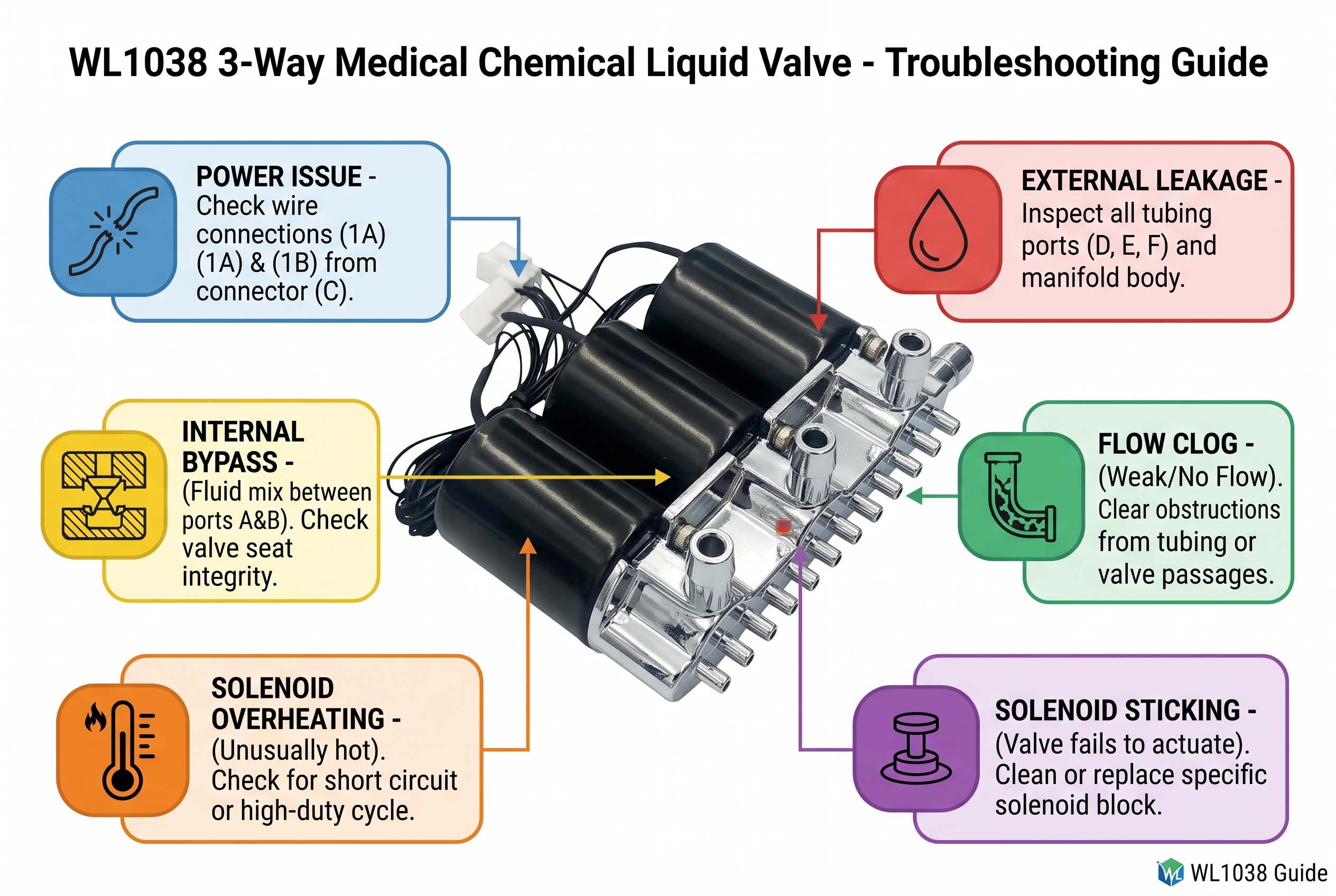
Check electrical supply, connector, control signal, polarity (where applicable), and specified voltage if the medical chemical liquid valve does not operate. Check pilot pressure and air connections for pneumatic designs.

If the valve operates but the liquid flow is not correct, verify the fluid path for blocked tubing, particles, crystallized chemicals, deposits, incorrect connections, or too low a pressure differential. Compare the valve specification with the actual operating conditions.

Checking for Leakage: Check seals, diaphragms, valve seats, fittings, and tubing interfaces. The improper closure may occur because of chemical swelling, degradation, contamination, or particles in the sealing surface.

The inconsistency in the flow can be caused by inlet pressure fluctuations, air bubbles, blocked passages, changes in liquid viscosity, temperature, or upstream pump performance. If the valve temperature is too high, it may be caused by wrong voltage, too high duty cycle, poor heat dissipation, or operation outside of specifications.

If there are several failures, you should conduct a systematic root cause analysis. “Document operating conditions and failure modes, examine affected parts, and contact the valve manufacturer. Safety-critical medical equipment must be serviced and validated to the device manufacturer’s approved procedures.

Custom Medical Chemical Liquid Valve FAQs

1. What is the right Medical Chemical Liquid Valve for my equipment?

Begin with liquid type, chemical concentration, operating pressure, flow rate, temperature, size of orifice, voltage, duty cycle, and connection method. Reagents, disinfectants, buffers, and cleaning chemicals may affect seals and valve bodies in a different way. The buyers should pay special attention to the wetted material compatibility. Provide all operating conditions to the supplier so that he can recommend a suitable valve configuration.

2. For what chemicals can the Medical Chemical Liquid Valve be used?

Chemical compatibility is determined by the valve’s wetted materials and the liquid, which is controlled. Depending on the design, applications may include reagents, buffers, cleaning solutions, calibration liquids, disinfectant solutions, and other process chemicals. The buyer must provide the chemical name, concentration, pH level, operating temperature, and duration of exposure. Before the production release, check the compatibility.

3. What materials should I consider when buying a medical chemical liquid valve?

Typical considerations include the valve body, diaphragm, seals, valve seat, and any other parts in contact with the liquid. The choice of material is determined by chemical compatibility, temperature, pressure, cleanliness, and service life requirements. The buyers should ask for the wetted-material list and then review the list against all fluids used in the equipment.

4. Can the Medical Chemical Liquid Valve be customized for OEM medical equipment?

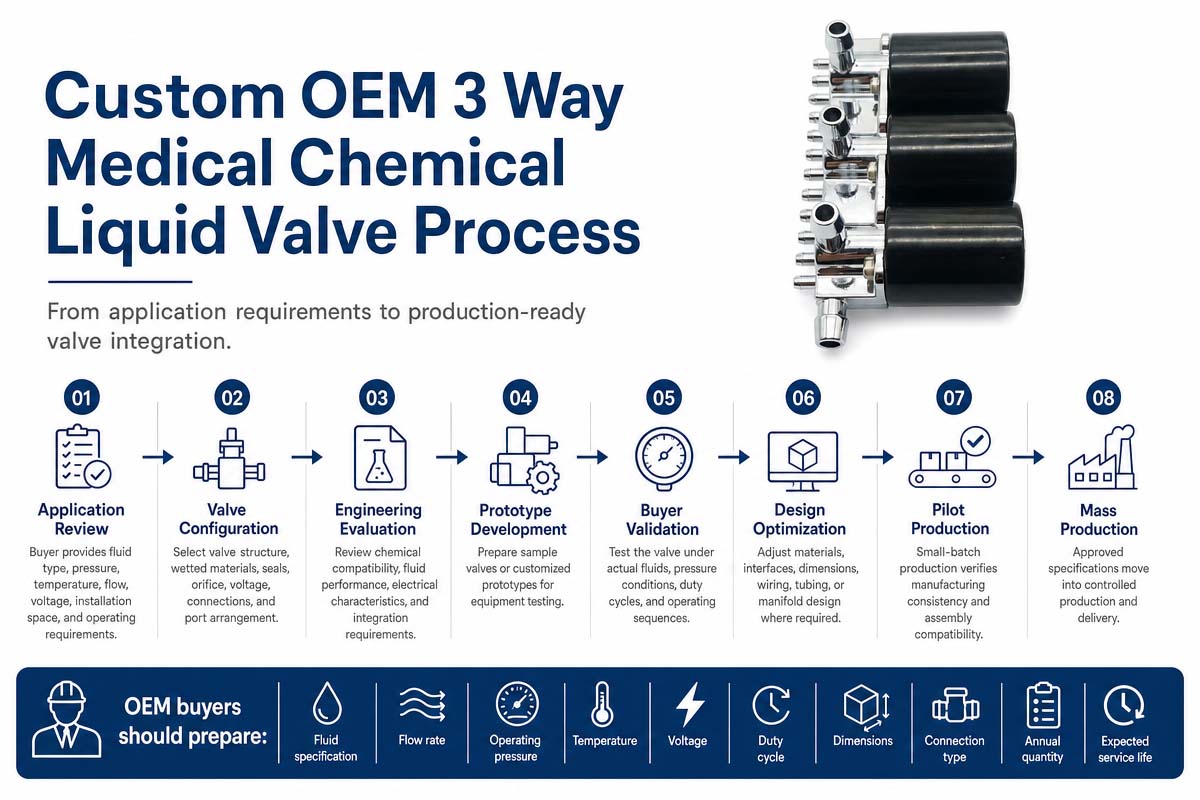
The manufacturer can customize voltage, electrical connector, tubing interface, port configuration, mounting structure, orifice size, flow characteristics, wetted materials, manifold integration, cable length, and other mechanical or electrical parameters. The buyers (OEMs) should provide drawings, operating conditions, target quantities, and technical requirements early in the development process to determine the feasibility of customization.

5. What information should I provide when requesting a quote?

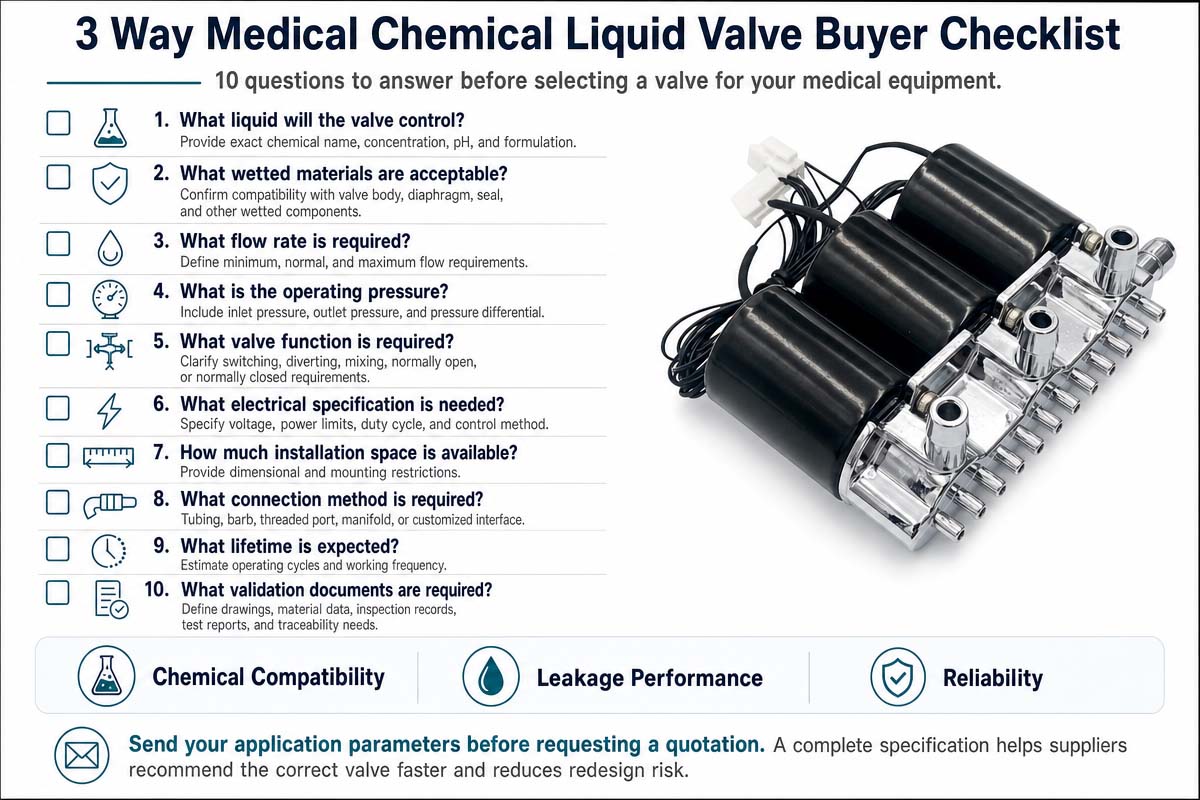
To receive a correct quote, please provide the application, liquid or chemical name, concentration, operating temperature, inlet and outlet pressure, required flow rate, voltage, duty cycle, port or tubing size, leakage requirement, expected cycle life, annual quantity and any special material requirements. If possible, provide a drawing or fluid-system diagram. Complete application information allows the supplier to recommend a suitable medical chemical liquid valve and reduces the risk of the wrong choice.

6. How to identify if my Medical Chemical Liquid Valve is good quality and reliable?

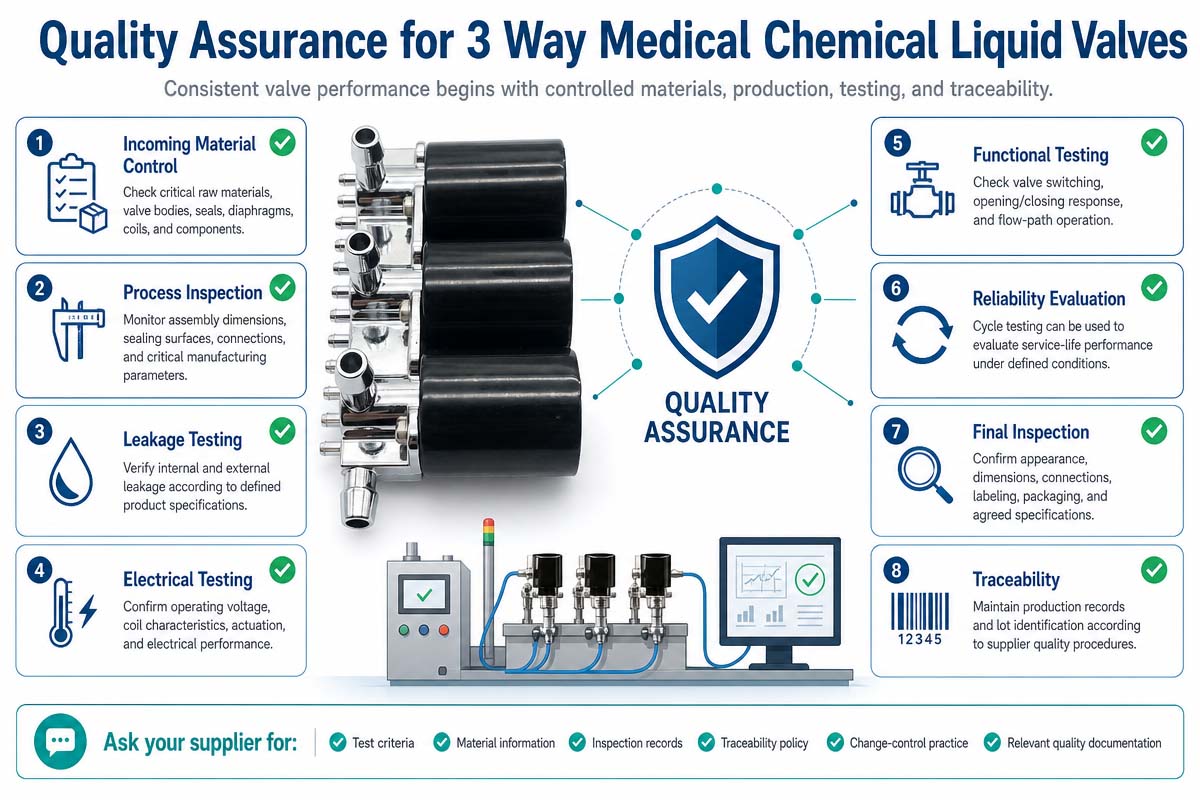
Buyers should compare not only prices. Evaluate dimensional stability, leakage performance, response characteristics, chemical compatibility, pressure capability, projected cycle life, manufacturing controls, traceability, and available test documentation. Ideally samples should be tested in the actual process liquid under representative operating conditions. In addition, buyers should evaluate the supplier’s quality documentation and change-control practices for medical-device applications according to their own regulatory and risk-management requirements.

7. What specifications are most important to compare among suppliers?

Important specifications include wetted materials, operating-pressure range, flow coefficient or flow rate, orifice size, internal and external leakage, response time, operating voltage, power consumption, duty cycle, temperature range, dimensions, connection type, expected cycle life, and customization capability. Different suppliers may report performance in different ways, so buyers should compare specifications at equivalent test conditions.

8. Should I test the samples before ordering the mass production?

Yes. It is recommended to test samples, particularly for medical, diagnostic, laboratory and chemical handling equipment. Test the medical chemical liquid valve with the actual liquid, concentration, temperature, pressure, flow conditions, electrical duty cycle and operating sequence expected in the final product. Buyers would also look at flow stability, response, chemical resistance, heat generation, durability and leakage in evaluation. Successful sample testing reduces technical and commercial risks before prototype approval, pilot production and volume purchase.

Tips for Choosing the Medical Chemical Liquid Valve

To choose the proper medical chemical liquid valve, one should start by knowing the fluid first. All liquids that can come in contact with the valve should be identified, including reagents, buffers, disinfectants, cleaning agents, calibration fluids, and rinse solutions. It is necessary to note their concentration, pH, temperature, exposure time, and conditions of cleaning. These parameters are very important for the determination of the compatibility of valve-wetted materials with the fluid.

Hydraulic requirements have to be specified. It is necessary to set minimum, normal, and maximum operating pressure and flow rate requirements. Do not consider only supply pressure. You have to pay attention to the pressure differential across the valve. Select an appropriate orifice or flow coefficient without unnecessary valve oversizing.

Leakage requirements should be assessed. For the applications where expensive reagents, contamination-sensitive processes, or accurate dosing are used, very low internal and external leakage is required. Take into account dead volume and carryover when the same paths are used by different fluids.

The actuation system should be considered too. If it is a solenoid valve, check voltage, current, power consumption, duty cycle, response requirements, electrical connection, and heat generation. Low-power technologies can be required for portable or battery-operated equipment.

The mechanical integration of the valve is equally important. It is necessary to verify dimensions, mounting orientation, port type, tubing connections, manifold compatibility, space for installation, and access for assembly or service.

Finally, reliability and compliance have to be taken into account. It is necessary to estimate the number of operational cycles and evaluate environmental conditions, storage conditions, cleaning procedures, manufacturing cleanliness, traceability, and supplier documentation. For medical device integration, engineers have to perform application-specific validation and verification. Before final design approval, the prototype should be tested with the actual chemicals and operating conditions.

Tips to Avoid Common Mistakes in Medical Chemical Liquid Valve Designing

It is common to make a mistake in the choice of the medical chemical liquid valve because of pressure and flow only. Chemical compatibility has to be assessed according to actual fluid formulation, concentration, temperature, and exposure time.

Do not assume that all materials in the same general family have the same properties. It is necessary to confirm the exact wetted materials of the body, diaphragm, seal, adhesive, spring, etc., proposed for the valve.

Do not forget about dead volume, trapped liquid, and carry-over. These aspects can be very important in diagnostic systems where multiple reagents flow through the common fluid path.

Valve designers have to avoid the valve oversizing. An increase of the flow path means an increase of the internal volume, making precise liquid management difficult.

The effect of thermal actuation has to be verified, especially if the valve is energized for a long time. It is necessary to confirm the worst-case duty cycle and operating temperature.

Do not select tubing, fittings, and valves separately. Their interfaces have to be evaluated as one fluidic system.

Finally, you cannot rely on catalog specifications only. Prior to finishing the design of the medical device, it is necessary to test the representative production valves with actual chemicals, pressure profiles, temperatures, electrical conditions, cleaning procedures, and intended lifetime.
Get A Free Quote Now

Contact Form

Related Products

Related News

Scroll to Top

Get A Free Quote Now !

Contact Form
If you have any questions, please do not hesitate to contact us.
Weilong Solenoid Company Culture