

The rapid advance of electric vehicles (EVs) has led to the demand for the highest performing power electronic components which are high-efficiency, reliable, and compact. Custom power inductors are the main components playing a vital role in energy conversion, power loss reduction, and system efficiency improvement in the EV electrical systems.
The difference between custom power inductors and standard inductors is the performance characteristics which include high current capacity, small physical size, reduced EMI, enhanced thermal performance, and long lifespan of operation. Such custom products help optimize the battery systems, motor controllers, charging systems, and power management units of automotive vehicles.
The further advance of EV technology toward high voltage platforms and fast charging will raise the demand for high-performance custom power inductors.
Chapter 1: Introduction to Custom Power Inductors
Power inductors are passive electronic components that store energy in a magnetic field and release it when needed. They are used in the power conversion circuits, filtering systems, voltage regulation modules, and energy storage applications.
Custom Power Inductors
Custom Power Inductors are the inductors manufactured according to certain electrical and mechanical specifications. The use of customized inductors allows optimizing parameters of the device compared to standard commercial inductors:
Inductance (quantity)
Current capacity
Saturation current
DC resistance (DCR)
Working temperature range
Physical dimensions
Magnetic materials
Mounting construction
Performance EMI
Such inductors help increase the efficiency of the energy conversion process in electric vehicles as well as survive the harsh automotive environment.
Chapter 2: Why Are Custom Power Inductors Needed for EV Applications?
The power electronics plays an important role in the control of the power flow between the battery, motor, charger, and auxiliary systems in electric vehicles. There is the potential of the energy losses during each of the conversion stages. The efficiency of such systems has a direct impact on the driving range, charging speed, and the lifespan of the battery.
2.1. Improvement of the Efficiency of Energy Conversion
The power systems of EVs require a number of voltage conversions, namely:
Battery voltage control
Conversion DC-DC
On-board charging
Motor inverter operation
Custom power inductors help to stabilize the current flow and reduce the energy losses during the conversion process.
The properly designed inductor will reduce:
Copper losses
Core losses
Heat generation
Switching losses
This will improve the overall efficiency of the system and increase the driving range of the vehicle.
2.2. High Current Capability
The modern EV batteries are subject to the high power conditions and should withstand the high currents.
Custom power inductors can be designed according to:
Increased size of the conductor
Optimized winding arrangement
High performance magnetic core
Enhanced thermal path
Such properties allow the inductor to function efficiently in high current conditions without overheating.
2.3. Size and Weight Reduction
The car manufacturers are always interested in the manufacture of smaller and lighter electronic components in order to increase the efficiency of the car.
Custom Power Inductors Allow Engineers to Achieve:
High power density
Small size package
Reduced weight of the system.
Various mounting options
The compact design of the inductor helps to optimize EV control units and power modules.
Chapter 3: Custom Power Inductor Applications in Electric Vehicles
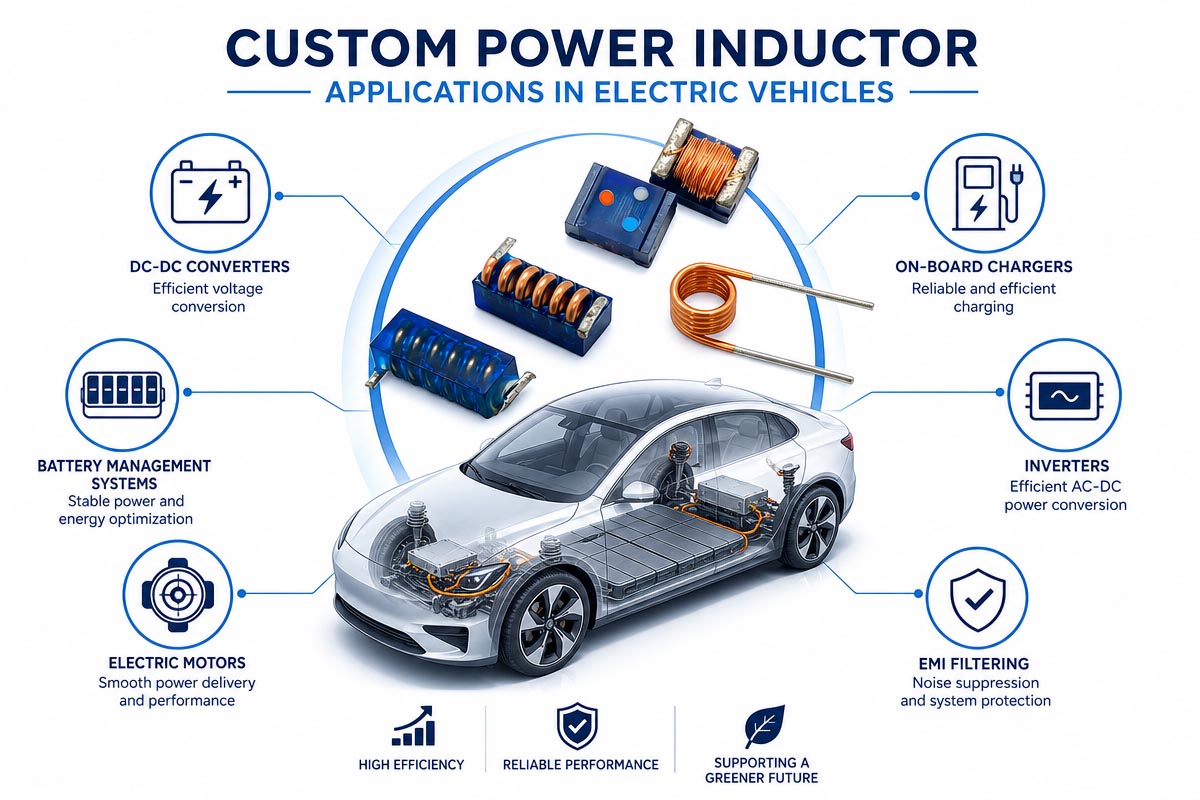
3.1. DC-DC Conversion System
The DC-DC converters are vital elements in EVs that convert the high voltage battery power into low voltage power for use by vehicle electronics.
The custom power inductors in DC-DC converters provide the following benefits:
Stable voltage control
Reduced ripple current rating
High conversion efficiency
Reliable operation under various loads
They are used in the following applications:
EV Platforms 400V
800V Fast Charging Platforms
Auxiliary electrical power supplies
3.2. Battery Management Systems (BMS)
The battery management system helps to monitor and control the battery performance, safety, and charging efficiency.
The custom power inductors help BMS circuits to achieve:
Precise current control
Stable power supply
Noise reduction
Enhanced battery protection
The quality of inductors has great impact on the lifespan and safety of the battery.
3.3. On-Board Chargers (OBC)
The chargers of electric vehicles (EV) require efficient AC/DC conversion. The power inductors are used in the following circuits:
Power factor correction circuit
Filtering circuit
Power supply switchover
Custom designs help to improve:
Energy efficiency
Thermal management
Electronic stability
3.4. Inverters for Motor Drives
The inverter converts the DC power of the battery into AC power for the electric motor.
The custom power inductors help:
Reduce electrical noise.
Improve current control
Increase motor efficiency.
Protect sensitive electronics.
The high-performance inductors are especially valuable in the case of high-speed motors and high-power EV applications.
Chapter 4:EV Custom Power Inductor Design Considerations
The design of the reliable custom power inductor requires a lot of attention to such aspects as electrical, mechanical, and environmental factors.
4.1. Inductance Value
The inductance value influences the performance of the component as far as energy storage and releasing are concerned.
The engineer has to find the proper balance between:
Necessity to store energy
Switching frequency
Ripple current
Physical size
If the value of inductance is correct then the circuit becomes stable.
4.2. Saturation Current
The current peaks in EV applications are often high.
When the inductor saturates magnetically:
The inductance reduces.
The current increases rapidly
Heat generation increases.
The custom power inductors are designed using appropriate core material and construction to perform well in high current conditions.
4.3. Heat Generation
The biggest challenge in EV electronics is the management of the heat generation.
The custom inductors may be equipped with the following features:
Optimization of core material
Enhanced heat dissipation structure
High-temperature insulating materials
Improved winding technology
It will provide reliable operation in the difficult automotive environment.
4.4. EMI and Noise Mitigation
The high switching frequencies in the EV power systems cause electromagnetic interference.
The custom power inductors help to reduce:
Conducted noise
Noise emission
Ripple voltage
Harmonic distortion
The proper magnetic design increases the reliability of the system and meets the automotive standards.
Chapter 5:Benefits of Custom Power Inductors vs. Standard Inductors Feature
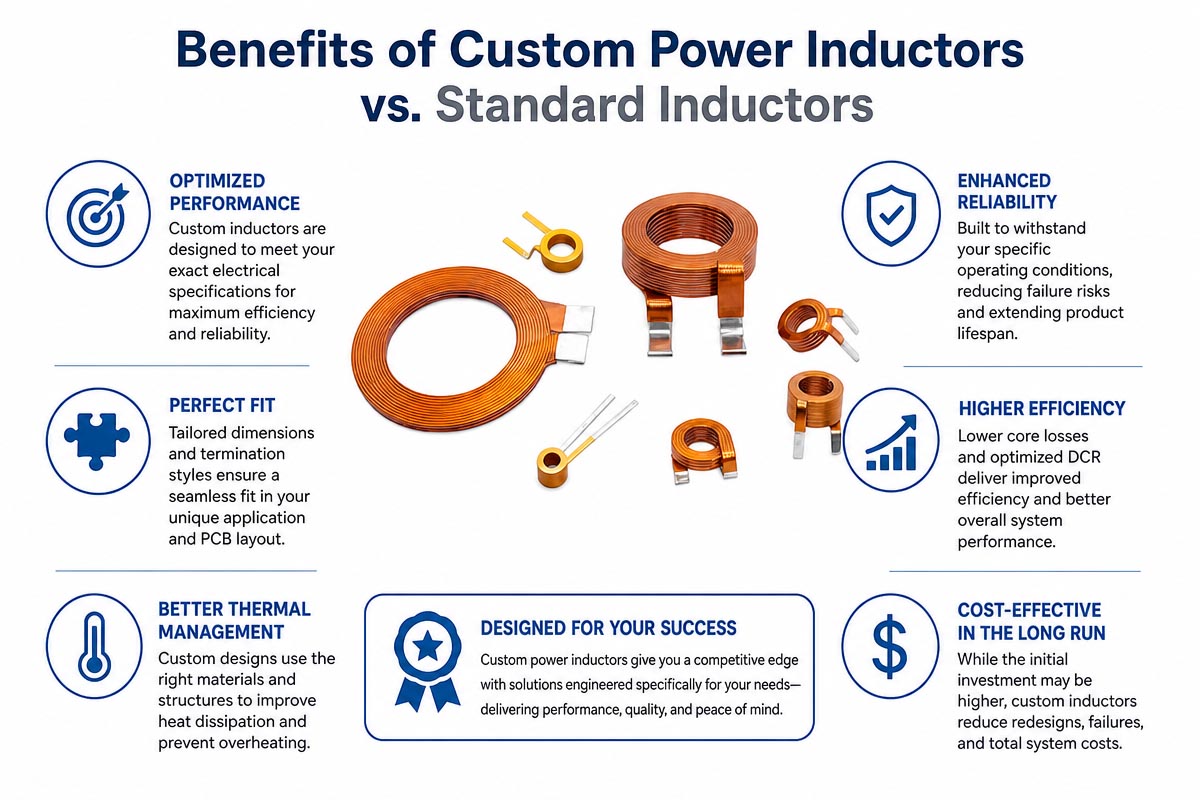
Custom power inductors are created specially for a certain application, whereas standard inductors are just general components manufactured according to the existing industry standards. There are certain advantages of using custom power inductors for complex applications like automotive electronics, industrial power supplies, medical devices, renewable energy and high-frequency converters.
| Feature | Standard Inductors | Custom Power Inductors |
| Design flexibility | Limited | Fully optimized |
| Current capacity | General purpose | Designed for high current |
| Size optimization | Fixed dimensions | Application-specific |
| Thermal performance | Standard | Enhanced cooling design |
| EMI control | Basic | Optimized magnetic design |
| Automotive reliability | Limited options | Designed for EV environments |
5.1 Application-Specific Electrical Performance
The main benefit of using custom power inductors is their special engineering, which takes into account the precise needs of your application.
It becomes possible to optimize the following parameters of inductors:
Inductance value (µH/mH)
Rated current
Saturation current
Switching frequency
DC resistance (DCR)
Operating temperature
Magnetic flux density
For instance, a DC-DC converter applied in automotive electronics requires a high-current inductor with low losses and good performance at extreme temperatures. A standard inductor will not be able to meet these parameters.
5.2 Small Size and Efficient Space Utilization
The design of modern electronic devices tends to become smaller and lighter. Standard inductors have fixed dimensions, and engineers need either to change the PCB layout or accept extra space.
With the help of customization it becomes possible to optimize the following inductors’ parameters:
Core shape
Coil structure
Winding type
Terminal location
Installation type
This feature becomes especially useful for the following applications:
Automotive control units
Portable medical equipment
Battery management systems
Industrial controllers
A custom inductor will maximize the magnetic performance inside the limited space and will provide higher power density.
5.3 High Current Capability
High-power applications often require inductors that are able to work properly under heavy load without magnetic saturation.
It becomes possible with the help of the following features:
Optimized ferrite cores
Powdered iron cores
High-temperature magnetic materials
Advanced winding techniques
The following benefits can be obtained:
Increased output power
Higher efficiency
Reduced component overheating
Increased product lifetime
5.4 Higher Efficiency of Power Usage
Power losses in inductors happen due to the following reasons:
Copper loss which appears due to winding resistance
Core loss, which appears due to the magnetic changes
Eddy current loss
The losses in inductors can be minimized by:
Using bigger conductors
Optimized winding patterns
Using appropriate core materials
Improvement of magnetic circuits
As a result the following positive effects can be observed:
Increased efficiency of energy conversion
Decreased operating temperature
Reduced need for cooling
5.5 Improved Thermal Performance
Heat management is one of the key issues in high power electronics.
The thermal performance of inductors can be improved by the following ways:
Creation of better heat dissipation channels
Using high-temperature insulating materials
Improved core structures
Customized packaging
It becomes possible to determine:
Maximum temperature rise
Ambient operating temperature
Conditions of continuous current
5.6 Reduced Electromagnetic Interference (EMI)
The electromagnetic interference is a common problem in switching power systems.
The EMI of inductors can be reduced by:
Using shielded magnetic structures
Optimizing the core geometry
Improved winding arrangements
Reducing leakage flux
The applications where low-noise inductors are required are the following:
Audio equipment
Medical electronics
Automotive systems
Communication devices
5.7 Flexible Mechanical Design
As opposed to the standard inductors, it becomes possible to adapt custom solutions to the structure of a product.
The customization includes:
Various dimensions of the package
Various installation types (vertical and horizontal)
Custom pins or terminals
Various connectors
Particular installation requirements
This will make the assembly process easier.
5.8 Increased Reliability and Longer Lifetime
Custom power inductors can be created taking into account special environmental conditions:
High temperature operating
Resistance to vibrations
Resistance to humidity
Requirements for automotive products
Requirements for industrial products
It becomes possible to provide the inductors with appropriate materials and constructions.
5.9 Cost Benefits of Mass Production
Despite the necessity of initial engineering costs, the custom inductors provide cost benefits during mass production.
The advantages of using custom power inductors include:
Reduced PCB space
Fewer additional components
Increased system efficiency
Lower failure rate
Simple assembly
For OEM customers manufacturing thousands or millions of units, it becomes possible to get better cost-performance of a custom inductor solution than of several standard inductors.
5.9 Design Support and Engineering Collaboration
Professional custom inductor manufacturer can provide the following services:
Magnetic simulation
Material selection
Prototyping
Sample testing
Verification of reliability
Mass production support
This kind of collaboration makes it possible to get the optimal balance between electrical performance, size, cost, and reliability.
Chapter 6: EV Custom Power Inductors Materials
The selection of magnetic materials influences greatly the performance of inductors.
Typical materials are:
Ferrite Materials for Cores
Advantages: 1.
Low core losses
High-frequency performance
affordable
Good for:
DC-DC converters
Charging systems
Powder Core Materials
Advantages: *
High saturation capability
Distributed airgap
Superior DC bias performance
Best for:
High-current EV applications
Power conversion systems
CompositeMaterials Metal
Advantages: Advantages: Advantages:
Small footprint
Good thermal performance
High power density
Best For:
High power modules for automotive
Chapter 7: Choosing a Reliable Custom Power Inductor Manufacturer
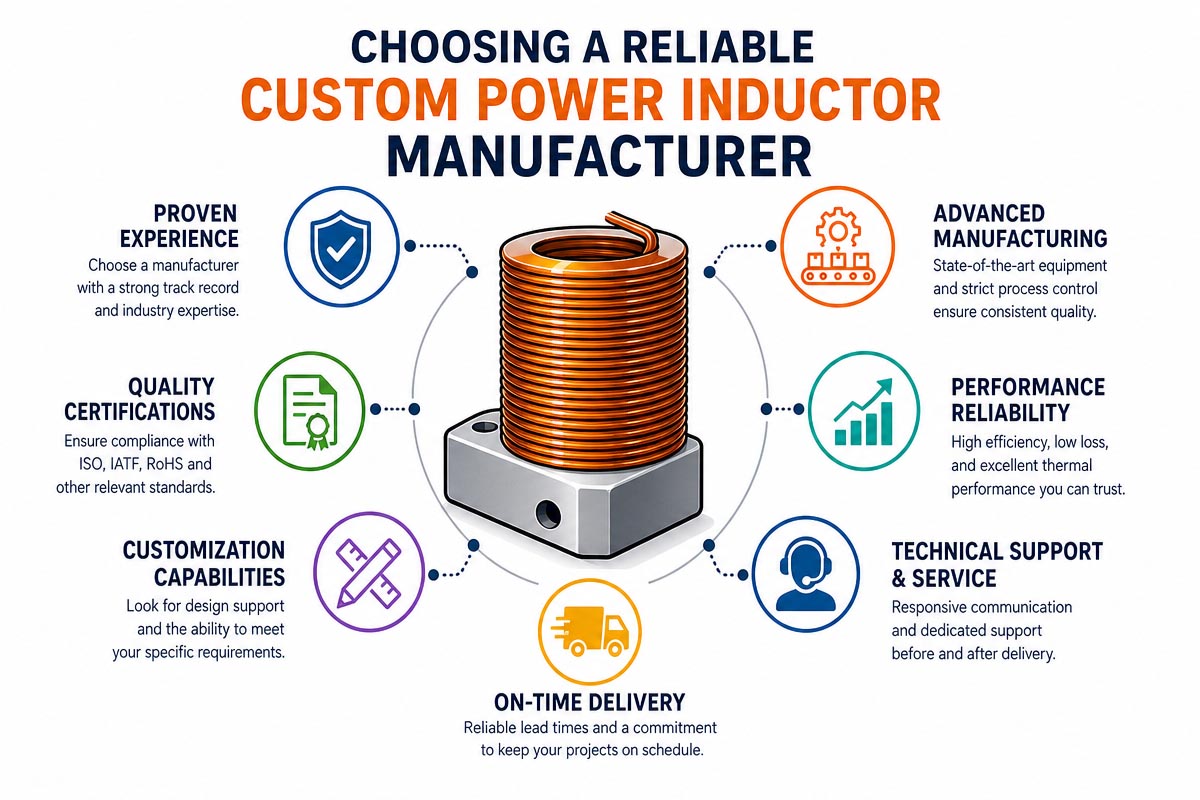
In the EV applications where reliability and safety are of great importance, the choice of the manufacturer is crucial.
The main evaluation criteria are
Engineering Capability
It should be provided by a qualified manufacturer:
Magnetic modeling
Electrical optimization
Prototype manufacturing
Test support
Manufacturing Capability
It is necessary to check the ability of the company to:
Precision coil winding
Core assembly
Automated testing.
Quality Assurance
Quality Control in Automobiles
The key quality criteria are:
Temperature test
Electrical test
Reliability tests
Consistency control
Chapter 8: Future Trends of Custom Power Inductors in EV Technology
The future trends of custom power inductors in the EV technology will be:
Higher Power Density
The future EV systems require compact components with increased output capability.
Voltage Systems 800V and Higher
The charging and efficiency will be increased using the complex magnetic designs for high voltage platforms.
Improved Thermal Management
The future inductors will be manufactured using the better materials and cooling structures to operate at the higher power level.
Integrated Power Modules
The inductor will become more integrated with the converter and power electronics to decrease the size and increase the reliability.
Chapter 9: Conclusion
The custom power inductors are becoming very important in the technology of electric vehicles through increasing energy efficiency, reducing power losses, and allowing compact high performance power systems.
Such custom components help the manufacturers of EVs to increase the driving range, charging speed and reliability of the vehicle from DC-DC converters, battery management systems up to the chargers and motor inverter circuits.
As the EV architecture evolves toward high-voltage and power-density systems, the innovative custom power inductor solutions will become the key technology of the future of electric mobility.
Chapter 10:FAQs on custom power inductors for EVs
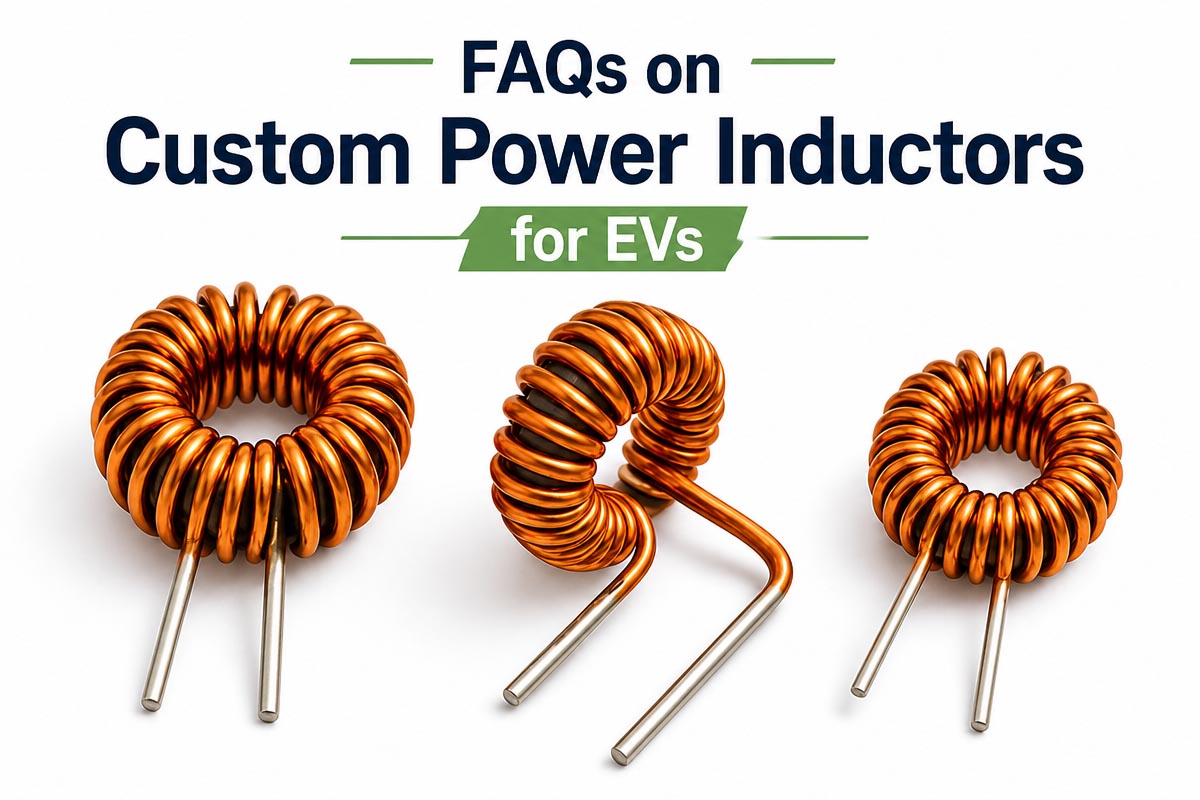
Q1: What is a custom inductor for power?
A custom power inductor is a special magnetic component designed for certain electrical, mechanical, and environmental specifications.
Q2: Why do electric vehicles use power inductors?
They increase the power conversion efficiency, reduce energy losses, enable high current capability, and improve the system reliability.
Q3: What are power inductors used for in electric cars?
They are usually used in the DC-DC converters, battery management systems, chargers, and motor inverter circuits.
Q4: What are the design factors for custom power inductors?
The inductance value , current capacity , core material , thermal performance , size and EMI requirement are important factors.
Q5: Custom power inductors to increase EV range?
Yeah. They can reduce the electrical losses and improve the conversion efficiency.


