Durable SCR Solenoid for Diesel Exhaust System
Industrial Grade SCR Solenoid Valve Solutions
Reliable Automotive SCR Solenoid Valve Design
Heavy Duty SCR Solenoid for DEF Injection Use
Advanced SCR Solenoid for Emission Control
High Efficiency SCR Solenoid Valve for Trucks
Durable SCR Solenoid for Diesel Exhaust System
Industrial Grade SCR Solenoid Valve Solutions
Reliable Automotive SCR Solenoid Valve Design
Heavy Duty SCR Solenoid for DEF Injection Use
Advanced SCR Solenoid for Emission Control
High Efficiency SCR Solenoid Valve for Trucks

WL106629 Compact Diesel SCR Solenoid for DEF Control

A SCR solenoid refers to the solenoid for selective catalytic reduction that is used as a component of diesel exhaust fluids. A solenoid in general is a type of electromagnet that produces a mechanical motion when it is subjected to an electric current.

In the case of solenoids for selective catalytic reduction, this refers to the actuator that controls the flow of Diesel Exhaust Fluid (DEF). As a matter of fact, solenoids for SCR function with the aim of reducing the emission of NOx gases.


SCR Solenoid Main Features

Solenoids for SCR provide fast response to diesel engine DEF injection. They also have stable electromagnetic performance and low power consumption.

High-quality solenoids for SCR are built from corrosion-resistant materials and therefore provide resistance to DEF liquid and harsh operating environment.

SCR solenoid provide accurate DEF dosing, which ensures efficient lowering of NOx emissions and makes diesel engines capable of meeting such environmental standards as Euro 5 and Euro 6.

Automotive SCR Sonlenoid Product Overview

Solenoids for SCR are electromagnetic valves that are installed in the systems of diesel engines. Their role is to provide selective catalytic reduction with proper injection of Diesel Exhaust Fluid, thus minimizing NOx emissions. The SCR solenoids are widely used in the automotive, industrial, agricultural and heavy-duty engines.

Usually, a typical solenoid consists of several components: a solenoid coil, plunger, spring, valve body, sealing mechanism, electrical connection.

When energized, the magnetic field produced by a coil pulls the plunger, either opening or closing the valve depending on the task to perform.

Key features of these solenoids include fast response speed, stable performance, energy savings, high temperature resistance, waterproof and corrosion resistance. SCR solenoids are available in several voltages DC 12V, 24V and also provide OEM customization options.

Automotive SCR Solenoid Valve Video

heavy duty SCR solenoid valve detail Display

Automotive SCR Solenoid Valve Technical Datasheet

Brand Weilong Technology Model Number WL106629
Rated Voltage (V) DC 12V  or 24V Rated Power (W) 10-12 W
Media Hot Water or Air Holding Force (N)  150 —– 300 GF
Ports: Dia.  10 mm Reset Time(s) 1 S
Service Life 100 Thousand Times Certification CE, RoHS, ISO9001,
Material Nylon Lead Wire Length (mm) 200
Install Style Flange Tolerance of Dimension  +/-  0.1 MM
Water-proof IP-68 Insulation Class B
Hi-Pot Test AC 600V 50/60Hz 2s Non-excitation Holding Force 0
Working Temperature -10°C-100°C Duty Cycle 1-100%
Working MPa from 0 to 0.25 Mpa Payment Term TT, or LC At Sight
Sample Order Yes Warranty 2 Year
MOQ 1000 PCS Supply Ability 5000 pcs per Week
Delivery Time 30 Days Port of Loading shenzhen

SCR Solneoid Automotive Application Guide

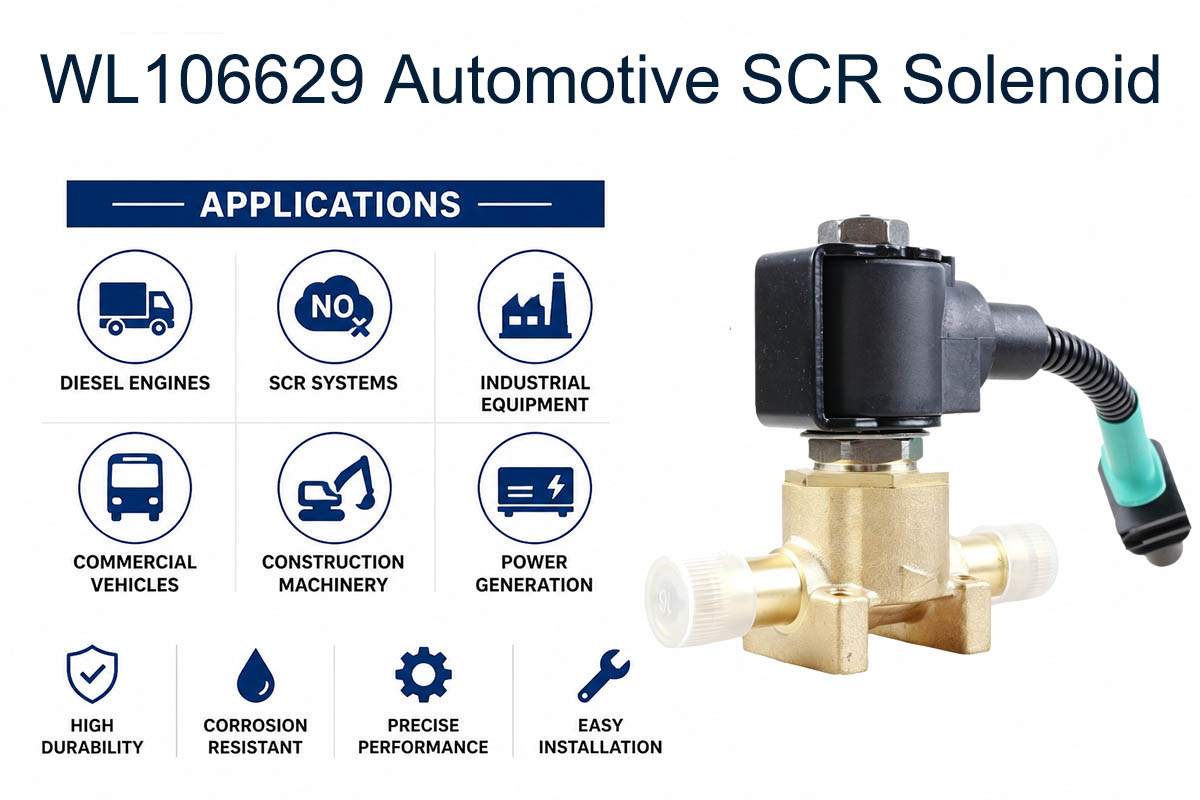
WL160609 SCR Solenoid Valve Application

A SCR solenoids finds wide applications in precise DEF injection, in processing of exhaust gases in diesel engines. These devices serve to control the amount of Diesel Exhaust Fluid supplied to SCR catalyst system.

The SCR Solenoid is frequently found in automotive sector in heavy trucks, buses, pick up trucks, commercial vehicles and passenger diesel vehicles. Agricultural equipment including various types of tractors and harvesters, where there is a significant usage of diesel engines, cannot work without SCR solenoid.

Solenoids for SCR are widely used in construction equipment including excavators, bulldozers, loaders and cranes. SCR solenoids are also found in industrial sectors including marine engines, mining equipment, generators and stationary diesel engines. These solenoids provide accurate DEF dosing, improving fuel economy, lowering exhaust emissions and meeting environmental regulations like Euro 6, EPA and Tier 4.

Advantage and Disvantage of SCR Solenoid

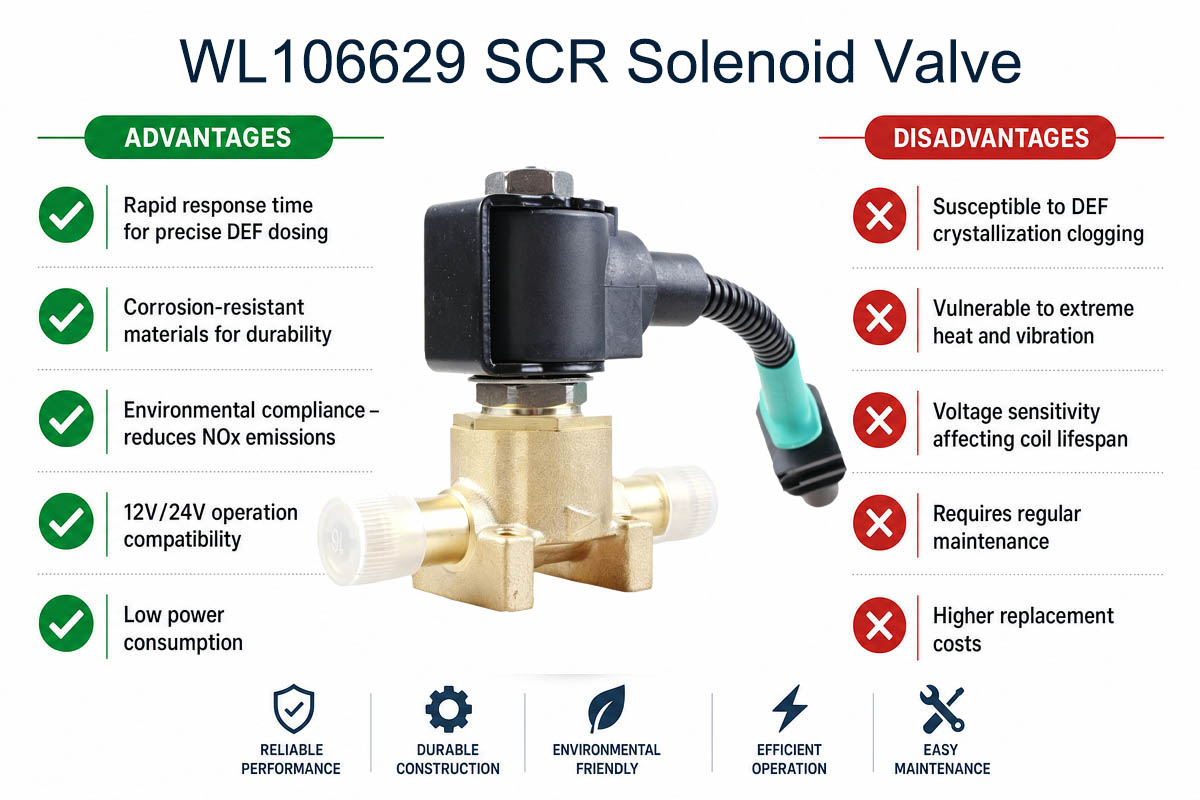
Automotive SCR Solenoid advantage and disadvantage

Advantages of SCR Solenoid

A SCR Solenoid provides a significant reduction of NOx emissions. These components have fast switching time and highly reliable performance. The current solenoids for SCR have a reduced size and energy efficiency which makes them suitable for both automotive and industrial usage.

High quality solenoids are durable due to their ability to resist various factors. Such solenoids can operate in extreme conditions for a considerable period of time. The other significant advantage of solenoids for SCR is that these devices help diesel engines to meet requirements of various regulations and environmental standards. Thus, solenoids for SCR improve fuel economy and prevent environment from pollution.

Cons of SCR Solenoid

One of the main disadvantages of the current SCR solenoid is their vulnerability to low quality DEF fluid and absence of routine maintenance. Excessive contamination, excessive heat, wrong voltage setting shorten their service life.

DEF liquid can crystalize under freezing temperature, which negatively influences the overall performance of the SCR system and solenoid itself. One of the main disadvantages is complicated electronics that is often required to control the operation of these devices. Finally, SCR solenoid may be costlier to manufacture and replace than basic solenoids.

General Troubleshooting Process

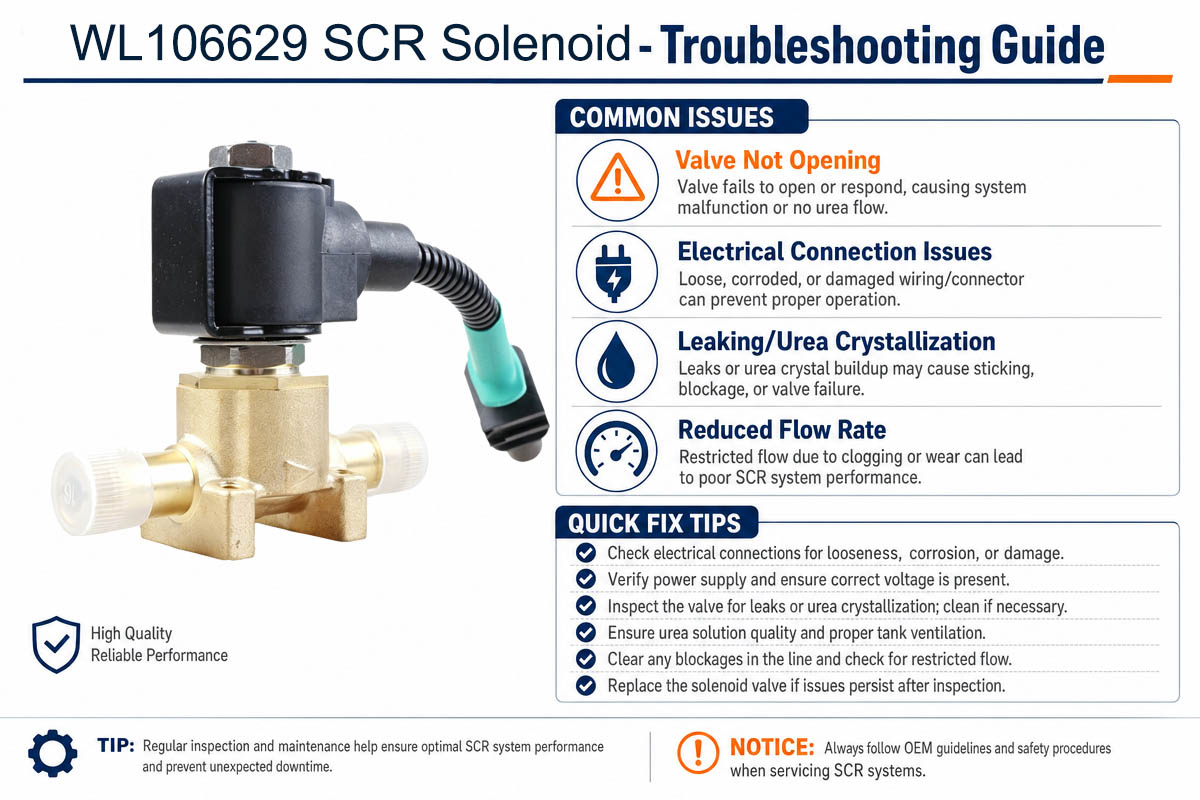
SCR Solenoid Troubleshooting Guide

SCR solenoid problems typically include two types: inability to start and stop the solenoid. Start troubleshooting broadly, and then move on to details of components.

Step 1: Safety First & Visual Inspection

Power Down: Always isolate and turn off power supply to the system.

Visual inspection: Inspect SCR, solenoid, and the circuit board. Look for any burn marks, damaged wires or connectors. Pay attention to any signs of overheating.

Step 2 Basic Electrical Checks

Fuse check: Check if the circuit breaker is tripped. In this case, check the continuity of the circuit breaker and, if necessary, replace it with a new one.

Wire & Connectors Inspection: Look for damaged, burned out or loosely connected wires and connectors. Be especially attentive to the connectors as a single loosely placed pin causes an open circuit.

Resistance check: Use the multimeter to test for the resistance between the solenoid coil pins. Compare the result with the manufacturer’s specifications. If the reading shows an infinite resistance, it indicates a fault in the solenoid.

Step 3: Isolate the Error

Control Signal check: Inspect whether the control board sends the proper triggering voltage to the gate of the SCR.

SCR bypass (use with caution): This approach may be helpful to determine if the SCR or solenoid fails. Only bypass the SCR if you are aware of the circuit structure and take safety measures. If a test with bypass shows that the solenoid functions normally, the problem is the SCR or its trigger circuit.

⚠️ Typical SCR-Solenoid Failure Modes

With standard relays you don’t run into such failure modes that might occur in SCR solenoids.

Failure Mode Typical Symptoms Possible Root Cause

Solenoid Won’t De-energize (Stays On) The solenoid is energized, although the control signal is absent. The problem is often caused by leakage currents flowing through the SCR.

Solenoid Will Not Energize (Remains Off) The solenoid does not turn on. This is often a sign of an open circuit or lack of triggering signal.

Solenoid Intermittently Turns On & Off (Chattering) The solenoid chatters. The reason is “holding current” or “dI/dt” of SCR.

🔎 Detailed Diagnosis of each failure mode

Here’s how to troubleshoot a particular failure mode in SCR solenoid circuits.

1. Solenoid Does Not De-energize (Stays On)

In this case, the solenoid continues to stay on although the control signal is turned off. Usually, it means that the SCR doesn’t turn off. The common reason of the phenomenon is leakage current of internal “snubber” circuitry of the SCR.

Diagnosis: SCR solenoid has the snubber circuitry consisting of resistor and capacitor which protects the SCR from voltage spikes. At the same time, the snubber allows current (e.g. 4 mA) to pass even if the SCR turns off. Leakage currents may be enough to keep a sensitive and low power solenoid on.

Solution: Adding the ‘bleeding’ resistor to the circuit. In such case the current will pass through the bleeder resistor rather than through the coil, allowing the solenoid to turn off.

2. Solenoid Won’t Turn On (Remains Off)

This case is quite typical and often represents simple failure of one of the elements.

Diagnosis: Inspect the power path. You need to check the solenoid, wiring, fuse and signal of the trigger circuit to identify a place with a break.

Solution: Repair or replacement of a failing part (a fuse, broken wiring, faulty SCR).

3. Chattering or Intermittent solenoid operation

This is the most difficult issue related to the “holding current” requirement of the SCR.

Diagnosis: This problem occurs because of newer energy-saving solenoids that have less current than old ones. In this case, when the solenoid armature reaches its position of final stroke, the current drawn becomes too low to maintain latching state of SCR.

Solution: Install a resistor in parallel with SCR. Constant minimal current drawn prevents SCR from unlocking even if the current drops momentarily.

💡 A note on terminology

Watch out searching for a solution on the internet as the term “SCR” has two meanings when it comes to vehicle repairs.

Silicon Controlled Rectifier (SCR as used in this guide)

Selective Catalytic Reduction (part of diesel exhaust systems) For example, a Perkins engine diagnostic may mention “SCR Relay”, which controls coolant diverter valve. It’s talking about diesel exhaust system, not the silicon switch. Use full search phrases, “silicon controlled rectifier” or “SCR solenoid”.

FAQs of Auotmotive SCR Solenoid

1. Problem of the SCR turning off in relation to the solenoid. (Leakage Currents).

It is the most common issue. The SCR module has a “snubber” internal circuit (resistor and capacitor), that produce leakage currents – up to 4mA on a 120V circuit – even when the SCR is considered to be “off”.

As soon as this current exceeds the minimum drop-out current of your solenoid, the latter remains energized. Solution: adding a load resistor in parallel to the solenoid in order to shunt the leakage current.

2. Why does my SCR solenoid begin to chatter or turn off by itself?

A SCR Solenoid keeps being turned on while the current in it is larger than some limit referred to as the holding current.

Modern solenoids tend to be energy efficient, thus their current consumption once the armature is closed reaches very low values that sometimes become smaller than the holding current of the SCR, which makes it switch off automatically. Solution: adding a “keep alive” resistor in parallel to the SCR.

3. How to protect an SCR Solenoid from the back EMF produced by the solenoid?

The coil of a solenoid generates an energy field when activated. Once the solenoid turns off, the collapse of this energy field leads to a high voltage “back EMF” spike, that could destroy an SCR.

For DC circuits: The easiest answer would be putting a flyback diode in parallel to the coil terminals in reversed polarity. It must be as close to the coil as possible, and its voltage rating should be at least 1.5 to 2 times greater than the circuit voltage.

For AC circuits: Diodes cannot help since AC current is periodic. For AC applications, use an RC snubber circuit (a resistor and a capacitor in parallel) across the SCR.

4. What are the criteria for choosing the SCR solenoid?

Voltage is just one criterion for selecting an SCR. However, in the case of the SCR for a solenoid, we shall also take into account the following:

The RMS current rating of the SCR must be at least 1.5 to 2 times greater than the nominal holding current of the solenoid.

A SCR solenoid requires a huge surge current (10-20 times greater than its steady-state value) at the moment of being turned on. Thus, the maximum non-recurring surge current rating (ITSM) must be sufficiently large to resist it.

5. Can SCR Solenoid be used in AC and DC circuits?

They can, but for AC circuits they should be used differently.

DC solenoids. They are easy: you can use a single SCR, and you should provide the SCR protection by adding a flyback diode.

AC solenoids. As the current in AC circuits changes to zero twice per period, you need at least two SCRs for controlling an AC solenoid.

6. Is it possible to trigger the SCR Solenoid with a mechanical switch or relay?

It is possible, but you should remember that an SCR is a latching device. You activate the SCR with a short impulse to its gate, and after this, even if you remove the gate signal, the SCR stays on.

This happens till the load current becomes smaller than the holding current. Therefore, a SCR is different from a transistor, where you should provide a continuous trigger impulse.

7. How to solve the Signs of wiring problem?

Many times, while trying to troubleshoot the circuit based on the SCR and the solenoid, the problem will turn out to be related to the control wiring. Look for these problems:

There are active diagnostic codes indicating a “below normal” or “above normal” current. In most cases, this means the presence of an open circuit or short circuit to ground.

High resistance of the trigger or supply wires. Such a problem indicates corroded connectors or worn out wire.


8. What is the SCR solenoid?

Yes. In relation to modern diesel engines, “SCR” stands for Selective Catalytic Reduction, which is an exhaust gas treatment system. In this sense, a “scr solenoid” could be such things as the coolant diverter valve or the AdBlue metering valve controlled by a relay.

Trouble engine diagnostic codes related to scr systems (for example, the code 2814) are usually associated with the fluid quality or the dosing system.

SCR Solenoid Valve Selection Guide

The selection of the proper Silicon Controlled Rectifier (SCR) for a solenoid circuit is rather a specialist field of electronics, but here I’ll guide you through the key choices.

The selection of a basic mechanical relay switch is a relatively simple process but selecting an SCR requires special attention, taking into account the specific switching properties of an SCR itself and the inductive behavior of a solenoid, along with basic electrical parameters of a circuit.

Let’s take a look at the key selection steps:

⚡ 1. Match Electrical Parameters (The Non-Negotiable’s)

The beginning of any selection step. The rating of an SCR must be higher than requirements of your circuit.

Parameter | Definition | Choice

Voltage (VDRM/VRRM) The maximum voltage the SCR can hold when off.Choose > 1.5x to 2x your peak supply voltage.

For line voltage transients of 120V AC use a 200V or 400V SCR.

Current (ITRMS) The maximum continuous RMS current the SCR can hold in the “on” state.Choose > The steady state solenoid holding current with 2x safety margin.

Surge Current (ITSM) The maximum one-time non-repeating current the SCR can endure during one cycle (i.e. 50/60Hz).Choose > The solenoid inrush current. In rush current can be 10 to 20 times the steady state current value.

It is recommended to derate an SCR 50-75%If your solenoid draws 1 amp, then select 2-4 amps rated SCRs.

🔥 2. Properly Set the Holding Current Parameter (The MOST Common Pitfall)

This parameter is the most vital one and most likely to confuse a beginner. The Holding Current (IH) of an SCR is the minimum current level that keeps the SCR ON once it’s been switched to the ON state.

The Problem: Today’s solenoids are designed to work energy-efficiently, and thus consume very small currents after they become operational. If the steady-state current is lower than the holding current of the SCR, then the latter will automatically switch off, causing unwanted chattering and dropping of the solenoid.

 How To Pick:

Find out the lowest required holding current of the solenoid It will be listed in the data sheet of your component.

Select an SCR with a HOLDING CURRENT lower than the MINIMUM OPERATING CURRENT of the solenoid.

In case you don’t have such a part in stock, you should artificially increase the current load. Add a “keep-alive” resistor to the solenoid coil (in parallel with it). The resistor must draw an additional current of 5 to 10% of the solenoid operating current.

🛡️ 3. Determine If Your Circuit Requires a Snubber Protection

As it’s known, solenoids are inductive circuits . When an inductive circuit gets turned off it causes high voltage spikes in the circuit. Such spikes may burn out an SCR. To absorb the energy and limit dV/dt a snubber circuit (series resistor and capacitor) is added to the SCR.

Selection Options:

Options When To Use

SCR with integrated Snubber Circuit The simplest way for low power and general purpose circuits.

SCR with External Snubber Circuit The most popular in heavy duty applications. Here you can control the actual values.

SCR Snubberless A variant used exclusively with purely resistive loads or in some special AC circuits.

A Starting Point for Snubber Circuit:

Resistor (R): 0.5Ω to 1Ω per volt on the contacts. For a 24V circuit use 10 to 22Ω resistor as starting point.

Capacitor (C) .5µF to 1µF per amp on the contacts. For a 1A current choose 0.47uF or 1uF capacitor.

The only reliable way to choose the perfect R/C ratio is to try it on an oscilloscope.

🔧 4. Choose the Appropriate Package and Technology

Consider the physical and control parts of your circuit.

Discrete SCR vs. Module For simple low-power application use one discrete SCR in TO-220 housing. For high-power and three-phase control use dedicated SCR modules with multiple SCRs inside.

AC/DC Control:

DC solenoids: Use one SCR.

AC solenoids: You will need to control both positive and negative half-waves of the AC sine wave. Use either two SCRs in back-to-back configuration or one TRIAC.

In Summary of the Selection Process:

Size it: Check the peak and steady-state solenoid current ratings. Choose an SCR twice bigger.

Latch it. Select an SCR that latches well at the required current. Add parallel resistor if needed.

Protect it. Use an SCR snubber circuit – either integrated or external.

Set it up: One SCR for DC, two SCRs/TRIAC for AC.

Get A Free Quote Now

Contact Form

Related Products

Related News

Introduction: Solenoid Coil Manufacturing  Solenoid coils are key electromagnetic components commonly applied in industrial automation, automotive, medical instruments, electronic locks, […]

Chapter 1 : introduction of Electromagnetic solenoid All the modern homes are equipped with dozens of household appliances that need […]

Chapter 1:Introduction Precision Engineering is mandatory for high performance solenoid, but one of the essential details is frequently overlooked – […]

Chapter 1 : What is a Metal Stamping Die? Metal stamping die (also called stamping tool, press tool or metal die) […]

Scroll to Top

Get A Free Quote Now !

Contact Form
If you have any questions, please do not hesitate to contact us.
Weilong Solenoid Company Culture
