Chapter 1 : What is a Metal Stamping Die?
Metal stamping die (also called stamping tool, press tool or metal die) is a precise manufacturing equipment which is mounted on a press machine and provides force to the sheet of metallic or non-metallic material in order to cut, form, bend, draw, or shape the material.
By using material deformation or separation, stamping dies create high-precision parts with consistent quality and reliable accuracy.
Metal stamping is one of the fastest and economical manufacturing techniques which is commonly applied for:
automotive parts
consumer electronics
home appliances
communication equipment
medical devices
new energy devices
industrial automation equipment
Main Benefits of Metal Stamping die
✅ High dimensional accuracy
✅ Consistent production
✅ Fast volume production
✅ High material yield
✅ Economical price
✅ Automated production compatible
Chapter 2 :Metal Stamping Die Strengths and Weaknesses
Advantages of Metal Stamping Dies
2.1 High Productivity Rate
High productivity rate is one of the major benefits of using metal stamping dies for manufacturing purposes. Once the metal stamping die is installed on the press machine, it will operate at a fast and steady pace due to high levels of automation.
2.2 Good Repetitiveness and Consistent Results
Good repetition and consistent results are important aspects to consider when choosing metal stamping as your manufacturing technique. Metal stamping dies ensure good consistency of product features.
2.3 Low Cost of Production When Used on a Large Scale
Despite the high initial cost of designing and manufacturing a metal stamping die, the unit price per item will drop when working on mass production.
2.4 Capability to Produce Complex Shapes
Modern metal stamping dies offer advanced possibilities to create sophisticated geometries, make holes with a high level of accuracy, bend and emboss metals, etc. Precision dies and progressive dies are especially useful in producing highly precise products.
2.5 Efficient Use of Materials
The layout of strips and design of dies contribute to optimal material utilization, which helps reduce costs related to procurement of the necessary raw materials.
2.6 Easy Automation
Since metal stamping dies facilitate quick production and require minimal manual interference, they can be easily automated through installation of robots for handling pieces and feeding systems.
2.7 Variety of Materials to Process
There is a great variety of materials that can be used in metal stamping including stainless steel, carbon steel, aluminum, brass, copper, and various alloy materials.
Weaknesses of Metal Stamping Dies
2.8 High Tooling Cost
Creation of a metal stamping die involves certain costs due to necessity of purchasing equipment for the purpose and paying for professional services. Moreover, designing progressive dies and compound dies may prove to be rather costly.
2.9 High Costs Related to Development Time
Development of dies includes multiple phases that include design, manufacturing, assembly, and testing of metal stamping dies. Thus, a lot of time should be allotted for developing dies.
2.10 Lack of Flexibility
Once the die has been developed, modification of products’ geometry and other characteristics become hard tasks to perform efficiently.
2.11 High Maintenance Costs
Maintenance of metal stamping dies is associated with sharpening tools and cleaning them from debris, lubricating metal surfaces, inspecting alignments, etc. Failure to perform these actions can cause appearance of defects such as burrs, deviations from standard tolerances, and even die breakage.
2.12 Suitable Only for Large Volumes Production
Low-volume production cannot justify the expenses on designing and manufacturing stamping dies since they prove to be economically unreasonable.
2.13 Die Wear and Possible Damage
Wear, crackling, and chipping represent possible risks related to continuous operations with metal stamping dies especially when processing hard materials.
2.14 Need of Professional Expertise
Metal stamping dies should be designed by professionals with adequate experience in designing dies of various complexity levels.
Chapter 3 : Safety Precautions in Metal Stamping die Operations
Metal stamping is considered a high-risk manufacturing process. Strict safety management is essential.
Common Risks and Prevention Measures
| Risk Type | Common Issue | Prevention Method |
| Foreign Objects Inside Die | Wrenches, screws, tools left in die | Inspect and clean before operation |
| Die Transportation | Unsafe lifting or handling | Use forklifts/cranes properly and keep personnel clear |
| Operator Injury | Incorrect press operation | Install safety guards and emergency stop systems |
| New Employee Risks | Inexperienced operators | Mandatory training before machine operation |
🚨 Safety must always take priority over production output.
Proper safety awareness greatly reduces accidents, equipment damage, and production downtime.
Chapter 4: Basic Structure of a Metal Stamping Die

Most metal stamping die is composed of four major systems:
Die plates
Insert blocks
Standard components
Guide systems
Upper Die Structure
| Plate Name | Code |
| Top Plate | U1U |
| Upper Spacer Block | U2U |
| Upper Die Shoe | UPU |
| Upper Backup Plate | UBU |
| Upper Clamp Plate | PHU |
| Stopper Plate | PPS |
| Stripper Plate | PSU |
Lower Die Structure
| Plate Name | Code |
| Lower Die Plate | DIE |
| Lower Backup Plate | LBD |
| Lower Die Shoe | LPD |
| Lower Spacer Block | B2D |
| Bottom Plate | B1D |
Common Die Components
Upper Die Components
Punches
Clamp plate inserts
Stripper inserts
Lower Die Components
Die inserts
Cutting edges
Standard Parts
Springs
Guide pins
Guide bushings
Hex screws
Set screws
Lifting pins
Height spacers
Non-Standard Parts
Internal stops
External stops
Pitch stops
Limit posts
Chapter 5 : Metal Stamping Die Numbering System
Metal stamping die numbering systems are designed to name, classify, and control stamping dies in manufacturing, maintenance, and storage. Such numbering helps increase the efficiency of the manufacturing process.
The stamping die numbering usually includes data about the following:
Product category
Die type
Year of production
Station number
Customer code
Revision number
Example:
90-KNMF0125RAH
Explanation:
R means a transfer die
S means a progressive die
F0125 might denote the year of production or project number
Letters at the end could stand for the revision number
Using a numbering system is essential for identifying tooling data, minimizing mismanagement, and maintaining maintenance.
Major production plants use the stamping die numbering systems together with barcode technology, ERP software, and other digitized systems.
Chapter 6 : Common Stamping Die Materials and Their Properties
Material selection directly affects:
Product quality
Formability
Die life
Production stability
Manufacturing cost
Common Material Comparison
| Material | Advantages | Disadvantages | Typical Applications |
| SPCC Cold-Rolled Steel | Smooth surface, good formability, low cost | Poor corrosion resistance | Brackets, enclosures, appliance parts |
| SECC Galvanized Steel | Excellent rust resistance | Easy to scratch | Electrical cabinets, computer cases |
| Stainless Steel (SUS) | High strength and corrosion resistance | High die wear | Medical devices, automotive parts |
| Aluminum | Lightweight and corrosion resistant | Low hardness | Heat sinks, EV components |
| Copper Alloys | Excellent conductivity | High material cost | Connectors and electrical contacts |
Chapter 7 : Selection of Metal Stamping Die Materials
The choice of die material determines wear resistance, toughness, stability, and maintenance frequency.
| Die Material | Characteristics | Typical Applications |
| Cr12Mov | Good wear resistance and economical cost | General cutting dies |
| SKD11 | Excellent wear resistance and stable heat treatment | Precision progressive dies |
| DC53 | High toughness and long service life | Stainless steel stamping |
| Tungsten Carbide | Ultra-high hardness and wear resistance | Ultra-precision high-speed stamping |
Recommended Applications
SKD11 → Precision blanking and forming
DC53 → High-speed stainless steel stamping
Tungsten Carbide → Ultra-long-life production dies
Chapter 8 : Metal Stamping Dies – Main Design Considerations
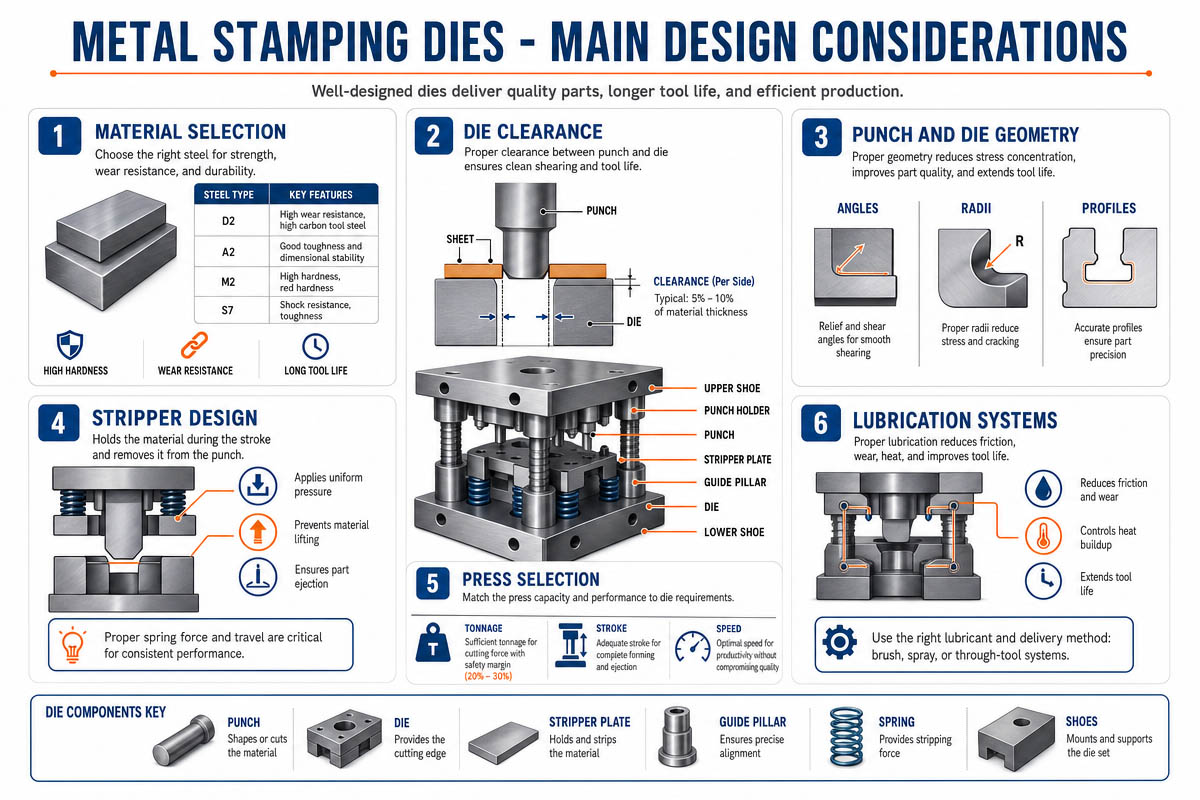
8.1 Better die design leads to:
Consistent products
Longer life dies
More efficient production
Increased equipment reliability
1️⃣ Appropriate Die Clearance
Condition of clearance Results
Too tight Breakage of punch, die cracking, heavy wear
Too loose Increased burrs, bad edge conditions
Recommended Die Clearance
The recommended clearance should be about:
Clearance=(5%∼10%)×tClearance=(5\%\sim10\%)\times tClearance=(5%∼10%)×t
In which t refers to material thickness.
8.2 Nesting Design
Good nesting maximizes material usage while reducing waste.
Factors that affect nesting include:
Feed stability
Material flow
Distance between stations
Balance of strength
8.3 Punch Strip Design
Bad striping will result in:
Material clinging
Scratches on product
Punches being pulled
Damages to die
Various Strip Methods Used
Spring Strip
Nitrogen Gas Spring Strip
Polyurethane Strip
8.4 Guide Accuracy
Inadequate guide accuracy results in:
Misalignment of punches
Cracks in cutting edges
Dimensional inconsistency in products
For high-speed dies, good guides should have:
Perfect concentricity
Both upper and lower plates parallel
A stable structure
8.5 Scrap Ejection Design
Scrap jam is a frequent occurrence in stamping process.
Possible solutions:
Scrap relief angles
Discharge channel smoothing
Air blow systems
Scrap holding mechanisms
8.6 Die Strength
Big dies
Chapter 9 :Common Metal Stamping Die Problems and Solutions
When performing metal stamping operations, there are some troubles that can arise. These can negatively impact the product quality, production process, and the life of dies. Therefore, it is helpful for producers to understand the most common failure types and methods of their prevention.
9.1. Extra Burrs
These burrs usually result from dull cutting edges or improper clearance. The solution includes sharpening edges, adjustment of the clearance between dies, and replacement of defective punches.
9.2. Punch Fracture
This phenomenon occurs due to eccentric load, poor guidance, long punches, and usage of hard materials. Improvement of guiding precision, use of higher hardness material such as DC53 steel, and shorter punches can help prevent punch breaking.
9.3. Part Deformation
Such defects occur in case of unbalanced force during parts ejection and lack of appropriate holding pressure. Adding holding means, improvement of part forming stations, and regulation of ejector force are recommended actions.
9.4. Galling
Aluminum and stainless steel are more susceptible to sticking. To overcome the issue, you can polish and apply DLC or TiCN coatings on dies’ surfaces and improve lubrication process.
9.5. Scrap Jamming
Poorly designed scrap outlet channel may cause scrap jamming that leads to damages and downtime. Relief angle application, air blow systems, and increased dimensions of scrap outlets contribute to solving the problem.
9.6. Unstable Dimension
This problem occurs due to dies wear, guide pins movement, and material thickness variations. To avoid it, regular dies maintenance and precise calibration are required.
9.7. Cracks Appearing during Drawing
This problem can be solved through optimization of radius during drawing and addition of new drawing steps.
9.8. Scraps Jumping
Vacuum effect and light weight cause parts to jump. To eliminate the issue, you should add scrap hold-down means and air blowing devices.
Chapter 10 :Types of Metal Stamping Die
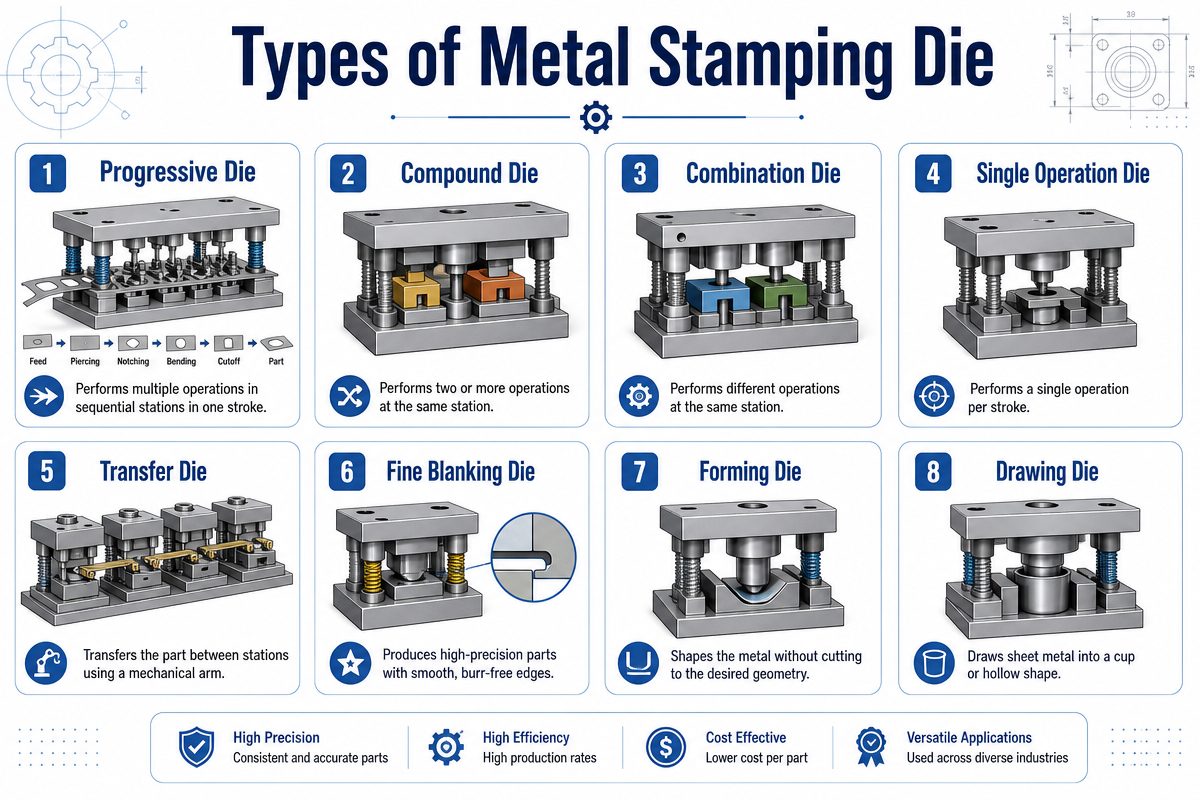
Metal stamping dies are categorized based on their structure, manufacturing process, and use. Various dies have different capacities for handling different kinds of products with various manufacturing requirements. The choice of the right metal stamping dies can significantly improve efficiency, quality, and management of manufacturing costs.
10.1 Transfer Dies (Single-Station Dies)
The transfer dies perform operations at every station individually; workpieces are moved manually or by an automatic system from one station to the next during manufacturing.
Advantages
Simplified design
Ease in maintenance and modifications
Applicable for producing larger parts
Disadvantages
Reduced efficiency
Increased labor costs
Less consistency than progressive dies
The application of transfer dies includes automotive body parts, large bracket parts, and other heavy-duty parts.
10.2 Compound Dies
This type of die performs more than one process in a single press operation, like piercing and blanking.
Advantages
Enhanced dimensional accuracy
Increased consistency
Faster than one-step dies
Disadvantages
Increased complexity in designing
Increased manufacturing and maintenance cost
It has been widely applied in manufacturing precision electronic parts, washers, and other thin metals.
10.3 Progressive Dies
It is a widespread use of stamping dies in modern industrial manufacturing processes, with coils feeding automatically between stations performing different processes.
Advantages
Very high productivity
Greatly improved automated processes
High consistency in product quality
Reduces labor cost
Disadvantages
Expensive manufacturing tools
Increased complexity
The use of progressive dies can include connectors, terminals, appliance parts, and precision metal parts.
Different types of metal stamping dies offer distinctive advantages depending on their intended application.
Chapter 12 : Why Metal Stamping Dies Need to Be Maintained
Metal stamping dies are precision instruments for high-speed manufacturing processes. While being utilized in continuous processes, dies may be subjected to severe loads, vibration, heat, friction, and impact.
In case no appropriate measures are taken, even top-quality dies start suffering from wear and damage.
Metal stamping die maintenance should be done regularly for ensuring optimal product quality, increasing dies’ longevity, minimizing downtime and improving manufacturing processes in general.
For those engaged in making automobile parts, electronic devices, home appliances, medical products, and industrial items, metal stamping die maintenance plays a crucial role in achieving efficient and economically viable production.
12.1. Increase Die Service Lifespan
Extending die life span is one of the primary benefits of metal stamping die maintenance.
During the working process, the following problems occur:
Wear of punches
Blunting of cutting edges
Lack of precise guide mechanisms
Degradation of springs
These negative effects become more evident without timely inspection and care.
Effective maintenance helps to:
✅ Avoid excessive wear
✅ Eliminate punching breaks
✅ Prevent chipping
✅ Sustain accurate cuts
✅ Prolong dies’ lifespan
Under proper maintenance, a progressive die lasts longer than its counterpart with neglected care by several million hits.
12.2. Ensure High Product Quality
Product quality directly depends on dies.
Neglecting dies may lead to:
Excessively high burr height
Poor dimensional accuracy
Scratches on surfaces
Deformation of parts
Cracks due to forming
With maintenance, dies ensure:
✅ Uniform clearance
✅ Sharp cutting edges
✅ Accurate guidance
✅ Reliable forming
The following quality improvements can be achieved:
✅ Improved precision
✅ Smooth surface
✅ Low defect rate
✅ Constant product quality in batches
For precision engineering, such as electronics and automotive manufacturing, constant accuracy is essential.
12.3. Minimize Downtime in Production Line
Failure to use a die leads to shutdowns and machine stops.
Reasons for unexpected die stoppage include:
Punch breakage
Scrap jamming
Guide pin breakage
Fastener loosening
Loss of spring elasticity
Emergency maintenance requires additional time and money.
Proactive inspection of metal stamping dies helps prevent any malfunctions.
Benefit of maintenance include:
✅ Reduced machinery stoppage
✅ Minimized repair costs
✅ Faster restoration
✅ Increased machine productivity
Even short periods of machine downtime in large-scale production may cause losses for a manufacturer.
12.4. Reduce Manufacturing Expenses
While focusing solely on speed of production, many manufacturers fail to notice potential cost-saving opportunities in maintenance.
Poor maintenance results in:
✅ Excessive scrap rate
✅ Frequent change of parts
✅ Labor costs
✅ Rejection of parts
✅ Machine breakdowns
Regular maintenance allows you to save on costs of operation in the long run.
12.5. Increase Working Process Safety
Metal stamping involves working with powerful forces that can result in hazardous situations.
Hazards of using defective dies include:
Ejection of breaking punches
Overload resulting in a jamming process
Loosening of parts of a die
Unexpected cracks
With timely inspections, you can avoid injuries caused by these defects.
Maintenance for the sake of safety involves:
✅ Checking the tightness of fasteners
✅ Inspecting guides
✅ Monitoring fatigue of springs
✅ Ensuring proper alignment
✅ Removing scrap from dies
✅ Safe die system guarantees safety both for people and machinery.
12.6. Ensure Steady High-Speed Performance
Modern progressive dies perform stamping at incredibly high speeds.
To ensure optimal high-speed stamping, there should be:
Accurate alignment
Precise feeding
Smooth stripping
Reliable removal of scrap
Any sign of wear adversely impacts process efficiency.
Die maintenance helps to:
✅ Increase accuracy of feeding
✅ Facilitate stripping
✅ Eliminate vibrations
✅ Maintain steady speed
Maintenance ensures uninterrupted and error-free operation of a production line.
Chapter 13:Future Development Trends of Metal Stamping Die
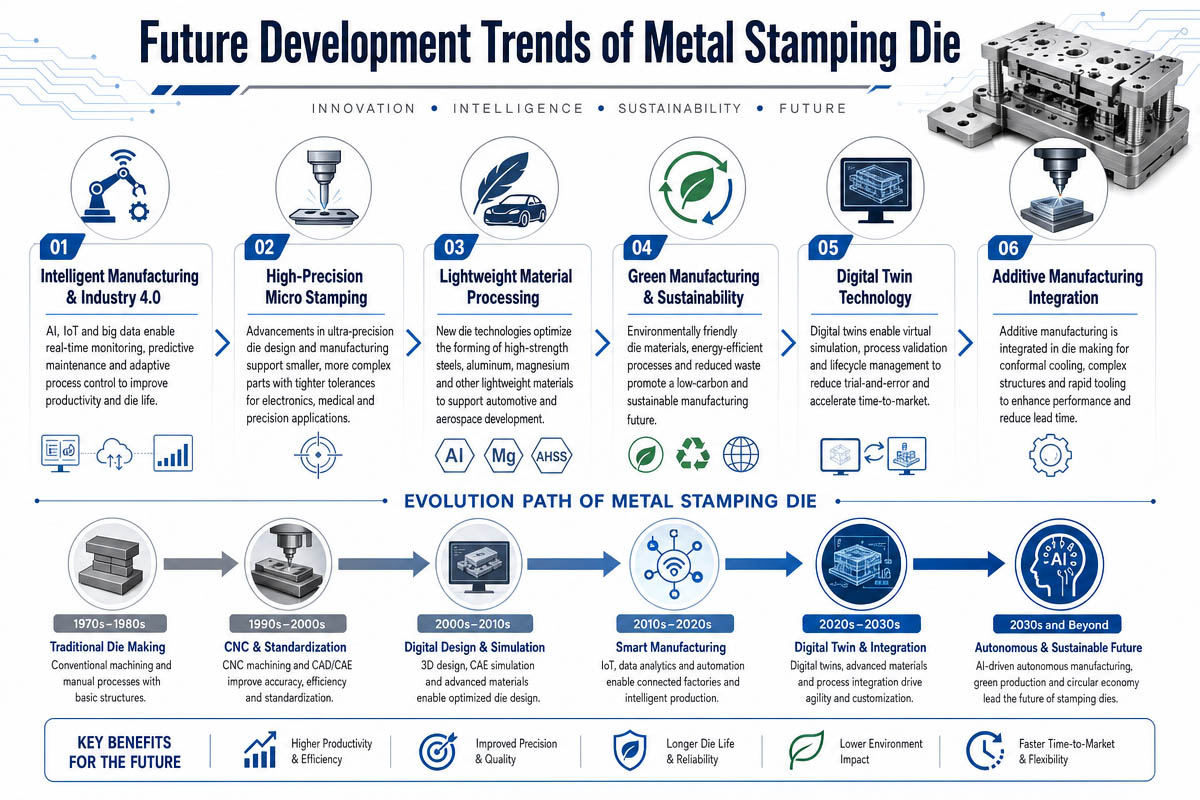
In the current technological development era, future metal stamping dies will be significantly affected by emerging automation technologies, artificial intelligence systems, high precision manufacturing, and sustainable production processes. Modern industries such as electric vehicles, consumer electronic devices, medical equipment, and industrial automation have increased demands for speed and precision of production.
Modern stamping dies are expected to incorporate the Internet of Things technology and smart production processes. Smart stamping dies are embedded with sensors and other advanced technology that monitors temperature, vibrations, and production performance parameters. In doing so, smart production allows for efficient prediction and prevention of machine breakdowns and downtime periods.
The use of fully automated production line processes will become increasingly popular. High-speed progressive dies are becoming common due to demands for higher efficiencies and lower labor costs. As a result, manufacturers install robots for material feeding and inspection, and servo presses for improved efficiency and low vibration production.
Modern dies and their surfaces have also been developed to withstand stamping process conditions. Modern stamping dies are fabricated from materials such as DC53, Powder Metallurgy Steel, and Tungsten Carbide, providing high wear resistance. Also, surface coatings such as DLC, TiCN, and AlCrN have reduced friction and galling during stamping of stainless steel and aluminum.
Environmental protection and energy saving measures will be prioritized in the future. Green manufacturing practices will involve energy-efficient stamping equipment, optimized material usage, and recyclable systems of production.
Simulation programs can also help in designing new dies and tools to save on development costs and shorten manufacturing times.
Overall, future metal stamping dies will be more intelligent, fully automatic, energy-saving, and precise.
Chapter1 3 : Conclusion
Metal stamping dies combine:
Precision engineering
Material science
Heat treatment technology
Mechanical design
Automated manufacturing
To improve stamping efficiency and product quality, manufacturers should:
✅ Select suitable die materials
✅ Optimize die design
✅ Perform regular maintenance
✅ Strengthen production safety management
A deep understanding of metal stamping dies, tooling structures, materials, and troubleshooting methods helps manufacturers improve competitiveness, reduce costs, and achieve stable high-volume production.
Make every stamping die stronger, safer, and more efficient.
Chapter 14 :Frequently Asked Questions (FAQs)
FAQ 1: How long does a metal stamping die last?
Die life depends on:
Material type
Production speed
Maintenance quality
Die material
High-quality DC53 or carbide dies may exceed millions of strokes with proper maintenance.
FAQ 2: What is the difference between progressive dies and transfer dies?
| Item | Progressive Die | Transfer Die |
| Production Speed | Very high | Moderate |
| Automation | Fully automated | Semi-automated |
| Best For | Small precision parts | Large complex parts |
FAQ 3: How do I select proper die clearance?
Recommended clearance per side:
SPCC: 5–8% of thickness
Stainless steel: 8–12%
Aluminum: 4–6%
High-strength steel: 10–15%
FAQ 4: Why does galling occur in stainless steel stamping?
Main causes:
High friction
Poor lubrication
Rough die surfaces
Solutions:
DLC/TiCN coatings
Better lubrication
Polished surfaces
FAQ 5: How often should stamping dies be maintained?
Recommended maintenance schedule:
| Frequency | Maintenance Task |
| Every Shift | Clean and inspect |
| Weekly | Lubricate guide systems |
| Monthly | Measure critical dimensions |
| Every 100,000 Strokes | Regrind cutting edges |
FAQ 6: What is the best die material for stainless steel stamping?
Recommended options:
| Material | Best Application |
| DC53 | High-speed stainless stamping |
| SKD11 | General precision stamping |
| Tungsten Carbide | Ultra-high-volume production |
FAQ 7: How can burrs be reduced in metal stamping?
Best practices:
Optimize clearance
Sharpen punches regularly
Improve die alignment
Use precision inserts
Add shaving stations if necessary
FAQ 8: What is the difference between SPCC and hot-rolled steel?
| Property | SPCC Cold-Rolled | Hot-Rolled Steel |
| Surface Finish | Smooth | Rough |
| Precision | High | Lower |
| Formability | Excellent | Moderate |
| Applications | Precision stamping | Structural parts |
Rule of thumb:
Use SPCC for precision and appearance parts, and use hot-rolled steel for structural applications.