Solenoid Push Pull type Product Overview
The solenoid push-pull type is a small, high-performance linear actuator made for use in businesses and factories. It has a strong metal case, a high-quality copper coil, and a plunger that has been precisely machined for smooth and reliable motion.
This product can be used in both push and pull modes, making it easy to add to locking systems, automation equipment, and control devices. You can choose from different voltages (DC 6V, 12V, and 24V), and you can also change the stroke length, force output, and mounting configuration.
It is the best choice for applications that need reliable and efficient linear actuation because it responds quickly, runs quietly, and lasts a long time.
WL1037 Push Pull Type Solenoid Video
WL1037 Solenoid Push Pull Type Detailed Display
WL1037 Push Pull Solenoid Technical Datasheet
| Brand |
Weilong Technology |
Model Number |
AS -1037 |
| Rated Voltage (V) |
DC12V or 24V |
Rated Power(W) |
5-10 W |
| Work Mode |
Push and Pull |
Holding Force (N) |
0.1–1.5 N |
| Stroke(mm) |
3-6 MM Customized |
Reset Time(s) |
1 S On,3 S OFF |
| Service Life |
200 Thousand Times |
Certification |
CE,ROHS,ISO9001, |
| Material |
Superior Magnet Iron |
Lead Wire Length(mm) |
200 MM |
| Install Style |
Screw |
Tolerance of Dimension |
+/- 0.1 MM |
| Water-proof |
None |
Insulation Class |
B |
| Hi-Pot Test |
AC 600V 50/60Hz 2s |
Non-excitation Holding Force |
0 |
| Working Temperature |
-10°C-100°C |
Duty Cycle |
1-100% |
| Thread Depth(mm) |
/ |
Payment Term |
TT, or LC At Sight |
| Sample Order |
Yes |
Warranty |
1 Year |
| MOQ |
1000 pcs |
Supply Ability |
5000 pcs per Week |
| Delivery Time |
30 Days |
Port of Loading |
shenzhen |
WL1037 Solenoid Push Pull Type Industrial application
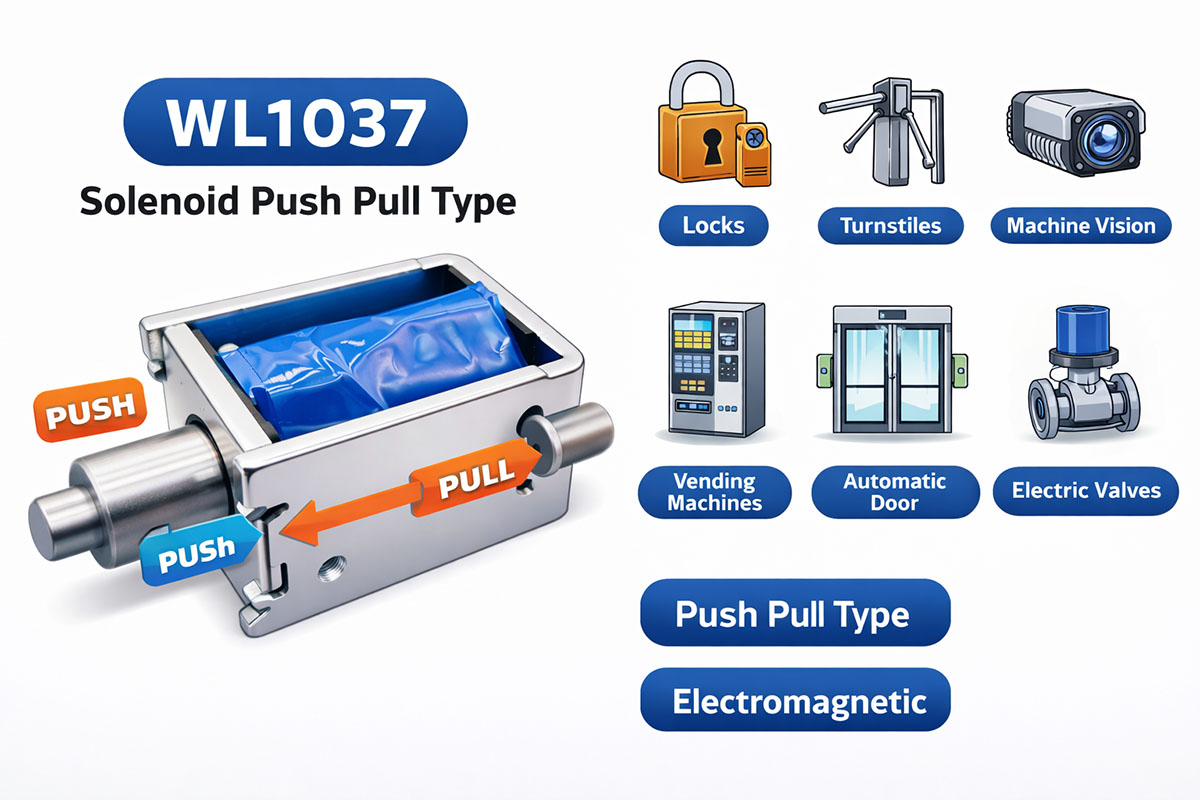
Solenoid Push Pull Type is used in many different fields because they are flexible and provide reliable linear motion. They control the locking and dispensing mechanisms in vending machines and ATMs. In smart lock systems and electronic safes, they provide secure and efficient locking and unlocking operations.
Solenoid Push Pull Type is applied in industrial automation to move valves, switches, and mechanical linkages. You can find them in a lot of places, like packaging machines, textile machines, and CNC auxiliary systems that need very precise control.
They are used in the automotive industry to lock doors, control fuel systems, and shift gears. These solenoids are also used in medical devices to make sure that diagnostic and laboratory equipment works correctly.
Solenoid Push Pull Type is also used in self-service kiosks, gaming machines, robotics, and office automation. Because they can move quickly and repeatedly, they are perfect for operations that happen a lot. In general, they are very important for modern electromechanical systems because they make them more efficient, safe, and aut
Advantages and Disadvantages of Solenoid Push Pull
Solenoid Push Pull Type Pros and cons
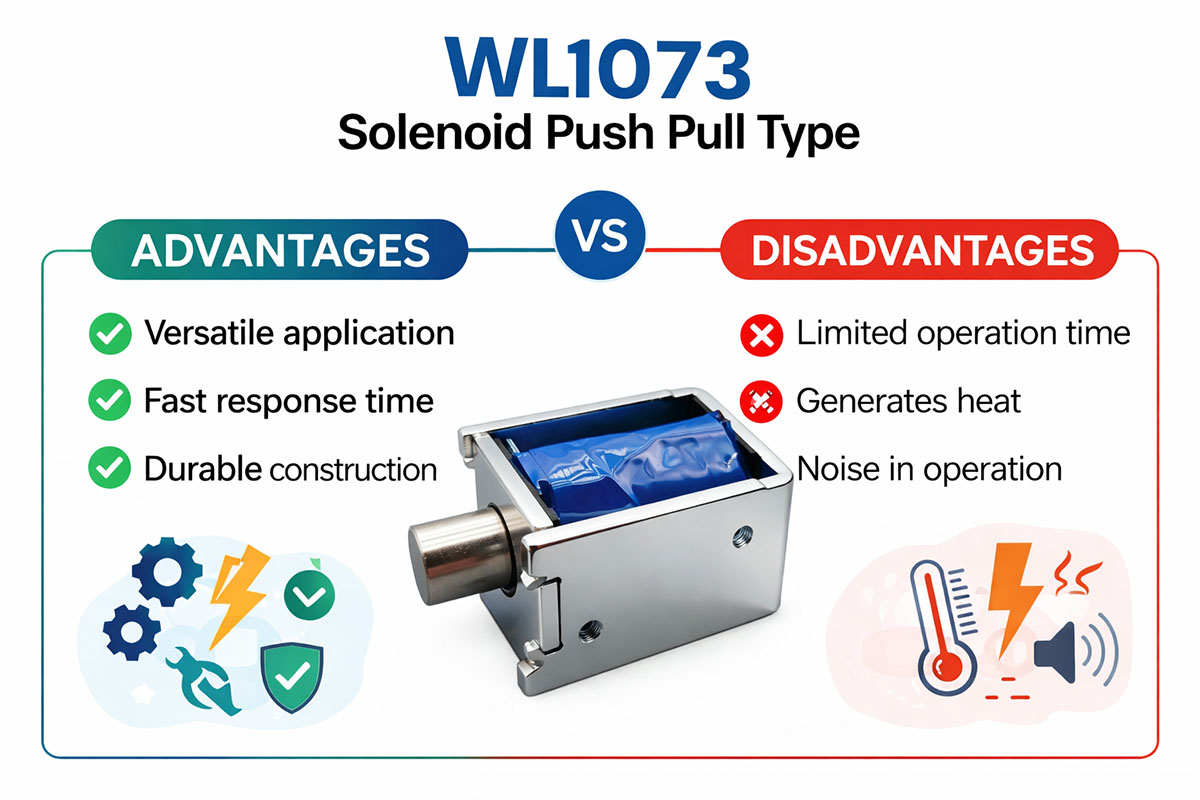
Benefits:
Push-pull solenoids have several advantages, such as quick response times and accurate linear motion. Because they are small, they can be easily added to small devices and tight spaces. Because they have fewer moving parts and a simple design, they are very reliable.
They also work the same way every time, which makes them great for automation systems. They can be used in a variety of ways because you can change the voltage, stroke, and force. Also, they are cheaper than more complicated actuators like motors or pneumatic systems.
Solenoid Push Pull Type Cons: Push-pull solenoids have some drawbacks, even though they have some good points. Compared to hydraulic or pneumatic actuators, their force output is not very high. If something runs continuously, it can get hot, so you need to control the duty cycle properly.
They also have a short stroke length, which means they can’t be used for long-distance motion. Some designs use a lot of power, especially those that run all the time. Also, if not properly protected, dust, moisture, or very hot or cold temperatures can affect performance.
Troubleshooting of Solenoid Push Pull Type
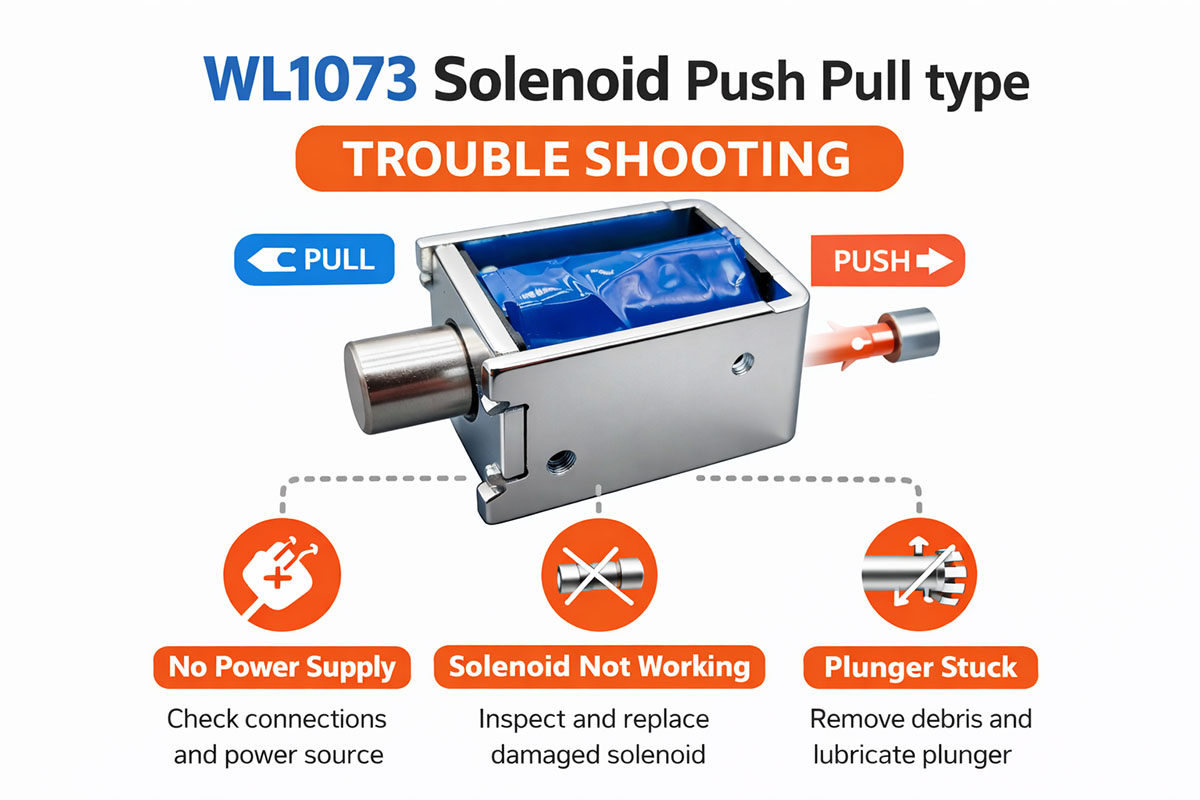
1 No Action (The solenoid isn’t working)
Possible Reasons:
Not enough power
Wrong voltage input
Wires that are loose or broken
Coil that has burned
Check the power source and voltage rating for solutions.
Check the terminals and wiring connections
Use a multimeter to check the coil’s resistance.
If the coil is broken, replace the solenoid.
2. Weak Force or Not Enough Movement
Possible Causes: Power that is low or not stable
Too much load beyond the rated force
Too much air gap
Coil getting too hot Solutions:
Make sure the right voltage is given
Lower the mechanical load
Make changes to the installation to reduce the air gap.
Let it cool down or make the duty cycle better
3. The plunger is stuck and won’t move.
Possible Causes: Dirt, dust, or trash inside
Corrosion or rust
Installation went wrong because of misalignment
Not enough lubrication
Solutions: Clean the parts inside
Put the right amount of oil on
Check the accuracy of alignment and mounting.
If parts are broken, replace them.
4. Getting too hot
Possible Causes: Keeping the power on all the time (over duty cycle)
Voltage that is too high
Not good at getting rid of heat
Failure of coil insulation
Answers:
Work within the duty cycle that has been set
Check that the voltage input is correct
Make the air flow better or cool it down.
If you need to, use a solenoid with a higher rating.
5. Noise or shaking
Possible Reasons:
Screws that aren’t tight
Parts inside that are worn out
Vibration from AC power
Installation that isn’t done right
Answers:
Tighten the hardware that holds it up
Change out worn parts
If possible, use DC power.
Make sure the installation is lined up correctly.
6. Slow Response
Possible Reasons:
Magnetic field that is weak
Unstable power supply
Tiredness in the spring
Friction inside
Answers:
Make the power supply stable
Change the return spring
Clean and oil the parts that move
Check how well the coil works
7. Short lifespan and frequent failure
Possible Causes: Too much use or too much load
Harsh environment (dust and moisture)
Choosing the wrong model
Power supply of bad quality
Answers:
Choose the right solenoid specifications
Add a protective case (IP rated)
Use a power supply that is stable and controlled.
Follow the suggested operating conditions
✅ Helpful Tips
Always make sure that the voltage, stroke, and force are right for the job.
Don’t run continuously unless the system is rated for it.
Regular maintenance makes things last longer.
Use the right insulation and protect the environment.
FAQs of Solenoid Push Pull Type


