

Efficient, safe, and precise material handling plays a crucial role in the success of any modern industrial company. The holding electromagnet is invaluable in moving heavy ferrous materials quickly and safely in steel mills, shipyards, recycling companies, factories, and even automated production lines.
Using electromagnets for lifting instead of other techniques allows for instant on-off magnetic force, which means total control of steel plates, beams, billets, scrap metal, and any ferrous materials you may wish to handle.
This buyer’s guide aims to provide all information needed about holding electromagnets. We will go through the basic concept, main features, applications, and selection criteria and answer some frequently asked questions.
Chapter 1. What Is a Holding Electromagnet?
An electric magnet used for lifting and transporting ferrous materials. When an electric current passes through the copper winding inside the electromagnet, a powerful magnetic field appears, creating enough magnetic force to attract iron and steel materials.
While permanent magnets offer a constant magnetic field, electromagnets allow for a significant amount of control—there is no magnetic force until the magnet is powered up. As electromagnets ensure great accuracy, high efficiency, and safety of operators, industries use these devices where all three aspects are of primary concern.
Main applications
Handling steel plates and sheets
Manipulating with steel beams and billets
Transportation of scrap metals
Positioning of workpieces in manufacturing operations
Automation of material handling in robotics
Holding parts in machining and welding processes
Chapter 2. Important Properties of Holding Electromagnets
Optimized magnetic circuit
With the development of magnetic circuitry, electromagnets now offer a wide range of properties—high lifting force, lightweight design, low energy consumption, high magnetic efficiency, and a long life cycle.
High-quality winding
Inner winding is usually made of highly conductive aluminum or copper wires and high-temperature insulation and is reinforced by mechanical protection.
High-end insulation system
The high-end insulation system consists of several components, including vacuum drying, vacuum encapsulation, high dielectric strength, high resistance to vibrations, and Class C heat-resistant insulation.
Heat resistance
Specialized lifting electromagnets are capable of handling materials that reach temperatures up to 600 degrees. They can handle hot foundry castings, billets, and scrap metal safely.
Reliable design: The product features a rugged design, easy maintenance, stability, longevity, and high safety standards.
Intelligent control options
Intelligent control systems may involve wireless remote control, PLC controlling systems, load control options, and battery backup systems.
Chapter 3: How Do Holding Electromagnets Work?
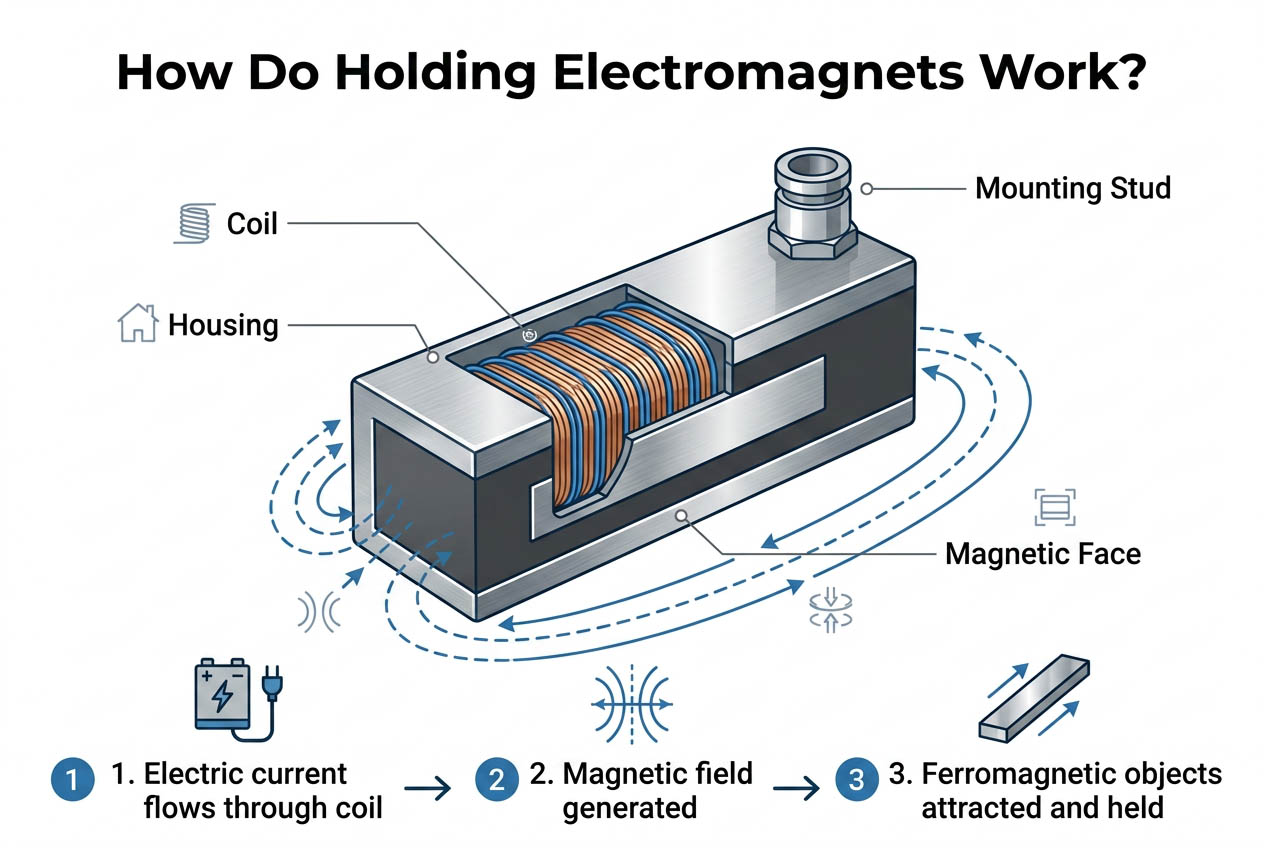
The principle behind its function is basic.
Step 1. Power Supply Activation—The electromagnet is powered up by DC power, causing the electric current to flow through the coil.
Step 2. Magnetic Field Creation—As the coil becomes energized, a magnetic field appears around it.
Step 3. Attraction of the Materials—As a result, the magnetic field attracts ferrous materials like steel plates, beams, castings, and scrap.
Step 4. Holding—Due to magnetic force, the material stays in the same position while being transported or manipulated.
Step 5. Release—By removing the power supply from the electromagnet, you make it stop producing a magnetic field.
That is what makes material handling quick, safe, and efficient.
Chapter 4: History of Electromagnets and their Inventors
Centuries of discoveries and innovations gave us the electromagnets we use today to automate lifting processes and manufacture products with them. There are several pioneers whose discoveries contributed significantly to the creation of lifting electromagnets that are in use nowadays.
Hans Christian Ørsted (1777-1851)
Danish scientist Hans Christian Oersted discovered that a nearby electrical current would deflect the needle of a compass in 1820. That discovery laid the foundation for electromagnetism and proved a direct connection between electricity and magnetism.
Key achievements: discovery of the connection between electricity and magnetism; discovery that electric current creates a magnetic field.
William Sturgeon (1783-1850)
Building upon Ørsted’s findings, Sturgeon invented the first practical electromagnet in 1824. He developed a horseshoe-shaped core surrounded by coils of insulated copper wire.
Important inventions include the first practical electromagnet, the use of iron cores to intensify magnetic fields, and industrial applications of lifting magnets.
Michael Faraday (1791-1867)
Father of electromagnetism, Michael Faraday discovered a phenomenon known as electromagnetic induction. He established that an electrical current could be induced due to changes in magnetic fields.
Important achievements: discovery of electromagnetic induction; invention of the first practical electric motor design; transformation of electromagnetism into engineering practice.
James Clerk Maxwell (1831—1879)
The last great scientist of that era was Scottish mathematician James Maxwell. He summed up years of discoveries in his famous Maxwell’s equations, which explain how magnetic fields generate and affect electrical charges.
Important discoveries: formulation of Maxwell’s equations; unification of electromagnetism; new knowledge about the nature of magnetic field generation and control.
From discovery to widespread industrial use
Thanks to the works of Ørsted, Sturgeon, Faraday, and Maxwell, electromagnetism became the cornerstone of the modern manufacturing industry. Today we widely use holding electromagnets for lifting steel sheets and billets, scrap recycling, shipbuilding, and many more.
Chapter 5: Types of Holding Electromagnets
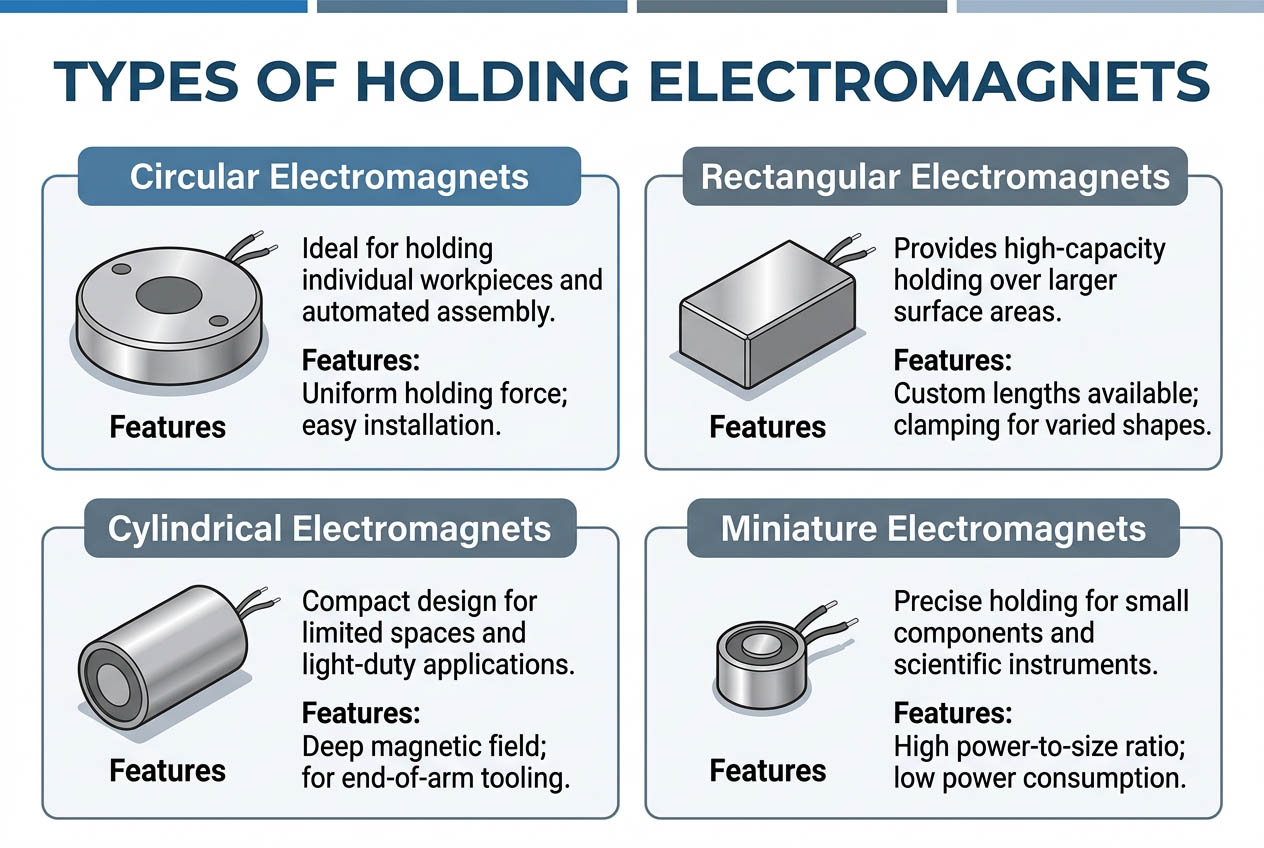
Electromagnets Round Lifting
Commonly used in scrap processing, steel processing, and foundries. Advantages: good magnetic penetration, suitability for irregular load shapes, and good lifting results.
Rectangular Lifting Electromagnets
Perfect solution for handling steel sheets, beams, and plates. Typical applications include shipbuilding, steel processing, and warehousing.
Battery-operated Lifting Electromagnets
Offer mobility and independence from power supply. Greatly valued in construction and for remote sites and for mobile lifting operations.
Fail-safe All-time Electromagnets
Combine control over an electromagnet with a permanent magnet. Advantages include lack of magnetic force during load holding, safe material holding in case of power failure, and lower energy consumption.
Chapter 6: Benefits of Using Holding Electromagnets
Increased Productivity—Reduced time spent on loading and unloading.
Increased workplace safety—No need to manipulate heavy material manually, reducing operator injuries.
Reduced expenses—lower labor costs, maintenance, and equipment wear and tear.
Accurate material handling—Adjustable magnetic force allows handling materials of various weights safely.
Versatile use—can be attached to overhead cranes, gantry cranes, hoists, robots, and automation systems.
Chapter 7: Selection of the Right Holding Electromagnet
When choosing electromagnets, consider the following criteria:
Type of materials: steel sheets, coils, beams, billets or scrap
Maximum lifting weight: the lifting capacity required.
Industrial use cycle—Usually TD-60%
Operation conditions: temperature, humidity, corrosion, vibrations, and shocks.
Power source—Options may include battery power, DC power supply, and others.
Attachment method—external mounting screw, threadable housing, slotted housing, etc.
Compatibility—Can be installed on an existing crane/hoist/automation system
Chapter 8: Advanced Features for Higher Efficiency
Among other things, advanced industrial lifting systems include:
Telescopic lifting devices
Special lifting hooks
Safety contact pads
Remotely-controlled operation (wireless)
Collision avoidance systems
Automatic battery backup system
Systems for load control
Automated positioning options
Integrated rotary mechanisms
All those improve safety, efficiency, and performance.
Chapter 9: Industrial Applications of Holding Electromagnets
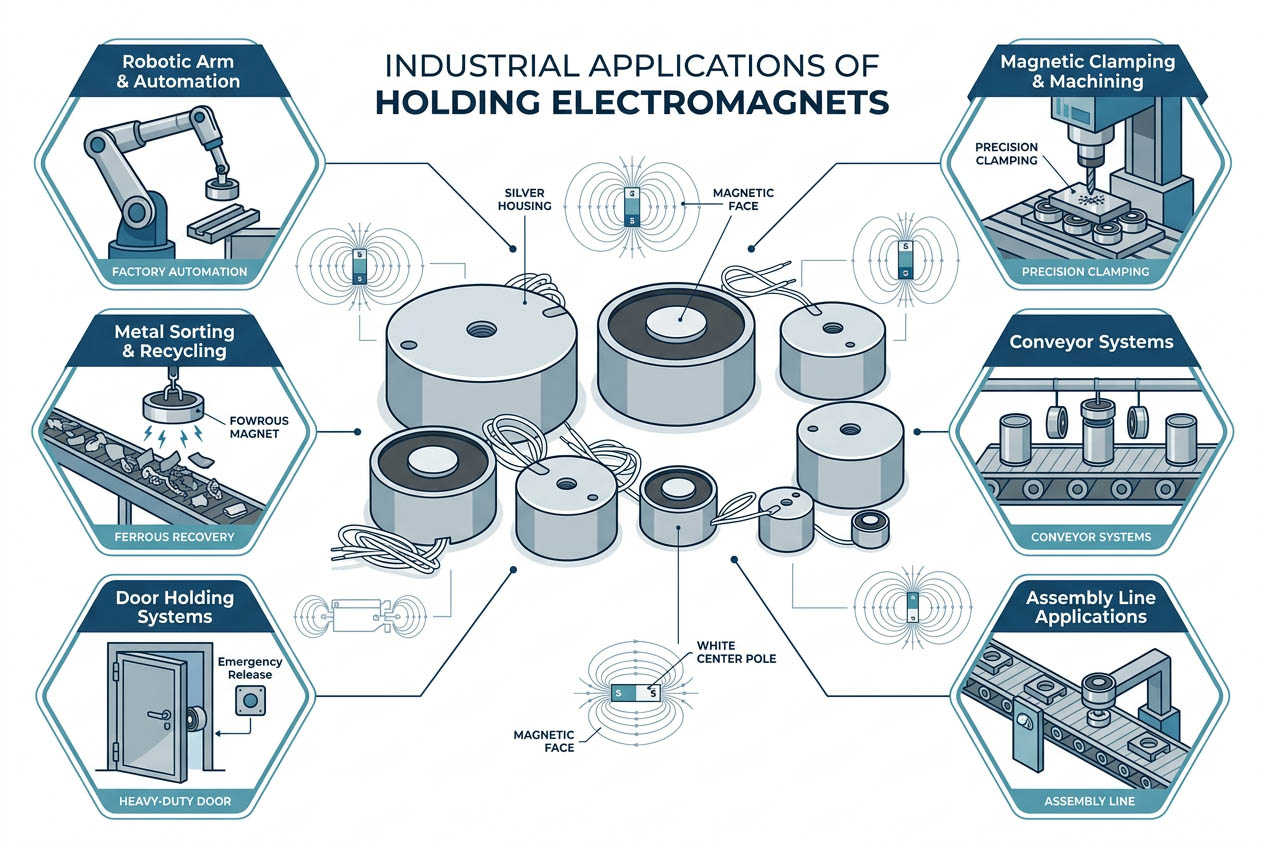
Steel industry—handling of steel sheets, transportation of billets, coil movement
Scrap recycling industry—sorting, loading and processing of scrap
Shipbuilding industry—plate assembly, steel beam handling
Manufacturing industry—automated manufacturing lines, material handling solutions
Robotics—automated gripping, automated pick and place solutions
Machine tools—part clamping, machining support, welding fixtures
10 Tips to Avoid Mistakes While Choosing a Holding Electromagnet
Chapter 10: How to avoid the Common Mistake While Picking Up the holding electromagnets
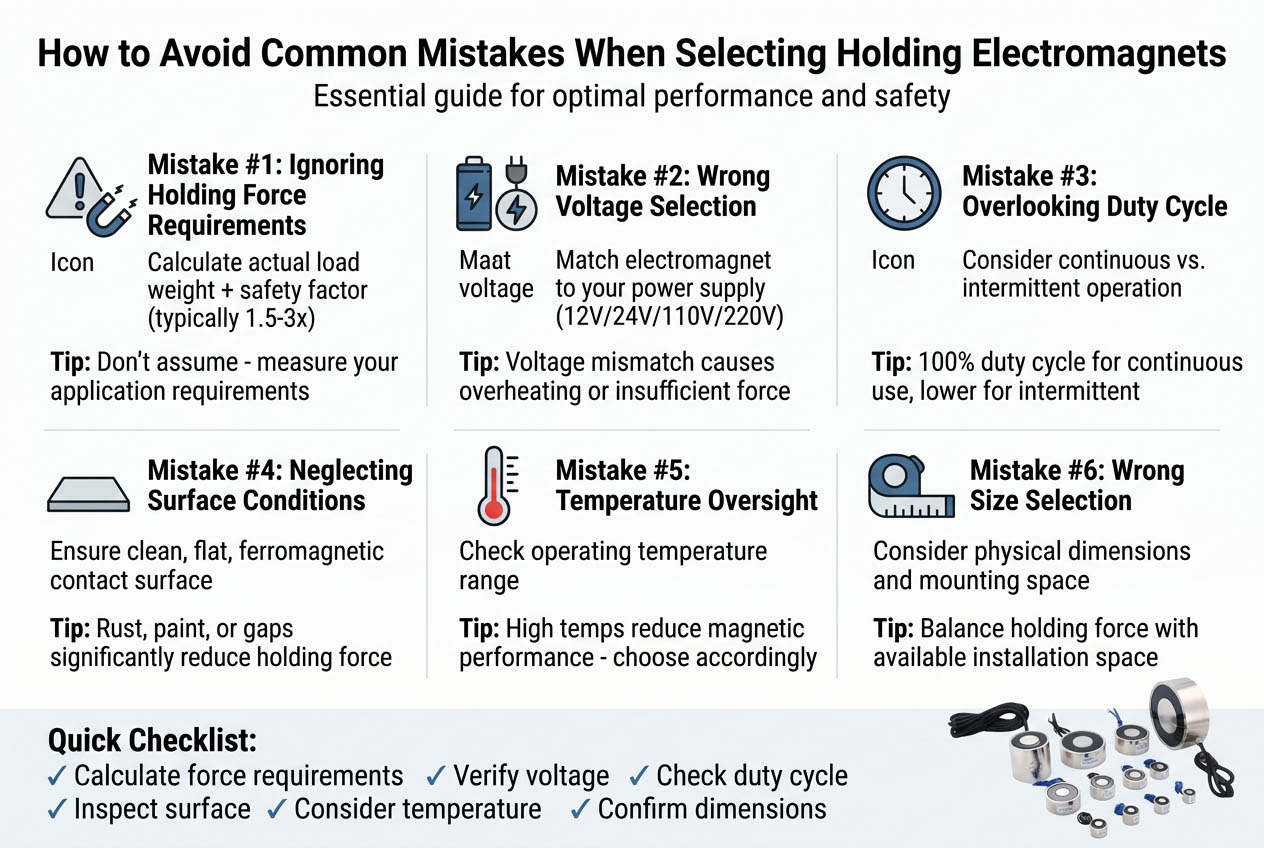
The proper choice of holding electromagnet is necessary to provide for safe and effective operation and extended lifespan. However, many people take notice of the force of a holding electromagnet but overlook some other parameters. Knowledge of the most common errors will help you avoid failures and downtime.
10.1 Disregarding the duty cycle
Selecting an electromagnet based on the holding force parameter only and not considering its duty cycle leads to failures. Continuous energization results in overheating of magnets designed for intermittent service.
The solution here would be always checking the specifications for the required duty cycle of your application. In case of a need for continuous operation, select either a 100% duty cycle electromagnet or one with enhanced cooling. An excess of heat in case of regular operation means insufficient duty cycle.
10.2 Omitting the safety margin
In order to select a certain electromagnet, many people use the rated force of a magnet equal to the load weight. Thus, they neglect rust, paints, air gaps, vibrations, and other factors.
According to the general rule, holding applications must not go over 50% of the rated force, while lifting must not go over 25%. Proper safety margin is crucial for reliable and safe operation.
10.3 Overlooking surface contact
Contact surface significantly influences the operation of a magnet. Rust, paint, oil, scales, and irregularities on a surface can decrease the holding force by 20% to 50%.
The best solution here is providing full contact between a magnet and the material being lifted. It is highly recommended to test the holding electromagnet with the actual material first.
10.4 Not complying with temperature requirements
Rated temperature of industrial holding electromagnets does not normally exceed 80-120°C. However, use of a magnet for lifting hot steel, billets, or casting causes its rapid destruction.
The recommended solution is selecting an electromagnet with enhanced temperature resistance rated up to 200°C, 400°C, or even 600°C.
10.5 Not considering operating conditions
When selecting a magnet, make sure that you understand its specifications and the conditions it will operate under. Incorrect voltage and current ratings can negatively affect its performance.
Environmental conditions are equally important. Depending on the environment, different kinds of protection are needed.
10.6 Not paying attention to power-off protection
A standard holding electromagnet loses its attraction force immediately after disconnecting its power.
For applications requiring additional safety, consider a fail-safe permanent electromagnet, battery backup system, or load monitoring device.
10.7 Opting for price rather than quality
A cheap magnet can actually cost you a fortune.
Selection of an expensive but higher-quality magnet, with enhanced insulation, sturdy design, and excellent performance, can pay off in savings on maintenance.
Consideration of operating conditions, power, temperature, and other aspects can greatly assist you in choosing the right holding electromagnet.
Chapter 11 : Conclusion
The introduction of holding electromagnets brought a breakthrough in the material handling industry due to the increased capacity and efficient performance of these machines. These machines play an extremely important role in steelmaking, shipbuilding, waste recycling, automation, and manufacturing, as they allow for reliable lifting, holding, and releasing of ferrous materials.
With the selection of the right holding electromagnet and the incorporation of additional safety features, productivity increases, operating expenses are reduced, and the workplace becomes safer for employees.
Weilong Technology specializes in the customized manufacture of holding electromagnets for lifting, automation, and material handling applications.
Chapter 12 : Frequently Asked Questions about Holding Electromagnets
-
What is being held by a magnet?
A holding electromagnet is an electrically energized magnetic device that is able to produce a magnetic field for lifting, positioning, and holding ferrous materials.
-
What can a holding electromagnet lift?
Holding electromagnets are specifically designed to lift ferromagnetic materials such as steel, iron, cast iron, billets, bars, and other types of scrap metals.
-
What is the difference between a holding magnet and a permanent magnet?
While a permanent magnet operates without any electricity, a holding electromagnet requires power for turning on and off.
-
Can holding electromagnets be used in high-temperature conditions?
Yes, since there are special kinds of industrial lifting electromagnets that can lift hot materials.
-
Are holding electromagnets safe to hold?
Yes, provided that they are chosen and used properly. Modern systems feature various protection measures, backup power supplies, load monitoring, and remote control.
-
Which industries use holding electromagnets?
Steel mills, shipyards, scrap recycling plants, foundries, manufacturing and automation systems, and other industries use holding electromagnets in their operations.
-
How do I select the right holding electromagnet?
Some of the aspects you should consider when selecting a holding electromagnet include the load weight, material type, operating temperature, duty cycle, power requirements, and conditions.
-
Can electromagnets be ordered as custom products?
Yes, Weilong can provide customized voltages, holding forces, dimensions, mount methods, duty cycles, and control systems for your holding electromagnets.

